This Week @ MHS

By Dan Hinchen

On Tuesday, 24 February, joing us at 5:15PM for an Immigration and Urban History Seminar. “‘I Had Ample Opportunity to Notice the City as It then Was’: Social and Economic Geographies in New York City, 1783-1830,” is presented by Carl Smith of Providence College. Joshua Greenberg of Bridgewater State College provides comment. This event is free and open to the public, RSVP requiredSubscribe to receive advance copies of the seminar papers.

On Thursday, 26 February, MHS Fellows and Members are invited to a special preview of and reception for “God Save the People! From the Stamp Act to Bunker Hill.” This exhibition tells the story of the coming of the American Revolution in Boston, using letters and diaries, political cartoons, newspapers, maps, artifacts, and portraits. The reception begins at 6:00PM. Registration required at no cost.

The exhibition opens to the public on Friday, 27 February, and is on view Monday-Saturday, 10:00AM-4:00PM, until 4 September 2015. 

With the opening of the new exhibition we will also return to hosting our free Saturday tours! Come by on Saturday, 28 February for the History and Collections of the MHS, a 90-minute docent-led walk throught the public spaces at the Society’s home on Boylston St. The tours are open to the public free of charge. No reservation required for individual or small groups. If you would like to bring a larger party (8 or more), please contact Curator of Art Anne Bentley at 617-646-0508 or abentley@masshist.org.


Stephen Greenleaf Bulfinch Diary, Post 41

By Elaine Grublin

The following excerpt is from the diary of Stephen Greenleaf Bulfinch.

Saturday, Feb. 4th, 1865

In public affairs, rumors thicken with the promise of peace. The visit of F.P. Blair to Richmond has led to a meeting of the Sec. of State, & since of the President, with commissioners from the rebels, at Fortress Monroe. Meantime, the proposed amendment to the Constitution, abolishing slavery, has passed, & is already ratified by some of the states. There is cause for praise, trust, and hope.

Friday, Feb. 10th 1865

 The peace conference has resulted in failure; & Grant is opening the campaign of 1865.


From Russia with Love: LCA’s Journey from Russia to France

By Amanda A. Mathews, Adams Papers

This month marks the 200th Anniversary of Louisa Catherine Adams’s six-week and nearly 2,000-mile trip from St. Petersburg, Russia, to Paris, France. Travelling by carriage across a war-torn Europe and in the midst of Napoleon’s Hundred Days after his escape from his exile on Elba, trying to reach her husband, John Quincy, who, negotiating an end to the War of 1812 in Ghent, she had not seen for a year, Louisa’s story is an amazing one.

Louisa’s journey began on Sunday, February 12, 1815—her fortieth birthday—setting out with her seven-year-old son, Charles Francis, and a few servants she didn’t know if she could entirely trust. Despite what she knew would be an arduous and dangerous journey, Louisa started out in hope and expectation as she wrote to her husband:

I am this instant setting off and have only time to say that nothing can equal my impatience to see you some of my business is necessarily left undone but I hope that you will forgive all that is not exactly correspondant to your wishes and recieve me with as much affection as fills my heart at this moment for you. I could not celebrate my birthday in a manner more delightful than in making the first step towards that meeting for which my Soul pants and for which I have hitherto hardly dared to express my desire but in the full conviction that the sentiment is mutual.

During her trip, Louisa faced poor lodgings, broken down and lost carriages, and news of murders on the roads she was travelling. Still she recalled the scenes she passed in her retrospective Narrative of a Journey from Russia to France: “The Season of the year at which I travelled; when Earth was chained in her dazzling, brittle but solid fetters of Ice, did not admit of flourishing description, of verdant fields, or paths through flowery glebes; but the ways were rendered deeply interesting by the fearful remnants of mens fierry and vindictive passions; passively witnessing to tales of blood, and woes.” Finally, as she approached Paris, a unit of soldiers loyal to Napoleon, seeing that her carriage was of Russian origin, threatened to seize and kill them. Louisa, fluent in French, was able to show them her passport and explain that she was an American and diplomatically shouted, “Vive Napoleon!” to appease the troops and guarantee her safe passage. At last, late in the evening of March 23, a “delighted” John Quincy reunited with his wife and child.

You can read more of Louisa’s recollections in A Traveled First Lady: Writings of Louisa Catherine Adams.

Images: LCA to JQA, 12 Feb. 1815; LCA’s French Passport issued 10 March 1815; and the first page of LCA’s Narrative of a Journey


This Week @ MHS

By Dan Hinchen

As we endure yet another snowstorm here in Boston, we are entering a shortened week again, this time thanks to a holiday. Please note that the Society is closed on Monday, 16 February, in observance of President’s Day. If you plan to come in for any of our upcoming events, please check our website or call the Society before your visit to ensure that the event is proceeding as scheduled. 

First up this week on Tuesday, 17 February, is a midday author talk featuring Thomas de Waal, Senior Associate – Carnegie Endowmentfor International Peace. Join us at 12:00PM for his talk entitled “The Great Catastrophe: Armenians and Turks Come to Terms with Genocide, Memory, and Identity.” This talk is free and open to the public. 

The event scheduled for Wednesday, 18 February, “Comic Books in the History Classroom,” is POSTPONED. Contact the education department at education@masshist.org or 617-646-0557. To inquire about rescheduling. 

And on Thursday, 19 February, come in for the third program in the Adams Family Series. This time, independent author Rosanna Wan presents “The Culinary Lives of John and Abigail Adams: A Cookbook.” Registration is required for this event at a cost of $10 (no charge for MHS Fellows and Members). Please call 617-646-0578 to register, or click here. There is a reception that begins at 5:30PM and the talk begins at 6:00PM. 


All the Single Ladies: Deliberate Spinsterhood in the 19th Century

By Susan Martin, Collection Services

With Valentine’s Day just around the corner, I thought I’d take a closer look at some letters related to courtship and marriage that recently caught my eye. The Fay-Mixter family papers at the MHS include correspondence by the very witty Maria Denny Fay (1820-1890) of Cambridge, Massachusetts. In a letter to her brother Joseph Story Fay on 15 Nov. 1846, Maria began by discussing their mother’s health and the recent death of Salem merchant Dudley Leavitt Pickman. Speculation about the marriage prospects of Pickman’s children, Eliza and Dudley, prompted Maria to remark:

I agree with you in thinking it desirable for every body to be married, and I should be the first to set the example if I were not an only daughter as it were, and if I was not assured that having been created entire, I need not expect a better or worse half.

Maria Denny Fay was the sixth of seven children of Samuel P. P. and Harriet (Howard) Fay. She did, in fact, have two sisters, but all of her siblings were married by this time, and Maria was the last still living at home. Was it solicitude for her parents that compelled her to stay single? It’s impossible to say for sure, but her breezy dismissal of matrimony (and not-so-subtle dig at married couples) suggests a deliberate choice. At 26, she was, by all accounts, attractive and accomplished, and she must have been under some pressure to find a suitable husband. But she had other priorities. Her mother Harriet had written to Joseph the previous year about Maria’s romantic apathy:

Maria has her new piano which is a source of endless pleasure to her, and she is also very much engaged in the study of the german language. She therefore stays at home, goes to no parties, and enjoys her music and study more than the conversation of beaux.

The less generous among us may wonder if she lacked for offers. Apparently this was very far from the case. Just three months after Maria’s letter, her mother passed along this juicy gossip:

We have had a little variation to our domestic affairs by a love affair of Maria, except, as is always the case with her, the love was all on the other side. I mention the circumstance lest you should think her remaining single was on the principle of “sour grapes.” The case in question would offer a most unexceptable [i.e., unobjectionable] connexion, if she had the least disposition to marry. The gentleman is a resident in Cambridge, of suitable age, a scientific man and is one of the most prominent literary men of the day, has sufficient property and a good income, has urged his suit with great zeal, and renewed his offer after an interval of several days, in the hope to gain her consent. But she is very decided, and declined giving him any encouragement. I do not mention his name, because his conduct was very honorable and frank, and it would therefore be wrong to expose him to the mortification of having it known that he [has] been refused.[…] I presume there is not another lady in Cambridge would have refused so eligible an offer. Maria has no wish to marry and therefore a man must have great attractions to win her heart.

Who was the disappointed suitor? I wasn’t able to identify him, but I hope Maria let him down easy!

Maria’s cheerful and confident self-sufficiency is very refreshing. Not exactly “conscious uncoupling,” but maybe “conscious never-coupling”? I found no sign of resignation, despair, or loneliness in her letters. The 19th-century author Catharine Maria Sedgwick wrote in her novel Hope Leslie (1827), “Marriage is not essential to the contentment, the dignity, or the happiness of woman.” Sedgwick was not only one of the most popular authors in America during the first half of Maria’s life, but also another “spinster.” The MHS holds an extensive collection of Sedgwick’s papers, including a large amount of correspondence devoted to her ideas on marriage and “maidenly independence.”

As a child, Maria Denny Fay had been educated at the Ursuline convent in Charlestown before it was burned in 1834. As an adult, she traveled widely, eventually returning to Cambridge and living in the family home, known as Fay House. This became the first building owned by Radcliffe College when Maria sold it to the school in 1885. A scholarship was also endowed in her name after her death.

Here’s to Maria Denny Fay, Catharine Maria Sedgwick, Esther Howland (“Mother of the Valentine”), and all of the other “singular” ladies of the 19th century on this Valentine’s Day.


This Week @ MHS

By Dan Hinchen

Assuming that we are not affected by another snow storm, there are a few events happening mid-week here at the Society. 

Kicking things off on Tuesday, 10 February, is an Environmental History Seminar. Beginning at 5:15PM, Katherine Johnston of Columbia University presents “An Enervating Environment: Altered Bodies in the Lowcountry and British West Indies,” an examination of the interactions between humans and the environment in the eighteenth century. Conevery Bolton Valencius of the University of Massachusetts – Boston provides comment. This event is free and open to the public, though RSVP is requiredSubscribe to receive advance copies of the seminar papers.

On Wednesday, 11 February, join us at 6:00PM for an author talk with Maureen Meister as she presents “Arts and Crafts Architecture: History and Heritage in New England.” Registration is required for this event with a fee of $10 (no charge for MHS Fellows and Members). Click here to register. A pre-talk reception begins at 5:30PM.

And on Thursday, 12 February, we are doubling-up on the events, though both are off-site. First, beginning at 5:30PM is a History of Women and Gender Seminar. “Her Hat Will Not Down: Sumptuary Laws and Consumer Rights in 1890s Chicago” is presented by Emily A. Remus of the American Academy of Arts and Sciences, with Ardis Cameron of the University of Southern Maine providing comment. Please note that this event is taking place at the Schlesinger Library at Harvard University. The seminar is free and open to the public, RSVP required.

Also on Thursday, there is a special event that is open only to MHS Fund Giving Circle Members. “Everday Life in America: Behind Closed Doors” begins at 6:00PM with a reception, followed by a gallery tour led by Curator David Wood. Please note that this event is taking place at the Concord Museum in Concord, Mass. Space is limited. To reserve, please call 617-646-0543.


An American Woman in Egypt, 1914-1915: Cairo to Aysut

By Anna J. Clutterbuck-Cook, Reader Services

As Boston digs out from yet another heavy snowfall this week, it warms my imagination to return to our anonymous journey up the Nile by steamship — a pleasure cruise documented in the diaries of an anonymous American traveler during the winter of 1914-1915. Our diarist’s narrative begins shortly before Thanksgiving, as she and her travel companions board the steamer Egypt, likely in Cairo.

Nov. 25. Steamer Egypt, sailed at 10 a.m. & we went on board earlier with Mrs Phelps &  daughter also from our hotel. Had lunch early at 11.30 & right after started out on donkeys – first to site of ancient Memphis saw two statues of Ramses II lying down & a new sphinx discovered in the summer by Prof. Petrie. Then rode to steps pyramid of Sakkara on by Mariette’s house to tomb of Thi then the Serapheum with 24 sarcophagis. Got back to ship at 5:30 & had tea on deck.

Nov. 26. Saw beautiful sunrise from my window. Made no stops today, but several times stuck in the sand. Nothing of especial interest but very beautiful sunset with color on the water.

Nov. 27. Thanksgiving. Went on shore – soon after breakfast at Benihasan. Rode donkeys to  rock temple of Speos Artemidos, temple of Goddess Pekhet, then on further & climbed hill to tombs of Benihasan hewn in the rock. […illegible phrase…] back just for lunch. On boat in p.m.

Nov. 28. Boat got stuck in forenoon & it took over two hours to get it started so made us later at Assuit. Had […illegible phrase…] trek to get there & arrived about 4 p.m. Took donkeys & rode out through the town to a large rock  tomb of a Prince Hapzefai. Then on a hill & a fine view from there over Assuit then rode back through the bazars to ship in time for tea. Very dusty ride. Met “Arabia” at Assuit.

Nov. 29. Beautiful sunrise. Spent morning sewing in my room. Sailing all day.

Nov. 30. Boat got stuck on sand before ten & would not move for fully five hours. Dr. Hodson conducted services […illegible phrase…] at 10:30. Did not land.

This initial week of entries sets the tone for our diarist’s record: We are appraised of distances covered and modes of transportation, the time and place of meals, details of the weather, and provided with a list of archeological sites visited. One of the most basic observations to make about our traveler’s account is that her encounter with Egypt is a highly curated on. In its record of ancient sites, her amateur travel narrative hews closely to a number of commercial guidebooks. The table of contents to Cook’s guidebook The Nile (1901) provides entries for most of the sites, and its description of the country isalmost entirely mediated by archeology and ancient history.

I find myself wondering, though, how our diarist’s narrative compares to published travel narratives, of which there were many, covering the same ground. In six weeks’ time we will take a comparative look at several such narratives, alongside the next seven daily entries from our own narrator.

Note: My rough-and-ready transcriptions of the diary entries are not authoritative; if you seek to use this source in your own work, I recommend contacting the MHS for reproductions of the original. Some English-language spellings of Arabic place-names have changed since 1914. I have retained the diarist’s spellings throughout.

This Week @ MHS

By Dan Hinchen

January is in the bag and as February arrives we have a lot on the calendar here at the Society. Now that we have officially had our first blizzard of the year, be sure to check for building closures and event cancelations during bad weather before visiting the MHS.

Starting things off this month on Tuesday, 3 February, is a panel discussion titled “Slavery in Early Massachusetts.” This talk features Barbara A. Mathews of Historic Deerfield and Gloria McCahon Whiting of Harvard University and focuses on papers written by each of them. Maria A. Bollettino of Framingham State University provides comment. The talk begins at 5:15PM and is free and open to the public. RSVP is required for this event. Subscribe to receive advance copies of the seminar papers. 

On Wednesday, 4 February, we have a Brown Bag lunch talk given by one of our current MHS-NEH Long-term Research Fellows, Erin Kappeler. Swing by at noon with a lunch as she discusses her research project, “Everyday Laureates: Community Poetry in New England, 1865-1900.” This talk is free and open to the public. 

Up next on the list is the second program in the Adams Series. In this installment, Charles Edel of the U.S. Naval War College presents “Nation Builder: John Quincy Adams and the Grand Strategy of the Republic.” Registration is required for this event at a cost of $10 (no charge for Fellows and Members). Pre-talk reception begins at 5:30PM on Thursday, 5 February, with the talk beginning at 6:00PM. Please call 617-646-0578 to register or click here.

Finally, on Saturday, 7 February, there is an afternoon public program brought to you by the MHS and the Partnership of the Historic Bostons. Starting at 1:00PM, “Begin at the Beginning: Boston’s Founding Documents” will look at the documents at the heart of the Massachusetts Bay Colony. This is the first meeting in a new series of discussions and is chaired by Partnership President Rose A. Doherty. This event is free to the public on a first come, first served basis, and is limited to 15 people. Please RSVPLinks to the documents are available at the registration site. (Registration for this discussion group is coordinated by the Partnership of the Historic Bostons).


Ishpeming Illustrators

By Dan Hinchen

Two things that make creating these posts for the Beehive a little bit easier are visual images and convenient coincidence. I lucked out this time around in having both. The images below (except the photo-portraits) were created by two men who seem to have very little to do with one another. One was a Civil War captain and later a librarian, while the other made a career for himself as one of the most prominent American artists of the late-19th and early-20th centuries. The first was an amateur who mainly did pencil drawings in his scrapbooks and journals, the second designed posters, catalogs, and held public exhibitions in major cities.


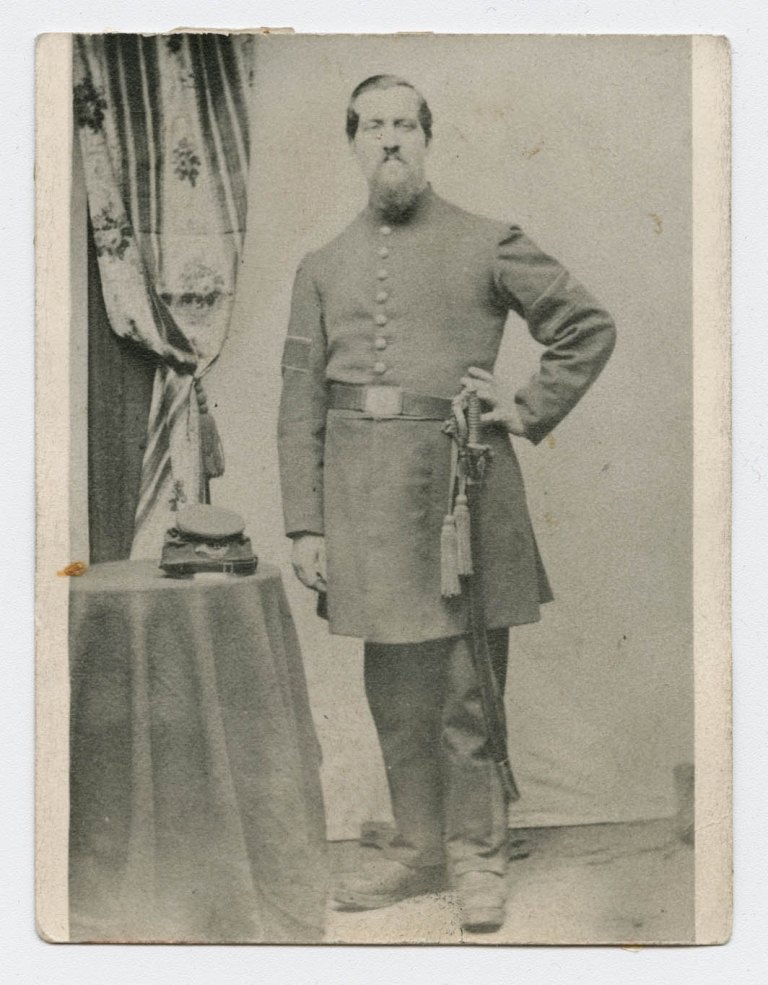
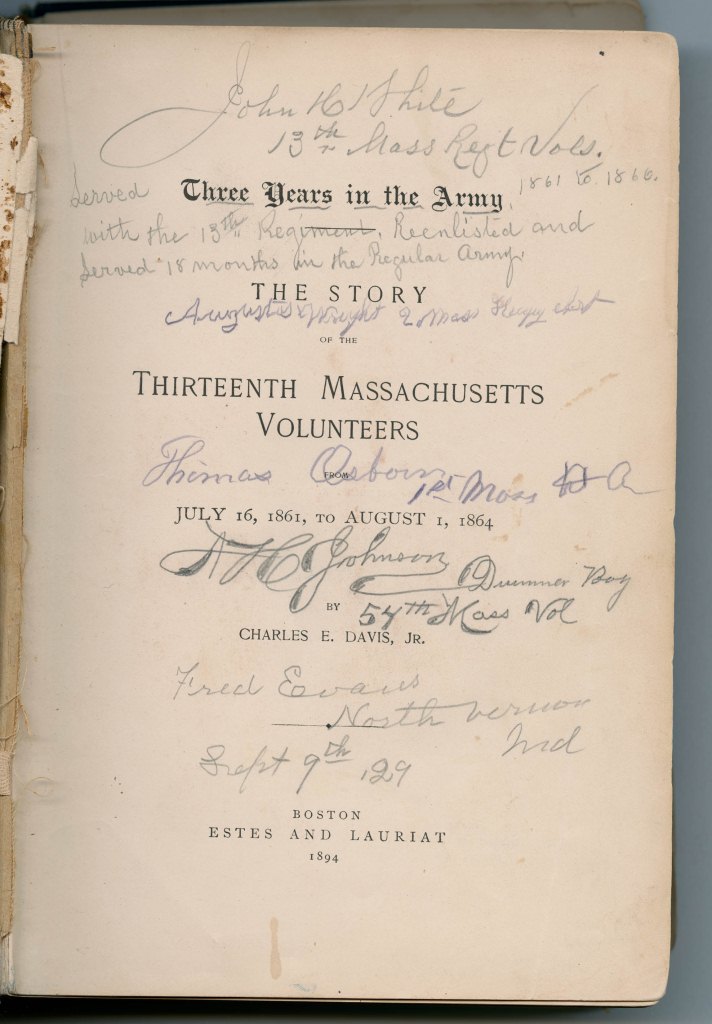
Eben W. Fiske (1823-1900) served during the Civil War as a Captain in the 13th Regiment Massachusetts Volunteer Infantry in Virginia. As part of the Fiske family papers here at the MHS, we hold several of his small notebooks which contain clippings from newspapers and a variety of pencil drawings. For ease of description, I split his drawings into two very broad categories: Civil War drawings and Other.

Fiske’s war artwork illustrates sketches of specific subjects such as the people and animals he encountered. I first saw his illustration pictured above in one of the Society’s past exhibitions. The image of this infantryman inspired me to further investigate Fiske’s artwork for this blog post.


The set of drawings I describe loosely as Other, consists of illustrations that Fiske created to go along with verses from poems and other writings. This set of drawings reminds me somewhat of those done by Christopher Pearse Cranch, subject of a previous post here. One such drawing illustrates a single verse from the poem “On Lending a Punch Bowl,” by Oliver Wendell Holmes:


“But changing hands, it reached at length a Puritan divine/Who used to follow Timothy and take a little wine/But hated punch and prelacy; and so it was, perhaps/He went to Leyden, where he found conventicles and schnaps.”


The second artist, Boston native Will H. Bradley (1868-1962), is best remembered as the “Dean of American Design.” Bradley’s Art Nouveau style widely graced the pages of commercial trade catalogs, posters, and public exhibitions through the late-19th and early-20th centuries. His career as a visual artist brought him international acclaim. He reigned in his time as the most highly-paid American artist. Recently, the MHS digtized a sample of his work for view on our website. Bradley designed and illustrated the Overland Wheel Co./Victor Bicycle catalog in 1899. Check it out here to learn more about his life and work.

In addition to the bicycle catalog available on the website, take a look at a few other pieces in the MHS collections that show Bradley’s work.


So, why is it that I am connecting these two men in this post? A clue lies in the image just above of the train. Fiske served as the librarian in Ishpeming, MI, a small town on the Upper Peninsula. Bradley, after the death of his father, moved with his mother to the town of Ishpeming, MI, to be closer to their relatives. It was here that he became a printer’s apprentice, his first job in the field he would come to dominate in his lifetime. It was a happy accident that led me connect these two men for this post. Unfortunately, I could not find information about the timing of Fiske’s tenure as librarian in Ishpeming. Perhaps a young Mr. Bradley crossed paths with the older librarian at some point in Ishpeming. Convenient coincidence that they should both end up represented at the MHS. 

To find out more about the collections that the Society holds relating to these two Ishpeming-ites, try searching in our online catalog, ABIGAIL.

Stephen Greenleaf Bulfinch, Post 40

By Elaine Grublin

The following excerpt is from the diary of Stephen Greenleaf Bulfinch.

Sunday, Jan. 1st

In public affairs, the success at Savannah is rendered more decided by the acquiescence of the people; and our northern people are doing what is right by contributions for the suffering population there. There is, on the other hand, to be recorded, the failure at Wilmington.

Sunday Jan. 15th, 1865

The only marked public news is the superseding of Gen. Butler. What is earthly greatness or popularity!

Jan. 23d 1865

My P.M. sermon had reference to the recent death (Sunday morning previous) of the illustrious Edward Everett.