Divorce, Colonial Style

By Susan Martin, Collection Services

The MHS recently acquired a manuscript collection called the Russell-Cutter family papers (Ms. N-2866) that contains one particularly interesting item: a divorce agreement dated 30 April 1735. It reads, in part:

Know ye that James Smith of Boston in the County of Suffolk in New England Coachman and Hannah his Wife In Consideration of the want of mutual Love & Affection between them, and for sundry acts which they each of them acknowledge is the Strongest proof for any divorce in Law, Have Agreed and by these Presents do agree to and with each other to part and Seperate themselves Voluntarily, and never to molest or Disturb each other in any act or acts Business or Imployments whatsoever or even if Either of them should marry again, they will not prosecute each other but will Look upon themselves as though they had never marryd at all.

Not knowing much about divorce law in colonial America, I did a little digging and found that, although rare, divorce was by no means unheard of at the time. Massachusetts Bay granted the first divorce in the colonies in 1639. (The husband was a bigamist.) According to historian Peter Charles Hoffer, in Law and People in Colonial America (Baltimore: Johns Hopkins University Press, 1998), the immigrants who settled in New England in the 17th century considered marriage a civil contract, not a religious sacrament. In fact, despite its Puritan beginnings, the New World had more permissive divorce laws than Anglican England. The laws varied from colony to colony and were generally more lenient in the north than in the south. Of course, social stigma would also have acted as a powerful deterrent.

Hoffer provides some helpful statistics:

In Massachusetts and in Connecticut, whose divorce practices were even more liberal than those of Massachusetts, there was rarely one petition per year in the seventeenth century. In the next century the number of petitions steadily increased. Between 1692 and 1785 the Massachusetts General Court heard 229 petitions for divorce, 101 of them from men, and granted 143. The Connecticut Superior Court would grant almost 1,000 divorces before 1800. (p. 108)

The most common reasons for divorce were adultery, cruelty, or desertion. The Russell-Cutter collection contains no clues to the unspecified “sundry acts” cited in this particular document, but it’s telling that, even in 18th-century Massachusetts, “the want of mutual Love & Affection” might be considered grounds for the dissolution of a marriage. I don’t know what happened to James or Hannah after 1735, but I like to think their divorce was a mutual and amicable one.
JQA’s Self-Assessment on His Birthday in 1812

By Nancy Heywood, Collection Services

On 11 July 1812, John Quincy Adams (JQA) celebrated his 45th birthday.  JQA was living in St. Petersburg, Russia, where he was serving as a diplomat from the United States.  His title was minister plenipotentiary to Russia, a position to which he was appointed in 1809.  Although he was still several years away from his eventual accomplishments as secretary of state under President James Monroe, and his own challenging term as U.S. President, by 1812, JQA had held a number of notable professional positions.  He had worked as a lawyer, held diplomatic positions in the Netherlands and in Prussia, served as a U.S. Senator, and taught rhetoric at Harvard. 

By the summer of 1812, JQA had an active family life too.  He and his wife, Louisa Catherine Adams (LCA), had three sons and a daughter.  JQA and LCA made the long journey to Russia in the summer of 1809 with their third son, Charles Francis Adams leaving their two older sons, George Washington Adams and John Adams 2d, in the care of relatives in New England.  In August 1811, JQA and LCA celebrated the birth of their daughter, who was named after her mother.

Despite these significant professional and personal accomplishments, JQA gave a rather harsh assessment of his situation on his birthday in 1812: 

I am forty-five years old— Two thirds of a long life are past, and I have done Nothing to distinguish it by usefulness to my Country, or to Mankind— I have always lived with I hope a suitable sense of my duties in Society, and with a sincere desire to perform them— But Passions, Indolence, weakness, and infirmity have sometimes made me swerve from my better knowledge of right, and almost constantly paralyzed my efforts of good— I have no heavy charge upon my Conscience—for which I bless my Maker, as well as for all the enjoyments that he has liberally bestowed upon me— I pray for his gracious kindness in future—  From John Quincy Adams diary 28, 5 August 1809 – 31 July 1813, page 394.


Do you think JQA had “done Nothing to distinguish [his life] by usefulness to [his] Country”?

If somehow you were able to send JQA a birthday message in 1812, what would you say?


This Week @ MHS

By Elaine Grublin

The weather man is predicting a lovely week, so plan to escape a bit on your lunch break and head to the MHS for one of our lunchtime programs.  Be sure to check the online calendar for additional details about the events.

Monday, 9 July at noon Moira Gillis, University of Oxford, will present a brown-bag lunch program, The Emergence of the American Corporation: The New England Example. Gillis will discuss her research into the legal and historical parameters of the corporation as it developed in New England.

Wednesday, 11 July at noon Allison Lange, Brandies University, wil present a brown-bag lunch program, Pictures and Progress: The Politics of Images in the Woman Suffrage Movement, in which she explores the visual culture of the suffrage movement.

Saturday, 14 July at 10:00 AM join our 90-minute building tour “The History and Collections of the Massachusetts Historical Society.”

An Interview with MHS Conservation Technician Oona Beauchard

By Emilie Haertsch, Publications

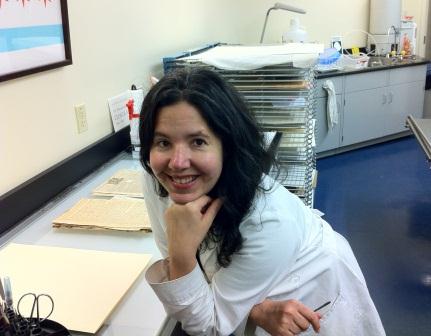
Photograph of Oona  Beauchard leaning on light table in  conservation lab

What does a conservation technician do?

My work consists of repairing and cleaning historic documents. I dry clean them by first removing the surface dirt, then testing the ink for solubility, and soaking the pages in purified water. After the soak, I de-acidify the pages and repair any damage with Japanese tissue paper and wheat starch paste that I make myself. 


How do you interact with manuscripts and objects in different ways than historians?

The main difference is that I view the documents as physical objects. I don’t focus on the intellectual content, but on the physical aspect of manuscripts.

What does a typical work day look like for you?

My days usually follow a routine, and involve a lot of multi-tasking. I come in, prepare the wheat paste, and begin soaking paper in the sink. Then I’ll dry clean the next batch, or trim excess repair paper while I’m waiting for the paper to finish soaking. Once in a while I’ll get unusual things in the lab that break up the routine. I once worked on cleaning glass plate negatives, and another time I cleaned a very large Civil War banner for an exhibition. The work is always interesting!

What are some common misconceptions about your job?

People always think I get to read all the manuscripts, but if I read every page I would never finish my work! Many also are shocked that I wash the paper. They think that that would ruin the documents, but it’s an important part of the conservation process.

What are you working on right now?

I’m currently working on conserving the final volume of Harbottle Dorr’s annotated Revolutionary-era newspapers (read more about that acquisition here). Dorr, a shopkeeper, collected Boston area newspapers in the years leading up to the Revolutionary War, indexing the contents and making his own notes. It’s a very interesting project because, as with most historic documents in need of conservation, much of the damage is on the edge of the pages. That’s also where Dorr wrote his notes, so the conservation is preventing very valuable information from being lost.

What are some of your favorite projects and why?

I’ve really enjoyed working on the Dorr newspapers. Another one of my favorites was the Sarah Gooll Putnam diaries. She started keeping a diary at a young age and continued until her death. She was an artist, so her diaries contained sketches and fabric swatches – a lot of interesting things for me to look at while I did the work.* I also am a big fan of Thomas Jefferson, so I love working on any documents authored by him.


*See an entry from Sarah Gooll Putnam’s diary here.

Massachusetts Goes to Nationals

By Kathleen Barker, Education Department

Early on the morning of June 10, 2012, I found myself standing in a parking lot in Woburn, Mass., with dozens of bleary-eyed middle- and high-school students. Despite the early hour there was a touch of excitement in the air, for these talented young ladies and gentlemen were waiting for the buses that would take them to the National History Day (NHD) finals at the University of Maryland in College Park. The 2012 contest was the largest ever in NHD history, and while 2,794 students participated in this year’s national competition, that number represents only a fraction of the students who participated in National History Day during the 2011-2012 school year.

For the students gathered in College Park, the national competition represented the zenith of a process that began nearly nine months earlier. Soon after the 2012 theme, “Revolution, Reaction, Reform in History,” was announced, students began investigating potential topics, exploring local (and not-so-local) libraries and archives, and creating exhibits, performances, documentaries, websites, or papers. Students from across the United States consulted collections at the Massachusetts Historical Society for this year’s competition. The Library Reader Services staff fielded reference calls and emails on topics such as the Boston Tea Party, the Battle of Bunker Hill, Horace Mann and nineteenth-century school reform, Dorthea Dix, and the abolition of slavery.

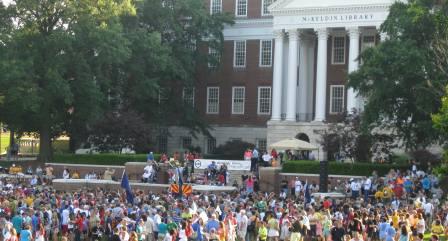
Panaromic shot of opening ceremony at National History Day in  College Park MarylandI was fortunate enough to travel with the Massachusetts delegation to this year’s national competition. The festivities began on the evening of Sunday, June 10, with a rousing opening ceremony on the lawn at McKeldin Library. Imagine thousands of students, parents, and teachers cheering, chattering, and trading pins and you’ll have a good sense of what the opening ceremony was like. The competition got down to business on Monday morning, and while in College Park I had the opportunity to serve as a judge along with more than 300 other historians and other education professionals. Anyone who has ever judged at a history day competition can tell you what an amazing experience this is. I met with many talented and enthusiastic students over the course of the three-day competition. They taught me a great deal about topics as diverse as Levittown, the use of helicopters in the Vietnam War, and Nicola Tesla. Thanks to a very well illustrated project on Civil War hospitals, I also have new appreciation for modern medicine.
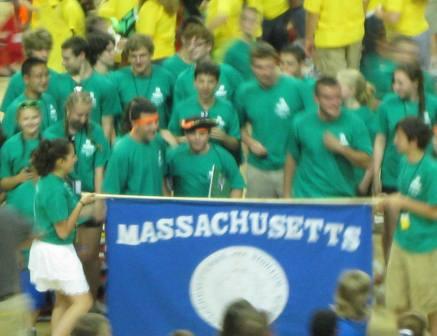
Alas, the contest did eventually come to end. After three days of intense but rewarding competition, winners were announced at a ceremony at the University’s Comcast Center on June 14, 2012. The event Massachusetts students entering auditorium for awards ceremonybegan with the best parade I’ve ever seen: a parade of participating students across the floor of the arena. I watched over 2,000 students circle the arena with everything from state flags to inflatable lobsters! Throughout the morning, dozens of students were singled out for awards and special prizes, and the boisterous crowd made sure that each winner was duly appreciated. Prizes were sponsored not only by NHD but by friends of history like the National Endowment for the Humanities, the History Channel, and the National World War II Museum. Several students from Massachusetts took home special prizes, but a special congratulations goes to our lone award winner, Chad Nowlan of Holyoke Catholic High School, who placed second in the Individual Performance category for his project, “From Revolution to Constitution, Shays’ Rebellion.” (You can find a complete list of winners on the NHD website.)
It takes a cast thousands to make History Day happen every year. Kudos to the national staff for making NHD a successful enterprise for more than 30 years! A special thanks to the Massachusetts History Day co-coordinators, Bill Szachowicz and Bob Jones, as well as all the members of the Massachusetts History Day board, who volunteer many hours to make History Day happen in Massachusetts. Thank you to all of the teachers, librarians, archivists, parents, and other mentors who shepherded students through the historical research process. Last, but certainly not least, a hearty congratulations to all of the students who participated in National History Day this year. These dedicated students gave up their evenings, weekends, and even school vacations to engage with the past. In the end, they are ALL winners!  

If History Day sounds like tons of fun (and it is), learn more about the 2012-2013 contest theme, “Turning Points in History” at the NHD website. Visit the Massachusetts History Day website for information about participating in contests in the Commonwealth. Finally, come back to the MHS website in September 2012 to find out how the Society can help you with your History Day research.

Celebrating Independence on July 2nd!

By Elaine Grublin

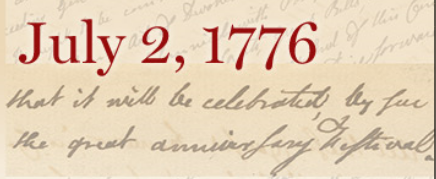
Yesterday we shared an Independence Day message from John Quincy Adams on the Beehive. In keeping in the spirit of preparing to celebrate our nation’s birthday, today we share some of John Adams’ words on the subject.  In a letter dated 3 July 1776 future president John Adams wrote to his wife Abigail: 

The Second Day of July 1776, will be the most memorable Epocha, in the History of America. I am apt to believe that it will be celebrated, by succeeding Generations, as the great anniversary Festival. It ought to be commemorated, as the Day of Deliverance by solemn Acts of Devotion to God Almighty. It ought to be solemnized with Pomp and Parade, with Shews, Games, Sports, Guns, Bells, Bonfires and Illuminations from one End of this Continent to the other from this Time forward forever more.

Adams was correct about everything but the date!  His description of people using “Bells, Bonfires, and Illuminations” to mark this “most memorable day” is spot on for most American communities today. On Monday, 2 July visit the MHS to hear Stephen T. Riley Librarian Peter Drummey explain why John Adams believed 2 July 1776 would be the most memorable day in the history of America. We will offer two gallery talks, at 10:00 AM and 2:00 PM, for interested visitors to learn the story.

If you cannot make it to a gallery talk, you can still plan to visit the MHS to view the exhibition The Most Memorable Day in the History of America: July 2, 1776. The exhibition, features letters exchanged between John and Abigail Adams, manuscript copies of early drafts of the Declaration of Independence in both John Adams and Thomas Jefferson’s own handwriting, and the Society’s own first printing of the Declaration, also known as the Dunlap broadside. The exhibition is open Monday through Saturday, 10:00 AM to 4:00 PM, from 2 July through 31 August.  

Alex Ashlock of WBUR spoke with Peter Drummey about the exhibition over the weekend. Read more in his write-up Should We Be Celebrating July 2nd?

An Independence Day Message for the World

By Amanda A. Mathews, Adams Papers

Here at the Adams Papers we receive calls on occasion from the media looking for information on John and John Quincy Adams. This past month, Gregg Lint, Series Editor for The Papers of John Adams, and Jim Taylor, Editor-in-Chief, fielded a somewhat more unusual request. Voice of America, Korea, interviewed them as a part of a series they are doing on American presidents (the interviews can be found here). These interviews posed an interesting question—what would you most want to convey about these two American presidents to an audience unfamiliar with American history?

Gregg Lint highlighted three aspects of John Adams’s career: his writing of the Massachusetts Constitution and its influence on the federal Constitution, his diplomatic career, and his success in keeping the country out of war with France during his presidency.

John Quincy Adams, Jim Taylor emphasized, was well prepared to be president by his legal, political, and diplomatic careers, however, partisanship and changing American democracy prevented him from accomplishing much while in office, leaving his most significant achievements before and after the presidency.

As Independence Day approaches, we think more about these two presidents. John Adams’s connection with the holiday is well known: the “Atlas of Independence” who famously died on the 50th anniversary of that historic event.

John Quincy Adams also has an important Independence Day connection. On July 4, 1821, he gave a speech before the House of Representatives, which later became the basis for the Monroe Doctrine. The Declaration of Independence, John Quincy Adams affirmed, “stands and must forever stand alone, a beacon on the summit of the Mountain, to which all the Inhabitants of the Earth may turn their eyes for a genial and saving light, till Time shall be lost in Eternity and this Globe itself dissolve nor leave a wreck behind.— It stands forever, a light of admonition to the rulers of men; a light of salvation and redemption to the oppressed.”

With this message of liberty to the world, there is no doubt that John and John Quincy Adams would have been well pleased to find the stories of their lives and their steadfast belief in liberty broadcast to people around the world.


John Boyle O’Reilly Memorial

By Daniel Hinchen, Reader Services

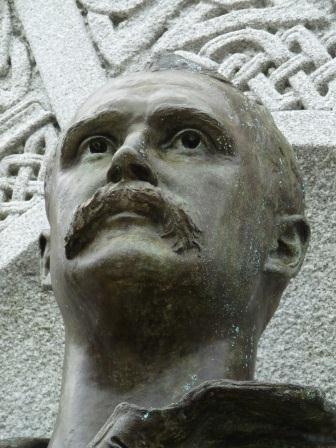
Detail of memorial to John Boyle O'Reilly featuring his face only

John Boyle O’Reilly’s faults were few, his virtues many. He did his work fearlessly and brilliantly. He did it, too, with a conspicuous ability which was seen and appreciated by men of all classes and men of all creeds. He has gone from among us, but he has left a record which the land of his nativity, his adopted country, and the city in which he lived will always cherish with pride, with honor, and with respect. Col. Charles H. Taylor (Memorial of John Boyle O’Reilly from the City of Boston, Boston: By Order of Board of Aldermen, 1891)

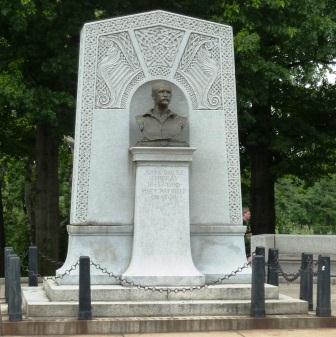
Across the street from the MHS, and facing back at it, is a large bronze bust commemorating  John Boyle O’Reilly, an Irish-born poet, newspaperman, author, Statue of John Boyle OReilly taken from Boylston Streetand social activist who brought his passion and patriotism to Boston. He was a giant in the city and won the admiration and respect of all those he met. Upon his death in 1890, thousands of people descended on Tremont Temple to pay their respects.
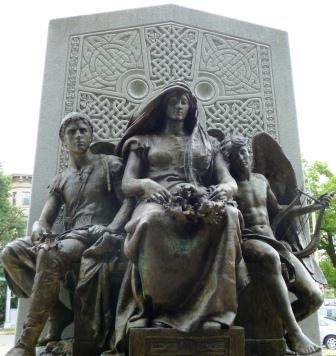
The memorial that stands directly across from the MHS was designed by Daniel Chester French and erected in 1896. French was responsible for creating such iconic sculptures as The Minute Man statue standing in Concord, MA, a statue of a seated John Harvard that is in Harvard Yard, and the giant sculpture of Abraham Lincoln that occupies the Lincoln Memorial in Washington, D.C.

French’s monument to John Boyle O’Reilly features a large bronze bust of O’Reilly on one side. On the reverse is a sculpture of Erin (representing Ireland), who is weaving a wreath and is flanked by her two sons, Poetry and Patriotism. Back of John Boyle OReilly Statue taken from Fenway The figures are placed in front of a backdrop composed of a Celtic cross and Celtic knots carved into the stone.

While there is no known large body of O’Reilly’s personal papers, the MHS holds letters written by O’Reilly scattered through our collection, including material in the Frederic Jesup Stimson Papers, the DeGrasse-Howard Papers, and the William Eustis Russell Papers. The MHS also hold a number of published items authored by O’Reilly, including his novel Moondyne: A Story from the Under-world (1879), and transcriptions of several speeches he made in his lifetime. The Boston Public Library newspaper room provides access to the full run of the Boston archdiocesan newspaper Pilot, including the issues produced during O’Reilly’s tenure as editor. To learn more about the life, death, and times of John Boyle O’Reilly, visit the MHS library to discover additional source materials.

Help Us Identify This Civil War Photo

By Emilie Haertsch, Publications

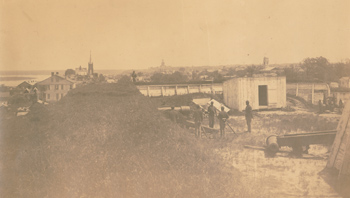
We need your help identifying the location of this photo! Taken during the Civil War, it was a 1911 gift from Edmund A. Whitman to the Society. The photograph accompanied the materials of his father, Col. Edmund Burke Whitman, a Harvard graduate and army quartermaster in the Civil War. Col. Whitman played a key role in the creation of the cemetery system for the Civil War dead, which was constructed after the war. During the war his career took him many places in the North and South, so it does not narrow the possibilities of this photograph’s location.

View a larger scan of the image here. It depicts what appear to be four African American soldiers with a cannon, probably a rifled Rodman breech-loading siege gun, a large cannon designed to knock down enemy fortifications. These Rodman guns were used by both the North and South. Since the Rodman gun fired cylindrical shells that looked like enormous modern-day bullets, the round cannon balls depicted were not used for that gun and may indicate that the emplacement had been in use before the arrival of these soldiers.

The fortification in the photograph appears old, and the grass growing over it indicates it was not very well maintained. Churches and other large buildings and a wide, bending river are visible in the background.  It is likely that some of the buildings in this photograph still stand and the modern-day view from the same vantage point is somewhat similar.

The soldiers could have been members of one of several U.S. Colored Heavy Artillery Regiments from the Civil War, designated with the numbers 1 and 3-14. They were raised in 1864, although some existed as state units prior to being called into federal service and re-numbered. Some remained in service, occupying the South after the end of the war. If the soldiers were part of these regiments, it would narrow the possibilities of the photo’s location because they often were assigned to border garrisons away from the fighting or to areas of the South occupied by the Union. However, the soldiers depicted in the photograph would not have needed to be members of a heavy artillery battery in order to man a siege gun, and there were African American artillery men not assigned to heavy artillery regiments.

Please help us solve this longstanding mystery! If you think you recognize the location of this photograph or have other related information, please share it in the comments below.

Caroline Dall Gears Up for Summer in 1862

By Jim Connolly, Publications

I don’t know how your week is going, but Caroline Healey Dall had a pretty nice one 150 years ago.

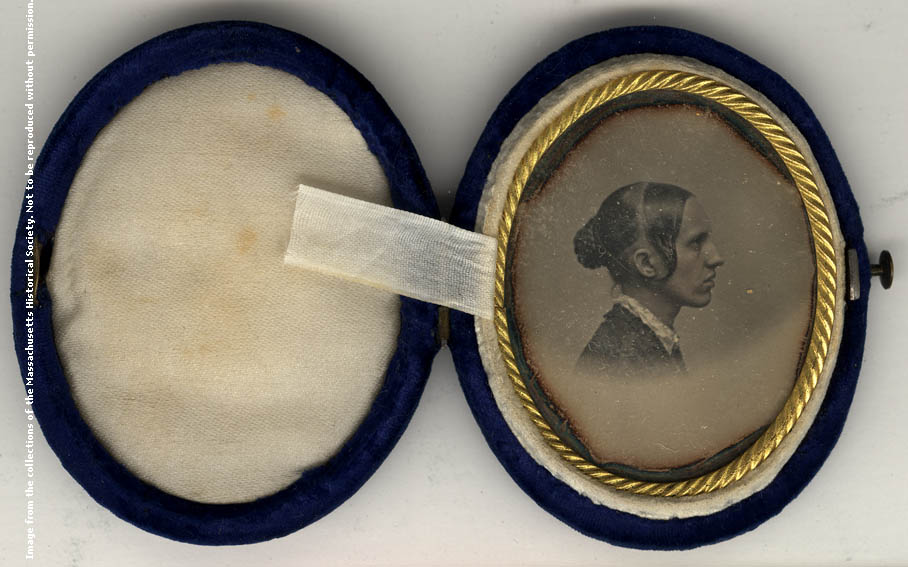
Daguerreotype of Caroline Wells Healy DallDall was a leading 19th-century reformer and essayist who played a significant role in the antislavery and women’s suffrage movements. The MHS published the Selected Journals of Caroline Healey Dall, Volume I (1838-1855), edited by Helen R. Deese, in 2006. The second volume, covering 1855 to 1866, is in the works: I am in the midst of preparing Helen’s manuscript for publication next year.

On 11 June 1862, Dall and her twelve-year-old daughter Sarah Keen Dall (“Sadie”) and sixteen-year-old son Willie were living in Medford, Mass. (my hometown, incidentally, and, the site of Lydia Maria Child’s “grandfather’s house,” of “Over the River and through the Woods” fame). She spent time with fellow Medford resident Mary B. Hall, who was apparently in a generous mood. Dall writes:

“Miss Mary gave me a little black silk sack for Sadie, & later with most tender motherly kindness–a bill for 100$–which I am to use now, & repay, if ever I am able to some one who needs it more than either of us, & whom I think Miss Mary would like to help if she were about.”

Not bad. A gift for her daughter and a C-note with instructions to “pay it forward,” if you will. Then Mary’s nieces show up with a nice surprise.

“Came home–& laid a cold tea for Sadie & self. Later Fannie & Anna Hall came with the first strawberries for Mr Towne, & in the eveg I helped him with his Ms.”

Nothing like iced tea and strawberries to prepare oneself for summer–assuming, of course, that her friend, the Unitarian minister Edward Towne, was kind enough to share the sweet fruit in exchange for help with his manuscript. Such help was valuable: Dall was an accomplished writer in many forms, including lectures, articles, and books, such as Woman’s Right to Labor (1860), Woman’s Rights Under the Law (1861), and The College, the Market, and the Court (1867).

An entry from later that week (14 June 1862) finds her in similarly idyllic territory, enjoying a “busy but peaceful morng.” and combing Towne’s hair “till he fell into a light slumber.”

page from journal of Caroline Wells Healy Dall

Union and Confederate troops in Virginia, meanwhile, enjoyed no such idylls as the disastrous Peninsula Campaign dragged on, resulting in tens of thousands of deaths. You can learn about the Peninsula Campaign and other aspects of the Civil War at the MHS Civil War web resource page.

Caroline Dall’s personal papers live at the MHS. To learn more about her and her materials, check out the Caroline Wells Healey Dall Papers 1811-1917: Guide to the Microfilm Edition, or pick up a copy of the MHS publication Selected Journals of Caroline Healey Dall, Volume I (1838-1855), mentioned above. Editor Helen R. Deese has also published a one-volume, redacted version of Dall’s diary, Daughter of Boston: The Extraordinary Diary of a Nineteenth-century Woman, Caroline Healey Dall (2005) through Beacon Press.