

By Emilie Haertsch, Publications
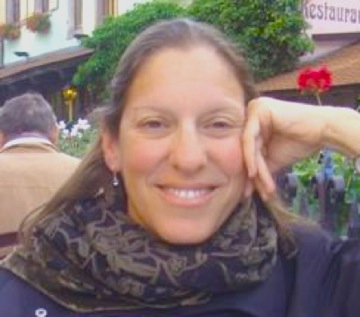 Martha Hodes, author of The Sea Captain’s Wife: A True Story of Love, Race, and War in the Nineteenth Century, is the recent recipient of an NEH fellowship to conduct research at the Massachusetts Historical Society. The Sea Captain’s Wife was a finalist for the Lincoln Prize and was named a Best Book of 2006 by Library Journal. Hodes, who teaches at New York University, took the time to talk with us about the book, her past research, and her current project.
1. How did you come to know the Society and become involved in research here?
I first conducted research at MHS while I was writing my second book, The Sea Captain’s Wife: A True Story of Love, Race, and War in the Nineteenth Century. The book’s protagonist, Eunice Connolly, is a white, working-class woman from New England whose husband fought and died for the Confederacy – after which she married a black sea captain from the Caribbean. Manuscript collections at the MHS illuminated important context, including anti-slavery sentiments in the New Hampshire town where Eunice lived during the Civil War, and anti-Irish sentiments in the cotton mills (where Eunice worked). Eunice lived in Lowell when the war was ending, so I also invoked a Lowell woman’s personal response to Lincoln’s assassination from the Martha Fisher Anderson Diaries at MHS. I had no idea then what my next book would be about.
2. What is the focus of your research during your NEH fellowship?
I’m writing a book, Mourning Lincoln, about personal responses to Lincoln’s assassination, encompassing northerners and southerners, African Americans and whites, soldiers and civilians, men and women, rich and poor, the well-known and the unknown, those at home and abroad. I’m specifically searching beyond the public and ceremonial record in order to move beyond the static portrait of a grieving nation that we find in headlines and sermons. The idea is to understand a transformative event on a human scale — access to the hearts and minds of individual Americans across the spring and summer of 1865 tells us so much more than we thought we knew.
3. How did you become interested in history and decide to enter this field?
I went to college sure I’d be an English major. At Bowdoin, I ended up creating a double major in Religion and Political Theory. Then I continued my studies in comparative religion by getting an MA at Harvard Divinity School. During those years, my work-study job was at Radcliffe’s Schlesinger Library on the History of Women in America, and that was where I came to see that I was happier immersed less in abstract ideas and more in the workings of people’s daily lives. That’s when I applied to PhD programs in History.
4. What inspired you to write The Sea Captain’s Wife? Did you discover anything unexpected while writing it?
While writing my dissertation at Princeton, I came across an amazing collection at Duke University – the letters of Eunice Connolly’s family. They didn’t belong in my dissertation and first book (White Women, Black Men: Illicit Sex in the Nineteenth-Century South), because Eunice’s story wasn’t a southern one, and I hoped no one else would discover the collection before I got to it. Lucky for me, no one did. And the letters did indeed yield unexpected discoveries — about race and racial classification. I found that when Eunice worked as a laundress during the Civil War (that was the lowest of lowly domestic work, reserved for Irish immigrants and black women), her New England neighbors barely thought of her as a white woman, and her subsequent marriage to a man of color further justified her exclusion from white womanhood. Then, when Eunice married the sea captain and went to live in the Cayman Islands, her neighbors there came to think of her as a woman of color, but in a very different way. In the Caribbean racial system, where the category of “colored” lay closer to whiteness than to blackness, Eunice’s status — as the wife of a well-to-do sea captain of African descent — rose beyond anything she had known as a poor white woman in New England. All in all, Eunice’s life story illuminates not only how malleable are racial categories and their meanings, but also how much power those classifications can hold. I didn’t know any of that when I began to write her story from the letters.
5. A number of professors have used The Sea Captain’s Wife in undergraduate and graduate-level courses. How do you feel about your work being taught and what do you look for in selecting materials for your own students?
I wrote The Sea Captain’s Wife for readers both within and beyond the academy, and I’m equally thrilled when professors assign it in their classes as I am when it’s chosen by, say, a women’s reading group. In my own classroom, whether I’m teaching conventional courses (like the Civil War or Nineteenth-Century U.S. History) or less conventional courses (like Biography as History or History and Storytelling), I strive to assign books that both impart good history and illuminate people’s lives, by asking — or prompting the students to ask — big questions about both the past and the present. I’m happy if The Sea Captain’s Wife can accomplish some of that. It’s what I hope to accomplish, too, in Mourning Lincoln.
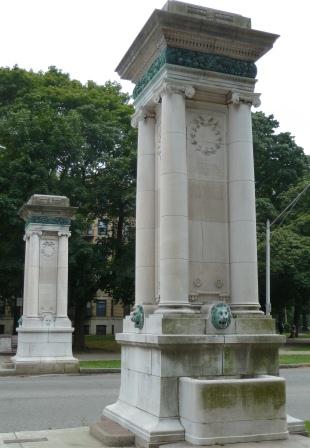 Erected in 1905, the Westland Gate is composed of a pair of large marble piers with columns on each corner and bronze lion head fountain spouts on each face. Beneath two of the spouts are marble basins. Flanking the piers are balustrades and two marble benches. The piers are constructed of white marble, while the balustrades and benches are Tennessee pink marble. While the fountains used to function and served as a water trough for animals, this use discontinued in 1919 due to an epidemic among horses.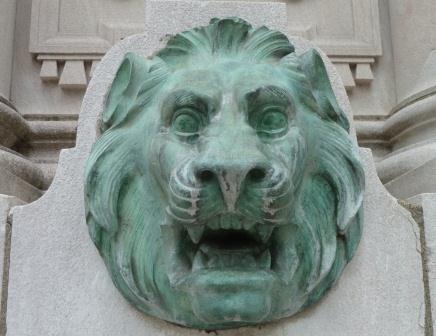
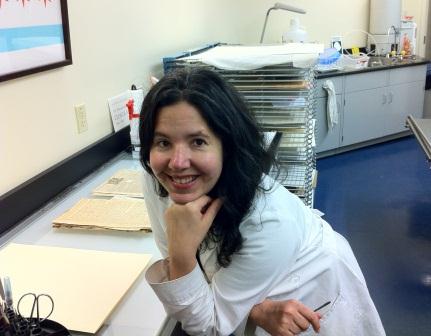
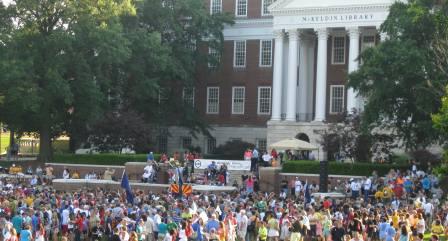 I was fortunate enough to travel with the Massachusetts delegation to this year’s national competition. The festivities began on the evening of Sunday, June 10, with a rousing opening ceremony on the lawn at McKeldin Library. Imagine thousands of students, parents, and teachers cheering, chattering, and trading pins and you’ll have a good sense of what the opening ceremony was like. The competition got down to business on Monday morning, and while in College Park I had the opportunity to serve as a judge along with more than 300 other historians and other education professionals. Anyone who has ever judged at a history day competition can tell you what an amazing experience this is. I met with many talented and enthusiastic students over the course of the three-day competition. They taught me a great deal about topics as diverse as Levittown, the use of helicopters in the Vietnam War, and Nicola Tesla. Thanks to a very well illustrated project on Civil War hospitals, I also have new appreciation for modern medicine.
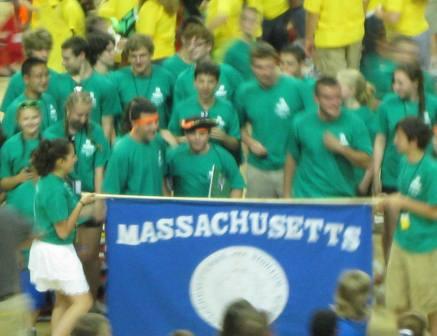 began with the best parade I’ve ever seen: a parade of participating students across the floor of the arena. I watched over 2,000 students circle the arena with everything from state flags to inflatable lobsters! Throughout the morning, dozens of students were singled out for awards and special prizes, and the boisterous crowd made sure that each winner was duly appreciated. Prizes were sponsored not only by NHD but by friends of history like the