2012-2013 Research Fellows Announced!

By Elaine Grublin & Kate Veins

Each year the MHS grants a number of research fellowships to scholars from around the country. For more information about the different fellowship types, click the headings below. 

Our fellowship programs bring a wide variety of researchers working on a full range of topics into the MHS. If any of the research topics are particularly interesting to you, keep an eye on our events calendar. All research fellows present at brown-bag lunch programs as part of their commitment to the MHS.

MHS Short-term Fellowships
African-American Studies Fellowship
Heather Cooper, University of Iowa
“Representing the Race: African American Performances of Slavery and Freedom in the Nineteenth Century”

Alumni Fellowship
Lauri Coleman, William and Mary
“Interpretations of New England Weather in the Revolutionary Era”

Andrew Oliver Fellowship
Katelyn Crawford, University of Virginia
“Mobility and Portrait Painting in the Late Eighteenth-Century British Atlantic World”

Andrew W. Mellon Fellowship
Frances Clarke, University of Sydney                                                                           
“Minors in the Military: A History of Child Soldiers in America from the Revolution to the Civil War”                                                                  

Eberhard Faber, Princeton University
“‘Everybody Talks of Visiting That Country’: New England Reactions to the Louisiana Purchase, Territorial Rule, and Louisiana Statehood, 1803-1812”

Michael Hevel, University of Iowa
“‘Betwixt Brewings’: A History of College Students and Alcohol”

Ann K. Johnson, University of Southern California
“Cabinets of Miscellany and Meaning: Managing Information in Antebellum America”

Greta LaFleur, University of Hawai’I at Manoa
“American Insides: Popular Narrative and the Historiography of Sexuality, 1675-1815”

Jen Manion, Connecticut College
“Crossing Gender; Female Masculinity in the 18th and 19th Centuries”

Brooke Newman, Virginia Commonwealth University
“Island Masters: Gender, Race, and Power in the Eighteenth-Century British Caribbean”

Benjamin Park, University of Cambridge
“Localized Nationalisms in Post-Revolutionary America”

Brad Snyder, University of Wisconsin
“The House of Truth: The Men Who Created Modern Progressivism”

Benjamin F. Stevens Fellowship
Sarah Sutton, Brandeis University
“Industrializing the Family Farm: Dairy Farming, Milk Consumption, and the New England Landscape”

Cushing Academy Fellowship in Environmental History
Jennifer Staver, University of California Irvine
“Energy, Work, and Power along the Pacific Coast of North America, 1768 to 1820” 

Malcolm and Mildred Freiberg Fellowship
Katherine Grandjean, Wellesley College
“‘Terror ubique tremor’: Communicating Terror in Early New England, 1677-1713”

Marc Friedlaender Fellowship
Rick Kennedy, Point Loma Nazarene University                                                          
“Cotton Mather Biblia Americana Volume 8”

 Massachusetts Society of the Cincinnati Fellowship
Holger Hoock, University of Pittsburgh
“Scars of Independence: Practices and Representations of Violence in the American Revolutionary War”

Ruth R. & Alyson R. Miller Fellowship
Bonnie Lucero, University of North Carolina Chapel Hill                                            
“Privates, Prostitutes, and Pardos: Women and Racial Conflict in Cienfuegos, Cuba, circa 1898”

Lindsay Moore, Boston University
“Women, Power, and Litigation in the English Atlantic World, 1630-1700”

W. B. H. Dowse Fellowship
Nichole George, University of Notre Dame
“Riots and Remembrance: America’s Idols and the Origins of American Nationalism”

Reiner Smolinski, Georgia State University
“Cotton Mather: The Life of a Puritan Intellectual”

Suzanne and Caleb Loring Fellowship
Ann K. Holder, Pratt Institute
“‘Making the Body Politic’: Sexual Histories, Racial Uncertainties and Vernacular Citizenship in the Post-Emancipation U.S.”

MHS-NEH Long-term Fellowships
Megan Bowman, University of California Santa Barbara
“Networking for Global Perfection: The International Dimension of Nineteenth-Century Fourierism”

 Kristen Collins, Boston University School of Law
“Entitling Marriage: A History of Marriage, Public Money, and the Law”

Matthew Dennis, University of Oregon
“American Relics and the Material Politics of Public Memory”

Martha Hodes, New York University
“Mourning Lincoln: Personal Grief and the Meaning of the American Civil War”

New England Regional Fellowship Consortium Fellows
*Denotes scholars whose itineraries include the MHS

Kelly Brennan Arehart, College of William and Mary
“Give Up Your Dead: How Business, Technology, and Culture Separated Americans from their Dearly Departed, 1780-1930”

Justin Clark, University of Southern California*
“Training the Eyes: Romantic Vision and Class Formation in Boston, 1830-1870”

Michael Cohen, Tulane University
“Jews in the Cotton Industry: Ethnic Networks in 19th Century America”

John Dixon, Harvard University*
“Found at Sea: Mapping Ships’ Locations on the Eighteenth-Century Atlantic”

Moira Gillis, University of Oxford*
“The Unique Early Modern American Corporation”

Jared Hardesty, Boston College*
“The Origins of Black Boston, 1700-1775”

Benjamin Hicklin, University of Michigan Ann Arbor*
“‘Neither a Borrower nor a Lender Be’?: The Experience of Credit and Debt in the English Atlantic World, 1660-1750”

Allison Lange, Brandeis University*
“Pictures of Change: Transformative Images of Woman Suffrage, 1776-1920”

Jason Newton, Syracuse University
“Forging Titans: Myth and Masculinity in the Working Forests of the American Northeast, 1880-1920”

Ana Stevenson, University of Queensland*
“The Woman-Slave Analogy: Rhetorical Foundations in American Culture, 1830-1900”

Gloria Whiting, Harvard University
“‘Endearing Ties’: Black Family Life in Early New England”


Anatomy of a Pun: 1813 Edition

By Emilie Haertsch


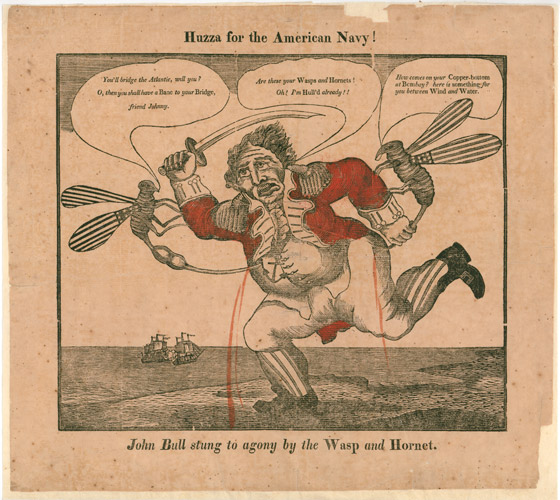
Humor, like beauty, is in the eye of the beholder. This colorful broadside will be featured in the MHS’s upcoming War of 1812 exhibition, Mr. Madison’s War, which opens on June 18. A broadside such as this would have been posted on the side of a building or kept for home consumption by a patriotic family. In its day, it would have been considered as funny – and meaningful – as our contemporary newspaper’s political cartoons or television news spoofs such as The Colbert Report. But without context, a great deal of this broadside’s wit could be lost to today’s reader.

With the title “Huzza for the American Navy,” the picture features a heavyset man in uniform. Two winged insects sting him on either side as he runs, brandishing his sword, to get away. They are on the beach, and two ships are visible at sea in the background. The caption below reads, “John Bull stung to agony by the Wasp and the Hornet.”

The man is “John Bull,” the personification of Great Britain, and his uniform is hand-painted in scarlet. The “Wasp” and the “Hornet” refer to American ships that won victories over Britain early in the War of 1812. USS Wasp defeated HMS Frolic on October 15, 1812, and USS Hornet sunk HMS Peacock on February 24, 1813.

The first insect says, “You’ll bridge the Atlantic, won’t you? Oh then you’ll have a Bane to your Bridge, friend Johnny.” The use of “Bane” and “Bridge” refers to William Bainbridge, who was captain of USS Constitution when it captured HMS Java on December 29, 1812.

John Bull replies, “Are these your Wasps and Hornets! Oh! I’m Hull’d already!!” “Hull” was Isaac Hull, who commanded USS Constitution during an earlier cruise when it defeated HMS Guerrière on August 19, 1812.

The second insect says, “How comes on your Copper-bottom at Bombay? Here is something for you between Wind and Water.” “Copper-bottom at Bombay” appears to be a taunt. When the Constitution defeated and then destroyed the Java off the coast of Brazil, the Royal Navy frigate was transporting the new commander-in-chief of British forces in India, Sir Thomas Hislop, to Bombay, along with copper to sheath the hull of a new 74-gun ship. Copper sheathing prevented a ship from being slowed by marine growth on its hull over the course of a long voyage. The loss of the Java and its cargo of copper delayed the completion of HMS Cornwallis.

“Between Wind and Water” denotes the way sailing ships engaged in battle. They aimed their cannons for the opponent vessel’s waterline, to “hull” it. A hit there was likely to do the most damage because a ship’s waterline rose and fell as wind and waves rocked the ship. But it also works as a double entendre, with the insect stinging John Bull between where he created “wind” and “water – as does the word “Bombay.”

Although this broadside has no inscription, due to the timely nature of its content it likely was printed in March or April of 1813, soon after the Hornet returned from its victory over the Peacock off of the coast of Guyana. The Hornet anchored at Holmes’ Hole in Martha’s Vineyard on March 19, 1813.

Some of the jokes hidden inside this broadside we will likely never know, but a little bit of context provides insight not just into the events of the war but also into what made Americans laugh in 1813, when the pun was the epitome of wit.

To see more documents from the Society’s collections related to the war, as well as more information about our upcoming exhibition and other planned events in the Boston area, please visit our War of 1812 web feature.


Stephen Greenleaf Bulfinch, Post 13

By Elaine Grublin

The following excerpt is from the diary of Stephen Greenleaf Bulfinch.

May 11th 1862

Meantime public news has come in rapid succession. New Orleans surrendered, Fort Mason soon followed, – Yorktown has been abandoned, and the rebels have been defeated at Williamsburg and West Point. God grant a speedy termination of the contest! In Washington, the Act for abolishing slavery in the D.C. having been passed, Congress have turned their attention to the great subject of a confiscation bill. This I am disposed to favor, as a means partly of emancipating many slaves, & thus preparing the way for the freedom of the rest, – partly of punishing treason in a less cruel but more effectual method than by executions. I was much impressed by a speech of Senator Wade of Ohio on this subject.

Be sure to check back in June, when Bulfinch notes Confederate movements in Virginia and the loss of a personal acquaintance and former parishioner. 

Guide to the Catharine Maria Sedgwick Papers Now Online

By Susan Martin

The MHS is pleased to announce that the collection guide to the Catharine Maria Sedgwick papers is now online. This is a very heavily used collection, and we hope the new guide will encourage even more scholarship about this interesting woman, her work, and her family.

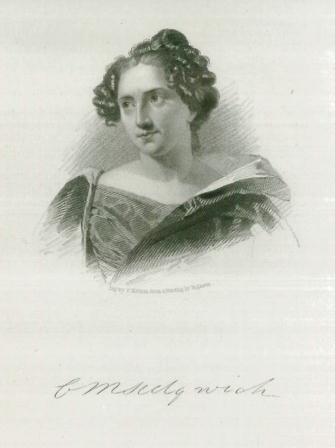
Engraving of Catharine Maria Sedgwick from Life & Letters (Harper & Bro, 1871)Catharine Maria Sedgwick (1789-1867) was a member of the illustrious Sedgwick family of western Massachusetts and a prolific antebellum author. She wrote many novels and short stories between 1822 and 1862, including A New-England Tale, Redwood, Hope Leslie, Clarence, The Linwoods, and Married or Single? Very popular in her time and praised by many of her contemporaries, including William Cullen Bryant, James Fenimore Cooper, Ralph Waldo Emerson, Harriet Martineau, and Edgar Allan Poe, Sedgwick was largely overlooked by scholars in the century following her death, and most of her books were out of print for decades. Recently, however, there has been a resurgence of interest in her life and work.
The Catharine Maria Sedgwick papers at the MHS actually consist of three separate sub-collections of papers acquired in installments between 1954 and 1965. In 1981, the three sub-collections were microfilmed together onto 18 reels of film, but the original three-part arrangement was retained, and each part was described and indexed separately. The paper guide ran to over 120 pages, and because of the overlap of subjects, dates, and correspondents across all three parts, using the collection could be a challenge, to say the least.

Now, thanks to a grant from the Sedgwick Family Charitable Trust, the new and improved Catharine Maria Sedgwick guide is available to researchers both on and offsite. Since we didn’t have the option of physically rearranging the collection itself, we concentrated on improving access to it by substantially revising the old paper guide. Among other changes, we combined the three indexes into one, enhanced descriptions of the volumes, and added a biographical sketch, timeline, and links to related collections at the MHS.

 Please take a look at the new Catharine Maria Sedgwick collection guide.

This Week @ MHS

By Elaine Grublin

This week we offer a bit of something for everyone.  Choose to attend one of the four programs we are offering to kick of May, or challenge yourself to see how many you can attend.  As always you can find more information about individual program on our online calendar.

Tuesday at 5:15 PM, Joanne van der Woude, Harvard University, will close out the season for the Boston Early American Seminar Series with a presentation of her paper “The Classical Origins of the American Self: Puritans and Indians in New England Epics.” Elizabeth Maddock Dillon, Northeastern University, will give the comment. The program is free and open to the public, but RSVPs are required. Subscribers receive an advance copy of the paper.

Wednesday at noon, join us in the Dowse Library for a brown-bag lunch program. Jordan Watkins, University of Nevada, Las Vegas, will present on his research “Clio and America’s Civil War.”  Be prepared to participate in a lively discussion after Watkin’s completes his presentation. 

On Friday at 2:00 PM, MHS Curator of Art Anne Bentley will present a gallery talk in conjunction with our current exhibition Clover Adams a Gilded and Heartbreaking Life. This one-hour program will examine Clover’s use of the photographic medium to reflect her emotional connections to the arts and her subjects, and will provide attendees with time to explore the exhibition up close.

On Saturday our 90-minute building  tour The History and Collections of the MHS departs the front lobby promptly at 10:00 AM.


Please note that the Biography Seminar scheduled for Thursday, 3 May, has been postponed.  A new date will be announced when our fall schedule is published. 

Explore the World of Marian Hooper Adams

By Elaine Grublin

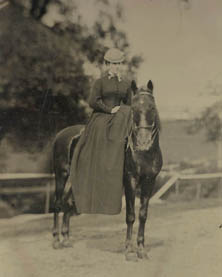
Marian Hooper Adams on HorsebackHave you had a chance to visit our current exhibition A Gilded and Heartbreaking Life: The Photographs of Clover Adams, 1883-1885? Hundreds of visitors have visited 1154 Boylston Street to view this stunning exhibition featuring the late-19th-century photographs of Marian Hooper Adams, whom family and friends called Clover. Read what some of them had to say about the exhibition:

“Clover Adams … you instantly fall in love with her”

“A very interesting and revealing installation”

“Very poignant”

“The written text made the exhibition come to life”

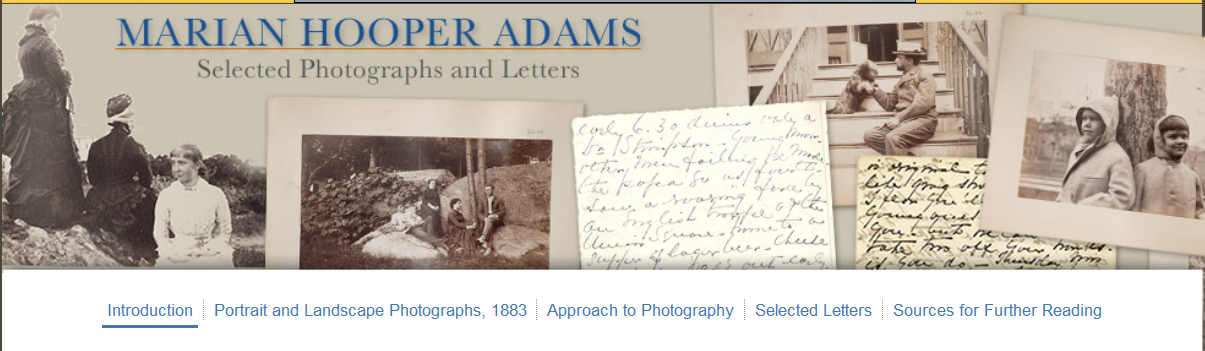
Not planning on visiting Boston in the near future? You do not have to miss out entirely. Clover’s photographs can be viewed by a wider audience via our web feature, Marian Hooper Adams: Selected Photographs and Letters. The website presents 48 photographs (one entire album) from the Marian Hooper Adams photograph collection, five selected letters from the Hooper-Adams papers, and two letters by Henry Adams in which he reflects on his wife’s death.

The website also provides information about Clover’s approach to photography by presenting a digital facsimile of a notebook Clover kept from May 1883 to January 1884 in which she listed many of her photographs and commented on exposures, lighting, and other technical details. The display of the notebook includes a transcription of the text provided by Natalie Dykstra, the guest curator for our current exhibition. 

The exhibition runs through 2 June 2012 and is free and open to the public Monday through Saturday from 10:00 AM to 4:00 PM. The web feature is available through our website 24 hours a day and will remain online after the exhibition closes.

If you want to learn even more about the life of Clover Adams, look for Natalie Dykstra’s new book Clover Adams: A Gilded and Heartbreaking Life ( Boston: Houghton Mifflin Harcourt, 2012), which offers a full-length biography of the woman behind the camera. 

This Week @ MHS

By Elaine Grublin

We have a couple of interesting events planned this week, as well as two exhibitions open to the public 10:00 AM to 4:00 PM, Monday through Saturday.  As always, check the online calendar for more details about individual events. 

Tonight, 23 April, at 6:00 PM Heather Nathans, University of Maryland, author of Early American Theatre from the Revolution to Thomas Jefferson (Cambridge University Press, 2003) will present “Democracies of Glee: Boston’s First Professional Theatres, 1794-98.” A pre-talk reception, offering an opportunity to explore our current exhibition The First Seasons of the Federal Street Theatre, beings at 5:30 P.M. This event is free and open to the public.  Registration is requested. To register please call 617-646-0560 or click here.

Tuesday, 24 April, at 5:15 PM the final installment of the Boston Immigration and Urban History Seminar brings Andrea Thabet, University of California, Santa Barbara, to the MHS to present her paper “A Successful Integrated Development for the Central City”: Constructing the Los Angeles Music Center, 1954-1967. Samuel Zipp, Brown University, will give the comment. This event is free and open to the public.  Advance copies of the seminar paper are available for a small subscription fee. RSVPs are requested and can be submitted via email.

Saturday, 28 April, all are welcome to attend our tour, The History and Collections of the Massachusetts Historical Society.  The 90-minute tour departs the front lobby at 10:00 AM.


Recently Published Research

By Anna J. Cook

Putting together a summer reading list?  Here are some recent publications that we are aware of, completed by researchers that made use of our collections or publications.


JANUARY-APRIL 2012:

Baldwin, Peter. In the Watches of the Night: Life in the Nocturnal City, 1820-1930 (University of Chicago Press, 2012).

Dyer, Justin Buckley. American Soul: The Contested Legacy of the Declaration of Independence (Rowman and Littlefield, 2012).

Dykstra, Natalie. Clover Adams: A Gilded and Heartbreaking Life (Houghton Mifflin, 2012).

Gamble, Richard. In Search of the City on a Hill: The Making and Unmaking of an American Myth (Continuum Press, 2012).

Johnson, Laura. “American Blues: Printed Pottery Celebrating a New Nation” Antiques and Fine Art (Winter 2012).

Lynch, Matthew. Before Obama: A Reappraisal of Black Reconstruction Era Politicians (Praeger Publishing, 2012).

Newton, Ross. “ ‘Persons of worthy Character’: Slaves, Servants, and Masters at Boston’s Old North Church” Journal of the North End Historical Society (March 2012).

Platt, Stephen. Autumn in the Heavenly Kingdom: China, the West, and the Epic Story of the Taiping Civil War (Alfred A. Knopf, 2012).

Winship, Michael. Godly Republicanism: Puritans, Pilgrims, and the City on a Hill (Harvard University Press, 2012).

Happy Birthday, Fenway Park!

By Elaine Grublin


Today hordes of people — Red Sox fans and baseball stadium aficionados alike — will descend on Fenway Park to celebrate the 100th anniversary of that venerable stadium’s opening in 1912.

We at the MHS are lucky. Being just a short walk from the ball park allows us to watch as a sea of red and blue outfitted fans make their way down Boylston Street toward the park for each home game. This morning, I was struck by the fact that the MHS has stood at 1154 Boylston since 1898, more than a decade before the park opened.  It made me wonder if Charles Francis Adams, MHS president from 1895 to 1915, and other MHS members stood before one of the large first floor windows and watched folks make their way to Fenway Park 100 years ago today. If they did, I would imagine they did not worry so much if the end of the day game coincided with quitting time at the MHS — as the current staff, anticipating traffic woes, now does.
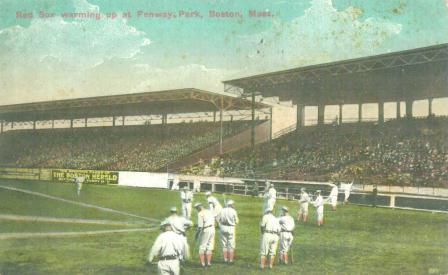
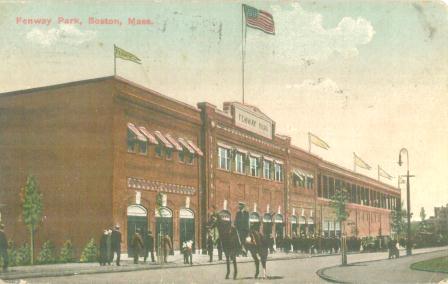
The two images here are postcards held in our collection. The cards, sent to members of the Pond family in Connecticut, were posted in January and March 1914. Although there is no evidence on the cards how much before that date they were printed, it is safe to assume they offer a fun glimpse of Fenway close to the time of its opening. 

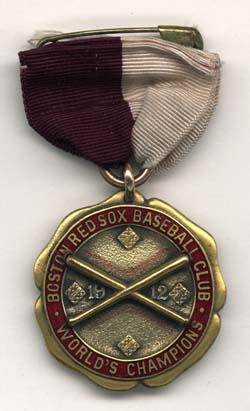
One final thought on Fenway’s special day. Although the season is off to a bit of a rocky start, let’s hope the Sox bring home another one of these!  Click here to learn more about the 1912 World Series medal held by the MHS.


This Week @ MHS

By Elaine Grublin

Mark your calendar and plan to join us for an event this week.  More information about each event is available through our online calendar. 

Wednesday, 18 April at noon join us for a brown-bag lunch program and listen as Trenton Jones, The Johns Hopkins University, talks about his project “Prisoners of War and the Making of Revolutionary American Military Culture.”  After the presentation, be ready to join in the lively Q & A session. 

Friday, 20 April at noon, Fred Wallace, Framingham Town Historian, presents Framingham’s Civil War Hero, the Life of General George H. Gordon.

And on Saturday, 21 April, the 90-minute building tour, The History and Collections of the MHS, departs the front lobby promptly at 10:00 AM.