New Edition of an MHS Manuscript Diary in Print: “Thomas Jefferson’s Granddaughter in Queen Victoria’s England”

By Ondine LeBlanc

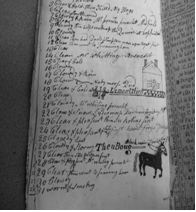
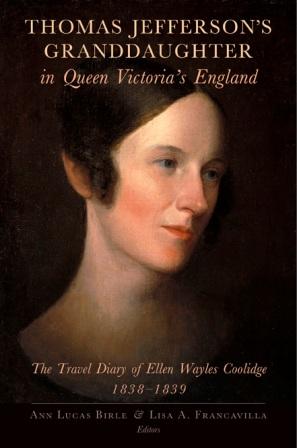
Cover Jacket of Published Volume with portrait of Ellen CoolidgeA little more than a year ago now, a hefty package arrived in the Publications office at the MHS. Sent from a corollary office at Monticello, Thomas Jefferson’s hilltop home in Virginia, it contained reams of closely printed paper. Along with various administrative sheets, such as permissions letters from art museums in London, the pages in the package included the text that would become our newest publication–an edition of the 1838-1839 travel diary of Ellen Wayles Randolph Coolidge, one of Jefferson’s grandchildren (and his reported favorite). The original, handwritten document made its way into the Society’s collections in 1964. Born in Virginia, Ellen Randolph had married Boston merchant Joseph Coolidge, Jr., in 1825 and became a Bay State resident thereafter.  

The transcription–entirely unabridged–and annotations had been prepared by two editors based at Monticello, Ann Lucas Birle and Lisa A. Francavilla. With the fruit of their labors now in our hands, Associate Editor Suzanne Carroll and I (plus several very helpful volunteers) began our part of the work: copyediting all of the notes and front matter and “collating” the transcription. The latter process is how we review the quality of a documentary edition, reading the typed transcription against the original manuscript. Taking our cue from the team in the Adams Papers Editorial Project, we do what documentary editors call a “tandem collation”: one person reads the typed text aloud while the other reads along in the handwritten manuscript, making sure they agree with the rendering of every word, every comma, every underlining.

Some colleagues may not agree with me, but it can be a tedious process. One does not get to read quickly when doing collation. No skimming the dry bits. But here’s the thing about Ellen Coolidge’s diary: it doesn’t have so many dry bits. In all the collating of historical punctuation and extra-curmudgeonly copyediting of annotations (we needed to make sure, for example, that every compound term is spelled exactly the same way throughout hundreds of pages of notes), Ellen’s words kept us going. She is astonishingly erudite–I’m sure the range of her knowledge could have put some of her college-educated male peers to shame–and her quick mind makes revealing, and sometimes irreverent, connections among the goings-on she observes. One moment I might be throttling my keyboard, trying to determine the exact title of some English peer, and then I’d find myself laughing over Ellen’s description of a bust she encounters at a gallery:

Saw in the Adelaide Gallery an electric eel of great size, and a marble head of Lord Brougham in a marble wig with marble curls. Looks like a Butcher’s dog with a wig, on & reminded me of an anecdote of Garrick playing King Lear and laughing in the most pathetic scene, where he should have been weeping over the body of Cordelia, at the sight of a dog in the pit, upon whose head his fat, perspiring master had placed his wig to the great relief of his own shining & naked noodle.

There are, of course, also more serious insights in her diary entries. As a visitor in a culture with a very different class structure, and in a city much more densely populated than the one she is used to, Ellen often has the advantage of unfamiliarity, allowing her to see her environment in sharp perspective. On one of her first drives into London, the crowds of humanity motivate her to think about free will: “they appeared more like flocks or herds obeying the impulse of a voice & a hand from behind than thinking beings going on their own way, chusing their own path, impelled each one by individual motives & governed by their several & independent wills.” Her thoughts turn to a treatise on ant colonies that she has read, and she notes a similarity, but ultimately she draws a distinction between humans and ants based on an idea of social evolution: “But with them all is instinct, men are governed by reason. that is Ants are stationary, neither advance nor recede, while men are capable of both.  Ants are the same now, no doubt, that they were in the commencement of their career—They were wise & methodical as they are now. They are strict conservatives. . . . [Y]et change, the power of improvement, the restless desire for a better order of things is what distinguishes the man from the insect, since it shews the working within him of the principle of progress.”  “Such,” she concludes, “were some of the strange thoughts which distracted my attention from my immediate object, the pursuit of a Cashmere shawl.” 

The Coolidge lineage of Ellen and Joseph has generously provided the MHS with some truly wonderful family archives, including this diary, passed along to us by Ellen’s great-granddaughter Mary Barton Churchill. In 1893, Ellen’s son Thomas Jefferson Coolidge gave the Society a substantial collection of Thomas Jefferson’s personal papers. His gift established the Coolidge Collection of Thomas Jefferson Manuscripts, the largest holding of Jefferson’s papers outside of the Library of Congress–and the largest bar none of his personal papers. Click here to view selected items from this collection available on the Society’s website.

I’ll be reading Ellen’s diary again over the holiday, and maybe I’ll get a chance to post a few more of my favorite bits.  I hope you’ll share yours too.


* How I wish there were a diary from that trip!

This Week @ MHS

By Elaine Grublin

Looking for some intellectual engagement as a reprieve from the holiday madness? Look no further than the MHS this week.

On Tuesday, 13 December at 5:15 PM the final installment of 2011 for the Boston Environmental History Seminar brings Harvard University’s Daniel Barber to the MHS to present his research Phase-Change: Maria Telkes after the Dover Sun House. Catherine Zipf, Salve Regina University, will provide the comment.

On Wednesday, 14 December at 11:00 AM come visit for a 1-hour gallery talk focused on our exhibition The Purchase by Blood. If you cannot make the gallery talk, remember that all MHS gallery spaces are free and open to the public Monday through Saturday from 10:00 AM to 4:00 PM.  

And on Saturday, 17 December the 90-minute tour The History and Collections of the MHS departs the front lobby at 10:00 AM.


Also note that the MHS library will be closing at 3:45 PM on Thursday, 15 December. 

Stephen Greenleaf Bulfinch, Post 9

By Elaine Grublin

The following excerpt is from the diary of Stephen Greenleaf Bulfinch.

Sunday December 15th 1861

The war advances slowly, but with pretty steady gain to the side of Union. Recent events are the occupation of Port Royal inlet and Tybee island, &c. by our troops & navy; – the arrest of Messrs Mason, Slidell, &c. on board a British steamer; – the fighting at Fort Pickens. Congress have assembled, & the question of emancipation begins to be discussed there. We have reports of great fires in Charleston, & alarm of negro insurrection. I fear to encourage such a terrible remedy; yet see with awe, the mark of that overruling hand which will probably sweep away slavery through the very war that has been undertaken to protect it.

In January Bulfinch reflects on all the events of 1861, so be sure to continuing following the Civil War series on the Beehive.

This Week @ MHS

By Elaine Grublin

There is always interesting research happening in the MHS library. This week, take a bit of time out from your holiday shopping to come learn about some of that research at one of our many programs.  

On Tuesday, 6 December at 5:15 PM the final Boston Early American History Seminar of 2011 brings Abby Chandler, UMass Lowell, and Ruth Wallis Herndon, Bowling Green State University, to the MHS for a Panel Discussion on Colonial Family Law. Cornelia Hughes Dayton, University of Connecticut, will deliver the comment.

Then on Wednesday, 7 December at noon MHS short-term research fellow Megan Prins, University of Arizona, presents her research, Winters in America, 1880-1930 at a brown-bag lunch program.

THIS EVENT HAS BEEN POSTPONED. Finally, on Thursday, 8 December at 5:30 PM the Boston Seminar on the History of Women and Gender wraps up 2011 with a final program at 1154 Boylston Street. as Jennifer Morgan, New York University, discusses Quotidian Erasures: Gender and the Logic of the Early Trans-Atlantic Slave trade. The comment will be delivered by Linda Heywood, Boston University. THIS EVENT HAS BEEN POSTPONED.  CHECK OUR WEB CALENDAR IN THE NEAR FUTURE FOR MORE INFORMATION

Beyond research based programs, on Wednesday, 7 December the MHS offers a special event exclusively for MHS members and fellows.  Starting at 6:00 PM the MHS Fellows and Members Holiday Party offers a chance to share good cheer with other members and MHS staff while enjoying the current exhibition. Click here to register for this event.

And on Saturday, 10 December our 90-minute building tour The History and Collections of the MHS departs the front lobby promptly at 10.00 AM. 

Allegorical Animals

By Anna J. Cook

Welcome to the second installment of our Beehive series, “Readers Relate,” in which we bring you a variety of examples of the type of research being done here in the MHS library.

Today’s responses come from Joshua Kercsmar, a PhD candidate under Mark Noll at the University of Notre Dame who spent several weeks conducting research here at the MHS this past summer.

Can you briefly describe the research project that brought you to the Massachusetts Historical Society?

My dissertation explores how British Americans used the moral meanings of animals to define religious and political identity in the New World. In coming to the MHS I wanted to know how ministers — key interpreters of nature for popular audiences — translated the meanings of animals for their listeners.   

What specific material in our collections made coming to the MHS important to your research?

The extensive collection of sermons at the MHS was a main attraction. Once there, however, I discovered an impressive collection of maps. Maps are important for my project, because engravers often framed them with allegorical scenes of people and animals. To promote whites’ image of themselves as improvers of the land, map-engravers would often portray Europeans in the vicinity of livestock. Scenes of Africa and America, however, tended to show Africans and Indians standing near (or riding atop) various species of wild, reptilian, or otherwise unproductive creatures. Through these kinds of comparisons, map-images helped reinforce the notion that Britain was more civilized and virtuous than other cultures.

While you were working here, was there something you examined that surprised you? What was it, and why was it surprising?

These animal-tropes were quite persistent, even into the late eighteenth century. Although I wasn’t sure what to expect, their persistence surprised me. I had thought that as the idea of the “noble savage” gained momentum during the eighteenth century, the equation of Indians with morally questionable reptiles might soften. But it didn’t.

Is there a particular quote (or visual image) from the material that you consulted that stands out for you? What is the quote (or image) and why is it important?

On two maps (Joshua Fry’s A Map of the Most Inhabited Part of Virginia Containing the Whole Province of Maryland [London, 1755], and John Henry’s A New and Accurate Map of Virginia [London, 1770]), I found not Indians but African slaves, who were portrayed as nearly naked and serving food. Given the strong connection between Africans and wild animals in sixteenth- and seventeenth-century maps, I read the slave-images as emblems of nature tamed. The images are important, because they suggest how common was the link (so often made in pro- and anti-slavery writings) between African slaves and domestic animals.

If you brought a visitor to the MHS and you had a chance to show them ONE item from our collections, what item would it be?

Detail of plate from Atlas des Colonies Angloises en AmeriqueI would show them the Atlas des Colonies Angloises en Amérique, which contains thirty-eight maps printed in a wide variety of styles from 1736 to 1777. Many of the maps I looked at were from this fine collection, although I was delighted to find that the MHS holds nearly two hundred other maps printed between 1500 and 1800 as well.


We invited Joshua to share anything further about his research that Beehive readers might be interested in. He writes:

 I earned my B.A. in Theology from Wheaton College (IL); my M.Div. from Gordon-Conwell Theological Seminary; and my Th.M. in American Religious History from Harvard Divinity School, where I worked under David D. Hall. I am now a Ph.D. candidate in U.S. History at the University of Notre Dame, and a student of Mark Noll.

My dissertation, entitled “Nature of the New World: Animals, Identities, and the Moral Ecology of British America, 1530–1800,” examines the ways that British Americans turned to the animal world, a vast repository of moral meaning, to make sense of their place in the American wilderness. I argue that ever since the Middle Ages, Britons had read systems of relationships among humans and animals (what we now call ecologies) as religious and moral indicators. Farmers were virtuous because they cultivated useful and industrious animals such as livestock, and killed destructive ones like foxes, crows, and wild dogs. Witches were evil in no small part because they reversed the scheme, cursing livestock and nurturing relations with snakes, frogs, black dogs, and a host of other corrupt animals. Responding to massive religious and social upheaval, sixteenth-century writers and artists expanded this system. They began to link Catholics and indigenous peoples to wolves, reptiles, and other wild beasts; and Protestants to domestic animals and ecological improvement. British colonists brought these ideas with them to America. Adapting them to new contexts (and through a wide range of sources), they came to define Indians and Africans as sub-humans that needed to be killed, removed, or (in the case of slaves) tamed, but themselves as Protestants, Britons, and (by the 1780s and 1790s) virtuous citizens of a new republic.

I also have two articles in progress. One of them explores how booksellers marketed the predictions of Ursula Shipton, an obscure English prophetess, to various London audiences during the English Civil Wars. Another, in the “revise-and-resubmit” stage with the William and Mary Quarterly, argues for the ongoing influence of Perry Miller on studies of early New England.

If you are a researcher who has worked at the MHS and are interested in participating, please contact me and I will be happy to forward our “Readers Relate” questionnaire to you.


Aiding Tennessee: An Ordeal in Forgery

By Elaine Grublin

Although the actual letter is no longer extant, it is widely accepted that in early May of 1861 Boston businessman Amos A. Lawrence wrote a letter to Senator Andrew Johnson of Tennessee suggesting he might provide “material aid” to Johnson to support Johnson’s anti-secession stand in Tennessee.  Why is it assumed that Lawrence, a wealthy textile merchant and member of the Constitutional Union Party, wrote such a letter to Johnson? Primarily because on 15 May 1861 Johnson replied stating “I received your kind favor on yesterday & hasten to reply.”  But did Johnson really write that letter?

It was not entirely unexpected that Lawrence would write to Johnson. In December of 1860, Lawrence wrote Johnson commending him for the “position which you have taken in your patriotic speech in the Senate.”  In this speech, delivered on the eve of South Carolina’s secession, Johnson vociferously declared his opposition to secession as an answer to the national crisis, declaring that it was “no remedy for the evils” currently facing the country.  More to the point, he declared that the people of Tennessee would “stand by the Constitution” and thus would save “the greatest Government on earth.”

Johnson received the 20 December 1860 letter from Lawrence. But he never received the letter written in early May 1861. That letter was intercepted by Knoxville postmaster Charles W. Charlton. Charlton was a supporter of Tennessee’s pro-secession Governor, Isham Harris, and after intercepting Lawrence’s letter Charlton, Harris, and others became embroiled a in conspiracy to embezzle as much as $10,000.00 from Lawrence and his fellow Union men in New England in order to aid Governor Harris in raising and arming regiments to fight for the Confederate army.

There is disagreement as to who actually forged the letters. Some scholars believe Charlton was the forger. Others, including William Brownlow a contemporary that claimed to recognize the handwriting, claim the forger was William G. Swan.  Swan was a lawyer and future confederate congressman from Tennessee. Either way, the conspiracy definitely involved Charlton, who intercepted at least two (perhaps three) of Lawrence’s letters to Johnson, and Governor Harris, who had two of Lawrence’s letters and several incriminating letters from Charlton in his possession when Nashville fell to Union forces in early 1862. The letters in Harris’ possession eventually came to Johnson and are currently part of the Andrew Johnson Papers held by the Library of Congress. 

Lawrence responded immediately to “Johnson’s” 15 May letter stating “if y[ou]r note to me were printed in our newspapers it would be good for Ten Thousand Dollars in three days time.” But Lawrence did not have the letter printed in the newspapers. If he had perhaps the scheme would have been stopped in its tracks, but understanding that he must “use it as a private letter” Lawrence instead called a meeting of like-minded men in Boston and shared the letter privately.  (You can read more about the outcome of that meeting a read Lawrence’s letter of 22 May 1861 describing the meeting here.)

Johnson sends two more letters to Lawrence. On 23 May he writes “If I could command…. Say $10,000 I have no doubt I could hold this State onto the Federal Union” and asks for “assurance that we can get men & guns before the 8th of June”.

The 8th of June being the date set by the Tennessee legislature (which had already voted to approve secession) for the popular vote on the secession issue. On 6 June, too late to allow for any effective assistance from Lawrence before the secession vote, he writes again asking for “ 5 or $10,000 in New England Currency in large bills, by mail via Cincinnati” for the purchase of arms.

Lawrence had no reason to believe he was not corresponding with the actual Andrew Johnson. During the three weeks that the correspondence strung out, Johnson was traveling through East Tennessee making anti-secession speeches in an attempt to impact the 8 June vote, and there is nothing to indicate that Lawrence had ever seen Johnson’s handwriting. It was known throughout the nation that Harris had refused Abraham Lincoln’s call for troop on 15 April, stating “Tennessee will not furnish a single man for purpose of coercion, but 50,000 in necessary for the defense of our rights and those of our Southern brethren.” And that on 8 May Harris, with the approval of the legislature, entered into an alliance of sorts with the Confederate government, placing the entire militia of Tennessee under the control of the Confederate government.  Lawrence would have known that Johnson had little hope of support from within his own state. And would have been happy to lend that needed support to Johnson in order to retain Tennessee for the Union. 

The forgers’ scheme began to unravel on 11 June when the Richmond Enquirer published one of Lawrence’s letters to Johnson.  Presumably Governor Harris or one of the conspirators provided the letter to the Enquirer in an attempt to humiliate Johnson, but the publication of the letter only drew attention to the fact that forged letters were being exchanged. Although there was question as to the fate of a $1000.00 draft sent by Lawrence sent on 18 May, after the conspiracy was revealed Lawrence and Andrew Johnson engaged in a long personal correspondence which did result in Lawrence provided some monetary aid to Johnson to support the Unionists in East Tennessee. 

For more of the story see Barry A. Couch, “The Merchant and the Senator: An Attempt to Save East Tennessee for the Union,” East Tennessee Historical Society Publications, 46 (1974): 53-75.


This Week @ MHS

By Elaine Grublin

If the unseasonably warm weather inspires you to explore the city a bit this week, be sure to wander by the MHS and attend one of our events.

Thursday, 1 December, at 6:00 PM we are pleased to offer a free public program featuring William M. Fowler Jr., Northeastern University, author of American Crisis: George Washington and the Dangerous Two Years After Yorktown, 1781-1783. A pre-talk reception begins at 5:30 PM. Registration is required. Read more about the program and register to attend here

Friday, 2 December, at noon author Carla L. Peterson, University of Maryland, presents a lunchtime program related to her recently published volume Black Gotham: A Family History of African Americans in Nineteenth-Century New York City. Read more about this free program here.

Also on Friday, 2 December, at 2:00 PM Stephen T. Riley Librarian Peter Drummey presents The Purchase by Blood: Gallery Talk. This is the third installment in the gallery talk series associated with our latest exhibition The Purchase by Blood: Massachusetts in the Civil War, 1861-1862. The exhibition is open Monday through Saturday, 10:00 AM to 4:00 PM. 

The Hoosac Tunnel Completed

By Daniel Hinchen

“…to write a history of the Hoosac Tunnel in all its details would be an almost endless task. The legislative bills and hearings, the reports of committees, remonstrances and private pamphlets on the subject, if stacked up in an orderly pile, would rival the size of the mountain itself.” (Orson Dalrymple, History of the Hoosac Tunnel 3.)

One of the benefits of creating these blog posts is the opportunity to gain some background on topics that were previously unfamiliar to me. While the research does not go into a great deal of depth, it is a good way to get some “quick and dirty” facts and to expand familiarity with the great collections here at the MHS.

And today’s topic is no exception. When initially given the assignment, the name itself, the Hoosac Tunnel, was not completely unfamiliar to me, but there was absolutely no background knowledge in my mind to illustrate it.

So, a few specifics: the Hoosac Tunnel is about 4.75 miles long and is located between Florida, Mass. and North Adams, Mass. It cuts through the Hoosac Range, a southern extension of Vermont’s Green Mountains. It was a part of the Boston and Maine Railroad, connecting Boston to Troy, New York by way of Greenfield, Mass. This rail system is now part of the Pan Am Railways network.

While the physical work of creating the tunnel started in 1851, the original planning for a new route across Massachusetts began as early as 1819 with discussion of a canal project, which, even then, proposed a tunnel through the Hoosac Range. Over time, proposals and ideas morphed and the national rail building craze turned the canal project into a tunnel project, with formal fundraising beginning in 1848.

Ambiguous beginnings were matched by indefinite endings, and the completion of the Hoosac Tunnel included many firsts: the first work train passed through on 9 February 1875. In that same year the first freight train passed through on 5 April, and the first passenger train on 13 October. The work was totally finished in 1877 with the completion of the stone facing on the east portal. But the reason that the tunnel gets our attention today is that on 27 November 1873 the center of the tunnel was opened, joining the eastern and western halves. With the final blast, the longest tunnel in the western hemisphere (second in the world) was finally completed. It would hold this title until 1916.

And that is the quick and dirty of the Hoosac Tunnel.

If you would like to find out more about this impressive feat of engineering in Massachusetts History, visit the MHS website to search our online catalog, ABIGAIL, and search for the subject “Hoosac Tunnel” and find out what resources we have available! 


This Week @ MHS

By Elaine Grublin

It will be a quiet week at the MHS. Please note that the library and exhibition areas will be closed Thursday, 24 November through Saturday, 26 November in observance of the Thanksgiving holiday. Regular hours will resume on Monday, 28 November.

If you are roaming the city early in the week and looking for something to do, the exhibition areas will be open Monday through Wednesday 10:00 AM to 4:00 PM . We currently have two shows onview: The Purchase by Blood: Massachusetts in the Civil War 1861-1862 and “Like a Wolf for the Prey”: The Massachusestts Historical Society’s Collection Begins.


Isaac Winslow Writes of Pope’s Day, 1765

By Anna J. Cook

Back in 2009 Jeremy Dibbell brought us an account of colonial Boston’s Pope’s Day celebrations of 1745 as witnessed by Rev. James Freeman, a founding member of the Massachusetts Historical Society. Little remembered today, Pope’s Day was an annual festival here in Boston – the New England counterpart to the English Guy Fawkes Day. You can explore the origins of Pope’s Day on the excellent 5th of November in Boston website, sponsored by the Bostonian Society.

Today, I’d like to share with you another account of Pope’s Day as written by Boston merchant and loyalist Isaac Winslow (1743-1793). In a letter on 15 November 1765 and later incorporated into a family history written by his son, also named Isaac. Isaac Winslow, Jr., writes in the Winslow Family Memorial:

Image of manuscript item written by Isaac Winslow of Boston

 [My father] says “The 5th of November happily disappointed ones fears, a union was formed between the South and North, by the mediation of the principal gentlemen of the town” – The Popes (meaning probably, the South end and north end processions) [“] paraded the Streets together, all day, and after burning them at the close of it, all was quiet in the evening. There were no disguises of visages, but the two leaders, M’cIntosh of the South, and Swift of the North, (the same who was so badly wounded last year, were dress’d out in a very gay manner, The authorities[”] he says [“]did not interfere at all in the matter[”] (MacKintosh was one of the most active of the mob which destroyed Governor Hutchinsons  house in North Square 26 August 1765, and was arrested by the Sheriff, but could not be committed on account of the popular interference).

The younger Isaac goes on to write:

On the anniversary of “Pope day” on the 5th of November, there had always existed a bitter rivalry between the South and North parts of the town, which party should capture and destroy each others Pope – the effigies of whom accompanied by others of the Devil and his Imps were carried about in procession on that day & he added by a distinguished fighting character from each Section – the Northern procession going to the South, and vice versa accompanied each other with a vast concourse of people – They usually met each other in or about Dock Square where the contest took place – These conflicts were very severe, but this year (1765) the popular leaders had excited in the minds of the people such a determined opposition to the Stamp act, that they succeeded in making peace, between the two parties who had before always been at swords points with each other.

 A full transcript of the Winslow Family Memorial can be read online (PDF). The account of Pope’s Day is on page 65-66 of the transcript.