Stephen Greenleaf Bulfinch Diary, Post 4

By Elaine Grublin

The following excerpt is from the diary of Stephen Greenleaf Bulfinch.

Tuesday, 16 April 1861

Our country is engaged in civil war. I have made no entry for three months past; but during that time the evil has been growing to a head. By the criminal neglect of the late administration, the secessionists have been encouraged, and the government handed over to the present ruler in an almost powerless condition. It is but justice however to exempt from this blame, Secretaries Holt and Dix, and to say that Mr. Buchanan seems at last to have tried to do something like his duty.

Mr. Lincoln’s prudence and conciliatory demeanor, – his unexpected passage through Baltimore, disappointing those who were preparing insults if not assassination, – his inauguration, with his excellent address, – the formation meantime of a provisional gov’t at the South, – the much talk & little done in the ‘Peace Convention’ and various other conventions, – the many rumors about Fort Sumter, – the desertion of Gen. Twiggs & other officers, – are now all matters of history. Last week brought on the crisis. On Saturday, Fort Sumter surrendered to the overwhelming force of the Southerners, – its battered ruins alone left; and Yesterday morning appeared President Lincoln’s proclamation, calling on the states for their quotas of troops, to the number of 75000 men, and convening Congress on the 4th of July next. The country is already responding nobly to the call. New York passed the necessary bill the same day; & two regiments, it is stated, of Mass. militia leave Boston for Washington to-day. Pennsylvania troops are probably already there, or on their way. The Democratic and ‘Bell & Everett’ papers are falling in with the national feeling.

I understand that I displeased some friends by a sermon Sunday before last, being the Sunday after the state fast. I regret their displeasure, but do not feel that I did wrong. The main sentiment for us all to feel now is to stand by the flag and the government of our country. God defend the right!


Next week look for SGB’s 8 May 1861 entry.  He discusses Massachuetts’ quick response to Lincoln’s call for troops, the attack on the Sixth Massachusetts in Baltimore, Maryland, and the organization of companies of soldiers from Dorchester.

Authorizing Labor Day

By Elaine Grublin

Did you know that the first Labor Day celebration was held in New York City on 5 September 1882?  The event was called for by the Central Labor Union (CLU).  After a successful first holiday, the CLU organized a second Labor Day celebration the following year.  In 1884 the CLU marked the first Monday of September as the day to observe the holiday, and encouraged cities around the country to join New York City in celebrating. 

Three years later Massachusetts became one of the first states to declare the first Monday of September an official state holiday. Oregon had been the first, passing legislation in February 1887.

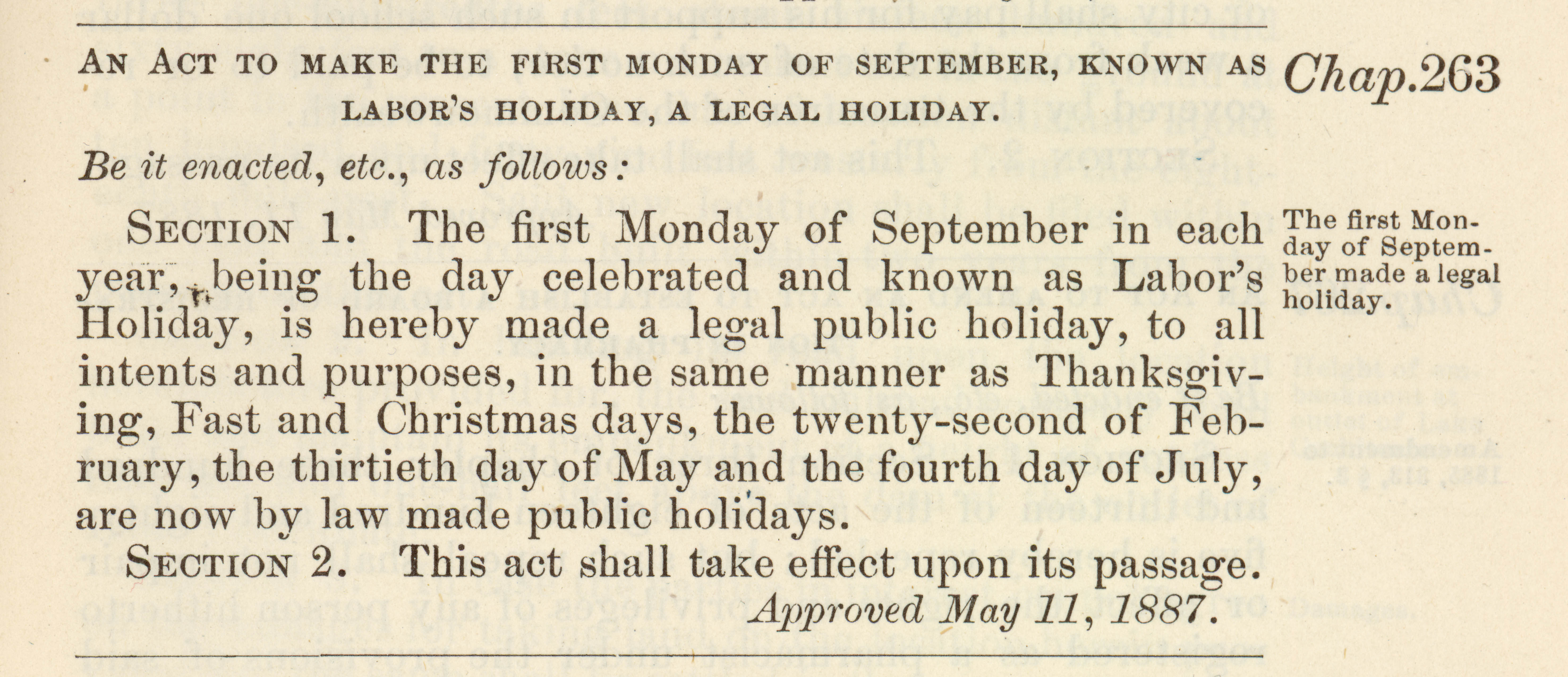
Below is a detail image from Acts and Resolves Passed by the General Court of Massachusetts in the Year 1887 (Boston: Wright & Potter Printing Co., 1887) showing the approval of the act to make “Labor’s Holiday” a legal holiday. 

Detail of page from Acts & Resolves Passed by the General Court of Massachusetts featuring the text of the law making Labor Day a holiday.


In 1897 Congress passed an act making Labor Day a federal holiday.  

Stephen Greenleaf Bulfinch Diary, Post 3

By Elaine Grublin

The following excerpt is from the diary of Stephen Greenleaf Bulfinch.

Monday, 14 January 1861

Instead of three of the cabinet, one alone, Mr. Floyd of Virginia, Sec. of War, resigned just previous to my last date; Mr. Cass having honorably retired before. Mr. Floyd lies under heavy suspicions of having betrayed to the secessionists the national forts and arms. Since then, Mississippi, Florida, & I think Alabama have passed secession ordinances; – a collision has been with difficulty avoided at Charleston by the prudence & manliness of Major Anderson, the state forces having fired on a steamer with troops & provisions for his relief. His conduct in protecting instead of fighting seems to have showed the violence of the rebels; and they appear to be negotiating. Meanwhile, Senator Seward, the destined Secretary of State of the next President, has made a noble, conciliatory speech, and brought forward a proposition which I hope may relieve the distracted country. The President appears to act more energetically, and another secessionist has left the cabinet, – Mr. Thoussour, Sec. of the Interior. This makes the fourth of that board who has left his place; – three of them, Cobb, Floyd, and Thompson, “for their country’s good.”

Next week look for SGB’s entry, dated 16 April 1861.  There he declares “Our country is engaged in civil war” and summarizes the events that had transpired over the course of this three month absence from his diary. 

An Educational Summer @ MHS

By Kathleen Barker

More than 500 teachers from across the United States (and Dubai!) will return to school this fall equipped with classroom resources obtained through various workshops at the Massachusetts Historical Society. Educators, as well as a few curious adults, took part in fourteen different workshops offered at the MHS this summer. These lucky participants investigated documents related to a vast array of intriguing characters, events, and issues. Topics on offer included the dilemmas of colonial governor Thomas Hutchinson, daily life during the Siege of Boston, the ratification of the United States Constitution in Massachusetts, women in colonial Boston, and Irish American and African American participation in the Union Army during the Civil War. 

Photograph of educators participating in an MHS workshop at the Forbes House MuseumWhenever possible, education programs at MHS provide educators with opportunities to explore landscapes related to the Society’s documents and artifacts. We were fortunate to take several field trips this summer to locales in Boston and beyond. Participants in our Thomas Hutchinson workshop spent a beautiful summer day exploring the Forbes House Museum and other Hutchinson memorabilia in Milton. (Pictured on left.) While learning about the Siege of Boston, other educators took a tour of Loyalist Cambridge with J.L. Bell that included a stop at Longfellow House – Washington’s Headquarters. Where better to see the Constitution in action than at a courthouse? Photograph of educators participating in an MHS workshop at  the John Adams Courthouse in Boston MAOur Constitution workshop participants were able to discuss the ratification process in the elegant surroundings of Boston’s John Adams Courthouse, home of the Supreme Judicial Court of Massachusetts. (Pictured on right.) Of course, not all of our excursions were land-based. In early August, twenty teachers from the Boston area participated in a workshop at Fort Warren on Georges Island, part of Boston Harbor Islands National Recreation Area.

Although the majority of our teacher workshops take place in the summer months, the MHS offers occasional workshops throughout the academic year. For a list of upcoming programs specifically for teachers, visit our events calendar or contact the Education Department.

This Week @ MHS

By Elaine Grublin

The final week before Labor Day looks like a quiet one at the MHS. There are no scheduled programs this week, but there are a couple of noteworthy items.

Please note that the library will be closed Saturday, 3 September through Monday, 5 September in observance of the Labor Day holiday. 

Also, Thursday, 1 August is the last Thursday evening that the library will be open until 7:45 PM. Starting on 6 September the library’s “late night” moves to Tuesday evening. The library will be open 9:00 AM to 7:45 PM on Tuesdays, and will close at 4:45 PM on all other weekdays and at 4:00 PM on Saturdays.  This is a permanent change.   

Finally, there are only three weeks left to view the exhibition History Drawn with Light: Early Photographs from the Collections of the Massachusetts Historical Society.  The exhibition is open Monday through Saturday, 10:00 AM to 4:00 PM. 

Stephen Greenleaf Bulfinch Diary, Post 2

By Elaine Grublin

The following excerpt is from the diary of Stephen Greenleaf Bulfinch.

Monday, 31 December 1860

I have much to record at the close of the year; and my record must be a sad one, in regard to public and private affairs alike, though hope looks through where faith points.

First of public affairs. South Carolina precipitately declared herself independent. The President, weakly listening to a cabinet whom charity can hardly acquit of treachery, refused to reinforce the week garrison, (less than 10 men) of Fort Moultrie, and pledged himself not to do so, on certain promises from the secessionists not to attack the fort. Gen. Cass, Sec. of State resigned in disgust at such conduct. Mr. Cobb, Sec. of Treasury resigned, leaving the Treasury empty, and went South to preach secession. Major Anderson, the Commander at Fort Moultrie, bravely took the responsibility of evacuating it, to place himself in the stronger Fort Sumter. S. C. demands that he be censured for this. I hear today that the President, after hesitation, has refused to obey this order, that three members of the Cabinet have resigned in consequence, a good riddance, and that Carolina which had already occupied Forts Moultrie and Pickney, has taken a revenue cutter of the U.S. If so, the new year must begin with a Civil War; an awful necessity, but ‘from this nettle, danger, we must pluck this flower, safety.’ God defend the right!

Meantime in Congress a conciliatory proposition has been made by Mr. Charles Francis Adams, and seems likely to be accepted generally. I hope, more than I did yesterday, for our greatest danger seemed to me to be from imbecility if not treachery at Washington, which would encourage state after state to commit itself to extreme measures. Yesterday, I kept by anticipation, in my afternoon services, the fast which the president had appointed for Friday next.

Be sure to check back next week for SGB’s next post, dated 14 January 1861, in which he corrects facts mistated in this post and reflects on the growing seccession crises.

What, Exactly, is an MHS “Brown-Bag” Lunch?

By Kate Viens

It is sometimes said that the MHS is “a genteel society.” Perhaps it’s our quiet customs, steeped in tradition. So, what are these hour-long events called “brown bag lunches”? Can one really bring food into the MHS, and upstairs, no less? Do presenters really deliver programs to a crowd munching on pretzels and carrot sticks?

The answer is “yes”! Think of the brown-bags as a working lunch for scholars, with you and I encouraged to join in and take the conversation in new directions. Many organizations offer brown-bag lunchtime talks, but at the MHS, they’re the epitome of “historical tradition meets modern scholarship.” 

Programs take place at the MHS around the oval table in the 19th-century gentleman’s library of Thomas Dowse. Participants settle into massive mahogany and leather armchairs, unpack their chicken Caesar wraps, and begin to introduce themselves: a scholar from Johns Hopkins, a neighborhood resident, a graduate student from Berkeley, an MHS staff member… The program begins as the presenter describes his or her research in the MHS collections, following which, all are welcome to ask questions and comment.  

The MHS offers a brown-bag lunch program on the first Wednesday of every month, with others scheduled during the year. Lunches begin at noon and end promptly at one o’clock, and the MHS provides an assortment of soft drinks and coffee. 

On September 7, Laurie Ellen Pazzano will describe her research on “Peace field: 1788–1818, The New England Farm of John & Abigail Adams.” Laurie is a student of the Landscape Institute of the Boston Architectural College/Arnold Arboretum of Harvard University. 

On September 14, Anthony Antonucci will discuss his work, “Americans and the Mezzogiorno: United States Relations with the Regno delle Due Sicilie from Thomas Jefferson to Herman Melville, 1783-1861.” Anthony has just spent the year as a Fulbright Scholar in Italy and is earning his degree at the University of Connecticut. 

If you can make the time to join us, we would love to see you at these or future programs!


This Week @ MHS

By Elaine Grublin

Today, 22 August, at noon join us in the Dowse Library for a brown-bag lunch presented by Jennifer Egloff of New York University.  Jennifer will present her project “Popular Numeracy in Early Modern England and British North America” before taking questions and comments from all attendees. 

On Saturday, 27 August, join us for the 90-minute building tour The History and Collections of the MHS.  The tour, which is free and open to the public, starts at 10:00 AM and departs from the front lobby. 


The Civil War and Citizenship @ Fort Warren

By Kathleen Barker

On 13 August 2011, members of the Education Department spent a beautiful day on Georges Island, part of the Boston Harbor Islands National Recreation Area.

Our day began with an exploration of Fort Warren, a National Historic Landmark built between 1834 and 1860.  Thanks to its strategic location overlooking the shipping channel into Boston’s inner harbor, the fort became a crucial part of Boston’s coastal defense plan during the Civil War. Fort Warren also served as a recruiting and training camp for Massachusetts regiments of the Union Army, as well as a Confederate prisoner-of-war camp. The first prisoners of war, including 155 political prisoners and over 600 military prisoners, arrived in October 1861. Perhaps the most famous Civil War prisoner held at Fort Warren was Alexander H. Stephens, Vice-President of the Confederacy, who was held there from 25 May – 13 October 1865. Enthusiastic visitors can still take a peek into the cell occupied by Stephens during his stay on the island.  Other interesting nooks and crannies to explore include the fort’s bakery, the old hospital, and a powder magazine. Brave souls can also explore the dark arch (Bastion A), a former storage area and recreation hall full of mysterious rooms and dim corners best explored by flashlight!

In addition to roaming the fort, we also enjoyed a fantastic talk by Dr. Christian Samito, a practicing lawyer and a faculty member at Boston University School of Law, where he teaches courses on the legal history of the Civil War and Reconstruction eras. Education staff members have been working with Chris throughout the summer on a series of public programs and teacher workshops related to issues of citizenship and Civil War military service. During this particular talk, which was co-sponsored by the MHS, Chris discussed how African American and Irish American soldiers influenced the modern vision of national citizenship that developed during the Civil War era. By serving in the Union Army, African Americans and Irish Americans demonstrated their loyalty to the United States and strengthened their American identity. While their experiences differed greatly, both groups cited their participation in Union efforts as they advocated for the expansion of citizenship rights after 1865. In the years following the war’s end, African Americans gained access to legal and political processes from which they had previously been excluded on the basis of race, and Irish Americans helped to cement recognition of their full citizenship through naturalization. For more information about this topic, pick up a copy of Chris’s recent book, Becoming American under Fire: Irish Americans, African Americans, and the Politics of Citizenship during the Civil War Era, published by Cornell University Press.

To learn more about Boston and Fort Warren’s role as a site of diplomatic intrigue, join MHS staff members on Georges Island at 1:45 P.M. on Saturday, September 17th, when we present “The Trent Affair.” In the fall of 1861, Jefferson Davis sent diplomats James Mason of Virginia and John Slidell of Louisiana to Europe seeking support and recognition for the Confederacy. Eluding the Union blockade, the Southerners reached Cuba, where they boarded a British mail steamer, the Trent, for passage across the Atlantic Ocean. On 8 November 1861, the ship was seized and its Confederate diplomats imprisoned at Fort Warren.  MHS Education and Library staff members will discuss the details of the event; Mason, Slidell and prisoner life at Fort Warren; and the important role the Trent Affair played in Anglo-American relations. We hope to see you there!

This event will take place on Georges Island. For information about ferry tickets and schedules, please visit the Boston Harbor Islands Partnership website.