Paul Revere’s Ride

By Elaine Grublin

A recent news story has resulted in renewed interest in Paul Revere’s famous ride to Lexington, Massachusetts on the night of 18 April 1775.  Within our collections the MHS holds three accounts of the evening’s events, all written by Revere.  Two of the accounts are a draft and fair copy of a deposition likely prepared for the Provisional Congress in 1775, shortly after the events occurred. The third document is a letter written by Revere to Jeremy Belknap, founder of the MHS, circa 1798, in which Revere offers a detailed description and some reflection on the evening’s events. 

Paul Revere’s deposition, draft, circa 1775

Paul Revere’s deposition, fair copy, circa 1775

Letter from Paul Revere to Jeremy Belknap, circa 1798 

In addition to the documents listed above the MHS holds a large collection of Revere family papers – spanning several generations – which is available to researchers in our reading room.  A guide to the collection is available here.

This Week @ MHS

By Elaine Grublin

This week the MHS offers two engaging brown-bag lunch programs.  Brown-bag lunches are free and open to the public.  Typically there is a twenty to twenty-five minute presentation, followed by an open discussion of the topic at hand.  You bring your lunch, the MHS provides beverages.

On Wednesday, 8 June, at noon current Ruth R & Alyson R. Miller Fellow Nora Doyle, University of North Carolina at Chapel Hill, presents her research “‘A Higher Place in the Scale of Being’: The Maternal Body in America, 1750-1850.” 

On Friday, 10 June, also at noon New England Regional Fellowship Consortium fellow Carrie Hyde, Rutgers University, presents her research “Alienable Rights.”

Also, the current exhibition History Drawn with Light has been extended through 30 June.  If you have not had a chance to visit, or if you would like to visit again, be sure to make time in June to come to the MHS. 

Finally, the Saturday building tour The History and Collections of the MHS returns this week.  Join one of our docents for a 90 minute tour starting from the front lobby at 10:00 AM on 11 June.   

Tornado Strikes Worcester County in 1953

By Nancy Heywood

The devastation caused by the tornadoes that touched down in Springfield, Monson, and other Massachusetts towns on Wednesday (June 1st) is sobering. The damage is substantial–several fatalities, many injuries, buildings and property utterly destroyed, and widespread power outages.

The staff of the Massachusetts Historical Society offers our condolences to those who have suffered losses and hope recovery efforts proceed smoothly for all in the affected communities.

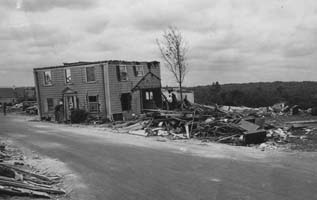
Thankfully, tornadoes are relatively rare in New England but the events of this week are not entirely unprecedented. The tornado that touched down in Worcester County, Massachusetts on 9 June 1953 killed 94 people, injured more than 1,000, and damaged 4,000 buildings. The Massachusetts Historical Society holds an album containing 72 photographs of the Worcester tornado taken by Alfred K. Schroeder. The images depict damage to cars, houses, and other town buildings. Several of these photographs were used in a segment that aired on a local television station in 2003 about the 50th commemoration of the tornado and are available for viewing on the MHS website:

Damage to Assumption College from Worcester tornado

Girl in Kitchen of house damaged by Worcester tornado 

Car in tree after Worcester tornado

Damage to neighborhood from Worcester tornado

Damage and house on road from Worcester tornado

Renewed Interest in Harvard’s First Wampanoag Students

By Anna J. Cook

The Boston Globe recently ran an article about Harvard student Tiffany Smalley (class of 2011), the first member of the Wampanoag tribe to graduate from Harvard since 1665. Smalley’s graduation, has drawn renewed attention to her predecessors Caleb Cheeshahteaumuck and Joel Iacommes, who attended Harvard in the 1660s. Cheeshahteaumuck graduated in 1665, while Iacommes died in a shipwreck shortly before receiving his degree. Today, Iacommes will be awarded a posthumous degree, after a delay of 346 years.

Little is known about either of these men. According to the entry for Cheeshahteaumuck in volume 2 of Sibley’s Harvard Graduates, both men were from Martha’s Vineyard and were likely converts to Christianity. Daniel Gookin of the Society in London for Propagating the Gospel, which sponsored the education of Wampanoag students, wrote of Cheeshahteaumuck and Iacommes:

I remember but only two of them all [the Wampanoag students], that lived in the college at Cambridge; the one named Joel [son of Hiacommes], the other, Caleb … These two were hopeful young men, especially Joel, being so ripe in learning, that he should, within a few months, have taken his first degree of bachelor of art in college … He was a good scholar and a pious man, as I judge. I knew him well; for he lived and was taught in the same town where I dwell. I observed him for several years, after he was grown to years of discretion, to be not only a diligent student, but an attentive hearer of God’s word; diligently writing the sermons, and frequenting lectures; grave and sober in his conversation.

About Cheeshahteaumuck, who survived until graduation, Sibley’s can offer little more insight. He succumbed in 1666 to consumption, an illness that was apparently common among the Wampanoag who had been sent from home to study. He must have been sickly even during his tenure as a student, as he was sent to a doctor soon after graduation and died within the year.

Hopefully there will be fewer than 346 years between Smalley’s graduation and the next matriculation at Harvard of a Wampanoag student.

“Houses of Ill Fame” in Boston, 1907-1910: A Police Report

By Anna J. Cook

A graduate student doing research on early social work and “delinquent” girls recently reviewed a publication in our collection titled A Record of the Enforcement of the Laws Against Sexual Immorality Since December 1, 1907 as Contained in the Information relating thereto Embodied in the Reports to the Governor of Massachusetts made Annually by the Police Commissioner for the City of Boston (City of Boston: Printing Department, [1910?]). The report compiles data on police activity between 1907 and 1910 to contain “public and semipublic sexual immorality” in the city of Boston.  “Total extinction” of immorality “cannot be hoped for, can hardly be imagined; but effectual restraint can be applied,” wrote Police Commissioner Stephen O’Meara in his introduction to the report.

Attempts at such “restraint” are what the report documents. For example, the report offers a table showing the number of “houses of ill fame” against which charges were brought (between 1879 and 1908, the number fluctuated from a low of 19 to a high of 114 annually) and enumerates how the “keepers” of these houses were punished. Most common was a fine of $50.00; two, however, were imprisoned and seven sent to a “house of correction” for one year.

“Night walkers” (women who sold sex on the street) were similarly rounded up and fined or confined in prisons or correction facilities. Notable for historians is the data on the sex workers that the author of the report believed was relevant to include. They provided tables showing the birthplace and age of women who had been found in brothels and who had been found working on the street, as well as detailing the punishments meted out. Specifically, they seem interested in noting the number of women who are native U.S. rather than foreign-born residents. Of the 375 women and girls arrested on the street (no mention is made of male prostitutes), 266 were from the United States while the remaining 109 had been born 14 other nations, all European countries with the exception of Canada and Russia. Their age ranged from sixteen to “above 40.” In addition, the police also arrested 46 women and girls who, “though conducting themselves in an immoral manner on the streets, were in most cases hardly more than delinquent or wayward children,” most often returned to their parents or placed on probation.

The report also includes a section on public fears surrounding “white slavery,” cautioning that “the transition from a virtuous life to a life devoted wholly or in part to mercenary immorality … is rarely sudden.” Women and girls, rather than being coerced, instead found themselves lured into “mercenary immorality” for a variety of reasons, ranging from lack of religious training to poverty to exposure to “flashy public entertainments and reading matter which rouse their bad instincts.” (Probably reading this report is bad for me!)

This report is an intriguing example of the intersection of law enforcement and the emerging fields of social work in the early 1900s. The report, and other early 20th century publications on similar topics, can be viewed in our library during our business hours.

This Week @ MHS

By Elaine Grublin

With the Memorial Day holiday this coming weekend, the MHS will be closed on Saturday, 28 May and Monday, 30 May.  As a result of the Saturday closure, there will be no building tour this coming weekend.  The tour will return on Saturday, 4 June.  And do not forget that time is running out for our current exhibition, History Drawn with Light.  The exhibition closes on 4 June, and with the holiday closures there are only nine days left to come in and view it.  So plan on stopping in this week. 

Also, an event that is on the horizon, although not happening this week, is a one day conference Off the Record: Telling Lives of People Hidden in Plain Sight.  The conference, co-sponsered by the MHS along with Mass Humanities, the University of Massachusetts Amherst Program in Public History, and the Joseph P. Healey Library at the University of Massachusetts Boston, takes place on Monday, June 6 at the Hogan Campus Center, College of the Holy Cross in Worcester. Participants must register for the conference and pay a registration fee of $65.00. 

A New Collection Guide for the Charitable Irish Society Records

By Susan Martin

Last year, the Massachusetts Historical Society received a grant to process the records of the Charitable Irish Society of Boston. Thanks to that grant, this popular collection has now been fully arranged and described, and a guide is available online.

The Charitable Irish Society, an organization that still operates today, was founded in 1737 by a group of prominent Irish businessmen in Boston to provide charitable assistance to Irish immigrants in the city. In early years this assistance consisted largely of loans and help finding work. Today the organization also provides information about employment & housing, promotes the study of Irish history, honors the contributions of the Irish, and actively engages in political issues affecting Irish Americans. Though the papers of this organization have been used by many researchers in their partially processed state since they were first given to the MHS over 30 years ago, a more thorough processing of any collection often uncovers hidden gems. The Charitable Irish Society records were no exception.

Some of the interesting discoveries include:

 1. Seven years of reports (1910-1917) by immigration agent Julia C. Hayes describing specific cases of Irish immigrants, mostly girls and women, looking for work and/or relatives in the United States. Hayes met them as they disembarked at the Boston docks. Her reports describe the immigrants’ home lives, their difficulties finding work, even some deportations. Here’s an excerpt from Nov. 1914:

While visiting the Immigration Office the agent [that is, Hayes herself] saw an old case in the detention room, a girl who had been followed up for a time about a year ago….The girl had a bad reputation at the factory where she had been employed and had succeeded in getting herself in the newspapers. She was taken from a questionable house some weeks ago and will probably be deported as a young woman of bad character.

 The reports are a fascinating slice of social history. For a great description of this port assistance program and the work of Julia C. Hayes, see American Catholic Lay Groups and Transatlantic Social Reform in the Progressive Era, by Deirdre M. Moloney (2002), p. 102-109.

 2. A volume of records of the Young Catholics’ Friend Society (1835-1842) containing detailed minutes and reports on the organization’s work running a Sunday School for boys and distributing clothes to the poor. The volume was originally attributed to another organization, the Roman Catholic Youth’s Society, but those records make up only the first few pages.

 3. Papers related to the Irish potato famine, including a list of Wrentham, Mass. citizens who contributed money “for the relief of the Starving population of Ireland” (8 Mar. 1847) and a certificate appointing Captain Douglas William Parish Labalmondiere inspector under the Irish Poor Law (2 Mar. 1849), signed by George William Frederick, Earl of Clarendon.

 4. Correspondence from many notable people, including Theodore Roosevelt, Henry Cabot Lodge, Herbert Hoover, Alfred E. Smith, Helen H. Taft, Franklin Roosevelt, and Leverett Saltonstall, who all wrote to the Charitable Irish Society between 1910 and 1939. One of the early record books also contains a copy of a long letter by Theodore Roosevelt (6 Nov. 1908) about the intersection of religion and politics. In it, Roosevelt writes:

 I believe that this republic will endure for many centuries. If so, there will doubtless be among its Presidents Protestants and Catholics, and very probably at some time, Jews. I have consistently tried while President to act in relation to my fellow Americans of Catholic faith as I hope that any future President who happens to be a Catholic will act toward his fellow Americans of Protestant faith. Had I followed any other course I should have felt that I was unfit to represent the American people.

 5. Some papers and printed matter related to Ireland’s struggle for independence, including a typewritten memorandum by republican leader Eamon de Valera ordering a ceasefire after the Irish Civil War of 1922-1923. The memo, dated Sep. 1923, is written on the letterhead of the Irish Republican Army and reads, in part:

Do not let sorrow overwhelm you. Your efforts and the sacrifices of your dead comrades in this forlorn hope will surely bear fruit….Seven years of intense efforts have exhausted our people….Give them a little time and you will yet see them recover and rally again to the standard. They will then quickly discover who have been selfless and who selfish—who have spoken the truth and who falsehood.

If your interest is piqued, and you would like to view the papers in person, you can plan a visit to the MHS library during our business hours or contact our reference librarian.   

Researcher Hopes to Write the Autobiography John Quincy Adams “Never had Time to Write.”

By Anna Cook

For the past six weeks, one of the digital microfilm readers in our library has been occupied by a researcher working his way through the microfilm edition of the Adams Family Papers. He is painstakingly transcribing passages from the handwritten correspondence of John Quincy Adams (JQA) in preparation for an intellectual biography of the man who witnessed two generations worth of political events play out on a world stage.

As the @JQAdams_MHS Twitter project highlights, John Quincy Adams was an obsessive chronicler of events in his own life and the global political networks in which he moved. Our dedicated researcher has set out to document JQA’s life as an observer of the world. De-centering the biographical subject, he hopes to write an outward-looking biography, “the autobiography [JQA] never had time to write” because he was so busy keeping diaries, writing letters, and otherwise documenting the events and interactions he took part in.

When asked for some of his initial observations, our dedicated researcher points to JQA’s antislavery agitation, which made him an outlier in his generation of Americans. The biographer suggests, echoing JQA’s own penchant for Biblical metaphors, that John Quincy Adams was a “John the Baptist,” helping prepare the way for the abolition of slavery decades after his death in 1848.

We wish our researcher the best of luck with his work and look forward to the biographical study to come.

This Week @ MHS

By Elaine Grublin

This week plan to spend your lunch hour at the MHS. On both Tuesday and Wednesday we offer one-hour lunch time programs.  Both programs are free and open to the public. You bring the lunch, we provide the beverages. 

Tuesday, 17 May at 12:00 PM join us for the final installment of the What Does Massachusetts Have to do With…. mini-course.  Kate Viens and Conrad E. Wright from the MHS Research Department will share their insights on What does Massachusetts have to do with … Columbus Day?.

Wednesday, 18 May at 12:00 PM current African American Studies Fellow Richard Boles of George Washington University presents his research Africans and Indians in Massachusetts Churches, 1730-1850 at a brown-bag lunch program.

On Saturday, 21 May the weekly building tour The History and Collections of the MHS departs the lobby at 10:00 AM.

New on our Shelves: “Revered Commander, Maligned General” by Michael Shay

By Tracy Potter

Continuing our blog series on recent publications based on research conducted at the MHS, I offer a look at Michael Shay’s newest publication, Revered Commander, Maligned General: The Life of Clarence Ransom Edwards, 1859-1931 (Columbia: University of Missouri Press, 2011).

During the summers of 2008 and 2009 Shay and his wife Marilyn visited the MHS and thoroughly examined the extensive (43 document boxes, 10 volumes) Clarence Ransom Edwards Papers.  In large part the result of that work, Revered Commander, Maligned General is the first in-depth full-length biography of Edwards, and it is the only substantial work written about Edwards since the early 20th century. 

Edwards, a career military man, was trained at Brooks Military Academy in Ohio and at West Point in New York.  In 1899 he departed the United States as a major to serve in the Philippines during the Spanish American War. In 1900, back in the United States, Edwards, now a lieutenant colonel, was named chief of the Division of Customs and Insular Affairs (later the Bureau of Insular Affairs) in the War Department.  By 1915 Brigadier General Edwards was responsible for planning and organizing the defense of the Panama Canal Zone, and with the start of World War One he was given the command of the 26th (“Yankee”) Division of the New England National Guard with orders to fight in France.  It was on the front in France that a conflict between Edwards and his superior, General John J. Pershing, developed, ending with Edwards’ disgraceful dismissal just a few weeks before the end of the war. 

In this volume Shay, who previously authored The Yankee Division in The First World War: In The Highest Tradition (College Station: Texas A&M University Press,  2008), provides a complete view of Edwards’ life and military career, shedding new light on his relationship with Pershing and the events leading up to his dismissal in 1918.

Revered Commander, Maligned General: The Life of Clarence Ransom Edwards, 1859-1931 is now on sale through the University of Missouri Press. Visitors to the MHS library can peruse our copy, currently on display in the library. Ask one of our friendly library staff members for assistance.