This Week @ MHS

By Elaine Grublin

We have another week of exciting events happening both at the MHS and at Old South Meeting House. 

Tuesday, 22 March, at 6:00 PM, Walt Woodward, State Historian of Connecticut presents a talk focused on his recent publication Prospero’s America: John Winthrop, Jr., Alchemy, and the Creation of New England Culture, 1606-1676. A pre-event reception begins at 5:30 PM.

And again on Thursday, 24 March, we have two events.  The daytime event, which begins at 12:15 PM, takes place at Old South Meeting House.  This lunchtime lecture features Jayne Gordon and Kathleen Barker of the Massachusetts Historical Society presenting Grandfathers; Grandsons: Parkers, Emersons and the Legacy of RevolutionThis lecture is the fourth installment of the A Nation Born: The Battles of Lexington and Concord series co-sponsered by Old South Meeting House. 

On Thursday evening at 5:15, you can join us back at 1154 Boylston Street as Mary Anne A. Trasciatti, Hofstra University, presenting her paper “Athens or Anarchy? Soapbox Oratory and the Early Twentieth-Century American City” as part of the Boston Immigration and Urban History Seminar.  Michael Willrich, Brandeis University, will give the comment. 

Brian Gratton Presents @ Brown Bag Lunch Talk

By Anna J. Cook

On Wednesday, March 16, short-term fellow Brian Gratton presented the preliminary results of his research here at the MHS, working with the papers of Massachusetts politician Henry Cabot Lodge (1850-1924). Dr. Gratton is a Professor of history at Arizona State University, specializing in the history of immigration and ethnicity in the United States, Latin America, and Europe. His work at the MHS explores Lodge’s role within the Republican party in late-nineteenth and early-twentieth century debates about race and immigration restriction.

Dr. Gratton used the formal portion of his talk to describe how the rhetoric of immigration restriction in Lodge’s political and personal writing (and speaking) shifted between the late-1880s and the mid-1890s from a near-total silence on the question of race, which Gratton describes as “not eerie — scary! … [an] almost pure form of political correctness,” to an argument for immigration restriction that relies on “good” and “bad” immigrants based on race and ethnicity.

During the late 1880s, Lodge relied on a primarily economic rationale for immigration restriction, attempting to persuade working-class constituents in Massachusetts that immigration restriction, like tariffs on imported goods, protected their jobs and their wages. Among working class voters, even those who had themselves immigrated or were the children of immigrants, the economic justification for immigration restriction had some limited success. However, the economic frame became problematic because it offered politicians, and their supporters, no way to differentiate between “good” and “bad” immigrants, and ultimately lost them support of those who feared their own ethnic communities would be targeted for restriction.  In the early 1890s, the language shifted subtly to distinguish between groups of immigrants understood to be part of the “founding” or “native” American ethic groups – Anglo-Saxon groups that, with some fancy footwork was amended to include Irish-Americans – and groups of immigrants deemed suspect.  The suspect groups, during this period, would have included Italians, Poles, European Jews, Eastern Europeans, and immigrants from Japan and China.

Dr. Gratton suggest that, on a national scale, the frame shifted from economics to race in stages, whereby first target groups were identified based on their willingness to accept lower wages (at least on its face an economic rationalization), and then gradually the discussion shifted to emphasize the group’s citizenship potential (or lack thereof) and questions of character.  Literacy tests proved a useful way of implementing de facto exclusion by race and ethnicity because the majority of Irish and German immigrants, by the late 1800s, were able to pass the tests, while Southern and Eastern Europeans and Chinese and Japanese immigrants were much less likely to meet the requirements.

Conversation following the presentation focused on the way these shifting discourses concerning race and ethnicity operated within the framework of Massachusetts state politics and on the national stage. Audience members also suggested possible avenues in to discovering the less public version of Lodge’s views on race and ethnicity, perhaps through reading the private writings of family and friends.

If you missed this brown-bag lunch, mark your calendar for April 6, when Dr. Linford Fisher will present “The Land of the Unfree: Africans, Indians, and the Varieties of Slavery and Servitude in Colonial New England.”

MHS Open House: The Coming of the Civil War

By Carol Knauff

1154 Boylston StreetJoin us this Saturday at our Open House as we kick off our commemoration of the sesquicentennial of the Civil War. Marking the 150th anniversary of the beginning of the Civil War–a conflict that changed the course of the nation’s development–the Open House will offer visitors an opportunity to learn more about the Civil War through the Society’s collections, programs, and services.

The Open House will take place from 10:00 AM to 3:00 PM and a variety of activities geared towards the Civil War will be offered throughout the day.

•    At 11:00 AM, visitors are invited to “Discoveries and Methods: Civil War Research at the MHS,” a lively discussion between four different MHS researchers as they share insights and discoveries stemming from their use of the Society’s Civil War resources.
•    At 1:00 PM, Stephen T. Riley Librarian Peter Drummey will present an exhibition talk focused on photographs from the Abolitionist movement and the Civil War.
•    Starting in the front lobby at 10:00 AM, 12:00 PM, and 2:00 PM, tours of the Society’s public rooms will give visitors a taste of the history and collections of the MHS.
•    Visit our newly refurbished gallery to view History Drawn with Light: Early Photographs from the Collections of the Massachusetts Historical Society and its iconic photographs of from the Abolitionist movement together with images of soldiers, camps, and battlefields of the Civil War.
•    “‘Oil and water are not more contrary…than North and South’: Three Generations of Adamses on Slavery and Sectionalism” will be on display along with a presentation of on-going Civil War projects at the MHS.
•    Enjoy refreshments throughout the day and visit our information table to learn about MHS resources, upcoming programs, and membership.

For more information e-mail rsvp@masshist.org.

This Week @ MHS

By Elaine Grublin

If you are looking for some midday excitement, plan on joining us for one of our lunchtime programs this week. And do not forget that Saturday, we have a full day of events planned for the MHS open house.

Tuesday, 15 March  at 12:00 PM, the Collection Services Department presents the next installment in our mini-course series. Bring your lunch and learn “What does Massachusetts have to do with … Tahiti, Pirates, and Graham Crackers?” Beverages will be provided.  

Wednesday, 16 March at 12:00 PM Twentieth-Century History Fellowship recipient Brian Gratton, Arizona State University, presents his research “Henry Cabot Lodge and the Politics of Immigration Restriction” at a brown bag lunch program. 

We have another offsite program on Thursday, March 17th.  At 12:15,  J.L. Bell, author of the blog Boston 1775, moderates the panel discussion “Where Did It Begin?” a look at the question of whether the Revolution began in Lexington or Concord.  This programs is part of the A Nation Born: The Battles of Lexington and Concord series co-sponsered by the Old South Meeting House, and will take place at Old South.

And on Saturday, bring the family, the neighbors, and all other history lovers you know to 1154 Boylston Street for the annual MHS Spring Open House: the Coming of the Civil War.  The building will be open to the public from 10:00 AM to 3:00PM, with tours, discussion panels, and lectures planned throughout the day.  See a schedule of the day’s events here.

Welcome Short-Term Fellow Brian Gratton

By Anna J. Cook

This week, the MHS staff welcomes Brian Gratton, Professor of History at Arizona State University, as the recipient of our 2010-2011 Twentieth-Century History Fellowship. Dr. Gratton, who received his Ph.D. in 1980 from Boston University, studies immigration and ethnicity in the United States, Latin America, and Europe. His recent publications and research focus on the experience of immigrant elders, 1880 to the present, and on the teaching of U.S. history with a particular emphasis on the American Southwest.

Dr. Gratton’s MHS fellowship project, titled “Henry Cabot Lodge and the Politics of Immigration Restriction,” examines the role of Massachusetts historian and politician Henry Cabot Lodge (1850-1924) in Progressive-era battles over legal restrictions on immigration. Lodge fought for three decades in support immigration restriction, a goal finally realized in the Emergency Quota Act of 1921, which dramatically reduced the number of immigrants streaming into the United States. Using Lodge as an entry-point for reconstructing the late-nineteenth and early-twentieth century debates about immigration, Gratton hopes to better illuminate the political thinking among Republicans, Lodge’s party, on race and ethnicity in politics during this period. He will be working primarily with the Henry Cabot Lodge papers.

Dr. Gratton will be giving a brown bag lunch talk about his research at the MHS on Wednesday 16 March from 12:00-1:00pm. The event is free and open to the public.

The MHS staff welcomes Dr. Gratton back to Boston and wishes him a fruitful research visit.

“What does Massachusetts have to do with … the French Revolution?”: Brown Bag Lunch Talk

By Anna J. Cook

On Tuesday, 1 March, Sara Martin and Sara Sikes of the Adams Papers gave a presentation on the Adams family’s perspective of the French Revolution, as chronicled in their correspondence. During that period of upheaval in France (the 1780s and 1790s) the Adams’ network of family and friends extended up and down the Eastern United States and across the Atlantic in both Britain and on the European continent. Abigail (Nabby) Adams Smith was living with her family in London; John Quincy and Thomas Boylston Adams were in The Hague; and Charles Adams spent considerable time with his father, John Adams, in Philadelphia where John was serving as Vice President in the Washington administration. The correspondence during this period is particularly rich as the family endeavored to keep in touch with one another, across geographic distance.

Sara Martin and Sara Sikes observed how the Adams family privileged first-hand accounts of the turmoil over published newspaper reports, despite the fact that personal letters often took months to travel across the Atlantic – at times not arriving at all. Nabby would write home to her parents describing the first-hand accounts of friends in London who had been in Paris during the Terror, while Abigail wrote to her daughter about the public support in the United States for the revolutionaries. Members of the Adams family publically and privately expressed their disapproval of the way in which the French Revolution so quickly devolved into violence. In reflecting back upon both the American and French revolutions in later years, John Adams wrote to his friend Benjamin Rush, “Have I not been employed in mischief all of my days?”

Discussion following the presentation centered on the question of differences between the French Revolution and the American Revolution. Specifically, participants wondered what about the French Revolution was different enough from the American Revolution that one led to continued violence and ultimate failure of the revolutionaries while the other succeeded in establishing a viable government following the war with England. It was suggested by several present that a rebellion by colonists against the metropole is fundamentally different than an uprising of citizens against an established government in their own nation.

“What does Massachusetts have to do with … the French Revolution?” was part of an ongoing series highlighting collections at the MHS that contain material on unexpected topics. The next installment will take place on Tuesday, March 15, at 12:00pm and is titled: What does Massachusetts have to do with … Tahiti, Pirates, and Graham Crackers? The event is free and open to the public. Bring your lunch; beverages will be provided.

Spotlight on Collections: Lodge Papers, Part IV

By Tracy Potter

Last time in Spotlight on Collections, I wrote about Henry Cabot Lodge’s (HCL) family, education, and literary and political careers. This week I describe his connections to the MHS and look at the MHS holdings related to his life. 

HCL had many connections to the MHS.  Besides being a good friend of Henry Adams, who was from a long line of politicians and influential members of the MHS, HCL was also a long standing member of the MHS himself.  He spent 48 of his 74 years as a member of the Society.  Elected a member in 1876, HCL attended meetings and other events as a member of the Society while also performing his political duties in the U.S. House of Representatives and in the U.S. Senate. 

In 1915, upon the death of MHS president Charles Francis Adams, brother of HCL’s friend and mentor Henry Adams, the nominating committee and MHS Council nominated HCL to sit as the next president. As was often the case with HCL, he had both supporters and critics within the MHS. This made for a very lively election. Those supporting Lodge eventually won out and elected him president. Although often absent due to his responsibilities as U.S. senator, once elected HCL served as president of the MHS until his death in 1924.

According to the MHS bicentennial history written by Louis Leonard Tucker, after the death of HCL the Lodge family placed his personal papers on deposit at the MHS. Almost four decades later a determined Stephen T. Riley, the Director of the Society from 1957 to 1976, made it his mission to convince the grandson of HCL, Henry Cabot Lodge, Jr. (HCLII), to deed the papers over to the Society to ensure their safety then and in the future. Riley, who was known as an “unrelenting pursuer of his quarry” when it came to acquiring manuscripts, tirelessly pursued HCLII for several years.  In 1969 HCLII relented and signed a deed of gift to the Society for HCL’s papers.     

In total the MHS holds five collections directly related to HCL. The main body of manuscripts is in the Henry Cabot Lodge Papers, 1745-1966 containing 51 cartons and 2 oversize boxes of material. The collection includes personal, official, and family papers focusing on Republican Party politics and American foreign policy. This large collection is stored in an offsite facility. To provide more convenient access and long-term preservation for the manuscript materials the MHS microfilmed the collection (183 reels total) and stores the reels onsite for use by researchers. 

The MHS also holds a collection of eleven boxes (10 reels of microfilm) of correspondence between HCL and his long-time friend Teddy Roosevelt in the Lodge-Roosevelt Correspondence, 1884-1924. HCL published about half of these letters in his book Selections from the Correspondence of Theodore Roosevelt and Henry Cabot Lodge which was completed by his Secretary Charles F. Redmond after his death. Other HCL collections held by the MHS include 2,059 photographs in the Henry Cabot Lodge Photographs, ca. 1860-1945, letters to HCL’s nephew Ellerton James in Letters to Ellerton James, 1850-1924, and letters to HCL’s friend and lawyer William C. Endicott in the Henry Cabot Lodge papers IV, 1887-1933.

For more information about Henry Cabot Lodge’s connection to the Massachusetts Historical Society see:

Lord, Arthur.  “Tribute to Henry Cabot Lodge.” Proceedings of the Massachusetts Historical Society, 58, (1924-1925): 97-99.

Morse, John T., Jr. “Tribute to Henry Cabot Lodge.” Proceedings of the Massachusetts Historical Society, 58, (1924-1925): 99-110.

Tucker, Louis Leonard. The Massachusetts Historical Society: A Bicentennial History, 1791-1991. (Boston: Massachusetts Historical Society, 1996).

Join me on March 23rd when I turn to Henry Cabot Lodge, Jr. and his contributions to history.

 

This Week @ MHS

By Elaine Grublin

This week we have a two events at our 1154 Boylston Street home, and two co-sponsored events at alternate locations. Please note where events are happening as you plan to attend.

Thursday, 10 March, we have two public events. At 12:15 PM join us for a co-sponsored event at Old South Meeting House. Come listen as Jim Hollister, Minute Man National Historical Park, and Emily Murphy, Salem Maritime National Historic Site, present
“Let Us Wait No Longer!” Salem and the Lexington Alarm. And at 5:30 PM Annette Gordon-Reed, author of Pulitzer Prize winning The Hemingses of Monticello, will present her paper “The Hemings Family in the Nineteenth Century” as part of the Boston Seminar on the History of Women and Gender. Nell Irvin Painter, Princeton University, will give the comment. This event will take place at the Schlesinger Library at Harvard University.

Friday, 11 March, we kick off our spring exhibition History Drawn with Light: Early Photographs from the Collections of the Massachusetts Historical Society. The exhibition will be open to the public Monday through Saturday, 1:00 PM to 4:00 PM, from March 11th to June 3rd.

And last but not least, our 90 minute Saturday building tour will begin at 10:00 AM in the front lobby on 12 March.

The Bloody Massacre perpetrated in King Street….

By Elaine Grublin

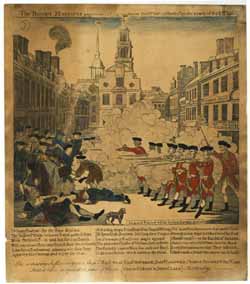
Today marks the 241 anniversary of the events that came to be known as the Boston Massacre.

On our website and in our reading room, you can read contemporary accounts of the events of that day or study visual representations such as Paul Revere’s engraving (based on an original drawing by Peter Pelham) which captures a less than historically accurate view of the event, but speaks volumes about how the event was interpreted for years to come.

 Revere's Massacre

For the hands-on learner, the Bostonian Society is offering a day full of interpretive events at the Old State House, culminating in a re-enactment of the Massacre at 7:00 PM.

Welcome Dan Hinchen, Library Assistant

By Anna J. Cook

It has been a season of change in the Massachusetts Historical Society’s library. On February 23rd, the Library Reader Services staff welcomed yet another new member to our ranks: Library Assistant Dan Hinchen.

Dan is not a complete stranger to the MHS, having served as a reference intern with us in 2009. During his tenure he became skilled at responding to long-distance reference queries, and also began to develop subject guides for our collections – a skill we hope to put to good use in the near future as the library revisits some of its online reference resources.

In 2007, Dan was hired to develop an archives program for the Boston Arts Academy and Fenway High School, where he has served as the “lone arranger” for the past four years. There he established the archives’ policies and procedures and supervises the work of student interns and volunteers. In addition to this position, Dan has worked at the Simmons College Beatley Library and completed a cataloging internship at the ProjectSave Armenian Photographic Archives. In 2010 he earned his Master’s in Library Science at Simmons College Graduate School of Library and Information Science.

We are pleased to welcome Dan as part of our staff, and look forward to working with him as part of our team.