By Jeremy Dibbell
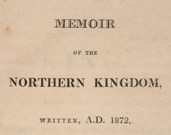 In the Summer 2010 issue of the Journal of the Early Republic I was pleased to find a new, edited version of one of the most fascinating pamphlets published in the early nineteenth century: it’s called Memoir of the Northern Kingdom, Written, A.D. 1872, By the late Rev. Williamson Jahnsenykes, LL.D. and Hon. Member of the Royal American Board of Literature, in six letters to his son, and the imprint reads Quebeck: A.D. 1901. See the full title page here.
The 48-page pamphlet (actually written in 1808 and published at Boston) is a bit hard to describe (and I’m hopeful that a full digital version will be available soon for all to read), but basically it’s a thinly-veiled criticism of the Jefferson Administration’s policies in the form of a counterfactual history of America. As the author tells it, due to the commercial policies of Jefferson the Union came to be dissolved into a French-dominated imperial South, a British/Canadian-controlled New England under a British viceroy, and the Illinois Republick (the last bastion of democratic government in America). In a series of six letters the author “reflects” on the breakup of the United States into these separate fiefdoms.
While the essay is often studied because of its “prediction” of the North-South split, it’s interesting for many other reasons as well, not the least of which is the fascinating level of detail its author goes into when describing the political and social changes that resulted from the conflict between the states during the period of tumult. A phrase immediately sprang out at me as I was reading this time: at the start of the fifth letter, which covers the history of New England, the author writes the following:
“Had that valuable library of domestick history, collected by the friends and associates of Belknap and Minot, survived the troubles of civil war, it would have been needless for me to leave you any hints of the antient history of New England. It was doubtless a politick measure of his Majesty’s lieutentants to suppress also the publication of those patriotick details of history, which could serve only to renew the memory of a different form of government from the present, and of purer times, those those, in which we live.”
Wait a moment, I thought, “that valuable library of domestick history, collected by the friends and associates of Belknap and Minot” – that’s the MHS! Jeremy Belknap and George Richards Minot were two key founders of the Historical Society, and both contributed significantly to the MHS’ early collections.
But who was the author of this curious tract, this Williamson Jahnsenykes? Not surprisingly, that was a pseudonym: he was one Rev. William Jenks (1778-1866), and although he was not yet a member of the MHS when he wrote Memoir of the Northern Kingdom, he was elected to the Society in 1821 (at the same time as Daniel Webster), and served as Librarian from 1823 to 1832.
Jenks graduated from Harvard in 1797, served as a Congregational minister at Bath, Maine and taught Oriental and English literature at Bowdoin College until 1818, when he returned to Boston and opened a school. Jenks was active in the Society for the Religious and Moral Instruction of the Poor, and later took up the pastorship of a church on Green Street, where he preached for nearly a quarter-century. He was a member and officers of the American Antiquarian Society and a founding member of the American Oriental Society. His magnum opus was the Comprenhensive Commentary on the Holy Bible, published in six volumes between 1834 and 1838, but he composed many other works, including a eulogy to James Bowdoin, several memoirs in the MHS Proceedings, and a historical account of the MHS (Collections, 3d Series, Volume VII).
When Jenks died in 1866 he was the second-oldest member of the Historical Society, at the December meeting that year MHS president Robert C. Winthrop remembered Jenks for his services and publications, and makes mention particularly of Memoir of the Northern Kingdom, calling it “a political jeu d’esprit, of no common felicity, written during the party heats which attended the close of Mr. Jefferson’s Presidency, and was designed to portray the danger of a dissolution of the Union, and the overturn of our republican institutions. Meeting our venerable friend in the street, on New-year’s Day, 1863, – after exchanging the salutations of the season, – I told him I had found a copy of a pamphlet bearing this title, among my father’s books; and I ventured to ask him, through that ponderous ear-trumpet, – which was the badge of the only infirmity he had, – whether he was the author of it. He replied, without an instant’s hesitation, that he was.”
Among the MHS collections are Jenks’ diaries and fifty boxes of his papers, so I dug in a little bit to see if I could find any reference to the composition or publication of Memoir of the Northern Kingdom. In a partial letterbook covering the period 1806-1811 I found a particularly exciting letter, written by Jenks to Messrs Farrand, Mallory & Co. of Boston:
“Gentlemen, The inclosed little work is committed to you, in preference to other Booksellers of this town, to be published for your own emolument – if emolument arise from the publication – if not, at your risque.
It is however requested, since the design of it is the public good, that if it should prove sufficiently advantageous to you, & should bring in more, than might be necessary to defray your expenses & give you a comfortable profit, you would, in such case, deposit a sum, of whatever amount beyond $100 you please, with the Selectman of the town of Boston, to be awarded to the writer of the best ‘Essay on the best means of perpetuating the Federal compact of the United States of America.’
As to typographical execution, it is requested to be in a good & neat style, that it may form a large sized duodecimo volume of about, perhaps, 100 pages – paragraphs & lines well distanced, paper & size of type such, as might befit a book from ‘the Royal press at Quebeck.’ Not too costly, however, for a general perusal.
On no account must an item of the title page, or a sentence of the work, be altered. And, Gentlemen, you are requested that, after it be prepared for the bookstore, it may immediately find its way to Washington, Baltimore, Charleston, Philadelphia, New York, Albany, New Haven, Portland, &c. N.B. Orthography Johnsonian.
It hardly needs be added, that all the effect, which the writer expects from this effort of anxious patriotism, depends upon secrecy & suddenness of appearance.
It need not appear but to have come immediately from Canada.
I am, Gentlemen, with respect, Your (at present) unknown humble servant, Pomponius ‘Atticus’*.
P.S. Would it not be well to advertise ‘Messrs &c. expect to receive’ (forsooth, from the printers) ‘in a few days a New Work, entitled ‘Memoir of the Northern Kingdom‘ Quebeck 1901?”
Unfortunately Jenks’ diaries for 1808 aren’t part of the collection (and they aren’t mentioned in any of the other Jenks collections around either, so if anyone knows of them I’d be delighted to hear of it), but we do hold his diary for 1809, and I uncovered an entry there from the day Jenks received the printed copies of his essay. On 18 January, upon receiving copies of the pamphlet in the mail, Jenks writes: “At length my ‘Memoir’ has arrived, & with it the ‘Review.’ I took the package from the office with a palpitating heart, & have read with mingled emotions. I did expect certainly a more detailed notice, but perhaps it is not prudent to bring into too open discussion the questions I had prepared [or proposed?] to handle.” On 21 January he reports that of late his thoughts had been preoccupied with thoughts of poor health, death, and Heaven. “Such were my feelings, views & wishes till my ‘Memoir’ arrived on tuesday & with it the last no. of the Anthology containing a review of it. The reading of these, & the several readings & reflections consequent upon them & connected with them banished from my mind those pious efforts, to which alone I had before attended. The world, literary refutations, scientific labor, & learned research became again interesting.”
Jenks’ efforts were at least somewhat successful. The correspondent who sent Jenks’ copies notes “by the way in several places lately I have heard much said about a northern Kingdom, leads me to believe that this book is not unnoticed.” The pamphlet quickly attracted some attention in Boston: the members of the Anthology Society (precursor to the Boston Athenaeum) had received a copy by the time of their 29 November meeting, when it was assigned to Mr. [William] Tudor for review (which he read to the Society on 13 December). The short review, printed in the December 1808 issue of the Monthly Anthology (pp. 683-684), reads:
“This is a production generated by the temper of the times. The pretended author, whose barbarous name it is too much trouble to copy, undertakes, towards the close of this century, to give an account to his son of the troubles, which had previously taken place in the United States, and which ended by the formation of a Southern and Northern Kingdom, while the middle states constituted a republick. Were we to occupy ourselves in speculations of this kind, we should not be disposed to predict the future fate of the country exactly as the author has done, even if we admitted the notion of the destruction of the present Union. The idea of anticipating the events of futurity, is not new, but this opens a wide field for ingenuity and political sagacity, if it be lawful even to think on the subject. The style of this publication is very good, but it has been too hastily written to preserve more than a momentary existence. The author possesses of affect the candour, which is natural, when treating about the political characters of past times.”
It is advertised (price 25 cents) in several New England newspapers in late November and early December 1808, (Portsmouth NH Gazette on 29 November; Boston Gazette and Independent Chronicle on 5 December; Newburyport Herald and Salem Gazette on 13 December). It is headlined as “Interesting PAMPHLET” in the Boston Repertory of 20 December and as “A Peep into Futurity” in the 27 December Connecticut Herald. By January 1809 copies could be had in Portland, ME and Walpole, NH, and an Albany bookstore advertises its availability in late May. I’m sure a more detailed study of newspapers would be useful in tracking its spread. Unfortunately the Memoir may have met an unfortunate end: the 14 December 1811 issue of the Boston Centinel reports that 532 copies in sheets were to be sold as part of a sheriff’s sale, and what happened to them after that is unknown. At any rate, my supposition is that Messrs. Farrand and Mallory did not end up sponsoring the essay prize Jenks recommended in his letter to them.
In doing a little sleuthing for this post I found a 1942 footnote suggesting that perhaps the manuscript of Jenks’ Memoir was in his papers here at the MHS at that time, but I have not had any luck in locating it thus far (if it’s in there, it’s hiding very well). Nonetheless, I was somewhat surprised to find even the references I did, and am pleased to be able to add a little bit to the story of this interesting work. When I started working on this post it was just going to be about the little oblique reference to the MHS in Jenks’ essay, but, as these things tend to do, the story got much more interesting than that!
* Jenks’ pseudonym in the letter to his publishers, Pomponius Atticus, probably refers to the Roman writer Titus Pomponius Atticus (109-32 BCE)

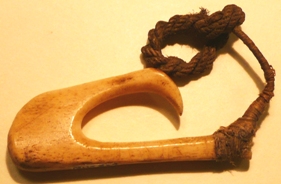 “A Hook, from the Sandwich Islands, made out of a bone of Captain Cook,” received from Mr. Jacob Williams, May 1804. A letter in the MHS Archives from W. Emerson to the Corresponding Secretary reports “The hook which accompanyes [sic] this Note I received from Deacon Jacob Williams, formerly an officer in my church, who requests me to present it in his name to the Historical Society. It was given to him by his son Jacob Williams, who received it from a man, who attended Capt. Derby, who died at Waterloo, one of the Sandwhich Islands, in 1802, and who, (Derby) received it from an indian chief, who said, that the prong of the hook was made of one of the bones of the celebrated navigator, Capt. Cook.” In 1996 the hook was tested by the staff of the Kendall Whaling Museum; they confirmed that it is human bone, but could not narrow it down to the precise original owner.
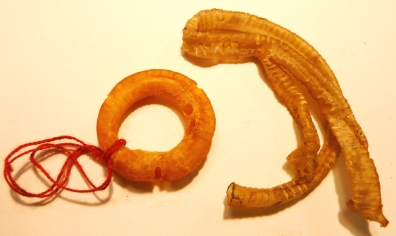 The windpipes of a chicken and a turtle, given by S. Hall of Bridgewater, 31 January 1833. We have no idea which is which (informed suggestions gladly accepted).