Seminar Series 2010

By Jeremy Dibbell

The Massachusetts Historical Society sponsors four seminar series, each addressing a diverse range of topics including: Early American History, Environmental History, Immigration & Urban History, and the History of Women & Gender. Seminars are open to everyone. Click on the title of the seminar series for information on this season’s speakers and topics.

Seminar meetings usually revolve around the discussion of a pre-circulated paper. Sessions open with remarks from the essayist and an assigned commentator, after which the discussion is opened to the floor. After each session, the Society serves a light buffet supper. We request that those wishing to stay for supper make reservations in advance by calling 617-646-0540.

We are now offering seminar papers in PDF format at a password-protected web page. Subscribers will receive instructions for accessing the essays when we receive their payment. Annual fees for seminar subscriptions are as follows:

Boston Early American History Seminar: $25 (online)
Environmental History Seminar: $25 (online)
Immigration & Urban History Seminar: $25 (online)

Visit our website to purchase an on-line subscription: http://www.masshist.org/events/attend.cfm

(Visit the Schlesinger Library to subscribe to the History of Women & Gender seminar: http://www.radcliffe.edu/events/calendar.aspx)

For questions or registration assistance, contact the Research Department: seminars@masshist.org or 617-646-0557.

The fall seminar season begins on 16 September, and all seminars appear in the MHS Events Calendar as well as in each week’s This Week @ MHS blog post.

This Week @ MHS

By Jeremy Dibbell

Please join us on Wednesday, 8 September at 12 noon for a brown-bag lunch talk with research fellow Sarah Keyes of the University of Southern California. Sarah will speak on “Beyond the Plains: Migration to the Pacific and the Reconfiguration of America, 1820-1900.” More info here.

Just Published: Mather’s “Biblia Americana”

By Jeremy Dibbell

We received a long-awaited and much-anticipated package in today’s mail: a copy of the first volume of Cotton Mather’s Biblia Americana, just published by Mohr Siebeck/Baker Academic. This volume (of ten) marks the first publication of this weighty and important work, edited by a team of extremely dedicated editors headed up by Reiner Smolinski, Professor of English at Georgia State University.

The manuscript of Mather’s Biblia Americana, which comprises some 4,500 pages over six volumes, is in the collections of the MHS, so understandably we’re thrilled to see this project bear its first fruits in this volume, which covers Mather’s commentary on the book of Genesis. It and the future volumes will certainly be a great help to us here in the library as well as to the scholars around the world who will now have access to a well-edited, carefully-annotated version of the text.

Mather’s work is, as Smolinski describes it in his erudite and thorough introduction to the volume, “the oldest comprehensive commentary on all the canonical books of the Bible to have been composed in British North America” (p. 3). It “represents one of the great untapped resources in American religious and intellectual history,” Smolinski writes, as Mather’s “scriptural interpretations reflect the growing influence of Enlightenment thought in America as well as the rise of the transatlantic evangelical awakening.”

This is hardly your run-of-the-mill biblical commentary. Mather poses rhetorical questions about the verses he annotates, and uses a stunningly broad range of source texts to explore the topics at hand. As Smolinski notes, this often leads Mather far beyond “the more conventional concerns of biblical philology and academic theology,” as he tackles questions of natural philosophy and particularly topics of specific interest to American readers (such as religious customs, cultural practices, and medicinal treatments). Having sifted through “literally hundreds of different tomes” (a list of which Smolinski provides), Mather intended his work to be a “clergyman’s personal encyclopedia (in the absence of a college library), a one-stop shop where educated readers could interface with Pagan antiquity, Newtonian science, and Old-Time Religion” (p. 6).

Alas, and despite years of trying, Mather never found a publisher to take on the project, though certainly not for lack of effort on his part (a process recounted ably by Smolinski in his introduction).

A hearty congratulations to Reiner Smolinski and his team for their hard work on this volume (and on those to come)!

If you’re interested in the editorial project, you can learn more at the project website.

Holiday Closure Notice

By Jeremy Dibbell

Please note that the MHS, including the library, will be closed for the Labor Day holiday on Saturday 4 September as well as Monday 6 September.

A Summer of Surprises

By Elaine Grublin

Librarians love tracking statistics and studying trends. Here at the MHS our statistics show that July is typically the busiest month of the year and February is typically the slowest. Generally speaking we use this information to make informed decisions about scheduling staff, arranging vacations, planning for long term projects, and determining how to best serve our researchers.

This summer everything the library staff thought they knew about summer trends flew out the window. As I mentioned, July is traditionally our busiest month of the year. Looking back at the statistics for the previous five summers, we averaged 380 daily visits to the library in the month of July. Last year, we had a record setting 444 daily visits from 202 individual researchers.

This summer the reader services staff was set, mentally and physically, to weather the July storm. We had extra part-time hours scheduled; we told everyone to wear their sneakers for ease of running up and down the stairs to the stacks; staff meetings were filled with pep talks and words of wisdom from veteran staff members. Then the storm appeared to pass us by. Our July numbers were way down. We had only 334 daily visits, by 141 individual researchers. Far below our averages! We scratched our heads wondering where the researchers had gone. Perhaps it was a sign of the struggling economy — lack of funding available for extended research trips or family vacations to Boston. We did not know.

But the storm was waiting, gathering strength. It struck in August. Statistically speaking August is a refreshing change of pace after the July rush. The past five years show an average of 260 daily visits in the month. Last summer we had only 220 daily visits from 124 individual researchers. So far this month we have already seen more than 340 daily August visits from 148 individual researchers.

Along similar lines, it is almost unheard of to have a day where twenty or more individual researchers visit the reading room in August. In July it is typical, but in the last five Augusts it has only happened once — August of 2009. This summer we have already had five days with twenty or more researchers, hitting a 2010 high of twenty-six researchers on August 12th.

Long story short, what looked like it was shaping up to be a slow summer, was indeed just a statistically unusual summer, proving to be the busiest summer we have seen in the recent past. Perhaps the airlines and hotels were offering better fares in August this summer. We will need to look at why this happened. Yet with two business days remaining in the month, the library already surpassed the total number of researchers for the combined months of July and August for the past five years, reaching 675 total visits as of Saturday.

Now we must wait until next summer to see if this is an emerging trend, or just a statistical anomaly.


This Week @ MHS

By Jeremy Dibbell

Please join us on Wednesday, 1 September at 12 noon for a brown-bag lunch talk with research fellow Matthew Bahar of the University of Oklahoma. Matt will speak on “People of the Dawnland and Their Atlantic World.” More info here.

.

Microfilm Goes High-Tech!

By Jeremy Dibbell

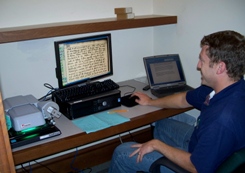
We’ve recently acquired three wonderful new microfilm reader/scanners, and they’re receiving rave reviews from staff and readers alike (research fellow Matt Bahar, pictured here, has been making good use of one in recent days), and other library visitors have been tossing around some pretty impressive superlatives about them (by which I mean positive superlatives, which was not usually the case with the previous readers).

The new machines, called ScanPro 2000s, allow readers to scan images from microfilm as PDF or image files onto a flash drive, to their email account, or to a printer in the library. The quality is significantly better than the printouts made from our older machines, and the ability to create zoomable, enhanceable image files and high-quality PDF documents is definitely an improvement.

When we first saw a demo of one of these, staff picked a reel of microfilm that we knew was just about impossible to read on our other machines (too dark, too smudgy, &c.). With the ScanPro, a couple of quick clicks resulted in a clear, easily-readable image (I confess, I was shocked at the level of detail we could pick out by adjusting the settings just a little bit). There’s even a “spot-edit” feature, that allows you to lighten up that dark corner of a page or highlight a signature by increasing the contrast. Just about every time I use one of them (usually before we open since they’ve been pretty popular during the day!) I find another nifty new feature.

Researchers who cannot visit the library can request digital files to be e-mailed to them by the library staff. Please see details here at under “low resolution digital files.”

The purchase of the ScanPros was made possible thanks to a grant from the Ruby W. and LaVon P. Linn Foundation, and to fundraising efforts led by MHS Fellow Frederic D. Grant, for which we (and our readers) are exceedingly grateful.

Next time you visit, be sure to ask for a “test drive” of one of the new machines!

Digital Collections Highlighted

By Jeremy Dibbell

The MHS was among several Boston-area repositories featured in Sam Allis’ Saturday Boston Globe article “Historic collections meet the 21st century.” Allis highlights HIstoric New England’s new online collections database, and also reports on digitization efforts at the Boston Public Library, the American Antiquarian Society, and the Boston Athenaeum.

Among our digital projects mentioned by Allis are our presentations of Thomas Jefferson’s manuscript of “Notes on the State of Virginia” (you can also view Jefferson’s book catalogues, farm and garden books, a copy of the Declaration of Independence in his hand, and many of his architectural drawings on our Thomas Jefferson Papers website) and our forthcoming digital collection of materials relating to the Siege of Boston during the Revolutionary War.

For the Adams Family Papers (which amount to some 300,000 manuscript pages in all) we host several different types of digital collection. The diaries and autobiography of John Adams, plus the correspondence between John and Abigail Adams (nearly 1,200 letters) are available in digital facsimile with transcriptions through the Adams Family Papers Electronic Archive. The diaries of John Quincy Adams (some 14,000 pages) are presented in digital facsimile, searchable or browsable by date (and JQA’s line-a-day diaries are currently being broadcast via Twitter, after which the transcriptions are added to the digital facsimile pages). And thirty-two volumes of the published Adams Papers are freely available as annotated transcriptions as part of the Adams Papers Digital Editions.

But our digital collections go far beyond the Adamses and Jefferson. You can browse the full list of our digital offerings here, but among the collections launched (fairly) recently are our Coming of the Revolution site, which features an interactive timeline of documents covering the period 1764-1776; African Americans and the End of Slavery in Massachusetts, a collection of 117 manuscript and printed documents from our collections including letters and poems by Phillis Wheatley and our (unique) copy of Samuel Sewall’s anti-slavery pamphlet The Selling of Joseph. If maps are more your style, check out Massachusetts Maps, a selection of 104 maps (mostly unique manuscripts) from our collections. Or there’s the ever-popular MHS Highlights Gallery, where you can see many of the most popular and striking visual items housed at the Society.

We hope you enjoy our digital collections, and always welcome feedback about them. Just email beehive@masshist.org, and I’ll pass them along.

This Week @ MHS

By Jeremy Dibbell

Please join us on Wednesday, 18 August at 12 noon for a brown-bag lunch talk with Daniel R. Mandell of Truman State University. Dan will talk about his current research project, “Revolutionary Price and Wage Regulation.” More info here.

Bentley Receives ANA Presidential Award

By Jeremy Dibbell

Anne Bentley, our Curator of Art, was presented with a Presidential Award by the American Numismatic Association, meeting in Boston this week.

The plaque below the medal (pictured at left) reads: “Thank you for your outstanding contributions to our hobby community.”

With John W. Adams, Anne is the curator of our current exhibit, “Precious Metals: From Au to Zn,” which you can view Monday-Saturday, 1-4 p.m. here at the Society through 2 October.

Anne was feeling far too modest this morning to comment on her award, but she said “Come see the show. We’ve got some great items on display, and you’ll have a chance to learn some interesting things about your history.”

We’re so proud of you, Anne – congratulations on this well-deserved honor!