MHS Annual Meeting on Wednesday

By Jeremy Dibbell

The annual meeting of the Historical Society will be held this Wednesday, 19 May, beginning at 5 p.m. The business meeting will be followed by a program honoring the memory of MHS Trustee and Fellow William L. Saltonstall. Reservations are required; please go here for more info.

Please note: to allow for setup, the reading room will close at 3 p.m. on Wednesday.

“Send us every regiment … ” – May Object of the Month

By Jeremy Dibbell

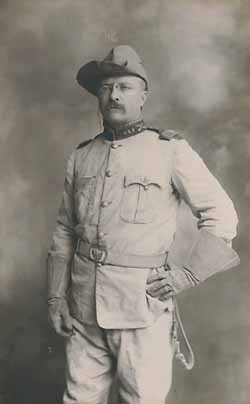
Our Object of the Month for May is a fascinating 3 July 1898 letter from Theodore Roosevelt to Henry Cabot Lodge, written just after the famous Battle of San Juan Hill, as the siege of Santiago continued. Roosevelt (pictured at left in his Rough Rider uniform) urges his friend, “Cabot,” to “Tell the President for Heavens sake to send us every regiment and above all every battery possible. … We are within measurable distance of a terrible military disaster; we must have help — thousands of men, batteries, & food & ammunition.” Roosevelt has even added at the corner of the front page of the letter, “For God’s sake have heavy reinforcements sent us instantly.”

As the Object essay notes, “Few documents show so vividly the contingency of history: Roosevelt believed the situation was so dire that he was prepared to go outside the army chain of command to send a message directly to the president. In fact, the result of the battle on 1 July was almost exactly opposite what Roosevelt expected. Within two weeks the Spanish would lose their naval squadron at Santiago and surrender the city.”

You can read a transcription of the letter, see images of all four pages and learn more about the background of the document here.

This Object of the Month celebrates the publication of The War Lovers: Roosevelt, Lodge, Hearst, and the Rush to Empire, 1898 (New York: Little, Brown and Company, 2010) by Evan Thomas, a corresponding fellow of the Historical Society, who spoke here about the book last week. In The War Lovers, Thomas argues that, more than the American Civil War, or even World War II, the Spanish-American War was a harbinger–if not the model–of modern American wars. The “splendid little war” against Spain was a “war of choice,” not immediately vital to national security but ostensibly waged for broader and sometimes shifting humanitarian purposes. A sampling of the letters, diaries, and photographs of Theodore Roosevelt and Henry Cabot Lodge that Thomas used in writing The War Lovers will be on display here at 1154 Boylston each afternoon from 1:00-4:00 p.m., Monday-Saturday, through 5 June 2010.

This Week @ MHS

By Jeremy Dibbell

Here’s what’s on our calendar for this week:

On Wednesday, 12 May, we’ll have a brown-bag lunch at 12 noon with Justin Pope of The George Washington University. Justin will speak on “Whispers and Waves: Insurrection, Conspiracy, and the Search for Salvation in the British Atlantic, 1729-1742.”

And on Friday and Saturday, 14-15 May, we’re hosting a two-part series on education in Boston with Alex Goldfeld. On Friday, we’ll have a brown-bag lunch at 12 noon, “The Eliot School and the Catholic Exodus of 1859.” And on Saturday, join Mr. Goldfeld for a customized walking tour of Boston’s Black Heritage Trail, “The African School and the Fight for Equal School Rights.”

Reservations for the Saturday event are required. Please call (617) 646-0519 to register, and for information on meeting place and time.

Reviews of “The War Lovers” Roll In

By Jeremy Dibbell

Newsweek editor Evan Thomas’ new book The War Lovers: Roosevelt, Lodge, Heart, and the Rush to Empire, 1898 (Little, Brown & Co., 2010) has received rave reviews by Ronald Steel in the New York Times and James McGrath Morris in the Washington Post.

Steel writes: “Thomas has illuminated, in a compulsively readable style, a critical moment in American history. This is a book that, with its style and panache, is hard to forget and hard to put down.” Morris adds that Thomas has “delivered an innovative, frequently entertaining and valuable retelling of an episode that set the pattern for more than a century of foreign military adventurism. This timely book is a cautionary tale about how the psyche of powerful and ambitious leaders may matter more than fact — or even truth — when the question of war arises.”

Evan Thomas will be at MHS today, Monday 3 May, at 12 noon, for a discussion of The War Lovers.

Collection Profile: Francis Blake Photographs

By Jeremy Dibbell

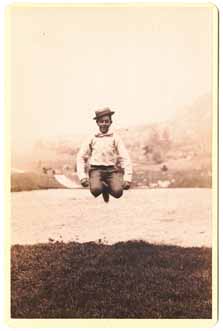
One of the most interesting of our image collections here at MHS are the Francis Blake photographs, more than 1,000 images taken by physicist and amateur photographer Francis Blake (mostly during the years 1875-1898). Blake is known for his early use of high-speed photography: “In the mid-1880s, Blake designed a focal-plane shutter that allowed him to take photographs with exposure times of 1/1000 to 1/2000 of a second. (The average working speed of a contemporary commercial shutter was about 3/100 of a second.) The resulting stop-action images of trains, pigeons, horses, bicyclists, and athletes were exhibited in Boston, Philadelphia, and London from 1891 to 1893 to critical acclaim.”

We’ve digitized a selection of Blake’s photographs, including a few of his well-known portraits and high-speed images; these are browsable here. The image included here (taken c. 1886-1889) is an “action shot” of Blake’s son Benjamin.

You can read more about Blake and his photos in a short biographical essay introducing the digital images.

Upcoming Events @ MHS

By Jeremy Dibbell

We’ve got a very full calendar of events for the next few weeks. Here’s what’s going on through 7 May:

On Thursday, 22 April, former long-term research fellow April Haynes will speak on “Making ‘False Delicacy’ True: The Passions of Female Moral Reformers, 1835-1845.” This seminar, part of the Boston Seminar on the History of Women and Gender, will be held at the Schlesinger Library, Harvard, beginning at 5:15 p.m. Please read the Seminars @ MHS blog post for more information on attending seminars, including how to make reservations and receive the papers in advance.

At 2 p.m. on Friday, 23 April, Leslie Wilson (Curator of Special Collections at the Concord Free Public Library) will give a gallery talk here at MHS to complement the ongoing exhibition: “No Worthless Books: Elizabeth Peabody’s Foreign Library and Bookstore, 1840-1852.” More information here.

We’re happy to present the First Annual Jefferson Lecture on Wednesday, 28 April. Douglas L. Wilson will speak on “Jefferson’s ‘Notes on the State of Virginia’ and Lincoln’s ‘Discoveries and Inventions.'” Refreshments will be served at 5:30 p.m., with the lecture to begin at 6 p.m. Reservations for this event are required – you can sign up here.

On Thursday, 29 April, the Boston Immigration and Urban History seminar series continues with a 5:15 p.m. talk by Gunther Peck of Duke University, “Trafficking in Race: Locating the Origins of White Slavery, 1660-1815.” Claire Potter of Wesleyan University will give the comment. Please read the Seminars @ MHS blog post for more information on attending seminars, including how to make reservations and receive the papers in advance.

MHS Members and Fellows are invited to participate in a special tour of Mt. Auburn Cemetery on Sunday, 2 May, “Mount Auburn & the MHS: Intertwining Paths.” More information here, and registration is required for this event.

On Monday, 3 May, Newsweek editor Evan Thomas will be here for a brown-bag lunch event relating to his new book The War Lovers: Roosevelt, Lodge, Hearst, and the Rush to Empire, 1898. This event will begin at 12 noon, and reservations are requested. You can sign up here.

On Wednesday, 5 May, we’ll have another brown-bag lunch presentation by Danielle Boulay of Simmons College. Danielle will speak on “Portraits of Courage?: An Examination of the Civil War Carte de Visite Album of Charles P. Bowditch.” This event will begin at 12 noon.

Later on Wednesday, 5 May, there will be a panel discussion on the recent MHS publication Remaking Boston: An Environmental History of the City and Its Surroundings (University of Pittsburgh Press, 2009). Co-editor Anthony Penna will moderate the discussion. Refreshments will be served at 5:30 p.m., with the panel convening at 6 p.m. Reservations are requested for this event; you can sign up here.

And last but certainly not least, on Thursday, 6 May the Boston Early American History seminar series continues, with Katherine A. Grandjean of Wellesley College presenting a talk, “Canoes, Cartpathsm and Colonization: The Evolution of Travel in Early New England, 1635-75.” Cynthia Van Zandt of the University of New Hampshire will deliver a comment. Please read the Seminars @ MHS blog post for more information on attending seminars, including how to make reservations and receive the papers in advance. The seminar will begin at 5:15 p.m.

Wood a Pulitzer Finalist

By Jeremy Dibbell

We’d like to congratulate MHS Fellow Gordon S. Wood, whose book Empire of Liberty: A History of the Early Republic, 1789-1815 (Oxford University Press, 2009) was named a finalist for the 2010 Pulitzer Prize in History. The winner in that category this year was Liaquat Ahamed, for Lords of Finance: The Bankers Who Broke the World. Joining Wood as a finalist was Greg Grandin, the author of Fordlandia: The Rise and Fall of Henry Ford’s Forgotten Jungle City.

Interact with Jefferson in new “Notes” Site

By Jeremy Dibbell

On the eve of Thomas Jefferson’s 267th birthday, we at MHS are delighted to annouce a new web presentation of the manuscript copy of Jefferson’s Notes on the State of Virginia, his only full-length book. Read more about the manuscript here.

By way of introduction to the new site: “When Jefferson was in Paris in 1785 representing the United States as a diplomat, he paid to have 200 copies of Notes printed for private distribution. Prior to publication, Jefferson reworked an earlier version of his manuscript by using sealing wax to attach corrections and changes written on small additional pieces of paper to full handwritten pages. He also expanded the text by inserting additional full pages. These changes show the evolution of Jefferson’s ideas on a number of topics, and the supplemental information he gathered as he wrote. This website allows the reader to interact directly with Jefferson’s complex manuscript by reading the original manuscript and by following all the changes that he made to the text before it was first published – including the opportunity to see passages written by Jefferson that have been hidden by attachments for more than two centuries.”

Our digital projects team has really worked some pretty amazing magic with this presentation – you can literally lift attachments off the page and see what Jefferson wrote underneath – or flip up additions and check out what’s on the back. It’s a little complicated at first, so I encourage you to use the Tutorial before you begin. It helps, believe me! Once you’ve mastered the navigation, you can start browsing at page 1, select your chapter, choose a selected passage, or search.

Also check out the list of sources for further reading, and some additional documents compiled by Jefferson during the composition of this work (including a table of Virginia birds).

Enjoy!


This Week @ MHS

By Jeremy Dibbell

Just one public event this week:

On Tuesday, 13 April, the Boston Environmental History Seminar series continues with a 5:15 p.m. talk by Anya Zilberstein of Concordia University, “Cold Comfort: The Benefits of Climate Change in Early Northern America.” Brian Donahue of Brandeis University will give the comment. Please read the Seminars @ MHS blog post for more information on attending seminars, including how to make reservations and receive the papers in advance.