This Week @ MHS

By Jeremy Dibbell

The MHS, including the library, will be closed on Monday, 15 February for the Presidents’ Day holiday.

On Wednesday and Thursday, 17-18 February, MHS is partnering with the Massachusetts Supreme Judicial Court to present a two-day teacher workshop based on court cases and documents dealing with the end of slavery in both Massachusetts (after the Revolution) and in the country (before the Civil War). During their day at MHS (Thursday) participants will work with key documents from the collections that have been paired with Library of Congress documents to enhance an understanding of activities and events leading to the emancipation of slaves in this state and others. Teams will complete lesson plans around the documents to be shared by all the attendees. More info here.

MHS Announces New Membership Rates

By Jeremy Dibbell

In case you missed it in this month’s e-newsletter: the Massachusetts Historical Society has announced a promotional new member rate for 2010: Members who join through the end of June can take advantage of a special first-year introductory membership rate of $75. As an added incentive, new members who are recommended by an existing MHS Member or Fellow will be eligible for a reduced introductory rate of $50 for the first year. The MHS is confident these new members will want to remain involved and help the Society secure a future for our past.

Read more about member benefits and see what your membership supports.

This Week @ MHS

By Jeremy Dibbell

Join us on Tuesday, 9 February for a conversation with Keith Lockhart, conductor of the Boston Pops. Lockhart will speak on “Creating the Past through Music.” The conversation will be facilitated by Steve Marini of Wellesley College. Refreshments will be served at 5:30 p.m., and the conversation will begin at 6 p.m.

Reservations for this event are requested: email education@masshist.org or call 617-646-0557.

Reading “Silence Dogood”

By Nancy Heywood

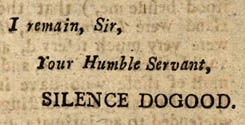
Many people have heard of Silence Dogood, and recognize that name as a pseudonym used by Benjamin Franklin, but how many people have read “her” words? The MHS has just launched a web exhibition, “Silence Dogood: Benjamin Franklin in The New-England Courant”  featuring contextual essays about the topic as well as digital images and transcriptions of the 14 pieces appearing in a Boston newspaper between March and October of 1722 “by” the outspoken widow Silence Dogood.

In 1722 Boston-born Benjamin Franklin was 16 years old and busy working as an apprentice for his brother James, the printer and publisher of The New-England Courant. The Courant wasn’t officially tied to the colonial government of Massachusetts and the newspaper became known for publishing opinionated, lively, and satirical pieces, some of which questioned the political and religious establishment. In his autobiography Benjamin Franklin remembered how he wanted to write for the paper but thought his brother wouldn’t accept or print any pieces he submitted.  So Benjamin thought of a less direct method to get his writing published: he recalled, “I contriv’d to disguise my Hand, and writing an anonymous Paper I put it in the Night under the Door of the Printing House.” This “anonymous Paper” was the first essay written by “Silence Dogood” that was published as a letter to the editor in the 26 March-2 April 1722 issue of the Courant.

The appearance of Silence’s letter in the newspaper (followed by a note from the publisher, James Franklin, with suggestions to Mrs. Dogood about how to ensure the safe delivery of future letters to the newspaper) prompted Benjamin to continue writing. Over the next 7 months, thirteen more essays appeared in the newspaper. Silence Dogood shared her life story (see essay one to read a dramatic account of her birth on board a ship), advocated for the rights of women (essay 5), quoted a lengthy piece from a London newspaper about freedom of speech (essay 8) and commented on the vice of drunkenness (essay 12), which includes what is perhaps one of the longest lists ever compiled of all the harmless sounding terms used to describe a state of drunkenness: “boozey, cogey, tipsey, fox’d, merry, mellow, fuddl’d, groatable, Confoundedly cut, See two Moons, are Among the Philistines, In a very good Humour, See the Sun, or, The Sun has shone upon them … .”).

Also available within the MHS’s web presentation of the Dogood essays are links to online displays of the full issues of the 14 newspapers in which the essays appear. Website visitors have the opportunity to browse a few sample issues and see the output of the publishing house where Benjamin Franklin learned many aspects of the printing trade.

“A Good Stiff Grog”

By Jeremy Dibbell

Our February Object of the Month is a 15 February 1939 letter from President Franklin D. Roosevelt to historian Roger Merriman, FDR’s former teacher at Harvard and in 1939 the vice president of the MHS. In this letter, Roosevelt bemoans what he calls the “We who are about to die, salute you” attitude exhibited by the British, recounting to Merriman a recent visit by the British ambassador, Lord Lothian which made him “mad clear through.” He ends his letter thus: “What the British need today is a good stiff grog, inducing not only the desire to save civilization but the continued belief that they can do it. In such an event they will have a lot more support from their American cousins — don’t you think so?”

You can see images of the letter, read a transcription, and get some more background here, in Tracy Potter’s Object of the Month essay.

New Forbes Family Collections

By Jeremy Dibbell

New Forbes family papers which arrived at the MHS in several installments, deposited by the J. M. Forbes Family Archives Committee in 2004, 2008 and 2009, have recently been processed and added to ABIGAIL. These include the J. M. Forbes & Co. estate papers, a collection of the papers of the estates of a number of Forbes family members, including Edith Emerson Forbes, William Hathaway Forbes, John Murray Forbes, Sarah Swain Hathaway Forbes, and others. The finding aid is available at http://www.masshist.org/findingaids/doc.cfm?fa=fa0331.

A new collection of Perkins-Cunningham scrapbooks highlights the families and lives of another branch of the Forbes family, descended from Robert Bennet Forbes (the brother of John Murray Forbes, and a noted ship captain and China trader). His daughter Edith married railroad magnate Charles Elliott Perkins and lived much of her married life in Burlington, Iowa.  She kept twelve volumes of “A Grandmother’s recollections found in a diary in an old hacienda on the banks of the Mississippi River,” which consist of letters, reminiscences, and clippings about her family.  Edith Perkins’s daughter Edith married Edward Cunningham and lived most of her life in the Boston area, and she kept six volumes of scrapbooks, “Letters of Many Years,” similar to those of her mother, which tell of her life and her family over the years. Both of these series are a rich source of information on the Forbes, Perkins, and Cunningham families.  A description of them can be found at http://www.masshist.org/findingaids/doc.cfm?fa=fa0330.

The Forbes deposits also include a very substantial group of “Additions” to the Edith Emerson Forbes and William Hathaway Forbes papers already here at the Society. These Additions have been added to the existing collection, and arranged in the same series (although not integrated with the original material), and can be accessed on-line through the finding aid to the whole collection, which now bears the somewhat cumbersome title of “Edith Emerson Forbes and William Hathaway Forbes Papers and Additions.” The finding aid is located at  http://www.masshist.org/findingaids/doc.cfm?fa=fa0225.

The John Murray Forbes papers also received one box of additions, consisting of correspondence on various business and political subjects, and including a series of letters to Benjamin F. Sanborn concerning the education of J. M. Forbes’s son Malcolm. These were not integrated into the existing papers but added as a separate series to the collection, and described in the on-line finding aid at http://www.masshist.org/findingaids/doc.cfm?fa=fa0228.

In addition, a handful of items were integrated into the existing Elise Cabot Forbes papers. No revisions to the guide were necessary; it is available at http://www.masshist.org/findingaids/doc.cfm?fa=fa0107.

Please note that many of these collections are stored offsite and must be ordered at least one business day in advance. Follow the instructions in the finding guides for ordering material from these collections.

This Week @ MHS

By Jeremy Dibbell

Join us on Wednesday, 3 February at 1 p.m. for a brown-bag lunch with research fellow James Downs, who’ll speak on “Sick from Freedom: The Unexpected Consequences of the American Civil War.”

Please note: this event has cancelled. Sorry for the inconvenience.

Pamphlets, Pamphlets Everywhere!

By Jeremy Dibbell

Some excellent news from our Senior Cataloger, Mary Fabiszewski, who announces a major milestone in her current project, creating catalog records for our online catalog (ABIGAIL) of all the printed pamphlets in our collections. Mary writes:

“The cataloging department (me) is pleased to announce, that with the addition of Barret Wendell’s ‘Relations of Radcliffe College with Harvard’ (much less salacious than it sounds, I’m sure), the 1800s are finally at an end (as far as cataloging pamphlets are concerned).

I started this project back in January of 2008 with the year 1831. Since then 15,725 new records have been added to ABIGAIL, bringing the total number of pamphlets for that time period to 19,352. Along the way, of course, each pamphlet got a new envelope and was put in its proper place..”

Reference Librarian Elaine Grublin provides some data about what the presence of online records means for the use of these documents:

“Just to show how much Mary’s cataloging efforts have paid off, here are some quick call slip numbers.

In 2006, items with “box” call numbers were requested 195 times. That was 7.6% of the total number of printed items called for in that year.

In 2009, items with “box” call numbers were requested 620 times. That was 29.6% of the total number of printed items called for in that year.”

I know all our researchers who use these materials join us in congratulating Mary for her hard work, and look forward to continued progress in 2010. The twentieth century pamphlets are scheduled to be completed by July of this year.

Oh, and in case you’re interested in Mr. Wendell’s pamphlet, you can (now) find the ABIGAIL record for it here.

The Thomas Shepards and Their Books [Part 3]

By Jeremy Dibbell

Just a brief update on some of the latest discoveries in our research on the Thomas Shepard books (see Part 1 and Part 2 for earlier posts):

More than 100 extant copies of books (at ten different libraries) once belonging to the Shepards have now been identified, as Steve Ferguson notes in a post from Princeton, and each day we’ve discovered a few more. I’ve created an online version of the Shepard Library, which you can now browse here (just click on “Your Library” for the whole collection, or on each instution to see the books they now hold). Please note: as of 28 January this catalog is not yet complete – the largest portion of books, at Princeton University and Princeton Theological Seminary, still need to be added. But we’re getting there!

One neat find from our collections here at MHS was a note (at left) in Thomas Shepard III’s copy of John Danforth’s An almanack or register of coelestial configurations &c. for the year of our Lord God 1679 (Cambridge: Samuel Green, 1679), which is among our holdings. Shepard kept notes in the interleaved almanac (mostly in shorthand), including one in which he describes receiving books from the estate of his friend and ministerial colleague Daniel Russell, who died of smallpox on 4 January 1678/9. In his will, Russell left Shepard a choice of books from his library, and Shepard reports choosing fourteen titles. Two of these, we were delighted to find, are now held at Princeton, and each contains an inscription by Shepard noting that it came from Russell’s library. You can see catalog records for the fourteen books here.


This Week @ MHS

By Jeremy Dibbell

We hope you’ll join us on Wednesday, 27 January at 6 p.m. for a talk by Christian J. Samito, author of Becoming American Under Fire: Irish Americans, African Americans, and the Politics of Citizenship during the Civil War. More info here. Reservations are required for this event: please email education@masshist.org or call 617-646-0557. Refreshments will be served prior to the event, beginning at 5:30 p.m.

And on Thursday, 28 January, as part of the Boston Immigration and Urban History seminar series, Rosalyn Negron Goldbarg of UMASS Boston will discuss her paper “Situational Ethnicity for the 21st Century.” Deborah Pacini Hernandez of Tufts University will give the comment. Please read the Seminars @ MHS blog post for more information on attending seminars, including how to make reservations and receive the papers in advance.