American Indian Photographs at MHS

By Jeremy Dibbell

One of the MHS digital collections currently being highlighted on our homepage is Photographs of Native Americans, a compilation of portraits and other photos collected by four Bostonians during the late 19th and early 20th centuries. “Charles W. Jenks and Francis Parkman collected carte de visite and tintype portraits of American Indians during the 1860s as historical records of tribal groups and their role in contemporary American politics. After a visit to southern California, Boston collector Kingsmill Marrs brought home platinotypes of southwestern Indians taken by Adam Clark Vroman in the late 1890s. An anonymous donor was inspired to collect Joseph Kossuth Dixon’s photogravures from the Wanamaker Indian expeditions of the early 1900s after hearing Dixon lecture in 1912.”

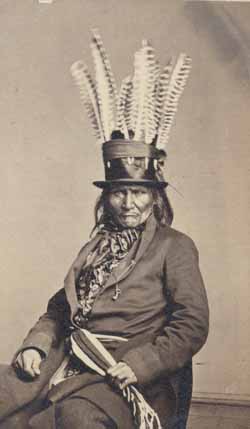
The fellow at left is a Chippewa man, photographed in Washington, D.C. in 1862 by Charles D. Fredericks & Co. The carte de visite is from the Charles W. Jenks collection.

You can find background text and links to many more photographs here.

This Week @ MHS

By Jeremy Dibbell

Join us tonight, Monday 19 October, at 6 p.m., for a talk and booksigning by Gordon S. Wood, the Alva O. Way Professor of History Emeritus at Brown University. His books include the Pulitzer Prize-winning The Radicalism of the American Revolution, the Bancroft Prize-winning The Creation of the American Republic, 1776-1787, The Americanization of Benjamin Franklin, and The Purpose of the Past: Reflections on the Uses of History.

Wood’s talk tonight will be on his new book, Empire of Liberty: A History of the Early Republic, 1789-1815, just published by Oxford University Press. Professor Wood will sign copies of his book following the talk. Refreshments will be served at 5:30 p.m.

And join us on Wednesday, 21 October, at noon, for a brown-bag lunch with Caroline Frank, current MHS short-term research fellow. She’ll discuss her current project, “Native American Enslavement in Southern New England, 1630-1730.”

“Sexual Warfare”: Lunch Talk Recap

By Anna Cook

Last Wednesday (9 October) current NEH-MHS long-term fellow Crystal Feimster gave a brown bag lunch talk titled “Sexual Warfare: Rape and the American Civil War.” Crystal described for us the research project that brought her to the MHS, which builds upon the material in her first book (newly-released through Harvard University Press), Southern Horrors: Women and the Politics of Rape and Lynching.  In Southern Horrors, Crystal explored the fears about sexual violence in the postwar South; her current research moves back in time from Reconstruction to the war itself. 

As a way of sharing the early findings of her research with us, Crystal described some of the materials she has been using to piece together the story of sexual violence in wartime and posed some of the questions that these documents leave her pondering. For example, elite white women’s diaries kept prior to and during the war express coded fears about sexual violence at the hands of Union troops, but rarely talk directly about being raped – at the same time, they use the language of invasion, and talk about Union troops entering their bedrooms. They also describe sexual violence witnessed against other women (often female slaves).  Another source of information has been the approximately two hundred court marshals against Unions for sexual assault, a small percentage when compared to other conflicts that has left some historians to conclude the Civil War was a “low rape” war.  However, Crystal raises questions about how accurately the court marshals reveal the situation on the ground: What rapes are being reported? When reported, which are likely to be entered into the record and brought to trial?  Correspondence from officers in MHS collections suggests that there was an expectation within the military hierarchy that certain behaviors among the troops not enter into the official record. 

During the discussion period, questions were raised about change over time during the course of the war.  Crystal described General Butler’s occupation of New Orleans during which local women openly resisted Union troops.  In response to the women’s disrespectful behavior toward Northern soldiers, Butler enacted General Order No. 28, or “the women’s order,” that sanctioned the use of sexual violence – or at least the threat of sexual violence, as a way of controlling women’s behavior.  She sees Butler’s occupation as one of a series of moments during the war during which the discourse – and possibly the practice – of sexual violence shifts.  Through tracking certain individuals for the duration of the war – Southern women, men in the military – Crystal hopes to chart out when and how these shifts took place. 

We are excited to have Crystal here as one of our research fellows, awed by her diligence in making sense of nineteenth-century military culture (not to mention nineteenth-century handwriting!) and look forward to future updates on the project, and eventually the book that will no doubt result.

Ulrich Receives Society’s Kennedy Medal

By Jeremy Dibbell

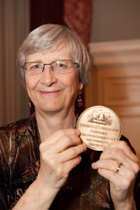
Harvard professor Laurel Thatcher Ulrich was awarded the Massachusetts Historical Society’s John F. Kennedy Medal on Wednesday night at the Society’s 60th annual dinner. Ulrich, the tenth Kennedy Medal honoree, is the first woman to receive the medal, the Society’s highest possible honor.

“Throughout her career Professor Ulrich has mixed very distinguished scholarship with an ability to cross conventional academic boundaries, which has greatly enriched our understanding of history,” stated Bill Clendaniel, chair of the Society’s Board of Trustees. “In addition, she has helped make American history relevant and thought-provoking to a wide audience through her PBS documentary and the popular use of her phrase ‘well-behaved women seldom make history.’ That she is the first woman to receive the Kennedy Medal also gives the Society particular pleasure.”

Shortly after President Kennedy’s death, the Society received several gifts designated for use in any appropriate way to perpetuate President Kennedy’s memory as an active member of the Society and a great friend of historical scholarship. The MHS determined to create a medal in President Kennedy’s name and commissioned eminent artist and MHS Fellow Rudolph Ruzicka to design the medal. Since then, the Society has presented 10 honorees with the Kennedy Medal, awarded from time to time to persons who have rendered distinguished service to the cause of history. It is not limited to any field of history or in fact to any particular kind of service to history. The previous recipients of the medal are Samuel Eliot Morrison (1967), Dumas Malone (1972), Thomas Boylston Adams (1976), Oscar Handlin (1991), Edmund S. Morgan (2002), Alfred DuPont Chandler, Jr. (2003), Bernard Bailyn (2004), John Hope Franklin (2005), and Arthur M. Schlesinger, Jr. (2006).

Professor Ulrich, the 300th Anniversary University Professor at Harvard University, delivered a talk at the dinner, “A Mormon Apostle in Boston: Sightseeing, Riot, and Martyrdom.”

The Harvard Gazette features a story about the award.

Invade Canada?

By Rakashi Chand

This is a lovely time of year to visit the beautiful province of Quebec, Canada. Quebec City is a special hidden gem, the feel of Europe without boarding a plane! But many Americans crossing the border are not aware of American invasions of Canada (most significantly, the Quebec expedition, during the American Revolution).

The first Continental Congress invited the French-Canadians to join their cause, hoping to appeal to their desire to be rid of British rule. Although this union never came to fruition, there was perhaps the possibility of a fourteenth colony. France had recently lost the Province of Quebec to the British in the French and Indian War so the Americans forces hoped the French Canadians would join them in over-turning British rule in North America when they invaded Quebec. This was the first major military excursion for the young Continental Army. General Richard Montgomery led a successful campaign in Montreal, but his snow-storm assault on the last day of the year in 1775 ended in disaster below the heavily fortified walls of Quebec City.

The six-week trek from Boston to Quebec City through the Maine wilderness led to the creation of an interesting array of documents in testimony of the hardships endured and the battle which ensued. Here at the MHS, researchers can view the William Dorr Journal, 1775-1776, which describes the journey to Maine up the Kennebec River and down the Chaudiere to Quebec and the hardships incurred; Jonathan Hill Journal, 1776, which recounts the march from New York to Montreal (and is written on the back pages of an arithmetic copy book); the handsome penmanship of Benedict Arnold in a letter regarding the siege of Quebec in the Hector McNeill papers, 1765-1812. Alternatively, researchers can get the British perspective, through the Journal of an officer of the 47th Regiment of Foot, 1776-1777, kept during campaigns in Canada describing the regiment’s activities under Gen. Guy Carleton while reinforcing the Quebec area against American forces in 1776.

There are also numerous printed documents recounting the “Canadian Invasion.” The Quebec expedition turned out to be much more than what the Continental Army could manage the winter of 1775-76, but don’t take our word for it. You can read about the expedition through journals, letters, books and even a drama (The death of General Montgomery, in storming the city of Quebec: A tragedy By H. H. Brackenridge (Norwich [Conn.]: Printed by J. Trumbull, for and sold by J. Douglass M’Dougall, on the west side of the Great-Bridge, Providence, 1777). If this topic piques your interest, please use our on-line catalog, ABIGAIL, to do a subject search for “Canadian Invasion, 1775-1776”; to see a list of available sources. And the next time you cross the border or if you ever have a chance to walk through the fortifications of Old Quebec City, you can imagine the hardships encountered by General Montgomery, Benedict Arnold, and the continental army as they attempted to “take Canada”.

This Week @MHS

By Jeremy Dibbell

Tonight, Tuesday 13 October, our Boston Environmental History Seminar series gets underway, with a 5:15 p.m. talk by Joyce Chaplin of Harvard University, “Earthsick: The Circumnavigator’s Malady.” Harriet Ritvo of MIT will give a comment after the paper.

On Thursday, 15 October, the Boston Seminar on the History of Women and Gender begins its 2009 run with a 5:15 p.m. talk by Felicia Kornbluh of the University of Vermont, “Disability, Gender, and Politics: The National Confederation of the Blind Confronts the Post-W.W. II U.S. Welfare State.” Laura Frader of Northeastern University will give the comment.

Please read the Seminars @ MHS blog post for more information on attending seminars, including how to make reservations and receive the papers in advance.

And, our John Brown exhibit (“John Brown: Martyr to Freedom or American Terrorist – or Both?”) is now open to the public for viewing, Monday-Saturday from 1-4 p.m.


JQA’s Shipboard Reading List: October Edition

By Jeremy Dibbell

As John Quincy Adams and his family continue their voyage to St. Petersburg (they began, you’ll recall, way back on 5 August), and you can follow along on Twitter, we’ve been tracking JQA’s shipboard reading as noted in his line-a-day and long diary entries (see the August and September posts for prior entries). For the first six dates of October there is no mention of his reading, but on 7 October he resumes his chronicle:

10/7/1809: Voltaire’s Peter. Voltaire, The History of the Russian Empire Under Peter the Great, first published in French as Histoire de l’Empire de Russie sous Pierre le Grand (1759). There were several English editions before 1810. I didn’t find a contemporary edition in English available in my quick web-search, but there is a 1901 edition of Voltaire’s works on the Internet Archive, of which the Peter the Great text comprises Volume 34 and Volume 35. In his long diary entry, JQA writes “I read something of Voltaire’s Peter the Great.”

10/8/1809: Two Sermons of Massillon: Religious inconstancy, and small number saved. See entry for 8/6. In his long diary entry, JQA adds “read also part of Paley’s Horæ Paulinæ.” See entry for 9/10.

10/9/1809: Voltaire. See entry for 10/7. In his long diary entry, JQA notes “I am reading Voltaire’s History of Peter the Great.”

10/12/1809: Chantreau. See entry for 8/8. In his long diary entry, JQA writes “I am reading Chantreau’s Voyage into Russia.”

10/15/1809: Two Sermons of Massillon and Horæ Paullinæ. See entry for 8/6. In his long diary entry, JQA says that the sermons were “the last two in the second volume of Lent Sermons – On the mixture of good and evil persons in the world; and on real Religion. I read also some sections in Paley’s Horæ Paullinæ.” See entry for 9/10. He adds “This is the first day, of ten, in which I have found it possible to read or write with the composure which admits of due attention.”

10/16/1809: Chantreau. See entry for 8/8. In his long diary entry, JQA writes “I took a minute of the ship’s papers; and read in Chantreau’s travels into Russia. Commenced reading the New Testament.

10/30/1809: Oddy’s European Commerce. In his long diary entry, JQA writes that he spent time “at home, principally reading Oddy’s European Commerce; the second volume of which has lately come into my hands, and which contains much information which I was seeking.” This is Joshua Jepson Oddy, European commerce, shewing new and secure channels of trade with the continent of Europe: detailing the produce, manufactures, and commerce, of Russia, Prussia, Sweden, Denmark, and Germany; as well as the trade of the rivers Elbe, Weser, and Ems: With a general view of the trade, navigation, produce, and manufactures of the United Kingdom of Great Britain & Ireland. It was first published in one volume at London in 1805, but the two-volume Philadelphia edition of 1807 is that most likely being read by JQA. It’s available online via Google Books: Volume 1, Volume 2.

10/31/1809: Read Oddy. See entry for 10/30.

Highlighting Rachel Revere

By Jeremy Dibbell

October’s Object of the Month is a letter from Rachel Revere to her husband Paul, dated 2 May 1775 (just a couple weeks after his famous ride). “The Revere Family papers (collection guide) held by the Massachusetts Historical Society contain only a small number of documents by or about Rachel Revere, so we know relatively little about her life–the life of an ordinary woman in 18th-century Boston–compared to that of her celebrated husband. In this letter, we get a brief glimpse of her character at a moment of crisis in their lives. It shows her to have been engaged by the momentous events taking place around her, but anxious to be of practical help to her husband. Torn by the necessity of offering bribes to the servant of a British officer she clearly detested to secure her family’s safety, and by the necessity of leaving her fifteen-year-old stepson, Paul, behind the British lines in Boston, she concerned herself with settling family business affairs and supplying her husband with money and clothing.”

You can see images of the letter, read a transcription, and find more background about Rachel and Paul Revere here.

This Week @ MHS

By Jeremy Dibbell

Please join us on Wednesday, 7 October at 12 noon for a Brown-bag lunch with Crystal Feimster, current NEH long-term research fellow here at MHS. Crystal will discuss her project, “Sexual Warfare: Rape and the American Civil War.”

On Monday, 12 October, the MHS library will be closed in observance of the Columbus Day holiday, but we hope you’ll stop by nonetheless for our Open House, part of the Fenway Alliance’s Opening Our Doors festival. The building will be open from 11 a.m. through 4 p.m., and we’ll debut our fall exhibit, “John Brown: Martyr to Freedom or American Terrorist–or Both?”

The Ghoulish Bits

By Jeremy Dibbell

In October’s issue of Boston magazine, writer Adrianna Borgia examines a few of the more macabre artifacts in the collections of the Society and other local institutions. Among the items highlighted from MHS are a lock of John Quincy Adams’ hair, some cloth stained with the blood of Abraham Lincoln, and a fishhook supposedly made from a bone of Captain James Cook. The ashes of Sacco and Vanzetti (a portion of which are now at the Boston Public Library) and the book bound in human skin from the collections of the Boston Athenaeum round out the ghastly set.

You can read the whole article, and see pictures (if you wish), here.

We have a few other “relics” here in the MHS collections, including a piece of tanned human skin which accompanies a pamphlet (“Argument before the Tewksbury Investigation Committee by Governor Benj. F. Butler, upon facts disclosed during the recent investigation, July 15, 1883”), the death masks (casts of faces made soon after the subject’s demise) of artist Washington Allston and historian Francis Parkman, some hair jewelry and other locks of hair (including that of Abraham Lincoln, John Brown, and the very creepy “hair of Josiah Winslow of Plymouth Colony, taken from his head in 1740, sixty years after he was buried”). We’ve also got a noose which its donor believed was the very one used to hang John Brown in 1859, and the windpipes of a chicken and a turtle, both given to the Society by S. Hall of Bridgewater in 1833.