Martineau Society Visits MHS

By Jeremy Dibbell

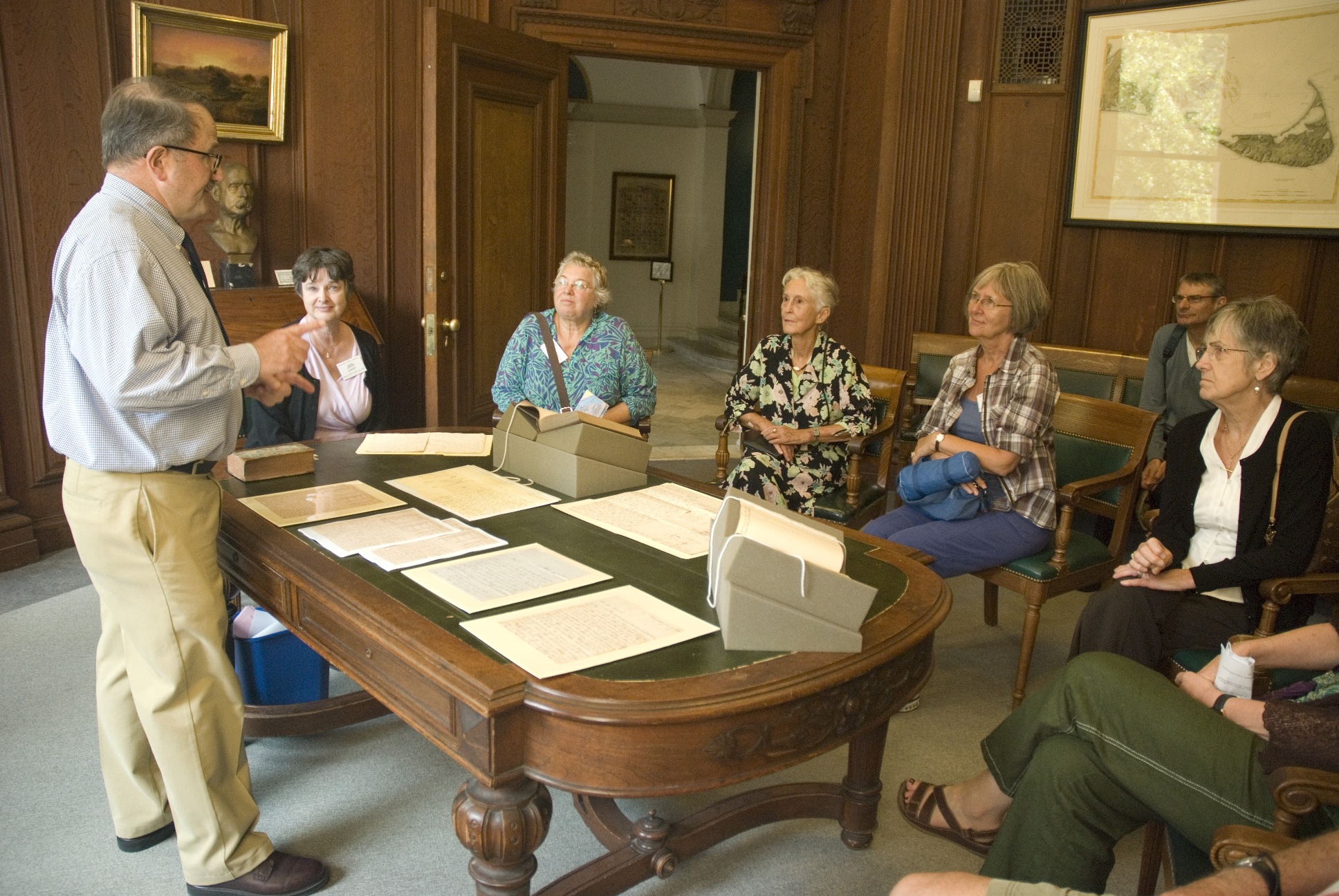
Last Thursday, the MHS hosted sixteen members of the Martineau Society, a group based at Manchester College, Oxford and devoted to the “preservation, study and publication in the public interest of material relating to the Martineau family of Norwich in the 19th century and the principles of freedom of conscience advocated by Harriet Martineau and her brother, Dr. James Martineau.” Librarian Peter Drummey displayed manuscript materials from our collections related to Martineau and her works, while curator of art Anne Bentley showed paintings, medals and other artifacts.

Among the items shown was a Harriet Martineau manuscript, a long letter to an unidentified recipient about a trans-Atlantic voyage, in the form of a journal, 3-25 August 1836. This letter, from the George E. Nitzsche Unitariana Collection, 1778-2007 (collection guide) was printed in edited form as an appendix to Martineau’s Autobiography (1877). The manuscript copy in the Nitzsche collection contains several drawings by Martineau, and also includes the names of those discussed in the letter (which are changed in the printed version).


To Russia With Tweets

By Jeremy Dibbell

Back in late May I wrote a post here titled “Was JQA a Tweeter?,” in which I noted a visitor’s observation of the similarities between John Quincy Adams’ line-a-day diary entries and the micro-blog posts produced on Twitter. Well, that got the wheels spinning here at MHS, and when we realized that JQA begins a long series of line-a-day entries on 5 August 1809 as he departs on his voyage to Russia (where he would serve as the first American ambassador), we decided some opportunities are just too good to pass up.

So, beginning on 5 August 2009, we’ll be posting JQA’s line-a-day diary entries on Twitter, one per day exactly 200 years later. You can check out the project at http://www.twitter.com/JQAdams_MHS, and if you use Twitter too we hope you’ll follow along and receive the daily updates. We’ll be posting JQA’s exact words (his entries really do work perfectly as 140-character tweets), and where possible we will augment the posts with maps showing his location (thank him for providing regular latitude and longitude readings), links to longer diary entries, and other information. His short entries are surprisingly rich, full of wonderful details about his reading, meals, weather, and shipboard activities.

This is an exciting opportunity for us to test out some new technological tools (and to create a transcription of the line-a-day diaries, which will be useful for future projects as well). We certainly hope others will find JQA’s journey as fascinating as we do, so please follow him on Twitter, and feel free to send me any feedback you have on the project (beehive@masshist.org).


[Note: the image included here, which you’ll also see as the background of JQA’s Twitter page, is his drawing of a ship from the inside back cover of his second diary (1780)]

This Week @MHS

By Jeremy Dibbell

Please join us this Friday, 17 July for the following events:

Brown Bag Lunch (12-1): Using a combination of lecture and discussion, Linda Palmer will introduce the audience to the rise of the Puritans in England and the Puritans’ disagreements with each other after they reach the New World. You will also “meet” Ann Vassall, wife of William Vassall, an influential, yet unpopular figure among the Bay leaders. She will talk to her audience as though it were 1637 and they had just arrived in the Massachusetts Bay Colony.

Teacher Fellow Reception (1-2): Stick around after the lunch discussion to welcome the 2009 Teacher Fellows and hear about their projects.

JQA Turns 42

By Jeremy Dibbell

On 11 July 1809, two hundred years ago today, John Quincy Adams wrote the following diary entry:

“I am this day forty-two years of age. And the reflections which return at every anniversary of my birth day, naturally recur, with increasing pressure. The year of my life now expiring has been marked by a continuance of that persecution which the combined personal enemies of my father and myself, had unrelentingly pursued the year before. It has appeared in various forms, some of them singular enough; but its effect has been to impel me into more general notice and estimation throughout the country. I have now just received an appointment of great trust and Importance, totally unsolicited, and confirmed by every vote in Senate, excepting my personal enemies, and two others, who voted not against me, but against the mission. Mr. Turner of North Carolina, who voted against the nomination, express’d in the highest terms his approbation of the person. With this Trust, my duties to my Country, bring again a burden of responsibility, which I ought perhaps to have declined. On the integrity of my Intentions, and on the aid of that Gracious Heaven which never has deserted me, I must rely. I pray for clearness of intellectual vision to see the right path – for the necessary courage to pursue it; and for the Fortitude and the Temperance to bear with equanimity the vicissitudes of its Fortunes, whether adverse or propitious. Grant, O God, that I may do good to my Country and to Mankind! And deal with me, and mine, if it be thy gracious will, in Mercy.”

A second paragraph followed, in which JQA chronicled the specific activities of the day (dining with his family, making a catalog of the books in his office, investing some stock for his father [or, perhaps, his mother?], resigning from his position as a professor at Harvard). “I was engaged all the rest of the day,” he writes, “in other arrangements preparatory to my departure, which will employ me the full remainder of the time I shall have here.”

The appointment referred to in Adams’ diary entry was indeed one of great trust and importance: President Madison had appointed him to be the American minister plenipotentiary [ambassador] to Russia, and he had been confirmed by the Senate on 27 June by a vote of 19-7. He would depart less than a month after he wrote this diary entry, on 5 August 1809, beginning what would ultimately prove to be an eight-year stay in Europe.

We’ve got some very exciting plans for the bicentennial commemoration of JQA’s journey to Russia, which we’ll officially announce right here in The Beehive next week. [you can get a sneak preview here!]. In the meantime, we wish Mr. Adams many happy returns on his birthday.

“Marriage Extraordinary”: Lunch Talk Recap

By Anna Cook

This Wednesday (8 July), the MHS hosted a brown bag lunch talk, “Marriage Extraordinary: Interracial Marriage and the Politics of the Family in Antebellum Massachusetts,” given by Amber Moulton-Wiseman, a graduate student of African-American Studies at Harvard University and a short-term research fellow here at the MHS.  Amber spoke on the nineteenth-century battle to lift the ban on interracial marriage that had been in effect in Massachusetts since 1705, prohibiting legal marriages between whites and people of color (particularly those of African descent).  Amber gave a brief description of the six-year campaign to end the ban, which began in 1837 with a grassroots petitioning drive and ended during the 1843 legislative session when the Massachusetts legislature voted to lift the ban, wiping away what many at the time considered to be one of the “old stains of slavery.” The political campaign was seen by activists as the first in a series of battles to defeat segregation, closely tied to debates over segregation of railway cars and Massachusetts schools.

Amber highlighted some of the collections she has used here at the MHS, such as the Charles Francis Adams diaries and the Wigglesworth family papers, to establish the context of the interracial marriage debate here in Massachusetts, and to understand the diverse interest groups that eventually came together in order to bring about the repeal – from female reformers who organized petition drives, to high-profile anti-slavery activists such as William Lloyd Garrison, to everyday Massachusetts citizens who, otherwise uninterested in the issue of interracial marriage of the rights of African-Americans, saw repealing the ban as a way to establish a Northern identity distinct from the slave-holding South.

In conversation following Amber’s initial presentation, attendees posed questions about the concept of race identity during antebellum period, and the problem of identifying interracial marriages as such, since “race” is such a fluid concept.  Amber clarified that, for the purposes of her research, she believed it best to draw the “race line” according to how people were seen (or saw themselves) at the time, rather than attempt to impose our own conceptions of racial categories onto an historical situation.  We also talked at length about the way in which the benefits of interracial marriage were framed by its supporters: marriage, Amber argues, was usually held up as a question of security for children and mothers.  The moral question concerning those who sought to legalize interracial marriage was, as one attendee put it, “whether men were bound to support women they have sex with” and the children they have as a result of those sexual relationships.  The legitimacy and security of mothers and children, rather than the rights of women as sexually-active individuals, was the primary concern of the pro-marriage reformers – even as the specter of women having sex outside of marriage (and outside of their own race!) was never far from peoples’ minds.

Many thanks to Amber for an engaging introduction to her topic and we wish her the best as she begins drafting her dissertation!

Abigail Adams, Investor

By Jeremy Dibbell

Historian (and 2003-04 MHS research fellow) Woody Holton had an essay in Sunday’s Washington Post, “On Money, a Founding Mother Knows Best.” He writes “If you were to hire Abigail Adams as your financial adviser, here’s the advice that the Massachusetts matriarch would offer,” and provides ten pieces of financial wisdom drawn from Adams’ experiences and correspondence. I think my favorite might be the eighth, which Holton describes as “Prevent your spouse from keeping a close eye on you. One of Abigail’s favorite techniques was the cover letter. Since John had no compunction about opening his wife’s incoming mail but considered letters received by Abigail Junior to be sacrosanct, Abigail sometimes asked her correspondents to enclose their messages for her inside letters to her daughter.”

Holton is the author of “Abigail Adams, Bond Speculator” in the October 2007 William & Mary Quarterly, and his biography of Abigail Adams (Abigail Adams: A Life) will be published by Free Press in November 2009.

On the Fourth of July

By Jeremy Dibbell

Happy Independence Day! To mark the occasion, a few digital highlights from our collections.

The Dunlap Broadside: The first printing of the Declaration of Independence, created overnight on 4 July 1776. Copies of this broadside were read to announce independence in New York on 9 July and in Boston on 18 July. Only 26 copies of this broadside are known to exist (the 26th was recently discovered in the collections of the British National Archives). This is one of many important Declaration of Independence broadsides in the MHS collections.

John Adams’ Draft Copy of the Declaration of Independence: At some point during the drafting process, John Adams made this handwritten copy of the early Declaration of Independence (he may even have sent this copy home to Abigail). It shows the text at a middle stage, before the full Continental Congress had its way with the draft. In the Adams Family Papers.

Thomas Jefferson’s Manuscript Copy of the Declaration of Independence: A partial copy of an early version of the Declaration of Independence, in Jefferson’s hand. Given to the MHS by Mr. and Mrs. Arthur C. Washburn in 1893.

John Adams to Abigail Adams, 3 July 1776: In this letter, Adams predicts the great celebrations which would mark future Independence Days (but he suggests it will be 2 July, not 4 July, which would be so honored): “But the Day is past. The Second Day of July 1776, will be the most memorable Epocha, in the History of America. I am apt to believe that it will be celebrated, by succeeding Generations, as the great anniversary Festival. It ought to be commemorated, as the Day of Deliverance by solemn Acts of Devotion to God Almighty. It ought to be solemnized with Pomp and Parade, with Shews, Games, Sports, Guns, Bells, Bonfires and Illuminations from one End of this Continent to the other from this Time forward forever more.” Congress voted for independence on 2 July, and approved the text of the Declaration two days later.

Abigail Adams to John Adams, 21-22 July 1776: Here, Abigail describes hearing the Declaration read for the first time in Boston, on 18 July: “Last Thursday after hearing a very Good Sermon I went with the Multitude into Kings Street to hear the proclamation for independance read and proclamed. Some Field peices with the Train were brought there, the troops appeard under Arms and all the inhabitants assembled there (the small pox prevented many thousand from the Country). When Col. Crafts read from the Belcona of the State House the Proclamation, great attention was given to every word. As soon as he ended, the cry from the Belcona, was God Save our American States and then 3 cheers which rended the air, the Bells rang, the privateers fired, the forts and Batteries, the cannon were discharged, the platoons followed and every face appeard joyfull.Mr. Bowdoin then gave a  [illegible Sentiment, Stability and perpetuity to American independance. After dinner the kings arms were taken down from the State House and every vestage of him from every place in which it appeard and burnt in King Street. Thus ends royall Authority in this State, and all the people shall say Amen.”

“with renewed enthusiasm”: Celebrating the Fourth

By Jeremy Dibbell

By tradition, our July Object of the Month highlight tends to be related in some way to the Fourth of July. This year’s is no exception: it’s a broadside issued by the Foxborough Fourth of July Committee, informing the town’s residents that the Fourth of July celebrations will go forward as planned. In fact, the Committee suggests that “the observance of INDEPENDENCE DAY be carried out with renewed enthusiasm because the attempt to our PRESIDENT has so far been unsuccessful and will, it is hoped, undoubtedly fail.”

President James A. Garfield had been shot by Charles Guiteau just two days earlier at a Washington train station, where he was preparing to board a train for Massachusetts (he was to give a speech at his 25th college reunion at Williams College). The president clung to life for eighty days, suffering through various attempts by doctors to find and remove a bullet lodged near his spine. He died on 19 September, the second murdered president in two decades.

You can read more about the Foxborough broadside, Garfield, and Guiteau here.

Visiting Monticello Vicariously

By Jeremy Dibbell

Maira Kalman’s New York Times blog is called And the Pursuit of Happiness, and her most recent post is particularly apt, given the title. In “Time Wastes Too Fast,” Ms. Kalman recounts a recent visit to Monticello, Thomas Jefferson’s home near Charlottesville, VA. It’s a very nice piece, and even features several images from the MHS’ collection of Jefferson manuscripts, including a photo from his Farm Book.

Surgeon’s Kit on Display

By Anne Bentley

A fitted case containing surgeon’s instruments belonging to William Swift, M.D., United States Navy, in the War of 1812 is on display in the USS Constitution Museum’s newest exhibition: “All Hands on Deck: A Sailor’s Life in 1812.”  

William Swift (1779-1864), an 1812 graduate of the Harvard Medical School, served in the U.S. Navy from 1812 until his retirement in 1861. He sailed to the coast of Africa in the frigate Chesapeake, and was serving on her when she fought the British vessel Shannon in Boston Harbor, 1813. He later served as naval surgeon in the brig Syren.

The kit was given to the Society by Dr. Lucy H. Swift, 26 October 1991. The MHS also holds Dr. Swift’s papers (Ms. N-162): see the collection guide for more information.

Curators at the USS Constitution Museum have installed Swift’s surgeon’s kit in their “Aftermath” area that very effectively illustrates the realities of war at sea.  You can see it there through December 2010. The grand opening of the exhibit, featuring Boston mayor Tom Menino, will be held on 3 July at 11 a.m.