Workshop Opportunity for Teachers

By Jeremy Dibbell

Teachers are invited to participate in a collaborative professional development project presented by the American Antiquarian Society (AAS), the Massachusetts Historical Society (MHS), and the Worcester Public Schools (WPS). Defining Freedom examines how Americans conceived and promoted both individual and communal liberties and responsibilities from 1763 through 1863. The project seeks to create a series of professional development experiences in which participating teachers will examine the imperial crisis, the American Revolution, the Early Republic, the antebellum period, and the Civil War.

The workshop will be held in late July at the MHS in Boston and AAS in Worcester. Teachers will interact with leading historians and scholars and explore the vast collections of primary source documents and images available through the collections of the American Antiquarian Society and the Massachusetts Historical Society in preparation for developing and piloting instructional units. These units will employ technology to help students develop and teachers assess 21st century skills. The project will encourage teachers to explore each of these institutions’ artifacts through onsite workshops, presentations, and individual research conducted by teachers at their own pace. Additionally, teachers will be encouraged to use various online resources, including those developed by AAS and MHS. Defining Freedom will employ various digital and printed resources to help students analyze and evaluate information, think critically, develop coherent and intellectually rich theses, employ evidence to support arguments, and fashion compelling written, oral, and multimedia presentations.

Registration information and more background on the workshop is available here.

Holiday Closure Notice

By Jeremy Dibbell

Please note: The reading room will be closed on Saturday, 23 May and Monday, 25 May for the Memorial Day holiday.

“… he is a moral nuisance …”

By Jeremy Dibbell

Our curator of art, Anne Bentley, recently pointed out a fascinating (but brutal!) passage quoted in the MHS Proceedings of the March 1929 meeting. I feel compelled to share, and for any current author out there who’s ever received a bad review, take heart – it could be worse.

The Proceedings record that Mr. Ford [Worthington Chauncey Ford, then the Society’s Editor] “read the following criticism on Emerson’s Conduct of Life, published in the Southern Literary Messenger for April 1861 [Volume XXXII, pp. 326-7] – a fateful month in our history.” What did the reviewer have to say about Mr. Emerson?

“His mind is like a rag-picker’s basketfull of all manner of trash. His books are valuable, for the very reason they are of no earthly account. They illustrate the utter worthlessness of the philosophy of free society. Egoism, or rather Manism, (if we may coin a word), propounded in short scraps, tags, and shreds of sentences may do very well for a people who have no settled opinions in politics, religion or morals, and have lived for forty years on pure fanaticisms. We of the South require something better than this no-system. Your fragmentary philsopher, of the EMERSON stamp, who disturbs the beliefs of the common folk, without again composing or attempting to compose them with a higher and purer faith, is a curse to society. Such a man ought to be subject to the mild punishment of perpetual confinement, with plenty of pens, ink and paper. Burn his writings as fast as they come from his table, and bury the writer quietly in the back yard of the prison as soon as he is dead. If in early life, the speculative lobes of his brain had been eaten out with nitric acid, EMERSON would have made a better poet than any New England has given us. As it is, he is a moral nuisance. He ought to be abated by act of Congress and his works suppressed.”

Thanks to the Making of America site, you can read a digital version of the original review (here), which includes two lead-off sentences not read by Mr. Ford into the Proceedings: “Whoever undertakes to conduct his life according to the precepts (if there be any) inculcated in this book, will find himself in a worse labyrinth than that of Crete. EMERSON never had a fixed opinion about anything.”

You can read a first edition of Emerson’s Conduct of Life (Boston: Ticknor and Fields, 1860) at the Historical Society, or online via the Internet Archive (click on “flip book” at the left margin).

Today @ MHS: Brown Bag, Annual Meeting

By Jeremy Dibbell

Note: the reading room will close at 3:30 p.m. today (Wednesday, 20 May) for setup purposes.

It’s going to be a busy day at the Historical Society!

Please join us at 12 noon for a brown-bag lunch with Alan Rogers, professor of history at Boston College and a 2009-10 New England Regional Fellowship Consortium fellow. Rogers will speak on “Smallpox and Skeptics: The Battle Over Compulsory Vaccination in Massachusetts.” This event will be held in the Dowse Library and is free and open to the public.

The MHS will hold its annual meeting beginning at 5:30 p.m., in Ellis Hall (the reading room). After Society business has been completed, attendees will enjoy the unveiling of the Massachusetts Historical Society’s newest publication, “Collecting History,” which details its vast collections. Peter Drummey, the Stephen T. Riley Librarian will conclude the meeting by talking about collection highlights.


Sedgwick Diaries Now Available

By Laura Lowell

We are pleased to announce that the diaries of Rev. Theodore Sedgwick (1863-1951) are now available for research. Sedgwick, an Episcopal minister, graduated from Harvard College in 1886 and from the Berkeley Divinity School in Middleton, Connecticut in 1890. He served as the rector of churches in New York City, Williamstown, Massachusetts, and St. Paul, Minnesota before becoming the rector of St. Paul’s American Church in Rome from 1930-1934.

Rev. Sedgwick’s diaries consist of 46 loose-leaf volumes dating from 1884 to 1950. Chronicling numerous European voyages and trips throughout the United States, as well as Sedgwick’s daily life in Rome, New York, Florida, and Sharon, Connecticut, they include newspaper clippings, postcards, photographs, letters, programs, brochures, and other mementos that have been pasted on pages opposite related text. Sedgwick begins regular journal-keeping in 1930, typing several pages each day for almost twenty years. His diaries eventually totaled 7,044 numbered pages compiled into two volumes per year. They came to MHS as a gift of his granddaughters in late 2008.

Sedgwick’s motivation for compiling these amazing volumes is best expressed in his own words: “For a number of years my ministry was in Italy, which meant a divided family. A daily record, type-written with carbons, one to each member of the family across the sea, held us together. The weekly letters went then, and have not stopped since to keep alive the bond created by the daily happenings, which although of slight moment, yet tell of thoughts and reading, of church-going and gatherings, of political rallies and candidates, of friends and all that happens in intimate associations. One copy I have always kept and its pages were bound, at first in alluring Italian leather covers, but now in simpler form. Against the pages I insert newspaper items, of which I have made mention, and at least these clippings form a history of importance.” (“Good Weaving: The Happy Values of Increasing Years,” The Evangel, March 1949)

With rich detail and gentle wit, Rev. Sedgwick, or “Teedy”, as he was known to his family, chronicles his observations of the Fascist revolution, the Great Depression, and World War II. My favorite diaries are those that he wrote in Rome (vols. 6-13), which contain many descriptions of the well-to-do American community in Rome, Sedgwick’s changing impressions of Italian dictator Benito Mussolini, and comments on Italian politics and culture. Here’s an example:

“Yesterday a priest came to me, I could not understand what he was driving at so I sent him to Sartorio. Henry told me he wanted to know of some rich American girls to whom he could affiance some poor Italian boys. Henry told him he was selling his soul. The priest did not like Henry.” (9 February 1933)

You can read more about Rev. Sedgwick and his diaries in the collection guide. MHS also holds a large multi-generational collection of Sedgwick Family papers (1717-1946), as well as the papers of Rev. Sedgwick’s brother, Ellery Sedgwick (1872-1960), former editor of the Atlantic Monthly.


MHS Remembers Longtime Member

By Jeremy Dibbell

David Herbert Donald, the Charles Warren professor of history emeritus at Harvard and a member of the MHS since 1960, died on Sunday at the age of 88. Mr. Donald’s many books included Lincoln’s Herndon (1948); Charles Sumner and the Coming of the Civil War (1960); Charles Sumner and the Rights of Man (1974); Look Homeward: A Life of Thomas Wolfe (1987); Lincoln (1995); and ‘We Are Lincoln Men’ (2003). With his wife Aida DiPace Donald, he edited a two-volume edition of The Diary of Charles Francis Adams, 1820-1829 (1964). He won Pulitzer Prizes for the first volume of his Sumner biography and for Homeward.

Dr. Donald was at work on a study of John Quincy Adams’ post-presidential career, which he spoke about during his last public lecture at the Historical Society, on 11 October 2006. He reported that he was delighted by the digital collection of JQA’s diaries, because they meant that he could work comfortably from home. In my notes from that talk, I wrote that a member of the audience asked a question after Donald’s lecture about how he’d decided to write the book, and he said his agent told him that the publisher wanted it done. “But I’m too old,” Donald said, to which the agent replied “You’re no older than Adams was and he kept at it.” Donald told the crowd that he kept saying no until the agent said “Listen, you have to write this book, you’re just as cranky and cantankerous as Adams ever was!” “And then,” Donald quipped, “I couldn’t say no.” In my notes from that night I also wrote how much I enjoyed listening to him speak – he had a wonderfully rich, Southern voice.

The first mention of David Herbert Donald in the MHS Proceedings was at the annual meeting in 1957, when Librarian Stephen T. Riley reported that he had visited the library for research purposes that year (Riley described Donald as having “been long engaged on his life of Charles Sumner”). The MHS elected Donald a corresponding member at the December 1960 meeting, and a resident member in January, 1975. Since 1963 he has been a member of the Adams Papers Editorial Advisory Board.

Donald, a native of Mississippi, was a graduate of Millsaps College (B.A., 1941) and the University of Illinois (Ph.D., 1946). He taught history at Columbia University, Smith College, Princeton University, Johns Hopkins University, as well as Harvard University. A full obituary appears in today’s Boston Globe.

Serendipity Strikes!

By Jeremy Dibbell

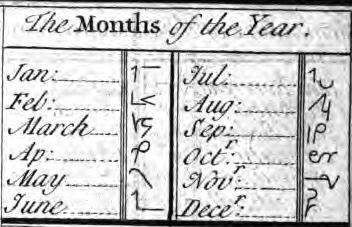
Well I have to say I can’t quite believe what I’m about to write. Literally hours after typing up my short introduction to the “Anonymous cipher diary“, I decided to spend a little time surfing around on Google Books and see what I could find in terms of 18th century short-hand manuals. There are a few there, but I was positively shocked to hit paydirt on the second title in the list! James Weston’s Stenography Compleated, or the art of short-hand brought to perfection was first published in 1727; Google Books has scanned a copy of the 1743 edition, and right there on page 30 [XXX] is what may be the smoking gun: the months of the year:


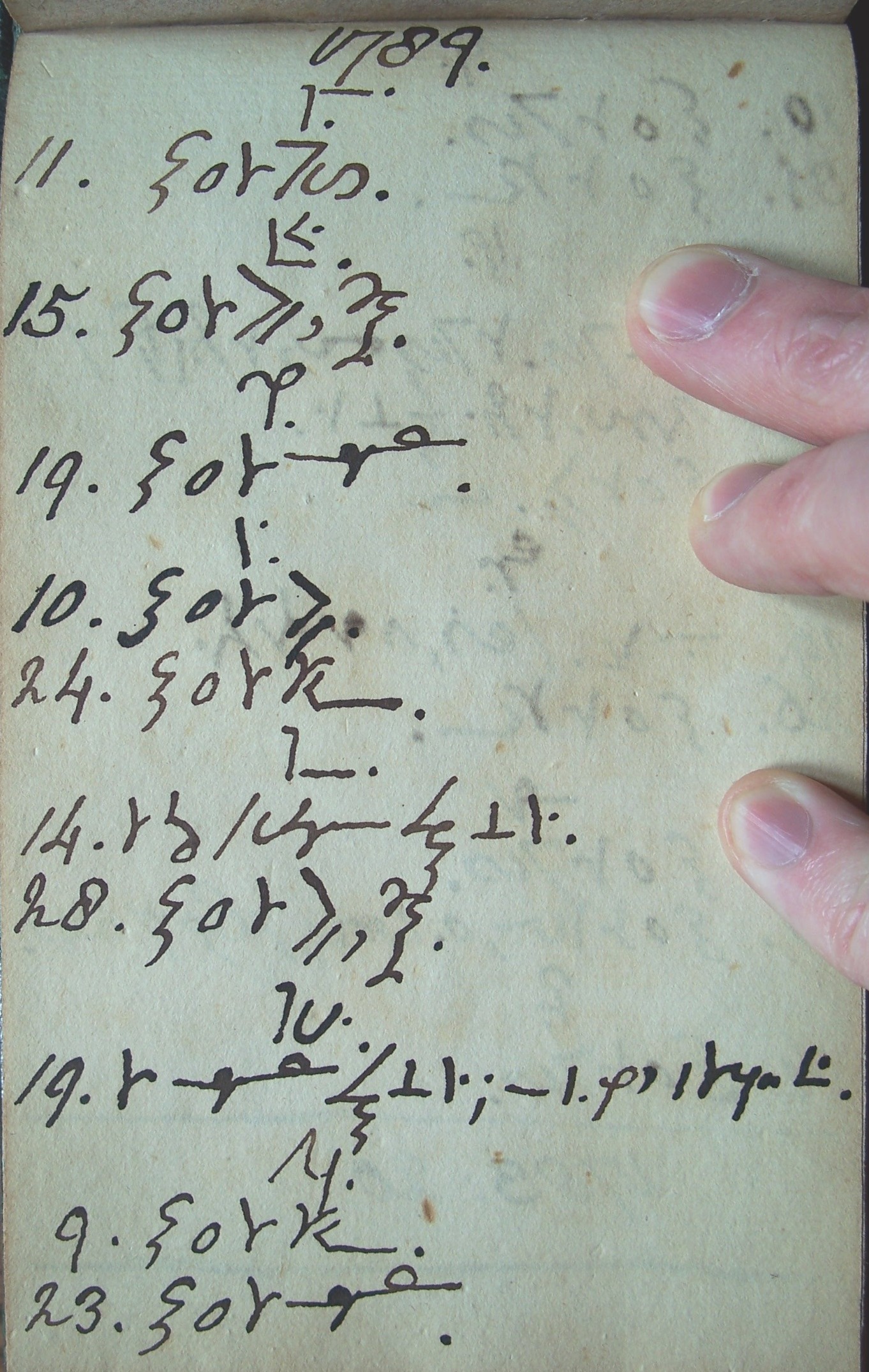
These match those used by our anonymous writer exactly. Here are the first short entries for 1789, showing the notations for January, February, April, May, June, July, and August (please pardon my fingers). Our writer appears to be adding some punctuation markings, which I still have to figure out, and I’m not entirely sure just yet just how much of Weston’s system our diarist is using – some portions of the short-hand seem to be homegrown. But confirming the months gives us much more of a start on actually reading this diary than I thought possible even a few hours ago.

You just never know when serendipity will strike, I guess. And now I know what I’ll be up to this weekend! More on my findings and on the possible identity of our diarist on Monday.


Can you Crack the Cipher?

By Jeremy Dibbell

One of the items in our collections I find most intriguing is the “Anonymous cipher diary, 1776-1845” (known by its call number, Ms. Sbd-133). It is a small bound volume containing ciphered or shorthand notations broken down by years, months, and days, with long entries on one side of the sheets and shorter entries on the opposite side. The writer used Arabic numerals, so tracking years and dates is possible, and the notations for each month are evident from the entries. Beyond that, the contents are almost a complete mystery (and since the years covered by the diary are of some considerable interest, I’ve long thought it would be fascinating to try and puzzle this out).

The diary was given to MHS member (and former president) Judge John Davis in 1841 by Theophilus Parsons [Jr.] (1797-1882), a legal scholar and longtime Dane Professor of Law at Harvard. A note on the first pages of the diary, written on 27 March 1845 by Davis, reads:

“This book, probably a Diary, I received from Theophilus Parsons, Esq. in the year 1841. It was found in his father’s Library after his decease, its origin and contents unknown. I hoped to find some person of sufficient skill in stenography, to decipher the pages. But it is still, to me & those whom I have consulted, a Sealed Book. With the consent of my friend from whom I rec’d [the] Book, it is now offered to the acceptance of the Mass. Hist’l Society. The late B.L. Oliver who had some skill in stenography, tho’ unacquainted with the characters in this volume, expressed to me an opinion that it was a diary of a Clerygman, perhaps as has been conjectured, of Rev. Moses Parsons of Byfield. But the entries extend to 1799 – sixteen years after the death of that gentleman. J. Davis.”

Theophilus Parsons [Sr.] (1749-1813), a well-known Massachusetts politician (of the Federalist persuasion), jurist and the chief justice of the Supreme Judicial Court from 1806 to 1813, left an extensive library at his death; when it was sold at auction in 1814, the catalog ran to twenty-three printed pages. Among the volumes in his collection, and apparently retained for a time by the Parsons family, was this curious little book. The man consulted by Davis about the diary was Benjamin Lynde Oliver, Jr., (1788-1843), a legal author (and noted chess player). In his diary (which is held at MHS as part of the Oliver Family Papers), Oliver writes on Saturday, 13 August 1842 “Go to see Judge Davis & get of him his treatise on shorthand, which is supposed to be the one used in the Mss. Book he lent me to decipher.” Over the next several months, Oliver reports additional visits with Davis, but does not mention the manuscript again (so far as I have been able to determine).

In his note, Davis records the “conjecture” that perhaps the diary had been written by Rev. Moses Parsons (1716-1783), the father of Theophilus. But, as he helpfully points out, Moses died well before the diary entries stop. Perhaps there is another clergyman member of the Parsons family who might have kept a ciphered diary? I’ll examine a possible (and potentially really fascinating) contender in a future post. In the meantime, if anyone out there recognizes this method of shorthand, I’d certainly be fascinated to hear any insight you can provide.

Organizing the 54th

By Jeremy Dibbell

Our “Object of the Month” for May is a letter from Massachusetts governor John A. Andrew to Francis Shaw. In the letter, dated 30 January 1863, Governor Andrew lays out his reasons for forming what would become the 54th Massachusetts, the first regular army regiment of African American soldiers raised in the North during the Civil War. Enclosed with the letter was a note to Francis’ son Robert, offering him command of the regiment. Francis Shaw personally carried Andrew’s letter to his son, then in winter encampment with the 2nd Massachusetts Infantry in Virginia. Robert was at first not entirely enthused about the idea, but his father proved persuasive … and the rest, as they say, is history.

You can read the whole story, see digital versions and transcriptions of Andrew’s letters to Francis and Robert Gould Shaw, and get ideas for further reading and research here.

Today @ MHS: Cope Brown-Bag

By Jeremy Dibbell

Join us today (Wednesday) at 12 noon in the Dowse Library for a brown-bag lunch with Rachel Cope, Ph.D. candidate at Syracuse University and current Ruth R. and Alyson R. Miller Fellow at MHS. Cope will discuss her current project: “‘A New Course of Life was Begun’: The Religious Impact of Revivalism on Nineteenth-Century Women.”

This event is free and open to the public.