By Jeremy Dibbell
The MHS awards a wide variety of research fellowships each year. Those for the 2009-2010 season were recently announced. Please pardon the lengthy list (impressive, isn’t it?). For more information about each type of fellowship, click the link in the heading.
MHS-NEH Long-Term Research Fellowships:
– Crystal Feimster, Assistant Professor, Department of History, University of North Carolina, Sexual Warfare: Rape and the American Civil War (four-month award)
– Linford Fisher, Assistant Professor, Department of History, Brown University, The Indian Great Awakening: Religion and the Shaping of Native Cultures in Early America (ten-month award; deferred to 2010-2011)
– April Haynes, Post-Doctoral Fellow, Massachusetts Historical Society and American Antiquarian Society, Riotous Flesh: Gender, Physiology, and the Solitary Vice, 1830-1860 (four-month award)
MHS Short-Term Research Fellowships:
– Karen Woods Weierman, Associate Professor, Department of English, Worcester State College, The Case of the Slave-Child, Med: The Geography of Freedom in Antebellum Boston (African American Studies Fellow)
– Mazie Harris, Ph.D. Candidate, Department of the History of Art and Architecture, Brown University, “To Feast Our Bodily Eyes”: Nineteenth-Century American Portrait Vignettes and Card Albums (Andrew Oliver Research Fellow)
– Carol Bundy, Independent Scholar, McClellan’s Visit to Boston, January 28-February 8, 1863 (Andrew W. Mellon Fellow)
– Jan Cigliano, Independent Scholar, John Hay: Genius of Diplomacy (1838-1905) (Andrew W. Mellon Fellow)
– Lindsay DiCuirci, Ph.D. Candidate, Department of English, The Ohio State University, History’s Imprint: The Colonial Book and the Writing of American History in the Nineteenth Century (Andrew W. Mellon Fellow)
– Jim Downs, Assistant Professor, Department of History, Connecticut College, Sick from Freedom: The Unexpected Consequences of the American Civil War (Andrew W. Mellon Fellow)
– Caroline Frank, Visiting Lecturer, Department of American Civilization, Brown University, Native American Enslavement in Southern New England, 1630-1730 (Andrew W. Mellon Fellow)
– Elizabeth Kelly Gray, Assistant Professor, Department of History, Towson University, Worlds of Pain: Opium and Early America (Andrew W. Mellon Fellow)
– Matt Hudock, Ph.D. Candidate, Department of History, University of Delaware, African American Colonization and Identity (Andrew W. Mellon Fellow)
– Whitney Martinko, Ph.D. Candidate, Department of History, University of Virginia, Progress through Preservation: History on the American Landscape in an Age of Improvement, 1790-1860 (Andrew W. Mellon Fellow)
– Rachel Shapiro, Ph.D. Candidate, Department of History, University of Virginia, Washington Brotherhood: Friendship and Politics in the Civil War Era (Andrew W. Mellon Fellow)
– Lori Veilleux, Ph.D. Candidate, Department of Religious Studies, Brown University, Religion, Science, and Boston’s 1832 Cholera Epidemic (Benjamin F. Stevens Fellow)
– Alea Henle, Ph.D. Candidate, Department of History, University of Connecticut, Preserving the Past, Making History: Historical Societies, Editors, and Collectors in the Early Republic (Malcolm and Mildred Freiberg Fellow)
– Matthew Hale, Assistant Professor, Department of History, Goucher College, The French Revolution and American National Identity (Marc Friedlaender Fellow)
– Jeffrey Kosiorek, Visiting Assistant Professor, Department of History, Hendrix College, The Power of Our Patriot Fathers: Memory, Commemoration, and the American Revolution in the Nineteenth Century (Massachusetts Society of the Cincinnati Fellow)
– Sara Lampert, Ph.D. Candidate, Department of History, University of Michigan, The Public Woman: Taking the Stage in Nineteenth-Century America (Ruth R. and Alyson R. Miller Fellow)
– Deborah McNally, Ph.D. Candidate, Department of History, University of Washington, Within Patriarchy: Puritan Women in Massachusetts’s Congregational Churches, 1630-1715 (Ruth R. and Alyson R. Miller Fellow)
– Derek Attig, Ph.D. Student, Department of History, University of Illinois, Race, Religion, and the Idea of America in Twentieth-Century Bookmobility (Twentieth Century History Fellow)
– Justin Pope, Ph.D. Candidate, Department of History, The George Washington University, Whispers and Waves: Insurrection, Conspiracy, and the Search for Salvation in the British Atlantic, 1729-1742 (W.B.H. Dowse Fellow)
– Richard Rath, Associate Professor of History, University of Hawai’i at Manoa, The Disenchantment of America: Mediating the Senses in the Eighteenth-Century Atlantic World (W.B.H. Dowse Fellow)
Suzanne and Caleb Loring Research Fellowship (with the Boston Athenaeum):
– Kathryn Shively Meier, Ph.D. Candidate, Department of HIstory, University of Virginia, “Under the Siege of the Blue”: Environmental Effects on Civil War Mental and Physical Health in Virginia, 1862
New England Regional Fellowship Consortium (NERFC) Awards (with 16 other institutions)*
– Elizabeth Blackmar, Professor, Department of History, Columbia University, Land, Capital, and the Ethos of Preserving Family Property
– Michael Block, Ph.D. Candidate, Department of History, University of Southern California, New England Merchants, the China Trade, and the Origins of California
– Eileen Botting, Associate Professor, Department of Political Science, University of Notre Dame, Reclaiming a Lost Text of Early American History and Political Thought: Hannah Mather Crocker’s “Reminiscences and Traditions of Boston” (Colonial Society of Massachusetts Fellow)
– Sean Harvey, Ph.D. Candidate, Department of History, College of William and Mary, American Languages: Indians, Ethnology, and the Empire for Liberty
– Alea Henle, Ph.D. Candidate, Department of History, University of Connecticut, Preserving the Past, Making History: Historical Societies, Editors & Collectors in the Early Republic
– Whitney Martinko, Ph.D. Candidate, Department of History, University of Virginia, Progress through Preservation: History on the American Landscape in an Age of Improvement, 1790-1860
– Amber Moulton-Wiseman, Ph.D. Candidate in African and African-American Studies, Harvard University, Marriage Extraordinary: Interracial Marriage and the Politics of Family in Antebellum Massachusetts (Bostonian Society/New England Women’s Club Fellow)
– Alan Rogers, Professor, Department of History, Boston College, Smallpox and Skeptics: The Battle Over Compulsory Vaccination in Massachusetts
– D. Jamez Terry, B.A. Candidate, Department of History, University of Maine at Farmington, Cultural Constructions of Charles Guiteau
– John Wong, Ph.D. Candidate, Department of History, Harvard University, Global Positioning: China Trade and the Hong Merchants of the Eighteenth and Nineteenth Centuries
– Helen York, Ph.D. Candidate, Department of History, University of Maine at Orono, Sound and Silence: Enfranchised and Disenfranchised Radio in New England
* Note: not all of the NERFC fellows will be researching at MHS as part of their NERFC award.
Teacher Fellowships:
– Richard Gallagher, Hartford Memorial Middle School, White River Junction, VT (Adams Fellow)
– Adam Zilcoski, W. L. Chenery Middle School, Belmont, MA (Adams Fellow)
– Danielle Fernandex, North Quincy High School, Quincy, MA (Swensrud Fellow)
– Sean Irwin, Boston College High School, Boston, MA (Swensrud Fellow)
– Edward Davey, Jonas Clarke Middle School, Lexington, MA (Kass Fellow)
– Charles Newhall, St. John’s Preparatory School, Danvers, MA (Kass Fellow)

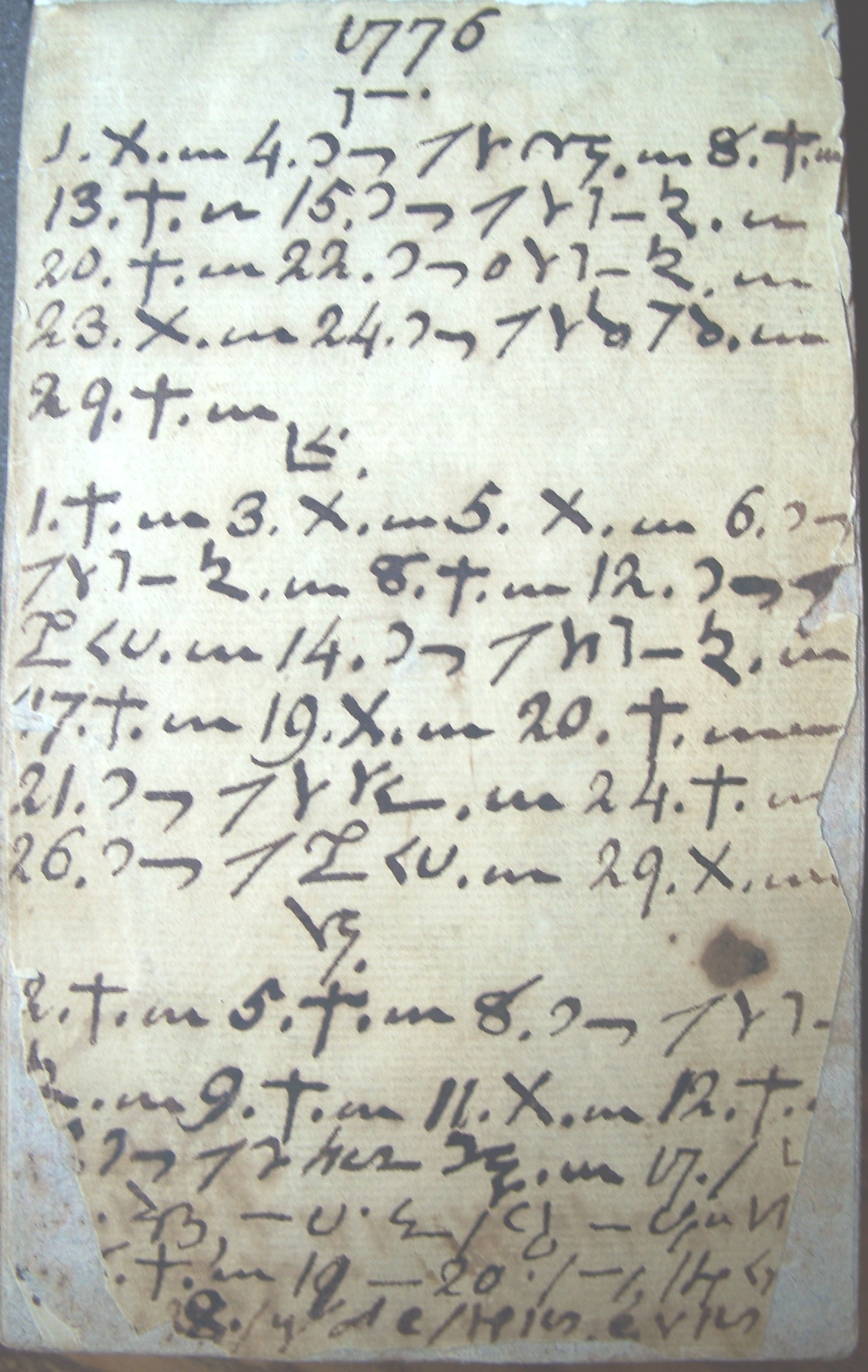 One of the items in our collections I find most intriguing is the “Anonymous cipher diary, 1776-1845” (known by its call number, Ms. Sbd-133). It is a small bound volume containing ciphered or shorthand notations broken down by years, months, and days, with long entries on one side of the sheets and shorter entries on the opposite side. The writer used Arabic numerals, so tracking years and dates is possible, and the notations for each month are evident from the entries. Beyond that, the contents are almost a complete mystery (and since the years covered by the diary are of some considerable interest, I’ve long thought it would be fascinating to try and puzzle this out).
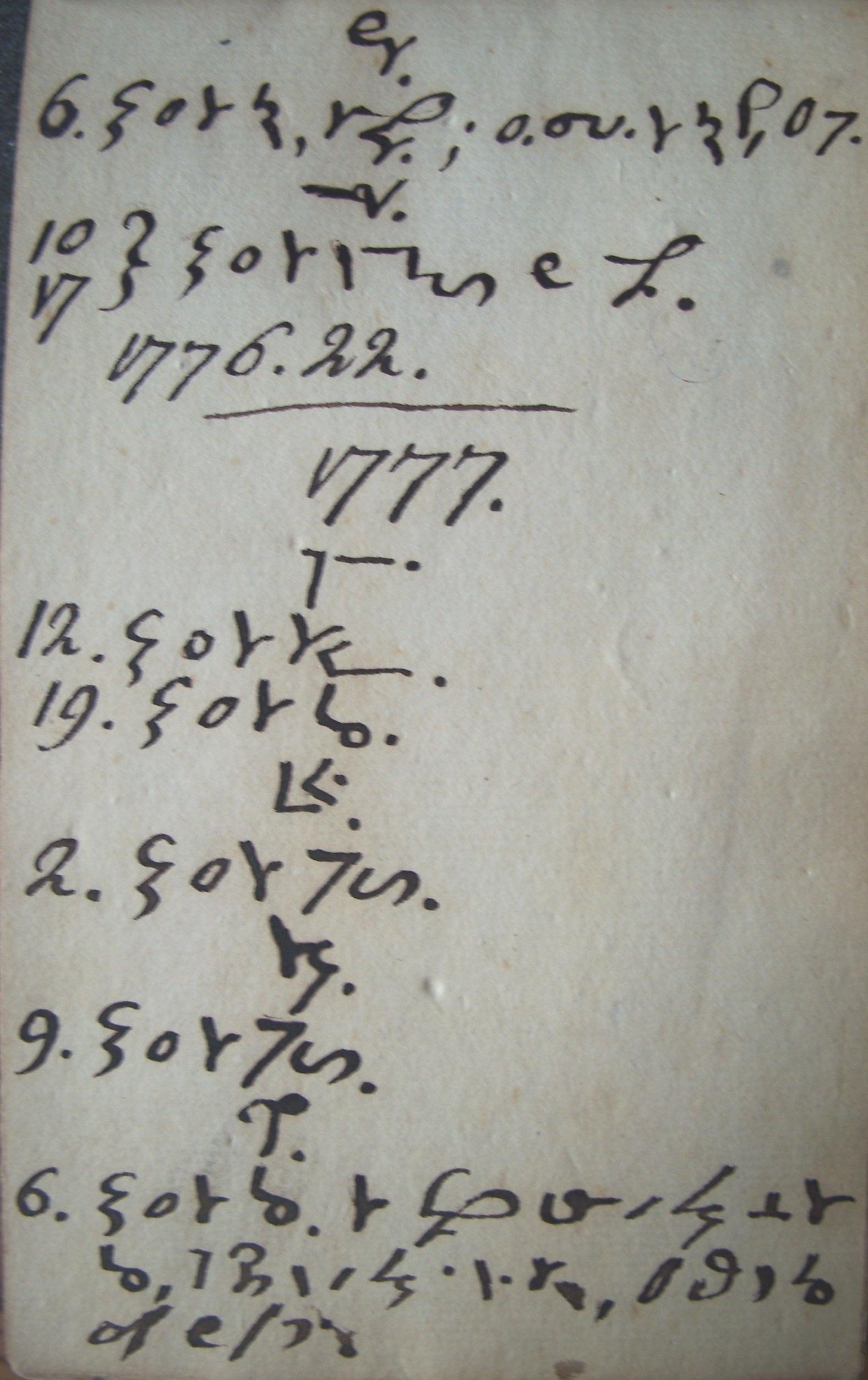 olume, expressed to me an opinion that it was a diary of a Clerygman, perhaps as has been conjectured, of Rev. Moses Parsons of Byfield. But the entries extend to 1799 – sixteen years after the death of that gentleman. J. Davis.”
 I can’t resist posting a wonderful bit of good news just received this afternoon: Hobson Woodward, Associate Editor of the Adams Papers, has received the first review for his forthcoming book,