The Battle of Whitehall: The Journal of Howard J. Ford, Part IV

By Susan Martin, Senior Processing Archivist

This is the fourth installment in a series. Click here to read Part I, Part II, and Part III.

In my last post about the Civil War journal of Howard J. Ford, I described his experiences in the Battle of Kinston, North Carolina, the first of three he would fight in quick succession during the Goldsboro Expedition of December 1862. Though his regiment, the 43rd Massachusetts Infantry, never engaged directly with the enemy at Kinston, I think you can tell from his journal that he was shaken.

He was also very tired. He and the other Union troops had already slogged through about 35 miles of difficult terrain, more than half the distance between New Bern and Goldsboro. The day after the battle, they ate a quick breakfast, shouldered their packs, and continued the march. Harold’s staccato sentences really convey the exhaustion.

The boys say that they had rather fight and run the risk of being killed than march. It is indeed severe. No one who has not tried it knows anything about it. Marching is not walking. O, how the load cuts in and draws down. Never mind. On, on. The roadside lined with the weak. Misery depicted on their faces.

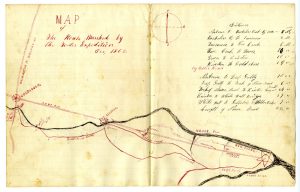
When doing historical research, I always like to try to orient myself geographically. I found this very helpful manuscript map of the Goldsboro Expedition drawn by a member of the 27th Massachusetts Infantry and digitized by the UNC Special Collections Library.

Image showing a drawn map at the bottom of the page with handwritten text at the top left and top right
Diary commencing Oct. 14 1861 – ending Sept. 20th, 1863 / Newton Wallace, VCC970.742 W19d, from the North Carolina Collection, Wilson Library, UNC Chapel Hill

The location of the Battle of Kinston is indicated by the star to the left of the middle fold. The Battle of Whitehall took place a little further west, close to Goldsboro, on 16 December 1862.

I’d like to quote at length from Howard’s powerful description of the Battle of Whitehall because I couldn’t possibly do it better. I love his use of sound in this passage to evoke the chaos.

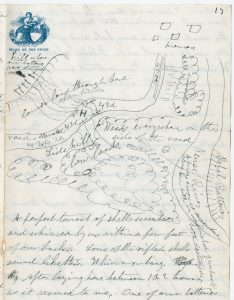
We marched till about 9 o’clock when boom, boom went the cannon in front. We halted in the road. We could hear now volleys of musketry which sound something [like] a boy pulling a stick along a fence. Then there would be a cannon fire followed in 2 or 3 seconds by the explosion of a shell. Boom, bang. Boom, bang. Lively. Crack (rifle) 4 or 5 Booms at once. &c &c ad infinitum. The artillery firing was the heaviest I had yet heard. […] We advanced a few hundred rods and halted. What we were here for is more than I know. We were placed between the fires of the opposing artillerists. We all fell flat on our faces. We laid closer to the ground than ever before. We all crawled into the gutters as low as possible, – colonel and all. Here we laid for 2 hours I should think expecting every moment would be our last. […] A perfect torrent of shells screeched and whizzed by us within a few feet of our backs. Some of the rifled shells sound like this. Whir-r-r-bang. […] You can hardly imagine the sensation while spread out there. I can never describe it.

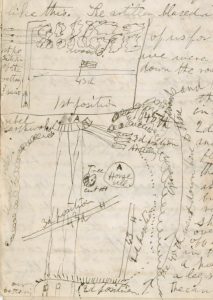
Once again, Howard illustrated the battle in his journal, including features of the landscape and the relative positions of the batteries. The letter “H” in this drawing indicates Harold’s location on the road right between the Union and Confederate firing lines.

Image showing a hand drawn illustration of a battle with handwritten text
Illustration of Battle of Goldsboro by Howard J. Ford

As I mentioned in a previous post, Howard was sending his journal home to Cambridge, Mass. in installments. I wonder what it must have been like for his parents, his siblings, and his wife Mary to receive these dispatches. I imagine them passing the pages around or reading them aloud to each other.

Join me in a few weeks for more on Howard J. Ford!

Only Bangers: Fireworks in 1776

By Meg Szydlik, Visitor Services Coordinator

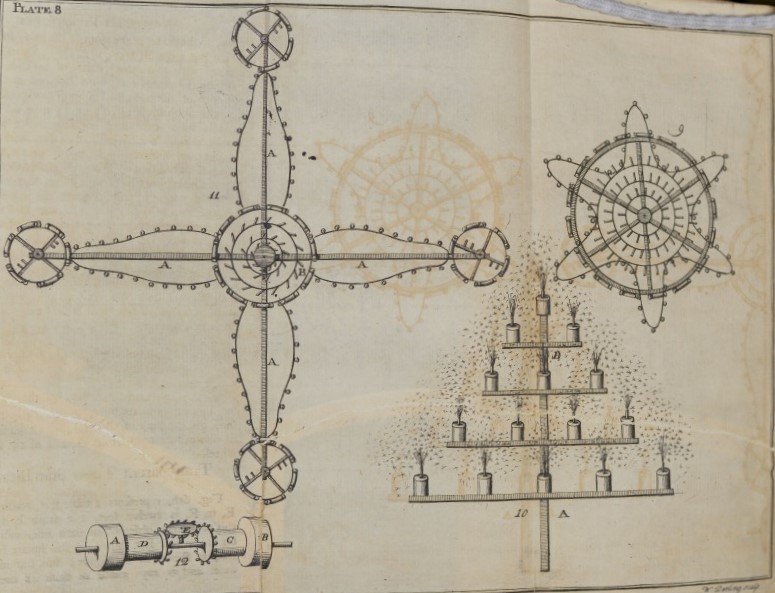
For this blog post, I thought I would return to my more science-y roots. I mentioned in a previous blog post that I was raised in a family with a lot of focus on science. One of the ways we did that was rocket launching. As a child, I used to launch all kinds of rockets. While explosives are not my preferred experimental matter, I do have very fond memories of building and launching these (air-pressurized and non-explosive) rockets hundreds of feet into the air. With July Fourth approaching, I thought it would be the perfect time to explore some MHS materials on fireworks and rockets while reminiscing about my own experiences. Our collections have quite a few fireworks-related material, but one of the most interesting is a how-to book called Artificial fireworks : improved to the modern practice, from the minutest to the highest branches which includes recipes and illustrations so that you too can make big, colorful 1776 fireworks.

image of firework constructions. In the top left corner it reads “plate 8.” The bulk of the page is taken up by different fireworks. From left to right and top to bottom they are: a large firework with a circle in the center and multiple prongs with additional circles on the ends, a smaller mechanical construction, a Christmas tree with lights, and a spiral with some prongs emanating from the center.
If you’ve ever wondered how to build a firework…page from Artificial fireworks : improved to the modern practice, from the minutest to the highest branches

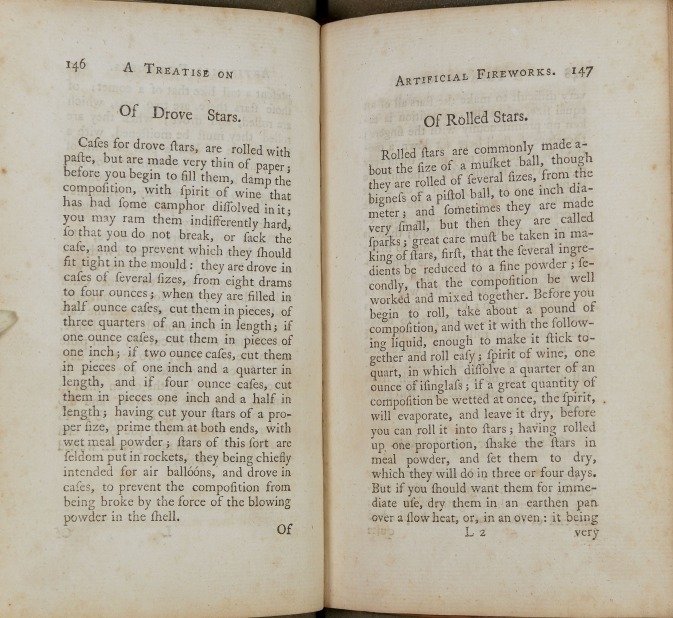
I elected not to create any of these fireworks myself, not least because I don’t think I can just roll up and purchase a lot of these ingredients without ending up on a government watchlist. But it was a very interesting read nonetheless! The author was an officer in the British Army and his writing style reflects the terse, clipped language I associate with military efficiency. Brisk, but clear and easy to read once you get past the ſ, or long s, in place of our modern round s. I learned that if you add the right kind of minerals, you can make virtually any color in a variety of shapes and showers. Different materials alter the color of flames, a fun experiment if you have a fireplace and a penchant for risk-taking. To make white fireworks, use saltpeter, sulfur, meal powder (also called black powder), and camphor. To make blue, the ingredients are saltpeter, sulfur, and meal powder. To make red, add saltpeter, sulfur, antimony, and Greek pitch (aka rosin). And voila! Everything you need to make your own fireworks–except measurements. While some of the recipes do have measurements, they are not nearly as precise as I would expect explosive recipes to be.

Image of an open book. The pages it is open to are headed “Of Drove Stars” on the left and “Of Rolled Stars” on the right.
A glimpse of the explosive text hidden within. Open page from Artificial fireworks : improved to the modern practice, from the minutest to the highest branches

Unclear measurements and temperatures are a chronic problem in old cookbooks and one that has been well documented in other Beehive blog posts, such as this one about bread pudding. So in many ways, this is just like so many recipe books in our collection, despite not being nearly as delicious. Do not worry, though—if you want to make a case, aka the rocket body to hold the fireworks, those come with detailed mechanical instructions and illustrations! I actually feel pretty good about my ability to put a case together, assuming I had the pieces and did not have to learn how to cut steel. I am confident that I could learn, but a girl needs some limits, even in her imagination.

Personally, I would recommend sticking to modern fireworks over making your own 18th century ones. Though if you do feel so inclined, feel free to head on down to the MHS and examine the book yourself! In the meantime, enjoy those Fourth of July fireworks and festivities knowing it’s a little safer than in 1776.

Celebrating “Freedom Day” 2023: A Virtual Juneteenth Exhibit with NHD Massachusetts

By Simbrit Paskins and Kate Melchior

Image of website header with 4 portraits.

There’s something quite special about the month of June, is there not? The month invites us to officially welcome in the Summer season, get excited about vacations and beach days, and everything feels inevitably brighter! June also makes way for cultural and historical celebrations across the nation, namely, LGBTQIA+ Pride month and Juneteenth, both of which honor the voices, legacies, and stories of community members far and wide. 

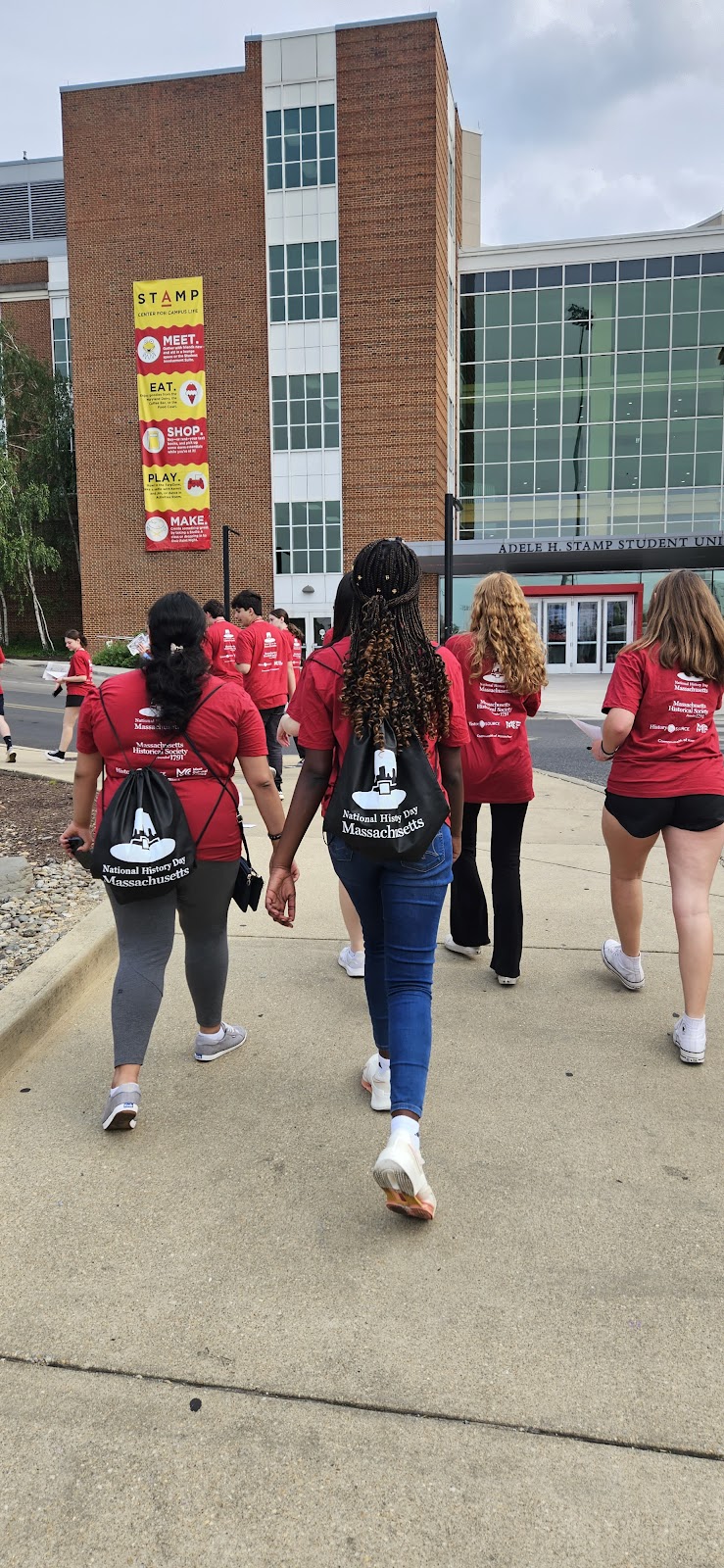
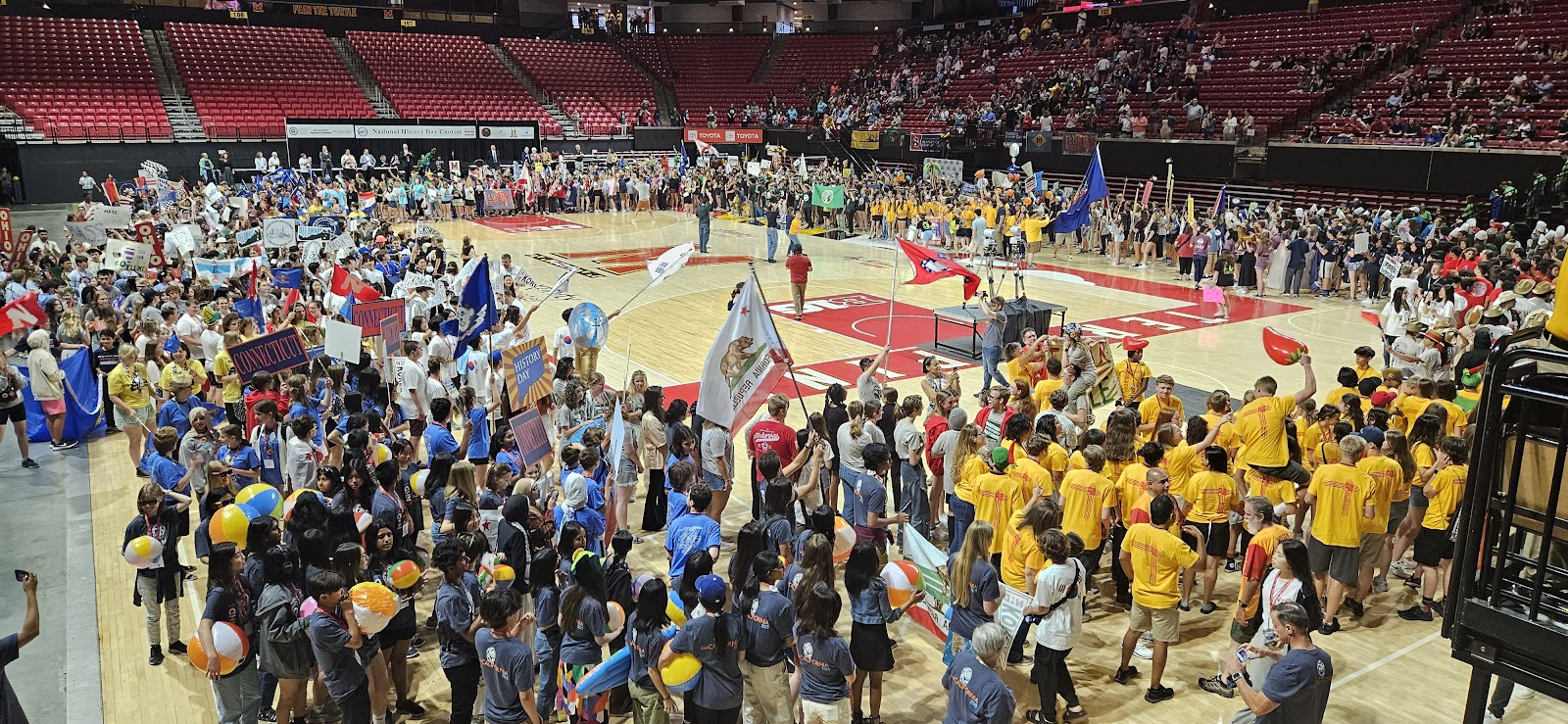
In the past few weeks, the MHS and our greater Massachusetts community have celebrated our National History Day students in a number of ways! While students from across the Commonwealth traveled to participate in the first in-person National competition since 2019, seventeen of our students said “yes!” to having their NHD projects featured in a virtual exhibit at the Massachusetts Historical Society to commemorate the history and legacy of Juneteenth.

Though it has long been celebrated among African American and BIPOC (Black, Indigenous, People of Color) communities, Juneteenth is a major part of American history that still remains largely unknown to the wider public. Juneteenth (short for “June Nineteenth”) celebrates the date in 1865 when Union troops arrived in Galveston, Texas to take control of the state, and enforce the 1863 Emancipation Proclamation, which legally freed all enslaved people, including those in Texas who had still been in bondage until union troops arrived. Since then, Juneteenth celebrations have annually created spaces for the storytelling of our country’s second independence day and recognized the ongoing fight for human rights and equality.

In 2020, Juneteenth was declared a state holiday in Massachusetts, and the following year was recognized as a federal holiday. 

The Massachusetts Historical Society began an annual NHD Massachusetts Juneteenth exhibition in 2020 with three goals in mind: 

  1. to promote an understanding of and engagement with the Juneteenth holiday; 
  2. to highlight select NHD student projects whose work explores topics related to Black/ African American history, culture, achievement, and freedom; 
  3. and to spread awareness of these often marginalized historical narratives. 

This year’s NHD projects approached history through the theme of “Frontiers in History: People, Places, Ideas.” Our virtual exhibit features students who researched leaders in history such as Dr. Anna Cooper, Marsha P. Johnson, and Katherine Johnson; and explored topics including the history of Hip-Hop, the Children’s March of 1963, and Black Wall Street. 

We invite you to explore this original and extraordinary student work from the 2023 NHD Massachusetts competition season. We invite you to think deeply and critically about the stories that our NHD youth chose to tell this year about Black and African American history, and we encourage you to share what you’ve learned with your friends, family, colleagues, and neighbors, joining us in our celebration of this invaluable and critical history. 

John Adams’ Secretary of War

By Rhonda Barlow, Research Associate

When John Adams became president of the United States, he inherited George Washington’s cabinet, including Secretary of War James McHenry. Adams has been criticized for not replacing immediately the inept McHenry with someone competent and loyal. But shortly after Adams took the oath of office, McHenry sent the new commander-in-chief a brief letter and a huge bundle of papers.

Handwritten letter on sepia-toned paper
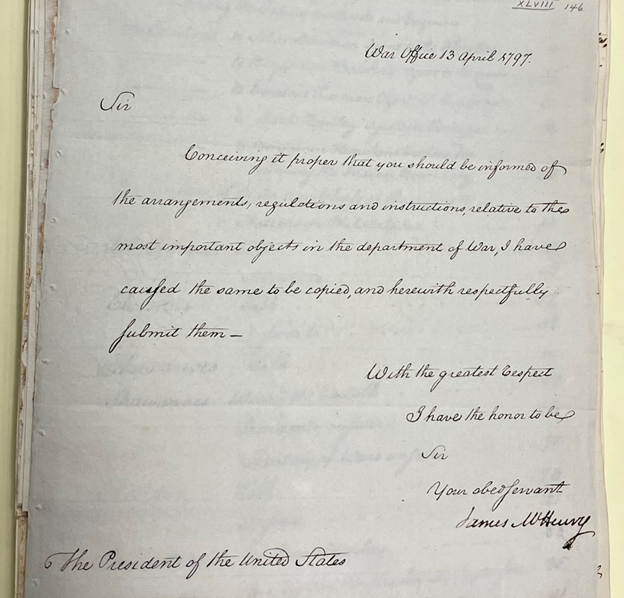
James McHenry to John Adams, 13 April 1797

“Conceiving it proper that you should be informed of the arrangements, regulations and instructions, relative to the most important objects in the department of War, I have caused the same to be copied, and herewith respectfully submit them,” wrote McHenry.

On his own initiative, McHenry surveyed the holdings of his department, made judgments about what was most important, and despite the heavy workload he and his clerks faced, had copies made for John Adams.

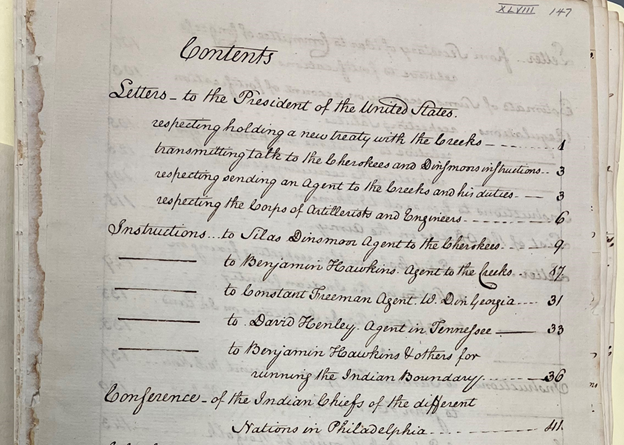
To help the new president navigate over 150 pages of documents, McHenry included a 2-page table of contents, a handy overview listing the letters to former president George Washington; instructions and negotiations with Native Americans, including the Cherokees and the Creek Nation; information on fortifications; and regulations governing salutes. Because there was not yet a separate department for the navy, McHenry also included the status of the frigates that were being constructed at Philadelphia, Boston, and Baltimore, as well as that of one for the Dey of Algiers.

handwritten document
Table of Contents created by James McHenry, 1797

Although we do not have a letter John Adams wrote thanking McHenry for his industriousness, or commenting on these documents, we do know he received them, for they are part of the Adams Papers archive at the Massachusetts Historical Society. In fact, because of a disastrous fire in the offices of the War Department in 1800,  McHenry’s initiative gives historians a treasure trove of what would have otherwise been destroyed. Perhaps historians should be asking, not why didn’t John Adams replace James McHenry in 1797, but why would he?

The upcoming volumes of The Papers of John Adams are an exciting opportunity for a fresh look at the Adams Presidency.

The Battle of Kinston: The Journal of Howard J. Ford, Part III

By Susan Martin, Senior Processing Archivist

This is the third installment in a series. Click here to read Part I and Part II.

Since my last I have seen experiences which are new and and [sic] startling. Only by the blessing of God have I got through unharmed. I think that all have seen marching and fighting enough to last them a lifetime. Our best boys begin to wish they were at home. Some of the best and most patriotic are discouraged and willing to end the war on any terms.

These are the words Pvt. Howard J. Ford wrote in his Civil War journal after seeing combat for the first time. What follows are several pages describing his experiences during what came to be known as the Goldsboro (or Goldsborough) Expedition, including the battles of Kinston, Whitehall, and Goldsboro Bridge, N.C.

In two previous Beehive posts, I wrote about Howard’s life prior to his service with the 43rd Massachusetts Infantry Regiment, as well as his enlistment and training. But it was his descriptions of battle that really drew me to this collection in the first place. I’ve rarely seen personal accounts from this time that paint such a vivid picture of what war actually feels like.

Just three weeks after his arrival in the South (specifically New Bern, N.C.), Howard was already hearing rumors that his regiment would be deployed. He prayed most of all for “perfect calmness” in battle, writing on 7 December 1862, “I want to be ready with nothing to do but to attend to my business.” Sure enough, his readiness would soon be tested by three battles in quick succession.

On 11 December at 5:30am, the 43rd Mass. Infantry and other regiments set out from New Bern as part of Brig. Gen. John G. Foster’s big push to Goldsboro, N.C. Goldsboro played a vital role in the Confederate supply chain. It was a major junction on the Wilmington and Weldon Railroad, which brought troops and supplies up from the port of Wilmington. Foster was on a mission to disrupt that supply chain by destroying the Goldsboro Bridge. Along the way was the town of Kinston.

The march from New Bern was grueling. Surrounded by “dismal & gloomy” pine woods, the troops had to ford streams, trudge through mud, and climb over large tree trunks that the Confederates had placed across the road to slow them down. Rations were low, and packs were heavy.

Early in the march, Howard saw signs of recent fighting, including dead and wounded Confederate soldiers and shell damage to trees. On the third day, he heard nearby shelling for the first time, and the danger suddenly felt very real. He wrote, “Of course we pricked up our ears somewhat. Some began to turn pale and fret. I tried to think it was nothing of consequence.” His regiment set up camp in an open field surrounded by trees, out of which, Harold feared, the enemy might fire at any minute. An army doctor demonstrated how to make a tourniquet with a handkerchief.

The Battle of Kinston was fought the next day, 14 December 1862. Although the 43rd Mass. Infantry was present, it was held in reserve, and Howard never engaged directly with the enemy. He wrote, “I suppose an old soldier would laugh at the dangers to which our regiment was exposed but for green troops it was something.” His descriptions of the battle are very detailed, cover more than six pages, and include maps and illustrations.

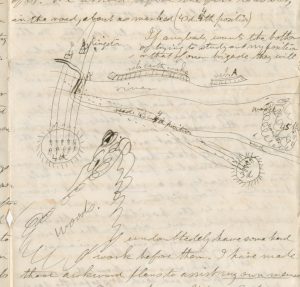
Image of a hand drawn illustration and handwritten text.
Illustration of Battle of Kinston by Howard J. Ford
Image of hand drawn illustrations and handwritten text.
Illustration of Battle of Kinston by Howard J. Ford

But when it comes to the chaos of war, words and pictures fall short, even Howard’s. He noted, “It is very difficult to give a distinct idea of this or any battle. The few things I have referred to were occurring with great rappidity [sic] and several at the same time in some cases. We forgot our danger in the excitement of the occasion.”

Just two days later, Howard would face more fighting, and this time he’d be in the thick of it. Stay tuned for the next installment.

“Have a good trip to No. H. & a good summer”: Summer Trips through the Archives

By Heather Rockwood, Communications Associate

Summer trips have a long tradition. Several motives inspire them including weather, health, visiting family, or travel to see the world. Collected here are some quotes from summer letters and diaries kept in the archives of the MHS.

Let’s begin with the oldest quote. In it, Thomas Mott asks John Winthrop his advice in crossing the Atlantic during the summer:

I humbly thancke you that you were so mindfull of my busines. and I would desier you to send me word whether or not there goe noe more shipps over into New England this summer, and if they doe at what time they doe goe, and whether if a man should goe over this summer, if the winds lye so that a man may returne next summer with the wind, and goe over againe the same summer conveniently. As yet my mind stands inclinable though I heare of great rubbs in the way, but if god hath ordained it for my good I hope the Lord will make the rough wayes smooth.

Thomas Mott to John Winthrop, 13 June 1629

In this quote, Elizabeth Seccombe writes to Robert and Sophie Valentine some news about her relationship and where she has been all summer.

I have just returned from England where I have been for the last two months to try & get rested & strong again I should have written before I went but I was too sick & sad to do so & have kept putting off the evil day when I have to tell you two dear people that I have left Amy we have not seen or written to each other for three months & there seems no chance for our ever meeting again she does not wish it so that ends it.

Elizabeth Seccombe to Robert and Sophie Valentine, 17 September 1907

The following quote is from Charles Francis Adams’s diary regarding the invitation from his father, John Quincy Adams, to visit for the entire summer.

Received an urgent letter from my father inviting my Wife and myself to spend the Summer with them. I suppose I must accede to it. If it was not for the inconvenience that it puts us to I should like it very much.

Diary of Charles Francis Adams, Volume 4, Friday, 13 April 1832.

Some summer trip information is added to the end of letters as well wishes such as in this 30 June 1946 letter from Leverett Saltonstall to Eleanor Brooks Saltonstall.

Have a good trip to No. H. & a good summer.

Color photograph showing the last line of a black-ink handwriting letter that reads “Have a good trip to No. H. & a good summer. Affec. Leverett” on paper discolored with age. The image is much more wide than it is tall.
Leverett Saltonstall to Eleanor Brooks Saltonstall, 30 June 1946.

And some are about summer plans ruined by the weather.

I pleasd myself for some time past, I should have paid her a Visit at her habitation, but the excessive heat of the season forbids our journeying.

Hannah Winthrop to Mercy Otis Warren, 29 August 1778

If you would like to read more about trips, check out these Beehive blog posts.

Brief Trip to Revere Beach

The White Mountains in Summer: Maria G. Webber’s Travel Diary, 1837

Healthcation Anyone?

Sarah Freeman Clarke: Artist, Traveler, Diarist

AAPI Voices from the Collections of the MHS

By Rakashi Chand, Reading Room Supervisor

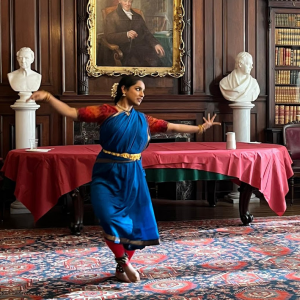
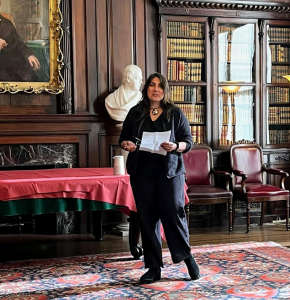
The MHS celebrated AAPI Heritage Month with a special event featuring material from our collections related to the Asian American Pacific Islander Histories including manuscripts, art, maps, and artifacts. As a segue to the arts and culture brought to the Commonwealth by AAPI communities, we were honored to have Bharatanatyam dancer Janani Ganesh of Newton, Mass. perform a classical dance from India to begin the program. The welcome dance was followed by guest speaker Yasmin Padamsee Forbes, Executive Director of the Massachusetts Asian American Pacific Islander Commission, who spoke about the importance of AAPI Voices in both historic and current contributions to the fabric of Massachusetts culture and identity, as well as the need for advocacy of our AAPI communities. 

Janani Ganesh performs a Bharatnatyam dance at the MHS on 30 May 2023. 

Yasmin Padamsee Forbes, Executive Director of the Massachusetts Asian American Pacific Islander Commission, speaks at the MHS on 30 May 2023. 

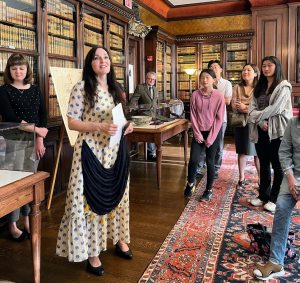
Color image of people looking at a woman in a long floral dress standing between two display cases.
Rakashi Chand and Peter Drummey present to the audience at the MHS on 30 May 2023. 

Below are a few examples of the items exhibited and discussed during the event by MHS Chief Historian Peter Drummey and Reading Room Supervisor and AAPI community leader Rakashi Chand.

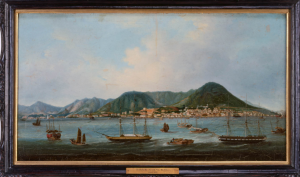
Harbor at Hong Kong, attributed to Lam Qua, [1850s] 

This oil painting of the harbor at Hong Kong is attributed to Lam Qua, a 19th-century artist from the Canton province in China. Also known for his portraits of Western and Chinese merchants, as well as medical subjects, Lam Qua was one of the first Chinese painters exhibited in the West. For further reading about this painting and a companion view of the Harbor of Macao, visit www.masshist.org/database/2277

Harbor at Hong Kong, attributed to Lam Qua, [1850s] 

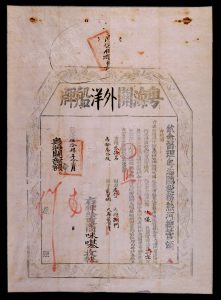
Grand Chop of the ship Astrea 

Grand chop, or permit, issued to the ship Astrea in Guangzhou (Canton), China, January 1790. The Grand Chop permitted the ship and its cargo to leave the anchorage at Huangpu Qu (Guangzhou Shi, China). To learn more, visit www.masshist.org/database/2519.

Grand chop of the ship Astrea, January 1790

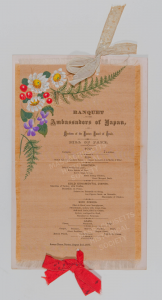
Banquet to the Ambassadors of Japan, by Members of the Boston Board of Trade: Bill of Fare, broadside on silk, 2 August 1872 

After Commodore Matthew Perry’s Mission of Peace and Goodwill opened commerce with Japan, an Embassy or mission lead by Iwakura Tomomi visited Europe and America to improve the unequal terms given to Japan by Western countries and to learn about the West. In 1872 Boston, the Boston Board of Trade hosted a lavish banquet at the Revere House with speakers including Ralph Waldo Emerson and Dr. Oliver Wendell Holmes. The latter composed a poem for the occasion that begins with the line, “We welcome you, Lords of the Land of the Sun!” Learn more at www.masshist.org/database/2707.

Banquet to the Ambassadors of Japan, by Members of the Boston Board of Trade: Bill of Fare, broadside on silk, 2 August 1872 

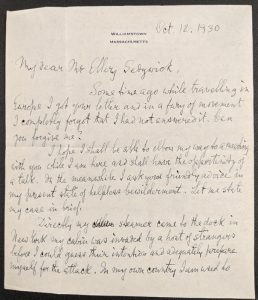
Rabindranath Tagore to Ellery Sedgwick, 12 October 1930 

In this letter dated 12 October 1930, Rabindranath Tagore writes to Ellery Sedgwick as a friend seeking guidance on how to handle the American media. In this letter, Tagore reveals his thoughts not only about his experience of coming to America, but what he feels as an Indian in America at that moment in time trying the grasp and understand American culture. Read more in this blog post.

Rabindranath Tagore to Ellery Sedgwick, 12 October 1930, From the Ellery Sedgwick Papers

Massachusetts Oct. 12, 1930  

My Dear Mr. Ellery Sedgwick,  

Some time ago while travelling in Europe I got your letter and in a fury of movement I completely forgot that I had not answered it. Can you forgive me?  

I hope I shall be able to elbow my way to a meeting with you while I am here and shall have the opportunity of a talk. In the meanwhile I ask your friendly advice in my present state of helpless bewilderment. Let me state my case in brief.  

Directly my steamer came to the dock in New York, my cabin was invaded by a host of strangers before I could guess their intention and adequately prepare myself for the attack. In my own country I am used to  such unannounced and unforeseen catastrophe. We are a democratic people with our doors open to all kinds and conditions of men. My position in the world offers no barricade against intrusion into my privacy, interruption of my work or disturbance of my peace of mind. So with a spirit of resignation which has become habitual to me, I silently suffered these unexpected guests of mine to fill up all of the available space in my cabin. At first, in my pathetic vanity, I though it was deputation from some committee which tried in its own manner to express its obligation to offer me welcome at the moment of my reaching your shore. But their object was made clear to me when they brandished their pencils and notebooks and began to question me about matters that were personal to myself or that concerned my own country. I meekly accepted the inevitable decree of my fate and did my best to satisfy their curiosity in as clear a language as was in my ability to use. Let me assure you that I did not court this publicity nor did I appreciate it as a favour. However, the next day to my painful surprise I found in the first newspaper that came to my hands my words twisted to give a contrary suggestion to what I tried to convey to them. Then I came to know from my friends that several other newspapers have followed the same track of misinterpretation on questions vitally important for my people and for the cause of truth. I am sorely puzzled. I cannot ascribe this to a sudden epidemic of unintelligence among the American reporters and my vanity forbids me to think that I failed to make my meaning clear specially on points which would lead to mischief if vaguely expressed. I fully know that all earlier misinformations have the advantage over the contradictions that follow later as the wound creates a deeper impression than the bandage. And yet I did send my own original version to one of the most important of these papers and waited for its appearance on the next morning. But I find that they are not as prompt in publishing the correction as they have been in giving currency to the wrong statement. I am a simple man from the East and I hate to carry in my mind distrust against any section of your community specially the one whose duty it is to supply information to the public. I tell you truly it has made me feel afraid, for I do not know the technique of your public life and it tires me to be always on my guard. I am beginning to feel like a pedestrian from my country trying to walk in his own absent-minded manner in some busy street in New York and suddenly finding some necessary portions of his limbs disappearing in the dust. I only wish I could laugh at my misadventure, but that has become impossible even for an oriental philosopher owing to its extremely mischievous nature. I have come to the conclusion that the only place which is safe for the eastern simpleton is his own remote corner of obscurity. Waiting for some advice and consolation from you  

I remain  

Very sincerely yours  

Rabindranath Tagore  

Sent from:   
Buxton Hill  
Williamstown  
Massachusetts  

“May the New Year bring our family together in peace and happiness”: Narratives of Jewish American Soldiers During WWII

By Susanna Sigler, Library Assistant

In my previous blog posts, I have explored MHS collections related to WWII. It likely isn’t a surprise by now that the Society holds a relatively small but strong number of these collections. But did you know that several of them are personal narratives of Jewish American soldiers? As we near the end of Jewish American Heritage Month, and having just observed Memorial Day, I want to highlight a handful of these Jewish voices in our collections.

One is the Robert E. Siegel papers, which I looked at for two blog posts this past year. Robert was a young soldier killed in France in 1944, and his mother compiled two scrapbooks in her quest to have him posthumously awarded the Bronze Star. As a Jewish American, I found it deeply moving to see this work of love and grief, especially the pages filled with notes of condolence from friends and family alike. In letters to his parents during training, Robert writes of attending events hosted by the Jewish Welfare Board, a non-profit which, alongside other organizations like the YMCA, attended to the spiritual and recreational needs of soldiers during the war.

Another collection is the Levovsky family papers, which contains letters by two brothers overseas to family back home. David (“Dave”) Levovsky served with the U.S. Army, 681st Quartermaster Laundry Company, and his brother Simon (“Sy”) with Army counterintelligence. David’s letters are not the narratives of combat that we largely see portrayed in popular films and books – his unit’s work is part of the massive infrastructure needed to move men and machines across a continent, and which we often forget about when thinking about the war. It’s fascinating to read about how David uses his “Jewish” (Yiddish), augmented by some German, to communicate with Polish and Yugoslavian POWs who are on labor detail. The Levovskys exchanges High Holiday greetings, andDavid is sent gifts of dried fruit (except from his sister Bertha, who sends a salami – his response is truly hilarious). He attends services when he can, and in one especially moving letter, recounts meeting a Jewish refugee in Normandy, “a nice little old lady with a blue dotted kerchief over her head” who visibly relaxes when in the company of David and fellow Jewish soldiers.

Image of a printed pages with some handwritten text on top of a page of handwritten text.
New Year’s greetings V-mail from David Levovsky to family back home.

The last collection I want to share is the Samuel L. Barres papers, recently written about by Meg Szydlik in her series on disability in the archives. Samuel was Jewish, the only son of immigrant parents. When he wrote home to his widowed mother, he sugarcoated his experiences so as not to make her worry. He speaks fondly of her home cooking, writing that he really can’t think of anything else for her to send him unless she could send him some herring or gefilte fish (agree to disagree here, Samuel).  Like David Levovsky, he refers to his Yiddish as Jewish, and helps his mother with her English through gentle lessons in his letters. I couldn’t help but draw parallels to my grandmother’s family – like Samuel, she and her brothers were born to Jewish immigrant parents. All three of my great uncles served in WWII (as did my grandfather), and at the time of the war were children of a widowed mother. He had passed away when my grandmother, the youngest, was seventeen, the same age as Sam.

Image of a New Year's card. The card depicts a burning candle on the left, an open book on the right, and text at the bottom.
New Year’s card from Samuel Barres to his mother Sarah – note the Jewish Welfare Board logo at the top.

Like each collection here, the Barres papers are a treasure trove, and I can’t do them justice in a blog post. However, Day, I wanted to highlight an appeal written by Samuel’s friend Bill Carmen, who was the national commander of the Jewish War Veterans of the United States of America, as well as instrumental in the construction of the New England Holocaust Memorial in Boston. Titled “Why Should I Join The Jewish War Veterans,” he speaks of solidarity between veterans organizations against antisemitic prejudice – people who call Jewish soldiers cowards who “sat out the war in the Quartermaster Corps and never left the States.” (This is the same unit with which David Levovsky served, as you’ll recall – he did not sit out the war, and even left the states.) “We helped win the war,” Carmen writes. “[l]et’s not give up now!”

Image of a page with two columns of printed text.
Appeal by Bill Carmen on why Jewish soldiers should join the Jewish War Veterans group.

Exploring these collections, I experience a range of emotions – sadness, fierce pride, feelings of familiarity and tenderness reading these soldiers seek out the comfort of their religion and upbringing far from home, what I know too having grown up as an Ashkenazi Jewish person in Massachusetts. All this in a war that always was and proved itself further to be deeply, horrifically personal.

Further reading on these collections can be done by visiting the MHS, and I really recommend that you do. I also want to share the Library of Congress page for the 2023 Jewish American History Month, as well as this blog series by Claire Jones on Judaica in the collections of the American Antiquarian Society.

Sources

Long, Tom. “William Carmen, ‘man of many passions.’” The Boston Globe. December 31, 2004. Accessed May 24th, 2023. http://archive.boston.com/news/globe/obituaries/articles/2004/12/31/william_carmen_man_of_many_passions/.

“National Jewish Welfare Board.” Wikipedia. Accessed May 24th, 2023. https://en.wikipedia.org/wiki/National_Jewish_Welfare_Board.

Congratulations to the Student Winners of our 2023 National History Day Contest in Massachusetts!

by Simbrit Paskins, Student Programs Coordinator

The 2023 National History Day season has been a whirlwind of epic proportions! Folks from across the Commonwealth came together energized for our first fully in-person contest season since the onset of COVID, and they came back with a bang! 

With 4,000 NHD participants across the state this year, over 600 middle and high school students competed in the Regional and State contests hosted by the MHS. It was impressive to witness student work come to life over the course of this program year: Guided by over 90 dedicated educators, students presented almost 350 projects to over 90 judges, all history lovers who enthusiastically volunteered their time to carefully assess the students’ work. While judges reviewed rubrics for each project category and prepared to interview the students on their topics, teachers tirelessly supported student work and helped move students’ projects from concept to reality, making this year’s local contests a collective community achievement!

Navigating after-school clubs, extra-curriculars, and even holiday breaks, students showed up this year with their historian hats on to teach us all about a wide range of topics that speak to this year’s NHD theme, “Frontiers in History.” Students developed papers, websites, performances, exhibits and documentaries to share about people, places, things, and ideas that demonstrate a frontier being crossed in history. What a sight! And we, their very impressed pupils, listened in awe! Projects covered a wide range of subjects such as: women’s roles in war, frontiers through race and gender, LGBTQ representation in literature, advancements in technology such as music and video games, frontiers in fashion, American furniture, entertainment, and even space exploration! 

2 smiling student presenters and 1 adult judge stand in front of a tri fold poster board sitting on top of a table
Students present their Exhibit to a Judge at the 2023 State Contest. Photography by Laura Wulf.
1 student in a classroom, sitting in a chair at a small desk with a pen in hand, leaning forward, enacting a performance
Student enacting an original performance at the 2023 State Contest. Photography by Laura Wulf.

On Saturday, April 1, we hosted an exciting awards ceremony at Winchester High School where NHD Winners from Massachusetts were announced at the closing of a very rich state contest. Among the many special History Day guests was Sen. Paul Feeney, who spent the morning observing project presentations and interviews and meeting NHD constituents! This visit helped all of us shine an even brighter light on the incredible experience that is National History Day.

Man in suit with soft smile facing the camera speaking to two students with backs to the camera and one students behind a piano, back also facing the camera.
Senator Feeney chats with NHD Students at the 2023 State Contest. Photograph by Laura Wulf.

This year, 50 projects received gold, silver and honorable mention awards, and local institutions sponsored 30 special prizes, including: Best Project in: Massachusetts History, LGBTQ+ History, and African American History. Our 62 Gold and Silver medalists will be moving on to the National Contest this June at the University of Maryland.

When I first began working here at the MHS, I was told that “National History Day is more than just a day, it is an experience!”, and after my first year of coordinating this program, I can see that nothing is more true. NHD builds strong community ties between folks from all different walks of life, connecting us under one common goal of supporting young people in their exploration of and relationship to history and to themselves. Teacher mentors connect their youth with the program on an individual basis, as a whole class, and even as an after-school program, opening the door for students from all backgrounds to explore history with both a critical and curious lens! Parents & guardians help students glue the pieces of their exhibits together, practice performance lines when no one is watching, equip and encourage students to advocate for themselves when in need, & usher their young people to our local contests on early weekend mornings. 

Thank you again to all of the students, teachers, parents, schools, and judges who supported the 2023 contests. Thank you as well to all of our sponsors at the Mass Cultural Council and the Commonwealth of Massachusetts, who help us grow the program and make it accessible to all students.

We invite members of the public to learn more about the NHD program and to contact us at nhd@masshist.org for more information. There are so many ways to engage with this program and support its growth! 

“This Looks Warlike”: The Journal of Howard J. Ford, Part II

By Susan Martin, Senior Processing Archivist

This is the second installment in a series. To read Part I, click here.

A few weeks ago, I introduced you to Howard J. Ford and his Civil War journal, held by the Massachusetts Historical Society. The MHS holds many collections related to the Civil War, of course, but this journal is truly remarkable. It’s not often we get such an honest and intimate look at a soldier’s inner life.

On 4 September 1862, Howard J. Ford of Cambridge, Mass. enlisted for nine months’ service in the 43rd Massachusetts Infantry Regiment. He started his journal one week later, on the day he reported to Camp Meigs at Readville, Mass. I call it a “journal,” but it really consists of loose pages of stationery that Howard initially titled “Memoranda” and sent home at intervals over several months.

Color image showing several handwritten pages
Pages from the journal of Howard J. Ford, Nov. 1862

Howard and his younger brother George were mustered in as privates on 24 September. The first few pages of Howard’s journal contain brief, dashed-off entries about life in camp, equipment issued, duty details, and the weather (mostly rain). But the 43rd Regiment was stationed at Readville for just six weeks, leaving from Boston Harbor on 10 November 1862. Their destination was New Bern, North Carolina.

The weather seemed to bode well. As Howard wrote, “This morning the sun shines and he seems almost like a stranger.” The men sang “Home, Sweet Home” as their ship pulled away from shore. And Howard made the following pledge in his journal: “I dont [sic] intend to come home if I have […] to save my life by being a coward or disobeying orders. Howard.”

His ship, the Merrimac, and two other troop ships, the Mississippi and the Saxon, traveled as a convoy under the protection of a gunboat, the Huron. The voyage was relatively uneventful, except for the usual bouts of seasickness and an accidental shooting. (Lt. Henry A. Turner shot himself in the foot “in consequence of carelessly handling his pistol while cocked.”)

When Howard disembarked in North Carolina on 15 November, he was unimpressed, calling it “a mean sort of a place.” Traveling inland, he described the landscape in more detail, including soil that was a combination of “sand & swamp”; architecture (“chimney on the out side of the house”!); and “that peculiar moss hanging [from trees] in pretty festoons.” He also began to see “contrabands,” or enslaved people who had escaped bondage and now worked for or sold goods to Northern troops.

The Union camp, later named Camp Rogers, was located on the southern bank of the Trent River. But even though Northern troops had occupied New Bern for the past eight months, Howard was disappointed to find “no tents, barracks or food ready for us.”

Sepia-toned image of a photograph showing people lined up in a rectangular shape. There are people in the middle of the rectangle. Some are on horseback. In the background are trees.
Photograph of Camp Rogers from Wikimedia Commons

His journal entries at New Bern contain a lot of vivid descriptions, even a few sketches. For example, here’s how he explained a skirmish drill to family members back home:

In this style of fighting the men keep at least 5 paces apart, so that it is more difficult to hit them than in the ordinary way. We also move more rapidly. It is lively work. One minute we are scattered over a long line, and the next rallied by fours, or perhaps sections or platoons. All up in a cluster with our bayonets looking like a porcupine sticking out in every direction to keep off cavalry. Sometimes we load and fire lying down, kneeling, advancing, retreating.

Howard knew Confederate troops were positioned nearby and that the next battle was probably imminent. He told his family that he anticipated having “a chance at the rebels” within the month. When each soldier was issued twenty rounds of ammunition, he wrote ominously, “This looks warlike.”

Stay tuned for more about Howard J. Ford in my next post!