“Old Ironsides”: The United States’ Innovative Ship of State

by Aaron Peterka, MHS Early Career Scholar Committee & Mentorship Program Member

On July 22, 1798, U.S.S. Constitution set sail on its first deployment. Two hundred twenty-seven years later, “Old Ironsides,” the world’s oldest commissioned warship still afloat, serves as a living link to its illustrious past. Yet, the heavy oak hull responsible for its name is but a part of a design that made Constitution so formidable.

When naval architect Joshua Humphreys planned the country’s first frigates, he was fully aware that the navy would be at a numerical disadvantage to its British and French rivals. Thus, the need for a fast, agile ship with enough firepower to outrun, outmaneuver, or outfight a two or three-deck enemy ship-of-the-line. Such a ship would “‘render those of an enemy in a degree useless, or require a greater number before they dare attack our ship.’” From this necessity Constitution was born.

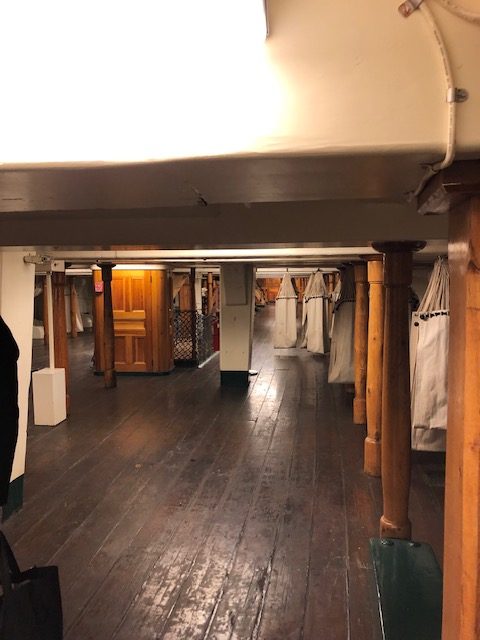
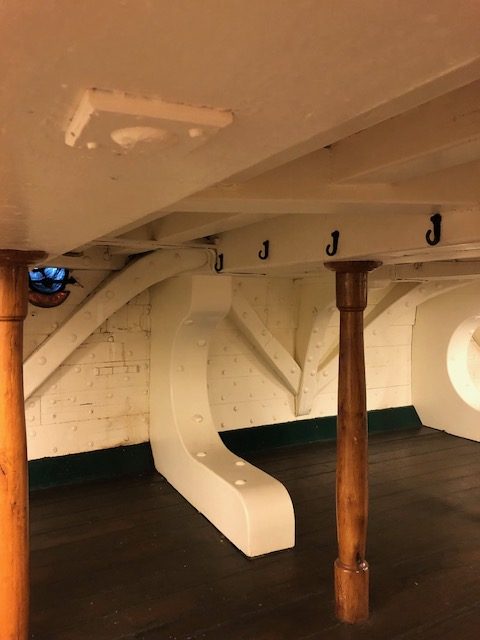
At 175 feet long and a beam of 43.5 feet, U.S.S. Constitution was wider and longer than the average British frigate; its narrower frame and higher “length-to-beam ratio” enhancing its speed and maneuverability. Furthermore, its reinforced spar deck allowed the ship to carry heavier cannons and carronades, and its unique integrated deck design prevented keel distortions caused by uneven weight dispersal at opposite ends of the ship. Humphreys’ system connected the spar, gun, and berth decks through a series of stanchions, knees, and planks, which evenly distributed the weight from the gun deck through the decks below. Six pairs of “diagonal riders” resembling those in a Pennsylvania Dutch barn channeled that weight to the center of the keel. The result was a solid 44-gun frigate that carried 55 and cruised at a top speed of 13.5 knots.

Wooden stanchions, right and far left, on U.S.S. Constitution’s berth deck.
Courtesy of Aaron Peterka
An example of wooden stanchions (left and right) and white knee (middle) supporting Constitution’s integrated deck system.
Courtesy of Aaron Peterka

Constitution’s innovations would serve it well during the War of 1812 with Great Britain and are visible throughout various holdings at the Massachusetts Historical Society. Its firepower is unmistakable in the de-masted wreck of the British H.M.S. Guerrière in D. Kimberly’s engraving of that famous 1812 sea battle, as is Midshipman Frederic Baury’s account of Constitution having “Shott away” H.M.S. Java’s masts, bowsprit, gaff, jib, and spanker booms. The Society’s detailed 1800 broadside engraving of Paul Revere and Son at their Bell and Cannon Foundry reflects how that company produced the frigate’s copper bolts, as well as its 242-lb bell and 10 carronades. Moreover, its speed and agility are also evident in records like Baury’s letter to his mother during the War of 1812 declaring, “‘Our Ship Sails remarkably fast and I think thus but Little Danger of our being Taken.’” His logbook observation of H.M.S. Java’s attempt to “rake” Constitution, which the ship “avoided by wearing” (changing course by turning its stern through the wind) confirms his confidence.  

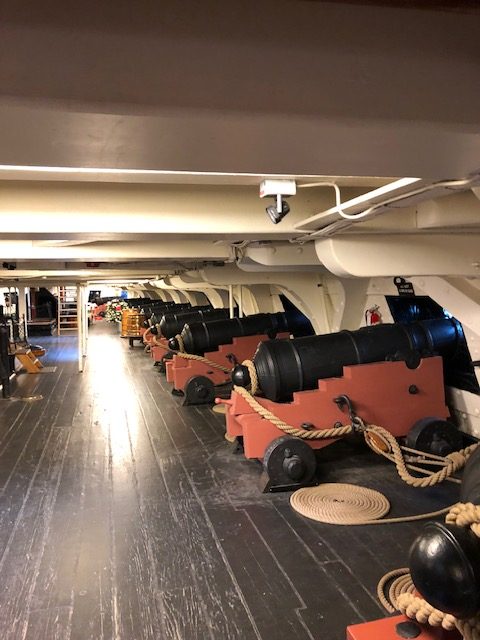
Looking down the gun deck and its 24-lb long guns on the right.
Courtesy of Aaron Peterka

At its height, U.S.S. Constitution was one of the most feared frigates at sea, and fortunately, this history is not lost. Today, people can see and touch it through the MHS’s physical & online collections and by touring the ship at the Charlestown Navy Yard. By doing so, visitors are stepping aboard one of the most innovative warships of its time; one that was fast, nimble, and undefeated.

Further Reading:

“Paul Revere’s Cannons.” Paul Revere’s Cannons | Paul Revere Museum The Paul Revere Heritage Site | Canton, MA.

Tyrone G. Martin. A Most Fortunate Ship: A Narrative History of Old Ironsides. Annapolis: Naval Institute Press, 1997.

“U.S.S. Constitution Facts.” January 11, 2023. https://ussconstitutionmuseum.org./uss-constitution-facts/.

Adams Family Correspondence, Volume 16: Part Three

by Miriam Liebman, Adams Papers

The newest Adams Papers publication is here! Adams Family Correspondence, volume 16, follows the Adams family from the end of 1804 through the middle of 1809 as John and Abigail Adams spent time at Peacefield and guided their growing family through challenges, big and small. This is the last of three blog posts exploring the volume’s main themes.

Part Three: The Adams Family, Party Politics, and Great Britain

The third major narrative arc in Adams Family Correspondence, volume 16, concerns the increased tensions between the United States and Great Britain, which posed the greatest threat to the new nation. Conflicts on the seas and impressment of sailors threatened war. As Federalists and Democratic-Republicans sought solutions to these issues, John Quincy Adams broke from family and Massachusetts tradition and sided with the Democratic-Republicans in voting for an embargo against Great Britain. Abigail challenged him to explain his vote since it would affect local families, and an anonymous newspapers article asked John Quincy to consider his father’s legacy when deciding his congressional actions. John Quincy defended himself by saying country comes before party. In response, the Massachusetts General Court voted to replace him as senator when his term ended, but he did not wait and resigned immediately.

While the United States sought to eliminate the prospect of war, tensions would further escalate between the two nations over the next several years. The volume ends with John Quincy heading off to St. Petersburg to serve as the first US minister to Russia. For those adventures, you will have to stay tuned for Adams Family Correspondence, volume 17.

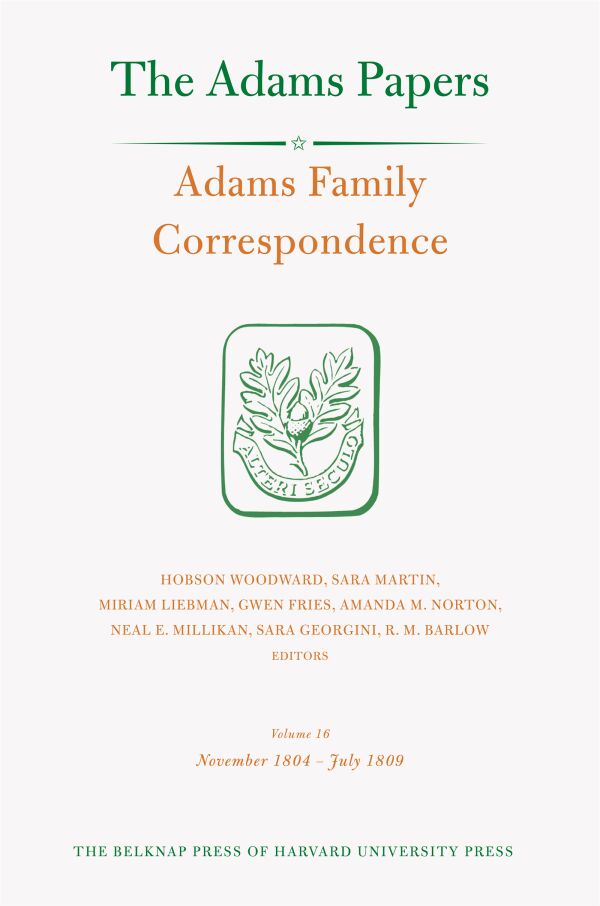
The cover of the Adams Family Correspondence. There is text on an off-white background. In the center is the oak leaf seal of the family.
The cover of the latest Adams Family Correspondence volume

The Adams Papers editorial project at the Massachusetts Historical Society gratefully acknowledges support for this volume from the National Endowment for the Humanities, the National Historical Publications and Records Commission, and the Packard Humanities Institute.

Adams Family Correspondence, Volume 16: Part Two

by Miriam Liebman, Adams Papers

The newest Adams Papers publication is here! Adams Family Correspondence, volume 16, follows the Adams family from the end of 1804 through the middle of 1809 as John and Abigail Adams spent time at Peacefield and guided their growing family through challenges, big and small. This is one of three blog posts exploring the volume’s main themes.

Part Two: The Adams Family and the Miranda Expedition: Scandal, Intrigue, and Rumor

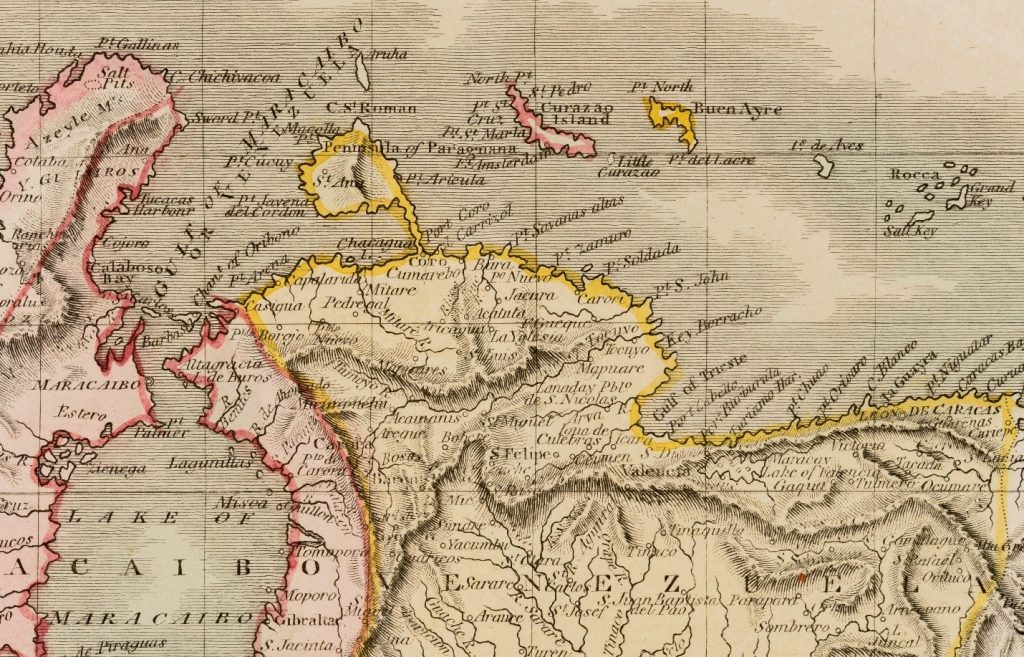
Adams Family Correspondence, volume 16, contains many political stories, but the Miranda Expedition might be the most surprising one. From their home in Quincy, Mass., the Adamses were drawn into scandal from the involvement of their son-in-law, William Stephens Smith, and grandson, William Steuben Smith, with Francisco de Miranda’s failed attempt to overthrow Spanish rule in Venezuela. From February through August 1806, Miranda, a Venezuelan revolutionary and friend of William Stephens Smith, staged an expedition to liberate Venezuela. Miranda met with President Thomas Jefferson and James Madison seeking financing from the United States but failed to garner their support. William Steuben joined as a member of the expedition. Prior to her son’s departure, Nabby wrote to Miranda asking him to care for her son and stating that due to his long friendship with her husband and her “own observations, I can say that I do not know any person to whom I could with so much confidence entrust him.” As newspapers reported the mission’s failure and rumors swirled regarding the sailors, the Adams family worried about William Steuben’s fate. The family learned he was safe when he crossed paths in Cambridge with his uncle John Quincy on his way to Peacefield. Many others in the expedition were not as lucky; the Spanish executed and imprisoned many of the participants.

Map of the coast of Venezuela highlighting the area near Caraccas.
Detail from “Caraccas and Guiana,” by John Moffat, 1817. Collection of the Massachusetts Historical Society.

William Stephens Smith lost his job as surveyor of the port of New York and was indicted for helping Miranda but was ultimately acquitted of the charges. John Quincy was “very sorry to see a connection of ours so much implicated.” William Steuben Smith struggled to find a career path upon his return and went with his uncle to serve as his secretary in St. Petersburg. For more on his time in Russia, stay tuned for the (already underway!) next volume of Adams Family Correspondence.

The Adams Papers editorial project at the Massachusetts Historical Society gratefully acknowledges support for this volume from the National Endowment for the Humanities, the National Historical Publications and Records Commission, and the Packard Humanities Institute.

Adams Family Correspondence, Volume 16: Part One

by Miriam Liebman, Adams Papers

The newest Adams Papers publication is here! Adams Family Correspondence, volume 16, follows the Adams family from the end of 1804 through the middle of 1809 as John and Abigail Adams spent time at Peacefield and guided their growing family through challenges, big and small. Several of the volume’s main themes will be explored over the course of three blog posts, including family, the Miranda Expedition and its repercussions, and the deteriorating politics between the United States and Great Britain.

Part One: The Adams Family at Home

At the center of volume 16 of Adams Family Correspondence is the growing Adams family at their home, Peacefield. The 236 letters in this volume highlight the bustle of almost every family member crossing paths with John and Abigail, including some of the first letters to their older grandchildren. Settled into their retirement, Abigail oversaw the household, cared for grandchildren, and even looked at houses to rent in Cambridge for John Quincy and his family, while John took care of his farm and educated the grandchildren. Daughter Nabby and all three of her children briefly lived at Peacefield to escape her husband William Stephens Smith’s financial and political troubles before they moved to a new homestead in upstate New York. John Quincy and Louisa Catherine Adams spent Senate recesses in Boston, and briefly moved to the area during John Quincy’s short tenure as a professor at Harvard. They also welcomed son Charles Francis Adams. Thomas Boylston Adams tried the family business of politics but settled instead into his career as a lawyer. He lived at Peacefield with his new wife Ann Harrod Adams, where two daughters were born to the youngest Adams couple.

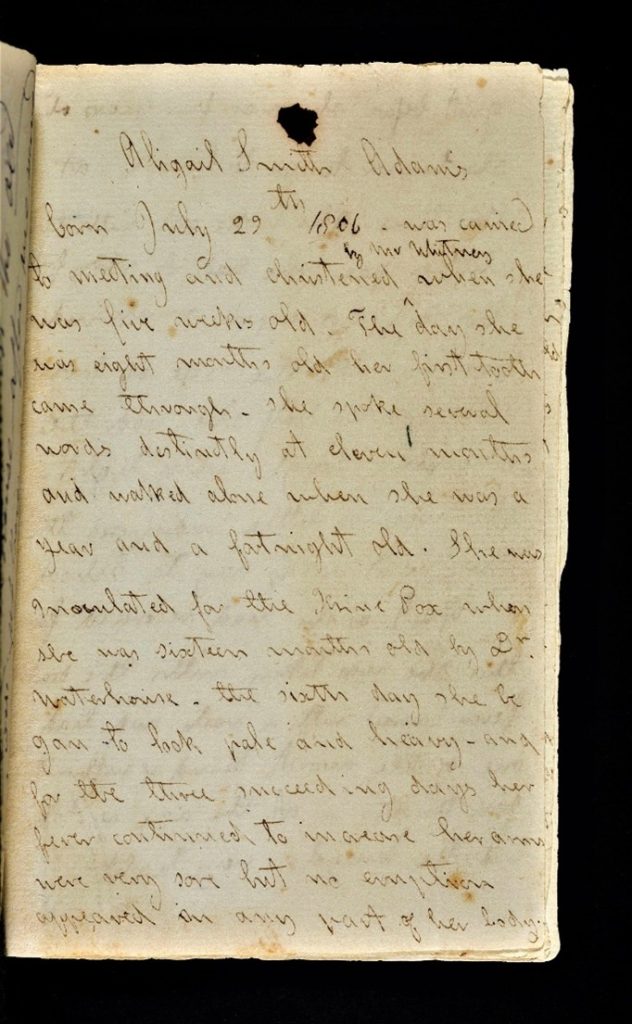
Handwritten document that reads: "Abigail Smith Adams born July 29th 1806–was carried to meeting and christened by Mr Whitney when she was five weeks old. The day she was eight months old her first tooth came through–she spoke several words distinctly at eleven months and walked alone when she was a year and a fortnight old. She was inoculated for the Kine Pox when she was sixteen months old by Dr. Waterhouse. the sixth day she began to look pale and heavy–and for the three succeeding days her fever continued to increase her arms were very sore but no eruption appeared on any part of her body.”
Ann Harrod Adams retained a journal recording her children’s growth, illnesses, and milestones.
Family Record, by Ann Harrod Adams, 1806–1825. Collection of the Massachusetts Historical Society.

Even with all their family events, Abigail and John remained apprised of and involved with political happenings. Abigail questioned John Quincy’s Senate votes and his attendance at a Democratic-Republican caucus writing that it was “inconsistant both with Your principles, and your judgment, to have countananced such a meeting by Your presence.” John began to write about his political life for the newspaper Boston Patriot in the endeavor to pursue “Truth and Justice” in shaping his legacy. From their home, they worried as domestic scandals and international tensions challenged the new nation.

The Adams Papers editorial project at the Massachusetts Historical Society gratefully acknowledges support for this volume from the National Endowment for the Humanities, the National Historical Publications and Records Commission, and the Packard Humanities Institute.

Clara E. Currier’s Diary, July 1925

by Hannah Elder, Associate Reference Librarian for Rights & Reproductions

Today we return to the transcription of Clara E. Currier’s 1925 diary. Currier was a working-class woman who lived in or near Haverhill, MA. Her diary records her daily activities—from fiber arts to paid employment to observations of the natural world—providing insight into daily life a century ago. You can find entries for January, February, March, April, May, and June in past blog posts.

July is another hot month, punctuated with occasional rain showers. Haverhill plays host to two national figures: President Calvin Coolidge and the rigid airship USS Shenandoah. The community also suffers a loss in the passing of Berenice (or Bernice) Marsh, a little over a month after she had given birth to a baby boy in June. Clara attends her funeral, noting it was “very sad.” Alongside this sadness, the rhythms of the summer continue, with an abundance of berries, parties to attend, and a trip to the coastal communities of southern Maine.

July 1, Wed. Fair, and hot, cooked.

July 2, Thurs. $19 Fair, Blanche came over.

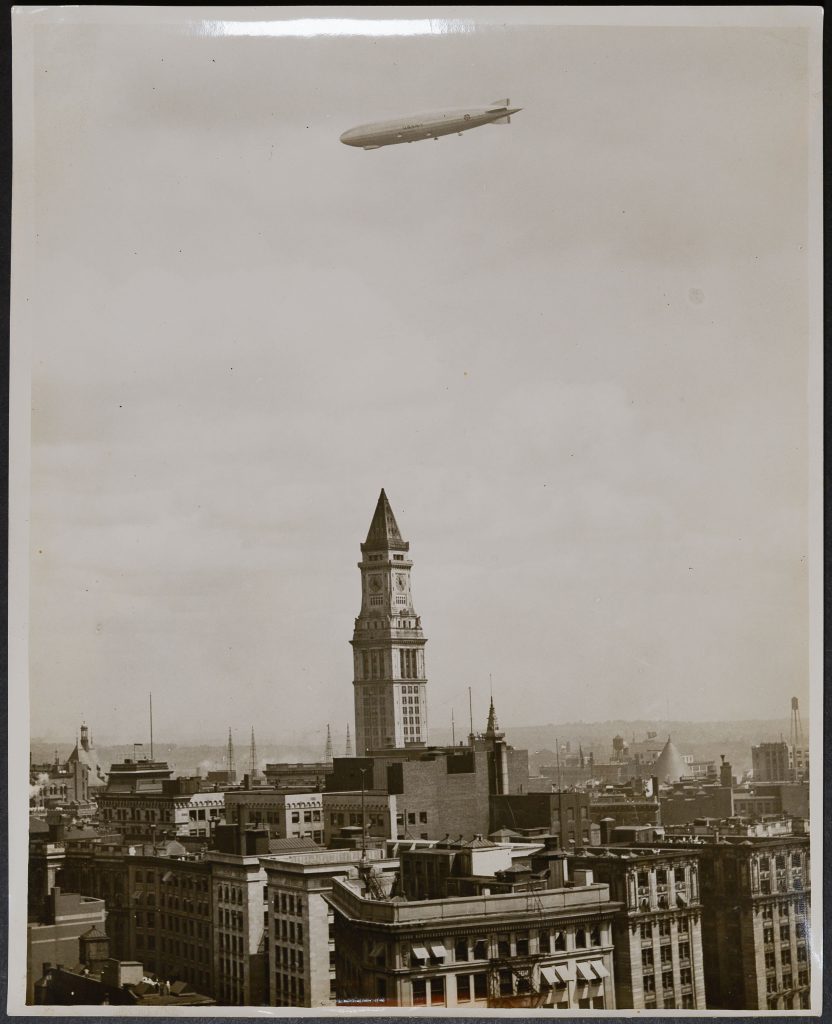
July 3, Fri. Fair, went up home, saw the [dirigible] Shenandoah.

USS Shenandoah flies over the Boston Customs House tower in a black and white photograph.
MHS Photo. 10.20 USS Shenandoah above Boston Customs House, ca 1925

July 4, Sat. Dull with showers, picked peas, strawberries and washed, started an English Broadcloth dress. Bernice Greeley has a baby boy.

July 5, Sun. Fair and hot, rained early, picked strawberries, came home.

July 6, Mon. Fair with showers, sewed.

July 7, Tues. Fair and showers, went to Salisbury Beach after meeting at Grange.

July 8, Wed. Fair, sewed and cooked, Blanche sick with diptheria. [sic]

July 9, Thurs $17.10 Fair, went up town.

July 10, Fri. Fair, went up to Etta’s, picked cherries and blueberries.

July 11, Sat. Fair, Pres. Coolidge was in town guest of Mr. Bauer at Pond Hills, went to Haverhill to see Mr. + Mrs. P.

July 12, Sun. Fair, went to church + S.S, read.

July 13, Mon. Fair, went up town.

July 14, Tues. Fair, finished my dress.

July 15, Wed. Fair, cleaned my kitchen. Shower a.m early

July 16, Thurs. [$]19 shower a.m early  Fair, cleaned out funnel. Went up town.

July 17, Fri. Fair, swept and dusted.

July 18, Sat. Fair, went to Haverhill and over home went blueberrying and picked 7 or 8 qts. Canned 8 ½ pts.

July 19, Sun. Fair, picked a few raspberries and blueberries, shampooed my hair.

July 20, Mon. Fair, went up town, cooked.

July 21, Tues. Showers and partly clear, William brought me peas and blueberries. Berenice Marsh died at 11 P.M.

July 22, Wed. Fair with shower at night.

July 23, Thurs. [$]18.62 Fair, went up town.

July 24, Fri. Fair, went up to Berenice’s funeral, very sad, had Rebekah service, called on Mrs. Pickering and Mrs. Quimby, came back and went over to see Sizzie, Grace and her husband.

July 25, Sat. Fair, went to Porpoise Beach, Beachwood, Me with Corner Class guests of Mrs. Willis Cummings had a fine time, went by auto by the way of Portsmouth, York Beach, Ogunquit, ^Wells, Kennebunkport and Cape Porpoise. 31 in all in the party. Crosses the new Memorial bridge between Me. + MH.

July 26, Sun Fair, wrote letters, went down to see Cody and they took me up to Uncle Will’s and home again.

July 27, Mon. Rainy, thunder shower A.M, cooked.

July 28, Tues Dull and cleared, went up home blueberrying with Mr. Dennis, Sizzie went, shower.

July 29, Wed. Fair, came down with Mr. Dennis. out of work the rest of the week.

July 30, Thurs. [$]15.58 Fair, washed and ironed, went up town, Sizzie and I went up home with Mr. Dennis. Went to lawn party up to Alice Marden’s.

July 31, Fri. Fair, went blueberrying, picked around a half bushel. July 31, Fri. Fair, went blueberrying, picked around a half bushel.

If you are interested in viewing the diary in person in our library or have other questions about the collection, please visit the library or contact a member of the library staff.

*Please note that this diary transcription is a rough-and-ready version, not an authoritative transcript. Researchers wishing to use the diary in the course of their own work should verify the version found here with the manuscript original.

This line-a-day blog series is inspired by and in honor of MHS reference librarian Anna J. Clutterbuck-Cook (1981–2023), whose entertaining and enlightening line-a-day blog series ran from 2015 to 2019. Her generous, humane, and creative approach to both history and librarianship continues to influence the work of the MHS library.

Lucius Cary’s Summer Reading List

by Betsy Klima, MHS-NEH Long-Term Research Fellow, Spring 2025

I’ve spent the last few months in residence at the MHS as a long-term research fellow. I’m working on a book on author Susanna Rowson and the story of her novel Charlotte Temple. Charlotte Temple tells the story of an English teenager who falls in love with a British soldier. They sail to New York, where he marries another woman and leaves the pregnant, unmarried Charlotte to a tragic death. My book, Guilty Pleasure: The Story of America’s First Romance Novel, explores Charlotte Temple’s unique popularity with American readers—and shows how it paved the way for today’s romance novels.

Charlotte got good reviews when it was first published in London in 1791. After it debuted in Philadelphia in 1794, Charlotte became a sensation. America’s first best seller, Charlotte Temple would remain in the public consciousness for over a century. Charlotte Temple’s name was inscribed onto an actual gravestone, given to children, and bestowed on a race horse. Her wax body captivated curious throngs. Her image circulated in pocket-sized books with tiny type.

Charlotte Temple was so popular for so long that it’s easy to find copies from the eighteenth and nineteenth centuries in libraries, often inscribed with their owners’ names. But I am looking for more than names. I want to understand how the novel found its early readers.

One day over lunch at MHS, a fellow researcher suggested that the Cary family papers might help me paint a picture of Boston in the 1790s and early 1800s when Susanna Rowson lived in town. So one June day, I sat in the Reading Room, a gray box full of manila folders on the table before me.

The Carys were Bostonians whose sugar plantation on the island of Grenada made them a small fortune. In 1791, patriarch Samuel Cary moved his growing family to a farm in Chelsea, Massachusetts, where they hoped to live out their days in comfort funded by the labor of enslaved people on an island far away. But slave rebellions in 1795 and 1796 destroyed their plantation. By 1797, their finances faltering, the Carys pulled their son Lucius out of school and sent him to work with his brother Sam in Philadelphia.

Handwritten letter
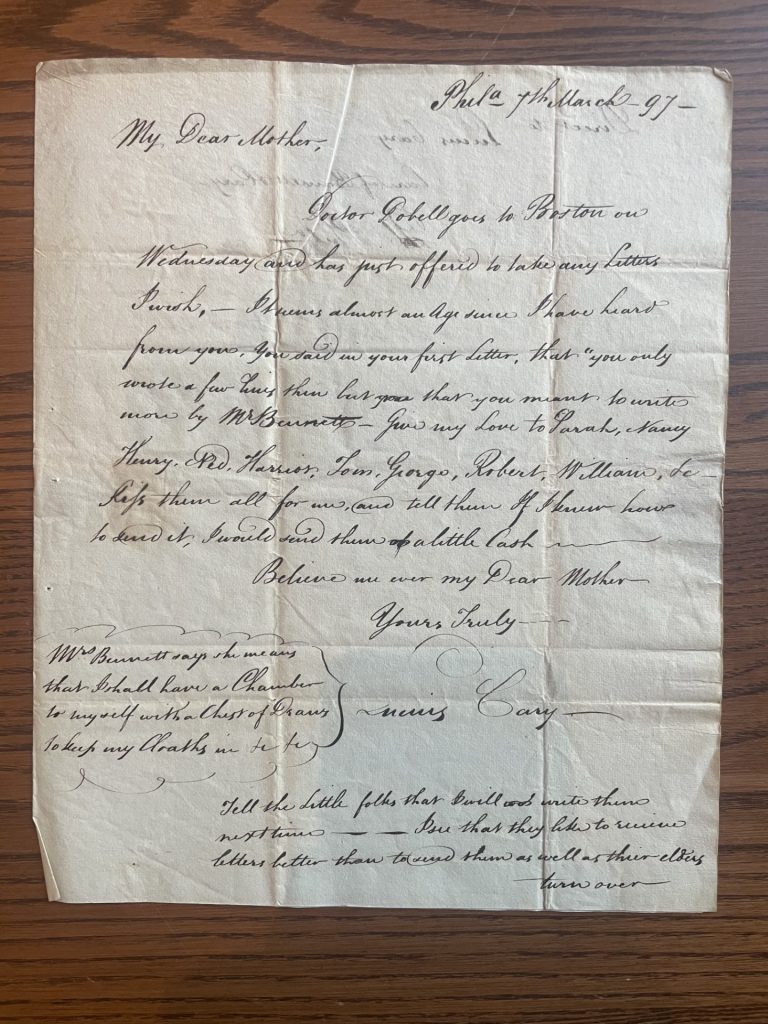
One of Lucius Cary’s letters to his mother, Sarah Cary

Lucius was not happy. His beautiful penmanship makes his feelings clear, even centuries later.  On January 23, 1797, Lucius wrote to his mother, Sarah Cary, “Now I call this a very lonesome life. I have not a single acquaintance…. You know I said in my last letter that I was going to the play. I did and was much pleased. I have found no circulating library yet. I have been quite wretched since I left you for want of society but I have exerted all my philosophy and have almost conquered it.”

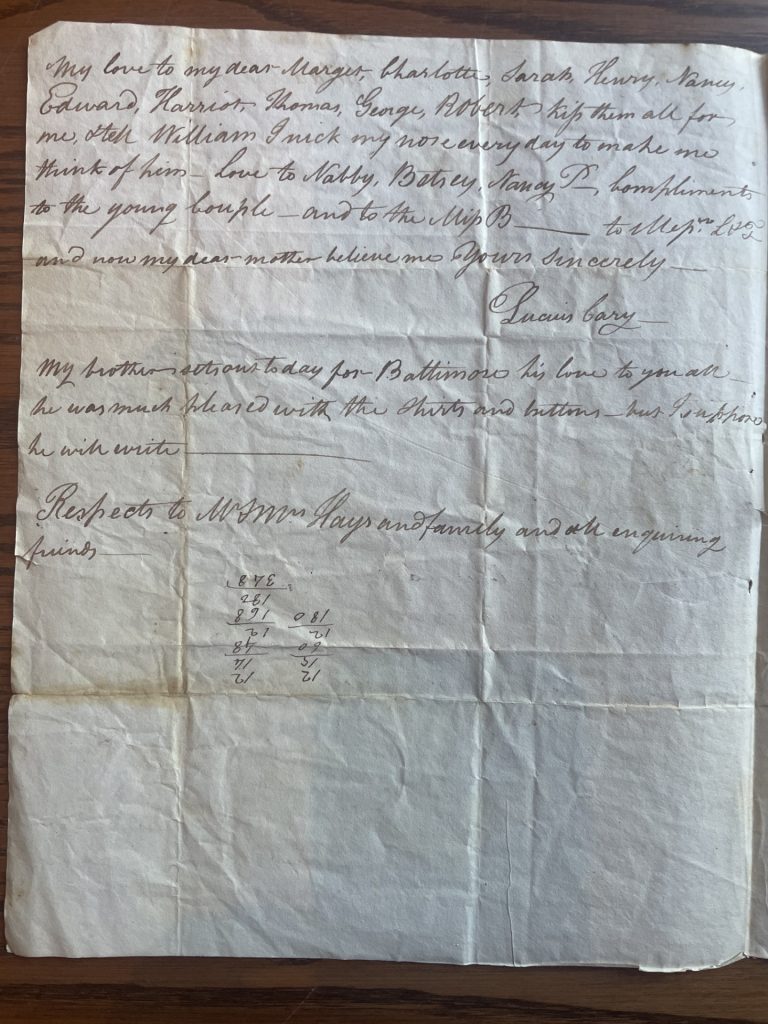
The letter stops me in my tracks—the unmistakable voice of a 14-year-old boy negotiating an unfamiliar and challenging situation. He has been wretched and homesick, but, he reassures his mother, he has “almost conquered it.” He misses his ten younger siblings and sends his love to each of them by name.

Lucius Cary sends his love to his ten younger siblings

Lucius wrote often to his mother about everyday life in 1797 Philadelphia. On March 10, he wrote, “I have been to Rickett’s once and twice to see the Play. I have also had the pleasure of seeing General Washington, Mrs. W, and family, I could hardly believe my eyes when I saw this long wished for sight.” Ricketts’ was a popular equestrian circus. Lucius saw the Washingtons at the New Theatre, where Susanna Rowson performed from 1794-1796.

I could feel myself getting closer. And then I found Charlotte.

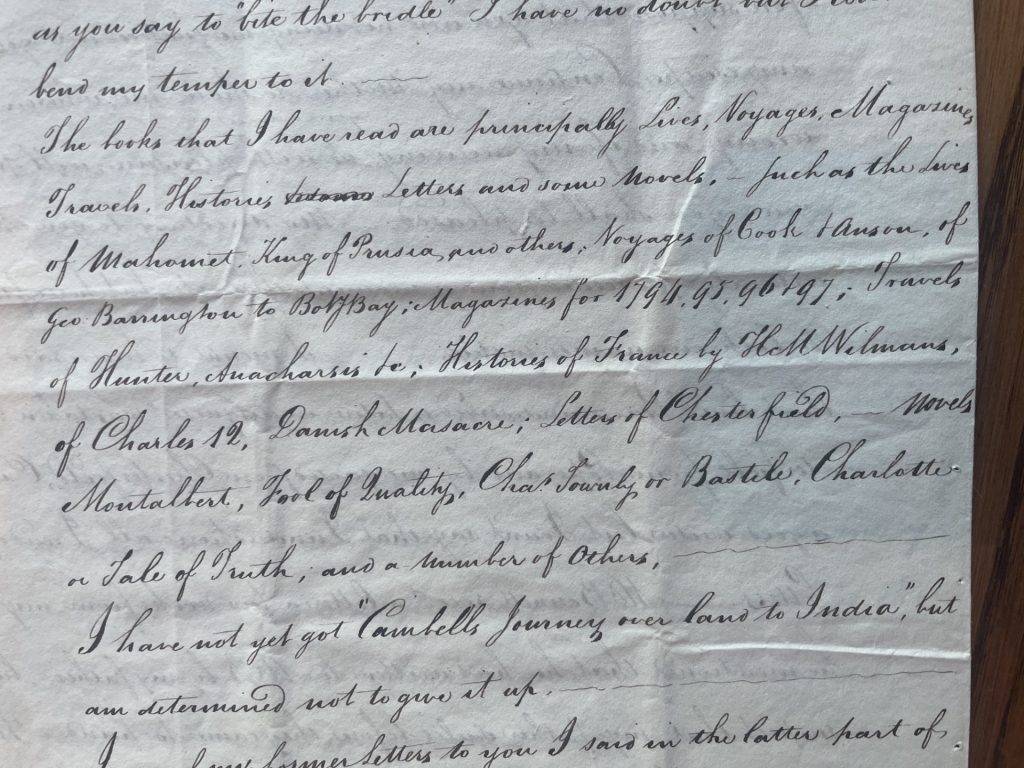
Lucius must have joined a circulating library. On July 1, he informed his mother, “The books that I have read are principally Lives, Voyages, Magazines, Travels, Histories, Letters, and some Novels…Novels Montalbert, Charles Townley or Bastile, Charlotte or tale of Truth, and a few others.”

Lucius Cary’s reading list

Charlotte is there, part of a lonely 14-year-old boy’s reading list. Did the story of teenaged Charlotte, friendless and alone in New York resonate with Lucius? Did it keep him company? Make him laugh? Make him cry? We’ll never know. But the evidence that he read Charlotte keeps me going on my quest to understand why it resonated with so many Americans—and why it’s been forgotten.

John Boit logbooks return to the MHS

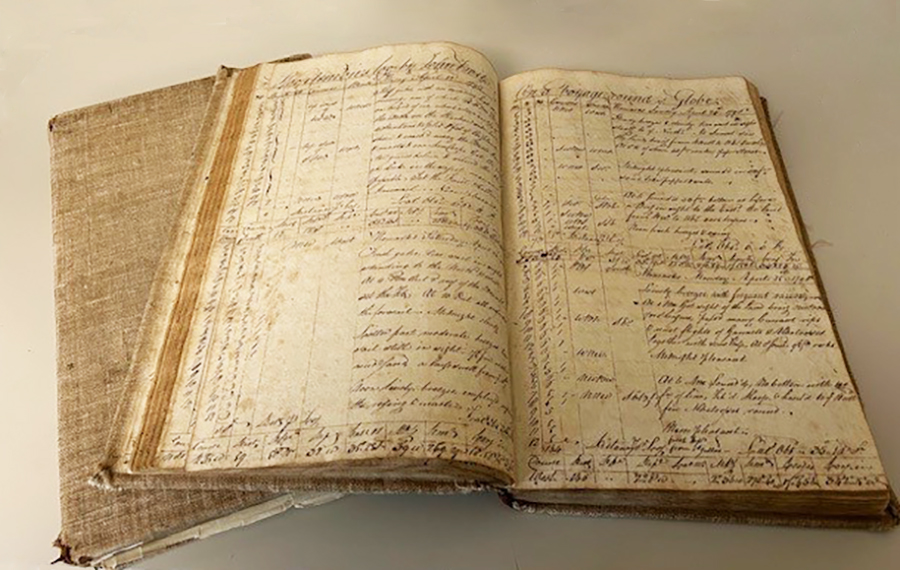
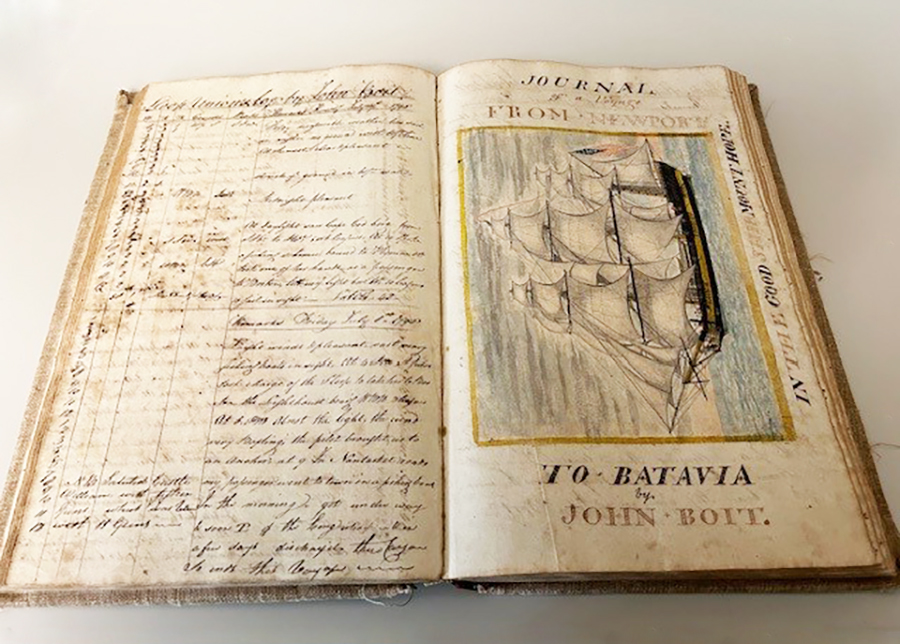
The MHS has held a collection of ships’ logs kept by John Boit, Jr. since his descendant, John Boit Apthorp, donated them in 1919. Three volumes kept by Boit on trading voyages from 1790 to 1802, including a log of the Columbia, document voyages to the Northwest Coast to trade for fur before sailing on to the Sandwich Islands (now Hawaii) and to China in the early years of the newly-opened China Trade. Boit served as a captain’s mate on the Columbia and other vessels before taking command of the Union.

Two volumes covering the Union’s voyage from Newport, R.I., to China via the Northwest Coast had reportedly disappeared when the collection was sent offsite to be microfilmed, probably in the 1960s or 1970s. Until now.

Rusty Farrin of Farrin’s Country Auctions in Randolph, Maine, recently contacted the MHS to report the recovery of two of Boit’s logbooks that were discovered in a storage locker. Farrin’s research revealed that the volumes had been part of the Society’s collection and he generously returned them, as he said, “back where they belong.”

open log book with handwriting across columns
John Boit logbooks

The voyage of the Union spans the two volumes and includes stops in the Falkland Islands, Nootka Sound and other locations in British Columbia, Macao, Canton, and Mauritius from August of 1794 to July of 1796. One volume also documents a voyage from Boston to Charleston, S.C., Dublin, Ireland, and back on the ship Eliza, 1793-1794, and the second includes a voyage from Newport to Batavia in the Dutch East Indies and back on the Mount Hope, 1801-1802. Both volumes include long narrative passages that describe the locations where they anchored, including encounters with indigenous people, as well as watercolor drawings of the vessels and land formations seen along the way.

We are enormously grateful to Mr. Farrin for ensuring these volumes made their way back to the MHS.

open log book with handwriting on the left page and an illustration of a ship with words "Journal From Newport to Batavia by John Boit" on right side
John Boit logbook

Reflections of an Education Intern

By Heather Baxter, Education Intern

Over the last six months I have had the incredible opportunity of working with the Massachusetts Historical Society education department as a Northeastern University co-op student intern. In my time here I have been able to help out with National History Day, Professional Development teacher workshops, class visits, and creating digital education materials. I’ve learned so much and gained so much new experience in my time here, and will be forever grateful to the incredible people I’ve had the pleasure of working with.

The Education team puts so much hard work into organizing National History Day and making it a truly special experience for the students that participate. It was so amazing interacting with students and watching them light up as they spoke about their project topics that they had so thoroughly researched. Although I helped out with a bit of everything, during the State contest my personal responsibility was creating and running a Kahoot contest for students. Kahoot is a game-based learning platform popular in schools. I sent out a form to students in advance where they could submit Kahoot questions related to their project topics, and by the time of the contest we had received over 90 responses. I was so impressed with the thoughtful questions students had submitted and really enjoyed putting together the final Kahoot games.

four screens showing history questions with multiple choice answers
Some of the Massachusetts History Day student-submitted Kahoot questions

On contest day, I ran two Kahoot contests and was amazed as students rushed into the previously empty cafeteria in order to participate. Our second game completely filled up to capacity. It was such a special experience and the students had so much fun battling for Dunkin gift cards and Hershey kisses.

In a large
Students playing Kahoot trivia

My largest long-term project that I worked on throughout my co-op was writing an encyclopedia of abolitionists to be featured on our website. I wrote eight biographies of prominent Black abolitionists Ellen Craft, Charles Lenox Remond, John Van Surley DeGrasse, Joshua Bowen Smith, Philis Wheatley, Frederick Douglass, Eliza Gardner, George T. Downing, and William Wells Brown. It was so incredible getting to do in-depth research on each of these important figures and include relevant items in our collections into my biographies. It made it all the more special when I was given the opportunity to actually see and handle objects such as a first edition of Phillis Wheatley’s book of poetry or a letter written by Frederick Douglass that I had referenced in his biography. I also really enjoyed learning more about and bringing to light abolitionist figures who might be lesser known in our time but were incredibly influential in their own. I often really struggled to single out quotes to include since there were so many powerful and profound options. I really feel like I learned so much throughout this process and gained a lot of new skills as a writer that will continue to be useful as I return to taking classes at Northeastern.

book open to title page of "Poems on Various Subjects, Religious and Moral." On lefthand page is an illustration on Wheatley writing at her desk.
Poems on Various Subjects, Religious and Moral by Phillis Wheatley

I really couldn’t have asked for a better co-op experience with a better team of people and I will miss the MHS so much. The projects I got to work on in my time here have been an absolute dream for a History and English undergraduate student and I will absolutely be using what I’ve learned here going forward both in my academic and professional careers. Thank you for everything!

Four Months in the Life of a Traveling Salesman

by Susan Martin, Senior Processing Archivist 

I’d like to tell you about a small collection at the MHS that includes a truly wild diary. It was written in 1838 by Samuel Leonard of Bridgewater, Massachusetts, as he traveled throughout the Southern United States exhibiting cotton gins to potential buyers.

Color photograph of two manuscript pages covered with writing in black ink. The pages are slightly torn and stained in a few places, and the ink is smeared in the lower right corner. There’s a bulge across the middle of the pages where they were previously folded.
Pages from the diary of Samuel Leonard, 1838

The diary is wild because of all the historical “timelines” Leonard crossed in just a four-month period. He was like a 19th-century Forrest Gump. It was fun to research and catalog because I never knew what was coming next.

The diary is 48 pages long, and the first four pages are missing, but we join Leonard on 3 February 1838 in Washington, D.C. From there, he traveled to multiple Southern states, including South Carolina, Georgia, Florida, Louisiana, Mississippi, and Tennessee. Here’s the highlight reel:

  • In D.C., he met John Pennington, who had “a moddle and drawing of a machine for flying he is a droll kind of a man but verry good humoured he has to Bear ridicule from all quarters he proposes to give lectures to the citizens of Washington on the possibility of flying by steam power.”
  • He also met Anne Newport Royall, “an editores[s] of a news paper she is a woman that is about looking into every boddys business the Congress men seem to be afraid of her for she finds out all or sufficient of their prank to hold a power over them.”
  • On 24 February, Congressman Jonathan Cilley of Maine was killed in a duel with Congressman William Graves of Kentucky at the Bladensburg Dueling Grounds in Maryland. Leonard wrote, “I saw the carriage that brought in the corps[e], but I had no inclination to see the body.”
  • At a hotel in Charleston one night, Leonard “was awoke by the cry of Murder in the yard.” The cause of the commotion was none other than Junius Brutus Booth, the father of John Wilkes Booth. “Being crazy by liquor,” he had attacked fellow tragedian Tom Flynn with an andiron. Leonard editorialized, “This is what I call a real tradgady.”
  • In Florida, he traveled through the thick of the Second Seminole War, writing about a recent alleged attack on white settlers “six or seven miles from this place.” From old newspapers, I learned he was probably referring to the Purify family near Tallahassee.
  • He witnessed a fire that destroyed a whole city block in downtown Mobile, Alabama.
  • His steamboat nearly capsized into the Mississippi River during “a verry severe tempest […] it was so dark I could not see my hand before me.”
  • Not long after, he was on the steamboat Tuscumbia when a fireman fell into the Cumberland River and drowned.
  • Lastly, he visited “the old General,” a.k.a. Andrew Jackson, at the Hermitage in Tennessee. Leonard found the former president “verry free and sociable but his health was not good.” It should be noted that this time, the Cherokee people were being forcibly removed from their ancestral lands as a result of the Indian Removal Act signed by Jackson eight years earlier.
Black and white illustration of a box-like machine with gears, brushes, and other components. The machine is propped up on its side, and the lid is open to reveal the inside. Text along the bottom reads: “Model of the Cotton Gin.”
Model of the cotton gin, from The Story of the Cotton Gin by Edward Craig Bates (1899)

Leonard encountered enslaved Black people nearly everywhere he went and witnessed auctions of trafficked Africans. In one instance, he carefully noted the price paid for each person. About one “heartrending” auction, he wrote, “it is hard business to separate husband and wives parents and children, brothers, and sisters.” Given that Leonard made his living selling a machine that helped to perpetuate and expand slavery, there’s no indication that he ever reckoned with his own complicity.

Samuel Leonard’s diary is fascinating for so many reasons. To dive even further into his life, the MHS holds another collection of his papers.

Clara E. Currier’s Diary, June 1925

by Hannah Elder, Associate Reference Librarian for Rights & Reproductions

Welcome back to the transcription of Clara E. Currier’s 1925 diary. Currier was a working-class woman who lived in or near Haverhill, MA. Her diary records her daily activities—from fiber arts to paid employment to observations of the natural world—providing insight into daily life a century ago. You can find entries for January, February, March, April, and May in past blog posts.

June is a less eventful month than April and May, which I’m sure is a relief for Clara. She endures hot and changeable weather, recording multiple thunderstorms throughout the month. She also plays donkey (a four-player card game), goes on her usual calls, and works. She also reports on the health of those in her community and works on new hats for herself and for friends.

June 1, Mon. Fair, went uptown.

June 2, Tues. Fair, went to Grange. Showers at 3 a.m.

June 3, Wed. Fair and hot, Blanche came over.

June 4, Thurs. Fair and hot, showers at night. [$]19

June 5, Fri. Fair and hot, went to Newton Grange with Mr. + Mrs. Flanders, Mr. + Mrs. Roy Lane, had a lovely ride, hottest June 5 for 85 years.

Jue 6., Sat. 100° in shade Fair and hot, washed and pressed some dresses.

June 7, Sun. Fair, went to Haverhill to church and to Mary’s, Ivah was there. The wind came out east and it turned cold and the temperature dropped nearly 50° from the day before.

A page of a lined notebook with handwritten entries.
Clara’s diary entries for June 1-7, 1925

June 8, Mon Fair and cooler, went to class meeting, Blanche called.

June 9, Tues. Fair, went over to Blanche’s, finished Annah’s hat.

June 10, Wed. Fair, thunder shower, played donkey downstairs.

June 11, Thurs [$]19 Fair, sewed.

June 12, Fri. Fair, went to W. Newbury grange with the Flander’s, had a fine time.

June 13, Sat. Fair, no work, washed and cleaned my bedroom, went up home.

June 14, Sun. Fair with a little shower, Sizzie and I came back. Bernice March had a boy baby yesterday morning.

June 15, Mon. Fair with a shower at night.

June 16, Tues. Showers in A.M then cleared, went to Grange. Rode home with Earl Currier.

June 17, Wed. Fair with shower at night, sewed.

June 18, Thurs. [$]17.10 Fair, Showers in morning went down to see Cody, saw Uncle Will’s house and Gertie and they brought me home.

June 19, Fri. Fair, sewed.

June 20, Sat. Fair with thunder shower at night. No work, washed and cooked, went to Haverhill and got a new coat $19.50. Sewed.

June 21, Sun. Fair with a little shower at night, went to church and S.S, called on Mrs. F. Jewell and Gertie.

June 22, Mon. Fair, sewed.

June 23, Tues. Fair, went downstairs to play donkey.

June 24, Wed. Fair, trimmed my outing hat.

June 25, Thurs. [$]17.10 Rain, Sizzie and I went up to Etta’s to supper. Mr. Jackson see us home.

June 26, Fri. Fair, went up town.

June 27, Sat. Fair, worked all the forenoon, went up town in evening.

June 28, Sun. Fain, wrote letters and called on Aunt Abbie.

June 29, Mon. Shower early, then cleared and shower at night.

June 30, Tues. Rained early, cleared, went up town and Mary and Charles and Mabel. Sent a card to Bernice Marsh who is very sick.

If you are interested in viewing the diary in person in our library or have other questions about the collection, please visit the library or contact a member of the library staff.

*Please note that this diary transcription is a rough-and-ready version, not an authoritative transcript. Researchers wishing to use the diary in the course of their own work should verify the version found here with the manuscript original.

This line-a-day blog series is inspired by and in honor of MHS reference librarian Anna J. Clutterbuck-Cook (1981–2023), whose entertaining and enlightening line-a-day blog series ran from 2015 to 2019. Her generous, humane, and creative approach to both history and librarianship continues to influence the work of the MHS library.