A few weeks ago, I introduced you to Mary Breed of Lynn, Mass. and her fascinating family history. Now I’d like to continue her story, as told in her own words in a 12-page manuscript at the MHS.
When she wrote this manuscript in 1933, Mary was 64 years old. She had lived in Lynn her whole life, but now she and her husband Mayo were out of work and wanted to relocate to Boston. Not only would employment opportunities be more plentiful there, but Mary had ties to the city going back generations, and the move had been the express wish of her late grandfather John Bemis Ireland, a Boston blacksmith and wheelwright.
Mary hadn’t actually known her grandfather for the first two decades of her life. After his wife Nancy’s death in 1866, John moved to Boston and, for reasons that aren’t clear, “lost all track” of his daughter and her children. Then one day in 1888 (or 1889, Mary is inconsistent on this detail), John was strolling down a street in West Lynn on his way to a job, and “it just happened that they met each other.”
The family relationship reestablished, John began to visit the Breeds every week. Mary was obviously a fan of her newly discovered grandfather, writing, “we were glad and happy to meet him. I have his Photo now. Also a pair of fire tongs that he made when he was 21 years of age.” She bragged that he had “helped make the iron and steel works in Bunker Hill Monument, and the iron works in the old North Station and other places.” And according to her account, “he said he would have taken us all to Boston to live with him. He said he was sorry he hadn’t met us years before that he could have helped us out a lot.”
Unfortunately, this happy interlude didn’t last long. John died in November 1889, the day before the Great Lynn Fire. In one version of Mary’s timeline, this was only a month after their reunion.
In November 1933, Mary’s circumstances were dire. The country was in the depths of the Great Depression, her husband Mayo was unemployed, and she had been laid off from the shoe factory where she worked because of her age. She was also, incidentally, disabled since birth, “with a deformed left leg.” The only accommodation she asked for was a job she could perform sitting down. She had worked for 47 years and declared that she still could. Seeing her bold, clear, insistent handwriting, it’s easy to believe her.
She addressed her appeal to “To the Societys of Boston Mass. And The Historical Society,” hoping that some organization would help her to find work, possibly as companion to an elderly couple. Mayo could take care of the couple’s house. And surely the fact that her mother’s family hailed from Boston—not to mention that her grandfather had literally contributed to the city’s infrastructure—must count for something.
I love Mary’s spirit. She wrote, “I have lived a good respectable life and I have worked hard.”
Its pretty hard luck when I am able to do a good days work as ever before and I cannot work and help out a little. I am willing even now anytime to work if I could get something I could sit down at. I am pretty handy at anything I undertake to do. I make most of my own clothes by hand, I have never run a sewing machine. I have made Patchwork Quilts and sold quite a number. I love to sew and make pretty things that are usefull.
Mary’s only living relative was a brother in Maine. Mayo had a daughter from his first marriage, but she didn’t earn enough from her work as a housekeeper to support them. Mary complained that no one in Lynn cared about them except for one kind friend who sometimes gave her money for clothes. Some people, Mary said, would rather send them to the Poor House. Her frustration at the injustice is palpable.
They are not interested in anyone unless they are young. Those, they will try and help. The poor old has beens can beg or starve or be evicted from their tenements as I have been only a month ago.
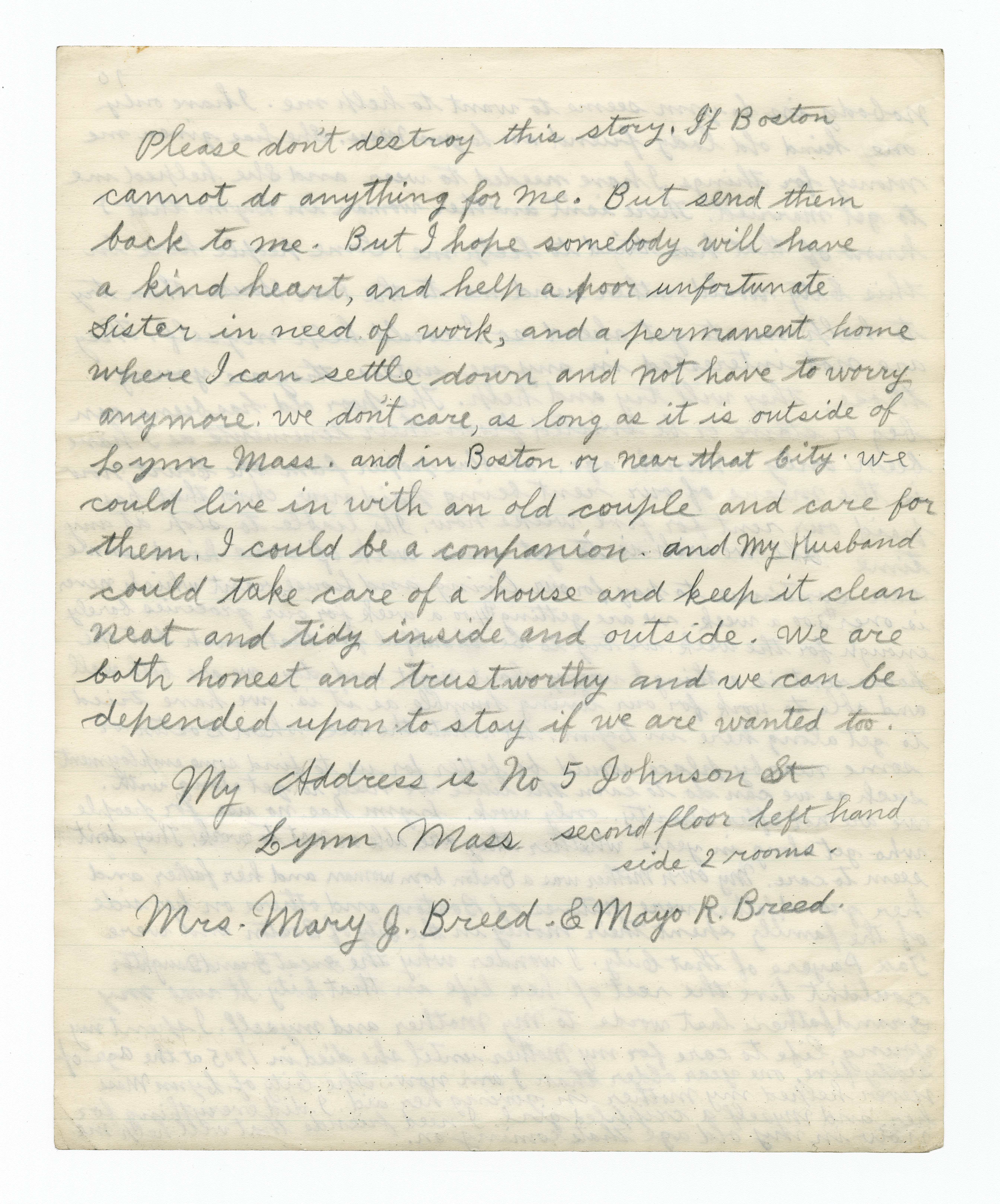
One page is written directly to the reader.
Please don’t destroy this story. […] But I hope somebody will have a kind heart, and help a poor unfortunate Sister in need of work, and a permanent home where I can settle down and not have to worry anymore.
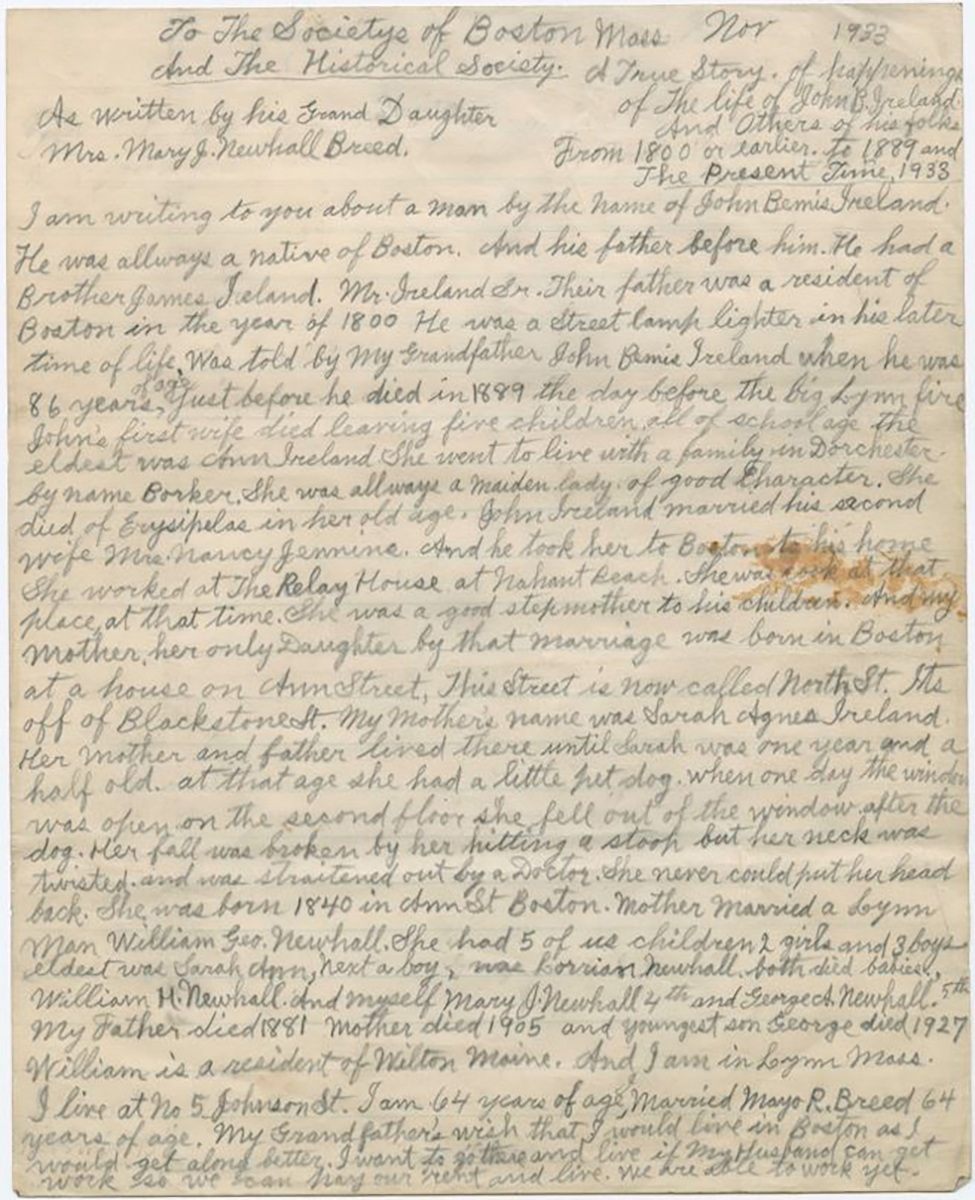
One page of Mary J. Breed’s manuscript, 1933
Mary’s plea was ultimately unsuccessful. She and Mayo didn’t relocate to Boston, at least not permanently; both died in Lynn, in 1950 and 1954 respectively. And while the MHS and other “Societys” could not or would not help Mary 88 years ago, we can at least share her story now.
When English and European colonists arrived in what is now New England, they were overwhelmed by what they perceived as tractless wildernesses. Far from the cultivated cities and
manicured countrysides of England, what they saw were dense forests populated by immense trees. As colonists continued to overtake lands inhabited by Native Americans, they altered the
landscape to suit their needs for the sake of agricultural, industrial, and national progress. In reviewing field books kept by land surveyors in the eighteenth and nineteenth century at the
Massachusetts Historical Society, it becomes clear that trees of numerous varieties played a surprisingly large role in laying out the geographical shape of the United States. Surveyors
tasked with measuring and marking the boundaries of personal estates, roads, towns, cities, counties, states, and nations in early America would choose natural landmarks not only to help
them mark the bounds of the land they were surveying but also to find themselves in space. Surveys might start at a building, a heap of stones, a wooden stake, or quite often, a tree.
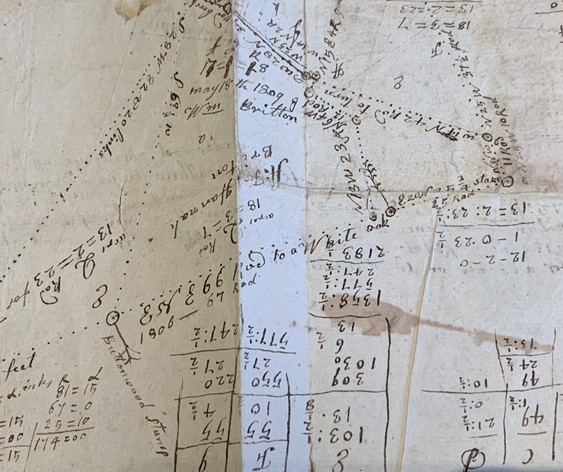
Surveyors and citizens of early America had a strong knowledge of trees so as to be able to identify them quickly by sight, as these collections show.
John Selee Papers, 1780-1846, MS N-266, Folder – land survey notes. Note how Selee has written out “White Oak” and “Buttonwood Stump” and included small drawings of trees as major points of measurement on his survey.
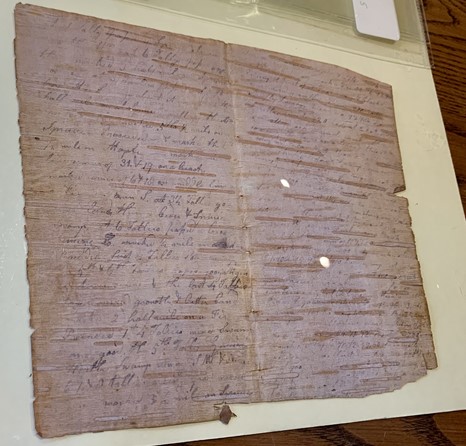
In town records for Sandisfield, Massachusetts from 1794-1819, the surveys of roads were described in detail: landmarks like Beach and Oak trees, and even the stump of a Hemlock tree were identified. [1] Thatcher Magoun, in his surveys of towns in eastern Massachusetts from 1811-1813, wrote that in marking a survey of Zachariah Shed’s Farm in Waltham, MA, he at one point travelled South 36 degrees to a “Small Peach Orchard.” [2] Benjamin Shattuck, who surveyed the western boundary line of the Cherokee nation in 1823, describes his movements in the survey as they were oriented around such trees as Cottonwood, Gum, Sycamore, and Hickory. [3] Because trees were subject to any number of natural or human events and activities, these surveys retain a strong sense of ephemerality and hyperlocality, offering a detailed snapshot of a piece of land at a very specific time. The role of trees in a land survey could sometimes be even more literal. Such was the case when Charles Turner recorded the minutes of an Allotment Survey of Mars Hill Township in Maine in 1804 on birch bark. Though his writing is now only partly legible, Turner has noted the surveyor’s movements and the mile markings he made on trees: “half a mile on a Spruce,” “2 half mile on a Fir,” “1 half mile on small Maple,” “the 4 th half mile on a Yellow burch [birch],” and “3 1/2 miles on Cedar,” for example (11). [4]
Allotment survey of Mars Hill Township, Me., 1804, Ms. S-219
Not only did the trees serve to mark boundaries and provide the material surface for surveys, so too did they track environmental change over time. Lines of demarcation between states, for
example, would need to be renewed and resurveyed, and old landmarks like trees, stakes, heaps of stones, and bodies of water were sometimes seen to register the advance of the colonization of
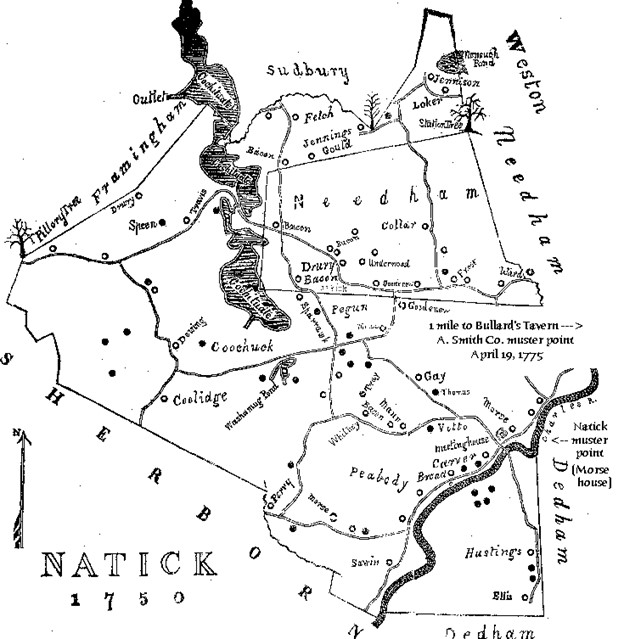
North America. In “An Account of the Boundary Lines of the Commonwealth of Massachusetts,” Samuel Williams recounts the history and renewal of state division lines in Massachusetts. Williams discusses a prominent landmark found during a renewal survey in the 1780s which was used in original surveys of the Massachusetts Bay and Plymouth colonies in 1638: “A Tree which has long been known by the name of The Station Tree is still standing; and by measure was found to be 120 rods distant from the Station where the several colony lines were set off.” He continues, remarking that other aspects of the place have changed: “But the southerly branch of the [Charles] river from which the mensuration was made is now become but a small brook. Such streams must naturally have decreased as the woods were cut down and the country laid open: an event which… [takes] place with the cultivation of a country.” “This station,” established by the previous surveyors Nathaniel Woodward and Solomon Saffery, “is not now distinguished by any nature, stones, or monument,” Williams wrote. [5]
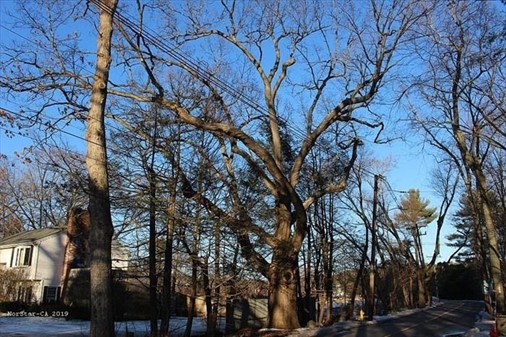
The Station Tree still stands in Natick, MA, as per an update from the website Waymarking.com in 2019. The White Oak tree is estimated to be nearly 500 years old. What would Samuel Williams have to say about the state of Massachusetts that surrounds the Station Tree today?
The manufacture of shoes was industrialized in the 19th century, but before the Industrial Revolution shoes were made by hand in workshops. Shoemaking was a specialized trade performed by many people working together in a workshop, not the single shoe cobbler we hear about in fairy tales like The Elves and the Shoemaker. Each person in the workshop had a specific job to do, from cutting the leather to forming the base of the shoe. Some shops could make dozens of shoes a week.
But don’t call them cobblers! Cobblers were not specialized or trained. The term was reserved for people looking to make ends meet. They would repair shoes, but the result was typically slipshod. Cobblers were usually illiterate and could be very poor. Shoemakers, on the other hand, were highly educated and well trained. They would have been offended if you called them a “cobbler,” as it would imply not only that they were lower class, but that their shoes would not be well made.
Workshops would keep fashionable daily footwear in stock, just like shoe stores today, so that a customer could walk into their shop and purchase shoes at that moment. It was less common and reserved for the pricier materials and the well-to-do customer, to have shoes custom made for someone. But shoes could also be imported, or sent back home from someone traveling abroad, like this letter from Thomas Jefferson to Abigail Adams shows: “The shoes you ordered, will be ready this day and will accompany the present letter. but why send money for them? you know the balance of trade was always against me.” And, apparently, Jefferson would not let Mrs. Adams pay for them.
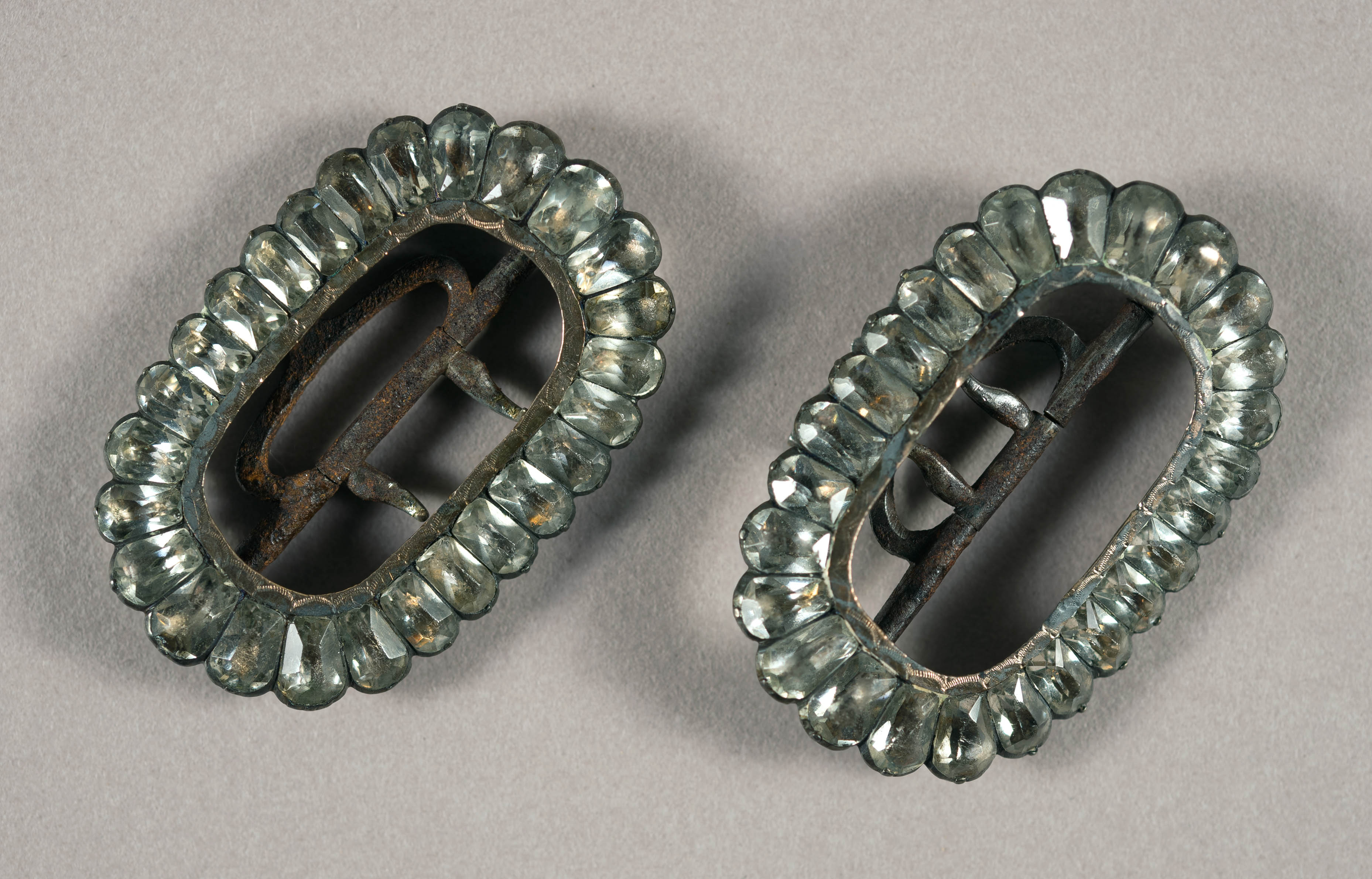
Most footwear at this time was made to be worn with a buckle, like the wedding shoes of Rebecca Tailer Byles in the previous post about shoes. However, shoemakers did not produce buckles and they had to be obtained elsewhere. Most buckles were imported from England in the 18th century and had various styles. They could be used to dress for more formal occasions or for every day. The pair of buckles below is thought to have been worn by James Madison on formal occasions. These silver buckles are adorned with cut glass backed with tin foil, which would have made them sparkle.
The myth that shoes weren’t made to have a left or a right is not true; shoes were made to be in pairs that did have designated right and left sides, but it was the materials that were used to make the shoes that determined how they would be shaped. For instance, leather was used for shoes that were made to be worn daily. Once a pair of shoes had been purchased and worn, the leather would mold to the wearer’s foot. It would be very soft and comfortable and, as some sources say, even more comfortable than today’s shoes, which are made with plastics and do not mold to our feet in the same way.
I hope you learned a little more about shoes in the 18th and 19th centuries in these past two blog posts.
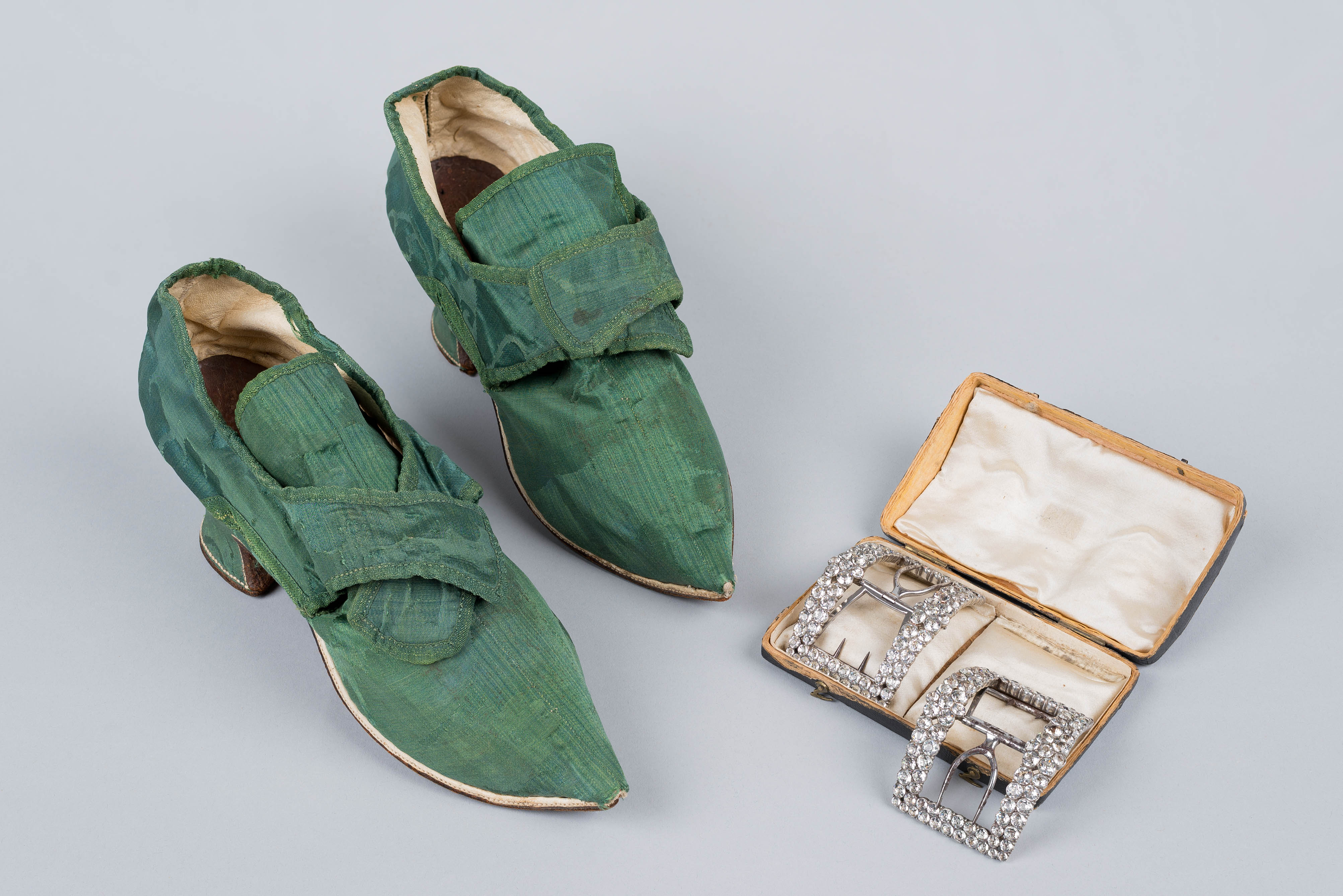
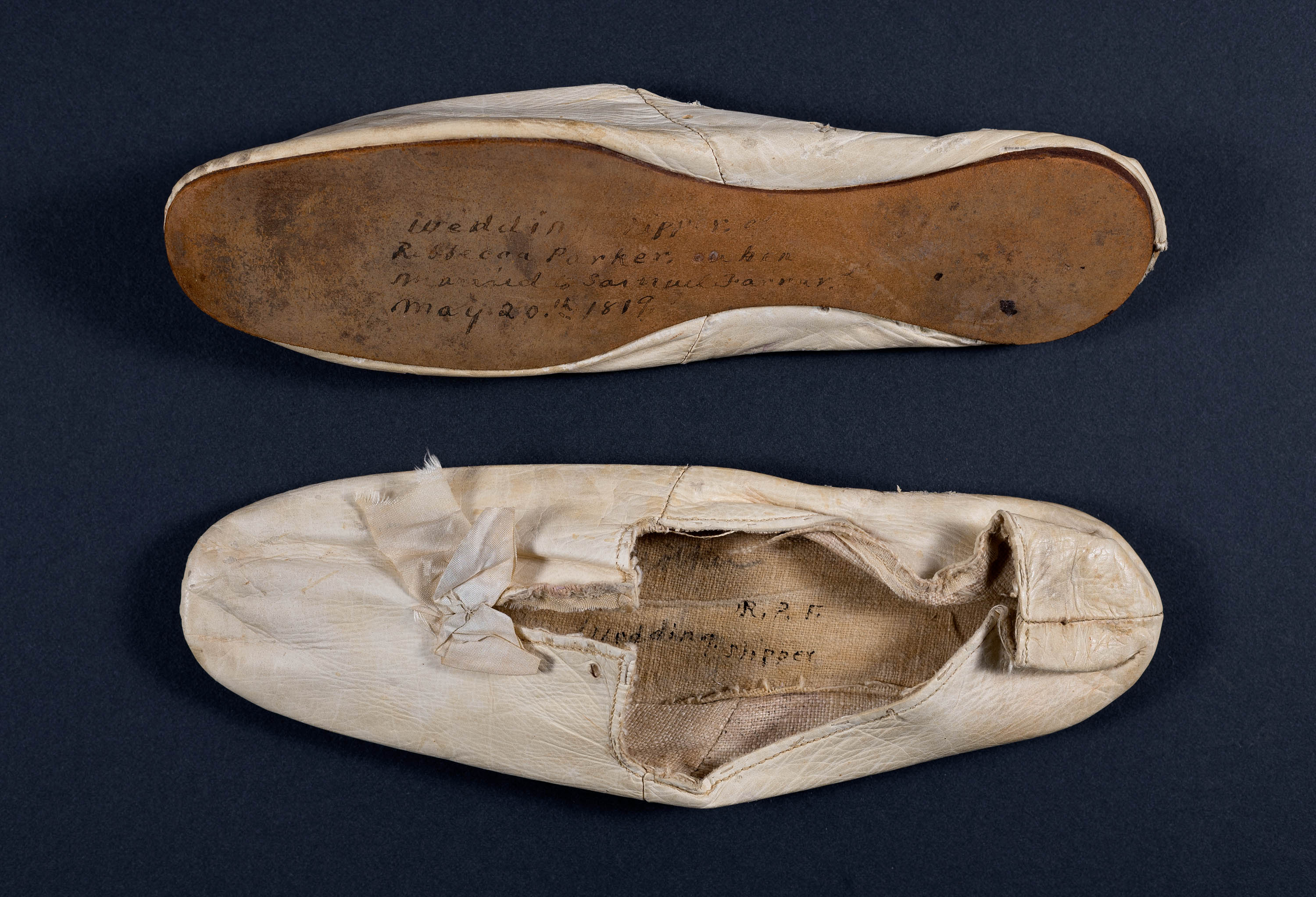
These wedding shoes were made for Rebecca Tailer, a woman from a well-connected family in Boston, who married Mather Byles on 11 June 1747. They were made to match her green wedding dress. Green is not typically the main color on wedding dresses today. Why is that?
Wedding shoes and shoe buckles of Rebecca Tailer Byles, 1747
White wedding dresses, the norm today, came into fashion in the mid-19th century after Queen Victoria wore a white gown when she married Prince Albert in 1840. Queen Victoria’s wedding, taking place just four years after photography was invented, was heavily photographed and publicized like no other wedding had yet been. It was seen by so many people that it set this fashion trend that continues into today.
Before Queen Victoria’s white gown became the fashion, most brides had to consider practicality in their wedding gowns, even upper-class women who could afford a bit of frippery. As there was no set color for weddings, middle- and lower-class women would usually pick their best dress from what they already owned, which could be any color, even black. For many western women, wedding gowns would be worn again, whether as a regular outfit, placed back amongst their usual rotation, or as a special occasion dress for holidays, parties, and, for some, when being presented to royalty. This meant that many wedding dresses were chosen for the longevity of the fabric and color, and not as they are today, dresses typically worn only once and then kept as an heirloom for the next generation.
Even after white wedding dresses rose in popularity, they were only functional for the upper class, those who could afford to have their dresses cleaned professionally after wearing them, used to show off their wealth.
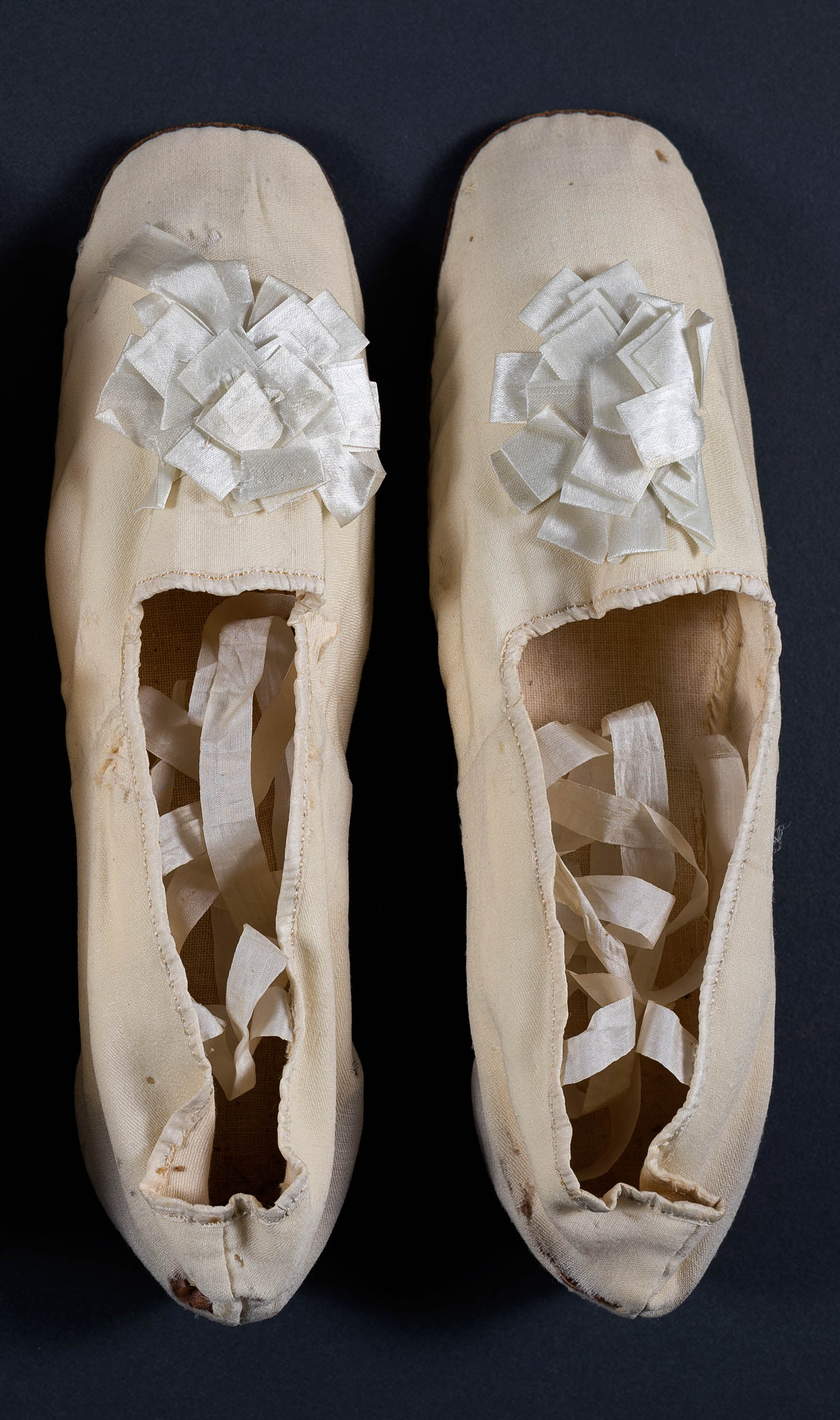
Here are three shoes from the MHS collection that show the popularity of white as a wedding color in the 19th century.
This is part one of a two-part series discussing the history of shoes and fashion. Watch for the next part, “How Were Shoes Made Before the Industrial Revolution?,” coming soon!
Every time I write a blog post or teach a workshop and mention John Adams’s complicated relationship with Benjamin Franklin or mistrust of Alexander Hamilton, some member of the public will invariably scoff, “Who did John Adams like?”
I’m always taken aback by this attitude. “He liked lots of people!” I protest. In fact, the word that jumps to mind when I think of John Adams is “gregarious.” Adams loved to tell stories, crack jokes, and debate the topics of the day. He preferred his house bursting at the seams with children, grandchildren, and friends. Adams was a member of various dinner clubs and societies and well into old age welcomed curious citizens into his home for a friendly chat.
So how have we collectively developed an image of a scowling, curmudgeonly John Adams with a strong dislike of everyone besides Abigail? Probably because for many of us—myself included—our first introduction to John Adams was through a screaming Paul Giamatti in HBO’s John Adams or a sniping William Daniels in 1776. (And his reputation surely hasn’t been helped by the demonic “Welcome, folks, to the Adams Administration” voiceover in Hamilton that makes audience members feel they’ve left the sunshine days of President Washington behind and are advancing through the open gates of Hell.)
Adams undeniably spewed enough venom to inspire scriptwriters to cast him as the exasperated, irritated comic relief—the late Bob Dole called him the “eighteenth-century Don Rickles.” But imagine if the memory of you that is passed down to posterity consisted only of the words you used while venting to a trusted friend after a particularly stressful day (or even what you wrote in your diary). Adams is often remarkably generous in his descriptions of his contemporaries, so why are we only familiar with the insults? It may be because Adams’s gripes are funny, snappy, and eminently quotable. Posterity likely wouldn’t remember a lengthy diatribe against Pennsylvania’s John Dickinson, but we can forever associate him with his two-word title, the “piddling Genius.”(See also: Hamilton as the “bastard brat of a Scotch Pedler,” etc., etc.)
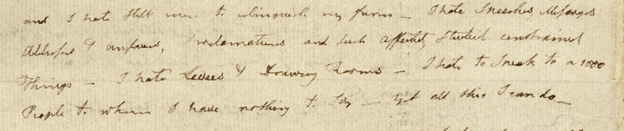
John Adams to Abigail Adams, 1 March 1796
Another reason we tend to view John Adams as unsociable is that the people he liked best aren’t preserved in the pantheon of American political history. Adams cared for two things: his family’s peace and happiness and his country’s peace and happiness. He had, in effect, sacrificed the former for the latter, and thus jealously guarded the latter. Where we see serene and omniscient statesmen, Adams saw self-absorbed, blundering politicians undermining his life’s work. (I think most of us agree that a mistrust of politicians is probably wise. In his line of work, it’s remarkable Adams found so many people he did like.) While serving as Vice President, John wrote home to Abigail: “I hate Speeches, Messages Addresses & answers, Proclamations and such Affected, studied constrained Things— I hate Levees & Drawing Rooms— I hate to Speak to a 1000 People to whom I have nothing to Say.”
Adams’s idea of contentment was sitting at his fireside after a long day’s work on his farm, surrounded by family and lifelong friends, speaking freely. “Formalities and Ceremonies are an abomination in my sight. —I hate them,” a 34-year-old John Adams confided to his diary. He was not to change his mind. Though he did acquire true friends during his political career—Benjamin Rush comes to mind—most of Adams’s nearest and dearest were Quincy farmers, in-laws, and former law students.
John Adams’s diary entry for 30 June 1770
If John Adams were half the curmudgeon he’s made out to be, I wouldn’t delight in sitting down each day to read his letters. But he’s kind and affectionate, witty and wise, candid, (sometimes exasperating), generous, and supremely lovable. And so, I delight.
The Adams Papers editorial project at the Massachusetts Historical Society gratefully acknowledges the generous support of our sponsors. Major funding is provided by the National Endowment for the Humanities, the National Historical Publications and Records Commission, and the Packard Humanities Institute. The Florence Gould Foundation and a number of private donors also contribute critical support. All Adams Papers volumes are published by Harvard University Press.
By Hannah Elder, Assistant Reference Librarian for Rights and Reproductions
Happy December! As I write this, Thanksgiving has passed, we are part of the way through Hanukkah, and with Christmas and New Year right around the corner, we are well and truly in the holiday season. For me and my family, the holidays have always meant sharing recipes and baking together. Every year, we make a treat from my great-grandmother’s arsenal of recipes – her doughnuts, tossed in cinnamon sugar, are a perennial favorite. We experiment too, trying new recipes we find online or shared by a friend.
This year, as the holidays approached, I began to wonder what people in the past baked and how they got the recipes. With the collections of the MHS at my fingertips I knew I could find an answer. I started, of course, with our catalog AIBGAIL. Using the subject headings “Cooking” and “Cookbooks” and a simple keyword search for “recipe,” I was able to find a number of interesting titles in our collection. They ranged from manuscript volumes of family recipes, to a collection of recipes used in the kitchen of King Richard II, to published collections of community recipes, lovingly gathered and distributed.
Through browsing these titles, I got a pretty good idea of what people cooked and baked. I also started to understand that recipes spread in the past much how the do today; through word of mouth, passed on to next generations, or found in published cookbooks, written by authors of varying authority. But I wanted to take it a step further. What were early American cookbooks like? Where did the recipes come from? What was the first “home grown” cookbook, written by an American author and published in the United States? For that, I turned to the experts.
In their book United Tastes: The Making of the First American Cookbook, Keith Stavely and Kathleen Fitzgerald provide answers to all of those questions and more. As the title suggests, the book explores the creation and significance of the first cookbook published by an American author in the United States: American Cookery by Amelia Simmons, published in 1796.
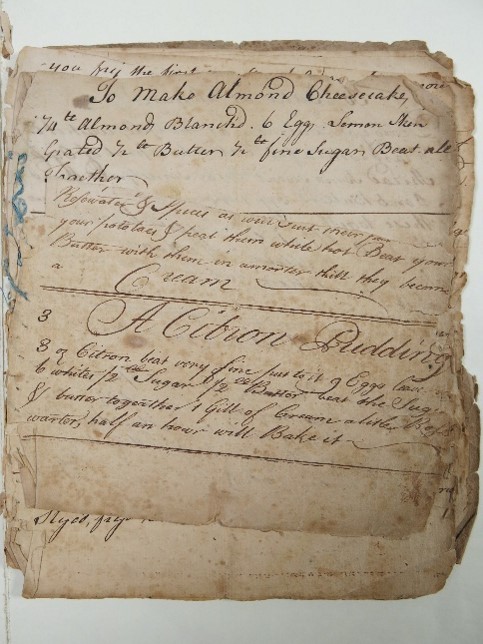
Before American authors began publishing their cookbooks, American home cooks looking for recipes used British (and some French) sources. According to Stavely and Fitzgerald, Simmons’ cookbook is largely a collection of recipes borrowed or copied verbatim from previously published British cookbooks.[1] Of the 192 recipes in American Cookery, only 44 of them (23%) have no obvious precedent in print. The rest were either copied directly from British cookbooks, heavily borrowed from them, or were traditional British dishes.[2] The dishes the Simmons plagiarized were likely already familiar to American audiences, as they came from cookbooks that had been reprinted and circulated in the United States prior to Simmons’ publication. Simmons drew from the cookbooks that struck a balance between refinement and simplicity, a balance that appealed to early Americans. These familiar recipes, combined with the use of American terms such as “molasses,” “cookie,” and “slapjack” as well as foods unknown in Europe such as johnnycakes, argue Stavely and Fitzgerald, are what makes American Cookery a truly American publication.[3]
Title page of American Cookery by Amelia Simmons (image courtesy of the Library of Congress).
By now, all of this research was making me hungry and left me itching to try out a recipe or two. After considering a few cookbooks and recipe collections, I decided to try one from the original: Amelia Simmons’ American Cookery. Since I was originally drawn into this rabbit hole by my family’s tradition of baking at the holidays, I decided to try my hand at one of Simmons’ sweet recipes. Luckily, there were plenty of them. As Stavely and Fitzgerald observe, “there are more cakes in American Cookery than any other type of food.” [4] At first, I was drawn to a recipe for “Another Christmas Cookey,” but had to rethink my plans when I reached the end of the recipe, which instructs to baker to place the “hard and dry” cookies into “an earthen pot, and dry cellar, or damp room,” after which they will be “finer softer and better when six months old.”[5]
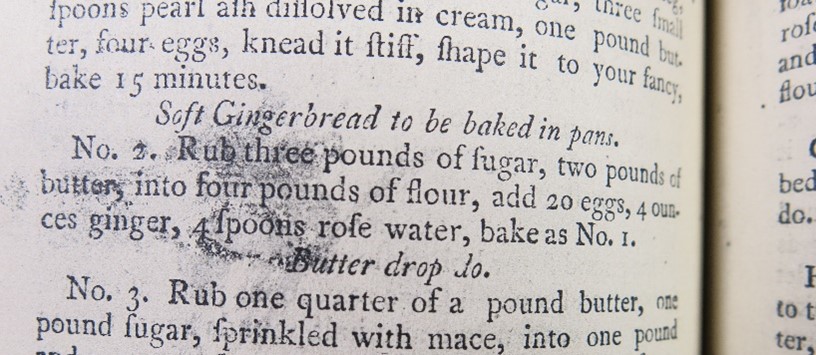
Since that option was out, I decided to make another seasonally appropriate treat: gingerbread. Simmons includes five different recipes for gingerbread in her book and I chose one of her gingerbread cake recipes, titled “Soft Gingerbread to be baked in pans.” In its entirety, the recipe reads:
No. 2. Rub three pounds of sugar, two pounds of butter, into four pounds of flour, add 20 eggs, 4 ounces ginger, 4 spoons of rose water, bake as No. 1.
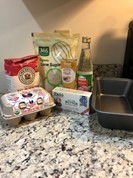
I did not want enough gingerbread to feed an army, so I reduced the measurements and quartered the recipe. With the help of some internet calculators, I ended up with these measurements:
1 2/3 cup sugar
2 sticks butter, softened
3 1/4 cup flour
5 eggs
1 oz ginger
1 tablespoon rosewater
Assembled ingredients, photograph by Hannah Elder
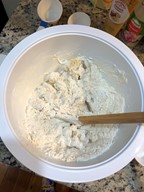
My ingredients gathered, I got to work! Although the recipe is light on technique, I used some previous knowledge and baking logic to construct my gingerbread. I started by creaming together the butter and sugar (by hand, with a wooden spoon, the way Amelia would have). Once they were as well combine as I could manage (my arm got tired), I added the flour and “rubbed” the butter and sugar mixture into it.
Mixing the gingerbread, photograph by Hannah Elder
At this point I must confess something: I don’t know how much flour I added. I was using a ¼ cup scoop to measure my flour and at the time I thought I had counted correctly. Looking back, I’m not sure whether I measured out 2 ¼ or 3 ¼ cups of flour. If I did use 2 ¼ cups, it was not a fatal flaw.
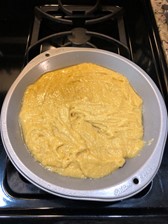
Once the unknown volume of flour was incorporated and had a texture a bit like damp sand, I added all of my wet ingredients. I gave it all a good mix and wound up with a thick, glossy batter. I plopped most of the batter into a pie pan (I abandoned the idea of the loaf pan but I don’t have a proper cake pan) and shepherded it into the oven.
Gingerbread batter before going into the oven, photograph by Hannah Elder.
While Simmons provides a baking time (15 minutes), I had to guess on the temperature. I tried 375°F, hoping to have the oven hot enough that it would cook in a reasonable time, but not so hot as to scorch my creation. As it went into the oven, I was most nervous about the thickness of the batter (very) and the lack of leavening agent. I was afraid I would end up with a tough, rubbery disk of ginger-flavored putty.
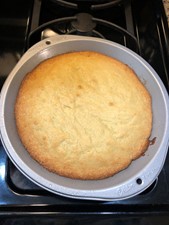
I checked it after 15 minutes, and while it wasn’t done by any means, it looked much more promising than I anticipated. I gave it another 10 minutes and was rewarded with something that looked and smelled great, far better than I ever imagined it could.
Baked gingerbread, photograph by Hannah Elder.
I gave it some time to cool and dug in. This gingerbread has a unique texture, more like a cornbread or another quick bread than the gingerbread cakes of today. It’s also much lighter in color than most would expect, owing to its lack of molasses. The rosewater adds a nice, unexpected floral note that balances the sharpness of the ginger. I used grated ginger from a tube that was likely much fresher than anything Amelia Simmons or her contemporaries would have used, but I think it is still a balanced cake and the ginger is not overwhelming. In all, I call this experiment a success!
If you’ve enjoyed this exploration of old-fashioned recipes, I encourage you to check out previous posts on this blog by other MHS staff members Alex Bush, who tried to make bread pudding, and Emilie Haertsch, who tried Benjamin Franklin’s recipe for milk punch.
Happy Holidays to you and yours!
[1] Keith Stavely and Kathleen Fitzgerald, United Tastes: The Making of the First American Cookbook (University of Massachusetts Press, 2017), 2.
[5] Amelia Simmons, American cookery, or, The art of dressing viands, fish, poultry, and vegetables : and the best modes of making pastes, puffs, pies, tarts, puddings, custards, and preserves : and all kinds of cakes, from the imperial plumb to plain cake, adapted to this country, and all grades of life (Hudson & Goodwin, 1796), 35.
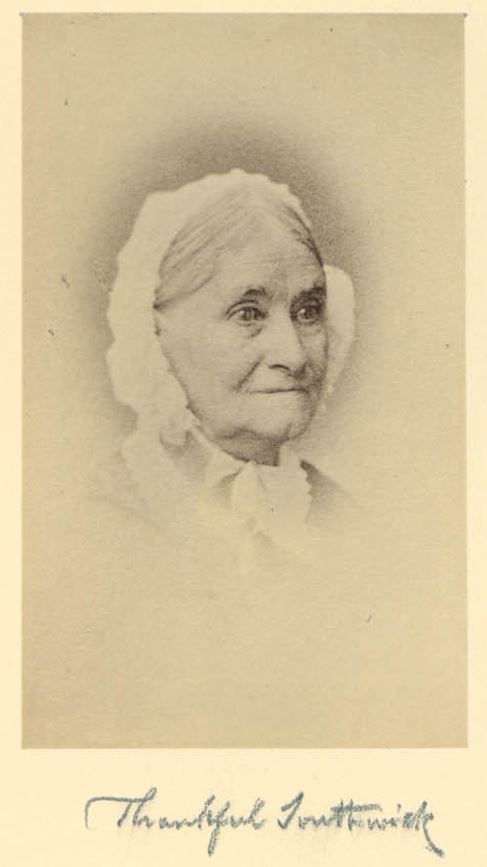
For this Thanksgiving Day, I scoured our catalog for material related to the holiday that hasn’t been covered on the Beehive before, but nothing grabbed my attention. It occurred to me that I might write something about gratitude in general, but all I turned up were printed sermons on the subject and personal correspondence thanking people for gifts. However, keyword searching led me, serendipitously, to abolitionist Thankful Southwick, so I thought I’d use this Thanksgiving Day to introduce you to this remarkable woman.
Now, the name Thankful is nothing new to archivists and historians in New England. We see a lot of these “virtue names,” mostly given to girls. Faith, Hope, and Charity are all very well, but my least favorites are definitely Silence and Submit.
Thankful was born in 1792 in Portland, Me., the third daughter of Samuel Fothergill Hussey and Thankful (Purinton) Hussey. (You couldn’t make these names up! One author calls Thankful Hussey a “quite unreasonable but none the less interesting name.”) Samuel was a prosperous merchant in Portland, and the elder Thankful was a well-known Quaker minister. Both were heavily involved in anti-slavery work. Legend has it that Samuel helped freedom seekers escaping on ships from the West Indies to get to Canada.
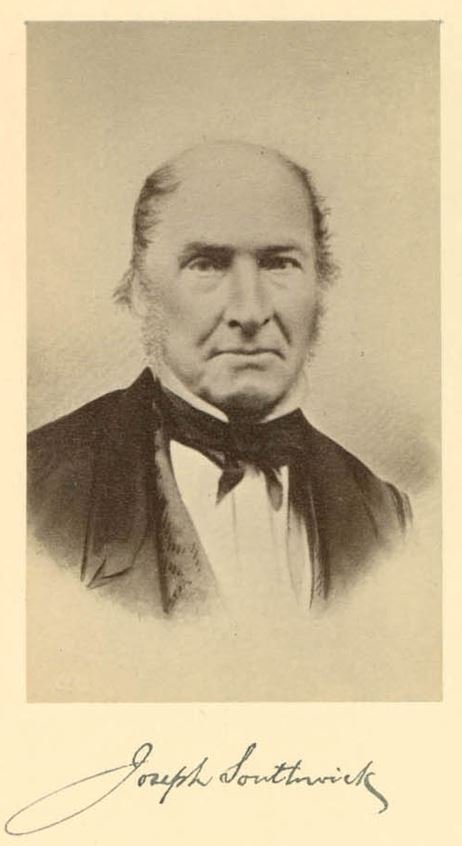
In 1818, the younger Thankful married Joseph Southwick, a tanner. The couple had three daughters in quick succession, Abigail, Sarah, and Anna. In 1834, the family moved to South Peabody (now Danvers), then to Boston in 1835.
The 1830s were a time of exponential growth in the abolitionist movement, and the Southwicks were in the thick of it. Joseph was one of the original subscribers to William Lloyd Garrison’s fiery Liberator, as well as a founder of the American Anti-Slavery Society in 1833, serving alternately as president and vice-president for its first 15 years.
Thankful, not to be outdone, was herself a member of the Boston Female Anti-Slavery Society, president of the society several times in the 1840s, and a proponent of women’s rights. All three of her daughters became anti-slavery activists, including Sarah Hussey Southwick, who got involved in the movement at the age of 13. The Southwick home was also part of the Underground Railroad.
Thankful was a participant or an eyewitness at several notorious incidents during the antebellum period, including the attack on William Lloyd Garrison by a Boston mob in 1835. She was also present at what’s been called the “Baltimore Slave Case” or the “Abolition Riot” of 1836.
The case began when Eliza Small and Polly Ann Bates, two Black women, arrived in Boston on a ship from Baltimore. Although they may have carried documents proving their status as free women, they were nevertheless captured by agents of enslavers to be returned to the South under the Fugitive Slave Act. The case was heard in court two days later. Apparently after a prearranged signal, the crowd surged up and bustled the two women out past their captors and to safety. You can read a detailed description of this fascinating incident here.
The rescue of Small and Bates was enacted almost entirely by Black men and women, whose quick thinking and literal solidarity won the day. Playing crucial roles were Samuel H. Adams and Samuel Snowden, both African American men, and an African American woman who physically restrained the deputy sheriff. Thankful was also in the courtroom and probably helped to plan the action. Lydia Maria Child, in her obituary of Thankful, included this anecdote from that day:
The agent of the slaveholders standing near Mrs. Southwick, and gazing with astonishment at the empty space, where an instant before the slaves stood, she turned her large gray eyes upon him and said, “Thy prey hath escaped thee.”
Thankful (Hussey) Southwick died in 1867. She was so well-known at the time of her death that none other than William Lloyd Garrison delivered her eulogy. Frederick Douglass would call Thankful and Joseph “two of the noblest people I ever knew.” She had lived long enough to see the end of the Civil War and the passage of the Thirteenth Amendment, the first of the Reconstruction Amendments. However, she would undoubtedly agree that the struggle for true equality was and still is far from over.
We’re now halfway through the fall semester and Massachusetts students are hard at work on their National History Day® projects! National History Day (NHD) is a year-long historical research and inquiry project for students in grades 6-12, and the MHS is proud to be the affiliate coordinator of NHD in Massachusetts. Every year NHD frames students’ research within a historical theme with a broad application to world, national, or local history. This year’s theme, Debate and Diplomacy in History: Successes, Failures, Consequences, seems particularly relevant as students explore important historic moments during which multiple perspectives either clashed or came together for the common good.
At the MHS, we’re excited about the possibilities of this year’s historical theme. MHS’ Hannah Wilson in Library Reader Services created an incredible resource list highlighting different themes of Debate and Diplomacy within MHS collections, including debates over the ratification of the Massachusetts constitution, protest and resistance to the Fugitive Slave Act, conflict over women’s suffrage, and the papers of senator and diplomat Henry Cabot Lodge Jr. Students are invited to explore questions such as “What are the strengths and limits of diplomacy?” and “Whose voices are included in debate, and who might be left out?” Our partners at the Boston Athenaeum, the Gibson House, and the Wyner Family Jewish Heritage Center and many other organizations have also created theme pages to help NHD students explore Debate and Diplomacy in their collections. You can find these pages and many others on our National History Day Massachusetts website.
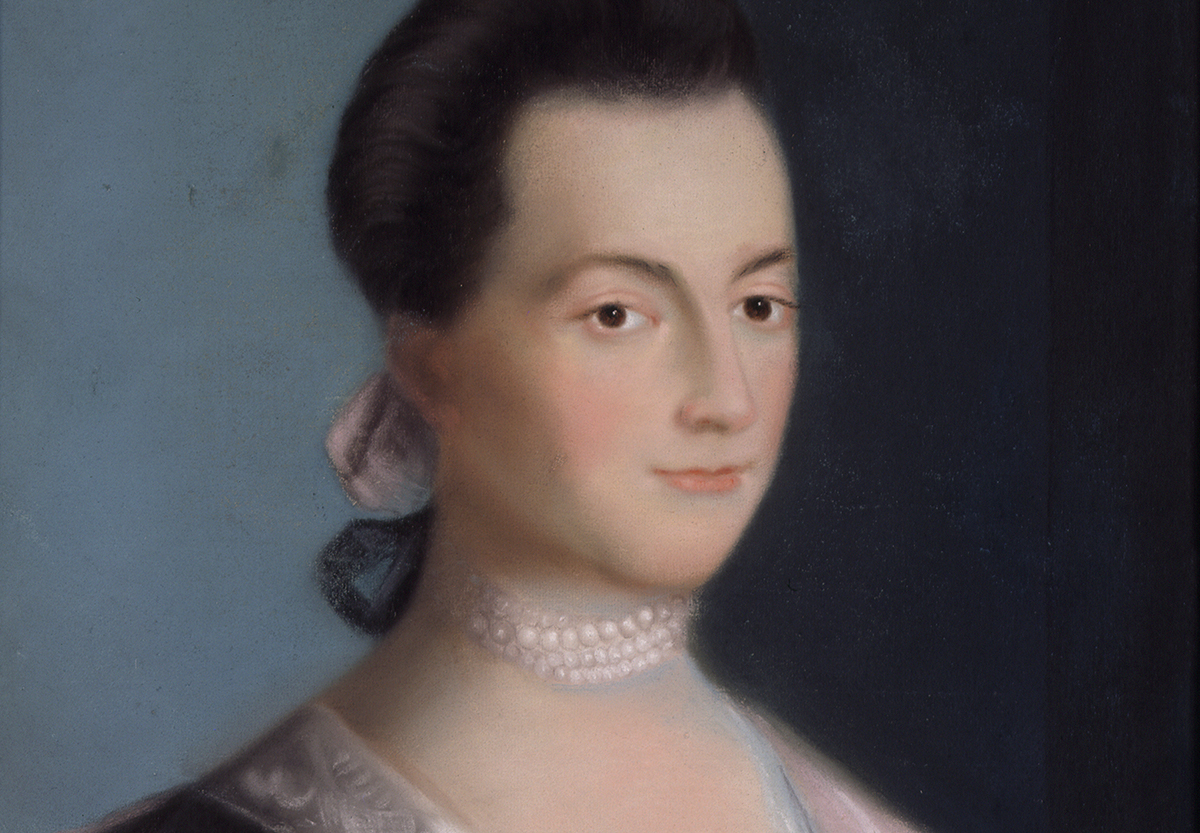
This year’s theme also offers the chance to highlight the continued resonance of another important figure from the MHS collections, one who just celebrated her 277th birthday! Born on 22 November 1744, Abigail Adams was the second First Lady in American history. Adams played a key role as advisor, diplomat, and public figure alongside her husband John Adams throughout his political career and presidency. In 2019, MHS John Winthrop Student Fellow Ella Amouyal created an online exhibit exploring Adams’ diplomatic work in France and England from 1784-88 and its impact on Adams’ views on patriotism, economics, and education. We anticipate that the Adams Family Papers at the MHS will serve as another rich resource for our NHD students as they explore the role of Debate and Diplomacy in the early years of US History.
You never know what you’re going to find in the archives! While digging into a collection of papers belonging to Edmund Munroe, a 19th century merchant, on the behalf of a long-distance researcher, I came across his 1794 mathematics example book from his boyhood days. (The schoolmaster asked practice questions that struck my eyes as somewhat forceful. One such question for subtraction stated, “A man was born in the year 1709. I demand his age in the year 1767.”)
After looking at one late 18th century schoolbook, I became eager to see more. Happily, the MHS has quite a few! I read through Sally Parkman’s 1787-1788 floral-covered cyphering book (her teacher asked similar questions Edmund’s asked him, but in a less demanding style); her 1795 French exercises, which I was helpless to read; and, her (undated) penmanship book in which she copied rather humorous templates for letters to various imagined acquaintances and relations. In a 1799 penmanship book, Ann Sprague of Boston, MA, practiced cursive letters and copied poems. An 1832 alphabet practice book I read surely belonged to a toddler – in pencil, little Eleanor Davis wrote slanting lower-case ‘l’s, backwards ‘j’s, and ‘o’s of varying roundness. The book was kept “for her dear father” and was less than three pages long. Surely, Eleanor had more engaging activities to occupy her time!
The Heath Family Papers contain multiple generations of girls’ penmanship and copybooks. Elizabeth Heath Howe’s (b. 1769) penmanship books proved to be the most individual of the bunch. One page also held an unexpected surprise—and had me scrambling to brush up on my Revolutionary War knowledge.
As a child, Elizabeth Heath Howe, then known as “Betsey,” attended the Brookline School. In 1781-1782 she kept a penmanship and copybook. The cover of her book is plain—the faded, splotched, brown paper does not even bear a title, or her name. Inside, however, Betsey’s personality shines through. At the bottom of each page, after copying lines, Betsey saved space for doodles. She always wrote her name, sometimes her school and the date, and then she added her flair.
On 3 July, twelve-year-old Betsey copied lines of “The living know that they must die” and then got to doodling, adding merry faces into two of her swirling lines.
Elizabeth Heath Howe penmanship and copybook, 3 July 1781
On 9 August, she added squiggly lines, flashes of red ink amongst the black, and her school and the date crammed inside of a heart.
Elizabeth Heath Howe penmanship and copybook, 9 August 1781
My favorite was when she misspelled her own name. On 19 October, Betsey was so engaged in doodling, she had to add a (^) for the “T” in her name. On the opposite side of the page, she didn’t even notice the missing “S”.
Elizabeth Heath Howe penmanship and copybook
The doodling, however, was not the only unexpected find within Betsey’s book. On each page, above the doodles, Betsey copied down an aphorism, often one that rhymed. Many gave general advice on how to live a good life—according to the values of wealthy, white Anglo-Americans (“Every moment spend unto some useful end”; “Money makes some men mad many merry but few sad”), while also reflecting on mortality (“He that would die well must live well”). Others focused on youth (“In days of youth mind the truth”; “Monuments of learning are the most durable”), and some strike me as clearly gendered (“A handsome face is a letter of recommendation”; “Politeness consists in being easy yourself and making others so”). A few are easily recognizable today (“Necessity is the Mother of Invention”; “Virtue is its own reward.”)
The lines Betsey copied on 26 October 1781, however, were different. “Liberty, peace & plenty to the united states of America,” she wrote. The previous day’s lines had included the book’s only explicit Biblical reference (“Uriahs beautiful wife made King David seek his life”) and then the next day took on a distinctly patriotic tone. This was the only entry from her entire school year that was not a piece of wisdom, or advice. But, why?
On October 25, 1781, Betsey Heath copied “Liberty peace & plenty to the united states of America” into her Brookline School penmanship book.
On October 19, 1781, in Yorktown, VA, British General Charles Cornwallis surrendered to Gen. George Washington. American and French forces had surrounded British troops in the port town since early in the month, and the siege had cut off the British army from supplies of food and ammunition. Cornwallis agreed to Washington’s Articles of Capitulation, and British troops marched out of Yorktown that very day.
The Revolutionary War did not come to an official end until almost two years later, when the Treaty of Paris was signed on 3 September 1783. The surrender at Yorktown, however, ended any hopes the British had for winning the war. Although historians agree Americans did not fully appreciate the significance of Yorktown at the time, the surrender was widely celebrated.
With the time it took news to travel, it seems many Americans in the northeast first learned about the surrender around 25 October 1781. A search in ABIGAIL, our online catalog, for the subject “Yorktown (Va.)—History—Siege, 1781” sheds some light on this. A sheet printed by John Carter in Providence is titled, “Providence, October 25, 1781. Three o’clock, P.M. [microform]: this moment an express arrived. . . announcing the important intelligence of the surrender of Lord Cornwallis and his army, an account of which was print this morning at Newport. . .” Another, “Colonel Tilgham, aid de camp to His Excellency George Washington, having brought official acounts [sic] of the surrender of Lord Cornwallis” was printed in Philadelphia dated 24 October 1781.
Thus, it seems likely, that Betsey Heath and her classmates copied “Liberty, peace & plenty to the united states of America” into their books just as many people throughout New England were learning about the surrender at Yorktown. They may not have known the war was over, but they—through their teacher—knew it was a day worthy of commemoration.
Looking to do some of your own hands-on research on girls’ education, the Revolutionary War, or any other topic of interest? The MHS is open to researchers on an appointment-only basis. Please read about our Covid-19 resources here and fill out this form to make a research appointment.
For more on the surrender at Yorktown and the end of the Revolutionary War, see:
I recently stumbled on a fascinating document in the collections of the MHS that I’d never seen before, and once I started reading it, I couldn’t put it down. It’s a twelve-page family history, written neatly in thick pencil, called “A True Story of happenings of The life of John B. Ireland And Others of his folks From 1800 or earlier to 1889 and The Present Time, 1933 As written by his Grand Daughter Mrs. Mary J. Newhall Breed.”
A True Story of happenings of The life of John B. Ireland And Others of his folks From 1800 or earlier to 1889 and The Present Time, 1933 As written by his Grand Daughter Mrs. Mary J. Newhall Breed.
Mary Breed wrote in a stream-of-consciousness style, recounting events out of order, often circling back and repeating herself, which makes reading this manuscript feel like sitting on a front porch listening to her talk. Some of the details are sketchy, but her family’s story is moving and at times tragic. I’ll do my best to summarize it here.
Mary J. Newhall was born in Lynn, Mass. on 27 February 1869, the daughter of Sarah Agnes (Ireland) Newhall and William George Newhall. William worked variously as a fisherman, as a field hand, and in the spice mills of West Lynn. He died in 1881, leaving Sarah with three children to bring up. Mary left school at 15 or 16 (she’s inconsistent on this detail) to work at the Lynn shoe factories and support her mother, whose health was bad. When her mother died in 1905, Mary kept house for her younger brother George until his death in 1927. Five years later, at the age of 63, she met and married Mayo Ramsdell Breed.
Mary had apparently lived all her life in Lynn, but her family’s ties to Boston went back generations. In her narrative, she mentions her great-grandfather, a street lamplighter; her grandfather John, a blacksmith and wheelwright; and she describes incidents in both her mother’s and her father’s lives and those of her in-laws.
I was particularly struck, though, by the story of her grandmother Nancy, which sounds like the plot of a BBC period drama, albeit told in Mary’s inimitable voice. Here is the relevant section (I’ve added paragraph breaks):
At the age of seven, my grandmother was bound out to a woman who kept a Sailor Boarding House near the old South Church in Boston. […] Nancy Jennins was one of five children who was brought over from England on the Sailing Vessel. Her Father followed the Sea as a Ship Rigger fixing the sails. She remembered when her mother left her with the Woman to keep her until she was 18 years of age. And she saw her mother go away with her little Brothers and Sisters, and she never saw her mother again.
Then one day the big Ship came into Boston Harbor. And little Nancy went to see her father, as she had done before when his Ship came in. But that last time she saw her father way up in the rigging fixing the sails and as she looked up she saw her father fall from the place where he had been at work into the water, she saw the sailors bring her father onto the shore dead. She ran home and cried. So she had nobody to love and care for her.
The Mistress of the Sailor Boarding House was not kind to Nancy. She made her work hard in the kitchen where she learned to cook everything. The Sailors were mostly bad men they carried swords and pistals [sic] in their belts, and she said some of them were kind to her, and they would give her presents, and some of the sailors were cross and wicked, she was afraid of them, but she had to wait on them or get a beating.
One day, Nancy was working in the kitchen and overheard her mistress, as Mary calls her, tell a neighbor that the following day was Nancy’s eighteenth birthday—in other words, the day she was a legal adult and free from her indenture. The mistress confided to the neighbor that she was keeping this fact from Nancy because she didn’t want to lose such a good servant.
Apparently Nancy didn’t know her birthday, or perhaps hadn’t understood that she was free to leave at eighteen. So she rose early the next morning, packed up everything she owned, and walked out of the house. Her mistress tried to stop her, but “Nancy told her that she was going to get work and take care of herself.”
She took a job as a cook for a family in Boston, as this was “the only work that she ever learned.” She married an Englishman named Barrily, who died in a shipwreck. She married again (I think this was Mr. Jennins), but was abandoned by this second husband after two or three years. And if all that wasn’t enough…
She had a pretty little baby boy by him, she carried him around in a covered basket, he was so little. […] But Nancy had to go to work and earn her living. So one day A Minister came along and he saw the baby boy. So he told Nancy how that his wife had a baby boy, and it died. He asked her if she would let him adopt the baby for his wife so she gave her consent to let the baby go and have a good home. The Minister and his wife were so pleased with the baby that they loved him and gave him everything a boy could wish for. But the boy only lived to be thirteen years of age he was all ways delecate [sic] and they felt badly to loose [sic] the little fellow.
Sometime in the 1830s, while working as a cook at the Relay House in Nahant, Nancy met the eponymous John Bemis Ireland, who became her third husband.
He rode to Lynn and Nahant on a white horse with a tall hat on, as men wore those days, to get her good dinners, that she used to cook. He liked her cooking so one day he asked her to marry him. She did.
John’s first wife had died, and he had five school-aged children. It’s a little unclear in Mary’s telling, but it seems that John lied to Nancy and told her his children were dead. Well, she married him and became “a good stepmother” to them. She and John would have one daughter together, Sarah Agnes, Mary’s mother.
I’ll pick up Mary’s story again here at the Beehive, so stay tuned!