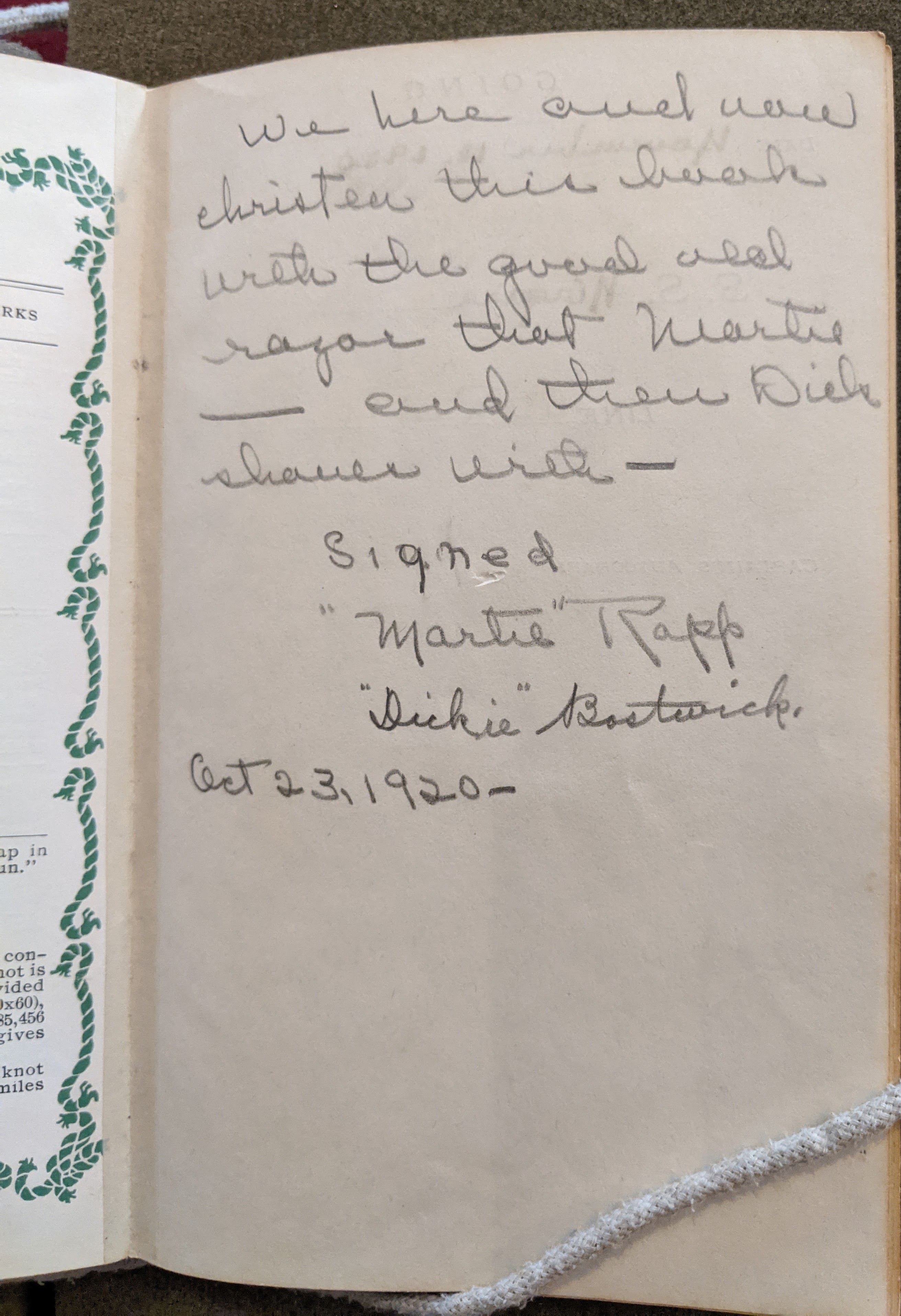
“We here and now christen this book with the good old razor that Martie – and then Dick shaves with-
Signed ‘Martie’ Rapp ‘Dickie’ Bostwick. Oct 23 , 1920-”
Martha Rapp’s Travel Diary, 1920-1921
Martha A. Rapp was a young woman from Brockton who travelled to New Zealand in 1920-21 with her parents, Walter and Annie Rapp. The Rapp family traveled from Boston through Canada by train, and finally boarded the passenger ship S.S. Niagara in Vancouver, CA to cross the Pacific ocean with a quick stop in Honolulu, Hawaii. Martha was on a fascinating journey across the ocean to a very distant land, with so much to explore. Luckily, Martha kept a diary of the entire journey and included details of life on board ship, stories of fellow passengers, storms, and descriptions of the many places and people she met and saw in New Zealand. The diary transports you back to not only life on a passenger ship in the early-20th century (naturally the soundtrack of the movie Titanic is playing in my head) but also directly into Martha’s world of non-stop adventure and exploration. There are days that she did so much that I was exhausted simply reading about it! She was quite a spunky woman and her humor comes across in her words.
Below are excerpts from the diary to give a taste of Martha’s journey. Please be mindful that these are ‘rough and ready’ unverified transcriptions.
Martha Rapp’s Travel Diary, 1920-1921
Nov. 10
Vancouver
Reached here at 10, foggy so couldn’t see any of the place until noon when the sun broke thru- Believe me I got into a bath as soon as I could – Ye gads how I eat- received some mail- lovely long letter from Ros- took a walk in the afternoon- Edith H. came over at night. It will seem good to sleep in a real bed again – boat doesn’t come until Friday..”
Nov. 11
Vancouver
This is armistice day. At eleven o’clock traffic of all kinds were stopped for two minutes. A gun that works by electricity was fired- Had trouble with our waitress at breakfast- found a sweet tea room..”
Nov. 13
Vancouver
“Went down and looked the ship over- its surely a huge boat- saw our state room where I expect to spend many a sick hour…”
Nov. 17
Vancouver At Sea
Pushed off at 7:15- reached Victoria at one- drove around town-saw a wild [?] right near the street left at 5- 10- Boat started to roll quite a bit- have met a lot of people – at night Mrs. Augila and Mrs. Miller and myself walked a bit – some one has a vector so we listened to it for a while…”
Nov. 18
At Sea
Thurs.
“ye gad’s [?] this boat rolls- Not many up to-day – I slepted all afternoon – got up for dinner but shot down here afterwards. Man at our table is drunk all of the time. Thru up- I wish I was back home-“
Nov. 19
At Sea
“Stayed in bed until 10- went to the Library- Sat on deck with Mr. Miller and another man- fought the League of Nations with them- Played quoits after luncheon it was bed for me- the boat is like a cork it bounces so – mother still in bed-“
Nov. 20
At Sea
Sat
“Stayed in bed all day- we’ve been in a dreadful storm all day- Haven’t made any progress- just rode the waves- nearly everyone sick- Dad peaked his face in just long enough to say he wasn’t feeling so good – the waves look like mountains from my bunk- they bang against the port-hole with such force I’m frightened it will break- Sighs from mother – it’s the last sea trip she’ll take she says-“
Nov. 21
At sea
Sunday
“Oh what a night- people yelling- women frighten and crying –
Got on deck today- sea is much quieter and we are going right along. Mother still under [illegible] at our table does not look so well-
Good time at night- crowd of us around a Vector …”
Nov. 22
At Sea
Mon
Enjoyed myself a great deal today – Played tennis three times also quoits- went to a sport meeting and was elected to the entertainment committee- like to get a hold of the one who did it – Calcutta (stales) on to-night – also DANCE- I never in my life saw such dancing – Maine has them stopped a while – In the smoking room with Mr. Dyer afterwards – lovely day and sea was very quite- I wish I was in New Zealand tho’
(Skipping ahead a few days)
Nov. 24 Wed
Honolulu
Sharks and boys diving
At ten we sighted land. Did my best to read my book but was pulled into quoits and tennis – after landing a party of eight of us went to the top of a mountain and such wonderful sights- this is a heavenly place – then we went out to the Mano hotel at Waikiki for dinner – Met Betty and two yanks god love em we went out on the water in a rig-canoe and rode the waves in – then danced and what heavenly dancers- the boys brought me lays-wreaths and flowers- kissed them all good bye- maybe I haven’t had a wonderful time
Martha Rapp’s Travel Diary, 1920-1921, Hawaii page
(Skipping ahead)
Dec. 6
Auckland
Mon-
Good lord what a day – awoke to find ourselves in a heavy fog with the old horn blowing for all it was worth- went way out of our way- got turned about and finally anchored as we were [?] into shallow water- rumor started we were stuck on a sand bank- that raised hell of course- finally got in at seven but did not get off the boat until nine [?] – Uncle Jack and Aunt Mary with us- [??]
Dec. 7
Auckland
Tuesday
This morning Dad and I went to the boat- Bank of New Zealand- American Counsel Office-and P. Office- I bought some strawberries that are wonderful. This afternoon we took a ride all over – wonderful country- went to the race track and what beauty- grounds are kepted beautifully- tonight we went to a lecture on spiritualism by Sir Conan Doyle- he is a wonderful speaker- but he hasn’t converted us.
Dec. 8
Auckland
Wed
Another busy day- spent the morning in the hair dressers- I [?] just as I was going to have my hair cut- had luncheon with the Mayor and his wife and a Mr. Buck- very nice- met a old friend of mother’s at 2:30 – at four we went to tea at Mrs. Roache’s house- her husband is a cousin of mother’s – stayed in at night- while writing this down one is playing [?]
Dec. 9
Auckland
Thurs-
Went and did some shopping this morning- shot a movie this afternoon which was very poor- received a wire from Mrs. Davis asking us for the weekend- folks aren’t going but I am- leave tomorrow at noon- went to call on Aunt Mary’s people at night – very nice- wonderful old lady
Dec. 14
Rotorua
Tuesday
Up at 5:30 and away at 6:30 with Mr. Cheney for Auckland. The trains here are so funny- after fussing about Auckland a bit my train left for here at ten- Beautiful ride but eight hours on these trains isn’t my idea of a good time- Dad and mother met me- we’re staying at the Grand- very nice hotel- the poor (?) Mrs. Dadd is here – we walked over to the bath houses – Beautiful park- boiling springs and they say that they’re apt to go up in smoke anytime –
Dec. 15
Rotorua
Wednesday
What a day this has been- at ten which started off with a Mr. Simpson in our party to see Wairoa – Lake Tarawera and Rotomahana – this is all volcanic and we saw the remains of a hotel that the roof was carried 130 miles away when the Waimangu geyser crate blew out. Went over a boiling lake after we had walked three miles – the lake was once a sand flat- It’s 600 feet deep – It was all so weird and yet wonderful to see the hot steam coming out of the side of hills and to see the boiling rivers and pools
Dec. 19
Taumarunui
Sunday
Four of us took a long walk this morning- went for a motor ride this afternoon. After our return a fire broke out across the way and off we flew – girl fainted so I took charge of her – went down and watched the men fish- had to cross a swinging bridge- when we came back Clarice and myself went and got some whiskey for the Mrs- put the empty bottle in the door shed
Dec. 21
Pipiriki
Tuesday
Up at 5:30 oh Lord and off once again down the river to this place – Poor dying Murai got on- her brother taking her home to die- very cold for a while – reached here in time for luncheon – great place – Mother sick- played cards walked this afternoon also had a tennis set with Clarice – she plays a wonderful game- we played cards and the piano till night- sleeping in Clarice’s room to-night-
Dec. 22
Waurramia
Wednesday
Ye Gad’s what a day up at 4:30 and on board the dirtiest old tub at 5:30 with a gang of Maori – hit a rock going down the rapid- broke two blades of the paddle and poked a whole in the bottom …”
Are you interested in reading the diary in person? The MHS is open to researchers on an appointment-only basis. Please read about our Covid-19 resources here and fill out this form to make a research appointment.
By Nym Cooke, NERFC fellow, choral conductor, independent scholar
I worked at the MHS for several weeks on a New England Regional Fellowship Consortium (NERFC) grant which is allowing me to inventory all the pre-1821 American materials containing sacred music, both printed and manuscript, in a number of New England libraries (next up: 27 different Harvard libraries, and the John Hay Library at Brown University). My NERFC project is part of a larger enterprise, the creation of a detailed inventory of all sacred-music sources in a large number of repositories in the Northeast. I’ve already inventoried the collections of the American Antiquarian Society, the Phillips Library of the Essex Institute, the Congregational Library and Archives, the Boston Athenaeum, the Connecticut Historical Society, the Watkinson Library at Trinity College, and a number of small-city and town historical societies. I’m paying special attention to the unique contents of the sources I work with: variant issues of printed items, ownership and other inscriptions, and (especially) manuscript music. Many hundreds of printed American tunebooks contain handwritten supplements of tunes and individual vocal parts, and I’m recording key information about every manuscript entry that I find. My “union inventory” is already being converted into a searchable database, which I’ll host on the web. Further, the inventory project–an attempt to look at absolutely everything that’s out there–will richly inform my next book, A Joyful Noise: Sacred Music in New England, 1620-1820. Among other uses, the data from my inventory will illuminate the practice of manuscript music copying and the varieties of musical literacy in early America to an unprecedented extent.
As might be expected, the Massachusetts Historical Society’s holdings of early American sacred music are fabulously rich. With the help of several MHS librarians, I unearthed 177 sacred-music sources produced in America and dated (or datable) to the period before 1821. Most of these were printed oblong tunebooks or “tune pamphlets,” but there were also manuscript books and booklets, hymnals with printed tune supplements, musical periodicals, a Haydn oratorio in its first American printing, and a piece of sacred-texted sheet music. My 72-page inventory describes all these sources in detail. The MHS owns no fewer than five copies of William Billings’s remarkable tunebook The Singing Master’s Assistant (several eds., 1778-1781). It also has a manuscript music booklet compiled by one Lucy Brooks; this small pamphlet, dated 1779 and 1784, contains 54 entries, 17 of them by Billings and are included (in identical versions) in The Singing Master’s Assistant. This circumstance suggests strongly that Brooks owned a copy of the Billings book; she may even have attended one of the many singing schools taught by Billings.
One sacred music item in the Society’s collections–a printed tunebook with a large manuscript supplement–especially caught my attention. This was a copy of the 4th edition of The Worcester Collection of Sacred Harmony (1792) that belonged to a 17-year-old named William Bowditch, the younger brother of mathematician and oceanic navigation pioneer Nathaniel Bowditch. William’s name and the dates “January 25 1793” and “1798” may be found in the volume. In another inscription (dated “Christmas 1889”), on a slip pasted inside the book’s front cover, Nathaniel’s son Henry Ingersoll Bowditch writes, in part, “This Book found among many others, old & dilapidated, which had lain unknown for over half a century, & had been in two ancient trunks without keys…. It was owned by Fathers brother William…. The book was terribly worn[;] I have partially repaired & cleaned of dust &c. William was Fathers [well?] beloved – They were both fond of music & of mathematics. I have little doubt that a little less than a century ago they sang together from it – ” Will Bowditch was clearly a musical youth; he copied 55 of his favorite pieces onto leaves tied inside the book’s back cover (at least 25 of these may be found in Samuel Holyoke’s 1791 tunebook Harmonia Americana, suggesting, as in the case of Lucy Brooks and the Billings tunebook, that William may have attended a singing school taught by Holyoke), and he made changes or corrections to a number of The Worcester Collection‘s printed tunes. William Bowditch died on an ocean voyage at Trinidad in 1799; he was 23 years old.
Here as elsewhere, it’s the human stories that these centuries-old sources tell (or touch on) that help make historical research so rewarding. I’ve been fortunate to come across a number of these stories, and many more tiny glimpses into past lives, in my sacred music inventorying. I invite anyone who’d like to know more about this project, or who has a collection of pre-1821 American sacred music to bring to my attention, to e-mail me at nymcooke@gmail.com.
Every year, the MHS selects one or more high school students for our John Winthrop Student Fellowship. This award encourages high school students to make use of the nationally significant collections of the MHS in a research project of their choosing. Applications for the 2022 Student Fellowships will open in November, 2021. Learn more and apply!
This year, our 2021 John Winthrop Student Fellow Sterling Hoyte of Concord Academy has created an educational website exploring the history of Black abolitionists and freedom fighters with the support of his teacher mentor Emma Storbeck. According to Sterling, “The goal of this project is to create an educational tool that displays Black abolitionists, their work, and how it impacted the abolition movement. It aims to tell the story of abolition through a uniquely Black perspective.” Visit Sterling’s website Black Abolitionists to learn more about his incredible research.
***
Throughout the majority of my education, I learned about the American abolition movement from a distinctly white perspective. Teachers relayed the words of Abraham Lincoln, William Lloyd Garrison, and Henry David Thoreau, but times when I learned about African Americans’ contributions to the anti-slavery movement were few and far between. The only Black abolitionist I was able to learn about extensively was Frederick Douglass. Though Douglass’s speeches interested me, they left me with a single Black perspective on abolition, whereas the perspectives of white men were seemingly infinite.
It is because of this important gap in my education that I applied for the John Winthrop Student Fellowship proposing a project that centers around Black abolitionists. In truth, some of the most effective and inspiring abolitionists have been Black people. Often their approach to the movement was shaped by the way they were raised, whether as a free or enslaved person, and the hardships they underwent. If a person began their life enslaved, they had to escape bondage before even beginning their career in abolitionism. If a person was born free, they had to constantly push against the legal and societal discrimination presented to them at any given moment of their lives. Based on their backgrounds, abolitionists fought differently: violently, peacefully, through their actions or through their words.
Fighting for the end of slavery as a Black person was dangerous; many of the abolitionists featured in my project were targeted as the subjects of mob and police violence. Several had stores looted and homes burned down. Despite the difficulties of advocating for an end to slavery as a Black person, the abolition movement produced some of the foremost Black speakers, writers, and thinkers in the history of the United States. The thousands of narratives, speeches, petitions, periodicals, journals, publications, etc. are a testament to the courage and effort that African American abolitionists put into emancipating their people. Though this project only explores a mere fraction of the anti-slavery work produced by Black people before emancipation, its goal is to do so thoroughly, accurately, and comprehensively. My website aims to tell the story of emancipation from a perspective glossed over in my classrooms, from a Black perspective.
During my research I used many of the MHS’s archives as primary sources. It was my first time doing historical research of this nature, and to be able to work directly with handwritten texts of the era was fascinating. The MHS helped me access historical graphics, newspaper articles, obituaries, pieces of legislation, and so much more that guided my research. ABIGAIL [the MHS online library catalogue] served as both an immediate resource and a jumping off point for further research.
Over the course of this project, I was given the opportunity to read abolitionist literature that I never would have discovered without this fellowship. For example, The Narrative of the Life of Moses Grandy: formerly a slave in the United States of America offered insight on daily life in slavery and the brutalities that accompanied it. Paul Jenning’s A Colored Man’s Reminiscences of James Madison revealed stories of enslavement in our nation’s government. The poetry of Frances Harper, the petitions of Prince Hall, and the records of the Boston Anti-Man Hunting League all built a world of abolitionism that I was excited to explore throughout the project.
If I could offer advice to future John Winthrop student fellows, I would tell them not to worry if your research is taking you in an unexpected direction. If you come into a project too narrow-minded, you’ll miss interesting history that could be useful. It is important to let your research guide you just as much as you guide your research. At the same time, you should know when to narrow the scope of your discoveries. With all topics there are an infinite amount of things to learn about, and you may feel compelled (as I did) to continue looking as far as you can. As your project comes to a close, set boundaries for yourself and your research. It is inevitable that there will be things you discover that are not included in the final product, and that’s okay.
I am incredibly grateful to the MHS for this opportunity, and would encourage anyone thinking about it to apply. It was a fun and informative experience, and has inspired me to continue doing historical research.
A fellow archivist and I often talk about that instinct you develop after working in this field for a few years. I call it the “I think this is a thing” instinct. It happens when you’re working with a manuscript collection and stumble on a passing reference, unfamiliar to you, that seems like it may have some significance not immediately apparent. Maybe it’s a name that sounds vaguely familiar. Maybe it’s just the fact that a particular nondescript item was saved at all that makes you ask yourself, “I wonder what’s so special about this?”
The John Hill Thorndike letterbook contains one such intriguing reference. Thorndike was a Boston businessman and lawyer, and his letterbook contains copies of outgoing correspondence, mostly related to real estate investments, property management, and decedents’ estates. Also included, however, are a few letters of more personal interest.
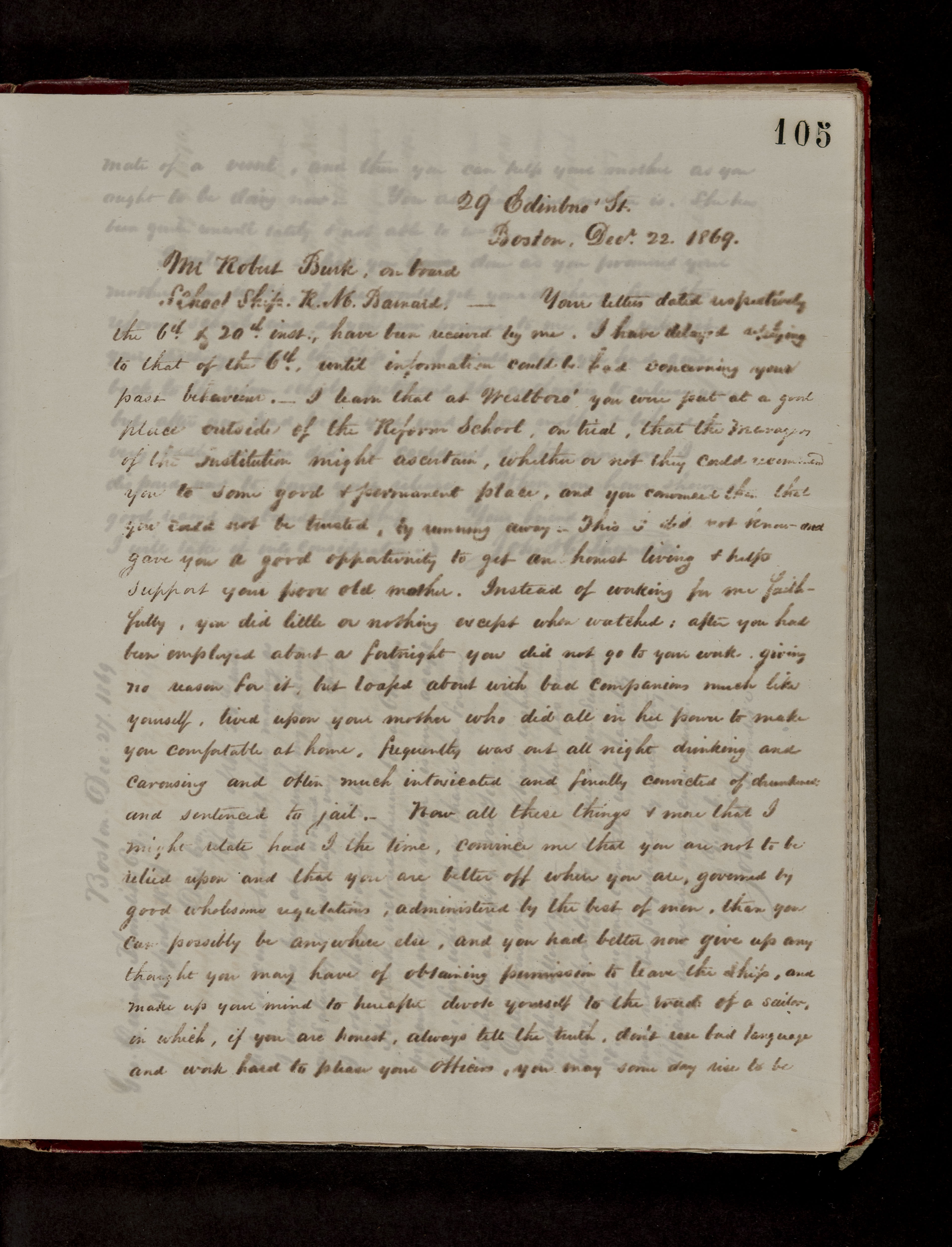
Copy of a letter from John H. Thorndike to Robert Burk, 22 Dec. 1869
For example, on 22 December 1869, Thorndike wrote to someone named Robert Burk (or possibly Burke) on the school ship R. M. Barnard:
I learn that at Westboro’ you were put at a good place outside of the Reform School, on trial, that the managers of the Institution might ascertain, whether or not they could recommend you to some good & permanent place, and you convinced them that you could not be trusted, by running away. This I did not know, and gave you a good opportunity to get an honest living & help support your poor old mother. Instead of working for me faithfully, you did little or nothing except when watched; after you had been employed about a fortnight you did not go to your work, giving no reason for it, but loafed about with bad companions much like yourself, lived upon your mother who did all in her power to make you comfortable at home, frequently was out all night drinking and carousing and often much intoxicated and finally convicted of drunkenness and sentenced to jail.
Now all these things & more that I might state had I the time, convince me that you are not to be relied upon and that you are better off where you are, governed by good wholesome regulations, administered by the best of men, than you can possibly be anywhere else, and you had better now give up any thought you may have of obtaining permission to leave the ship, and make up your mind to hereafter devote yourself to the work of a sailor, in which, if you are honest, always tell the truth, don’t use bad language and work hard to please your Officers, you may some day rise to be mate of a vessel, and then you can help your mother as you ought to be doing now. You ask how your mother is. She has been quite unwell lately & not able to work.
I’d never heard of anything called a “school ship,” so I did some research, and it was definitely “a thing.” School ships like the George M. Barnard (Thorndike got the name wrong) were used by the Nautical Branch of the Massachusetts State Reform School to train so-called “delinquent” boys to be sailors. Burk, apparently a former employee of Thorndike’s, had written asking him to petition for his release from the Barnard, but Thorndike was having none of it.
The State Reform School in Westborough, Mass. was one of the oldest, if not the oldest, publicly funded juvenile reform school in the U.S., although private reformatories had been around for a while. The impetus for the creation of the school ship system in 1859 was a fire at the school, set by one of the boys living there, that destroyed so much of the building that the governor thought it an opportune time to launch (no pun intended) the Nautical Branch.
In 1867, the Nautical Branch broke away from the State Reform School and became an independent institution called the Massachusetts Nautical School. It would operate until 1872.
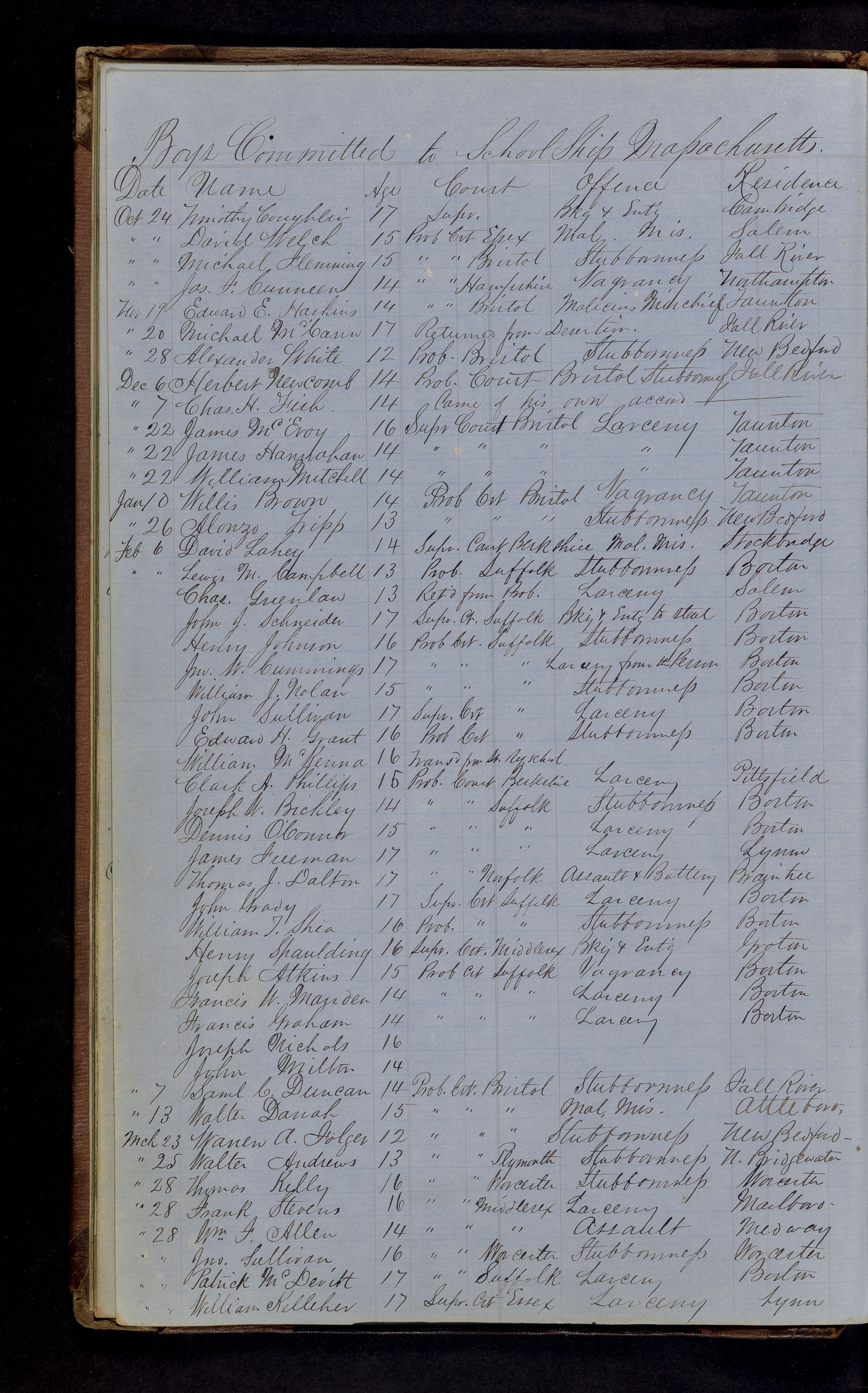
Page from the Massachusetts (Ship) records, Ms. N-623 (Tall)
It just so happens that the MHS also holds a volume of records of the first ship used by the Nautical School, the Massachusetts. The Massachusetts was such a success in the eyes of state legislators that they appropriated money for a second and larger ship, the George M. Barnard, named after a major donor.
This volume of Massachusetts records gives us a more detailed look at the boys the state deemed “delinquent.” They ranged in age from 12 to 18. (In fact, younger boys were committed to the Reform School, but the Nautical School was mainly for teenagers.) Their offenses included outright crimes, such as larceny and assault, but also what might be called behavioral problems: stubbornness and idleness, for example. Burk himself had been arrested for drunkenness.
Commitment to these Nautical School ships was a serious matter. Burk would have been sentenced by a judge to work and study on the Barnard until he reached adulthood, or until the trustees considered him reformed and discharged him. If he escaped, he’d be subject to re-arrest by police. He would receive only one family visit every three months.
However, this was an institution aimed at rehabilitation. Its curriculum included not just sailing and navigation, but also making clothes, cooking, and “the ordinary branches of education.” The school received donations from philanthropic individuals and organizations, as well as visits from distinguished guests. Charles Dickens even stopped by the Barnard during his 1867-1868 U.S. tour.
Many of the boys did, in fact, go on to become professional sailors. According to the annual report of the Nautical School trustees, about 40% of the boys committed to the school ships joined “the national, merchant, and whaling service” between 1859 and 1869.
I can’t help wondering about Robert Burk. The Thorndike letterbook doesn’t include any other correspondence from, to, or about him. Neither does the other collection of Thorndike papers here at the MHS. One of these days, I’ll have to stop by the Massachusetts Archives, which holds a collection of case histories of the boys of the George M. Barnard.
“We are all individuals, and also parts of the human family, and our best life is found in the way each of these capacities illuminates and vivifies the other.” Helen Bigelow Merriman wrote in her Treatise Concerning Portraits and Portraiture in 1891.
“Portrait painting has, after all, for its deepest secret, the same rule that lies at the bottom of all the best achievement in any direction, viz. Accept the Facts and then put the noblest possible construction upon them…It is the power of forming an abstract idea of a person- of seeing him whole- as it were, apart from any trifling incidental variations-that marks the true artist.” (Merriman 1891)
Helen Bigelow Merriman was born in 1844, the only child of Erastus Brigham Bigelow, founder of the Bigelow Carpet Company. Helen was raised in North Conway, NH, but later settled in Worcester and Boston, Mass. She returned every summer to her North Conway home, Stonehurst Manor. Helen was a painter, art collector, author, and a founder of the Worcester Art Museum along with her husband, Rev. Daniel Merriman, who served as the Worcester Art Museum’s first President. A visionary woman, Helen was also the founder and benefactor of the Memorial Hospital of North Conway, NH in 1911. (Sun 2011)
A champion of the arts, and especially in promoting women in the arts, Helen was active in the Worcester Art Society. She spearheaded the new building of the Congregational Church, served on both the Committee on Instruction and on the Committee on the Museum at Worcester Museum of Art advancing the museum’s Education mission and expanding the collections, and served as President of the North Conway Public Library.
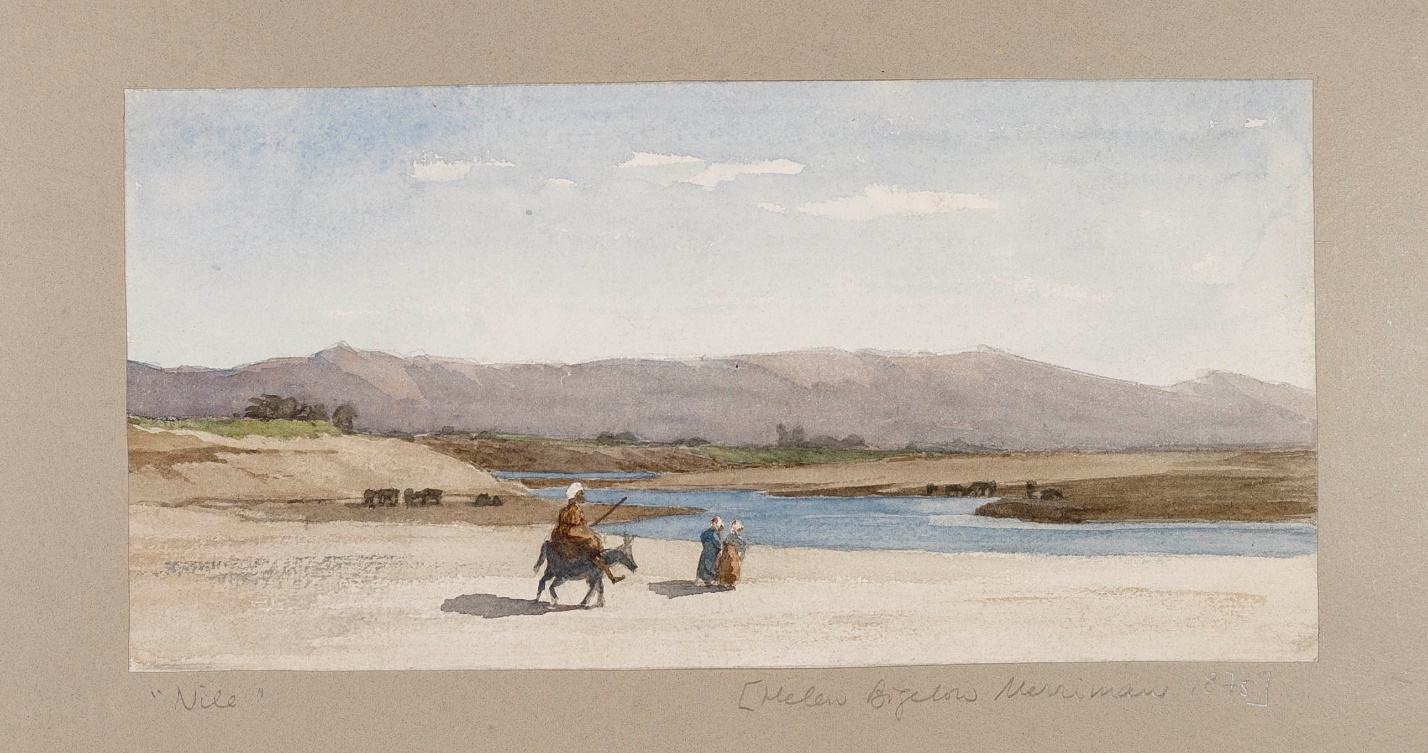
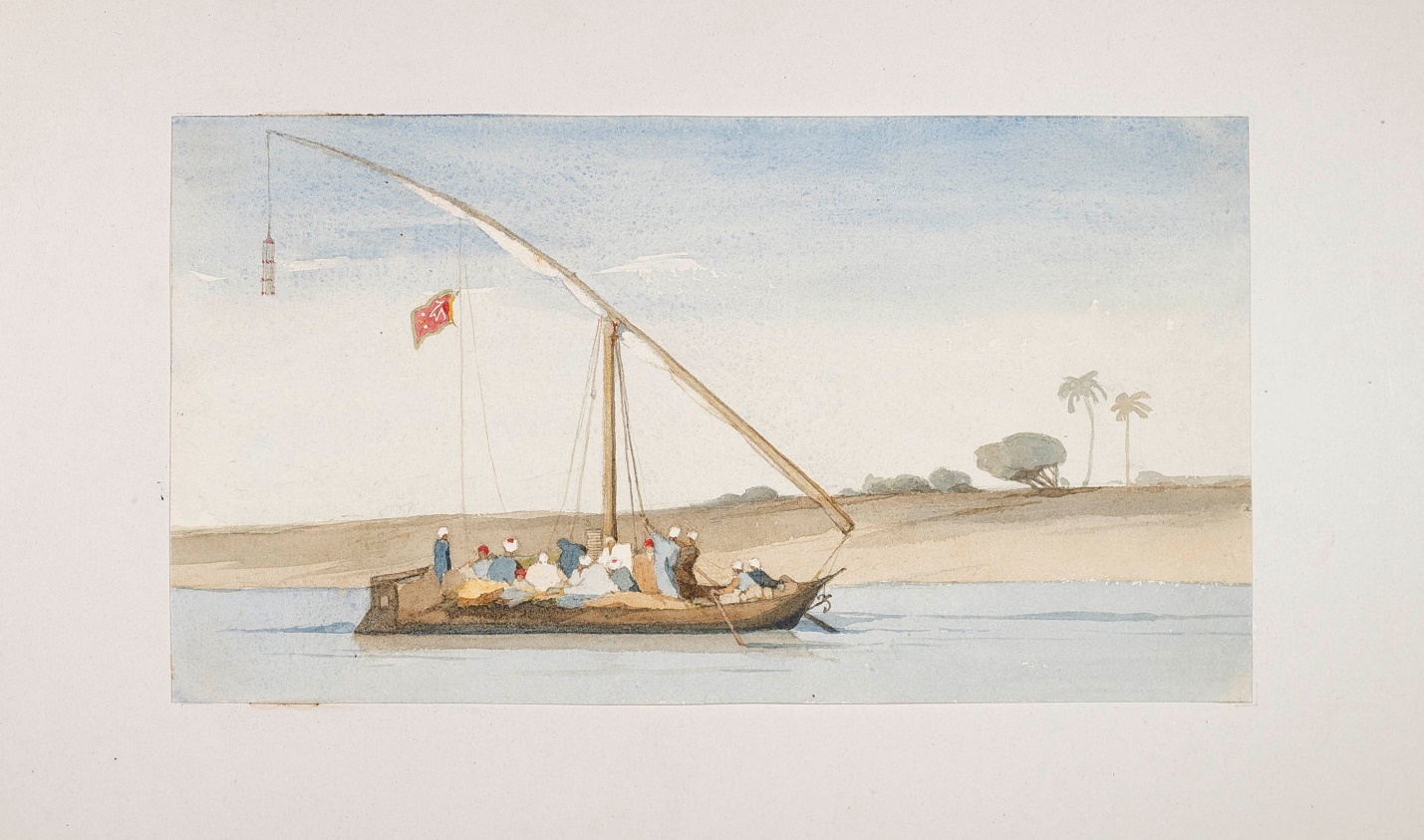
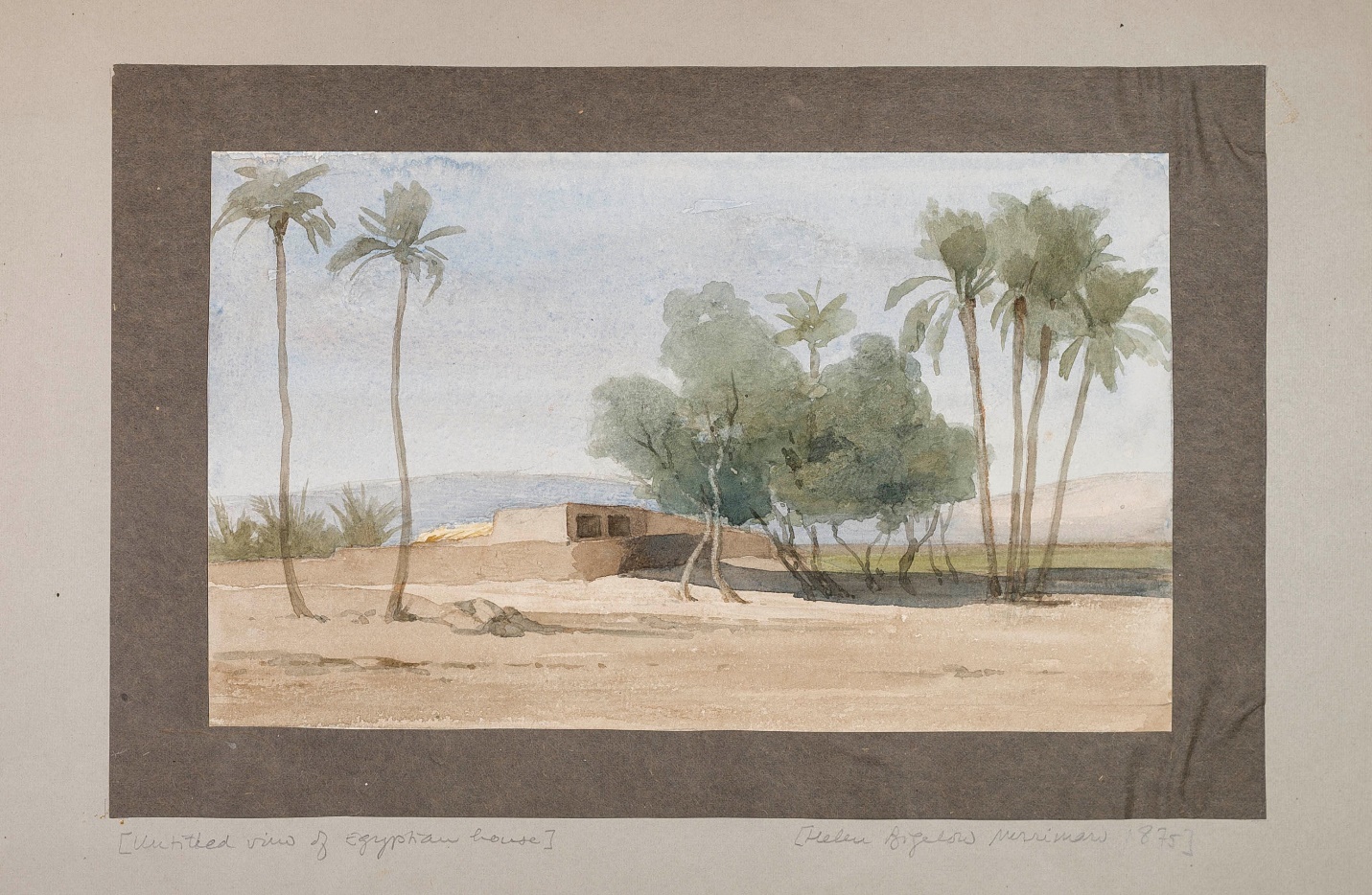
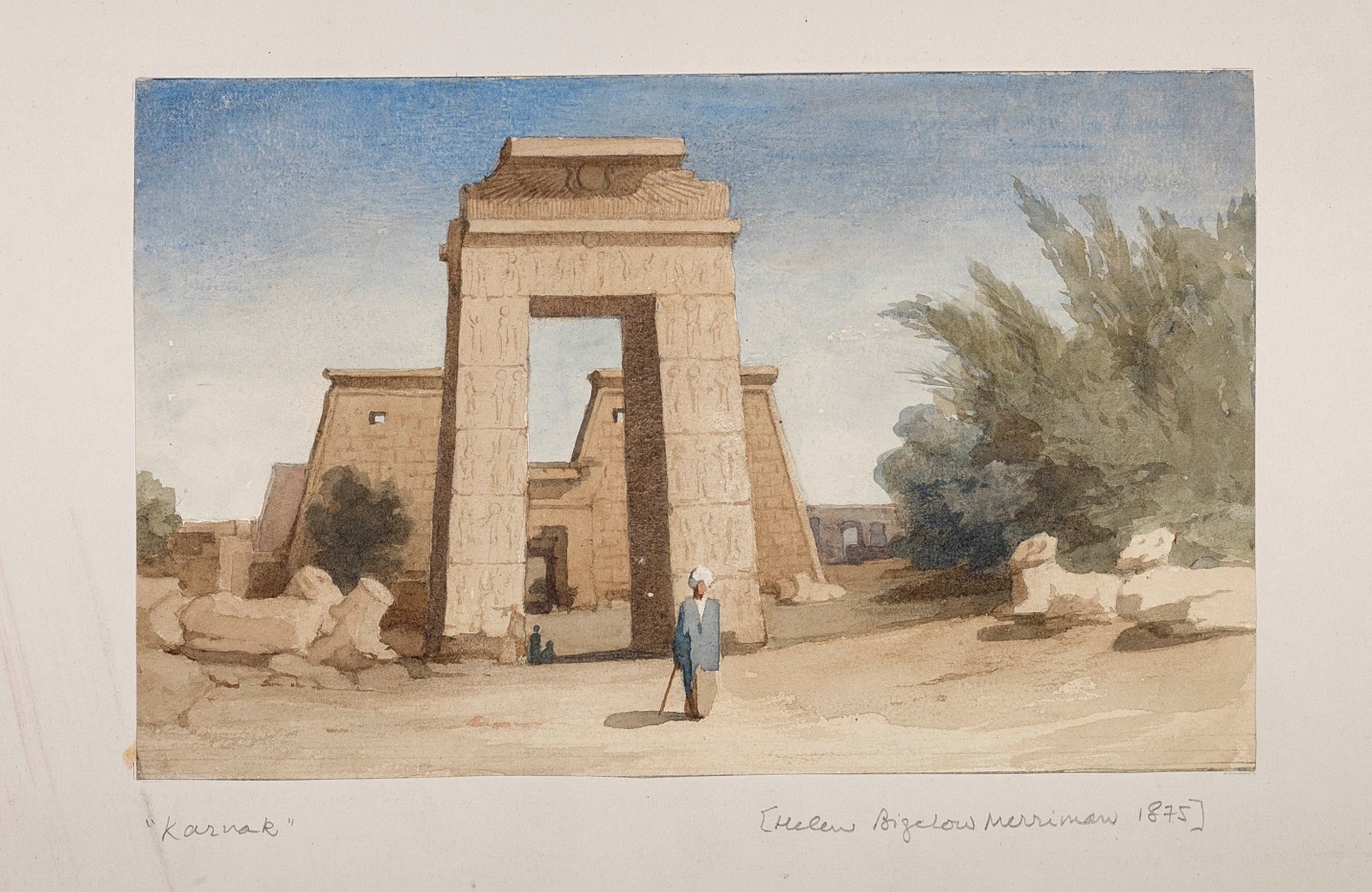
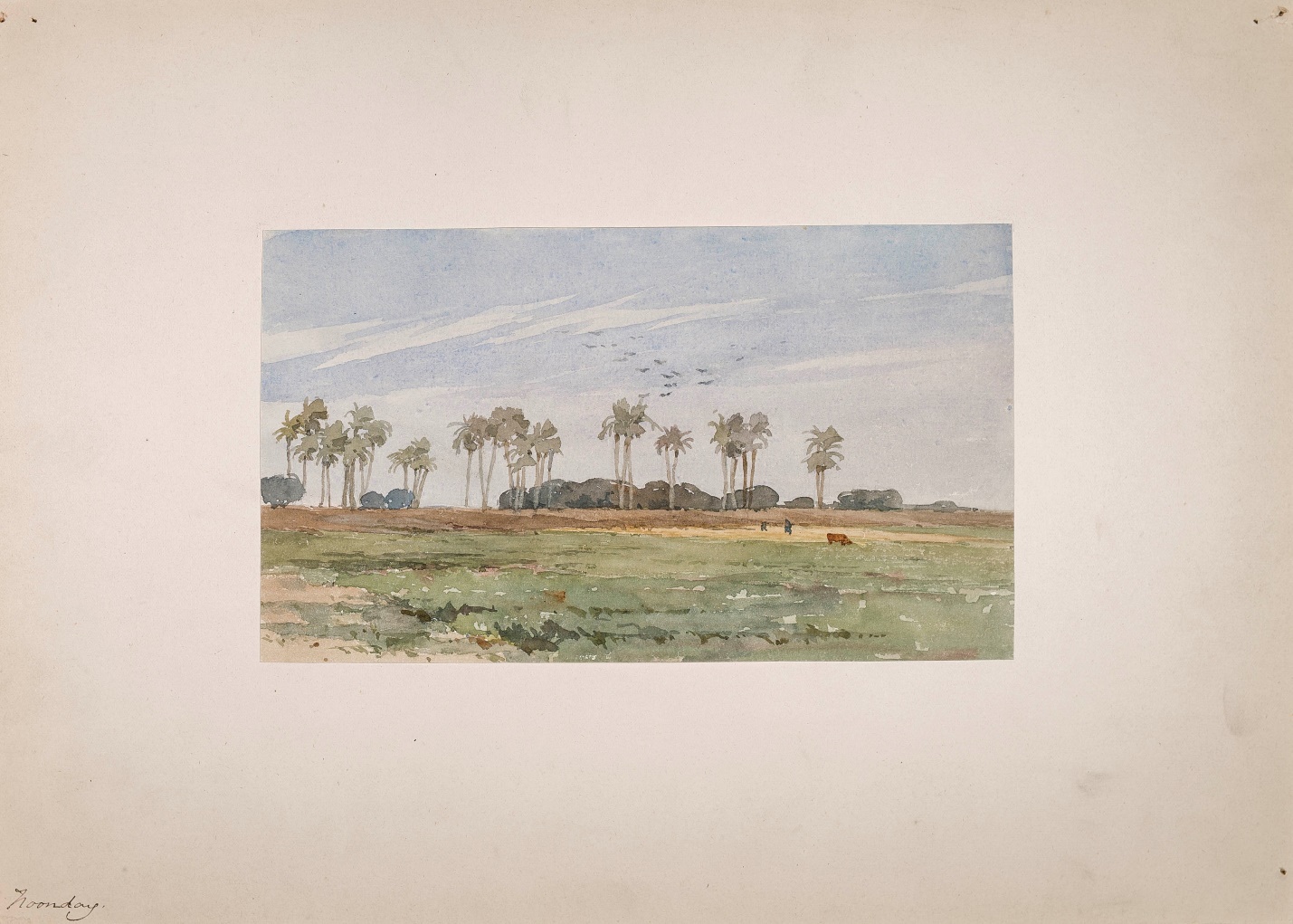
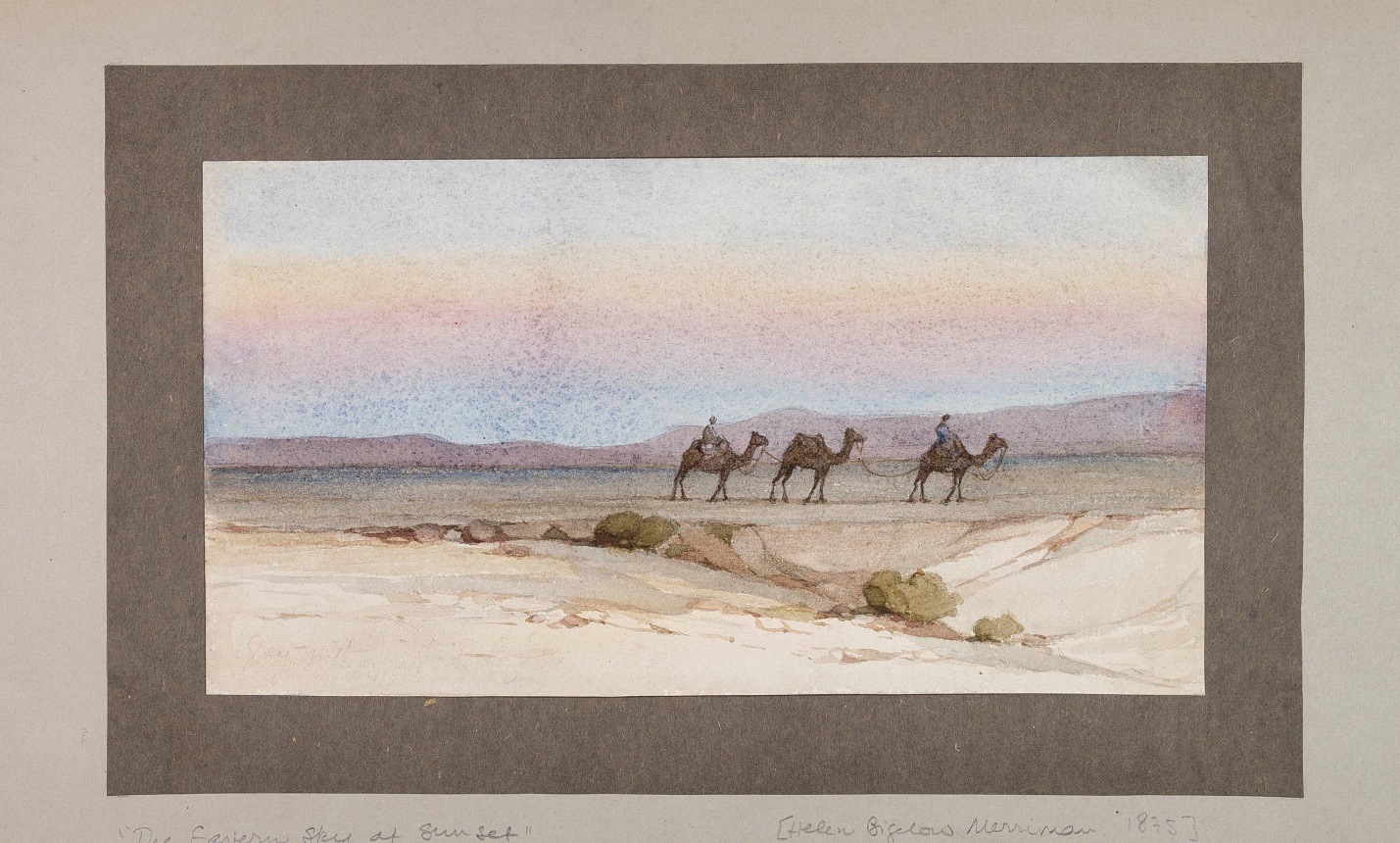
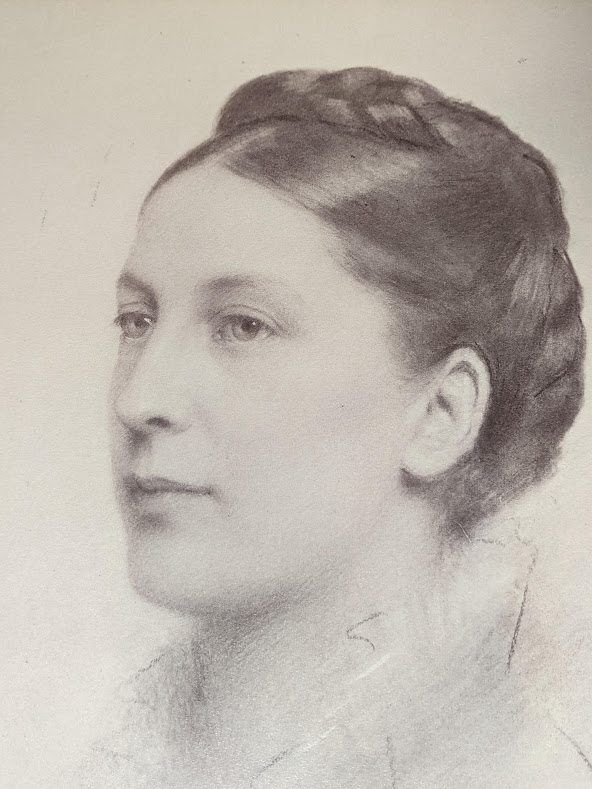
In 1875, Helen took a trip to Europe and Egypt. She painted and sketched everything around her as she travelled, capturing the worlds and people she met with exquisite and intimate detail. Housed at the MHS, the Helen Bigelow Merriman collection of watercolors and sketches consists of 50 drawings and paintings and 1 albumen photograph from the trip. The collection contains watercolors and drawings of people and scenes the artist saw on her journey down the Nile River, some of which were reproduced in her Figures drawn on the Nile. There are also English, Swiss, and Greek scenes, five lovely watercolors of birds, and an albumen photograph of a crayon drawing of a young woman, who might possibly Helen Bigelow Merriman herself.
When I came across the drawings and watercolors from Helen’s journey down the Nile River, my heart stirred. Time stood still as I opened the box that unveiled image after image, transporting me across the globe, 150 years past. Eventually, I had to close the box and return it to its shelf. I descended back down in the elevator to the Library with a refreshed mind. After all, I had just taken a trip down the Nile with Helen Bigelow Merriman!
Here are just a few of my favorite images. Let us begin with an image that simply has the word “Nile” written under this serene watercolor scene.
01.025 [Untitled, view of the Nile with three figures, one riding a donkey].To continue our journey, let’s board our vessel.
01.023 “Meerkeb” or common Nile boat.
Perhaps we will pass a house along the way.
01.015 [Untitled, view of Egyptian house].Next, we stop at the Temple of Karnak.
01.017 [Untitled, Karnak Temple with figure of a man in front].We might pass an oasis as we sail down the Nile.
01.027 Noonday [view of an oasis]We end our journey with this breathtaking image of the eastern sky at sunset.
01.003 [Camel train in the desert, Eastern sky at sunset]
“Although the artist is not properly a moralizer he gets from his art many side hints about very deep truths. I cannot help mentioning here a thought about immortality that has come to me very forcibly even in my small experience of portrait painting.
Our bodies become beautiful and natural only when they are transfigured by thought and feeling. The have in themselves only the most superficial kind of charm.
The outcome of all which is that if the body contributes so little to the highest beauty- if, in fact , it obstructs the highest beauty except as it becomes its unconscious instrument- then the mere loss of the body cannot take the highest beauty and truest life away from us.” (Merriman 1891)
With these words, I share the albumen photograph of a drawing of a young woman, possibly Helen herself, immortalized by her own art.
02.016 [Albumen photograph of a drawing of a young woman]Learn more about Helen Bigelow Merriman by exploring these collections at the MHS:
Last year, the MHS acquired a small collection of account books attributed to John Henry Clifford of New Bedford, Mass. Clifford was a lawyer who served in the Massachusetts legislature and as attorney general and governor of Massachusetts. This acquisition supplemented a large collection of Clifford’s papers that we already held.
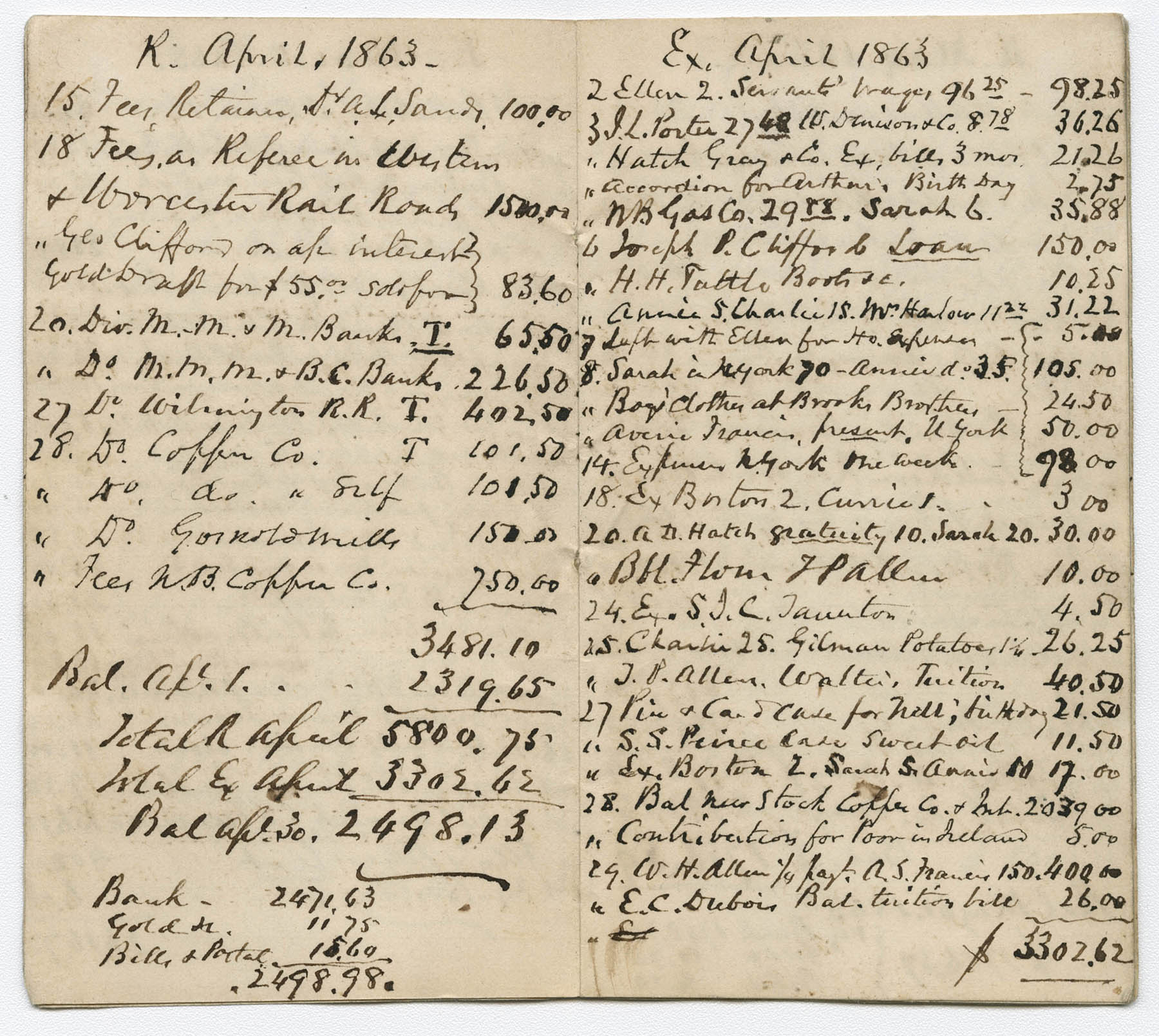
But when I started to catalog the collection, I noticed something odd. Six of the seven account books are tiny booklets measuring about 2 x 3.5 inches with accounts written out in a neat list, “receipts” on the left and “expenditures” on the right. These booklets date from 1847 to 1873.
One of John H. Clifford’s account books, April 1863
The seventh account book, however, is kind of an ugly duckling. It’s much larger (5 x 8 inches) and consists of hand-sewn signatures of mismatched paper containing miscellaneous accounts from 1845 to 1865. Not only is the handwriting different, but the accounts all run together in one big block of text.
Unidentified account book, September-October 1856
The account books were clearly kept by two different people. The six small volumes are definitely Clifford’s (I confirmed this by checking his papers for a handwriting sample), but who kept the seventh?
It seemed logical to assume the volume belonged to another member of the family, perhaps his wife Frances, and had been misattributed to John. This frequently happens with unsigned manuscripts in collections of family papers. But a closer reading revealed the accounts were definitely kept by a man. Included are records of joint expenses for him “& wife.” And when I compared entries for specific dates to those in Clifford’s, the accounts didn’t correspond. Sometimes our unknown individual was traveling to New York when Clifford was still in New Bedford.
A brother or son, then? Well, the handwriting didn’t match that of any other family member represented in the Clifford papers. So I abandoned that theory and started from scratch, digging into the content for clues.
This was easier said than done. Brief entries listing groceries and sundries purchased don’t exactly give you a lot of biographical details to latch onto. New Bedford is mentioned a few times, which probably explains the original misidentification. There are a few personal names, like Franklin, Sarah, and Dorah, but it was impossible to tell who was a family member and who was, say, a servant. I also saw the name Delano in several places.
Eventually a little more personal information emerged, like “my son Edward” and “my son Warren.” In fact, Warren makes many appearances throughout the volume. Well, John H. Clifford did have a son named Edward, but no Warren. Then I stumbled onto an unfamiliar proper noun that unlocked the whole mystery—Algonac.
If you’re an archivist or historian with expertise in a certain family, you may be ahead of me here. A quick online search revealed that Algonac was the home built by Warren Delano, Jr. in Newburgh, New York. This account book was kept, therefore, by none other than Warren Delano, Sr., who often traveled to visit his son and family. The clincher was the note Delano, Sr. wrote proudly marking his granddaughter Annie’s birthday.
Warren Delano, Sr. lived in Fairhaven, Mass., just across the Acushnet River from New Bedford. He died in 1866. He also happened to be the great-grandfather of President Franklin Delano Roosevelt.
If I were to extend my earlier metaphor, I’d say the ugly duckling turned out to be a swan. John H. Clifford was a conservative Whig who opposed the abolition movement and was called “pro-slavery” by his one-time servant Frederick Douglass. Warren Delano, on the other hand, supported abolition, aided those seeking freedom from enslavement, and subscribed to anti-slavery publications. Here are some of the relevant entries in his account book:
[27 August 1853] Donation to a Mother, to aid the redemption of a daughter, from the hands of a man thief 2 dolls.
[1 October 1856] Donation to suffering freemen in Kansas 25 dollars
[28 October 1856] For Liberator & A. S. [Anti-Slavery] Standard, & Bal. to the cause of freedom 10 dolls.
Autumn is my favorite time of year; celebrating Halloween and all things gruesome, haunted, and scary. One of my favorite, and kind of gross, stories to tell people, especially in September on its anniversary, is the tale of Giles Corey, pressed to death during the Salem Witchcraft Trials of 1692.
In 1692, Giles Corey was a successful farmer in Salem Village, the current location of Danvers, Mass., when a group of girls and young women started accusing locals of bewitching them with specters, pinches, and disease. Disliked personalities and large properties played a large part in who was accused of witchcraft during the trials. Giles was a criminal and was not well-liked. In 1676, he was tried for the death of Isaac Goodale, an indentured servant, whom he beat with a stick for stealing some apples. He was found guilty, but was only fined since corporal punishment towards indentured servants was legal. Many community members witnessed the beating and testified against him. Giles was also accused of stealing several times and had such a reputation that when John Proctor’s house burned down a few years previous, he assumed Giles had burned it! Giles’s wife, Martha, also had a mixed reputation. She was adulterous during her previous marriage but when she and Giles married, the community remarked a distinct change for the good in them both. However, their loud bickering was witnessed often.
Giles attended some of the first trials that took place in a tavern, and Martha was quickly accused of witchcraft. At first he testified against his wife, believing the accusations, but then changed his mind and tried to recant his words. Abigail Hobbs, another accused of witchcraft, named Giles Corey as a wizard close in time to when he testified against his wife. Martha denied the accusations but Giles would not plead guilty or not guilty. Giles Corey may not a have been a good person but he was smart. He knew that if he plead and let the trial happen, his estate would be taken away from his family after his execution. To save his children’s inheritance, he would not plead. According to the law at the time, those who did not plead could not be tried. To try to get the accused to plead, the legal remedy was “peine forte et dure,” translating to “strong and hard pain.” It became the name for the torture of pressing.
WARNING: below this image is graphic language explaining the mechanics of torture.
In the MHS collection is the diary of Samuel Sewall, one of the judges of the Salem Witchcraft Trials. Sewall kept a journal from 1673 until a few months before his death in 1730. His entry for 19 September 1692 reads:
“Monday; Sept-19th 1692. Abt noon, at Salem, Giles Corey was pressed to death for standing mute Much pains was used with him two days one after another by ye court & Capt. Gardner of Nantucket who had been his acquaintance: but all in vain. 20 Now I hear from Salem that abt 18 years agoe, he was suspected to have stamped and pressed a man to Death. But was cleared. twas not remembered till Ann Putnam was told of it by G Corey’s Specter ye Sabbath-Day night before ye Execution.”
After he would not plead, Giles was asked to strip naked and lay down, face up, on the ground. A wooden board was then placed on top of him, and on top of the board, one by one, Sheriff George Corwin placed large rocks. After two days of this torture, through which Giles had remained silent, never crying out, he was asked to plead. Giles did not want his property to be taken, so he never plead either way. On the third day 19 September 1692 he died from being pressed to death. His last words were “more weight.”
Giles plan did work, his estate passed to his two sons, however Sherriff Corwin successfully extorted money from Giles daughter who later pressed posthumous charges against the Sherriff for his crime. Sherriff Corwin died of a heart attack in 1696, and every Sherriff after him died or resigned of some kind of blood ailment until 1991 when the Sherriff’s office moved from Salem to Middleton, Mass. Some witnesses say that Giles Corey did not remain silent and had cursed the title of Sherriff: “Damn you, I curse you and Salem!” However, it is mostly agreed upon that “more weight” were his last words.
Giles Corey’s case is the only of its kind in New England, although other pressings happened in England. Martha was hung as a witch three days later. The gruesome and public torture of Giles Corey changed some of the minds of the community about supporting the witch trials.
Every year, the MHS selects one or more high school students for our John Winthrop Student Fellowship. This award encourages high school students to make use of the nationally significant collections of the MHS in a research project of their choosing. Applications for the 2022 Student Fellowships will open in November 2021. Learn more and apply!
This year, our 2021 John Winthrop Student Fellow Laasya Chiduruppa of Lexington High School has been researching the history of slavery and abolition in Massachusetts with the support of her teacher mentor Michael Egbert. Laasya has created an educational blog with articles on her research into the history of significant court cases on the road to ending slavery. Visit Abolition in Massachusetts to learn more and follow along with Laasya’s research!
***
As an American aware of deep-rooted systemic racism and as someone interested in contributing to moving our nation towards social justice, I have a keen interest in educating myself and others on historic injustices. So, when I came upon the Massachusetts Historical Society, I was thrilled to read about the John Winthrop Student Fellowship, seeing the research opportunity as a venue to educate myself and others on the importance of representation of unheard voices and recognition of our country’s painful past. With the resources provided, I dove into research focused on the early court cases credited with abolishing slavery in Massachusetts, and I created an educational blog focusing on these historic milestones to equality.
During initial conversations with Kate Melchior, an MHS historian who guided me through this process, and Mr. Egbert, my history teacher, I highlighted how I was interested in anti-slavery movements in the local area, regardless of date, era, or the laws they were protesting. However, through my research and their guidance, I soon realized that I needed to focus my topic into a much more specific time period and theme, ending slavery in Massachusetts, in order to have the clearest narrative in the educational blog I wanted to create. It was through this guidance that I was able to narrow down my research to a series of court cases in the 1780s, legal action ultimately resulting in the abolition of slavery in Massachusetts.
Early on in my research journey, the collection of the notes from Judge William Cushing’s legal notebook, stood out to me. Cushing had presided over the series of cases known as the Quock Walker case, which had ultimately found that the existence of slavery contradicted with the Massachusetts Constitution, and therefore couldn’t be supported by Massachusetts state courts. Through the quickly written notes, I not only was able to find a clear narrative of testimony on both sides, especially during the criminal indictment of Quock Walker’s owner for battery, but was also able to see the beginnings of his thought process behind his ultimate decision and instruction to the jury.
In my research process, I struggled to narrow down my research into specific fields. Due to the plethora of documents and primary sources available in the MHS catalog, I often found myself diving into antislavery records written decades after the abolition of slavery in Massachusetts, or identifying historical ads from the Civil War era. Through the use of key words and case studies, I was able to keep my research focused. In the writing process for my blog, I also initially had difficulties with finding the correct tone to highlight what I had found. Ultimately, after reading through historical entries in the Beehive Blog, the MHS’s historical blogging website, I was able to hone in on a format which used historical documents and a casual tone to develop a narrative.
If you plan on taking on this research opportunity in the future, don’t go into it with a strict cemented vision of what your end product, or even your research, will look like. Start the process by diving into materials which are related to your focus and importantly, are genuinely interesting or fascinating to you. As you move along further in the research process, these documents will guide you to the ultimate direction your final project will take on. As I was in the earlier stages of my research process, I started with the list of documents which I had highlighted in my application, as well as the list of resources provided by the MHS historians working alongside me. I used these accounts as starting off points, narrowing my focus to key figures like Mumbet, Quock Walker, and Anthony Burns. I then used these case studies to identify key words and further my research, ultimately allowing me to narrow my research down into a clear narrative.
Also, take full advantage of the resources, both in the archives and over email, available to you. The MHS historians are so thoughtful in their guidance, and their suggestions. Check-ins were imperative in molding the final direction my project took on.
From the blog that I have written, I hope to teach my peers and fellow members of my community that the journey to equality was a long and difficult one, and one that didn’t start and end with the Civil War. I hope to highlight underrepresented and disenfranchised voices and underline the physical and legal struggles these direct actors faced. Most importantly, however, I hope that the research and writing that I have done encourages others to diversify their knowledge of local history and the struggles on the road to freedom.
I think it’s fair to say that even the most seemingly mundane items here at the MHS tell an interesting story if you look at them closely enough. By way of illustration, I’d like to tell you about the Marian Lawrence Peabody record of wedding presents. This volume, given to the MHS earlier this year, complements our substantial collection of Marian Lawrence Peabody papers, the bulk of which came from Marian herself in 1969 and 1970. Visit the guide to that collection to learn more about her life and family.
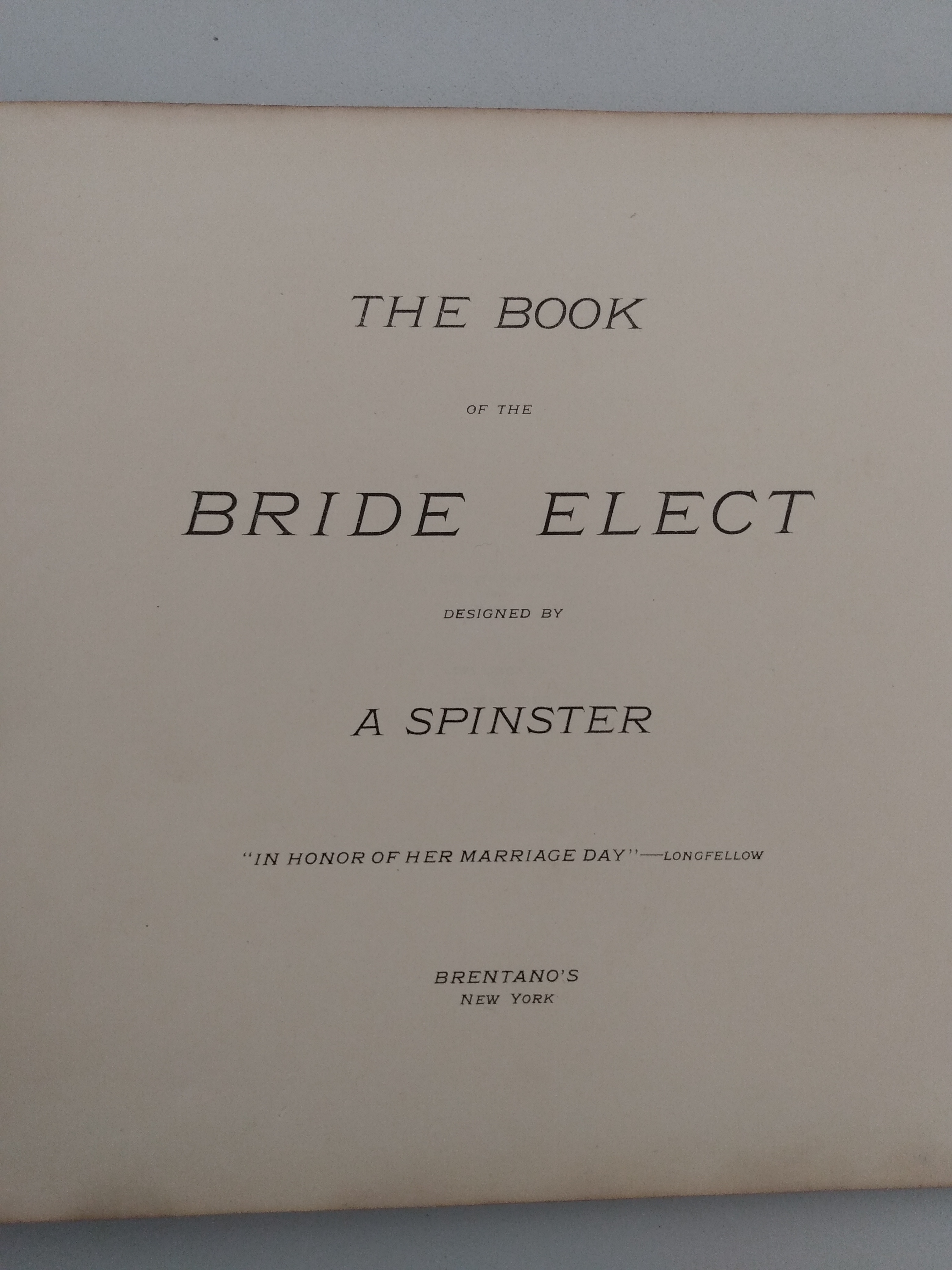
The volume is hilariously titled The Book of the Bride Elect Designed by a Spinster (N.Y.: Brentano’s, 1902). In it, Marian listed all the wedding gifts she received when she married Harold Peabody on 8 May 1906.
Title page of volume
Marian and her husband received a total of 375 wedding gifts, primarily things like dishes, silverware, candlesticks, tea sets, and vases, as well as furniture, rugs, clocks, jewelry, and books. The volume also contains a list of the over 100 presents the couple received, mostly flowers, when their engagement was announced.
Many of the wedding gifts were lavish. Endicott Peabody gave the couple a “run-about carriage” and another Mr. Peabody (possibly her father-in-law) gave them $1,000 cash, which online historical currency calculators tell me would be the equivalent of about $30,000 today. John S. Lawrence’s gift was a tiger-skin rug. Also included are several Tiffany and Wedgewood items. Some of the presents sound like they must have been beautiful, like the “Japanese drawing framed in teak,” the “tortoise-shell & silver paper cutter,” and a pearl and garnet pendant.
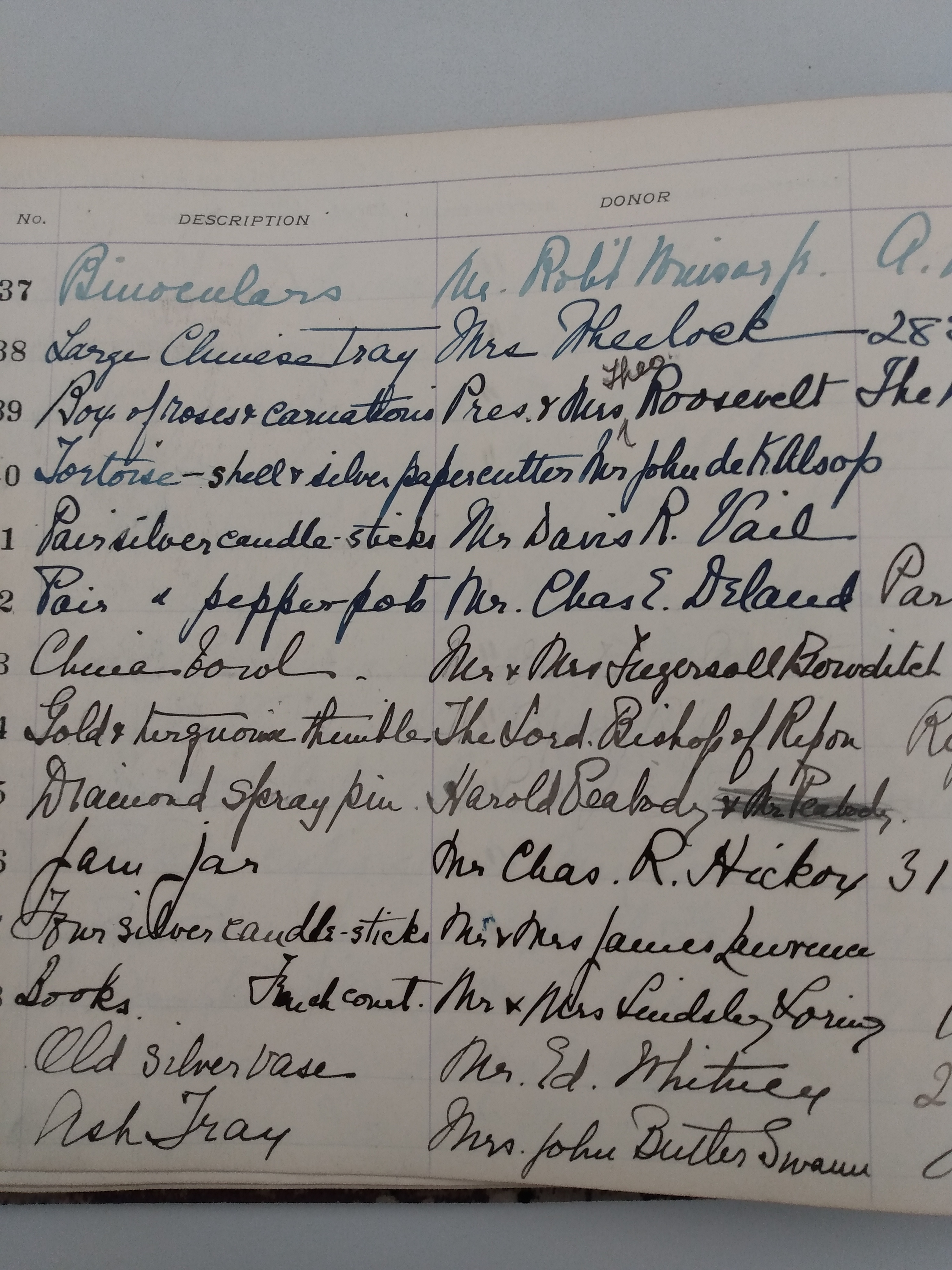
The list of donors is equally impressive, a veritable who’s who of the turn-of-the-century elite. The Archbishop of Canterbury gave the couple, quite aptly, a copy of Pilgrim’s Progress. President Theodore and First Lady Edith Roosevelt sent a box of roses and carnations. Other donors included Franklin and Eleanor Roosevelt; Thomas Jefferson Coolidge, the great-grandson of Thomas Jefferson; and Henry Francis du Pont of Winterthur, Delaware. Needless to say, Marian ran in very privileged circles.
Page containing the names of President and First Lady Roosevelt
The entry for each gift includes the name of the donor(s), their address, and where the item was purchased (if known), but also what happened to it afterwards. This last column was filled out, in some cases, many years later, and it’s here that we see what was regifted, exchanged, lost, worn out, broken, or sold.
A silver and glass fruit dish from Benjamin Vaughan and his wife is followed by the wistful note: “In 1934 gave to Katharine Lawrence King – regret it.” Many other items were unfortunately lost in a fire that ravaged Marian’s home at Bar Harbor, Maine, in 1947. These included two salt spoons and two salt cellars from Rev. Glenn Tilley Morse (“lost in fire & they were lovely”). Other gifts were distributed throughout Marian’s home at 302 Berkeley Street in Boston or safely ensconced at the State Street Trust building.
The works of Jane Austen were apparently a popular wedding gift that year. The Peabodys received three sets: one from Franklin and Eleanor Roosevelt, which they gave away; one from Roger Pierce, which they “changed for Victor Hugo”; and one from “Harold’s old nurse,” which they kept.
Particularly intriguing was one gift, a pair of binoculars given to the Peabodys by Robert Winsor, Jr. A unique wedding gift, to be sure, but so was the note that followed it: “Rented to the Navy thru’ the war for $1.00 / Then gave to Tony Parker my godson who let them fall overboard.”
I was curious what Marian wrote in her diaries during this time, so I consulted her papers. Her diary entry for 24 January 1906 refers to The Book of the Bride Elect, the very volume in my hands, which Marian called “the most useful present from Sally.” The entry describing her wedding goes on for an enthusiastic seven pages. She mentioned one gift in particular: “A large box of flowers arrived in the midst of all the excitement with ‘White House’ written all over it, & inside Pres. & Mrs Roosevelts cards & good wishes.”
Sixty years later, Marian published an autobiography called To Be Young Was Very Heaven (Boston: Houghton Mifflin, 1967), which consists primarily of her diary entries up to her wedding day. But there are significant discrepancies between the original and printed versions. For example, about the Roosevelts’ present, she incorrectly quoted her own diary this way: “Also a box came from the White House—but it was roses and we certainly had enough of those. Presidents should send something solid so it can be kept as a memento.”
Marian was in her 90s when her autobiography was published, and she engaged in some self-reflection, stepping back to comment on her former self with the wisdom of many decades. On her wedding day, the young woman may have gushed, but the older woman editorialized, “I did not half appreciate all that was done for me. I had been spoilt and still wanted everything the way I wanted it.”
Everything didn’t turn out the way she wanted it, however. Her marriage proved to be an unhappy one, and the couple lived apart for many years. Marian died in Milton in 1974 at the age of 98.
It was an open secret that the Adamses were no fans of Alexander Hamilton. Senator John Quincy Adams couldn’t even be prevailed upon to wear crape, join in a funeral procession, or “join in any outward demonstration of regret” after Hamilton’s untimely death. When chastised by his wife, JQA responded that he “had no respect” for the fallen statesman.
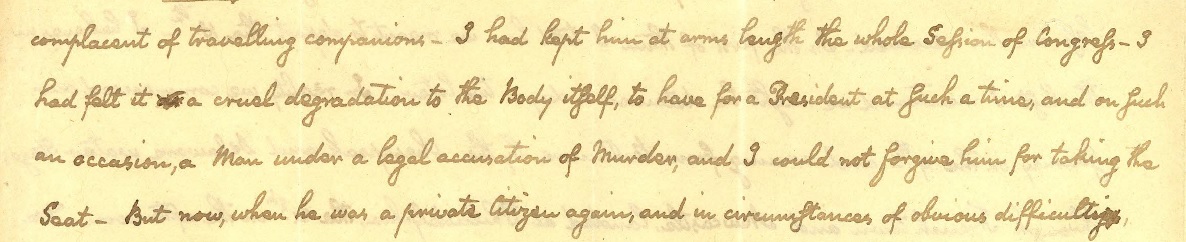
Nor did he much respect the man who had stood opposite Hamilton in the early hours of 11 July 1804, and his respect for Burr only plummeted further when Burr dared to return to his station as President of the Senate. Adams admitted he had kept Burr “at arms length the whole Session of Congress,” feeling it “a cruel degradation to the Body itself, to have for a President at such a time, and on such an occasion, a Man under a legal accusation of Murder.” Adams “could not forgive him for taking the Seat.”
John Quincy Adams to Thomas Boylston Adams, 1 April 1805 (Adams Papers)
When the second session of the Eighth Congress came to a close on 3 March 1805, Burr gave a farewell address—“the last act of his political life,” as Adams thought—and John Quincy left the Senate Chamber for home, convinced he had seen the last of Burr.
On 19 March, John Quincy and Louisa Catherine boarded a ship in Baltimore, sweating in the unseasonably warm weather, two sick and fitful toddlers in their arms, ready to get the trip over with and reach their next destination of Philadelphia. (When they later arrived in Philadelphia, the Adamses’ old friend Dr. Benjamin Rush diagnosed the boys with chicken pox and whooping cough.) An overwhelmed Louisa Catherine recorded in her diary that “the Children were both quite unwell and of course very troublesome It was the first time that I had the entire charge of them.”
One can imagine the sinking of already low spirits when the Adamses got on board and were greeted by Aaron Burr. Having been much affected by Hamilton’s demise, Louisa confided to her diary that she “felt a sort of loathing for this Col Burr.”
Within a few hours, Louisa—and everyone else on board—had fallen under his spell. “He appeared to fascinate every one in the Boat down to the lowest Sailor and knew every bodies history by the time we left— He was politely attentive to me . . . At Table he assisted me to help the Children with so much ease and good nature that I was perfectly confounded.”
John Quincy Adams to Thomas Boylston Adams, 1 April 1805 (Adams Papers)
When relaying the event to his brother, John Quincy wrote, “Whether the original seducer of mankind, has embodied himself in the person of the little ex-vice, I am not competent to pronounce— This I will say; that I defy Man, Woman or Child, so to withstand the powers of his fascination, as to part from him after such a transitory association, without feelings of good-will towards him.”
After a particularly rough passage—so rough, in fact, that at one point Louisa rolled out of her high berth and onto the floor—the Pennsylvania soil was a sweet sight to the passengers. Taking pity on the sleep-deprived parents of fussy young children, Burr swooped in, taking little John Adams II in one arm, taking Louisa’s luggage in the other hand, and offering her his arm to disembark. John Quincy followed behind them, George Washington Adams in his arms, his jaw on the gangplank.
“It was all done with so little parade and with such entire good breeding that it made you forget that he was doing any thing out of the way,” Louisa recalled. “He talked and laughed all the way and we were quite intimate by the time we got to Philadelphia where he called to see us, and this the first and last occasion on which I ever saw this celebrated man.”
After two weeks’ rumination, John Quincy summed up the experience by writing, “I had not strength of mind enough to retain in their full inflexibility the resentments even of Virtue— I felt a degree of compassion for the Man, which was almost ready to turn to Respect— He was more than barely civil to me and my family— I could not help feeling for him in return more kindness, than I was willing to acknowledge to myself—infinitely more than I suffered myself to shew him; and perhaps more than is justly consistent with that character which on a cool and distant estimate I cannot help believing to be his.”
The Adams Papers editorial project at the Massachusetts Historical Society gratefully acknowledges the generous support of our sponsors. Major funding is provided by the National Endowment for the Humanities, the National Historical Publications and Records Commission, the Packard Humanities Institute, and the Amelia Peabody Charitable Fund. All Adams Papers volumes are published by Harvard University Press.