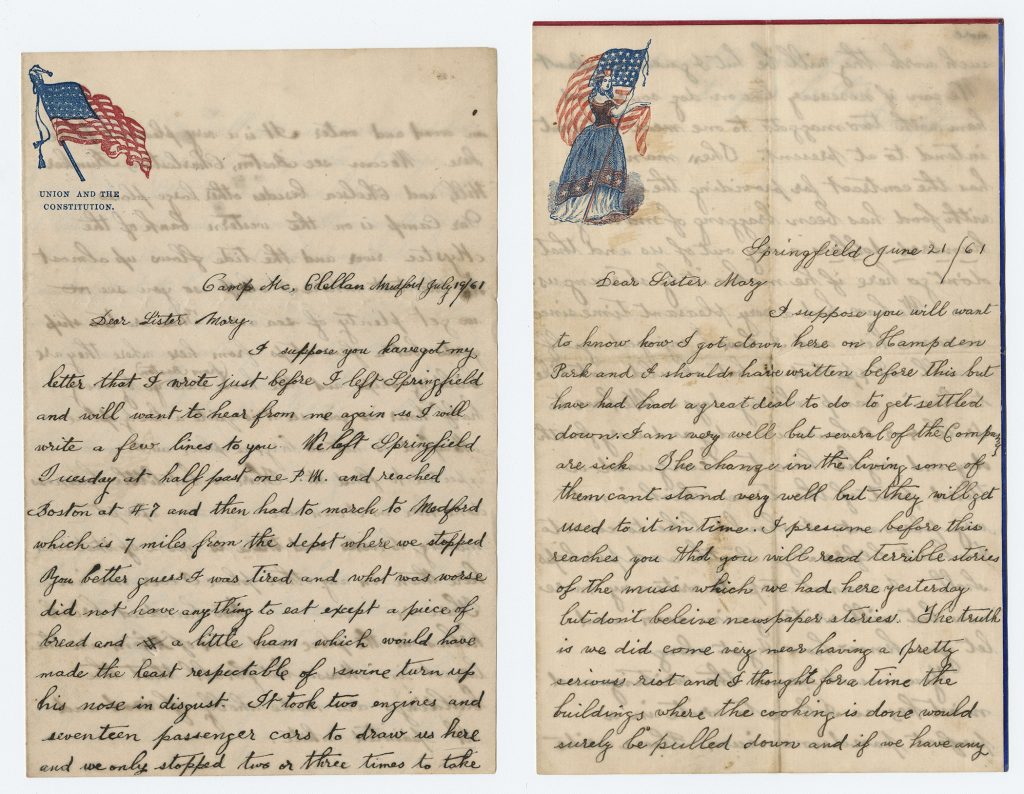
George Hyland’s Diary, April 1919


Please note that the MHS is closed on Monday, 15 April. Here is a look at the programs planned for this week:
On Tuesday, 16 April, at 5:30 PM: The Long 19th Amendment with Corinne Field, University of Virginia; Katherine Turk, University of North Carolina at Chapel Hill; and moderator Susan Ware, Schlesinger Library. With popular and scholarly attention focusing on the August 2020 centennial of the ratification of the Nineteenth Amendment, this session will explore “the long Nineteenth Amendment” stretching from the woman’s suffrage movement to second-wave feminism and beyond, with an eye toward continuities, challenges, and unfinished business. This is part of the Boston Seminar on the History of Women, Gender, & Sexuality series. Seminars are free and open to the public.
On Wednesday, 17 April, at 6:00 PM: The City-State of Boston: The Rise & Fall of an Atlantic Power, 1630–1865 with Mark Peterson, Yale University. In the vaunted annals of America’s founding, Boston has long been held up as an exemplary “city upon a hill” and the “cradle of liberty” for an independent United States. Wresting this iconic urban center from these misleading, tired clichés, Mark Peterson highlights Boston’s overlooked past as an autonomous city-state, and in doing so, offers a path-breaking and brilliant new history of early America. A pre-talk reception begins at 5:30 PM; the speaking program begins at 6:00 PM. There is a $10 per person fee (no charge for MHS Fellows and Members or EBT cardholders).
On Thursday, 18 April, at 5:15 PM: Historians & Ethics: The Case of Anne Moody with Francoise Hamlin, Brown University, and comment by Chad Williams, Brandeis University. In the process of conducting research for her book project, Hamlin encountered an ethical conundrum regarding the papers of Anne Moody, author of the iconic autobiography, Coming of Age in Mississippi. This paper explores this case in depth and probes how historians should record the lives of those who might not have wanted to be found. This is part of the Boston Seminar on African American History series. Seminars are free and open to the public.
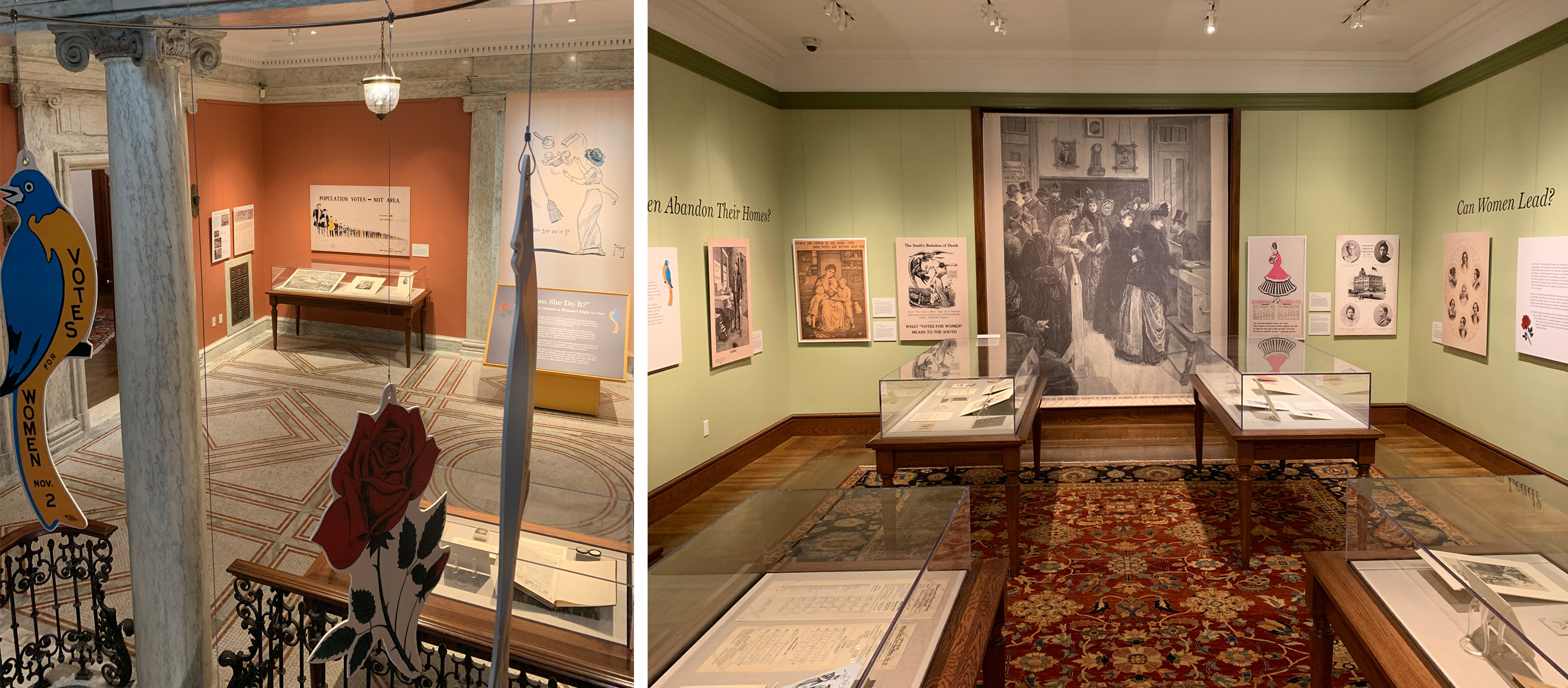
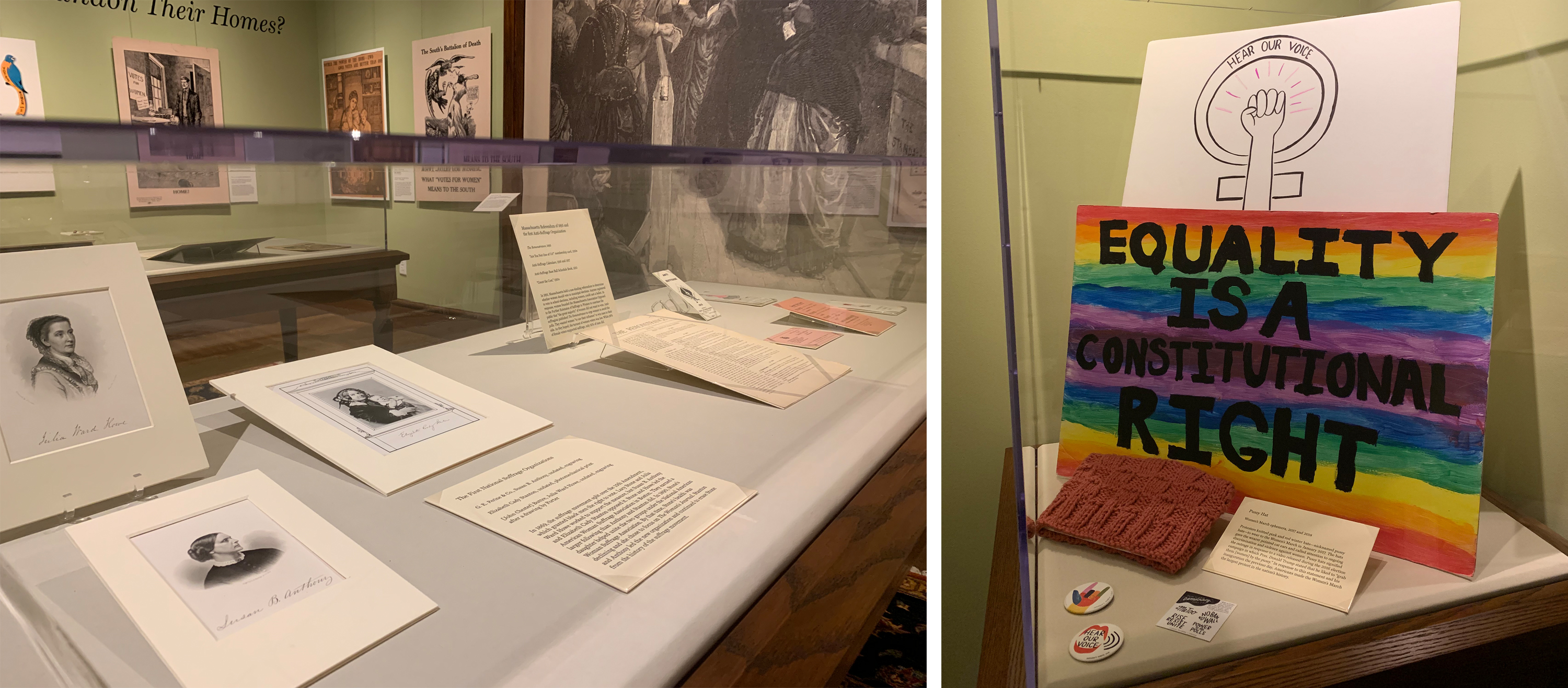
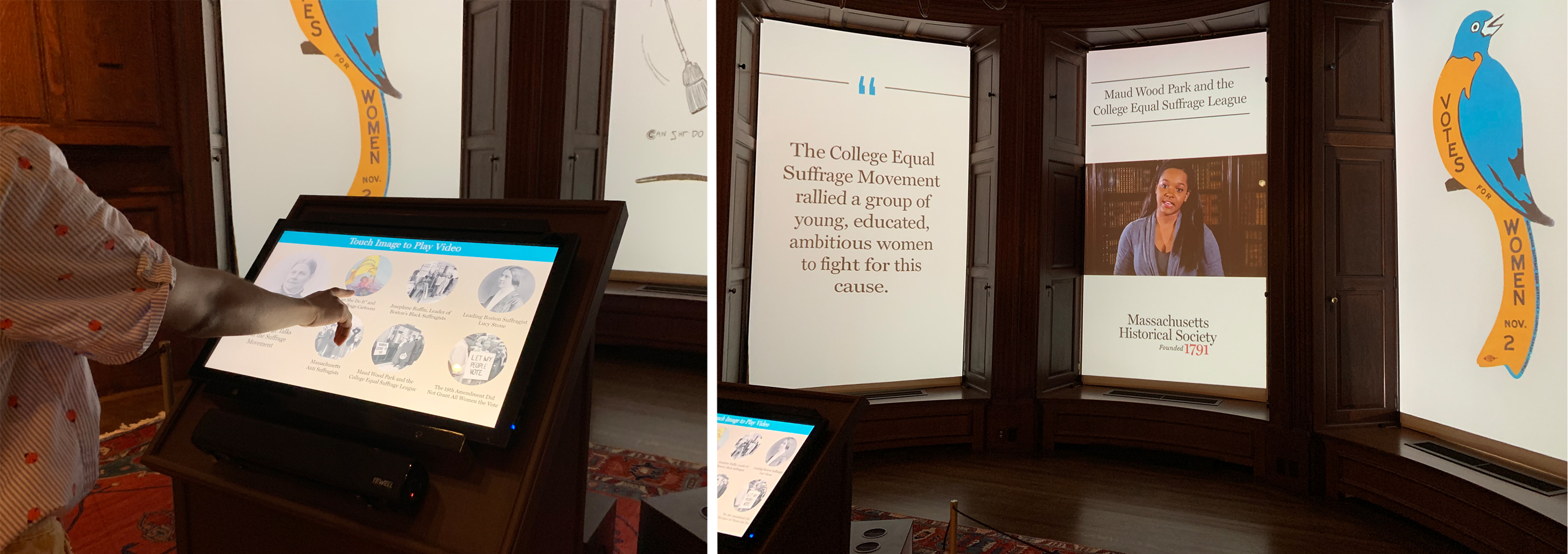
Opening at the MHS on 26 April: “Can She Do It?” Massachusetts Debates a Woman’s Right to Vote
Commemorating 100 years since Massachusetts ratified the 19th Amendment, this exhibition explores the activism and debate around women’s suffrage in Massachusetts. Featuring dynamic imagery from the collection of the MHS, “Can She Do It?” illustrates the passion on each side of the suffrage question. The exhibition will be open Monday and Wednesday through Saturday from 10:00 AM to 4:00 PM, and Tuesday from 10:00 AM to 7:00 PM through 21 September.
by Caroline Culp, Stanford University, Andrew W. Mellon Short-Term Research Fellow at the MHS
There is a curious, even eerie painting in the Massachusetts Historical Society’s collections. The remnant of a larger canvas, Charles Russell’s disembodied head floats as if suspended in its adopted gold frame. So many of the standard questions scholars lob at portraits fail to stick to Russell’s image—How does the sitter’s pose reflect his identity? How does his clothing mark his social rank? How do the objects surrounding him speak to his historical moment?

None of these questions can be answered. Instead, the repeated drumbeat of one query sounds: why and how did this cut-out face survive?
Charles Russell was painted by John Singleton Copley (1738-1815), colonial America’s preeminent artist. Perhaps the work was completed in 1757, on the occasion of Russell’s graduation from Harvard. A loyalist, Russell fled to Antigua in 1774, where he died six years later. His portrait remained in the care of his sister, Sarah Russell, until her death in 1819, when it should have been inherited by Charles Russell’s eldest daughter, Penelope Russell Sedgwick.
But according to family ledged, Penelope’s sister Katharine Russell was so distraught at not herself receiving the picture of her father that “she cut out the head with a pair of scissors, and concealed it in her pocket” where she “always carried the head cut from the portrait.” In the pocket it remained for nearly thirty years, until “shortly before her death in 1847 she sent for her cousin, confessed to her what she had done, and gave her the head.” For almost a hundred years afterward the fragment was passed down the female line of the family until Mary Curtis donated it to the Society in 1943.[1]
This startling tale of family jealousy, desire, and destruction reveals Katharine Russell’s deep fetishization of her father’s portrait. It is a story that calls us to re-imagine all those heritage portraits hanging silently above the fireplace of American history.
In the 19th-century Atlantic world, a portrait was no mere silent witness to domestic drama. It was often a personified presence, activated by the mind’s desire for connection. A set of Copley family letters in the MHS collections illustrate the role a portrait could play within the home. Years after the painter left revolutionary Boston for London, his daughter Elizabeth (called Betsy) married and returned to America. Letters between Betsy and her sister Mary vowed that Betsy’s “absence will never lessen our mutual attachment.” Please, Mary begged, “dear Sister write to me as frequently as you can, as that alone can alleviate the pain of separation.”[2]
It was Betsy’s portrait that lessened some of the heartbreak the Copleys left in London felt at her leaving the household—and the hemisphere. John Singleton Copley painted Betsy shortly before her departure, capturing her with dreamy directness, her mouth half open as if about to speak. Though her dress and background fade into incompleteness, the crisp strokes of her face look ahead to the “immense distance [that] will be between us.” Betsy’s portrait was touted as “perfectly satisfy[ying]” to the family, who were “quite in raptures” with this surrogate presence that came to represent her absence.[3]
Today, Copley’s fragments of the past continue to have a presence among the living. Anne E. Bentley, Curator of Art & Artifacts at the Massachusetts Historical Society, welcomes incoming staff members with: “Let’s see if we can find you a nice office mate.” New staffers may select a work of art from the Society’s collections to hang in their personal office—a work that would otherwise be languishing off view in the shadows of storage. Bentley helps MHS historians to find a fitting “office mate” to share their space and inspire their work. It is this practice that allows Copley’s miniature portrait of Samuel Danforth to retain the integrity of its original use. Looking out affably from his gilded oval frame, Danforth’s image from the 18th century continues to be comfort and company in the 21st. Would that we could all have “someone to live with” at work.[4]

[1] All quotations copied from a letter given by the donor, Mary Curtis, when she donated the fragment to the MHS in 1943. See Andrew Oliver, Ann M. Huff, and Edward W. Hanson, Portraits in the Massachusetts Historical Society: An Illustrated Catalog with Descriptive Matter (Boston: The Society, 1988): 87.
[2] Mary Copley to Elizabeth Copley Greene. August 23rd, 1800. MHS MS N-1034, Box 1.
[3] Ibid.
[4] Quotations derive from email correspondence with Anne Bentley and Katy Morris, April 5, 2019.
Rhonda Barlow, The Adams Papers
Unlike the Harvard-educated men in her family, Abigail Adams did not spend years of her life learning Latin. When John Adams wrote to her and used Latin phrases, he often included the English translation. Once, after quoting several lines of the Roman poet Horace, he advised her to have John Quincy translate it for her. Yet in 1796, when it was unclear who would succeed George Washington as president, Abigail declared, “Aut Ceasar aut Nullus, is my Motto tho I am not used to quote lattin or spell it.”

“Either Caesar or nobody.” Abigail’s long correspondence provides clues to how and why she developed this motto. When Abigail read Plutarch’s Lives, the descriptions of the “tyranny, cruelty, devastation and horrour” of the Roman emperors gave her nightmares. She observed that just as Satan “had rather Reign in Hell than serve in Heaven,” Julius Caesar would “rather be the first man in a village than the second in Rome.” She remarked that “to be the first in a village, is, preferable to the second in Rome and, is one of the first Maxims in the Catalogue of Ambition.”
When Abigail opened a 20 Jan. 1796 letter from John and read that George Washington would not seek a third term, she wrote back the next day, “My ambition leads me not to be first in Rome,” but “as to holding the office of V P, there I will give my opinion. Resign retire. I would be Second under no Man but Washington.” John also reported on the sectional divisions in Congress, and a possible compromise between “the Southern Gentry” and “the Northern Gentlemen” which would result in Thomas Jefferson becoming president and Adams remaining vice president.
But Abigail was having none of it. Writing to John on 14 Feb. 1796, she declared: “The Southern Gentlemen think I believe that the Northern Gentleman are fools, but the Nothern know that they are so, if they can believe that Such bare faced Dupery will succeed.” As long as Washington was president and Martha Washington first lady, she “had no desire for the first,” but if the Washingtons sought retirement, then, “Aut Ceasar aut Nullus, is my Motto tho I am not used to quote lattin or spell it.”

John responded with a Latin motto of his own on 1 March 1796: “I am quite at my Ease— I never felt less Aniety when any considerable Change lay before me. aut transit aut finit— I transmigrate or come to an End. The Question is between living at Phila. or at Quincy. between great Cares and Small Cares.” John’s stoical acceptance of his fate belied his own ambition.
Aut Ceasar aut Nullus: Abigail issued her challenge to Congress and the nation. John won the election, and she became the first woman in Rome.
Here’s a look at what is going on at the MHS this week:
On Tuesday, 9 April, at 5:15 PM: “The Dream is the Process:” Environmental Racism & Community Development in Boston, 1955-1980 with Michael Brennan, University of Maine, and comment by Daniel Faber, Northeastern University. When environmental justice became a widely understood framework for action in the 1990s, the core tenets of owning land, developing the built environment, and sustaining existing social institutions had long been a practice for Boston’s minorities. To this end, members of Roxbury’s Dudley Street Neighborhood Initiative (DSNI) worked to create an urban village in Dudley Square. The story of the DSNI demonstrates the utility of examining a topic in both a social and environmental sense. This is part of the Boston Seminar on Environmental History series. Seminars are free and open to the public.
On Wednesday, 10 April, at 12:00 PM: “Our Fellow Creatures”: Discourses About Black People in Early American Scientific Societies with Andrea Nero, University of Buffalo. Although not officially recognized as scientific practitioners, scholarly societies, including the American Philosophical Society and the American Academy of Arts and Sciences, depended upon black people as sources of observation and subjects for inquiry in the eighteenth-century. While their discussions about them were littered with racism from a modern-day standpoint, a close examination of their discourse reveals a complicated relationship with race. This talk on a dissertation chapter in progress seeks to navigate this rocky terrain, where, for example, black people are depicted as both victims of white superiority and as ugly in their blackness. This is part of the Brown-bag lunch program. Brown-bags are free and open to the public.
On Saturday, 13 April, from 9:00 AM to 4:00 PM: The Great Boston Molasses Flood of 1919, a teacher workshop. On 15 January 1919, Boston suffered one of history’s most unusual disasters: a devastating flood of molasses. The “Great Molasses Flood” tore through the city’s North End at upwards of 35 miles per hour, killing 21 and injuring 150 while causing horrendous property damage. With historian and author Stephen Puleo, we will explore how the flood is more than a bizarre moment in Boston history: it offers a lens into Boston and World War I, Prohibition, the anarchist movement, immigration, and the expanding role of big business in society. This program is open to all K-12 educators. Teachers can earn 22.5 Professional Development Points or 1 graduate credit (for an additional fee). There is a $25 per person registration fee. Please note that this workshop is now full. If you would like to join the waiting list, please contact Kate Melchior at kmelchior@masshist.org or 617-646-0588.
The MHS is closed on Monday, 15 April.
By Susan Martin, Processing Archivist & EAD Coordinator
The apothecary of Theodore Metcalf & Co. was a Boston staple for decades. Founded by Metcalf in 1837 in the former house of Peter Faneuil at 39 Tremont Street, the pharmacy was patronized by untold numbers of the city’s residents in the 19th and early 20th century. The MHS recently acquired a fascinating volume listing thousands of daily prescriptions administered to Metcalf & Co. customers between 19 April 1865 and 5 April 1866.

The volume is very large—over 16 inches tall and 2 inches thick—and every one of its 552 pages is dense with writing. (I don’t know if the handwriting is Metcalf’s or a clerk’s.) Prescriptions for a single day stretch to several pages. Considering that this volume represents only one year of prescriptions, we can get a sense of the scope of the operation. The pharmacy obviously did a booming business.
I couldn’t possibly list all the medicines, tinctures, extracts, and treatments Metcalf’s clientele were prescribed, but here are a few that caught my eye.
There’s cannabis…
Codeine…
And belladonna.
Other prescriptions include laudanum, potassium iodide, quinine sulfate, narceine, camphor, and Hooper’s Female Pills(!). (I’ll leave it to the experts to make inferences from these, but I admit I spent a little time researching what conditions these medications were used to treat.) A promotional booklet, cited in a later article, touted Metcalf & Co.’s role in introducing to the American public “the four inestimable boons to humanity, chloroform, cocaine, ether, and vaccine.”
Some entries in the volume contain specific instructions, such as “To be rubbed behind each ear at night” or “One pill every second hour until the bowels are thoroughly moved.” Many, though not all, include the name of the prescribing doctor, a who’s who of the Boston medical establishment, as well as the name of the patient. Among Metcalf’s more recognizable customers were poet Henry Wadsworth Longfellow…
And Massachusetts Senator Charles Sumner.
Some of the symbols and abbreviations are unfamiliar to me, including letters in the first column and something resembling shorthand or Roman numerals in the third. I assume these notations indicate doses or lots, but I wonder if any Beehive readers might know. Please leave a comment below if you do!
Theodore Metcalf was only 25 years old when he opened his pharmacy, which would grow by leaps and bounds until it became what an article in the National Magazine (September 1904) called “the finest drug store in the world.” A piece in the Bulletin of Pharmacy (July 1908) features some terrific photographs of the store’s interior.
An obituary of Theodore Metcalf in the American Druggist and Pharmaceutical Record (5 May 1894) compared him to the wise advisor of the Odyssey and the Iliad, “the Nestor of Boston’s drug trade.” Metcalf was also credited with “elevating the position of the pharmacist from the rank of a tradesman to that of a professional man.” He was one of the founders of the American Pharmaceutical Association (now the American Pharmacists Association) in 1852.
We hope this volume will prove to be a valuable resource for researchers. The raw data it contains could inform many different fields of study. And you don’t have to take my word for it: according to one of the articles cited above, “The prescription books of the Metcalf store are of great historic value.” Another writer agreed, declaring that Metcalf’s “array of prescription books bound in Russia leather […] told an eloquent tale.”
Fashioning the New England Family closes on Saturday, 6 April. Stop by 1154 Boylston Street this week to see it and to attend a program. We have a seminar, a brown-bag lunch program, and a tour planned. Read on for more information.
On Tuesday, 2 April, at 5:15 PM: Naming Plantations in the 17th-Century English Atlantic with Paul Musselwhite, Dartmouth College, and comment by Cynthia Van Zandt, University of New Hampshire. The language of “plantation” in early Virginia and New England described a providential, public process intended to serve the interests of god and the commonwealth. How and why did this civic language become transformed into a place for the private pursuit of agricultural wealth? This paper uncovers the ways ordinary men and women grappled with the definition of plantation by systematically investigating the names they gave to the places they termed “plantations.” This is part of the Boston Area Seminar on Early American History series. Seminars are free and open to the public.
On Friday, 5 April, at 12:00 PM: The Shade of Private Life: The Right to Privacy & the Press in Turn-of-the-Century American Art with Nicole Williams, Yale University. This talk considers how American artists shaped the modern concept of “the right to privacy” in response to the increasingly invasive mass media of the Gilded Age. It examines diverse artworks by John White Alexander, Augustus Saint-Gaudens, and others in relation to period critiques of the press and the emerging legal discourse on privacy protections. This is part of the Brown-bag lunch program. Brown-bags are free and open to the public.
On Saturday, 6 April, at 10:00 AM: The History & Collections of the MHS. This is a 90-minute docent-led walk through of our public rooms. The tour is free and open to the public. If you would like to bring a larger party (8 or more), please contact Curator of Art Anne Bentley at 617-646-0508 or abentley@masshist.org.
Fashioning the New England Family is open Monday through Saturday, from 10:00 AM to 4:00 PM through 6 April. The exhibition explores the ways in which the multiple meanings of fashion and fashionable goods are reflected in patterns of consumption and refashioning, recycling, and retaining favorite family pieces. Many of the items that will be featured have been out of sight, having never been exhibited for the public or seen in living memory. The exhibition is organized as part of Mass Fashion, a consortium of cultural institutions set up to explore and celebrate the many facets of the culture of fashion in Massachusetts.
Take a look at our calendar page for information about upcoming programs.
Looking for something to do this week? Stop by to see our current exhibition Fashioning the New England Family before it closes on 6 April. We also have a seminar, a panel discussion, and a tour planned.
On Tuesday, 26 March, at 5:15 PM: Carceral Culture with Melanie D. Newport, University of Connecticut—Hartford, and Morgan Jane Shahan, Johns Hopkins University, and comment by Elizabeth Hinton, Harvard University. This panel examines carceral culture in the twentieth century. Morgan Jane Shahan’s paper, “‘Making Good’: On Parole in Early 20th Century Illinois,” traces the experience of ex-prisoners, and exposes the negotiations between employers, voluntary organizations, prisons, and parolees. Melanie Newport’s chapter, “‘I’m Afraid of Cook County Jail’: Making Space for Women in Chicago’s Jails,” addresses how women both inside and outside Cook County jail contested the plan to double the jail’s capacity in the 1970s. This is part of the Boston Seminar on Modern American Society and Culture series. Seminars are free and open to the public.
On Wednesday, 27 March, at 6:00 PM: Reuse, Recycling, & Refashioning: Past, Present, & Future in Fashion with Linzy Brekke-Aloise, Stonehill College; Jay Calderin, Boston Fashion Week; Michelle Finamore, Museum of Fine Arts; and Pete Lankford, Timberland; and moderator Kimberly Alexander. Throughout history, garments have been handed down to be worn in different contexts or to be used as material to create something new. Our panel will talk about the history of reuse and refashioning as well as how designers today are using secondhand clothing or previously disposed of material in new ways. This panel will be the first in an annual lecture series in honor of President Emeritus Dennis Fiori in recognition of his leadership. The lecture series is made possible by gifts from friends of the Society. A pre-talk reception begins at 5:30. There is a $10 per person fee (no charge for MHS Fellows and Members or EBT cardholders).
On Saturday, 30 March, 10:00 AM: The History & Collections of the MHS. This is a 90-minute docent-led walk through of our public rooms. The tour is free and open to the public. If you would like to bring a larger party (8 or more), please contact Curator of Art Anne Bentley at 617-646-0508 or abentley@masshist.org.
Fashioning the New England Family is open Monday through Saturday, from 10:00 AM to 4:00 PM through 6 April. The exhibition explores the ways in which the multiple meanings of fashion and fashionable goods are reflected in patterns of consumption and refashioning, recycling, and retaining favorite family pieces. Many of the items that will be featured have been out of sight, having never been exhibited for the public or seen in living memory. The exhibition is organized as part of Mass Fashion, a consortium of cultural institutions set up to explore and celebrate the many facets of the culture of fashion in Massachusetts.
Take a look at our calendar page for information about upcoming programs.
by Hannah Elder, Library Assistant
Happy spring, everyone! In honor of this new season, I’d like to share a bit of an arboreal mystery that I recently uncovered. While thumbing through Volume VII of the Proceedings of the Massachusetts Historical Society, I discovered a series of letters exchanged between the MHS and Mr. D. McConaughy, in Pennsylvania, following the Battle of Gettysburg in 1863. The letters, transcribed in full in the Proceedings, were related to the transportation of the trunk of a white oak tree, riddled with bullets, from the forest of a hill on the battle site. I was immediately intrigued.
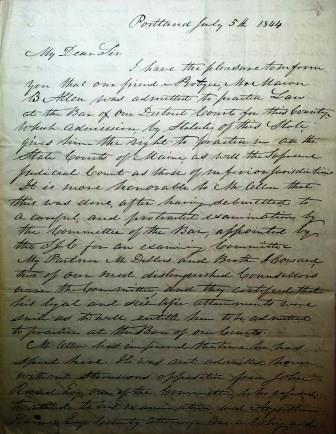
The first letter, addressed to Massachusetts Governor John A. Andrew, reads:
Gettysburg, Penn., August 7, 1863
Hon. John A. Andrew, Governor of Massachusetts.
Governor – I have selected from the forest upon Wolf Hill, at our breastworks, a trunk of a white-oak tree, fearfully riddled with bullets, so as to exhibit the effects of the withering musketry fire in the action of the 2d and 3d of July ult., when the enemy were so terribly repulsed on our right. In that wonderful strife, the Second Massachusetts Regiment bore a conspicuous and honorable part, as the thick graves of its noble dead eloquently attest. This scarred memento I desire to present to the Massachusetts Historical society; and have it now at the depot of our railroad, ready for shipment. Will you make the necessary arrangements for its transportation to Boston, and advise me of your readiness to receive it? For the life of your brave sons, poured out freely upon our soil, Pennsylvania sends this outgrowth of the life of her soil, eloquent of the dauntless strife and the glorious triumph here achieved.
With sentiments of high regard and esteem, yours truly,
D. McConaughy
Later that month, the Society replied:
Historical Rooms, Boston, Aug. 27, 1863
Dear Sir – Your eloquent and acceptable letter addressed to Governor Andrew has by him been forwarded to the Massachusetts Historical Society; in whose behalf I have the honor to communicate the wish, that you would add to the sense of obligation already conferred upon them, by transmitting by express, if no other means offers, the memorial of Gettysburg and its historic days which you have been kind enough to offer for their acceptance.
If directed to the Massachusetts Historical Society, Tremont Street, Boston I have no doubt it will duly reach its destination.
As I cannot speak authoritatively in the name of the Society, there have been no opportunity for them to act upon the matter, I shall not attempt to express, in such terms as I know they would desire, cordial response with which they would reciprocate the generous and patriotic sentiments with which you proffer this memorial of the great battle in this new war of independence. I hope a more formal recognition of these will be forthcoming when this shall have been added to the valued historic memorial which it is the purpose of this Society to collect and preserve.
Very respectfully your obedient servant,
Emory Washburn,
Chairman of Committee, &c.
The letters then tell the story of the tree’s journey from Pennsylvania to Boston over the course of September 1863. From Gettysburg, the tree traveled in an open-topped railcar to Philadelphia, where it was temporarily under the care of the Historical Society of Pennsylvania, which received a similar tree from Mr. McConaughy. While it was stopped in Philadelphia, it was under the guard of a police officer and a travel case was created for it. Next, the tree was placed on a steamship and it sailed to Boston, where it was received with excitement by the Society. After receiving the tree, the Society unanimously resolved to thank D. McConaughy for his donation of the tree, the Historical Society of Pennsylvania for caring for the tree, and the Northern Central Railway and the Pennsylvania Railway, along with the steamship Saxon, for transporting it free of charge.
After reading this, I had so many questions – was the tree still in the collection? What exactly did “trunk of a tree” mean? How had we stored and preserved it? So I took a look through our catalog, ABIGAIL, and asked a few members of the MHS staff, but was unable to locate the tree. It seems that it left the collection at some point, but no one is sure when. It was time for some digging through the institutional archives! I looked through the library records; the “Library Letters,” correspondence detailing gifts to the library; the Cabinet Book, which recorded the donations of artifacts to the collection; and curatorial records, but had no luck.

Next, I tried the various catalogs of the collection created in the mid- to late-nineteenth century. And I found it! In the 1885 Catalogue of the paintings, engravings, busts, & miscellaneous articles belonging to the cabinet of the Massachusetts Historical Society, the tree is listed as Entry 119. The catalog record quotes directly from the initial letter from Mr. McConaughy and notes its presence in the Proceedings. I was excited to find the tree in the 1893 version of the catalog as well, but that catalog was just an annotated version of the 1885 catalog. The entry for the tree was unchanged.

That’s where the tree’s documented journey ends, at least for now. I’ll keep searching, and I’ll be sure to post an update if I find evidence of the tree somewhere else in the collection.
In the meantime, in ABIGAIL I found records of other tree-related artifacts you may want to check out:
–Fragments taken from the roots of the Liberty Tree
–Triangular piece cut from Shakespeare’s mulberry tree
–Wood from the mulberry tree in the manor garden, Scrooby, England
–Piece of wood from a tree reportedly used to hang witches
If you want to view these artifacts or any of our other collections, please consider visiting the library!
Here is a look at what is going on this week:
On Wednesday, 20 March, 6:00 PM: Ike’s Mystery Man: The Secret Lives of Robert Cutler with Peter Shinkle. This Cold War narrative brings a new dimension to our understanding of the inner-workings of the Eisenhower White House. It also shines a bright light on the indispensable contributions and sacrifices made by patriotic gay Americans in an era when Executive Order 10450 banned anyone suspected of “sexual perversion”, i.e. homosexuality, from any government job, and gays in the government were persecuted by the likes of Joseph McCarthy and Roy Cohn in the Senate, and J. Edgar Hoover and Clyde Tolson at the FBI. A pre-talk reception begins at 5:30. There is a $10 per person fee (no charge for MHS Fellows and Members or EBT cardholders).
On Thursday, 21 March, 5:30 PM: Reckless Youth: Three Writers on their Youthful (Biographical) Passions with John Kaag, University of Massachusetts Lowell; Abigail Santamaria; Holly Van Leuven, and moderator Megan Marshall, Emerson College. Who are the new biographers shaping the future of the genre? What drove them to take up life writing at a young age? And what does a “youthful passion” for a biographical subject mean to a writer in retrospect? We’ve borrowed the title of Nigel Hamilton’s vivid narrative of JFK’s early years for this panel which features Holly Van Leuven, Ray Bolger: More than a Scarecrow; Abigail Santamaria, Joy: Poet, Seeker, and the Woman Who Captivated C.S. Lewis; and John Kaag, Hiking with Nietzsche: On Becoming Who You Are, three writers who started in on their respective books in college or soon after—with the exception of Kaag, who looks back on his student infatuation from the perspective of a thirty-something father. Megan Marshall, whose Elizabeth Bishop: A Miracle for Breakfast tells the life of her poetry professor, moderates. This is part of the New England Biography Seminar series. Seminars are free and open to the public.
On Saturday, 23 March, 10:00 AM: The History & Collections of the MHS. This is a 90-minute docent-led walk through of our public rooms. The tour is free and open to the public. If you would like to bring a larger party (8 or more), please contact Curator of Art Anne Bentley at 617-646-0508 or abentley@masshist.org.
Fashioning the New England Family is open Monday through Saturday, from 10:00 AM to 4:00 PM. The exhibition explores the ways in which the multiple meanings of fashion and fashionable goods are reflected in patterns of consumption and refashioning, recycling, and retaining favorite family pieces. Many of the items that will be featured have been out of sight, having never been exhibited for the public or seen in living memory. The exhibition is organized as part of Mass Fashion, a consortium of cultural institutions set up to explore and celebrate the many facets of the culture of fashion in Massachusetts.
Take a look at our calendar page for information about upcoming programs.