A Resolute & Brave Woman: The Education of Sarah White Shattuck
by Susan Martin, Processing Archivist & EAD Coordinator
The Shattuck family of Boston, Mass. consisted of father Lemuel, mother Clarissa (née Baxter), and five daughters: Sarah, Rebecca, Clarissa, Miriam, and Frances. The MHS recently acquired some papers of eldest daughter Sarah White Shattuck, primarily letters to and from family members while she was a student at Bradford Academy in Haverhill, Mass. The collection gives us not only a detailed picture of a young woman’s education in 19th-century New England, but also an intimate look at some interesting family dynamics.

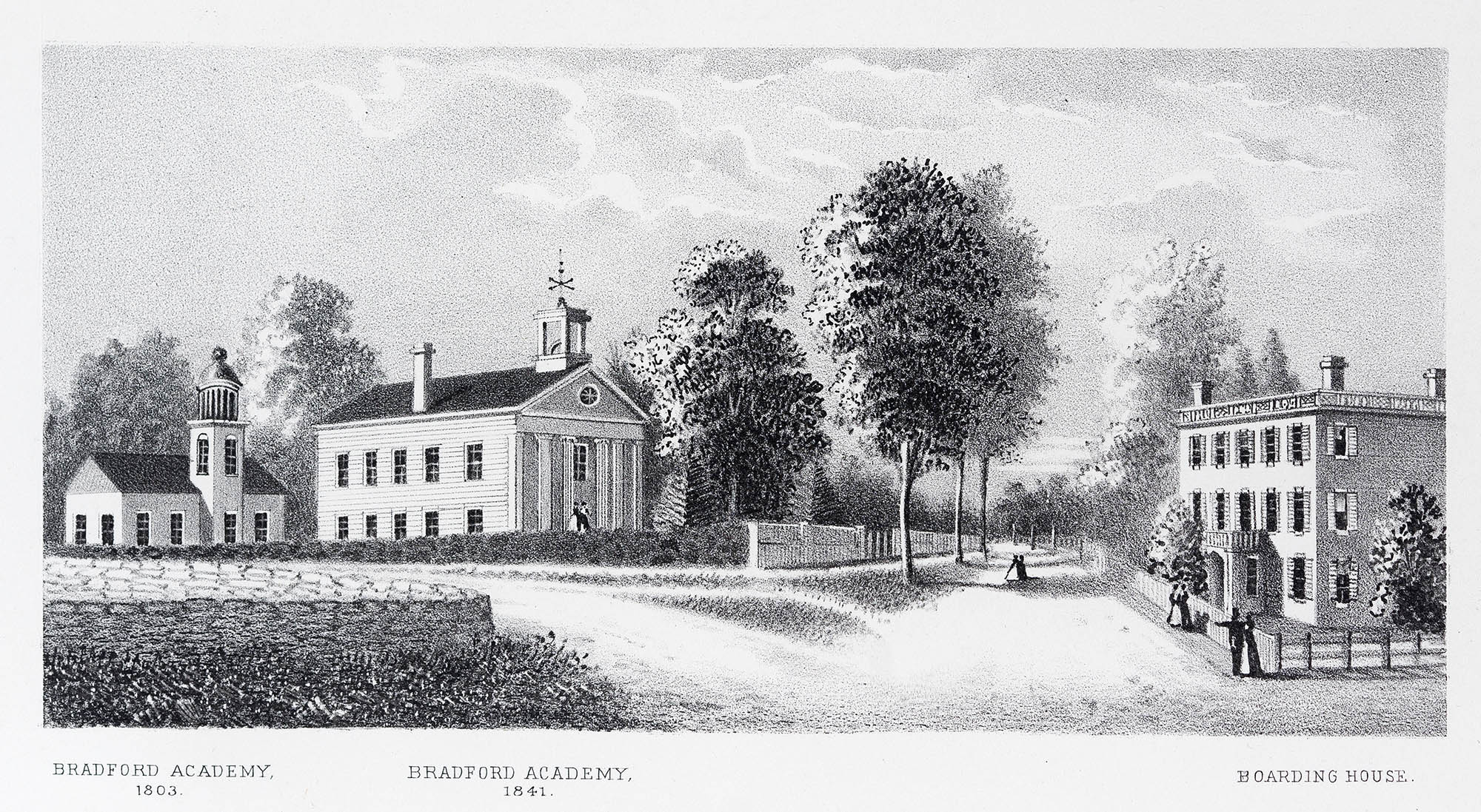
Bradford Academy, founded in 1803, was one of the premier schools for girls when Sarah began her studies there in April 1841 at the tender age of 13. Sarah’s letters include a lot of terrific detail about the school and its curriculum. Sarah learned philosophy, history, geography, algebra, chemistry, geometry (she was a big fan of Euclid), physiology, astronomy, French, and grammar and spelling (“these two studies they are the most particular with,” she said). There were prayers and Bible readings every morning.
This was a formative time for Sarah, both academically and socially. She seems to have flourished under the tutelage of several female role models, including the school’s teachers and especially its principal, Abigail C. Hasseltine. Sarah also took piano and singing lessons with Mary Noyes, the daughter of Deacon Daniel Noyes.
Sarah’s correspondents were her parents, her sisters, her uncle Daniel Baxter, and her aunt Sarah Baxter. The bulk of the letters, however, came from her father. Lemuel had little formal education himself, but had worked as a teacher, merchant, bookseller, publisher, and historian. He served on the Boston City Council and in the Massachusetts House of Representatives and was one of the founders of the MHS’s sister organization, the New England Historic Genealogical Society. (He was also a member of the MHS.) Unsurprisingly, Lemuel had high standards for his daughter’s education and high hopes for her success.
Lemuel advised Sarah on almost everything, particularly her courses and reading. Of botany, for example, he said, “there is no branch of knowledge—scientific knowledge I mean—better calculated to display the wonders of creation.” He also corrected her manners, at one point disapproving of certain “impudent expressions” and “unjust remarks” she’d made about other people. He critiqued her letters. He even had an opinion about the temperature of her room.
At times you feel sympathetic to Sarah for these well-meaning but incessant correctives from the paterfamilias. She couldn’t seem to catch a break. In one letter Lemuel would insist she work hard, and in the next warn her that working too hard may damage her health. However, Sarah was grateful for the opportunity to attend Bradford and never forgot the expense and trouble her parents were going to for her benefit.
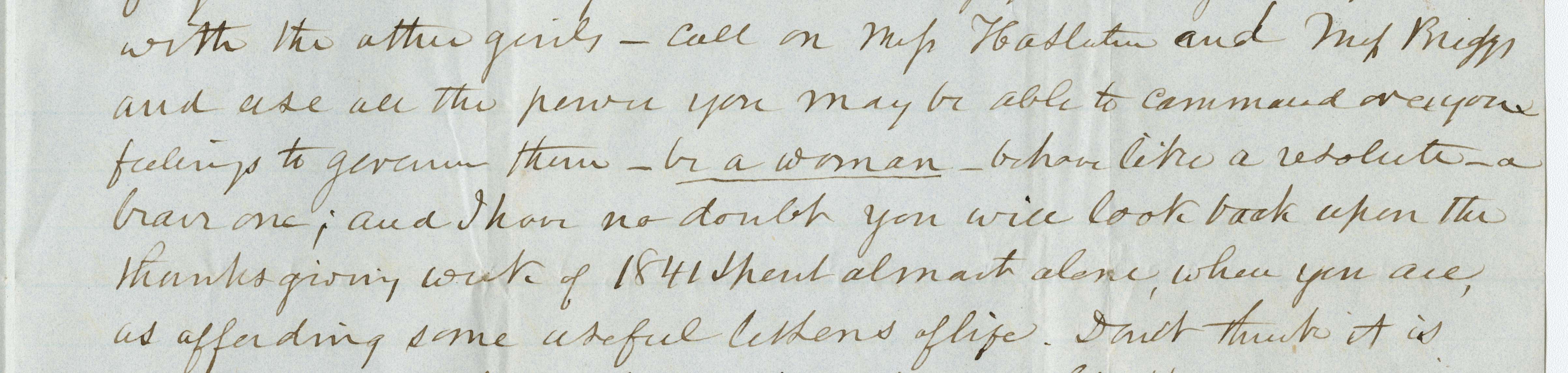
When she complained of homesickness, Lemuel usually told her not to indulge it. But he wrote with great compassion on one particular occasion: Thanksgiving 1841. Sarah was staying at school for the holiday, and the few remaining students who occupied the mostly empty boarding house were girls she didn’t know well. She felt lonely and homesick to the point of tears. Lemuel wrote on Thanksgiving day to tell her how much the family missed her, too. Then he suggested she reach out to the other students, and his advice was kind and uncritical.
Cull all the sweets and beauties from all the flowers that dwell under your roof, and let the fragrance of your own character be manifest to all others. After all, dear Sarah, this incident in your life may have its uses to you. Think of it rightly – your dear father meant to do right – there you are – lonely to be sure for a few days, but a few days soon pass away. Think how important it is that our minds should be di[s]ciplined to some little trials – try and surmount all you now experience – Resolve that you will make the best of your situation – […] use all the power you may be able to command over your feelings to govern them – be a woman – behave like a resolute, a brave one.

Sarah was only 14 years old, but this letter and others in the collection tell us a lot about their relationship. Lemuel may have scolded, but he was also very proud. He sometimes wrote to her about his own work and even asked her advice on the best school for her younger sister Rebecca. When Sarah worried about her exams, he encouraged her to be confident and to “overcome all diffidence […] there is no occasion for it in you.”
Unfortunately, the Shattuck family had its tragedies, as well, just like all of these old families. Two of the sisters died of consumption just a few months apart: the youngest sister Frances in 1850, at the age of 15, followed by 21-year-old Rebecca. Sarah wrote lengthy and moving tributes to both of them in her diary. (The collection also includes several letters by Rebecca.) Clarissa, the middle sister, died in 1858, 15 days after the birth of her third child. Lemuel died in 1859, and mother Clarissa in 1871.
Sarah married her first cousin, John Henry Shattuck, in 1849. The couple had at least one child, Lucy, before Sarah died on 4 February 1863 at the age of 35. Miriam lived until 1909, decades longer than the rest of her family.
I’ll let Lemuel have the last word. Here’s how he concluded one of his letters:
And now dear Sarah what shall I say further? If I say what I have so often said – love – love – love of all of us, sincere and ardent, is ever yours, it is but a repetition of the old story, but it is nevertheless as fresh and blooming as if it never had been told, and appears as a flame that never grows dim. O Sarah may you be returned to us in safety and in happiness and may you be prepared to enjoy or endure any event that may happen in all your future life.
Select references:
Barrows, Elizabeth A. A Memorial of Bradford Academy. Boston: Congregational S.S. and Publishing Society, 1870.
“Lemuel Shattuck.” Memorial Biographies of the New England Historic Genealogical Society: Towne Memorial Fund. Vol. III. Boston: New England Historic Genealogical Society, 1883. pp. 290-321.
Lemuel Shattuck papers, Massachusetts Historical Society.
Shattuck, Lemuel. Memorials of the Descendants of William Shattuck, the Progenitor of the Families in America That Have Borne His Name. Boston: Printed by Dutton and Wentworth for the family, 1855.
The MHS holds other material related to Bradford Academy, including printed items, papers of teacher and principal Rebecca Gilman, and papers of student Martha Dalton Gregg, a contemporary of Sarah’s.
This Week @MHS
Here is a look at what is going on this week:
On Tuesday, 12 March, at 5:15 PM: Biological Exchange in the Pacific World in the Age of Industrial Sugarcane Plantations with Lawrence Kessler, Consortium for the History of Science, Technology, and Medicine, and comment by Nancy Shoemaker, University of Connecticut. This paper traces how sugarcane planters directed circulations of plant and animal species in the Pacific World. This new biological exchange served the political and economic interests of the plantation owners and their allies. Planters, however, were unable to control the biological exchange processes they created. This paper thus argues that through the creation of new patterns of biological exchange, sugarcane plantations induced ecological changes throughout the Pacific World. This is part of the Boston Seminar on Environmental History series. Seminars are free and open to the public.
On Thursday, 14 March, 6:00 PM: The Great Molasses Flood Revisited: Immigrants in an Industrial Accident, with Stephen Puleo; Marilynn Johnson, Boston College; Jim Vrabel; and moderator Peter Drummey, MHS. Nearly 60 percent of Italian immigrants living in the North End in the early 20th century lacked legal citizenship, diminishing their political voice when the Purity Distilling Company erected a shoddily built molasses tank in their densely populated neighborhood. The tragedy that followed is a central event in Boston’s urban and immigrant history and still elicits questions as to the rights of non-citizen residents and the responsibilities of city governments to protect vulnerable communities. The final panel in our Molasses Flood Series will explore the social and political dimensions of immigration in Boston’s past, present and future. This program is a collaboration between the MHS and Old South Meeting House. A pre-talk reception begins at 5:30 PM; the speaking program begins at 6:00 PM.
On Saturday, 16 March, 10:00 AM: The History & Collections of the MHS. This is a 90-minute docent-led walk through of our public rooms. The tour is free and open to the public. If you would like to bring a larger party (8 or more), please contact Curator of Art Anne Bentley at 617-646-0508 or abentley@masshist.org.
On Saturday, 16 March, 10:00 AM: Primary Sources for Fashion & Costume History Research with Kimberly Alexander, University of New Hampshire, and Sara Georgini, MHS. Antique textiles, images of historical figures, and material culture hold a wealth of information that can enrich personal stories, explain relationships, and contextualize the world that people occupied. However, these sources can seem daunting to explore. Two experts on fashion and material culture will guide you through unraveling the stories woven into history’s fabric. Please note that registration for this program is now closed.
Fashioning the New England Family is open Monday through Saturday, from 10:00 AM to 4:00 PM. The exhibition explores the ways in which the multiple meanings of fashion and fashionable goods are reflected in patterns of consumption and refashioning, recycling, and retaining favorite family pieces. Many of the items that will be featured have been out of sight, having never been exhibited for the public or seen in living memory. The exhibition is organized as part of Mass Fashion, a consortium of cultural institutions set up to explore and celebrate the many facets of the culture of fashion in Massachusetts.
Take a look at our calendar page for information about upcoming programs.
This Week @MHS
Join us for a program this week. Here is a look at what is planned:
- Tuesday, 5 March, 5:15 PM: Washington, Lincoln, & Weems: Recovering the Parson’s Life of George Washington with Steven C. Bullock, Worcester Polytechnic Institute, and comment by Elizabeth Maddock-Dillon, Northeastern University. This paper argues that Mason Locke Weems’s biography of George Washington built a bridge between Washington and the world of Abraham Lincoln and Ellen Montgomery. Weems’s stories were not just expressing early-19th century cultural commonplaces, but helping to create them. The paper connects these transformations with Weems’s work to recover Weems’s importance within his own time. This is part of the Boston Area Seminar on Early American History series. Seminars are free and open to the public.
- Wednesday, 6 March, 12:00 PM: A Meaningful Subjection: Coercive Inequality & Indigenous Political Economy in the Colonial Northeast with Peter Olsen-Harbich, College of William and Mary. This talk presents archaeological and documentary evidence of indigenous authority structures and law enforcement in northeastern North America in the period immediately prior to European settlement. It then evaluates European comprehension of indigenous mechanisms of rule enforcement, and the degree to which awareness of them factored into designs for colonization. This is part of the Brown-bag lunch program. Brown-bags are free and open to the public.
- Wednesday, 6 March, 6:00 PM: Household Gods: The Religious Lives of the Adams Family with Sara Georgini, MHS. Reflecting on his past, President John Adams mused that it was religion that had shaped his family’s fortunes and young America’s future. Globetrotters who chronicled their religious journeys extensively, the Adamses ultimately developed a cosmopolitan Christianity that blended discovery and criticism, faith and doubt. Sara Georgini demonstrates how pivotal Christianity—as the different generations understood it—was in shaping the family’s decisions, great and small. This event is part of our Remember Abigail programming. A pre-talk reception begins at 5:30. There is a $10 per person fee (no charge for MHS Fellows and Members or EBT cardholders).
- Thursday, 7 March, 5:15 PM: Mourning in America: Black Men in a White House with Leah Wright Rigueur, Harvard Kennedy School, and comment by Elizabeth Hinton, Harvard University. This paper focuses on the 1980s HUD Scandal, wherein contractors, developers, lobbyists, HUD officials, and others misappropriated billions in federal monies set aside for low-income housing. Of particular interest are the intertwined stories of two African Americans: Samuel R. Pierce, Ronald Reagan’s HUD Secretary, and Kimi Gray, a Washington, D.C. public housing activist. In exploring these narratives, this paper aims to complicate our understanding of the “Black 1980s,” the Ronald Reagan-led White House, and democracy in post-civil rights America. This is part of the Boston Seminar on African American History series. Seminars are free and open to the public. (Rescheduled from Feb. 21)
- Saturday, 9 March, 10:00 AM: The History & Collections of the MHS. This is a 90-minute docent-led walk through of our public rooms. The tour is free and open to the public. If you would like to bring a larger party (8 or more), please contact Curator of Art Anne Bentley at 617-646-0508 or abentley@masshist.org.
Fashioning the New England Family is open Monday through Saturday, from 10:00 AM to 4:00 PM. The exhibition explores the ways in which the multiple meanings of fashion and fashionable goods are reflected in patterns of consumption and refashioning, recycling, and retaining favorite family pieces. Many of the items that will be featured have been out of sight, having never been exhibited for the public or seen in living memory. The exhibition is organized as part of Mass Fashion, a consortium of cultural institutions set up to explore and celebrate the many facets of the culture of fashion in Massachusetts.
Please note that the reading room will open at 12:00 PM on Wednesday, 6 March. Take a look at our calendar page for information about upcoming programs.
An Adams Tells All About Abigail
by Sara Georgini, The Adams Papers
When did you first hear the letters of John and Abigail Adams? Fashionable Bostonians could pin their first memory to an exact spot. Shortly after lunchtime on a January afternoon in 1838, two hundred curious guests swarmed into the Masonic Grand Lodge downtown. Braving the cold, they came to hear Charles Francis Adams (1807–1886), son and grandson of presidents, tell all about his famous family. He felt ready, even eager, to air a few memories. A month earlier, Charles had begun work on his lecture at the special request of the Massachusetts Historical Society, which hosted a series of talks around town. A studious researcher and a curator of the family archive, Charles wanted to share Abigail’s life story with a larger audience. He asked his father, John Quincy, for permission to narrate the private manuscripts in public. “My intention would be to use such of my grandmother’s letters most especially as would illustrate the female character of the age of the Revolution,” Charles wrote. “Of course, the selection must depend upon my discretion and there would be no publication.” When the query reached him, the senior Adams had retrenched in public service. He sent a hasty reply: “Use all the papers at your pleasure.” Charles dove into the project. Here is how her grandson chose to remember Abigail.

Charles was a systematic reader. Back at the family farm in Quincy, the papers overflowed with love letters and state secrets. He plodded through the stacks, more or less chronologically. In constructing a narrative for his lecture, Charles stuck to the basic timeline of the Revolution. His first pick was an 8 Sept. 1774 letter from John to Abigail. The Massachusetts delegate wrote hurriedly from the Continental Congress: “It would fill Volumes, to give you an Idea of the scenes I behold and the Characters I converse with. We have so much Business, so much Ceremony, so much Company, so many Visits to recive and return, that I have not Time to write. And the Times are such, as render it imprudent to write freely.” In his lecture draft, Charles summarized what happened next in that chain of correspondence: how John Adams compared the Anglo-American politics of the day to those of Julius Caesar; how the Harvard-trained lawyer quoted Shakespeare’s lines on the “shallows” of bravery; how John often addressed Abigail as “Portia.” Charles stressed that John cherished his wife as a confidante and adviser.
Enter Abigail. Two decades after her death, the second First Lady commanded Boston’s biggest stage and reclaimed the nation’s imagination. The first Abigail letter that Charles read was sent to John, dated 24 May 1775, heralding the drumbeat of war. “I wish you was nearer to us. We know not what a day will bring forth, nor what distress one hour may throw us into,” Abigail wrote. “Heitherto I have been able to mantain a calmness and presence of Mind, and hope I shall, let the Exigency of the time be what they will.” Carefully, Charles reconstructed Abigail Adams as an emblem of republic motherhood, a woman who raised her children to guard and grow the nation. In his selection of manuscripts and public remarks, Charles sharply reoriented the Adams family’s political brand around Abigail’s legacy. Appealing to early Victorian views on Christian nurture, he emphasized that women’s domestic influence fueled the American Revolution. Like “light to the diamond,” moral virtue gave to the “political character of a nation all its lustre and its value,” Charles wrote. Women like his grandmother were blessed and burdened to provide it.

Abigail Adams’s nature fascinated Charles, and he shared that awe with his audience for at least two hours. He wondered aloud: How did she balance private emotion and public duty? And what might studying other women’s lives reveal to Americans about the “revolutionary spirit”? He did not include her eloquent plea to “Remember the Ladies,” but he certainly kept her message intact. Thanks to Abigail’s canon, Charles glimpsed a new field for citizens and scholars to explore. “All of the leading actors in the revolutionary drama had mothers or wives or intimate friends with whom they indulged in the expression of their genuine, unadulterated feelings,” Charles said. “And yet when we take a glance over what is now known to exist upon record of them, where do we find anything even tolerably satisfactory to reward our search?” At the first public reading of the Adams Papers, Charles Francis Adams neatly laid out many of the editorial challenges and opportunities that we face today as an editorial project. And his initial encounter with family history encouraged him, as an editor, to learn how to think between the documents. Sometimes his opinions and ideas manifested on the page, when he silently omitted or even “corrected” his grandparents’ words. Yet Charles was the first to impose meaningful order on the archive. He also took on the task of building a presidential library on Peacefield’s leafy grounds.
Did the crowd of 1838 lean forward a little bit more as they listened in on Abigail and John? Charles repeated his lecture to several keen audiences, relieved that his “experiment” was a hit. Heartened by his hard-won popularity as a man of letters, he began compiling a popular edition of Abigail’s correspondence. With a few tweaks, he repurposed his Massachusetts Historical Society talk for use in the introductory memoir. He reminded readers that Abigail’s letters offered a backstage pass to revolutionary drama, and that Americans would benefit from her story. For Charles, remembering Abigail held “double charms…painted by the hand of truth.”
This Week @MHS
Here is a look at what is going on this week.
- Tuesday, 26 February, 5:15 PM: Our Own Orient: Mecca, California, & Dates with Eleanor Daly Finnegan, Harvard University, and comment by Laura Barraclough, Yale University. Residents changed the name of Walters, California to Mecca in 1904. They were trying to use the exoticism of the Middle East to sell dates. This paper will focus on Mecca, California and the Indio Date Festival, looking at the complicated ways in which Orientalism has changed in the United States, its relationship to consumerism, and the economic connections made to the Middle East. This is part of the Boston Seminar on Modern American Society and Culture series. Seminars are free and open to the public.
- Wednesday, 27 February, 6:00 PM: You Are What You Wear? Navigating Fashion & Politics in New England, 1760s–1770s with Kimberly Alexander, University of New Hampshire. Our guest curator will explore the social values placed on luxury and thrift in New England in the late 18th century. What messages were telegraphed by a person’s clothing and how were these understood? Did everyone in society read these messages the same way or were there statements only meant to be understood by a select few? A pre-talk reception begins at 5:30. There is a $10 per person fee (no charge for MHS Fellows and Members or EBT cardholders).
- Thursday, 28 February, 6:00 PM: The Great Molasses Flood Revisited: Labor & the Molasses Flood with Stephen Puleo, Robert Forrant, Carlos Aramayo, and moderator Karilyn Crockett. After the collapse of an industrial tank of molasses left a North End neighborhood devastated, a legal battle for reparations ensued, prompting questions about the role and responsibilities of businesses within a community. Using the Molasses Flood as an historical backdrop, this panel will explore questions around labor rights and safety, the function of government regulations and the relationship between the public and big business interests; issues that still resonate today as modern Bostonians grapple with a changing corporate landscape and city-wide gentrification. This program is a collaboration between the MHS and Old South Meeting House and is made possible with funding from the Lowell Institute. A pre-talk reception begins at 5:30 PM; the speaking program begins at 6:00 PM. This program will be held at Old South Meeting House.
- Saturday, 2 March, 10:00 AM: The History & Collections of the MHS. This is a 90-minute docent-led walk through of our public rooms. The tour is free and open to the public. If you would like to bring a larger party (8 or more), please contact Curator of Art Anne Bentley at 617-646-0508 or abentley@masshist.org.
Fashioning the New England Family is open Monday through Saturday, from 10:00 AM to 4:00 PM. The exhibition explores the ways in which the multiple meanings of fashion and fashionable goods are reflected in patterns of consumption and refashioning, recycling, and retaining favorite family pieces. Many of the items that will be featured have been out of sight, having never been exhibited for the public or seen in living memory. The exhibition is organized as part of Mass Fashion, a consortium of cultural institutions set up to explore and celebrate the many facets of the culture of fashion in Massachusetts.
Take a look at our calendar page for information about upcoming programs.
“Why cant I immortalize my name before morning?”: The Diaries of James Thomas Robinson
I am in the old store with Quin[1], drunk! He is drunk also and trying to scribble in his journal. The fact is “old Quin” has got a cask of damn good brandy here, and we have been drawing on it, sucking it from the bung, through a spike stem. This would look like having a strong desire for liquor, but the fact is I wanted to see how it would feel to be drunk. I never was really cocked before, since I can remember. How curious I feel! My head swims, my body feels warm, I am top heavy. Quin is dashing away like a steam boat, though he dont know what in hell he is writing. […] Drunk! Drunk! Why in hell cant I be a Byron, or more! Why cant I immortalize my name before morning? I dont think much of this heavy drunk after all that is said about it. I dont think tis very pleasant, this allmighty dizzyness. I cant seem to write. S**t.

It seems that I was drunk last night, from the preceeding page. Well I suppose it must be so, though I have no very distinct recollection of it, and now, on reflection, I cant say I am very proud of it, either as an instance of romance, or a circumstance of pleasure. No, on the whole I think it was a foolish freak, extreemely foolish, in this day of light and truth, and I dont think I shall cut such a caper again. To-day, as was to be expected, I’ve feel dull and spiritless. Slept on the chairs, eyes heavy and red, appetite gone.

This Week @MHS
Please note that the MHS is closed on Monday, 18 February; the building will open at 5:00 PM for visitors attending the evening program. Here is a look at what is going on this week:
- Monday, 18 February, at 6:00 PM: Separate: The Story of Plessy v. Ferguson & America’s Journey from Slavery to Segregation with Steve Luxenberg, Washington Post Associate Editor. Steve Luxenberg presents a myth-shattering narrative of how a nation embraced “separation” and its pernicious consequences. Plessy v. Ferguson, the Supreme Court case synonymous with “separate but equal,” created remarkably little stir when the justices announced their near-unanimous decision on May 18, 1896. Yet it is one of the most compelling and dramatic stories of the nineteenth century, whose outcome embraced and protected segregation, and whose reverberations are still felt into the twenty-first. A pre-talk reception begins at 5:30 PM; the speaking program begins at 6:00 PM. There is a $10 per person fee (no charge for MHS Fellows and Members or EBT cardholders).
- Tuesday, 19 February, at 5:30 PM: Panel: Feminist Economics with Danielle L. Dumaine, University of Connecticut, and Julie R. Enszer, University of Mississippi, with comment by Juliet Schor, Boston College. These papers begin a conversation on the intersection of the study of the women’s liberation movement with the history of capitalism. Danielle Dumaine’s paper, “Sisterhood of Debt: Feminist Credit Unions, Community, and Women’s Liberation,” examines the role of Feminist Credit Unions in the women’s liberation movement. Julie Enszer’s paper, “‘a feminist understanding of economics based on a revolutionary set of values’: Feminist Economic Theories and Practices,” looks at the feminist organizations that created the Feminist Economic Network. This is part of the Boston Seminar on the History of Women, Gender, & Sexuality series. Seminars are free and open to the public. This seminar will take place at the Knafel Center, Radcliffe Institute.
- Wednesday, 20 February, from 9:30 AM to 4:00 PM: Teaching the Industrial Revolution in Massachusetts. Lowell’s water-powered textile mills catapulted the nation–including immigrant families and early female factory workers–into an uncertain new industrial era. Nearly 200 years later, the changes that began here still reverberate in our shifting global economy. Hosted in partnership with the Tsongas Industrial History Center, this workshop will explore the history of industrial growth in New England and its impact on immigration, labor movements, women’s rights, and communities in New England and beyond. This program is open to all who work with K-12 students. Teachers can earn 22.5 Professional Development Points or 1 graduate credit (for an additional fee). There is a $25 per person fee. This workshop will be held at the Tsongas Industrial History Center in Lowell, Mass. For questions, contact Kate Melchior at education@masshist.org or 617-646-0588.
- Thursday, 21 February, at 5:15 PM: Mourning in America: Black Men in a White House with Leah Wright Rigueur, Harvard Kennedy School, and comment by Elizabeth Hinton, Harvard University. This paper focuses on the 1980s HUD Scandal, wherein contractors, developers, lobbyists, HUD officials, and others misappropriated billions in federal monies set aside for low-income housing. Of particular interest are the intertwined stories of two African Americans: Samuel R. Pierce, Ronald Reagan’s HUD Secretary, and Kimi Gray, a Washington, D.C. public housing activist. In exploring these narratives, this paper aims to complicate our understanding of the “Black 1980s,” the Ronald Reagan-led White House, and democracy in post-civil rights America. This is part of the Boston Seminar on African American History series. Seminars are free and open to the public.
- Thursday, 21 February, at 6:00 PM: Uncivil Society with Julian E. Zelizer, Princeton University; Michael Tomasky, Democracy; and Robin Young, WBUR and NPR. American political discourse has become so dysfunctional it is hard to imagine reaching a national consensus on almost anything. Longstanding historical fault lines over income inequality, racial division, gender roles, and sexual norms coupled with starkly different senses of economic opportunity in rural and urban America have fueled a polarized political landscape. Julian E. Zelizer, Fault Lines: A History of the United States Since 1974, and Michael Tomasky, If We Can Keep It: How the Republic Collapsed and How it Might Be Saved, and Robin Young, co-host of Here & Now on WBUR and NPR, will discuss how we got here and if there is a way back. A pre-talk reception begins at 5:30 PM; the speaking program begins at 6:00 PM. There is a $10 per person fee (no charge for MHS Fellows and Members or EBT cardholders).
- Saturday, 23 February, 10:00 AM: The History & Collections of the MHS. Join is for a 90-minute docent-led walk through of the public rooms of the MHS. The tour is free, open to the public, with no need for reservations. If you would like to bring a larger party (8 or more), please contact Curator of Art Anne Bentley at 617-646-0508 or abentley@masshist.org.
Fashioning the New England Family is open Monday through Saturday, from 10:00 AM to 4:00 PM. The exhibition explores the ways in which the multiple meanings of fashion and fashionable goods are reflected in patterns of consumption and refashioning, recycling, and retaining favorite family pieces. Many of the items that will be featured have been out of sight, having never been exhibited for the public or seen in living memory. The exhibition is organized as part of Mass Fashion, a consortium of cultural institutions set up to explore and celebrate the many facets of the culture of fashion in Massachusetts.
Take a look at our calendar page for information about upcoming programs.
Brief Sketches from Danvers Alms House in the 1850s


Joshua Daniels, Died [February] 19th, 1850–Mr. Daniels was a native of Great Britain, was a soldier in the British army, served under [General] Burgoyne–was taken prisoner, by the Americans, in 1777, as he informed. He would not return to the English. [H]e lived in the towns of Billerica, Beverly, Middleton, and other neighboring towns until about the year 1807, when he came to Danvers and married a Widow, Putney, who had some property. Mr. Daniels was first sentenced to the home for intemperance, in 1814, and continued to sentenced [sic] here accordingly, untill [sic] May 17th 1826, he was committed as a pauper, he remained untill Death, at the age of about 104 years.

This Week @MHS
Here are the programs on the schedule for coming week:
- Monday, 11 February, at 6:00 PM: Lincoln & the Jews: A History
with Jonathan D. Sarna, Brandeis University. Historian Jonathan D. Sarna reveals how Lincoln’s remarkable relationship with American Jews impacted both his path to the presidency and his policy decisions as president. Expressing a uniquely deep knowledge of the Old Testament, employing its language and concepts in some of his most important writings, Lincoln also befriended Jews from a young age, promoted Jewish equality, and appointed numerous Jews to public office.A pre-talk reception begins at 5:30 PM; the speaking program begins at 6:00 PM. There is a $10 per person fee (no charge for MHS Fellows and Members or EBT cardholders).
- Tuesday, 12 February, at 5:15 PM: Amputated from the Land: Black Refugees from America & the Neglected Voices of Environmental History with Bryon Williams, Academy at Penguin Hall, and comment by John Stauffer, Harvard University. This paper focuses on dictated narratives from the 1840s and ‘50s, accounts delivered by blacks who fled the U.S. to settle in the wilds of Ontario. These first-person accounts of environmental encounter and expertise are unrivaled in depth, breadth, and detail among black ecological writing of any era. New environmental histories need such accounts that not only counter dominant American environmental and political myths, but offer black-lived stories of environmental belonging and agency. This is part of the Boston Seminar on Environmental History series. Seminars are free and open to the public.–
- Wednesday, 13 February, at 6:00 PM: Peter J. Gomes Memorial Book Prize Ceremony with Douglas L. Winiarski and Stephen Marini. Please join us for a special evening in which Douglas L. Winiarski will receive the 2018 Gomes Prize for Darkness Falls on the Land of Light: Experiencing Religious Awakenings in 18th-Century New England. Winiarski will join historian Stephen Marini in a conversation about religious revivalism and the shaping influence of religious awakenings on faith and culture in eighteenth-century New England.A pre-talk reception begins at 5:30 PM; the speaking program begins at 6:00 PM. W
- Saturday, 16 February, at 10:00 AM: The History & Collections of the MHS. Join us for a 90-minute docent-led walk through our public rooms. The tour is free, open to the public, with no need for reservations. If you would like to bring a larger party (8 or more), please contact Curator of Art Anne Bentley at 617-646-0508 or abentley@masshist.org.
Fashioning the New England Family is open Monday through Saturday, from 10:00 AM to 4:00 PM. The exhibition explores the ways in which the multiple meanings of fashion and fashionable goods are reflected in patterns of consumption and refashioning, recycling, and retaining favorite family pieces. Many of the items that will be featured have been out of sight, having never been exhibited for the public or seen in living memory. The exhibition is organized as part of Mass Fashion, a consortium of cultural institutions set up to explore and celebrate the many facets of the culture of fashion in Massachusetts.
Please note that the MHS will be closed on Monday, 18 February. Take a look at our calendar page for information about upcoming programs.