No Such Thing as a Bad Question

By Rakashi Chand, Reading Room Supervisor

As the leaves begin to turn and the air grows crisp, it can only mean one thing: American Archives Month is here! Although #AskAnArchivist Day officially falls on October 16th, we asked our own staff what questions they are asked most often to help demystify and amplify archives and archival work. Read on as we celebrate American Archives Month and get answers to frequently asked questions! 
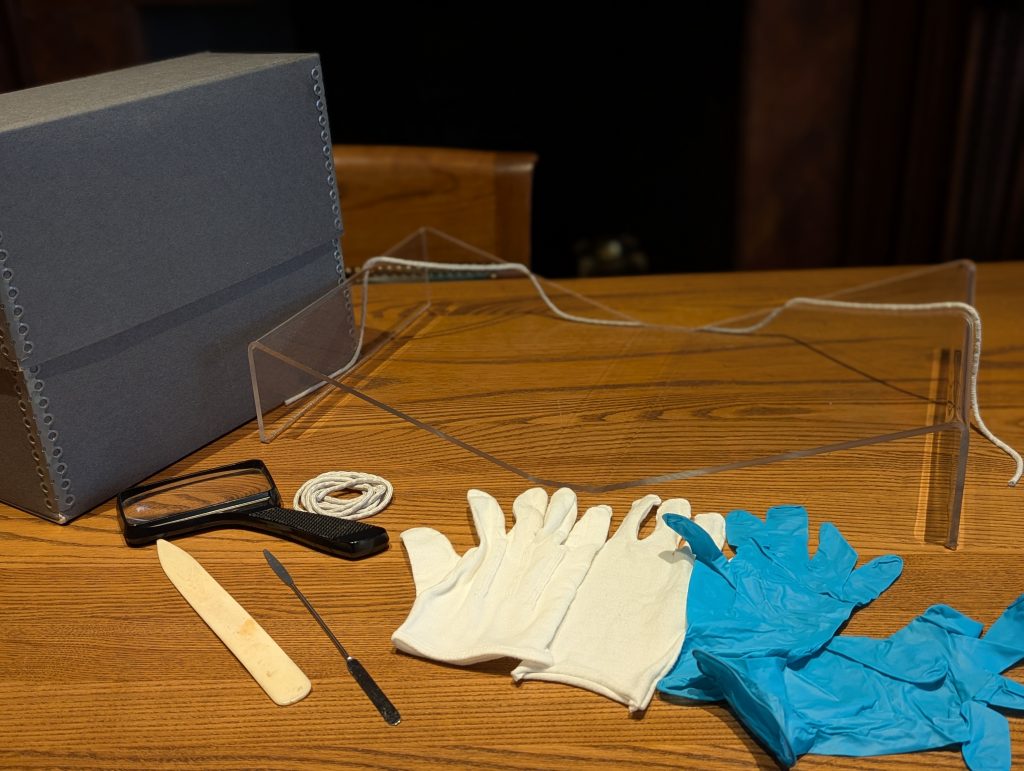
Objects on a table including a manuscript box, book cradle, cloth gloves, latex gloves, and a magnifying glass.

Brandon McGrath-Neely, Library Assistant II:

The question I get the most, other than white gloves, is: So who actually uses an archive? It’s exciting to be able to answer: ANYONE! Many people don’t know that the archives are free and open to the public – you don’t have to be a professor or author!

Stephanie Call, Curator of Manuscripts:

I often get asked by potential donors “why do you want this stuff? My family wasn’t (wealthy, important, famous, etc.)” And that’s the point—how else would historians and students of history know how the average person or family lived in specific time periods or during historical events? That’s how we relate to history—not through the extraordinary, but through the ordinary, everyday experiences of people who were just living their lives.  So, people shouldn’t be afraid to contact an archive about their family papers! They could be more interesting and historically relevant than they think.

Hannah Elder, Assistant Reference Librarian of Rights and Reproductions:

Q: What are personal and family papers? 

A: According to SAA, personal and family papers are records created by an individual or group of individuals closely related, relating to their personal and private lives. Some examples common at the MHS are letters, journals and diaries, recipe books, account books, and scrapbooks. 

Samantha Couture, Nora Saltonstall Conservator and Preservation Librarian:

“What is the letter you are working on about?”

Answer: I only know what’s in the catalog record- I don’t get to read the documents, but I need to make sure they are able to be handled safely by researchers who will read every word!

Nancy Heywood, Lead Archivist for Digital & Web Initiatives:

How do you decide what to digitize?

The MHS needs to consider the condition of the collection, the size of the collection, and the capacity and schedule of the digital production team as we determine which items get into the digitization queue. The  MHS usually requires some funding (either from grants, or projects) to take on larger projects (either full collections, or selected series, for example, a set of diaries or volumes).  The  MHS does have some capacity to work on digitization projects in support of events, or anniversaries, or themes that would benefit from additional digitized content on our website.  Digitization includes lots of detailed workflow steps relating to preparing the original materials, reviewing existing metadata and descriptions, creating master and derivative images, creating metadata for the delivery system, and loading and testing the digitized content on our webserver.

Rakashi Chand, Reading Room Supervisor:

Questions that I am asked often include

Why don’t I need to wear gloves to handle this letter?

Answer: We have found that the loss of dexterity can lead to a tear on a delicate page, so the best way to handle manuscripts is with clean hands and care.

Why can’t I use flash to take a picture of this letter?

Answer: Flash and direct sunlight can damage manuscripts, art and artifacts.

Where do you keep all of these documents?

Answer: We store all our material in temperature and humidity-controlled stacks. 

Are there any risks involved in being an archivist?

Paper cuts, sharp Hollinger box corners, poisonous 19th century book pigment, lifting heavy boxes on a daily basis, red rot on our clothes, and ladders… lots of ladders. 

Susan Martin, Senior Processing Archivist:

Probably the question I get the most (aside from the one about gloves) is: 

Can just anybody come in to do research there? Do you need to pay or be a member?

I tell them no, it’s free—all you need to do is register and provide a photo id.

Another one I’ve gotten is: Do we just collect the records of famous people?

I explain how historians are interested in the lived experiences of people from all walks of life. People are also surprised we collect up to the present day.

Sometimes I get asked what’s the weirdest thing I’ve found while processing.

Hands down, it was a piece of wedding cake from 1919. It was wrapped up and hard as a rock.

Grace Doeden, Library Assistant II:

Q: Are the stacks haunted?

A: I can neither confirm nor deny…But I often catch an ominous feeling on the 5th floor. Wait, is that Jeremy [Belknap]’s spirit in the cage? Oh, no, it’s just Peter [Drummey, MHS Chief Historian].
John Boit logbooks return to the MHS

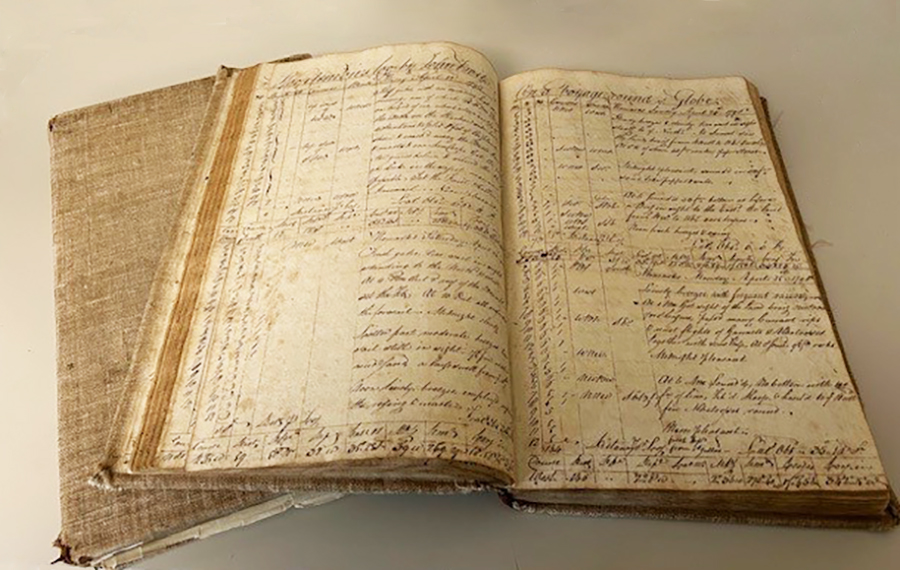
The MHS has held a collection of ships’ logs kept by John Boit, Jr. since his descendant, John Boit Apthorp, donated them in 1919. Three volumes kept by Boit on trading voyages from 1790 to 1802, including a log of the Columbia, document voyages to the Northwest Coast to trade for fur before sailing on to the Sandwich Islands (now Hawaii) and to China in the early years of the newly-opened China Trade. Boit served as a captain’s mate on the Columbia and other vessels before taking command of the Union.

Two volumes covering the Union’s voyage from Newport, R.I., to China via the Northwest Coast had reportedly disappeared when the collection was sent offsite to be microfilmed, probably in the 1960s or 1970s. Until now.

Rusty Farrin of Farrin’s Country Auctions in Randolph, Maine, recently contacted the MHS to report the recovery of two of Boit’s logbooks that were discovered in a storage locker. Farrin’s research revealed that the volumes had been part of the Society’s collection and he generously returned them, as he said, “back where they belong.”

open log book with handwriting across columns
John Boit logbooks

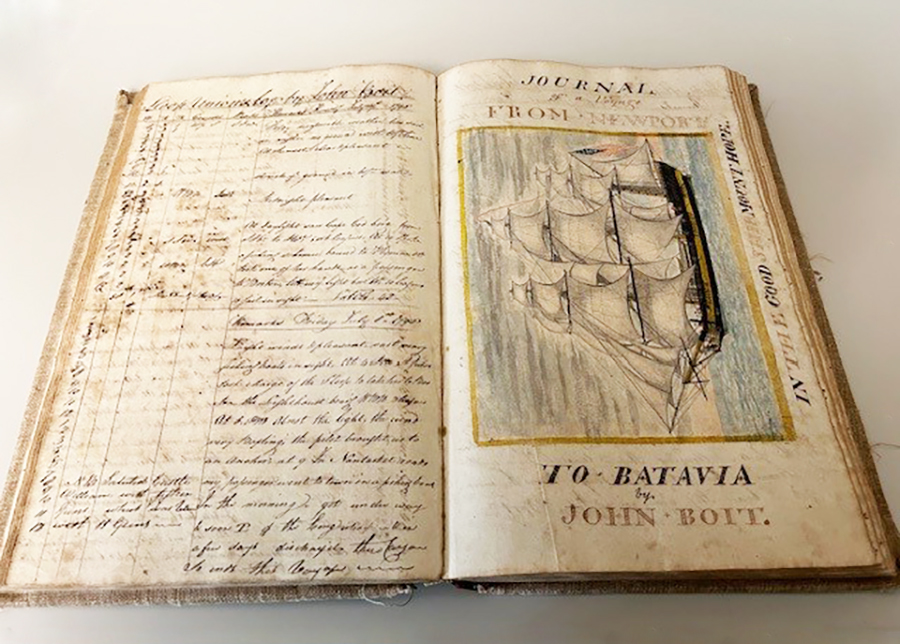
The voyage of the Union spans the two volumes and includes stops in the Falkland Islands, Nootka Sound and other locations in British Columbia, Macao, Canton, and Mauritius from August of 1794 to July of 1796. One volume also documents a voyage from Boston to Charleston, S.C., Dublin, Ireland, and back on the ship Eliza, 1793-1794, and the second includes a voyage from Newport to Batavia in the Dutch East Indies and back on the Mount Hope, 1801-1802. Both volumes include long narrative passages that describe the locations where they anchored, including encounters with indigenous people, as well as watercolor drawings of the vessels and land formations seen along the way.

We are enormously grateful to Mr. Farrin for ensuring these volumes made their way back to the MHS.

open log book with handwriting on the left page and an illustration of a ship with words "Journal From Newport to Batavia by John Boit" on right side
John Boit logbook

If You Give a Librarian a Cookie… (You’ll Get a Blog Post)

by Lauren Gray, Reference Librarian

From your grandmother’s kitchen to a well-stocked Girl Scout table, there’s something about cookies. Cookies make your taste buds dance and your fingers reach out to steal just one more from the jar. They are the quintessential American treat, encapsulating all that is quick and convenient: they mix easily, they bake quickly, they don’t require wrappers or refrigeration, and they taste wonderful. But cookies tell us more about ourselves than what we read on the label: they are a glimpse into family rituals and cultural traditions, sometimes passed down over generations. Every beloved cookie has a story.

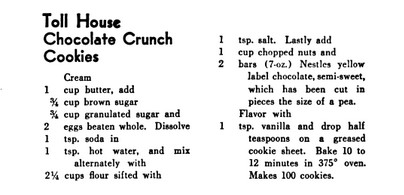
Americans are a nation of prodigious cookie eaters (we eat on average about 200 cookies a year)[1]. The most famous American cookie of all? The chocolate-chip cookie, of course. It is arguably the best and certainly the most popular. We like chocolate chippers so much we’ve even made a cereal out of them. Surprisingly, however, they are a relatively new invention. First mixed, scooped, and baked by Ruth Wakefield at her Toll House restaurant in Whitman, Massachusetts, the recipe was originally published in 1938 as the “Toll House Chocolate Crunch Cookie.”[2] Nestlé soon swooped in for the rights to the cookie, and the rest, as they say, is history.

Chocolate-chip cookies soon became America’s darling, a sweet bite amidst the Great Depression. Just a few years later, they appeared in care packages to New England troops sent abroad during the Second World War. By the 1950s, copycat chocolate-chip cookies popped up in supermarkets across the U.S., produced by companies like Pillsbury and Nabisco. Variations appeared, some with margarine, others with macadamia nuts; a few with white chocolate, others with M&Ms. Ben and Jerry’s put cookie dough in ice cream in 1984, and their Chocolate Chip Cookie Dough Ice Cream remains one of their most popular flavors.[2] As Jon Michaud posited in his New Yorker article on the history of the cookie, “In its ability to absorb such a heterogeneous list of ingredients and still retain its identity and appeal, the chocolate chip cookie is representative of the aspirations of the country for which it has become the preferred treat.”[2] The chocolate-chip cookie quickly became as American as apple pie.

Graphic image of black text on a white background titled "Toll House Chocolate Crunch Cookies" with a recipe underneath and to the right.
Original Toll House Chocolate Crunch Cookie recipe from Ruth Wakefield’s Tried & True Recipes, image from HathiTrust

Chocolate “chippers” (our family’s probably unoriginal nickname for them) were a steady favorite in our house during the 1980s and ‘90s. My mom baked them so often that my aunt bought her a special cookie-making bowl made of heavy beige ceramic and decorated with thick blue stripes. My aunt was clearly on to something, because I’m pretty sure I’ve seen versions of that bowl in antique stores across the country.

Probably like many Americans, we followed the recipe on the back of the Nestlé Toll House 12oz bag of semi-sweet morsels, which was adapted from Mrs. Wakefield’s original recipe. The ingredients and measurements are the same as the original, with a couple notable exceptions. For example, Nestlé no longer sells semi-sweet chocolate by the bar for you to chop into “pea-size pieces” (which Mrs. Wakefield swore by). She also instructed you to dissolve the baking soda in hot water before mixing it intermittently with the flour.

In my family, we used butter, but the omnipresent ‘80s Crisco occasionally made an appearance. I remember waiting ages for the butter to soften, impatiently pressing the back of my fork into the hard stick, its pliable metal tongs yielding against my thumb (I ruined more forks that way). Creaming the butter and sugar was the hardest part – even when I had begged to be allowed to make the cookies, my mom always ended up creaming the butter, bowl squeezed under one arm, her right hand steadily working the butter into the sugar. As an adult, I’m lazy and use a hand mixer, but my mom was a fork-purist. I wonder if that’s how she achieved the perfect texture and spread every time, not too greasy, not too cakey.

We used a mix of white sugar and light brown sugar in equal parts (the dark brown sugar was too reminiscent of molasses, though Mrs. Wakefield didn’t specify which type in the original recipe), and we always added the eggs together instead of beating them in one at a time (or beaten together prior to going in, as in the original). Then came the vanilla. My mom was heavy-handed with the McCormick – she tipped the bottle over the teaspoon and let it run over the edge for a solid 1-1000. She never seemed to worry about an imbalanced liquid to dry ingredient ratio.

If memory serves, mom would switch out the fork halfway through mixing in the flour. She had a designated oversized and sturdy ‘cookie spoon’ that we only used for baking, and it was always on hand to do the final mix of dough and chocolate chips. The recipe calls for a ludicrous amount of chips, and this is where we deviated from the measurements. We are parsimonious chip people, even today – the elegant simplicity of the chocolate chip cookie is in its rich vanilla dough to chip balance. Too much dough and it gets monotonous; too many chips and it may as well be dough-flavored fudge. We poured the chips by sight, occasionally just a small squeeze of the bag. We gently folded them in, careful not to overmix the flour. In the original recipe, Mrs. Wakefield also called for nuts, and the Nestlé bag lists them as “optional.” In our house, they were “optionally” excluded. Once mixed, we would take a small spoon from the drawer and measure out equal-ish balls of dough, putting them on the gray metal baking sheet, three to a row at alternating angles. (Mrs. Wakefield’s recipe called for ½ teaspoon balls, gently formed by moist fingers, which look ludicrously small to modern eyes.)

Baking time was our only real disagreement. My mom loved the soft middles and squishy centers, when cookies came out just shy of underbaked. And I appreciated that – at first. Then my dad’s genes kicked in. I quickly developed an appreciation for crunchy brown edges and stiff, unyielding crusts. The over-caramelization of sweet dough melted on my tongue. So, we compromised. One sheet went in for 9-10 minutes, the next sheet for 12-13. There’s no crying over cookies. (The original recipe called for the ½ tsp. size balls to be baked at 375 degrees for 10-12 minutes. Modern ovens must run hotter, because the only thing you get at the end of that are burned little hockey pucks. I suggest checking them at six minutes.)

Mrs. Wakefield baked her cookies to accompany ice cream, which perhaps accounts for the small size. We baked ours to eat, hot and crumbly from the oven, snatching them off the rack before they had time to set. It was in the kitchen that I learned the best lessons from my mom, which she in turn had learned from her mom. Baking cookies connected me with the grandmother I never knew. When Mrs. Wakefield dedicated her first cookbook to her own mother, “whose encouragement and confidence have meant more than mere words can express,” I think she was hoping that her recipes would bring families together.

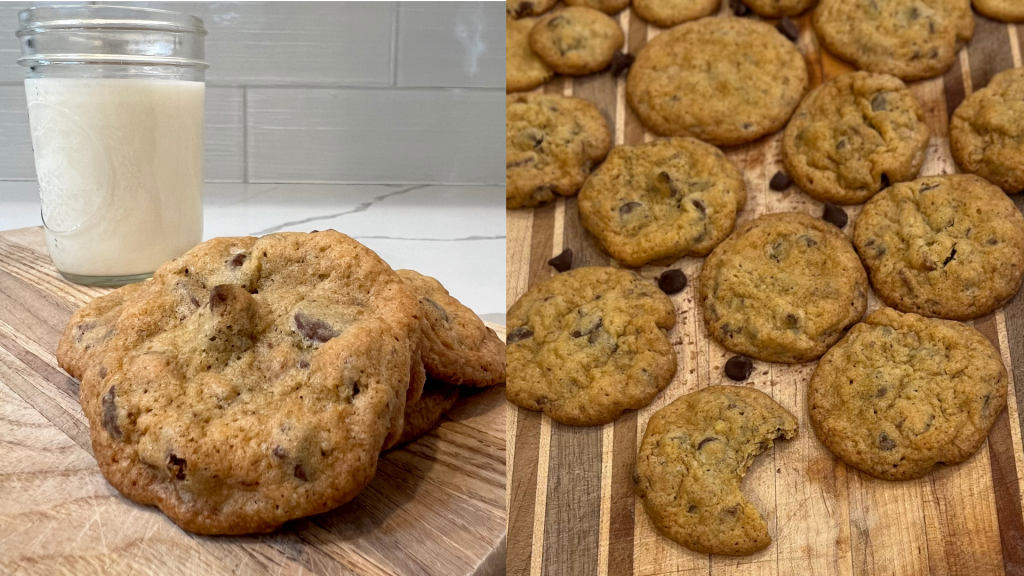
Growing up, neither my mom nor I knew that the original chocolate chip cookie originated in Massachusetts. When doing research for this blog post, I was sad to learn that the original Toll House restaurant, which the Wakefields ran from 1930 to 1967, was lost to a fire in 1984. I was equally sad to find that the MHS doesn’t hold her original recipe book, published in 1931, or any of the revised editions published thereafter, which include the famous cookie. If anyone has a copy, let us know, we’d be glad to take it off your hands.[3] We’ll bake you a batch of cookies for it. Having tested a batch of her original Toll House Chocolate Crunch Cookie, I can confirm, they are pretty darn tasty. I even liked the nuts.

Two modern color photographs side by side. On the right is a close up of a chocolate chip cookie resting on a pile of more cookies behind and underneath it. Behind the pile is a glass of milk. On the right are chocolate chip cookies in a single layer cooling on a wooden cutting board. The closest cookie to the viewer has a bite taken out of it.
From the Test Kitchen: Mrs. Wakefield’s Original Toll House Chocolate Crunch Cookie

P.S.

If you want to try your hand at a batch of the original “Toll House Chocolate Crunch Cookie,” you can find the recipe in several places. The 1940 version of Ruth Wakefield’s Toll House Tried and True cookbook is available online for free through HathiTrust. In 2018, the New York Times published a short obituary on Mrs. Wakefield, including the original recipe, in their “Overlooked No More” column, which documents the stories of remarkable but historically overlooked people.[4]


[1] https://wror.com/2023/08/07/how-many-cookies-does-the-average-american-eat-each-year/

[2] “Sweet Morsels, A History of the Chocolate-Chip Cookie” by Jon Michaud, The New Yorker

[3] The MHS has plenty of other cookbooks, both published and unpublished. Visit our catalog, ABIGAIL, to learn more.

[4] “Overlooked No More: Ruth Wakefield, Who Invented the Chocolate Chip Cookie,” by Sam Roberts, New York Times, originally published March 21st, 2018.

A Battery of Historic Knowledge | Architecture at the MHS (Part 3)

by Brandon McGrath-Neely, Library Assistant

This is Part Three of a three-part series on architecture at the MHS. You can find Part One here and Part Two here.

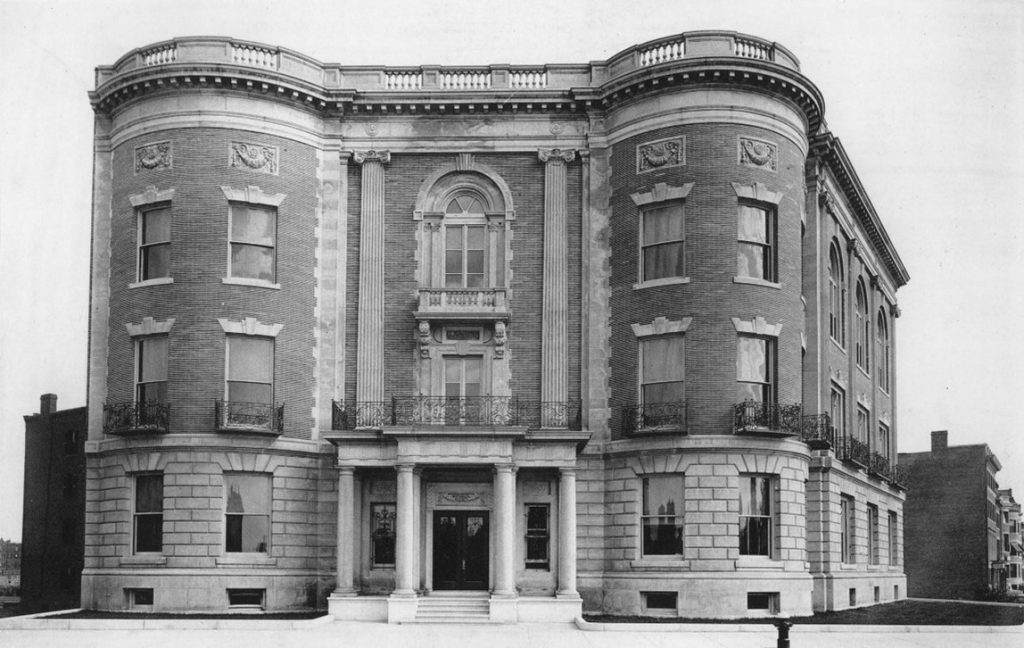
As you approach 1154 Boylston Street today, you’ll find the Massachusetts Historical Society tucked nicely between similarly sized buildings on both sides. Its strong, stone appearance blends into the Berklee College of Music buildings throughout the surrounding streets. But if you had arrived just after the building’s completion in 1899, you would see the MHS standing out from the fewer, smaller buildings around it.

A black and white photo of the large, sturdy Massachusetts Historical Society building. A few small buildings are visible in the background.
The MHS at 1154 Boylston Street, August 1899.

Designed by Edmund March Wheelwright, the physical structure emphasizes strength and scale with beautiful exemplars of the Georgian Revival movement. A quick tour of the exterior of the MHS highlights these architectural elements, which can be found on buildings throughout Boston and the United States.

The building is visually divided into three sections: the ground floor, the upper floors, and the roof. The ground floor is distinguished by the large, stone construction of its façade. This form of masonry, common in Georgian and Georgian Revival structures, is known as ashlar, meaning large, precisely cut stone blocks. Ashlar masonry emphasizes strength and simplicity in its appearance and recalls the monumental stone temples of classic civilizations.

The upper floors adopt more modern stylings, a transition from classic to contemporary (at the time) common in Georgian Revival buildings. The stone ashlar masonry transitions to brick masonry, and the height of the building is accentuated with white fluted pilasters (which we learned about in Part Two of this series). Above the windows, flat arches provide structural support, but some of the arch components—known as voussoirs—alternate in size, drawing attention to the windows by breaking the repetitive, consistent placement of the bricks beside and below. The flat arch, white in color, also provides visual contrast from the red bricks surrounding it. The use of bricks and flat arches recalls the Federal Style, an American architectural movement from the early Republic and famously utilized on the Massachusetts State House.

The Georgian period pulled not only from Classic structures (in its use of ashlar) and Federal structures (in its use of symmetrical brick façades) but also heavily pulled from Renaissance architecture, as seen in the balconettes, sometimes called Juliet balconies. These features are too small to actually serve as balconies but help make the exterior seem more refined. Balconettes have existed since the earliest architectural movements, but it was the Italian Renaissance which truly utilized the balconettes as varied, decorative flourishes. Though earlier periods used stone or wood balconettes, the Georgian Revival was unique in its introduction of wrought iron or metal balconettes, like those seen on the MHS.

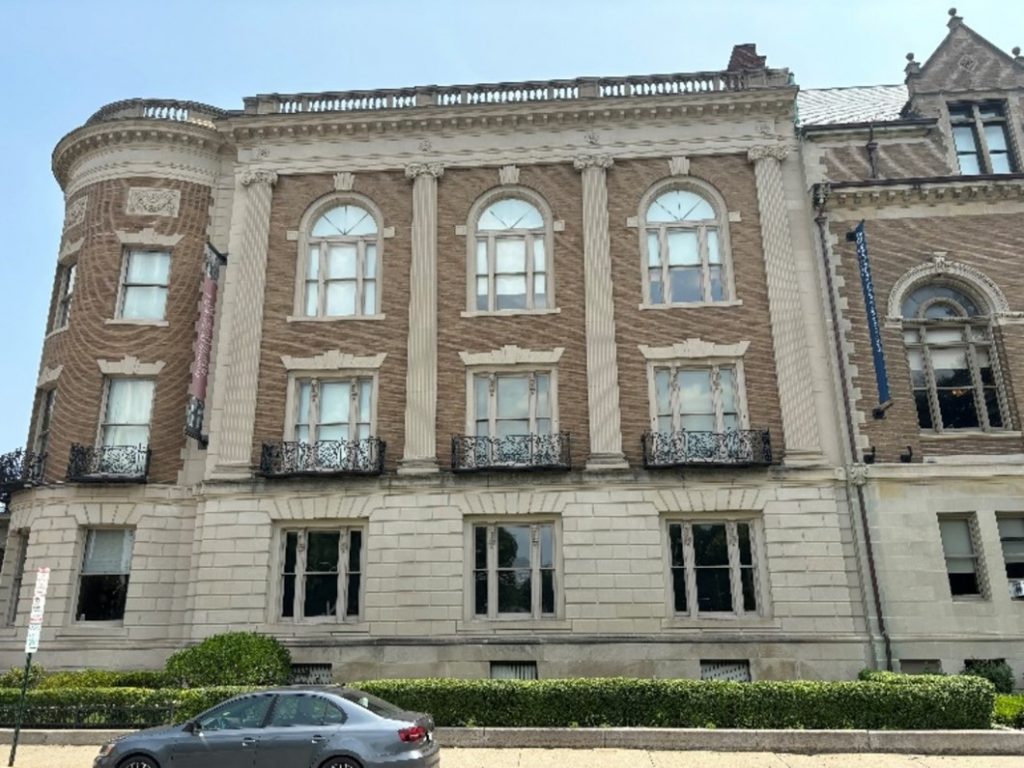
A modern photo of the western side of the Massachusetts Historical Building, with a stone exterior on the ground floor and brick exterior for upper floors. It is decorated with pilasters, windows, and balconettes.
The western façade of the MHS. Note the ashlar and brick masonry, pilasters, balconettes, semi-Palladian windows, and fanlights.

The third-story windows on the western façade of the building likewise pull from the Italian Renaissance. The Italian architect Andrea Palladio, one of the most influential Renaissance architects, popularized a style of visual organization in which one large element (in his case, an arched opening) is flanked by two thin elements on either side (in his case, two columns). This “Palladian style was quickly adopted throughout Europe and later, the Americas. Now that you know about Palladian style features, you’ll begin to see them everywhere. The ground floor windows at the MHS are somewhat Palladian (one large central window flanked by two narrower windows), but the third-story windows on the western façade are even more Palladian, with a fanlight  (or half-circle window, also known as a lunette) spanning over all three sections and recalling Palladio’s arches.[1] These windows exemplify a design philosophy on display throughout the building’s exterior: clean and simple symmetry.

The final portion of the building is also inspired by Palladio: The MHS boasts a flat roof, bordered by a balustrade—a broad, low railing made of molded and flat features. [2] The balustrade was popularized as a decorative feature during the Renaissance and became an important feature in both Federal and Georgian styles. Flat roofs were used by American founders and recalled the palaces of Renaissance Italy. (See how it contrasts with the sloped roof of the Boston Conservatory next door!) Once again Wheelwright used architecture to connect with idealized pasts and a simple but strong visual identity.

As with Ellis Hall, there is far more one could consider in regards the architectural choices present throughout the Massachusetts Historical Society’s exterior: the pedimented entryway could be the subject of a blog post all its own. Now that you’ve read the article, stop and take an extended look at our building the next time you’re doing research. If you’re not in the area, take a trip on Google Maps! Consider how Wheelwright emphasizes strength and precision in his design, and how those choices create an atmosphere of historical permanence and accuracy.

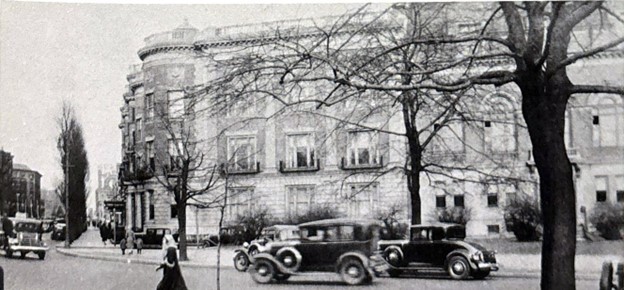
A black and white photo of the Massachusetts Historical Society building in 1932. Pedestrians and old cars pass by in the foreground.
The MHS at 1154 Boylston Street, 1932.

When the building opened in 1899, the Boston Herald remarked, “The place will be known as one of the surest storage batteries of historic knowledge in the city.” [3] Three years later, Charles F. Adams, president of the MHS, remarked that the beauty of the building lay in its “severe simplicity.” [4] Today, it is neighbored by other gorgeous buildings with styles and design choices all their own. 1154 Boylston Street simultaneously represents a number of Georgian Revival buildings in and around Boston yet stands out from other styles in a city overflowing with architectural movements and periods. Despite all that has changed on Boylston Street, in Fenway, and in Boston, I think the MHS building still stands out as an expertly designed symbol of how the past influences the present, and how the present is always reinterpreting the past.


[1] The third-floor window on the northern façade of the building, visible in the first image, is even more Palladian! Quintessential Palladian windows, such as the one installed by George Washington at Mt. Vernon, feature two narrow windows on each side of one large, arched window. Palladian windows are sometimes called Venetian windows.

[2] Below the balustrade, the cornice of the building includes a distinctive feature described in Part Two. Can you find it?

[3] Boston Herald, March 9, 1899. As cited in Tucker, Louis Leonard. 1995. The Massachusetts Historical Society: A Bicentennial History, 1791-1991. Boston: Northeastern University Press, 226.

[4] Charles F. Adams to Edmund M. Wheelwright, June 6, 1902. As cited in Tucker, 224.

“Tell it to the whales”

by Lauren Gray, Reference Librarian

Whale tours abound in Massachusetts. In 2024, boats take to the seas laden with tourists white-knuckling smart phones, their eager lenses hoping to catch a glimpse of tail, or a rounded, spurting hump. A native Missourian (read: ‘landlocked’) and new resident of Massachusetts, I took my first whale watch tour in June and was not disappointed. The whales delivered, and my phone was there to catch every hump, spurt, and tail (not to mention a few dolphins). The whale watch got me thinking about the history of whaling. Whaling was a massive industry in the 19th century, and the profits were enormous. But what did that mean to the whales? I’m an animal-lover at heart, and I can’t stand the thought of those giant majestic beauties floundering under a barrage of harpoons, yet that’s exactly what kept the New England economy viable during a critical point in the region’s history. That history has also given us scores of archival material. On further consideration, as it turns out, whaling is the perfect metaphor for America—its greed, violence, exploitation of nature, and human arrogance define one of the worst chapters in American environmental history. (In the west, their quadrupedal cousins, the bison, can tell you the sequel.)

Pilgrims brought whaling to Massachusetts. (Most pre-contact Indigenous people in New England did not actively hunt whales.) Spying a pod of whales during a voyage from Plymouth to Cape Cod in 1621, Edward Winslow commented, “…every day we saw whales playing hard by us, of which in that place, if we had instruments and means to take them, we might have made a very rich return, which to our great grief we wanted.” [1] He went on to report that, had he the right tools for the job, he “might have made three of four thousand pounds worth of oil” out of the whales, and “purpose the next winter to fish for whale here.”

However, it would be another two decades before there was wide-spread commercial whaling in the colonies. By the 1670s, small whaling ships, crewed by English and Indigenous people together, hunted off the coast of Cape Cod. Even before the end of the 18th century, scarcity in the whale population in the northern Atlantic forced whalers to round the horns to hunt for whales in the Pacific, where an ocean of opportunity awaited. The golden age of whaling had begun.

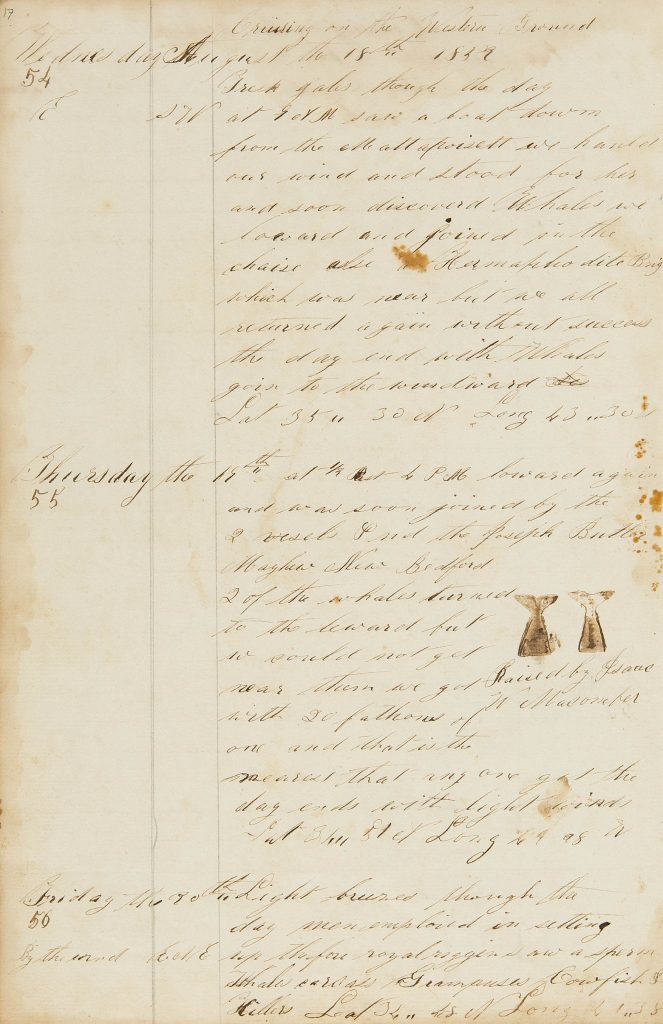
Color photograph of a page discolored with age with brown ink handwriting in a diary format. Halfway down the page are drawings of two whale's tails next to each other.
Page from the diary of Perry R. Brightman aboard the whale ship George & Mary, 1852

Golden, that is, for the sea captains, merchants, and bankers who lined their pockets from the spoils of the hunt. In the first half of the 19th century, American whalers dominated the global market, and the whaling industry contributed $10 million dollars to the U.S. GDP (which is over $300,000,000 in 2024 dollars).[2] Whale oil, made from boiled blubber, spermaceti from sperm whales’ heads, and baleen—the delicate bristles found in baleen whales’ mouths—were key resources for the Victorians. Baleen was woven into the corsets that pinched the waists of tubercular maidens and buxom madams alike; whale oil burned in lighthouses along every coast; and spermaceti wax dripped and flared in candles that illuminated nights “lit only by fire.”[3] In the Victorian world, the whale was omnipresent and indispensable.

If it was fantastically lucrative for the merchants profiting from their ill-begotten wares, it was not so fantastic for the whales. During whaling’s heyday, the whale population plummeted. Due to the steady decrease in whale populations and the advent of viable alternatives (like manufactured gas and petroleum), the American whaling industry went into a steep decline, and effectively ended in the mid-1880s.[4] While scholars disagree on exact numbers, over 150,000 whales were killed in just 50 years of whaling’s heyday, leading to the decimation of the blue, right, gray, and bowhead populations.

In the historical record, whales don’t fare much better. After my whale watch tour, I came back to the MHS to start research on this blog post, but I found that whales surface in the MHS catalog rarely and even then, the archival record captures them as creatures to be hunted and exploited. The MHS holds dozens of ships logs, descriptions of whaling voyages, personal papers of those who participated in the whaling industry or profited from it, histories of the towns where whaling dominated, and much more. But where, exactly, are the whales that make whaling possible? In the archive, the pictures that come down to us are grainy and grim: a boy perched next to a beached and conquered finback; a sun-bleached skeleton of indeterminate species, dreary in sepia; a captive beluga in the Boston Aquarial Gardens flashing through a young girl’s diary “white almost as snow.” In the archive, the whales’ memory is entwined with the legacy of violence and greed, the hunters’ hubris immortalized in ledgers and statistics.

The history of whaling is, in large part, the history of New England. Thankfully, the industry collapsed before irreparable harm could be done. Whale populations rebounded throughout the 20th century, and now the ‘gentle giants’ are objects of awe instead of greed. Just this month, amazed Bostonians were greeted by a breaching whale in Boston Harbor, and local institutions like the New England Aquarium are at the forefront of conservancy and education. However, despite whales’ popularity, and the efforts of environmental groups and advocates, whale populations continue to be disrupted by illegal whaling; shipping lanes interfere with mating patterns; and global warming makes whale feeding grounds unstable. Edward Winslow’s “great grief” in 1621 was that he could not hunt the whales; in 2024, it’s that the colonists eventually succeeded. Meanwhile, in the archive, we are left to grapple with whaling’s history. Whaling’s economic benefits alone fill volumes, and the data found in ships logs and ledgers help us to understand our changing climate. Stories from whaling voyages help us to better understand the human condition.

I wish it was as simple as balancing the karma between history and what we can learn from it. All I can think is, “tell it to the whales.”[5]


[1] Edward Winslow, Mourt’s Relation (1621)

[2] Lance E. Davis, Robert E. Gallman, and Teresa D. Hutchins, “The Decline of U.S. Whaling” (The Business History Review, Vol. 62, No. 4, Winter, 1988 pp. 569-595)

[3] William Manchester, A World Lit Only by Fire (Little, Brown and Company, 1993)

[4] Whaling globally didn’t peak until the 1960s.

[5] Max Brooks, World War Z (Three Rivers Press, 2007)

Horsford’s Vikings of New England, pt. 3 

by Hannah Goeselt, Reader Services

Continued from Part 1 & Part 2.

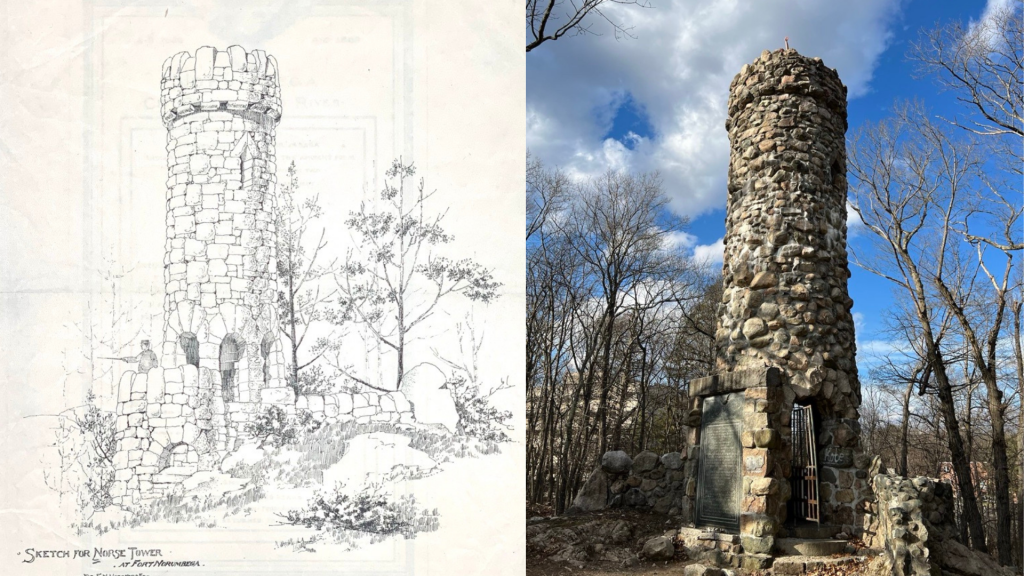
(left) Engraving of a stone-block turret, with a small drawing of a man pointing off to the side with a cane to show scale. (right) Photograph of same stone-block tower, with iron grille door swung open, and an inscribed stone tablet imbedded in the front.
“Norse Tower” engraving by Brunner & Tryon (left) & my own visit to Norumbega Tower (see arm at the top), Weston, MA, (right).

In the Preface to the 1892 publication The Landfall of Leif Erikson, AD 1000, and the Site of his Houses in Vineland, Horsford points out “the Committee appointed by the Massachusetts Historical Society to investigate the problem of the Northmen give the following as, in the judgement of the Corresponding Secretary, “the result of the best historical criticisms”: [and here he quotes back the verdict from the December 1887 Proceedings] These authorities seem to have written under the impression that the evidence, if there be any, of the presence of the Northmen at any particular point on the New England coast might be found in print. As they have failed to find it, they have been led to the conviction that such evidence cannot be found.” 

Haynes, as the author of this quote, for his part elaborated on this point in the 1890 Proceedings in that he “was entirely innocent of any intentional disrespect when I ventured upon the unlucky comparison of Leif Ericson with Agamemnon”1, and that the parallel came more from a real belief in the Iliad king rather than skepticism in the existence of the Sagas Vikings. 

Despite this—or maybe in some passive aggressive way because of—the Society’s continued animosity to his theories, Horsford made sure to gift a copy of every one of his published books to the MHS at the earliest opportunity. A closer look at the Society’s copy of The Landfall of Leif Erikson shows it is personally inscribed at the front: “Massachusetts Historical Society / with the compliments of the author / Cambridge Dec. 25. 1891”. 

Within this whole drawn-out affair, we also see the erasure of Indigenous history in the battle for Leif Erikson’s presence in New England, with the most blatant being the memorial committee’s insistence on Dighton Rock2 being somehow of Nordic production rather than created by a group much more local. Horsford’s theory behind a Viking Norumbega follows a similar line of thought, in that he reasoned the word itself must be a bastardization of ‘Norbega’, an archaic wording for Norvega, or Norway. The word “Norumbega” had originally appeared on several 16th century European maps of the American Northeast before the region became New England. Thought to be a mythic city of gold and riches, a bit like its Southern cousin of El Dorado, it is now acknowledged as most likely a misquote of the Abenaki ‘nolumbeka’, a calm stretch of water between two rapids3

Aftermath 

Horsford had alluded to the actual site of Leif’s home at Gerry’s Landing (a strip along the Charles in Cambridge) multiple times in previous writings with the intention of eventually publishing an in-depth monograph on it. However, after his death in early 1893, it was his daughter, Cornelia “Nellie” Horsford, who published Leif’s House in Vineland. / Graves of the Northmen later that same year, a posthumous collaboration investigating evidence for Horsford’s other major discovery. The experience of finding archeological “evidence” of Leif Erikson’s home in Cambridge would inspire Cornelia to continue her father’s research, including sponsoring trips to Iceland to visit actual Viking sites and digs. 

In 1895, the Norumbega tower and Leif statue were further linked by the construction of Comm Ave and its new street railway line, the two monuments now situated at opposite ends. Two years later, an amusement park and boating house named after Horsford’s precious Viking city sprung up on the opposite side of the Charles, within site of the tower. The Norumbega Park & Totem Pole Ballroom would become a beloved weekend destination for families and couples well into the 1960s. 

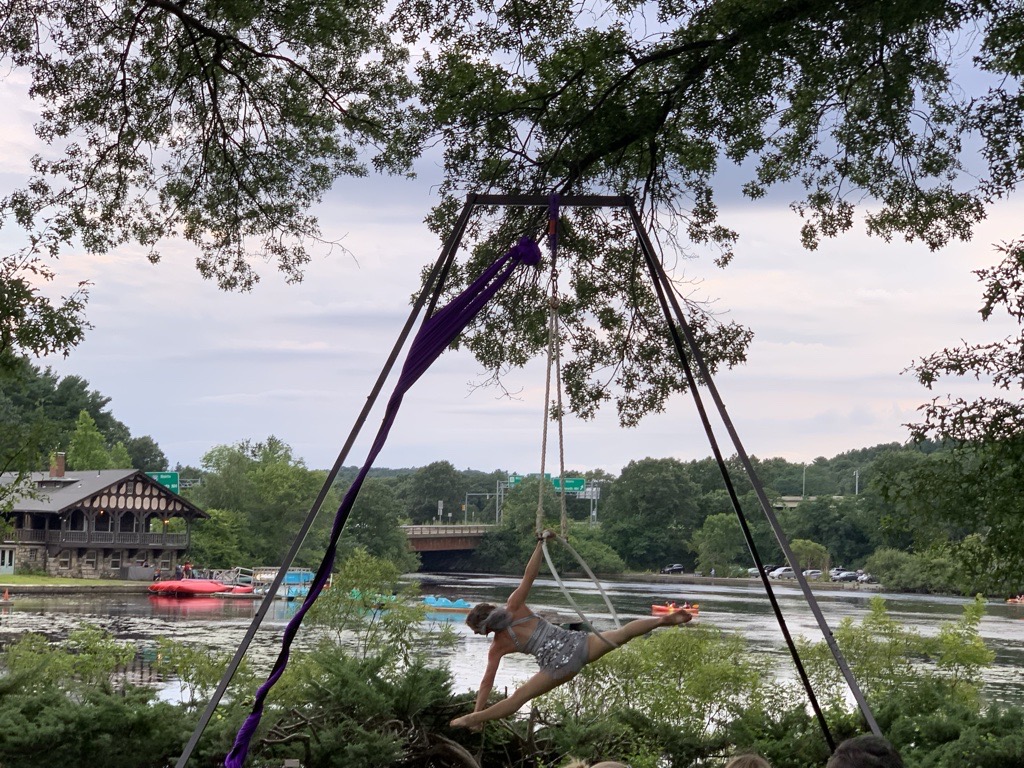
Performer doing a split in the air, suspended by a large ring tied to a support. In the background is a river view with bright colored boats and, in the distance, an old-fashioned single-story wooden structure.
Trapeze Act performed by Baechtold & Abel, with Norumbega Park’s surviving Boathouse in the background, 1 August 2021.

Further Resources

Greis, Gloria. “Vikings on the Charles, or, The Strange Saga of Norumbega, Dighton Rock, and Rumford Double-Acting Baking Powder”, Needham History Center & Museum. 

The Discovery Of The Charles River By The Vikings (Part One), History Cambridge. 

“Series A: Eben Norton Horsford”. Record Group IV: Horsford Family: Sylvester Manor Archive: NYU Special Collections Finding Aids 

“Subseries B: Norumbega Writings, 1871-1892″. Horsford Family Papers (MC5), Guides to Institute Records and Manuscript Collections (rpi.edu)  

Silverstein, Clara and Sara Leavit Goldberg. Norumbega Park and Totem Pole Ballroom. Arcadia Publishing, 2021. 


1 Proceedings of the Massachusetts Historical Society, Second Series, vol. V (February 1890), p.332-340. 

2 this is explored more in depth in the publication The Place of Stone: Dighton Rock and the Erasure of America’s Indigenous Past by Doug Hunter (Chapel Hill, the University of North Carolina Press, 2017). 

3 Nolumbeka Project: The Story of Nolumbeka 

Skating On By

by Brandon McGrath-Neely, Library Assistant

As spring arrives, the world around the MHS becomes full of life. Ellis Hall’s large windows frame Fenway’s new leaves, budding flowers, and traffic of all sorts. Any given day, you can see cars, buses, bicycles, scooters, pet strollers (my personal favorite), and on rare occasions–roller skaters.

Though roller skating isn’t as popular as it was in the mid-1990’s, it remains a popular warm weather activity here in Boston. Largely thanks to the fact that Boston, the second most walkable city in the United States, has plenty of flat, paved surfaces, but perhaps also because the inventor of the modern skate grew up nearby!

Born in 1828, James Leonard Plimpton showed an early affinity for machinery and invention. His mechanical skills were so strong that at 16, he moved from the family farm in Medfield to a machinery shop in Walpole. By 18, he supervised more than 50 employees at a factory in New Hampshire.[1] A young entrepreneur and mechanist, James was well-suited for the Industrial Revolution underway across the United States.

A tinkerer at heart, James filed his first patent in 1853. The invention was a “cabinet bed,” designed so a bed could be stored and retrieved without much strength or bending over. Sources simply note that Plimpton invented the cabinet bed “to supply a personal need,” but we may be able to guess what this need was. In December 1852, James married the bright, book-loving Harriet Amelia Adams. [1] Perhaps the newlyweds needed to save space or were preparing to add children to the home and needed a bed that would be easier for a pregnant Harriet to store. It is possible that Plimpton, in the words of Ana Ruhl, “loved her to the point of invention.” They would go on to have eight children together; only four lived to adulthood.

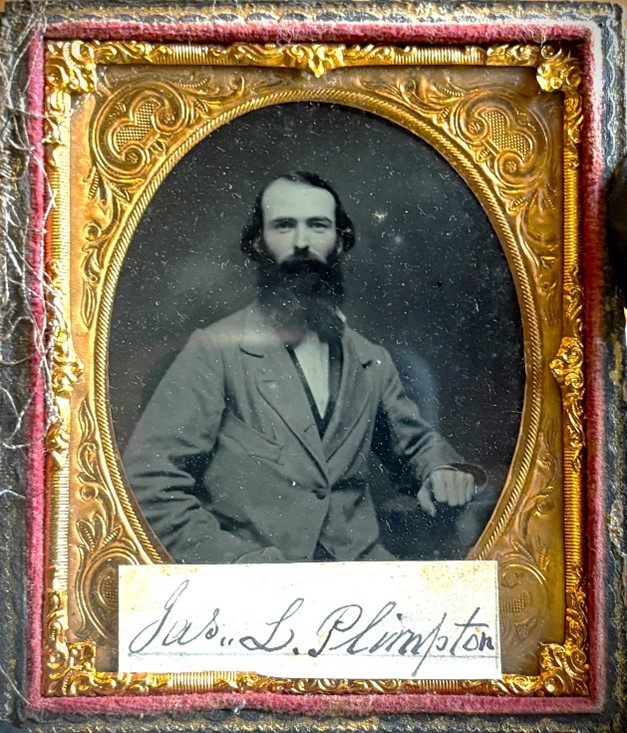
Around 1860, James and Harriet moved their family to New York City. The MHS collection has a single image of James Plimpton, probably taken shortly after arriving in the Big Apple. He gives the appearance of a hopeful, determined man. Within a year, James took ill. Consulting a doctor, James “was advised to practice ice skating,” and happily, James “took much benefit from it.” [2] Like many Northeasterners, James grew up ice skating in the winters. (The MHS has many materials about ice-skating, including a heroic rescue.) When spring arrived and the ice melted away, James purchased an early pair of roller skates.

Ambrotype photo of James Plimpton wearing a suit and resting against one arm.
James Plimpton in 1860 (Photo. 2.234)

Yes, roller skates existed before James Plimpton’s came along. The first recorded use of roller skates was “in a 1743 theater production in which actors affixed wheels to their footwear to mimic ice skating on the stage.” [3] Early roller skates were commercially available by the mid-19th century, but they were uncomfortable, awkward, and difficult to turn. They didn’t feel like ice-skating at all. After some experimenting and tinkering, James produced a new set of roller skates with two pairs of wheels, called “rockers” or “quad-skates.” [4] These new skates were more comfortable and far easier to turn. The modern roller skate was born.

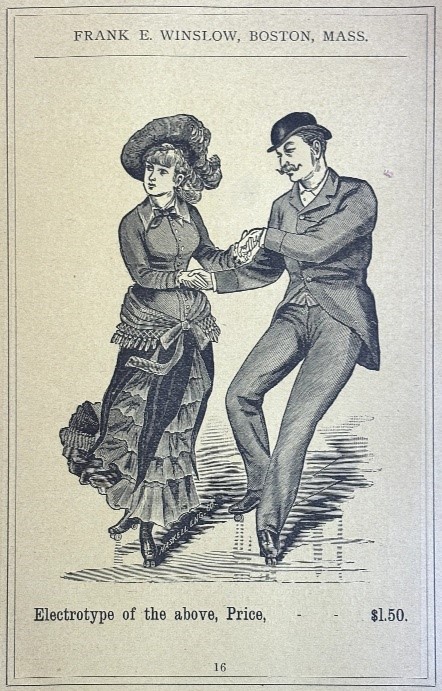
Man and woman in 19th century dress skating in a printed advertisement for roller skates.
Advertisement for roller skating in Winslow’s Roller Skate Catalog (Book 1882)

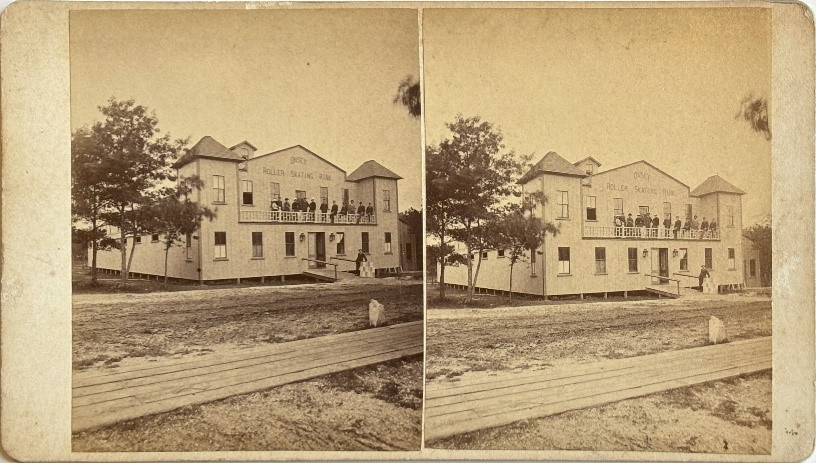
The invention was a giant success. Advertisements boasted that Plimpton’s skates were “the only one upon which all the graceful movements and evolutions of Ice Skating can be executed with ease and precision on a Smooth Floor.” [5] The MHS collection has plenty of evidence of this phenomenon: admittance tickets to roller skating rinks, skate advertisements and catalogues, bookplates, and photos of popular roller-skating clubs. Senior Processing Archivist Susan Martin has written about Great Depression-era debutantes making appearances by skating around town.

Stereograph of a group assembled on the balcony of the Onset Roller Rink.
People gathered at the Onset Roller Skating Rink, circa 1870 (Photo. 11.468)

James Plimpton spent the rest of his life selling, improving, and litigating his patents. Harriet was a caring mother and educator to their children, as well as an irreplaceable business partner. “Her quick perceptions and correct impressions as to social, legal and business points” ensured that she could “give her husband that assistance in the preparation of his patent cases that could not otherwise have been as thoroughly prepared within the time required.” [6] Roller skating was a family business and only possible through the hard work and intelligence of both Harriet and James.

The roller-skating crazes of the late 19th and 20th centuries have come and gone. Hoverboards, Onewheels, and E-bikes have replaced them on the sidewalks of Boylston Street. But occasionally, if you’re lucky, you may look out the windows of Ellis Hall and see a piece of Massachusetts history skate past you.


[1] Chase, Levi B. 1884. A Genealogy and Historical Notices of the Family of Plimpton or Plympton in America, and of Plumpton in England. Hartford: Plimpton Manufacturing Company. 196-197.

[2] “The Father of Modern Roller Skating.” 2023. National Museum of Roller Skating.

[3] Terry, Ruth. 2020. “The History Behind the Roller Skating Trend.” JSTOR Daily, September 7, 2020.

[4] “The History of Inline Skating.” 2023. National Museum of Roller Skating. 2023.

[5] MacClain, Alexia. 2010. “Those Exhilarating Roller Skates.” Smithsonian Libraries and Archives. September 27, 2010.

[6] Chase, A Genealogy and Historical Notices, 196-197.

Horsford’s Vikings of New England, pt. 1 

Hannah Goeselt, Reader Services

Commonwealth Avenue: that grand road snaking its way out of Boston and into the adjoining city of Newton, an eleven-mile stretch of boulevard from the Public Gardens to Auburndale-on-the-Charles, where it abruptly ends at the juncture of I-90 and I-95. At its head is Commonwealth Avenue Mall, a picturesque greenway home to an array of statues of historical figures leading up to the Garden’s entrance. 

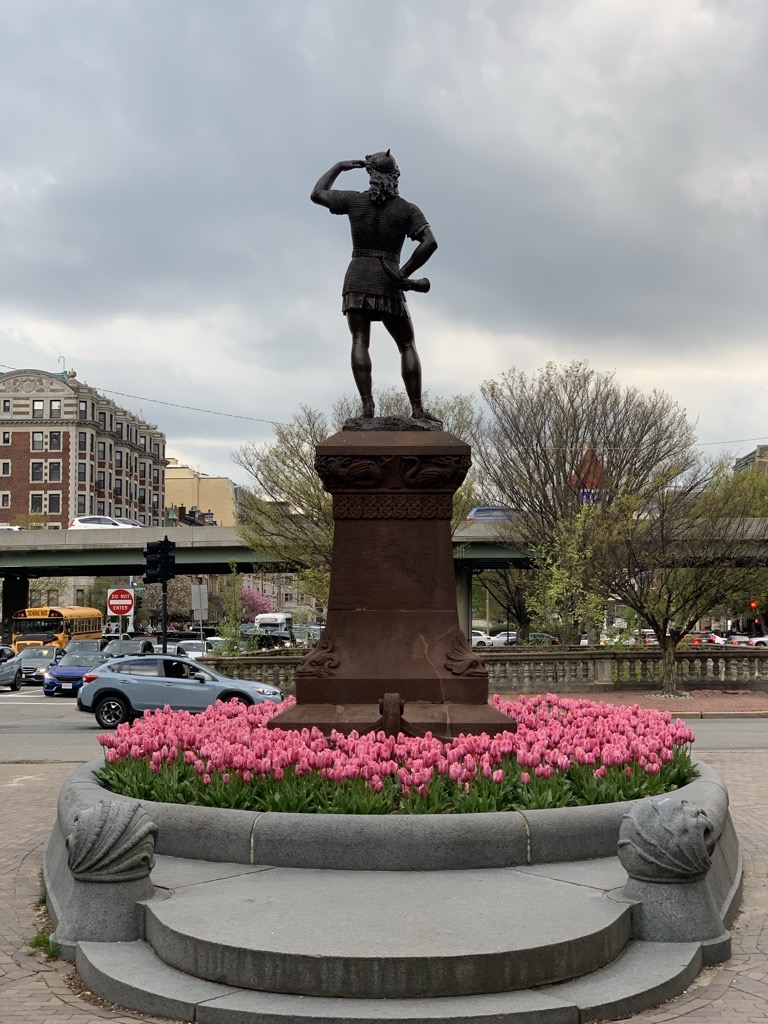
Gazing dramatically into the shadows of an overpass, Leif Erikson, dressed in a short chainmail tunic straight from the nineteenth-century imagination, looks practically glamorous posed with fist planted on his hip, bronze locks billowing behind him. Originally marking the end of the Mall, the statue relocated to nearby Charlesgate in 1917, and a stone’s throw from the MHS. 

In our most recent podcast episode, “Events That Did Not Happen”, Peter Drummey and Dr. Kanisorn Wongsrichanalai sit down to discuss the origins of the statue, and how the MHS fits into its narrative. 

Photograph of bronze statue depicting a man on a stone plinth, taken from the backside view, surrounded by pink tulips. Behind the statue is an overpass with cars
Leif Erikson statue on Commonwealth Avenue Mall.

The Norsemen Memorial 

This all began in December of 1876, during a reception honoring the Norwegian violinist Ole Bull1, in which Rev. Edward Everett Hale proposed a tribute to Bull’s devotion to the city and the formation of a “committee of the Norsemen Memorial”. The goals of the committee were twofold. 1) to erect a monument commemorating the Norse discoverers of America, and 2) the preservation of Dighton rock (including briefly gifting it to Denmark)2. The committee was full of prominent Bostonians such as Governor Alexander Rice and Mayor Samuel Cobb, but the one that would come to be emblematic of this whole affair was Eben Norton Horseford (whose life is better outlined in the podcast), a former chemistry professor made wealthy by his patented Rumford baking powder. 

In 1880, Hale’s cousin, William Everett, brought the matter of the committee and the statue to the MHS: “I desire, sir, to call the attention of the members to a scheme which is assuming somewhat serious proportions; in which, if it is really judicious, the Historical Society ought to help; against which, if it is otherwise, it is our duty to protest. I mean the scheme for erecting a monument to some person called the first discoverer of New England; not, however, John Cabot, or Sebastian Cabot, or Verrazzano, but an indefinite Northman, to whom, if I may be allowed a very bad pun, it is proposed to put up a Leif statue.”3 

The next time the statue was mentioned was at the November 18874 meeting, at which time a committee was selected to have a final word on the validity of the statue, which had by then been unveiled with great celebration the previous month. By December, there was a verdict: “there is the same sort of reason for believing in Leif Erikson that there is for believing in the existence of Agamemnon. They are both traditions accepted by the later writers; but there is no more reason for regarding as true the details related about his discoveries than there is for accepting as historical truth the narrative contained in the Homeric poems.” 

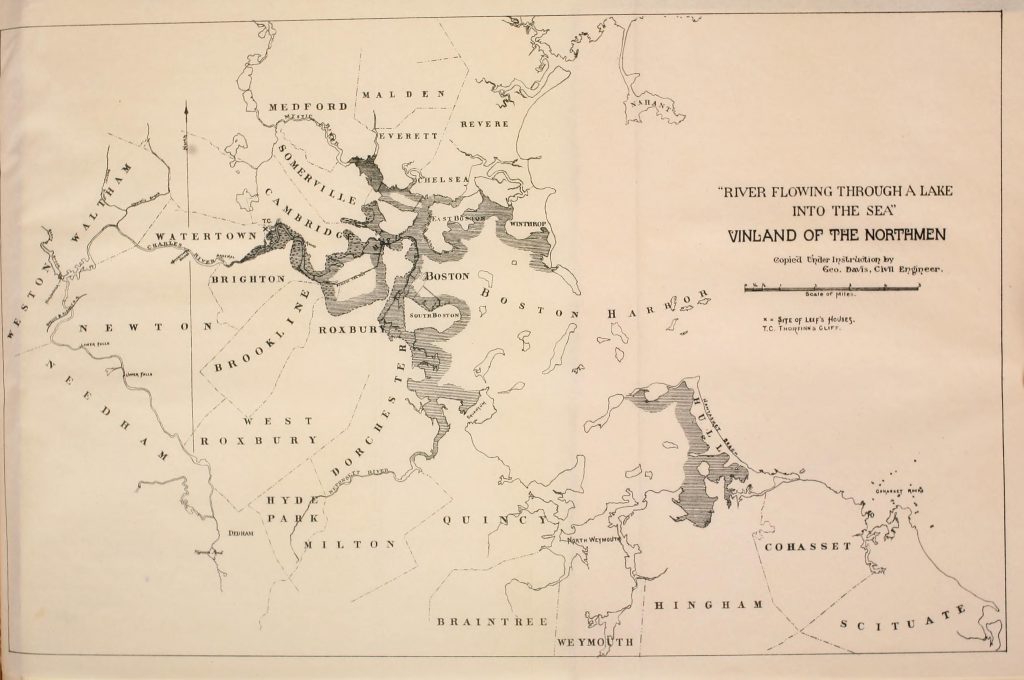
Engraved map of Boston Harbor and surrounding Massachusetts towns, with an x mark next to the river in Watertown
“’river flowing through a lake into the sea” Vinland Map of the Northmen” from Problem of the Northmen (1889); image credit Internet Archive.

To be Continued… 


1 Bull was a strong proponent of Carl Christian Rafn’s theories of Vikings discovering America before Columbus, a theory which had been published earlier in the century to wide interest. Much of Bull’s feelings on the matter are expressed in his memoir written posthumously by his wife, Sara Chapman Bull, a resident of Cambridge (see pp.270-76 of the memoir for details of the statue committee’s creation). 

2 I first saw an account of this in the ‘preface to the new edition’ of Rasmus Bjorn Anderson’s America not discovered by Columbus, 1877, which proved to be interesting on its own, as this particular copy was also inscribed on the front flyleaf: “Mr. Mauk, from his devoted friend and admirer Ole Bull Cambridge Nov 1879”, with a second inscription made “To Francis R[ussell] Hart Esq. With kindest regards Olaf Olsen, Oslo 1930”. 

3 Proceedings of the Massachusetts Historical Society [First Series], vol. XVIII (May 1880), p.79-81. The pun, as best I can tell, is based on an archaic verb usage of the word “leif” to mean ‘willing’ or ‘glad’. 

4 Proceedings of the Massachusetts Historical Society, Second Series, vol. IV (November-December 1887), p.12, 42-44. 

Women’s Labor and Livelihood in 18th Century Boston Newspapers

Maggie Parfitt, Visitor Services Coordinator

I want you to imagine the work of an 18th century American woman. What is she doing? Is she sewing and cooking and cleaning? Does she leave her home for work?

Now I want you to ask yourself where that image came from—what conjured it in your mind?

In historical anthropological theory there’s a recognition of recency bias—our understanding of the past is informed by our assumptions about our present.  This is complicated in the West by our beliefs about linear “progress.” We’re apt to believe current Western society is “the best it’s ever been” and our modern inequities are deeply rooted in history—progress necessitates as such.

Working in public history I run into the same fallacy again and again, especially when discussing Western women’s lives in the 18th century and earlier. Believe it or not, most strict Western gender roles don’t come from centuries long history of labor separation. Instead, most are rooted in the late 19th and early to mid-20th century (recent, by history standards!). As a quick example: the average marrying age of English women during the first half of the 18th century was 26[1], in 1850 America it was 23[2], and in 1960 it was around 20.[2]  

Now that we’ve reset our assumptions, what can we learn about how and why women worked in 18th century Boston? Newspapers are a valuable tool, giving us a peek into daily 18th century life. Browsing the advertisements in the Harbottle Door Annotated Newspaper Collection reveals many examples of the ways 18th century women supported themselves, their families, and their community. While reading and sorting through clippings I noticed women earned money in roughly three ways: through entrepreneurship, wage work, or indenture.

While outnumbered by advertisements for male-operated businesses, it’s not uncommon to see women advertising their wares, often in their own shops!

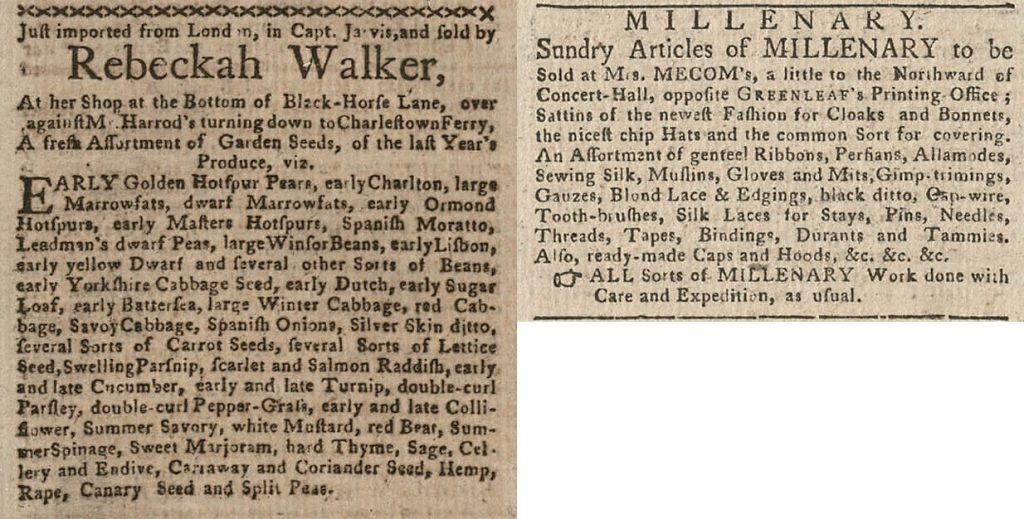
Two clippings from the Boston Gazette and Country Journal showing advertisements placed by Rebeckah Walker and Mrs. Mecom for their businesses. Both advertisements include lists of available products.
Rebeckah Walker sells at “her Shop at the Bottom of Black-Horse Lane” a variety of imported seeds The Boston-Gazette, and Country Journal, 8 March 1773, and Mrs. Mecom offers “Sundry Articles of Millenary” and “All sorts of Millenary Work done with Care and Expedition” The Boston-Gazette, and Country Journal, 14 March 1774.

In her study of women’s labor in 18th century cities Karin Wulf found women were more likely to operate businesses relating to “domestic labor” like sewing or cooking. [3] Mrs. Mecom’s millenary business falls into this category. This is not to say that women were confined to gendered businesses—women like Rebeckah Walker operated all kinds of businesses in all kinds of fields. Neither were women limited to retail. Women frequently placed ads for their service-based businesses ranging from teaching to operating taverns and coffeehouses.

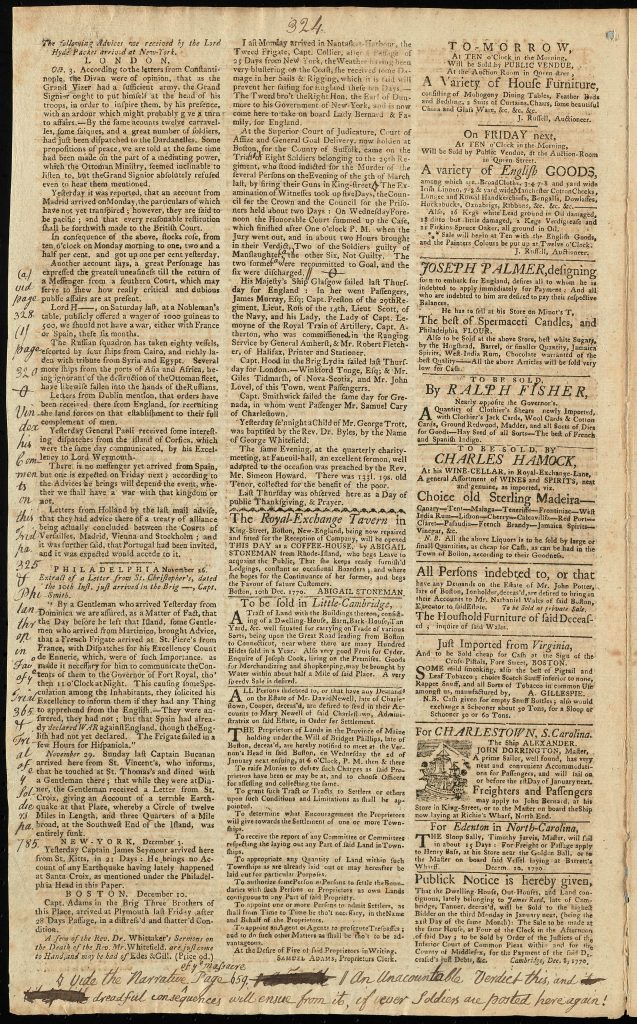
A clipping from the Boston-Gazette, and Country Journal, where Abigail Stoneman “begs leave to acquaint the public…The Royal Exchange Tavern in King-Street, Boston, New-England, being now repaired and fitted for the Reception of Company, will be opened this day as a coffee-house by Abigail Stoneman from Rhode-Island.”
Abigail Stoneman reopens the Royal Exchange Tavern in King-Street as a coffee house. The Boston-Gazette, and Country Journal, 10 December 1770.

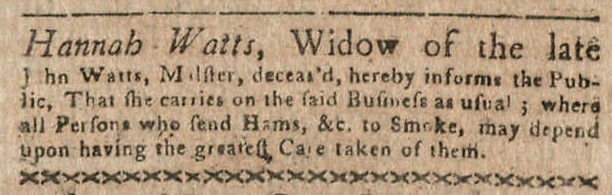
Women most often came business after their husband’s death. Upon being widowed, if the husband’s estate was uncomplicated (which typically included those in the merchant class or lower) the sole ownership fell to their wife, who could then choose to carry on the business.[3]

A clipping the Boston-Gazette, and Country Journal. The advertisement reads “Hannah Watts, Widow of the late John Watts, Master, deceased, hereby informs the public that she carries on the said business as usual. Where all persons who send hams etc to smoke, may depend upon having the greatest care taken of them.
Hannah Watts, widow of John Watts, assures her customers she will carry on his business with the same care. The Boston-Gazette, and Country Journal, 30 January 1775.

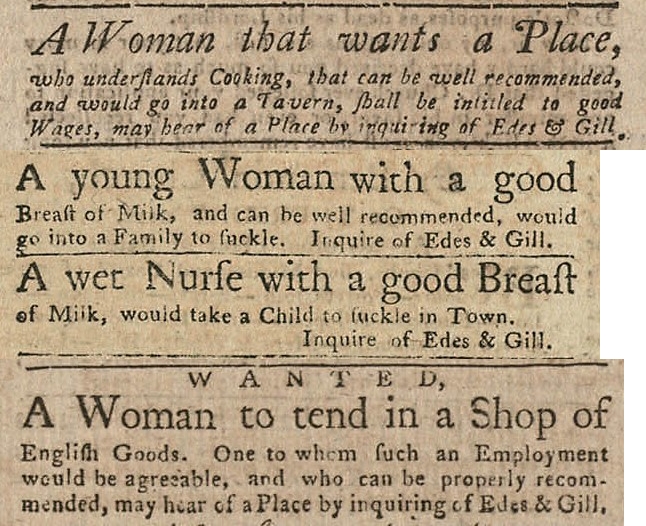
The second category of paid women’s work is wage work—what we would probably think of as regular employment or gig work, depending on the situation. Many but not all of these jobs also fell into domestic labor categories including household management, laundry, and wet nursing (which seems to be a whole separate industry![4]).

Three clippings from the Boston-Gazette and Country Journal of advertising four different jobs specifically requesting women. The first working in a tavern, the second and third as a wet nurse, and the fourth tending a shop.
Four separate advertisements from The Boston-Gazette, and Country Journal (15 March 1773, 19 November 1770, 15 March 1773) advertising work for women in a tavern, wet nursing, and tending a shop. (Interesting to note the publishers Edes & Gill seem to be doing a lot of leg work facilitating advertisements. I imagine it gets busy in that print shop!)

The third category is by indenture, where women signed a contract and in exchange received wage, food, and lodging. While certainly not all rosy, Kent’s research on female domestic servants in 18th century London suggests some young single women preferred indentured contracts to other forms of wage earning. Women earned about 1/3 the amount a man would earn for day labor, and the pattern holds even when comparing skilled trades, like a mantua-maker (dressmaker) to a tailor (men’s suits and clothes). Non-indentured working women often barely made enough money to cover housing and meals. An indenture contract came with “diet and lodging” included, meaning indentures were one of the few ways women could earn disposable income.[1]

A clipping from the Boston-Gazette and Country Journal. The advertisement reads “to be sold on board the sloop London Expedition, Nicholas Chevalier, Master, laying at Wibert’s Wharf, New-Boston. A Number of Indented [Indentured] Jersey Servants of both sexes: Likewise a quantity of cordage of all sorts, and hosiery.
“A number of Indented [Indentured] Jersey Servants of both Sexes” advertised for sale. The Boston-Gazette, and Country Journal, 23 May 1774.

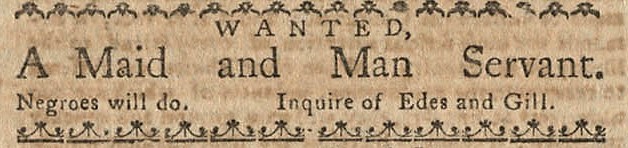
We can’t talk about the ways women provided for themselves without acknowledging the ways women were denied control of their own livelihood. You cannot look through an 18th century newspaper without directly confronting the flippancy of enslavement and the dehumanization of Black people, free and enslaved.

While beyond the scope of this blog post, I encourage you to learn more about enslavement in Boston by reading Dr. Jaime Crumley’s blog post on the enslaved parishioners of Old North and The City of Boston Archaeology Program’s “Boston Slavery” online exhibit. 

A clipping from the Boston-Gazette and Country Journal. The advertisement reads “Wanted a maid and man servant. Negroes will do.”
Advertisements both selling and seeking enslaved people appear in almost every edition of 18th century Boston newspapers. While unclear if this ad is seeking enslaved workers or paid domestic workers, the advertiser’s racism is clear as day. The Boston-Gazette, and Country Journal, 31 August 1772.

Married women, while part of a partnership, were still subject to the whims of their husbands.

Two clippings from the Boston Gazette and Country Journal. In the first Isaac Kingman “warn[s] all persons not to trust [his wife Ruth Kingman] on [his] account also to forbid all persons trading with her or purchasing any of my goods or chattels of her” in response to her “refus[ing] to remove and live with me as she ought to do.” In the second a husband forbids people from “trusting [his wife Sarah] on [his] account” as she “hath behaved in a vile manner, keeping company with wicked men.”
Husbands frequently placed advertisements asking for credit not to be lent to their wives, for reasons either vague or explicit. The Boston Evening-Post, 11 February 1771, The Boston Evening-Post, 27 August 1770.

While these ads paint a bleak picture, most of the time an 18th century husband was not the sole controller of the household, financially or otherwise. Karin Wulf calls the 18th century urban landscape one of financial “interdependence” rather than independence[3]. Both sides of the relationship entered a marriage with financial value, and both had to work to secure economic stability. Eliza Haywood wrote in 1743/44 London “You cannot expect to marry in such a Manner as neither of you shall have Occasion to work, and none but a Fool will take a Wife whose Bread must be earned solely by his Labour and who will contribute nothing towards herself.[4][1]”


[1] Kent, D. A. “Ubiquitous but Invisible: Female Domestic Servants in Mid-Eighteenth Century London.” History Workshop Autumn, 1989, no. 28 (1989): 111–28.

[2] Fitch, C., & Ruggles, S. (2000). “Historical Trends in Marriage Formation: Perspectives on Marriage and Cohabitation.” In L. Waite, C. Bachrach, M. Hindin, E. Thomson, & A. Thornton (Eds.), Ties that Bind: Perspectives on Marriage and Cohabitation (pp. 59-88). Aldine de Gruyter.

[3] Wulf, Karin. “Women’s Work in Colonial Philadelphia.” In Norton, Mary Beth., and Ruth M. Alexander (Eds). Major Problems in American Women’s History : Documents and Essays. 3rd ed. Boston: Houghton Mifflin, 2003.

[4] Shepard, Alexandra. “Working Mothers’ in Eighteenth-Century London”, History Workshop Journal, Volume 96, Autumn 2023, Pages 1–24, https://doi.org/10.1093/hwj/dbad008

The Case of the Redacted Husband

by Susan Martin, Senior Processing Archivist

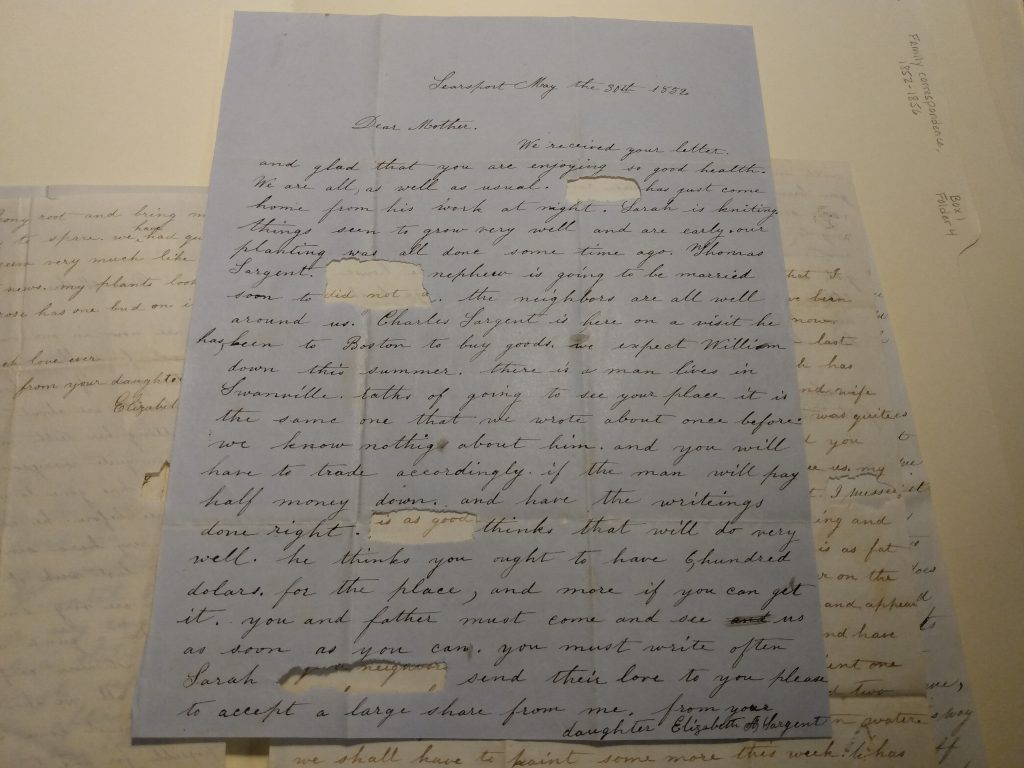
While processing the MHS collection of Huse family papers, the following letter caught my eye, for obvious reasons.

Color photograph of several black ink handwritten letters piled on top of each other. They have oval or rectangular ripped out sections, about the size of one word.
Letter from Elizabeth Sargent to Sarah Fuller, 30 May 1852

This letter was written by Elizabeth “Lizzie” (Fuller) Sargent to her mother Sarah Fuller. For some reason, everywhere Lizzie mentioned her husband Samuel, his name had been physically removed from the letter. “Hmm, that’s interesting,” I thought, and carried on processing. Then I noticed several more.

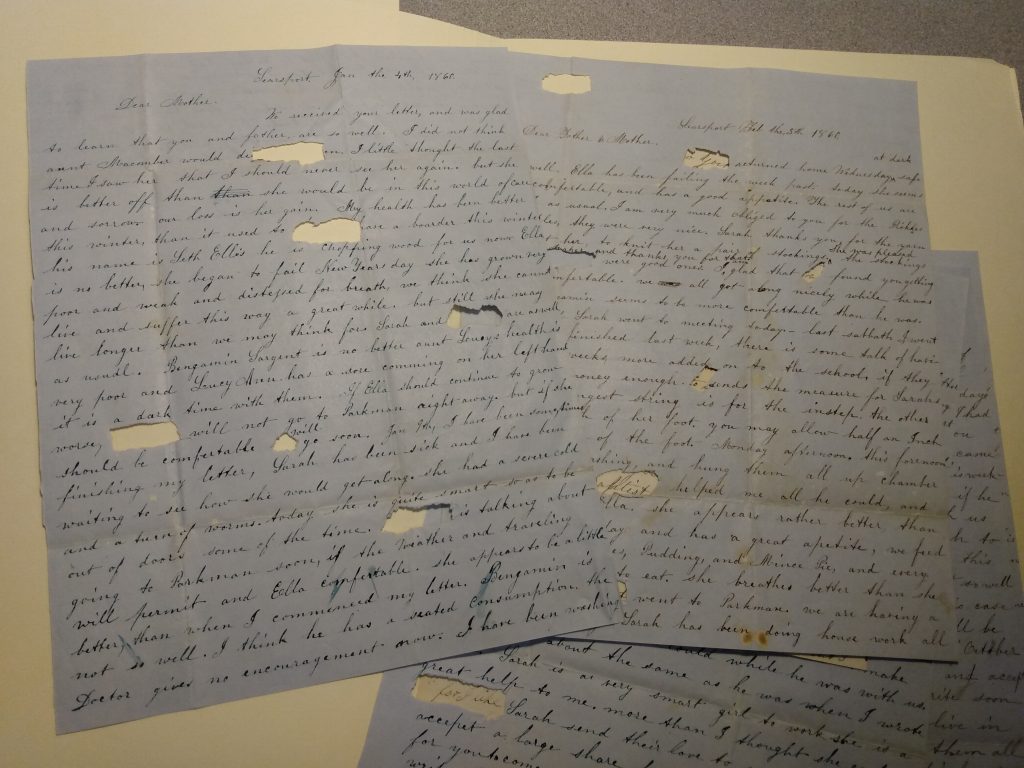
Color photograph of several black ink handwritten letters spread out in a messy layer. Each one has ovals or rectangles ripped out, the size of one word or one letter. The papers are folded, dirty, and discolored with age.
Letters from Elizabeth Sargent to Sarah Fuller, 1860

Something weird was definitely going on here. Nearly every letter from Lizzie to her mother got the same treatment. For example, “[?] sends his love with mine to you all”; “[?] has gone to meeting at the village this afternoon”; and “This is Saturday evening and [?] is oiling his harness and Sarah is rocking the cradle.” From context, it’s clearly her husband’s name that’s missing, and sometimes apparently just his initial!

I’ve occasionally seen words physically removed from letters, but only by a military censor or an aggressive autograph collector. This is obviously different. My first thought was that Samuel did something that landed him in the doghouse. It reminded me of cutting someone out of a photograph after a bad break-up. Had there been a divorce or separation?

Hoping to solve the mystery, I started researching the family, primarily using online genealogical resources. Unfortunately, I wasn’t able to find very much. Lizzie was born in 1827, the daughter of Sarah (née Austin) and Thomas Fuller, a Maine shoemaker. In 1849, she married Samuel Winthrop Sargent, who was twelve years her senior. They lived first in Charlestown, Massachusetts, and later in Searsport, Maine.

The Sargents appear to have been a typical 19th-century family. Samuel worked as both a brick mason and a farmer, while Lizzie stayed home with the children. Sadly, of their five children, only two—Sarah and George—survived to adulthood. On 1 July 1861, Lizzie wrote this passage after losing her third child.

It is with a sad and heavy heart that I write you, again. tears almost blind my eyes. Death has visited us once more, and taken our dear little Ella. she died this morning 25 minutes past 4. it seems as if I cannot be reconciled. O pray for me, that I may not lose my reason […] my home seems, desolate now.

As far as I can tell, Samuel and Lizzie never lived apart. He died in 1901, and she lived until 1903. They and several other relatives are buried at Mount Hope Cemetery in Searsport.

The collection also contains correspondence from Lizzie’s brother and sister-in-law, Andrew and (yet another) Sarah. Their story is compelling. Andrew, feeling “discontented” and “miserable” and wanting a change, joined the California Gold Rush of 1849. During his absence, his wife was desolate: “There is an acheing void […] I wonder when I eat what he has got to eat and when I go to bed what he has got to sleep on.” Andrew apparently died out west sometime in 1851, but I couldn’t confirm the circumstances. His wife Sarah remarried a few years later—believe it or not, to a man named Samuel!

While I enjoyed learning these details about the family, in the end I found nothing that accounts for the redactions. I don’t even know who was responsible for them. Was it Lizzie? Her mother? Someone else entirely? Did they happen at the time or later? Muddying the waters more, in a few instances, the name of another person was also removed. Perhaps an archival colleague or intrepid researcher out there has seen this sort of thing?

Whatever the answer, these letters are a good example of manuscripts that are interesting not just for their content, but as historical artifacts in and of themselves.