Announcing 2016-2017 Research Fellowships

By Elaine Heavey, Reader Services

The MHS is thrilled to receive the list of the incoming research fellows for the 2015-2016 cycle.  Each year our various fellowship programs bring a wide variety of researchers working on a full range of topics into the MHS library. The Reader Services Staff enjoys getting to know the fellows, many of whom become career-long friends of the Society, returning to our reading room year after year. 

If any of the research topics are particularly interesting to you, keep an eye on our events calendar over the course of the upcoming year, as all research fellows present their research at brown-bag lunch programs as part of their commitment to the MHS.

For more information about the different fellowship types, click the headings below.

*******

MHS-NEH Long-term Research Fellowships (With special thanks to the support of the National Endowment for the Humanities, an independent agency of the U.S. government):

Manisha Sinha, University of Massachusetts – Amherst, “Men for All Seasons: Sumner, Stevens, and the Making of Radical Reconstruction”

Kara Swanson, Northeastern University, “A Passion for Patents: Inventiveness, Citizenship and American Nationhood”


Suzanne and Caleb Loring Research Fellowship On the Civil War, Its Origins, and Consequences (with the Boston Athenaeum):

Kent McConnell, Phillips Exeter Academy, “A Time-Stained God: Spiritual Lives, Civil War Deaths and the Violent Remaking of Religion in America”


MHS Short-Term Research Fellowships:

African-American Studies Fellow

James Shinn, Yale University, “Republicans, Reconstruction, and the Origins of U.S. Imperialism in the Caribbean, 1865-1878”


Andrew Oliver Fellow

Kimberly Alexander, University of New Hampshire, “Exploring Anglicization Through Pre-1750 Textiles”


Andrew W. Mellon Fellows

Abigail Cooper, Brandeis University, ‘“Lord, Until I Reach My Home’: Inside the Refugee Camps of the American Civil War”

Stephen Engle, Florida Atlantic University, “Champion in Our Hour of Need: The Life of John Albion Andrew”

Jessica Farrell, University of Minnesota, “(Re)Capturing Empire: A Reconsideration of Liberia’s Precarious Sovereignty and American Empire as Exception in the 19th Century”

Andrea Gray, Papers of Thomas Jefferson and George Mason University, “’Leaving their callings’: Retirement in the Early Republic”

Ross Nedervelt, Florida International University, “The Border-seas of a New British Empire: The British Atlantic Islands in the Age of the American Revolution”

Luke Nichter, Texas A&M University – Central Texas, “Henry Cabot Lodge, Jr., and the Decline of the Eastern Establishment”

Franklin Sammons, University of California, Berkeley, “The Long Life of Yazoo: Land Speculation, Finance, and Dispossession in the Southeastern Borderlands, 1789-1840”

Michael Verney, University of New Hampshire, “’Our Field of Fame’: Naval Exploration and Empire in the Early American Republic, 1815-1860”

Stephen West, Catholic University of America, “A Constitutional Lost Cause: The Fifteenth Amendment in American Memory and Political Culture, 1870-1920”


Benjamin F. Stevens Fellow

Abram Van Engen, Washington University in Saint Louis, “American Model: The Life of John Winthrop’s City on a Hill”


Louis Leonard Tucker Alumni Fellows

Catherine Kelly, University of Oklahoma, “Making Peace: Loyalists in the Early U.S. Republic”

David Montejano, University of California, Berkeley, “From Southern Plantation to Northern Mill: Traveling along the Cotton Trail during the American Civil War”


Malcolm and Mildred Freiberg Fellow

Nora Slominsky, Graduate Center, CUNY, “’The Engine of Free Expression’[?]: The Political Development of Copyright in the Colonial British Atlantic and Early National United States”


Marc Friedlaender Fellow

Julia Rose Kraut, New York University, “A Fear of Foreigners and of Freedom: Ideological Exclusion and Deportation in America”


Massachusetts Society of the Cincinnati Fellow

Craig Smith, Lesley University, “Redemption: The American Revolution, Ethics, and Abolitionism in Britain and the United States”


Ruth R. & Alyson R. Miller Fellows

Evan Haefeli, Texas A&M University, “The Delaware as Women and the Iroquois Great Peace of 1670”

Cathryn Halverson, University of Copenhagen, “Faraway Women and The Atlantic Monthly”


W. B. H. Dowse Fellows

Nathan Fell, University of Houston, “The Nature of Colonization: Native Americans, Colonists, and the Environment in New England, 1400-1750”

Michael Hattem, Yale University, “The Past is Prologue: The Origins of American History Culture, 1730-1800”


New England Regional Fellowship Consortium (NERFC) Awards (* indicates that part of fellowship will be completed at the MHS):

*Cassandra Berman, Brandeis University, “Motherhood and the Court of Public Opinion: Transgressive Maternity in America, 1768-1868”

Amy Breimaier, University of Massachusetts – Amherst, “’I learn my Books well’: Child Readers and the Economics of Cultural Change in New England, 1765-1815”

Jamie Brummitt, Duke University, “Protestant Relics: The Politics of Religion and the Art of Mourning in the Early American Republic”

*Emily Burns, Auburn University, “Innocence Abroad: The Cultural Politics and Paradox of American Artistic Innocence in Fin-de-Siècle France”

Ben Davidson, New York University, “Freedom’s Generation: Coming of Age in the Era of Emancipation”

Mary Draper, University of Virginia, “The Tropical Metropolis: Cities and Society in the Early Modern British Caribbean”

*John Garcia, University of Pennsylvania, “Specimen Pages: Critical Bibliography and Digital Analysis of 19th-Century Subscription Publishing in America”

*Louis Gerdelan, Harvard University, “Calamitous Knowledge: Understanding Disaster in the British, Spanish, and French Atlantic Worlds, 1666-1755”

Matthew Ghazarian, Columbia University, “Famine and the American Protestant Mission: Humanitarianism and Sectarianism in Turkey, 1858-1893”

*Kenyon Gradert, Washington University in St. Louis, “The Second Reformation: Protestant Inheritance in Antislavery New England”

Nalleli Guillen, University of Delaware, “Round the World Every Evening: Panoramic Spectacles, Entertainment Culture, and a Growing Imperial Consciousness in Nineteenth-Century America”

Jane Hooper, George Mason University, “’Let the Girls Come Aboard’: Intimate Contact between America and Madagascar”

Rachel Knecht, Brown University, “Inventing the Mathematical Economy in Nineteenth-Century America”

*Jonathan Lande, Brown University, “Disciplining Freedom: Union Army Slave Rebels and Emancipation in the Civil War Courts-Martial”

*Rachel Miller, University of Michigan, “Capital Entertainment: Creative Labor and the Modern Stage, 1860-1930”

Alexandra Montgomery, University of Pennsylvania, “Projecting Power in the Dawnland: Colonization Schemes, Imperial Failure, and Competing Visions of the Gulf of Maine World, 1710-1800”

Carrie Streeter, University of California, San Diego, “Before Yoga: Self-Expression and Health in the Age of Nervousness”

Andrew Wasserman, Louisiana Tech University, “Bang! We’re All Dead: The Places of Nuclear Fear in 1980s America”

Counting Down to the Quasquibicentennial

By Susan Martin, Collections Services

In eleven days, the Massachusetts Historical Society will be celebrating its quasquibicentennial, or, if you prefer, its bicenquasquigenary. In other words, on January 24, the MHS will turn 225 years old! We don’t think it looks a day over 200.

The MHS was founded on 24 January 1791, when Rev. Jeremy Belknap and a group of like-minded men met in Boston to form a society that would “collect, preserve and communicate, materials for a complete history of this country.” It was the first historical society in America, so its founders called it simply “The Historical Society.” (The New York Historical Society came along in 1804, then the American Antiquarian Society in 1812.) The MHS lived at six different locations before moving in 1899 to its current building at 1154 Boylston Street, Boston.


Staff members at the MHS have been working on a web project to commemorate our 225-year history: a gallery highlighting 225 items from our collections, including manuscripts, artwork, artifacts, and printed material representing four centuries of American history. Helping out with this project, I’ve had the chance to see a broad cross-section of material, learn the stories behind individual items, and better understand their significance.

Of course, the MHS is well-known for its iconic collection of Adams family papers, which include the letters and other papers of John, Abigail, John Quincy, and many generations of family members. We’ll be featuring some of these papers in our 225th anniversary gallery, from an early love letter by John to correspondence about Abigail’s death. John Adams’ notes on the Boston Massacre trials and his son’s reflections on the Amistad case document fascinating milestones in this illustrious family’s story.

The MHS also holds the second largest collection of Thomas Jefferson papers after the Library of Congress. Not only will our project feature Jefferson’s original manuscript draft of the Declaration of Independence, but also John Adams’ manuscript copy, the first printing, and the first printing that included signers’ names.

Many of the items in our collections are, in fact, the only known surviving copies of printed works. These include Samuel Sewall’s seminal anti-slavery pamphlet The Selling of Joseph, Benjamin Franklin’s first published work, and an early engraving of Harvard discovered by accident in the MHS collections 85 years after its acquisition!

Other ground-breaking printed works you’ll find here are the first books of poetry by Anne Bradstreet (1650) and Phillis Wheatley (1773), as well as the first Bible (1663) published in North America, a translation into the Massachuset Native American language.

The MHS holdings also include some remarkable Civil War-era material, so these papers figure prominently in our gallery. Particularly heartbreaking is a letter from Lt. Col. Wilder Dwight to his mother, written as he lay dying on the battlefield of Antietam. And this broadside recruiting African American soldiers for Massachusetts’ famous 54th Regiment becomes more poignant when you learn how the U.S. government failed to make good on its promises to the men who answered its call.

As for papers related to slavery and abolition, we highlight an eight-page letter from Abraham Lincoln to his friend Joshua Fry Speed detailing Lincoln’s feelings about slavery and the Union, and one Harriet Beecher Stowe wrote on the day she finished her novel Uncle Tom’s Cabin. I also really like our 1892 photograph of the African Meeting House, the site of many anti-slavery meetings.

Speaking of striking images, here are a few more in MHS collections that you may not know about: a watercolor painting of the Heart Mountain Japanese internment camp, John Noble’s illustrated letter to his children depicting scenes from the South Pacific, and the only known portrait of legendary frontiersman Daniel Boone painted from life.

We hope you’ll enjoy our 225th anniversary celebration and visit us either in person or on-line. Keep an eye on our website, or follow us on Facebook or Twitter, as we count down to this momentous occasion.


MHS Staff Meet with Librarians from Uzbekistan

By Nancy Heywood, Collection Services

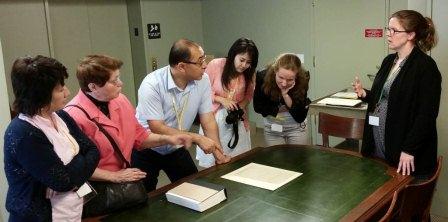
Although there are many miles between Boston, Massachusetts and Tashkent, Uzbekistan (6,148 miles according to Google) and although the English language is quite different from the Uzbek language, librarians from the National Library of Uzbekistan and staff of the Massachusetts Historical Society found much common ground and camaraderie during a recent meeting at MHS. 

The scheduling logistics for the group – comprised of the Director, Deputy Director, Head, Reading Halls Lead Specialist, and Head of IT and Access to Foreign Library Collections – were handled by WorldBoston. The focus of the meeting and tour, which took place on 5 June, was on how the MHS makes special collections materials available to researchers both remotely and on-site.  During the visit, with the aid of two highly skilled interpreters, we were able to convey information about cataloging, archival storage, and collections management issues.

Following Librarian Elaine Heavey’s  brief introduction to the MHS’s history and collections, Digital Projects Coordinator Nancy Heywood and Web Developer Bill Beck showed some examples of how we make selections of our collections available online. The MHS website features a few different types of digital presentations—some sections of the website present sets of materials comprised of relatively small numbers of items with lots of contextual information and transcriptions, but other sections of the website present large sets of documents and/or fully digitized collection with minimal descriptive information and usually without transcriptions.

Elaine Heavey then conveyed information about how researchers use online catalogs and collection guides to prepare for their research visit and she demonstrated Portal1791, our new researcher request system.  The group toured the building and saw the spaces that researchers use (orientation room, reading room, catalog room) as well as some staff areas including the conservation lab and one of the larger stack floors.  They also saw a few highlights from the collections.


Sneak Peek! The Inaugural GLCA Boston Summer Seminar

By Anna J. Clutterbuck-Cook, Reader Services

Eighteen months ago, I sat down for lunch with former MHS research fellow Dr. Natalie Dykstra (Hope College), author of Clover Adams: A Gilded and Heartbreaking Life (Houghton Mifflin, 2012). Over the meal, Natalie mentioned that she had been offered the opportunity to develop a faculty-student collaborative research program here in Boston for the Great Lakes Colleges Association (GLCA). From this seed of an idea, over the past year and a half, we have grown the GLCA Boston Summer Seminar, hosted here at the MHS this June.

Between June 1-18 we have three research teams in residence here in Boston, conducting research at five partner institutions: the MHS, the Center for the History of Medicine at Countway Library, Houghton Library, Northeastern University Archives & Special Collections, and Schlesinger Library. We are also offering behind-the-scenes archives tours and evening seminars with guest speakers who share their own experiences working with a wide range of archival materials. You can follow the Seminar in progress @GLCABOSTON.

Over the past five years, the MHS library has seen a dramatic increase in the number of undergraduate students who come through our doors or contact us remotely looking for sources to complete projects in various disciplines from architecture to English to history and political science. As a historian and librarian, I am excited to both observe and support these young researchers as they learn to navigate special collections material.

Some of these students will go on to careers in academic and public history or library science; hopefully all of them will develop a better appreciation for how historical sources can contribute to contemporary understanding. The six students participating in this inaugural Boston Summer Seminar are engaged in original, thoughtful research and I look forward to seeing where their projects take them!


Library Hours Changing

By Elaine Heavey, Reader Services

I write with sadness that as of 1 September 2014 the MHS library is reducing its hours, eliminating the extended hours on Tuesday evenings.  The new library hours will be:

Monday through Friday – 9:00 AM to 4:45 PM
Saturday – 9:00 AM to 4:00 PM

Unfortunately the reduction in hours was necessary. Once this became evident, many staff members looked at library use patterns to determine where cuts could best be made.  Over the years, especially since reinstating Saturday hours in the spring of 2008, evening use had steadily declined. That is not to say that we do not appreciate that this change will impact researchers – especially those visiting from great distances and those that enjoyed using the library until minutes before attending a Tuesday evening seminar. But it does mean that based on current use patterns, it is hoped that eliminating the evening hours would have the least impact on our researchers. In other words, the lesser of two evils. 

This morning, as I checked the MHS website, the outgoing phone messages, and library handouts to ensure that our hours had been updated in all the necessary places, I began to think about how an era was ending.  When I first started at the MHS in 2006 evening hours were a well-established part of the library schedule.  I knew we had switched the hours from Thursdays to Tuesdays a few years back (with almost no change in use statistics with that move), but as I began to wax nostalgic, I got to wondering just how long the MHS library had been offering evening hours to researchers. 

I went to the reference shelf and grabbed a box containing back issues of Miscellany, the MHS newsletter, and began browsing for notices of library hours. The first issue in the box I selected was dated 1990. I discovered that at that time the MHS was open Monday through Friday 9:00 AM to 4:45 PM.  Those hours did not change until June 1997 when Saturday hours (9:00 AM to 1:00 PM) were added.  I was surprised to learn that it was not until September 2001 that the Thursday evening hours (through 8:00 PM) were added.  And they were added as the Saturday hours were eliminated, hoping that the evenings would see greater readership. 

So as we say adieu to our evening hours, and offer researchers three less hours per week to explore our collections, I am happy to say that we are still offering Saturday hours, which on its second go-round was amazingly successful,** and that the MHS library continues to offer more operating hours than it did throughout most of the 20th century. 


**Perhaps being open until 4:00 PM allows weekend researchers to sleep in a bit on their Saturday morning and still feel they can have a worthwhile research day.


Visiting Dyer Memorial Library

By Andrea Cronin, Reader Services

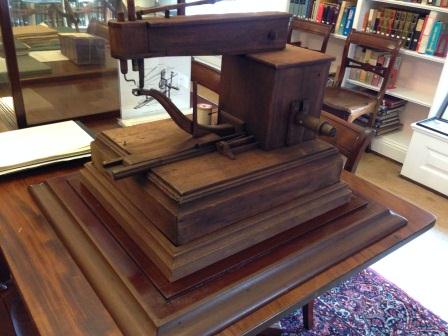
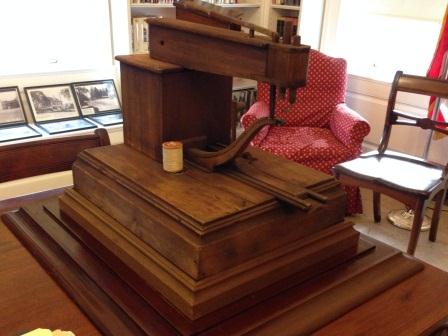
In “The McKay Stitcher,” I presented a letter from Henry H. Warden of the Russell & Company trade firm in Shanghai to colleague John Cunningham about potential shoe business in China. In response to my post, Joice Himawan, Director of the Dyer Memorial Library in Abington, Mass., kindly invited me to see an early wooden model of the McKay machine held there. Abington resident and inventor Lyman Blake created this particular model.  


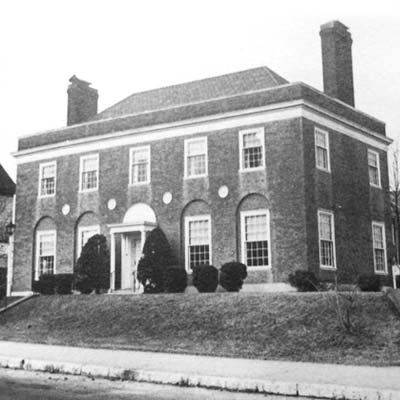
The Georgian architecture of the Dyer Memorial Library really caught my attention with its pleasing symmetry and order. The building, a trove of genealogical and historical information of the residents of Old Abington (modern day towns of Abington, Rockland, and Whitman), sits atop a slight hill on Center Street. Though this elevation makes the two-story building appear perhaps imposing, I enjoyed how the centered five-bay façade threshold with aligned windows drew in my eye and invited my curious mind to enter.

Boy, was I curious! I learned that the library opened its doors to the public in 1930 by the will and trust of resident inheritress Marietta White Dyer (1853 – 1918). Her uncle Samuel Brown Dyer (1809-1894) amassed quite a fortune as an international banker in France and bequeathed this inheritance to his niece, Marietta White Dyer.  As part of her will, Dyer established the Dyer Fund to construct and maintain the Dyer Memorial Library, leaving $80,000, land, and personal estate to the fund upon her death in 1918. Today the library collection focuses on local history with a concentration on materials by and about people connected to the area known as Old Abington.

As Old Abington’s history deeply involved the 19th century shoe industry, the inclusion of Lyman Blake’s early model of the McKay shoe stitcher to the library’s collections makes perfect sense. I would like to thank Joice Himawan of the Dyer Memorial Library for the invitation to visit. What a great gem of 19th century shoe production history!

The library is free and open to the public. I encourage all readers to plan a visit this special library.


Symbiosis at the Society: Fellows and Librarians Learn Together

By Dan Hinchen

A few weeks ago the Beehive featured an item about the 2014-2015 Fellowship recipients and their research projects for the coming year. This great opportunity for scholars to come and do funded research also is an opportunity for the MHS librarians to expose ourselves to subjects and collections that we otherwise do not interact with.

Each year, the reference librarians here look at the projects to be undertaken by the incoming research fellows and divide them up so that we can serve as individual liaisons for the various fellows. We choose which fellows to liaise with based on our own interest and background knowledge of the projects. This benefits the fellows by providing a specific person to contact if they have trouble navigating our collections or just need someone to bounce ideas off.  

Over the next year, I will be liaising with at least eleven different fellows to help them utilize the resources here at the MHS. The projects cover a wide range of subjects, including alcohol production, throat epidemics, Revolutionary War campaigns, antislavery texts, and religious reform. They also cover a long span of time, from the earliest days of the English colonies to the dawn of the Civil War.

This presents two challenges for me: to help fellows access materials they already identified using our catalog and to help them discover additional material in our collection that they missed. Perhaps I am familiar with a collection that they did not find in their search; maybe I can show them resources that are not available via our online catalog; in some cases, I can suggest another institution whose collections complement the Society’s.

Again, this exchange benefits both the fellows and the MHS staff. I know already from reading through some project descriptions that I will be exposed to topics that are completely new to me or that the fellow is looking at in a new way. And with some relevant materials already identified by the research fellow, I will learn more about the collections we have here. As I scour our catalog to find more resources for the fellow, I learn more about our holdings and about strategically searching our collections, information that will certainly come in useful down the road.

Back in January I wrote a piece for the Beehive about using the Researcher as Resource. Working with our research fellows each year is another way for our librarians to expand their knowledge and to learn even more about the collections here at the MHS. 


2014-2015 Fellowship Recipients Announced

By Elaine Grublin

Each year the MHS grants a number of research fellowships to scholars from around the country.  For more information about the different fellowship types, click the headings below. 

Our various fellowship programs bring a wide variety of researchers working on a full range of topics into the MHS library. If any of the research topics are particularly interesting to you, keep an eye on our events calendar over the course of the upcoming year, as all research fellows present their research at brown-bag lunch programs as part of their commitment to the MHS. 

A hearty congratulations to all of the fellowship recipients.  We look forward to seeing you all in the MHS library in the upcoming year. 

*******

MHS-NEH Long-term Research Fellowships (thanks to the support of the National Endowment for the Humanities, an independent agency of the U.S. government):

John Stauffer, Harvard University, “Charles Sumner’s America: A Cultural Biography”

Erin Kappeler, University of Maine Farmington, “Everyday Laureates: Poetic Communities in New England, 1865-1900”

Suzanne and Caleb Loring Research Fellowship On the Civil War, Its Origins, and Consequences (with the Boston Athenaeum):

Sarah Beetham, University of Delaware, “Sculpting the Citizen Soldier: Reproduction and National Memory, 1865-1917”

New England Regional Fellowship Consortium (NERFC) Awards (with 20 other institutions; the * indicates that part of fellowship will be completed at the MHS):

*Nicholas Bonneau, University of Notre Dame, “Unspeakable Loss: New England’s Invisible Throat Distemper Epidemic of 1735 – 1740”                             

*Frank Cirillo, University of Virginia, “‘The Time of Sainthood Has Passed’: American Abolitionists and the Civil War, 1861-1865”                               

Sascha Cohen, Brandeis University, “The Comedy of the Culture Wars: American Humor, Feminism, and Gay Liberation, 1969-1989”

Dan Du, University of Georgia, “This World in a Teacup: Sino-American Tea Trade in the Nineteenth Century”

*Amy  Ellison, Boston University, “‘To Bring Liberty to the North’: The Invasion of Canada and the Coming of American Independence, 1774-1776.”  Colonial Society of Massachusetts Fellow 

Mary Fuhrer, Independent Scholar, “The Experience and Meaning of Tuberculosis in Rural New England, 1800-1850”

*Brendan Gillis, Indiana University, “Cosmopolitan Parochialism: Colonial Magistracy and Imperial Revolution, 1760-1800”

Christina Groeger, Harvard University, “Paths to Work: The Rise of Credentials in American Society, 1870-1940”

*Brenton Grom, Case Western Reserve University, “The Death and Transfiguration of New England Psalmody, ca. 1790–1860”

Samira Mehta, Fairfield University, “God Bless the Pill? Contraception, Sexuality, and American Religion from Margaret Sanger to Sandra Fluke”

*Sean Moore, University of New Hampshire, “Slavery and the Making of the Early American Library: British Literature, Political Thought, and the Transatlantic Book Trade”                 

*Jacqueline, Reynoso, Cornell University, “(Dis)Placing the American Revolution: The British Province of Quebec in the Greater Colonial Struggle”

*Gregory Rosenthal, SUNY Stonybrook, Hawaiians who left Hawaiʻi: Work, Body, and Environment in the Pacific World, 1786-1876”

Kate Silbert, University of Michigan, “‘Committed to Memory’: Gender, Literary Engagement, and Commemorative Practice, 1780-1830”

Jordan Smith,  Georgetown University, “The Invention of Rum”

*Rachel Trocchio, University of California Berkeley, “The Puritan Sublime”

*Jordan Watkins, University of Nevada Las Vegas,  “‘Let Every Writer Be Placed in His Own Age’: Slavery, Sacred Texts and the Antebellum Confrontation with History”                              

MHS Short-Term Research Fellowships:

African American Studies Fellow

Westenley Alcenat, Columbia University, “Escape to Zion: Black Emigration and the Elusive Quest for Citizenship, 1816-1868”

Alumni Fellows

Mary Draper, University of Virginia, “The Urban World of the Early Modern British Caribbean”

Jonathan Koefoed, Indiana University – Purdue University Columbus, “Cautious Romantics: Trinitarian Transcendentalists and the Emergence of a Conservative Religious Tradition in America”

Andrew Oliver Fellow

Mark Thompson, University of Groningen,    “Land, Liberty, and Property: Surveyors and the Production of Empire in British North America”

Andrew W. Mellon Fellows

Laurie Dickmeyer, University of California Irvine, “Americans in Chinese Treaty Ports: The Interplay of Trade and Diplomacy in the Nineteenth-Century China and United States”

Mark Dragoni, Syracuse University, “Operating Outside of Empire: Trade and Citizenship in the Atlantic World, 1756-1812”

Jeffrey Egan, University of Connecticut, “Watershed Decisions: The Social and Environmental History of the Quabbin Reservoir, 1860-1941”

David Faflik,   University of Rhode Island, “Passing Transcendental: Harvard, Heresy, and the Modern American Origins of Unbelief”

Alex Jablonski, SUNY Binghamton, “Subjects into Citizens: The Imperial Origins of American Citizenship”

Nathan Jeremie-Brink, Loyola University Chicago, “Gratuitous Distribution: Distributing African-American Antislavery Texts, 1773-1845”

Jordan Smith, Georgetown University, “The Invention of Rum”

Robin Smith, University of North Carolina Chapel Hill, “The Labor of Poetry and the Poetry of Labor: Industrialization and the Place of Poetry in Antebellum America”

Meghan Wadle, Southern Methodist University, “Stray Threads: Industrial Women’s Writings and American Literature, 1826-1920”

Benjamin Franklin Stevens Fellow

Serena Zabin, Carleton College, “Occupying Boston: An Intimate History of the Boston Massacre”

Cushing Environmental Fellow (through the generosity of Cushing Academy, Ashburnham, Massachusetts)

Sean Munger, University of Oregon, “Ten Years of Winter: The Cold Decade and Environmental Consciousness in the Early 19th Century”

Malcolm and Mildred Freiberg Fellow

Kristina Garvin, Ohio State University, “Past and Future States: The Cultural Work of the Serial in U.S. Literature, 1786-1814”

Marc Friedlaender Fellow

Kristen Burton, University of Texas Austin, “John Barleycorn vs. Sir Richard Rum: Alcohol, the Atlantic, and the Distilling of Colonial Identity, 1650-1800”

Massachusetts Society of the Cincinnati Fellow (through the generosity of Massachusetts Society of the Cincinnati)

Daniel Soucier, University of Maine, “Navigating Wilderness and Borderland: The Invasion of Canada, 1775-1776”

Ruth R. and Alyson R. Miller Fellows

Kate Culkin, Bronx Community College, “‘For the Love of Your Sister’: Ellen Tucker Emerson, Edith Emerson Forbes, and the Emerson Legacy”

Rachel Walker, University of Maryland, “A Beautiful Mind: Physiognomy and Female Intellect, 1750-1850”

W.B.H. Dowse Fellows

Melissa Johnson, University of Michigan, “Regulating the Word: Religious Reform and the Politics of Knowledge in the Seventeenth-Century Anglo-Atlantic”

Adrian Weimer, Providence College, “Rumors and the Restoration in Boston”

“Long Sleeps Last Night for Both Sophias”: A New Mother’s Diary from 1910

By Anna J. Clutterbuck-Cook, Reader Services

As one of our staff prepared to depart on maternity leave this fall, I took the opportunity to delve into the print and manuscript materials in our collection related to pregnancy and childbirth, parenting and childhood. The MHS has a wide variety of print, manuscript, art and artifact materials related to the history of parents and children, from Cotton Mather’s Help for Distressed Parents, Or, Counsels & Comforts for Godly Parents Afflicted with Ungodly Children (1695) to the children’s health diaries of Helen C. Morgan (in the Allen H. Morgan Papers), who kept tidy notes on her children’s growth, eating habits, childhood illnesses, and medical treatments from their infancy through their college years (1923-1951).

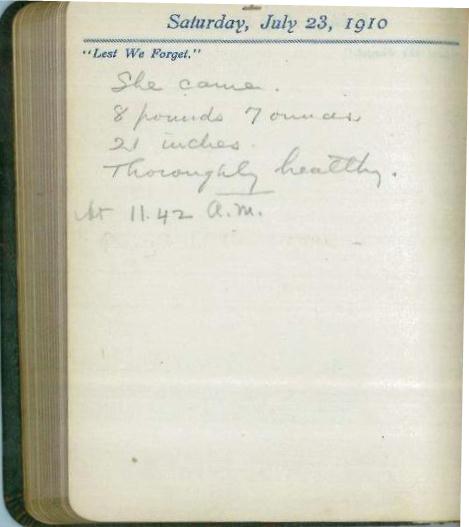
One of my favorite discoveries was the diary kept by Sophie French Valentine during the first months of her daughter’s life. Perhaps in anticipation of her daughter’s birth, Sophie purchased a page-a-day Standard Diary for 1910. In the days before Internet-based social media was our platform of choice for documenting the everyday, Standard Diaries offered a way for many Americans to keep account of their own comings and goings with “status updates” that continue to resonate with intimate immediacy for future generations.

Sophie Valentine’s 1910 diary remained blank until the page for Saturday, July 23, on which she wrote simply, “She came. 8 pounds 7 ounces, 21 inches. Thoroughly healthy. abt 11.42 a.m.”

While her infant daughter was healthy, Sophie was not. On August 2nd she had to undergo an operation (unspecified), that necessitated separation from her daughter and several days’ sedation with “narcotics.” Sophie wrote on the page for August 2nd, “I nursed the baby every three hours up to this time – but just before the operation it was decided best to take her from me!”

As the summer waned, Sophie recovered from her surgery and chronicled the comings and goings of her household, as well as the growth of her daughter (also christened Sophia). Several weeks after the birth, the family doctor paid a visit and pronounced “the little one…sound and vigorous.” Three days later, infant Sophie “went out in the bassinette in front of the house” for the first of what would be many afternoons in the fresh air with her mother. Sophie’s husband, a diplomat, appears to have been away during much of his wife’s convalescence, but a steady stream of female friends and relatives populate the pages of Sophie’s diary. On August 14th, for example, the day “the little one” was baptized Sophia French Valentine, she “had pictures taken with Harriet, Charles, Aunt Martha, Auntie May; and Elizabeth and Lucy,” as well as with her mother and Aunt Caroline (“who held her and talked to her lots”). Later she was visited by “Theodore, Mrs. Graves, and Auntie Beth.”

By Thursday of that week the social whirl may have worn thin for both mother and daughter: the entry for August 18th reads simply, “Long sleeps last night for both Sophias.” A heartfelt status update that will no doubt resonate with many new parents generations hence.

The Sophie French Valentine Papers are part of the Robert G. Valentine Family Papers and available for use by researchers in the reading room of the MHS library.


Coming Soon: Massachusetts Historical Review, Volume 15

By Jim Connolly, Publications

Fractious centennial commemorations reveal ethnic and socioeconomic tensions in Boston!

Daguerreotype of “white slave girl” rocks the North, stirs antislavery fervor!

Radical agrarian thumbs nose at Knox, describes self as “Plaintive worm”!

Real cause of Cape Cod salt industry decline EXPOSED!

So we begin in media res with my unofficial headlines for the four research articles that make up the meat of volume 15 of the Massachusetts Historical Review, a rich and satisfying historical meal with all the trimmings followed by a dessert of three book review articles. But first, readers will enjoy an invigorating apéritif in the form of distinguished professor and writer Gordon S. Wood’s “Remarks on Receiving the John F. Kennedy Medal,” which makes plain his views on the current divide between academic and popular history writing.

“Claiming the Centennial: The American Revolution’s Blood and Spirit in Boston, 1870–1876,” by Craig Bruce Smith

The 1870s—the decade in which Boston held celebrations to commemorate key events of the American Revolution—was fraught with conflict. Classes, lineages, races, and sexes raged in the press, in the streets, and in the meeting venues of Boston for the assumed right to “claim the centennial.”


“The Real Ida May: A Fugitive Tale in the Archives,” by Mary Niall Mitchell

In the mid 1850s, a daguerreotype of a young girl named Mary Botts—a freed slave so light-skinned she “passed” for white—caused a sensation. The image shocked its audience into a kind of empathy for slaves (and generally for African Americans and Africans under the Fugitive Slave Law) that many might not have felt otherwise. Botts’s story and others related in this essay illustrate the power of the early photographic image to speak to hearts and to change minds.


“‘Persecuted in the Bowels of a Free Republic’: Samuel Ely and the Agrarian Theology of Justice, 1768–1797,” by Shelby M. Balik

Follow the adventures of Samuel Ely, a New England minister and agrarian radical who never missed an opportunity to stir up trouble in the name of divine justice. The outspoken Ely railed against what he saw as the unfair distribution of land patents. Eden, he argued, “was a garden containing six acres only, . . . not a Patent, thirty miles square, nor seventy miles long.”


“The Making and Unmaking of a Natural Resource: The Salt Industry of Coastal Southeastern Massachusetts,” by William B. Meyer

The Cape might be coveted real estate today, but before the 20th century, it held very few economic opportunities. One of them was the production of salt by the solar evaporation of seawater. Domestic saltmaking was viable because of heavy tariffs on imported salt—for a time, the duty was the federal government’s main source of revenue. This essay tells the fascinating story of the industry’s rise and decline and offers keen analysis that will make you think twice before using the term “natural resource.”


The MHR is a benefit of MHS membership. Those who are not yet members can learn about subscription to the MHR or order individual copies here.