Welcome Liz Francis, Library Assistant

By Anna J. Cook

Today the Library Reader Services staff welcomes a new Library Assistant to our ranks: seasoned MHS intern Liz Francis.

Liz has been a familiar face at the MHS since June 2011, when she began as an intern with the Massachusetts Finds Her Voice Civil War project. Thanks to her diligent research and writing we were able to highlight Civil War-era documents from our collections in August, November, and December of last year.

A long-time Massachusetts resident, Liz comes to us with a degree in Art and Education (University of California at Santa Cruz) and graduate coursework in Museum Studies, History of Art and Architecture, German, Russian (Harvard University), and Library Science (Simmons College). Her extensive experience at public history institutions includes positions at the Custom House Maritime Museum (Newburyport, Mass.), the Harvard Museum of Natural History, and the archives of the Chelsea Public Library. She brings with her a keen interest in New England history and a passion for reference services.

In addition to working with us here at the MHS, Liz will also continue in her position at the Arnold Arboretum’s Horticultural Library as well as her studies at Simmons. She hopes to graduate with her MLS in August 2012.

We are pleased to welcome Liz as part of our staff, and look forward to getting to know her better.

What, Exactly, is an MHS “Brown-Bag” Lunch?

By Kate Viens

It is sometimes said that the MHS is “a genteel society.” Perhaps it’s our quiet customs, steeped in tradition. So, what are these hour-long events called “brown bag lunches”? Can one really bring food into the MHS, and upstairs, no less? Do presenters really deliver programs to a crowd munching on pretzels and carrot sticks?

The answer is “yes”! Think of the brown-bags as a working lunch for scholars, with you and I encouraged to join in and take the conversation in new directions. Many organizations offer brown-bag lunchtime talks, but at the MHS, they’re the epitome of “historical tradition meets modern scholarship.” 

Programs take place at the MHS around the oval table in the 19th-century gentleman’s library of Thomas Dowse. Participants settle into massive mahogany and leather armchairs, unpack their chicken Caesar wraps, and begin to introduce themselves: a scholar from Johns Hopkins, a neighborhood resident, a graduate student from Berkeley, an MHS staff member… The program begins as the presenter describes his or her research in the MHS collections, following which, all are welcome to ask questions and comment.  

The MHS offers a brown-bag lunch program on the first Wednesday of every month, with others scheduled during the year. Lunches begin at noon and end promptly at one o’clock, and the MHS provides an assortment of soft drinks and coffee. 

On September 7, Laurie Ellen Pazzano will describe her research on “Peace field: 1788–1818, The New England Farm of John & Abigail Adams.” Laurie is a student of the Landscape Institute of the Boston Architectural College/Arnold Arboretum of Harvard University. 

On September 14, Anthony Antonucci will discuss his work, “Americans and the Mezzogiorno: United States Relations with the Regno delle Due Sicilie from Thomas Jefferson to Herman Melville, 1783-1861.” Anthony has just spent the year as a Fulbright Scholar in Italy and is earning his degree at the University of Connecticut. 

If you can make the time to join us, we would love to see you at these or future programs!


Pardon Our Appearance….

By Anne Bentley, Curator of Art

Pardon our appearance while we prepare for our new gallery in the second floor lobby…

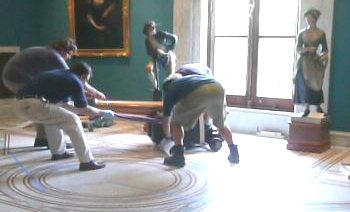
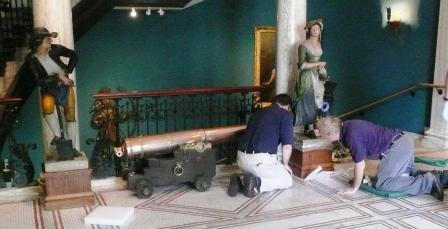
We are about to install the first of a series of changing exhibitions in our new MHS “Treasures Gallery,” an intimate space designed to highlight the extraordinary materials in our collection.  The art and sculpture have been cleared from the area and the Saltonstall Gun, our noble War of 1812 cannon, and “Paul and Virginie,” our pair of 18th century polychrome lead garden statues, have been moved across the landing in preparation for painting and the construction of display walls.

How does one move a 1,200-pound cannon and lead sculptures with fragile antique wire armatures?  Very gingerly.  A four-man team from U.S. Art Company, Inc. carefully positioned the cannon on heavy plastic before cinching it with straps and slowly hauling it across the marble floor to position it against the stair rail. Levers, shims, protective foam, and blankets all came into play as each phase of the move was planned and executed.

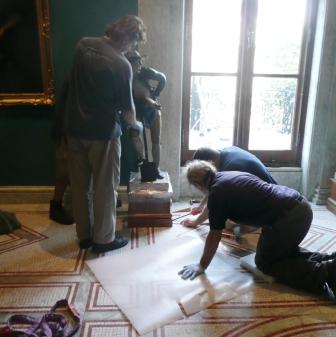
The MHS staff has moved the garden statues several times in the past: an unnerving experience which convinced us that they are best left to the professionals.  The U.S. Art team shrink-wrapped each sculpture base to its wooden plinth, then eased the heavy plastic sheet under the plinth and secured it to a winch attached to a marble column. 

With guardians to monitor the sculpture for any untoward movement, each statue was slowly pulled across the room, inch by inch, until the crew could position the sculpture by hand and lever out the plastic sheet.

After rehanging the front stair art, the crew was done and our space cleared for the next step to prepare the gallery for the first of our Treasures exhibitions, “’Like a Wolf for the Prey’: The Massachusetts Historical Society Collection Begins,” scheduled to open in the fall. Keep your eye on our website for more details.

This Week @ MHS

By Elaine Grublin

Looking for a way to beat the heat?  Come on in and enjoy the air-conditioning at the MHS. Our exhibition History Drawn with Light is open Monday through Saturday, 10:00 AM to 4:00 PM. Browse over 50 historical photographs — starting with the oldest daguerreotype in our collection, Old Feather Store (1840), and ranging through to the work of photographer Francis Blake who experimented with high-speed photography in the late 19th century — and spend time browsing our reference set of books about photography available in the exhibition area.  

On Saturday morning, our guided building tour The History and Collections of the MHS begins at 10:00 AM in our front lobby.  This ninety minute tour explores the art and architecture of the MHS, with a knowledgeable guide ready to answer your questions.   


Commemorating the American Civil War

By Elaine Grublin

Back in January I posted an announcement about our (then) newest web feature Looking at the Civil War: Massachusetts Finds Her Voice. That project was the first of many projects and events planned by the MHS to mark the sesquicentennial of the American Civil War.  While that project is going strong — we are seven months and seven documents into the fifty-three month project — many of our other Civil War related projects are just heating up and are not to be missed. 

You can visit our Commemorating the Civil War page to stay informed about upcoming events and projects happening at the MHS.  Currently there are listings for three upcoming public programs (in August, September, and November) and an upcoming exhibition opening in early October.  There is also information about educational resources and upcoming publication projects.

The Commemorating the Civil War page will be updated throughout the years of the sesquicentennial as new events & projects are added.  Be sure to bookmark the page so that you do not miss anything. 


Forbes House Museum Visits MHS Library

By Elaine Grublin

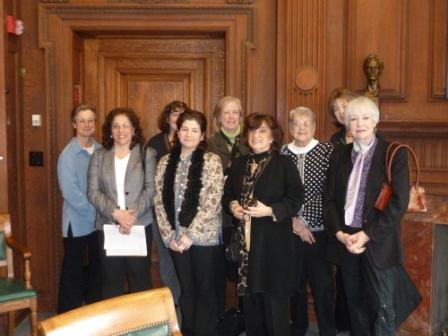
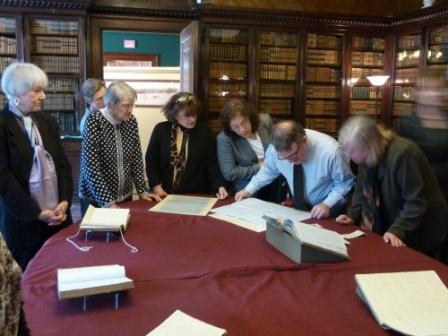
On Tuesday, April 26, eight women from the Forbes House Museum in Milton, MA, visited the library at the MHS for an introductory tour.  The visitors, a mix of docents, staff, and trustees from the museum spent the morning learning about how to access the MHS collections (both in the library and online), taking a tour of the library, and getting up-close to some specially selected documents from the Robert Bennet Forbes Papers, the Forbes Family Papers, and the Thomas Handasyd Perkins Papers.

The group posed for a picture on their library tour

The MHS is home to a number of manuscript collections, including but not limited to those listed above, with strong connections to the Forbes House Museum.  This visit, organized by the efforts of Robin M. Tagliaferri, executive director of the museum, was a step in developing a stronger connection between the MHS staff and the Forbes House Museum docents, preparing them to conduct research in the MHS collections in support of projects and other initiatives undertaken by the museum. 

Looking at documents with Librarian Peter Drummey

We look forward to a long and productive relationship with the Forbes House Museum docents and staff.  Our first major collaboration, Three Days, Three Viewpoints: The Worlds of Thomas Hutchinson, is a workshop scheduled for July 12 – 14.  The workshop, which is open to the general public with special added sessions for K-12 teachers, travels from the MHS through downtown Boston, and out to the Forbes House in Milton (which is on property that once comprised Hutchinson’s 95-acre country estate) over the course of the three days.  Please contact Kathleen Barker at the MHS if you are interested in more information about the workshop.  And thank you to the folks at Forbes House Museum for such a wonderful visit. 


2011-2012 Research Fellows Announced

By Elaine Grublin

Each year the MHS grants a number of research fellowships to scholars from around the country.  For more information about the different fellowship types, click the headings below. 

As you can see the fellowship program brings a wide variety of researchers working on a full range of topics. If any of the research topics are particularly interesting to you, keep an eye on our events calendar over the course of the upcoming year, as all research fellows present their research at brown-bag lunch programs as part of their commitment to the MHS. 

MHS-NEH Long-Term Research Fellowships:

Joshua R. Greenberg, Associate Professor of History, Bridgewater State University, “Face to Face: American Engagement with Paper Money in the Early Republic’

Joanne Pope Melish, Associate Professor of History, University of Kentucky, “Making Black Communities: White Laborers, Black Neighbors, and the Evolution of Race and Class in the Post-Revolutionary North”

Margot Minardi, Assistant Professor of History and Humanities, Reed College, “American Citizens of the World: The Political Culture of Peace Reform, 1812-1865”

Suzanne and Caleb Loring Research Fellowship On the Civil War, Its Origins, and Consequences (with the Boston Athenaeum):

Jordan Watkins, Ph.D. Candidate in History, University of Nevada, Las Vegas, “The Place of the Past in the American Civil War”

New England Regional Fellowship Consortium (NERFC) Awards (with 16 other institutions)

Lisa Brooks, Assistant Professor of History and Literature and Folklore and Mythology, Harvard University, “Turning the Looking Glass on King Philip’s War.”  Colonial Society of Massachusetts Fellow

Kathleen Daly, Ph.D. Candidate in American and New England Studies, Boston University, “Shapely Bodies: The Material Culture of Women’s Health, 1850-1920”

Jennifer Egloff, Ph.D. Candidate in History, New York University, “Popular Numeracy in Early Modern England and British North America”

Hannah Farber, Ph.D. Candidate in History University of California, Berkeley, “The Insurance Industry in the Early Republic”

Kara French, Ph.D. Candidate in History, University of Michigan, “The Politics of Sexual Restraint: Debates Over Chastity in America, 1780-1850”

Mazie Harris, Ph.D. Candidate in Art History, Brown University, “Photography and American Property Law in the 1850s”

Caroline Hasenyager, Ph.D. Candidate in History, College of William and Mary, “Peopling the Cloister: Women’s Colleges & the Worlds We’ve Made of Them”

Carrie Hyde, Ph.D. Candidate in English, Rutgers University, “Alienable Rights: Negative Figures of U.S. Citizenship, 1787-1868”

Sarah Kirshen, Ph.D. Candidate in History, Columbia University, “The Family’s Values: Marriage, Statistics, and the State, 1800-1909.”  Bostonian Society/New England Women’s Club Fellow

Robyn McMillin, Oklahoma City, Oklahoma, “Science in the American Style, 1680-1815: A School of Fashion and Philosophy, of Liberty and People”

Hari Vishwanadha, Professor of English, Santa Monica College, “Passages to India”

Marjorie E. Wood, Ph.D. Candidate in History, University of Chicago, “Emancipating the Child Laborer: Children, Freedom, and the Moral Boundaries of the Market in the United States, 1853-1938”


MHS Short-Term Research Fellowships:

African American Studies Fellow

Millington Bergeson-Lockwood, Ph.D. Candidate in History, University of Michigan, “Not as Supplicants but as Citizens: Race, Party, and African American Politics in Boston, Massachusetts, 1864-1903”

Alumni Fellow

Megan Prins, Ph.D. Candidate in History, University of Arizona, “Winters in America, 1880-1930”

Andrew Oliver Fellow

Mary Katherine Matalon, Ph.D. Candidate in History, University of Texas, Austin, “From Painting to Porcelain: American Women Collectors, c. 1780-1915”

Andrew W. Mellon Fellows

Sean Adams, Associate Professor of History, University of Florida, “Home Fires Burning: Keeping Warm in the Industrializing North”

Jane Fiegen Green, Ph.D. Candidate in History, Washington University, St. Louis, “The Boundary of Youth: Employment, Adulthood, and Citizenship in the Early United States”

Kerima Lewis, Ph.D. Candidate in History, University of California, Berkeley, “Atlantic Fires Burning: Arson as a Weapon of Slave Resistance in the British American Colonies, 1675-1775”

Andrew Lipman, Assistant Professor of History, Syracuse University, “The Saltwater Frontier: Indians, Dutch, and English on Seventeenth-Century Long Island Sound”

Bonnie Lucero, Ph.D. Candidate, University of North Carolina at Chapel Hill, “Race, Space, and Nation: Social Change amidst Imperial Transition in Cienfuegos, Cuba, 1895-1906”

Patricia Roylance, Assistant Professor of English, Syracuse University, “Anachronisms: The Temporalities of Early American Media”

Nancy Siegel, Associate Professor of Art History, Towson University, “Political Appetites: Revolution, Taste, and Culinary Activism in the Early Republic”

Jared Taber, Ph.D. Candidate in History, University of Kansas, “Last Dams Standing: Environmental Perspectives on Deindustrialization in Twentieth-Century Massachusetts”

Ben Wright, Ph.D. Candidate in History, Rice University, “Early American Clergy and the Transformation of Antislavery: From the Politics of Conversion to the Conversion of Politics, 1770-1830”

Benjamin Franklin Stevens Fellow

Randi Lewis, Ph.D. Candidate in History, University of Virginia, “To ‘the most distant parts of the Globe’: Trade, Politics, and the Maritime Frontier in the Early Republic, 1763-1819”

W.B.H. Dowse Fellows

Robyn McMillin, Oklahoma City, Oklahoma, “Science in the American Style, 1680-1815: A School of Fashion and Philosophy, of Liberty and People”

Tyler Boulware, Assistant Professor of History, University of West Virginia, “Next to Kin: Native Americans and Friendship in Early America”

Malcolm and Mildred Freiberg Fellow

Amy Morsman, Associate Professor of History, Middlebury College, “Reading, Writing, Race & Respectability: ‘Yankee Schoolmarms,’ Race Reform, and Northern Views on Reconstruction”

Marc Friedlaender Fellow

Jonathan Beecher  Field, Associate Professor of English, Clemson University, “Antinomian Idol: Anne Hutchinson & American Historiography”

Massachusetts Society of the Cincinnati Fellow

Trenton Jones, Ph.D. Candidate in History, Johns Hopkins University, “‘Deprived of Their Liberty’: Prisoners of War and American Military Culture”

Ruth R. and Alyson R. Miller Fellows

Kathryn Goetz, Ph.D. Candidate in History, University of Minnesota, “A Consuming Femininity: Gender, Culture and the Material Worlds of Young Womanhood, 1750-1850”

Jessica Linker, Ph.D. Candidate in History, University of Connecticut, “‘It is my wish to behold Ladies among my hearers’: Early American Women and Practices of Natural History, 1720-1860”


Congratulations to all the fellowship recipients.  We look forward to seeing you all in the library!

Scholars Convene for M.H.S. Conference on Recent Immigration

By Kate Viens

On April 7-9, 2011, scholars from across the U.S. will gather at the MHS—the nation’s oldest historical society—to discuss a question of compelling current interest for American life: What is new about recent immigration? Representatives of city and state agencies, elected officials, and non-profit organizations that work with immigrants have also confirmed their attendance at “What’s New about the New Immigration to the U.S.? Traditions and Transformations since 1965.”

Our goal? To understand not only the current state of U.S. immigration but how we arrived at it. We want to ascertain what is truly new about the new immigration, both documented and undocumented, how it compares to earlier migration waves, and what its consequences have been.

Since 1968, when the Hart-Celler Act, which replaced national quotas with priorities that emphasized education, jobs, and professional skills, went into effect, its provisions have governed immigration at a time when the subject has been intensely controversial. The end of the Vietnam War brought waves of refugees from Southeast Asia. Later, large numbers of arrivals came from the Caribbean, Central and South America, South Asia, East Asia, Africa, the Middle East, and the former Soviet Union.

All of this is prelude to today’s public and political discourse on immigration in multiple contexts including public funding for education and services, national security, states’ rights, and civil and religious liberties. The importance of understanding America’s collective values and direction is keenly felt by a new generation of Americans who find themselves in the midst of emerging majority minority communities and media headlines over topics such as Arizona’s immigration law.

Thursday’s evening’s keynote address speaks to the heart of these issues. “U.S. Refugee Policy in the Post-Cold War Era: Balancing Humanitarian Obligations and Security Concerns” will be presented by Maria Christina Garcia of Cornell University, the author of Seeking Refuge: Central American Immigration to Mexico, the United States, and Canada (2006). This event is open to the public free of charge.

The public is also welcome to register to attend the scholarly sessions on Friday and Saturday. Presenters will include Thomas Adams of Tulane University, Caroline Brettell of Southern Methodist University, Marc S. Rodriguez of the University of Notre Dame, and Xiao-huang Yin of Michigan State University. All told, the conference includes nearly two dozen scholars from across the nation and from half a dozen fields—history, political science, sociology, urban planning, anthropology, and ethnic studies—researchers who are some of the leading commentators on this topic today.

For more information, including a list of presenters and their topics and a detailed schedule, please visit. http://www.masshist.org/events/conferences.cfm.

Welcome Short-Term Fellow Brian Gratton

By Anna J. Cook

This week, the MHS staff welcomes Brian Gratton, Professor of History at Arizona State University, as the recipient of our 2010-2011 Twentieth-Century History Fellowship. Dr. Gratton, who received his Ph.D. in 1980 from Boston University, studies immigration and ethnicity in the United States, Latin America, and Europe. His recent publications and research focus on the experience of immigrant elders, 1880 to the present, and on the teaching of U.S. history with a particular emphasis on the American Southwest.

Dr. Gratton’s MHS fellowship project, titled “Henry Cabot Lodge and the Politics of Immigration Restriction,” examines the role of Massachusetts historian and politician Henry Cabot Lodge (1850-1924) in Progressive-era battles over legal restrictions on immigration. Lodge fought for three decades in support immigration restriction, a goal finally realized in the Emergency Quota Act of 1921, which dramatically reduced the number of immigrants streaming into the United States. Using Lodge as an entry-point for reconstructing the late-nineteenth and early-twentieth century debates about immigration, Gratton hopes to better illuminate the political thinking among Republicans, Lodge’s party, on race and ethnicity in politics during this period. He will be working primarily with the Henry Cabot Lodge papers.

Dr. Gratton will be giving a brown bag lunch talk about his research at the MHS on Wednesday 16 March from 12:00-1:00pm. The event is free and open to the public.

The MHS staff welcomes Dr. Gratton back to Boston and wishes him a fruitful research visit.

Welcome Dan Hinchen, Library Assistant

By Anna J. Cook

It has been a season of change in the Massachusetts Historical Society’s library. On February 23rd, the Library Reader Services staff welcomed yet another new member to our ranks: Library Assistant Dan Hinchen.

Dan is not a complete stranger to the MHS, having served as a reference intern with us in 2009. During his tenure he became skilled at responding to long-distance reference queries, and also began to develop subject guides for our collections – a skill we hope to put to good use in the near future as the library revisits some of its online reference resources.

In 2007, Dan was hired to develop an archives program for the Boston Arts Academy and Fenway High School, where he has served as the “lone arranger” for the past four years. There he established the archives’ policies and procedures and supervises the work of student interns and volunteers. In addition to this position, Dan has worked at the Simmons College Beatley Library and completed a cataloging internship at the ProjectSave Armenian Photographic Archives. In 2010 he earned his Master’s in Library Science at Simmons College Graduate School of Library and Information Science.

We are pleased to welcome Dan as part of our staff, and look forward to working with him as part of our team.