
By Peter Drummey
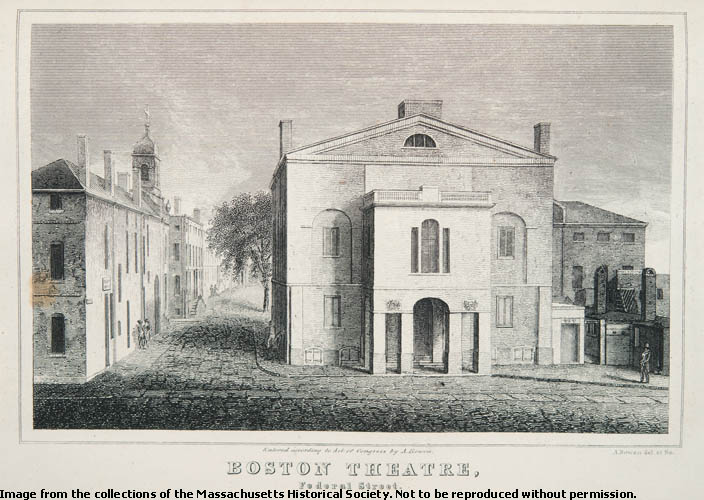
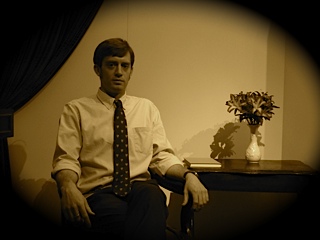
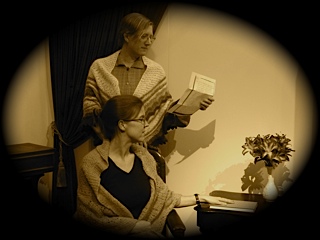
We have just opened a new exhibition, The First Seasons of the Federal Street Theatre: 1794-1798, that complements a larger exhibition, Forgotten Chapters of Boston’s Literary History, at the Boston Public Library. The controversy over a public theater that raged in Boston in the 1790s, an old and largely forgotten story, now has been brought to life through the efforts of Professor Paul Lewis of the English Department of Boston College and his very able students. Thanks to the audio production services of Boston College, it also is the first time that the Society—and the Boston Public Library—have used QR codes in an exhibition. QR codes, the ubiquitous matrix barcodes that appear everywhere in advertisements, now are used increasingly in museum settings so that smartphone users are able to call up additional audio information about what is on display.
The First Seasons of the Federal Street Theatre will be on display, Monday-Saturday, 10:00 AM-4:00 PM, through July 30, but more than twenty items from the MHS exhibition also are on “virtual” display at the Forgotten Chapters of Boston’s History website, www.bostonliteraryhistory.com. The online version of the First Seasons section of the Forgotten Chapters exhibition will reach a wider audience than those who are able to visit the MHS and be available for a longer period of time, but it also is an informative and engaging introduction to the original materials on show at the Society.
 In 1840, almost as soon as photography arrived in America, the Massachusetts Historical Society began to collect images of notable figures, artifacts, and landscapes recorded with “the pencil of nature.” Examples of these early photographs will be on display through 3 June, 2011 in the Society’s exhibition, History Drawn with Light: Early Photographs from the Collections of the Massachusetts Historical Society. Visitors can view one of Boston’s oldest photographs, taken of the Old Feather Store by MHS Member Francis C. Gray, together with portraits and views by early daguerreotype artists such as Albert S. Southworth and Josiah J. Hawes, and the later work of professional and amateur photographers who documented 19th-century American history as it unfolded. The exhibition is free and open to the public, Monday through Saturday, 1 PM to 4 PM.
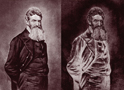 On the 150th anniversary of John Brown’s execution (2 December 1859), a reminder that you can visit our current