
Barbara Hillard Smith’s Diary, April 1918

By Lindsay Bina, Intern and Anna Clutterbuck-Cook, Reader Services

Today we return to the 1918 diary of Newton teenager Barbara Hillard Smith. You may read our introduction to the diary, and Barbara’s January, February, and March entries, here:

January | February | March | April

May | June | July | August

September | October | November | December


As regular readers of the Beehive know, we are following Barbara throughout 1918 with monthly blog posts that present Barbara’s daily life — going to school, seeing friends, playing basketball, and caring for family members — in the words she wrote a century ago. Here is Barbara’s April, day by day.


* * *

MON. 1                       APRIL

School. Mrs. Reeds. Muriel’s. Mrs. Reeds.

TUES. 2

Mother went to New York. Muriel’s. Mrs. Reed.

WED. 3

Mrs. Reed’s. Dance at Spud’s. Night at Pegs.

THUR. 4

Mrs. Reed’s all day. Red Cross Rally. Muriel Over Night. Hurt Knee

FRI. 5

Liberty Loan parade. In Town. Addressed cards for Dr. Godfrey

SAT. 6

Mother came home

SUN. 7

Sunday School. Studied.

MON. 8

School. Mrs. Reed’s

TUES. 9

School.

WED. 10

School. Rehearsed for Dancing.

THUR. 11

School. Knee hurt so came home at end of third. Mrs. Reeds

FRI. 12

School. Rehearsal for Camp Fire. Snow. Practice Kitchen for dinner

SAT. 13

Mrs. Reeds. Camp Reunion. “Pete” for week-end

SUN. 14

Church. Sunday School. Lasell Vespers

[Editor’s Note: Private college in Newton, est 1851, at this point would have been Lasell Seminary for Young Women]

MON. 15

School. In town. To lawyer. Awful Cold.

TUES. 16

Mrs. Reeds. Mrs. Bigelow here.

WED. 17

School. Rehearsal for dancing. Mrs. Reed’s

THUR. 18

School. Mrs. Reed’s. Surgical Dressings. Pegs over night

FRI. 19

Worked on Costume. Rehearsal for pageant. Missed Cousin Bert

SAT. 20

Mrs Redmond’s girls here. (Awful) ([fony]) Pageant Feast behind the scenes.

SUN. 21

Sick? Sunday School.

MON. 22

School. Rehearsed dance. Tennis.

TUES. 23

School. Took care of sonny.

WED. 24

School. Rehearsed for meet

THUR. 25

School. Took care of sonny.

FRI. 26

School. Gym. Meet. Tennis

SAT. 27

Washed my hair. Took care of sonny. Swimming

SUN. 28

Sunday School. Everyone Blue. Wendell showed me about the bugle

MON. 29

Headache? In town. Got material for skirt + dress

TUES. 30

School. Took care of the baby. Clark Reed wounded.

* * *

If you are interested in viewing the diary in person in our library or have other questions about the collection, please visit the library or contact a member of the library staff for further assistance.


 *Please note that the diary transcription is a rough-and-ready version, not an authoritative transcript. Researchers wishing to use the diary in the course of their own work should verify the version found here with the manuscript original. The catalog record for the Barbara Hillard Smith collection may be found here.


“Across wide fields of melting snow / The winds of summer softly blow”: The Easter poems of Lucy Larcom

By Anna J. Clutterbuck-Cook, Reader Services

On March 20th we marked the spring equinox here in New England with the arrival of our fourth nor’easter of the month. After a warmer-than-average February we found ourselves bundling up for a colder-than-average March and spring has seemed further around the corner than it ought to be. In this week that marks both the Jewish Passover and Christian Easter holidays, I decided to share a poem for spring from New England poet Lucy Larcom.

A book of Easter poems
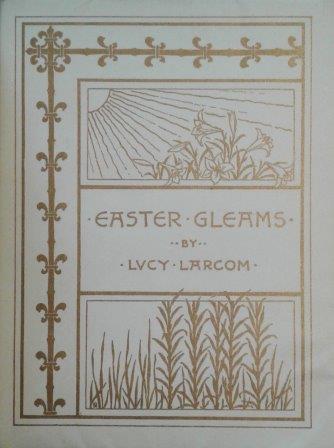
Easter Gleams, by Lucy Larcom, 1891

Many of you have likely encountered nineteenth-century writer Lucy Larcom through her autobiographical work A New England Girlhood (1889) which tells the story of her childhood in Beverly, Massachusetts and her experience working in the mills of Lowell before she traveled west to Illinois to become a teacher and later returned to Massachusetts to make her living as a writer and editor. In 1891, Larcom published a small collection of Easter poems, Easter Gleams with Riverside Press an imprint of Houghton, Mifflin & Company based in Cambridge, Massachusetts. Riverside had also published Larcom’s Girlhood three years before. Below are the poems “Ring! Happy Bells!” (5) poem “Sunrise” (13) from Easter Gleams.

Ring! Happy Bells!

Ring, happy bells of Easter time!

The world is glad to hear your chime;

Across wide field of melting snow

The winds of summer softly blow,

And birds and streams repeat the chime

Of Easter time.

Ring, happy bells of Easter time!

The world takes up your chant sublime,

The Lord has risen!” The night of fear

Has passed away, and heaven draws near:

We breathe the air of that blest clime,

At Easter time.

Ring, happy bells of Easter time!

Our happy hearts give back your chime!

The Lord has risen! We die no more:

He opens wide the heavenly door;

He meets us, while to Him we climb,

At Easter time.


Sunrise.

The Sunrise over the houses!

The beautiful rose of dawn

Reddening the eastern windows, —

The curtains of Night withdrawn!

More lovely than boughs in blossom

The spires and the roof-trees glow.

It is day; and, in God awaking,

Shall the spirit unfold and grow.

On the city, in chrismal splendor,

The blessing of morning falls: —

The Bride coming down out of heaven! —

The pearl-gates, the jasper walls!

The white light enters the casement

Like the wings of the Holy Dove;

And every house is a flower,

A blossom of peace and love.

The sunrise is fair on the gardens,

The groves and the forests afar;

But fairer the trees of manhood,

Of heavenly planting are.

And wide are the green savannahs

That under the dawn unroll;

But broader the landscape opens

In the sunrise of a soul!

The footsteps of morning hasten

Across yonder populous space,

And the dwellings of men are illumined

With the glory of God’s own face.

Who can guess the power of His coming?

He will banish doubt and despair;

The life of His Spirit will kindle

And stir the sleepers there.

Behold the Day Star ascending!

See the hour of His triumph begin!

The sunrise over the houses!

The Christ-light shining in!

In addition to holding a print copy of Easter Gleams and other published works by Larcom, the Massachusetts Historical Society holds Larcom’s diaries, correspondence, and other manuscript materials, principally in the Daniel Dulany Addison collection. We also hold issues of Our Young Folks (1865-1873) and the Lowell Offering (1840-1845), both of which Larcom was deeply involved in as a writer and editor. Researchers interested in accessing Larcom’s writings may visit the library or contact the reader services staff to learn about options for reproduction.

Barbara Hillard Smith’s Diary, March 1918

By Lindsay Bina, Intern and Anna Clutterbuck-Cook, Reader Services

Today we return to the 1918 diary of Newton teenager Barbara Hillard Smith. You may read our introduction to the diary, and Barbara’s January and February entries, here:


January | February | March | April

May | June | July | August

September | October | November | December


We will be following Barbara throughout 1918 with monthly blog posts that present Barbara’s daily life — going to school, seeing friends, playing basketball, and caring for family members — in the words she wrote a century ago. Here is Barbara’s March, day by day.


* * *

FRI. 1                          MARCH

School. Dentist Cousin Bert came. Papa glad to see him, Sick

SAT. 2

Showed C. Booklet to K. Heard Galli Curci. She is wonderful. Seminary with Mother


SUN. 3

Helped Mother. Studied

MON. 4

School. Mrs. Reed’s. Papa died. Grandma very brave, Mother is wonderful. C. Burt came.

TUES. 5

Aunt Mabel gave Mother her car. She is very busy. People are very kind. Cousin Bert is the [back…]

WED. 6

Everything peaceful. Deluged with flowers. Funeral services very sweet + pretty. C. Bert went back.

THUR. 7

I must stand up for Mother. Worked. Flowers from […]. Waltham with Mrs. Pyrene. Hard to keep tears back

FRI. 8

Worked. Doctors with Mother. Things [go] a little easier. I feel like crying all the time.

SAT. 9

Helped Mother. Got Camp Fire Cocoa. Mrs Richmond came. Wood called up. At McDonalds

SUN. 10

Church. Sunday S. Cousin Mildred to dinner. Dr. Huntington.

MON. 11

School. Mrs. Reed

TUES. 12

School. Basket Ball

WED. 13

School. Gym dancing. Swimming

THURS. 14

School. Basketball. Got on class team

FRI. 15

School. Took care of the baby. Captain of the team

SAT. 16

Sewed at Mrs. Bucknams. Over to Lanes. Went swimming

SUN. 17

Shot Cat. Church and Sunday School. Moody’s for supper. Mr. Bailey out.

MON. 18

School. Took care of baby. Got [byce] out. Living Pictures.

TUES. 19

School. Played the Freshmen. 16-5 s. Juniors beat 30-0. Saw Dr. Ashland.

WED. 20

School. Rehearsed dancing. Swimming.

THUR. 21

School. Played the Juniors. They beat us. 25-10. Saw Dr. Ashland.

FRI. 22

School. Mrs. Reed’s. Newton-Erasmus game. We licked em up. War is awful

SAT. 23

Mrs. Reed’s all day.

SUN. 24

Church. Sunday School. Saw Dr. Ashland ([nude]). He seems much better. Dr. McClure.

MON. 25

School. In Town. Got suit. It seems funny without paper.

TUES. 26

School. Went to Mrs Reeds. Sick.

WED. 27

School. Dancing. In Town. Peg went with me.

THUR. 28

School. Mrs. Reed’s. Wrote Dr. Gordon

FRI. 29                                    GOOD FRIDAY

No School. Mrs. Reed’s all day. Surgical dressings

SAT. 30

Mrs. Reeds. In town. Got new hat

SUN. 31                      EASTER

Church[,] Sunday School and Concert. [Fraulein] and Miss [Colin] to dinner.

* * *

If you are interested in viewing the diary in person in our library or have other questions about the collection, please visit the library or contact a member of the library staff for further assistance.


 *Please note that the diary transcription is a rough-and-ready version, not an authoritative transcript. Researchers wishing to use the diary in the course of their own work should verify the version found here with the manuscript original. The catalog record for the Barbara Hillard Smith collection may be found here.


Barbara Hillard Smith’s Diary, February 1918

By Lindsay Bina, Intern, and Anna Clutterbuck-Cook, Reader Services

Today we return to the 1918 diary of Newton teenager Barbara Hillard Smith. You may read our introduction to the diary, and Barbara’s January entries, here:


January | February | March | April

May | June | July | August

September | October | November | December


We will be following Barbara throughout 1918 with monthly blog posts that present Barbara’s daily life — going to school, seeing friends, playing basketball, and caring for family members — in the words she wrote a century ago. Here is Barbara’s February, day by day.


* * *


FRI. 1                          FEBRUARY

School. Took care of sonny. Gas froze. Pegs over night.

SAT. 2

Worked. Took care of Polly Godfrey. Seminary with Mother

SUN. 3

Sunday School. Hung around

MON. 4

School. Dentist. Dr. Ashland engaged.

TUES. 5

School. Bitterly Cold, “Sick.” Rosa Allen’s

WED. 6

School. Took care of sonny

THUR. 7

School. Rosa Allen’s. Took care of sonny

FRI. 8

School. Took care of sonny.

SAT. 9

Got my dress. Burton Holme’s Lecture. Sailor’s Dance. Met Mr. Wood

SUN. 10

Church. Sunday School. Aunt Mable’s. Met Sailor at the Station

MON. 11

School. Took care of sonny

TUES. 12                    LINCOLN’S BIRTHDAY

School. Basket Ball. Mother went to New York

WED. 13

School. Took care of Sonny

THUR. 14

School. Mrs. Moody to Basket Ball. Mother came home

FRI. 15

School. Took care of Sonny. Swimming

SAT. 16

Hung around. Over to Pegs. Plays at the Seminary

SUN. 17

Sunday School. Dr. Scott teacher. Studied

MON. 18

School. Took care of the Baby.

TUES. 19

School. Basket Ball. Papa sick. Sessions with the Doctor

WED. 20

Stayed to look after papa. Mrs. Reed’s

THUR. 21

Took care of papa. Took care of sonny. Red Cross play.

FRI. 22                                    WASHINGTON’S BIRTHDAY

Mrs. Reed’s in the morning. Home in afternoon. Masquerade

SAT. 23

Babys in the morning. In town in the afternoon

SUN. 24

Helped Mother. Studied

MON. 25

Toothache. Dentist. He goes to hospital soon. Married probably in Aug. Papa better. Sonny.

TUES. 26

Toothache again. Dentist can’t do anything about it. Mrs. Reeds.

WED. 27

Got class pins. Subscribed to Newtonian. Mrs. Reeds. Papa out. Tooth still at it.

THUR. 28

School. Basketball. Papa seems much better.

* * *

If you are interested in viewing the diary in person in our library or have other questions about the collection, please visit the library or contact a member of the library staff for further assistance.


 *Please note that the diary transcription is a rough-and-ready version, not an authoritative transcript. Researchers wishing to use the diary in the course of their own work should verify the version found here with the manuscript original. The catalog record for the Barbara Hillard Smith collection may be found here.


A New Year’s Greeting from Merrymount Press, 1918

By Anna J. Clutterbuck-Cook, Reader Services


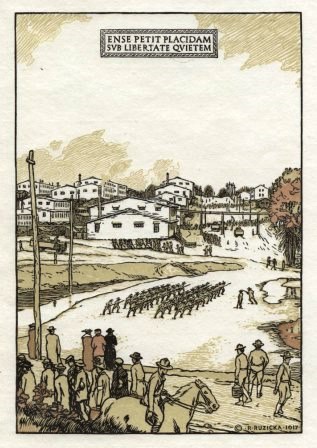
Welcome to the future! In this first week of the new year, I bring you a New Year’s greeting from one hundred years in the past. This illustration by Rudolph Ruzicka (1883-1978) graced the annual greeting to the friends of Merrymount Press, Boston at the dawn of the year 1918. The image is a view of the parade ground at Camp Devens (Ayer, Mass.) and the Latin text at the top of the image is the official motto of the Commonwealth of Massachusetts, “Ense petit placidam sub libertate quietem,” translated into English as “she seeks with the sword a quiet peace under liberty” — a solemn message for the advent of a year under the shadow of World War One.

The Massachusetts Historical Society holds a collection of illustrations by Ruzicka, himself a member of the Society for many years, as well as many titles printed by Merrymount Press. You are welcome to explore our print holdings through our online catalog ABIGAIL and reach out to the library staff with any questions you have about accessing items in our collection.

We look forward to welcoming you to the library in 2018 and beyond!


Gertrude Codman Carter’s Diary, December 1917

By Anna Clutterbuck-Cook, Reader Services

Today we return to the 1917 diary of Gertrude Codman Carter. You may read the previous entries here:


Introduction | January | February | March | April | May

June | July | August | September | October | November


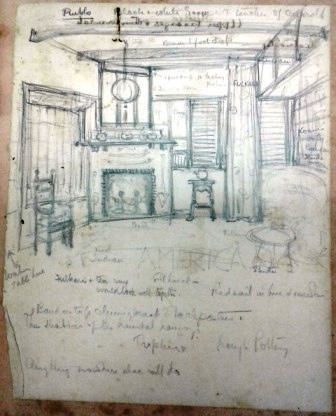
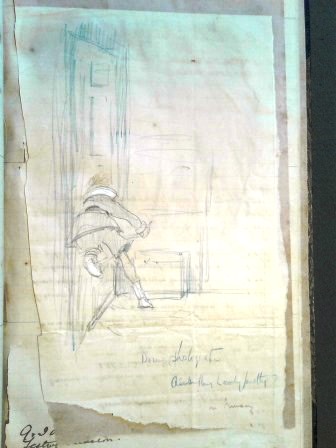
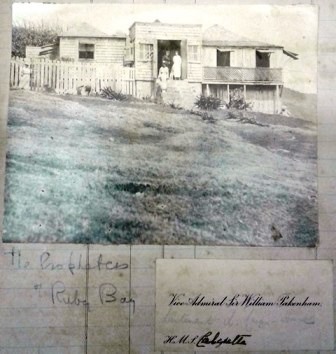
It is the final month of 2017 and 1917 as well; Gertrude Carter left scant record behind as the Carter family’s year ended in news of the death of Gertrude’s grown stepson, Otho, when his ship was torpedoed on November 28th. News reached his father on December 4th, the final page of the diary. The only items left in the journal are pasted in, a photograph, cryptically captioned “the Prophets of Ruby Bay,” and a sketch of a room — “Black & white room” — with Gertrude’s design notations penciled in — “Writing table here” and “Beam 1 foot deep”.

It seems fitting that we let Gertrude’s work as an artist and architect close out our year with her. Thank you for joining us on our journey with Gertrude Codman Carter through 1917! In January we will be introducing our diarist from 1918, a Newton (Mass.) teenager named Barbara Hillard Smith.


* * *

Dec 1.

Tea at the [illegible] Yearwoods.


Dec 2.

A very jolly [illegible] party. The Hancocks, Carpenters, Mrs. Smith [illegible], Laddie, Mr. Fell, Mrs. Da Costa. We sang & danced & had a generally jolly time of it.


Dec 3.

Met Mr. Eustace at L. Challum’s office. The [boots?] departed for the front.


Dec 4.

Poor G. came back from the town with a cable which had been handed him as he passed through. The cable was from Evelyn & said, “Otho lost at sea.” At first we could not grasp it for we had imagined him still in Africa — however when our letters came we found alas~ That he had been invalided home & they were expecting him shortly. G. went to the [illegible] who kindly cabled to the Colonial office & received the official confirmation that the “Apapa” had been torpedoed & sunk with severe loss of life & Otho amongst the lost.


Prophets of Ruby Bay”


 Black and White Room

* * *

As always, if you are interested in viewing the diary or letters yourself, in our library, or have other questions about the collection please visit the library or contact a member of the library staff for further assistance.


Gertrude Codman Carter’s Diary, October 1917

By Anna Clutterbuck-Cook, Reader Services

Today we return to the 1917 diary of Gertrude Codman Carter. You may read the previous entries here:


Introduction | January | February | March | April | May

June | July | August | September


October 1917 is a lean month in Gertrude’s records, possibly because of Gilbert Carter’s return home from his long absence while Gertrude was relocating the family to Ilaro. After a final, hurried day of preparation on October 1st, Gilbert and Wickham — the household servant who had traveled with him — arrive and are greeted in fine style by a “grand gala festival.”

The sketch of her son, pasted over the entry for October 28th, has a faint inscription that seems to indicate that the drawing was made on the day of the visit to the photographer — an inference supported by the fact that John appears to be wearing the same outfit as he wore in the photograph pasted into the September pages of the diary.


* * *

Oct 1.

Paid servants & rushed on with G’s room. Mickey & I moved books, put up curtains, laid down mats.


Oct 2.

Gilbert (and Wickham) arrived.

Grand gala festival.

Mr. Soelyn came up & witnessed my will.


Oct 3.

Talked.


Sketch of John


Oct 28.

G & I dined with Sir F. & Lady Clarke at the Crane. Festive occasion.


Oct 29.

Tea at the Challums. Laddy drove Mrs Gregg out & me in. 9 the [illegible].

We went to Bleak House.


Oct 30.

4.15 Miss Burton stonework.


Oct 31.

All Hallow’e’en Fete at the MacClaren’s 

Fete in red [illegible.]


* * *

As always, if you are interested in viewing the diary or letters yourself, in our library, or have other questions about the collection please visit the library or contact a member of the library staff for further assistance.


Holding Those in the Path of Hurricane Irma in Our Thoughts

By Anna J. Clutterbuck-Cook, Reader Services

As I write this post on Friday, September 8th, Hurricane Irma is working its destructive way through the Caribbean toward the southeast United States. While this blog post was scheduled to be the September 1917 diary entries of Gertrude Codman Carter it felt strange not to recognize the lives that are being turned upside down in the very islands that Lady Carter called home for much of her adult life. Carter’s diaries, chronicling her journey from Boston to Barbados in the early twentieth century, are far from the only or the earliest connections between Massachusetts and the Caribbean to be found in the MHS collections.


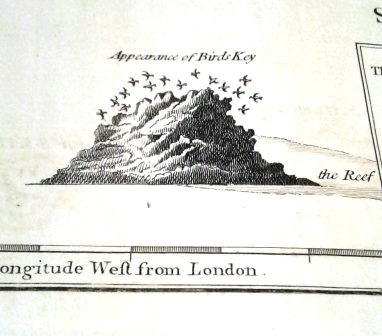
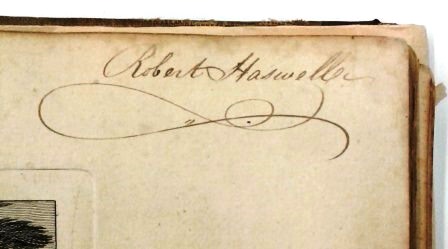
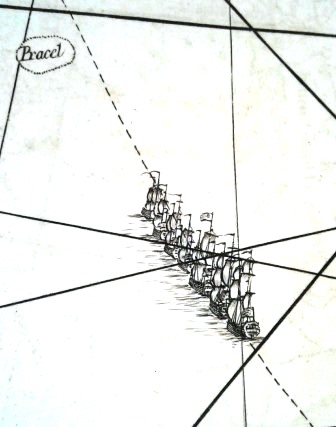
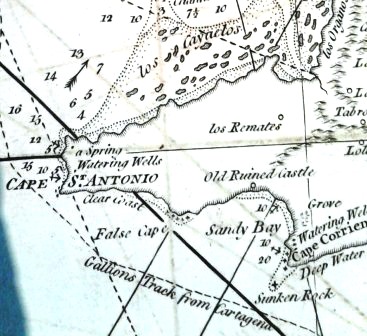
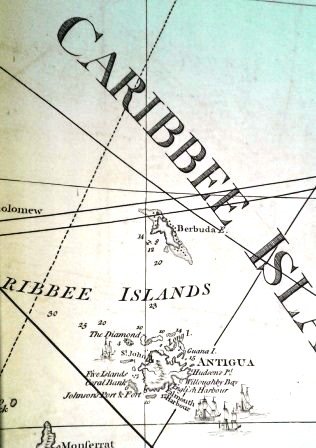
Today, I want to share some images from our copy of Thomas Jeffrey’s The West-India Atlas: or, A compendious description of the West-Indies: illustrated with forty correct charts and maps, taken from actual surveys. Together with an historical account of the several countries and islands which compose that part of the world (London: R. Sayer and J. Bennett, 1775). The MHS copy of this 18th century atlas was owned by Robert Haswell, whose Voyage round the world onboard the ship Columbia-Rediviva and sloop Washington, 1787-1789 also resides in our collections. A pastel portrait of Haswell by the English painter James Sharples may be viewed here.


The details in this atlas are both informational and whimsical. In addition to the flocks of birds pictured above, almost every chart includes tiny parades of detailed ships making their way safely past such landmarks as the Colorados Reef, sunken rocks, and false headlands.


The atlas also provides voyagers with information about fresh water, as in this detail of the tip of Cuba, an “old ruined castle.”


Earlier this week, Hurricane Irma devastated the islands of Barbuda and Antigua, pictured here. I encourage you, if you have the ability, to donate to a charity of your choosing that will support those who need to rebuild their lives.

Look for a return to Lady Gertrude’s diary at the end of September.

Origins of Memorial Day, In Brief

By Anna Clutterbuck-Cook, Reader Services

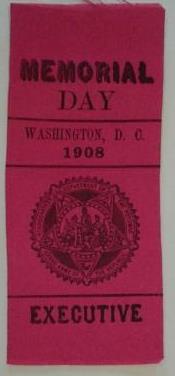
The Massachusetts Historical Society will be closed on Saturday and Monday this weekend in observance of Memorial Day. The origins of Memorial Day are rooted in the Civil War, and the rituals of commemoration that sprung up extemporaneously and then in a more collective, organized fashion in the postwar period and during Reconstruction. Decoration Day, later Memorial Day, celebrations honored the dead, celebrated emancipation, and in the white South kept the memory of the Confederacy alive. It was not until the First World War, in the early twentieth century, that Memorial Day became a national day to remember those who had fallen in all violent conflicts in which the United States had been militarily involved. 


The ribbon above [http://balthazaar.masshist.org/cgi-bin/Pwebrecon.cgi?DB=local&BBID=201361], from 1908, was worn by a participant in the Grand Army of the Republic ceremonies in Washington, D.C. It is one of two ribbons from the day’s celebrations held in the collection of the Massachusetts Historical Society. 

We at the MHS wish you the best on this holiday weekend, and look forward to reopening the library on Tuesday for our summer research season.


Gertrude Codman Carter’s Diary, January 1917

By Anna Clutterbuck-Cook, Reader Services

In late December, I introduced readers to Lady Gertrude Codman Carter, whose diary we will be exploring month-by-month through 2017. While a fairly regular diarist, Gertrude Carter’s journal skips from the end of December 1916 to February 8, 1917 without clear explanation. Thus, our January installment of this series will be slightly atypical as I introduce you to Carter’s diary through the look, feel, and format of the volume itself.


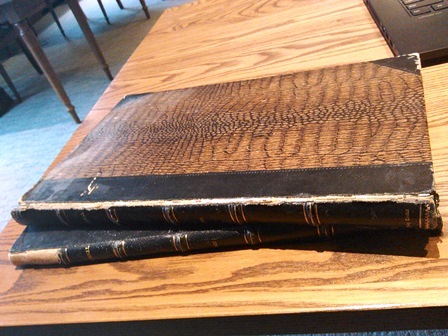
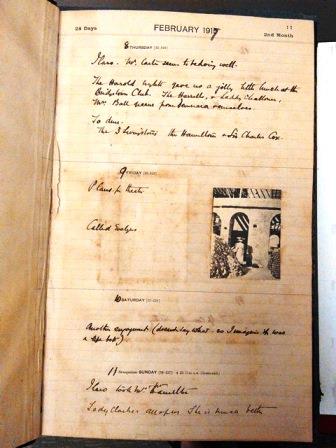
Unlike last year’s diary, which contained line-a-day entries with little or no elaboration, the Carter diary is a wealth of variation. While physically designed in a pre-printed format much like the line-a-day-diaries of Margaret Russell, Carter’s diary is a large format of 11.5 x 7 inches, three days per page. As you can see, Codman uses the design of the pages as only a loose guide; to begin with, she has repurposed a pre-printed volume meant for 1915 for her record of two years later. This thrift, perhaps caused by wartime shortages, requires her to correct the numerical date for each entry as well as the year printed next to the month on each page.


The page above, with which the diary opens, is preceded by the rough edge of several torn pages. Were the pages removed because they were unused, or was their information within them the diarist or descendent did not wish to be seen by future eyes? Impossible to tell from the volume itself.

It is also clear from Carter’s entries that, in some cases at least, the details were added in retrospect. “Another engagement,” she writes under February 10, a Saturday, “(doesn’t say what – so I imagine it was a life…)” … any suggestions for what that final word may be? To what other record is she referring, the record in which she failed to record her engagements? Another mystery.


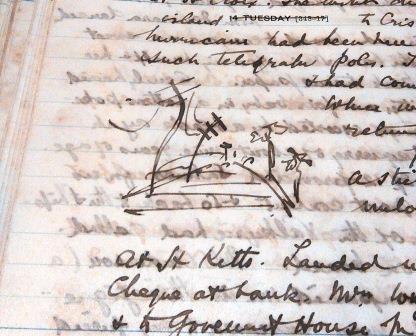
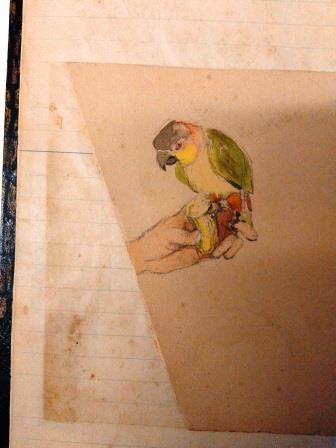
An artist, Carter’s record incorporates the visual. The photo affixed to the February page above is pasted on the date without remark, appearing to be an image of a construction site of some kind — perhaps work being done on Ilaro, the residence Carter was designing for her family. On other pages, we will encounter fanciful sketches and brilliant paintings, such as this tiny island sketched in an otherwise dense page of writing and the “Study of Captain Silver’’s Parrot,” both found in the volume for 1916.


In February, we will delve into the stories shared in the diary itself, including a long narrative recording about a what Carter deems a “real case of telepathy,” and the long, deathly shadow of the ongoing war.

Do you have specific questions about Codman’s life or diaries? Leave a comment below! Throughout the year, I will be exploring Codman’s biography and context, and will be happy to take requests.

If you are interested in viewing the diary yourself, in our library, or have other questions about the collection please visit the library or contact a member of the library staff for further assistance.