Reference Collection Book Review: Bay Cities, Water Politics

By Anna Clutterbuck-Cook, Reader Services

During a year when much of Massachusetts is experiencing drought conditions and water use restrictions have become a reality in the lives of many in the Commonwealth, it is timely to consider what our regional history of water use and management has been. In the recently-acquired Bay Cities and Water Politics: The Battle for Resources in Boston & Oakland (University Press of Kansas, 1998), historian Sarah S. Elkind documents the political development of water use policies in two geographically and culturally divergent areas of the United States: eastern Massachusetts and the San Francisco bay area. Briefly surveying early water use policies in both the Boston area and the East Bay, Elkind focuses her historical narrative on the late-nineteenth and early twentieth centuries when first-generation water systems began to strain under increasing demand and each region had to determine a way forward.
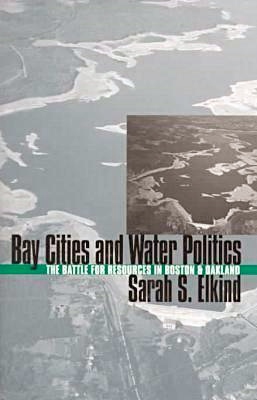

In Massachusetts, where clean water delivery and sewage disposal had long been framed as a public health concern, the political elite were able to build the case for a regional system that put water and sewage into the hands of state agencies. The voters supported the creation of “new institutions, controlled by engineers and bureaucrats…because they face pollution and water supply problems that their municipalities had repeatedly failed to solve” (114). On the East Bay, meanwhile, water resources became a struggle over private versus publicly-held water supplies as powerful commercial interests resisted attempts to establish publicly-controlled regional deep into the twentieth century.

In both regions, Elkind argues, “rural activities and economies were sacrificed for urban prosperity in spite of the continued nostalgia for America’s rural past” (155). While each region developed temporary solutions to both water supply and waste disposal, these systems remained vulnerable to increased demand for clean water and the growing environmental burden of pollution. Regionalism, Elkind argues, was a Progressive-era solution to challenge of water resource management. By creating infrastructure somewhat immune to the local politics of individual city or corporate interests, regional solutions created water systems that provided clean water to citizens and removed waste. However, regional technologies “ultimately impaired the ability of…natural systems to absorb the byproducts of modern industrial life” (171). By the late twentieth century, regional entities came under harsh criticism from citizen activists in both Massachusetts and California as water battles took center stage in regional politics once again.

For a book on water politics, Bay Cities and Water Politics is a fairly dry read. Elkind relies on government records, the personal papers of key figures, newspapers, pamphlets, and other print materials to construct her history. Readers unfamiliar with the individuals, municipal agencies, and corporations involved may get lost in the play-by-play accounting of regional politics at work. Nonetheless, the title will be an essential resource for anyone needing background on Progressive era water and sewage politics in Boston. It complements the work done by Carl Smith in City Water, City Life (University of Chicago Press, 2013) documenting water supply politics in Philadelphia, Boston, and Chicago before the Civil War.


Related Collections:

Boston & Roxbury Mill Corporation records, 1794-1912. 

Elizabeth S. Houghton papers, 1916-1999; bulk: 1955-1999.

Allen H. Morgan papers, 1923-1990.

Lemuel Shattuck papers,1676-1909; bulk: 1805-1867.

Quincy family papers (1665-1852) in the Quincy, Wendell, Holmes, and Upham Family Papers, microfilm edition.
 

Reference Collection Development: Watch This Space for New Titles!

By Anna Clutterbuck-Cook, Reader Services

During the past fiscal year, the MHS used income from hosting the GLCA Boston Summer Seminar to increase our reference collection development efforts. As a research library, it is crucial for the MHS to have up-to-date scholarly and reference works that support in-depth exploration and analysis of our manuscript, print, and art and artifact collections. In recent years we have depended primarily on the generosity of donors to add recent publications to our collection. We are excited that the Boston Summer Seminar income allowed us to be more proactive in strengthening our scholarly and reference holdings.

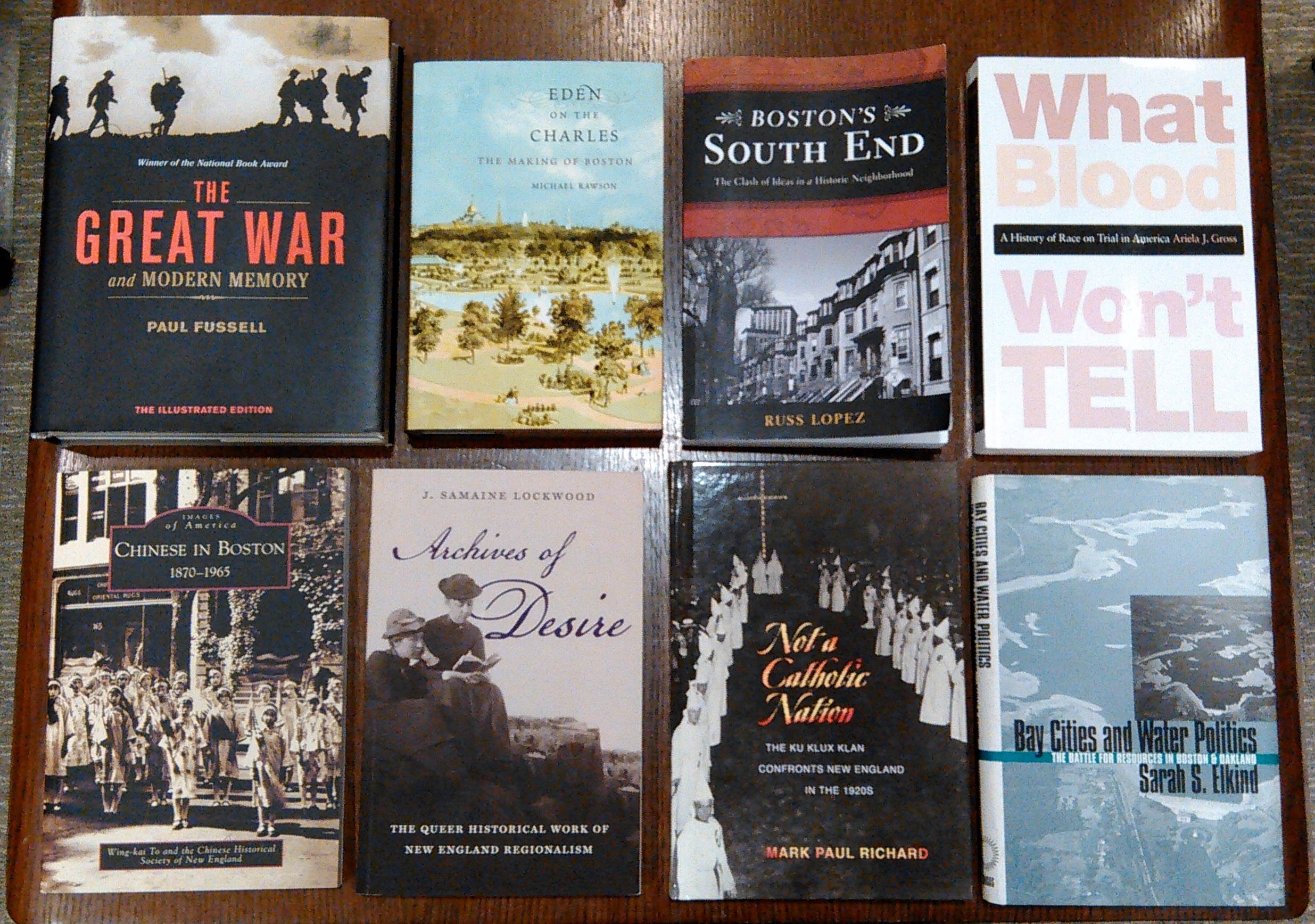
During the winter of 2016, our reader services team reviewed and updated the reference collection development policy, identified priority areas for acquisition, and surveyed trade publications for relevant titles. In June we were able to purchase over fifty titles in the following key areas: artifacts and material culture reference works, art and photography history and reference, Boston and local history, environmental history, immigration and emigration, New England in a global context, research fellows’ publications, World War I, research strategies and techniques, and twentieth century political and social history. Most of these titles are now cataloged and available upon request for review in the MHS library’s reference or reading rooms.

Beginning in September, reader services team members will highlight some of these newly-acquired works here on The Beehive, in the form of summary reviews paired with suggestions for which MHS collections might benefit from consultation with the work under review. We hope that these short reviews will encourage you to explore our scholarly and reference holdings for titles that support your work with our rare and unique collections material.

The MHS library also continues to welcome the donation of recent scholarly works that make use of or fit with our holdings, as well as being open to suggestions for titles that may be useful additions to our scholarly and reference collection. Offers of donation or suggestions for acquisition should be directed to the reference librarian Anna Clutterbuck-Cook at acook@masshist.org.

#BSS16! A Second Year of the Boston Summer Seminar @ MHS

By Anna Clutterbuck-Cook, Reader Services

Tomorrow night will be the final celebration for 2016 participants in the GLCA Boston Summer Seminar, a three-week program offered by the Great Lakes Colleges Association and hosted at the Massachusetts Historical Society. After a successful inaugural year, we had a competitive group of applications submitted to the Seminar last winter, from which we selected three teams to join us this June. Over the past three weeks, we have been excited to get to know a new group of soon-to-be alumni BSS16 participants:

Albion College

“Northern Black Lives Matter: The Experience of Black Northerners in the Era of Southern Emancipation”

Marcy Sacks, Chair & John S. Ludington, Endowed Professor of History

with students Corey Wheeler and Elijah Bean

Denison University

“Boston and New England in Atlantic Contexts”

Frank “Trey” Proctor III, Chair & Associate Professor of History

with students Rachael Barrett and Margaret “Maggie” Gorski

Oberlin College

“Haunted Subjects: Occult Practices and New Literary Traditions in Nineteenth-Century America”

Danielle Skeehan, Assistant Professor of English

with students Amreen Ahmed and Sabina Sullivan


These three teams have been with us since June 6th, conducting research at the Massachusetts Historical Society as well as the Seminar’s other partner institutions: the Center for the History of Medicine at Countway Library, Houghton Library, Northeastern University Archives & Special Collections, and Schlesinger Library.

The Seminar’s guest presenters this year were Kimberly Hamlin, Director of American Studies at Miami University of Ohio, and Stephen R. Berry, Associate Professor of History at Simmons College. Hamlin spoke to the group about her research on evolutionary theory, gender, and race in the archive; Berry walked participants through the intricacies of using ships’ logbooks as sources of information on the practice of religion at sea.

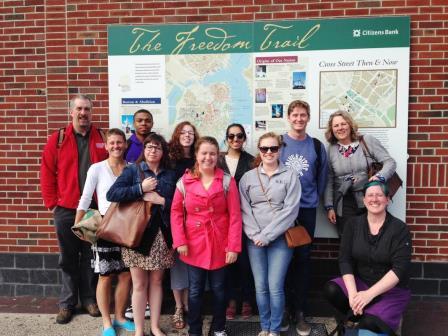
A new feature of the program this year, enthusiastically received by the group – despite the windy evening on which it was scheduled! — was the opportunity to participate in a walking tour, Boston’s Construction of Self, which introduced our participants from the American Midwest to some key moments and public history sites in central Boston.

We wish all of our 2016 participants a fruitful last few days in the archive and a productive return to campus this fall. Learn more at bostonsummerseminar.org and, if you are a faculty member or student one of the GLCA member institutions, watch for BSS17 call for proposals which will be posted and circulated during the upcoming fall semester.

Exploration, Encounter, and Exchange in History: Massachusetts History Day 2016

By Anna J. Clutterbuck Cook, Reader Services

Massachusetts History Day 2016, on the theme of “exploration, encounter, and exchange in history” is in full swing across the state of Massachusetts with the MHS as its official sponsor. In recent years, over 7,000 middle and high school students from across the Commonwealth have participated in MHD and — as in the past — winners from the 2016 state competition will have the opportunity to join thousands of other middle and high school students from around the country at The Kenneth E. Behring National History Day Contest in College Park Maryland (June 12-16, 2016).


Sabrina Panetta (Saugus, MA), discusses her submission in the Senior Individual Exhibit category, “Hidden Beneath the Surface,” with three volunteer judges. Photo courtesy of Kerin Shea, Massachusetts History Day.


“It’s like a science fair, but for history,” is how I like to describe the competition to those who have never heard of History Day before. Each year, an annual theme is announced by National History Day (NHD) within which students will select and research a topic, articulate a thesis, and present their historical analysis in one of five categories: documentary film, exhibit board, live performance, research paper, or website. The students present their work on competition day and are interviewed by volunteer judges who evaluate the quality of their historical research, analysis, and presentation.

This year’s theme of “exploration, encounter, and exchange in history” was a broad umbrella underneath which students have explored topics ranging from the economic and cultural exploitation of Hawai’i to the investigative journalism of Nellie Bly to Copernicus’ theory of a heliocentric universe.

There are many different ways to support Massachusetts History Day as individual historians and as cultural institutions. Since 2012, my wife and I have been involved as volunteer judges, getting up early on a Saturday morning to meet with junior historians to give them a chance to share their knowledge and enthusiasm.

There is still time to volunteer as a judge for the 2016 Massachusetts state competition on Saturday, April 9th!

Another option for supporting MHD is by offering special prizes for a best project in a particular topic (for example “labor history”) or type of primary source material (oral histories or photographs, for example). Since 2014 our family has been sponsoring a book prize at the district and state competitions for the best individual project in women’s and gender history. As professional historians, we are excited to encourage the work of those who will be our future colleagues and supporters – and we hope you will consider doing the same!

If you do not live in Massachusetts and are interested in NHD opportunities in your local area, find your state affiliate here. And if you want to watch the competition from afar, be sure to follow @MAHistoryDay for great competition day photos and updates.

New to the Reference Collection

By Anna Clutterbuck-Cook, Reader Services

Below are titles newly received or purchased for the library’s collection of contemporary historical scholarship and reference works. All of these books will be available for use in our library once we reopen to the public on Monday, 4 January 2016. In the meantime, enjoy the end of year holidays with family and friends. May you enter the new year renewed — and excited to pick your research back up in our cozy reading room while the winter snow piles up outside!


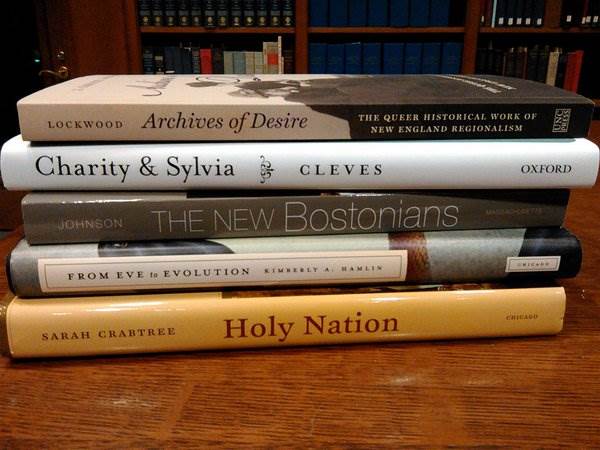
Cleves, Rachel Hope. Charity & Sylvia: A Same-Sex Marriage in Early America. Oxford University Press, 2014.

Crabtree, Sarah. Holy Nation: The Transatlantic Quaker Ministry in an Age of Revolution. University of Chicago Press, 2015.

Downs, Jacques M. with a new introduction by Frederic D. Grant, Jr. The Golden Ghetto: The American Commercial Community at Canton and the Shaping of American China Policy, 1784-1844. Hong Kong University Press, 2014.

Free, Laura E. Suffrage Reconstructed: Gender, Race, and Voting Rights in the Civil War Era. Cornell University Press, 2015.

Graves, Donald E., ed. First Campaign of the A.D.C.: The War of 1812 Memoir of Lieutenant William Jenkins Worth, United States Army. Old Fort Niagra Association, 2012.

Hamlin, Kimberly A. From Eve to Evolution: Darwin, Science, and Women’s Rights in Gilded Age America. University of Chicago Press, 2014.

Hemphill, C. Dallett. Siblings: Brothers and Sisters in American History. Oxford University Press, 2011.

Jefferson and Palladio: Constructing a New World. Centro Internazionale di Studi di Architettura Andrea Palladio, 2015.

Johnson, Marilynn S. The New Bostonians: How Immigrants Have Transformed The Metro Region Since the 1960s. University of Massachusetts Press, 2015.

Lockwood, J. Samaine. Archives of Desire: The Queer Historical Work of New England Regionalism. University of North Carolina Press, 2015.

Nicolson, Colin, ed. The Papers of Francis Bernard: Governor of Colonial Massachusetts, 1760-69. Volume IV: 1768. Publications of the Colonial Society of Massachusetts vol. 87. The Colonial Society of Massachusetts, 2015.

Prieto, Laura R. At Home in the Studio The Professionalization of Women Artists in America. Harvard University Press, 2001.

Rex, Cathy. Anglo-American Women Writers and Representations of Indainness, 1629-1824. Ashgate Press, 2015.

Schiff, Stacy. The Witches: Salem, 1692. Little, Brown and Co., 2015.

New Titles in the MHS Library’s Reference Collection

By Anna J. Clutterbuck-Cook, Reader Services

Here in the MHS library it is always a pleasure to see the fruits of scholarly labor pursued in our reading room come back to us as the form of publications hot off the presses. In recent months, we have been delighted to add a number of titles to our collection gifted to us by their authors.


The following recently-published titles have been cataloged and are now available for use as part of our reference collection:

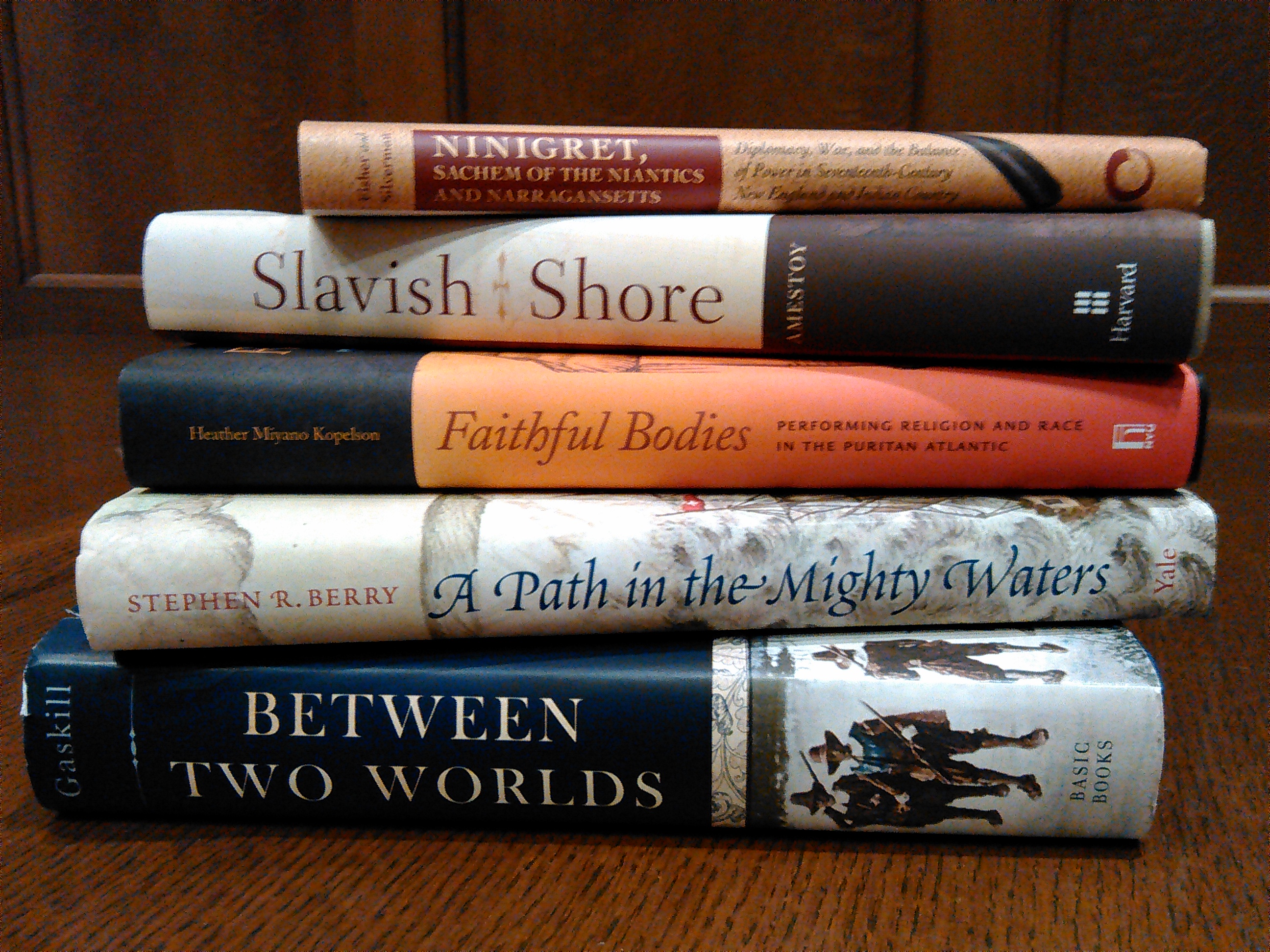
Amestoy, Jeffrey L. Slavish Shore: The Odyssey of Richard Henry Dana Jr. (Harvard University Press, 2015).

Balik, Shelby. Rally the Scattered Believers: Northern New England’s Religious Geography (Indiana University Press, 2014).

Berry, Stephen. A Path in the Mighty Waters : Shipboard Life & Atlantic Crossings to the New World (Yale University Press, 2015).

Blanck, Emily. Tyrannicide: Forging an American Law of Slavery in Revolutionary South Carolina and Massachusetts (University of Georgia Press, 2014).

Fisher, Julie A. and David J. Silverman. Ninigret, Sachem of the Niantics and Narragansetts : Diplomacy, War, and the Balance of Power in Seventeenth-century New England and Indian Country (Cornell University Press, 2014).

Gaskill, Malcolm. Between Two Worlds : how the English became Americans (New York: Basic Books, 2014).

Hodes, Martha. Mourning Lincoln (Yale University Press, 2015).

Kopelson, Heather Miyano. Faithful Bodies: Performing Religion and Race in the Puritan Atlantic (New York University Press, 2014).

Morrison, Dane. True Yankees: Sea Captains, the South Seas, and the Discovery of American Identity (Johns Hopkins, 2014).

Researchers are welcome to visit the MHS library during our regular business hours to consult these and other titles. If you are an author who has written a work drawing on research done at the MHS, we invite you to send a copy of your book to the Reference Librarian for inclusion in the Society’s collection. 


Military Manuscripts at the MHS and Beyond

By Dan Hinchen

It is not uncommon for the MHS library to receive copies of new publications from authors that did research here. In fact, we have an entire set of shelves devoted to displaying this type of new publication. After some time on display, these volumes are typically moved to our closed stacks and then available by request. Less often, we receive a new publication from a researcher that we deem appropriate to move immediately into our reference collection.

We recently received a newly published book called Military Manuscripts at the State Historical Societies in New England (2014). This volume, put together by Paul Friday, provides extensive documentation of manuscript collections relevant to military history in New England. Each chapter shines a spotlight on one individual institution and provides detailed lists of manuscript collections that contain materials related to military matters.

Since I started working at the MHS in 2011, Mr. Friday’s face has been one of the more familiar ones in the reading room. Over the years he placed scores of requests to consult manuscript materials from myriad collections in our holdings. The result is a box-level, sometimes folder-level inventory of military-related papers that the Society preserves. The sources include a large variety of material types, from maps and charts to correspondence and orderly books to printed materials like broadsides. The materials he worked with encompass a large chronology, going back as far as the Pequot War of the 1630s all the way up to the Vietnam War.

The countless hours of work that Mr. Friday did result in extremely valuable identifications of military papers held here. From documenting a single letter by Gen. John Burgoyne in the Bromfield family papers, to identifying thirty-five boxes, seven volumes, and three oversize items in the Clarence Ransom Edwards papers.

In addition to identifying such relevant collections, Mr. Friday also provides explanations in each chapter about the various organization schemes used by the different institutions, catalogs available for researchers (online and physical), procedures for requesting materials, hours of operation, and so forth.

At the back of the volume there are four appendices made up of several glossaries and complementary information. Also, there are five separate indices and a section introducing them.

Because he used available finding aids and collection guides to locate collections with military papers, Mr. Friday acknowledges that each historical society holds additional relevant collections that did not have companion finding aids and so did not show up in the volume. Despite this limitation, the volume as a whole will surely prove a tremendous help for researchers performing primary source research into the military history of New England and the United States. 


The King of the Filibusters

By Dan Hinchen

Filibuster, n. 1. An irregular military adventurer, esp. one in quest of plunder; a freebooter; — orig. applied to buccaneers infesting the Spanish American coasts; later, an organizer or member of a hostile expedition to some country or countries with which his own is at peace, in contravention of international law.

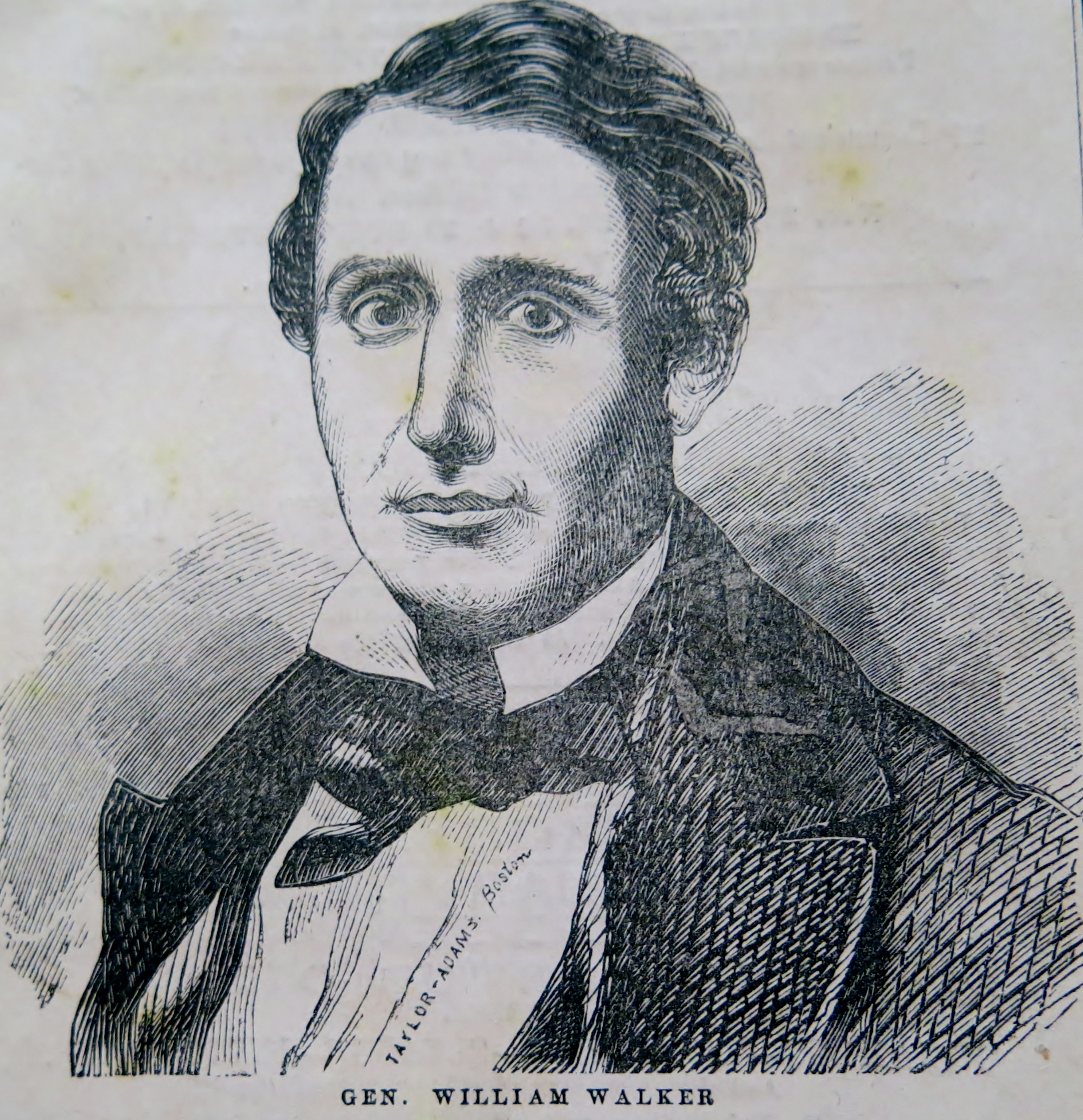
On September 12, 1860, an American lawyer and journalist, an adventurer and filibuster, was executed by firing squad in Trujillo, Honduras. This is his story in brief.

William Walker was born in Nashville, Tennessee, in 1824. Pushed by his parents to a good education, he graduated from the University of Nashville at the age of 14. By 1843, at 19, Walker received his medical degree from the University of Pennsylvania. He continued his medical education in Paris and toured several cities in Europe before returning to Nashville to practice.

Dissatisfied with his career in medicine, Walker changed his focus to law and, shortly after taking up studies, moved to New Orleans. While he attained the bar in Louisiana, his practice there was even briefer than his medical practice and he soon moved into the field of journalism. In the winter of 1848, Walker became an editor and proprietor of the conservative New Orleans Crescent.

The following year, like so many other intrepid young men, Walker responded to the lure of the West and settled in San Francisco, arriving in June, 1850. He continued his work as a journalist, speaking loudly against the judicial authorities in San Francisco for failure to roll back a tide of lawlessness and crime. His vocal stance raised the ire of district judge Levi Parsons who declared the press a nuisance and, after much wrangling, judged Walker guilty of contempt and set a fine on him. Now, Walker’s legal experience came to the fore as he defended himself in open court against the charges, with much popular support, and was ultimately vindicated.

Shortly after, Walker moved to the nearby and quickly growing town of Marysville where he practiced law with Henry Watkins. By this time, many men of California were already engaging in filibustering in Latin America. This practice, prominent during the 1850s, was an aggressive and idealized effort to expand the influence of the United States in fulfillment of manifest destiny.

Over the next several years, Walker pursued this activity with fervor. In 1853 he attempted an invasion of Mexico with a small band of men, barely escaping alive. The United States tried him in violation of the neutrality act but he was quickly exonerated. In 1855, he set his sights on Nicaragua. This locale was coveted by many as the key to linking the Atlantic and Pacific Oceans. No less a man than Cornelius Vanderbilt invested heavily in transporting goods across the narrow country. 

Landing with a small force of Americans, Walker supplemented his force with sympathetic liberal Nicaraguans and demanded independent command. With a lot of luck and small amount of daring, Walker and his men took the city of Granada and made hostages of its conservative leaders. 

Over the next several months, Walker used various schemes and local proxies to consolidate power in his own hands, eventually raising the alarm in neighboring Central American countries. In April 1856, Costa Rica occupied the Nicaraguan city of Rivas in order to drive Walker out but, with the aid of an outbreak of cholera, he forced them into retreat.

Throughout the next year, Walker’s course of action greatly alienated him from his supporters in American business. So it was with the financial backing of Vanderbilt that, in spring of 1857, an alliance of Central American countries besieged him at Rivas, forcing him to surrender to an American naval officer, at which time he and his men were delivered out of the country.

Still, he was not finished. By this time, Walker was something of a folk hero in the United States, meeting acclaim wherever he went. In November 1857, he tried to invade and was met by the US Navy which forced a quick surrender. In 1860 he made one last effort. This time, the Royal Navy captured him and delivered him to the nearest authorities, the Hondurans. In September of that year, William Walker finally met his end. 

The story of William Walker was unknown to me until I recently watched a film from 1987 called simply Walker, with Ed Harris in the title role and directed by Alex Cox. Though a fictional take on the actions of the man, it raised my awareness and piqued my curiosity. If you are interested in learning more about Walker and other 19th century filibusters, see below for some resources 


Sources at the MHS

–        The destiny of Nicaragua: Central America as it was, is, and may be, Boston: S.A. Bent & Co., 1856.

–        Scroggs, William O., Filibusters and financiers: the story of William Walker and his associates. New York: Macmillan, c1916.

–        Wells, William V., Walker’s expedition to Nicaragua…, New York: Stringer and Townsend, 1856.


Useful online resources

–        Stiles, T.J., “The Filibuster King: The Strange Career of William Walker, the Most Dangerous International Criminal of the Nineteenth Century,” History Now 20 (Summer 2009). The Gilder Lehrman Institute of American History. Accessed March 12, 2015. http://www.gilerlehrman.org/history-by-era/jackson-lincoln/essays/filibuster-king-strange-career-william-walker-most-danerous-i  

–        Tirmenstein, Lisa, “Costa Rica in 1856: Defeating William Walker While Creating a National Identity,” Accessed March 12, 2015. http://jrscience.wcp.muohio.edu/FieldCourses00/PapersCostaRicaArticles/CostaRicain1856.Defeating.html  

–        Judy, Fanna, “William Walker,” The Virtual Museum of the City of San Francisco, Accessed March 12, 2015. http://www.sfmuseum.org/hist1/walker.html  


Symbiosis at the Society: Fellows and Librarians Learn Together

By Dan Hinchen

A few weeks ago the Beehive featured an item about the 2014-2015 Fellowship recipients and their research projects for the coming year. This great opportunity for scholars to come and do funded research also is an opportunity for the MHS librarians to expose ourselves to subjects and collections that we otherwise do not interact with.

Each year, the reference librarians here look at the projects to be undertaken by the incoming research fellows and divide them up so that we can serve as individual liaisons for the various fellows. We choose which fellows to liaise with based on our own interest and background knowledge of the projects. This benefits the fellows by providing a specific person to contact if they have trouble navigating our collections or just need someone to bounce ideas off.  

Over the next year, I will be liaising with at least eleven different fellows to help them utilize the resources here at the MHS. The projects cover a wide range of subjects, including alcohol production, throat epidemics, Revolutionary War campaigns, antislavery texts, and religious reform. They also cover a long span of time, from the earliest days of the English colonies to the dawn of the Civil War.

This presents two challenges for me: to help fellows access materials they already identified using our catalog and to help them discover additional material in our collection that they missed. Perhaps I am familiar with a collection that they did not find in their search; maybe I can show them resources that are not available via our online catalog; in some cases, I can suggest another institution whose collections complement the Society’s.

Again, this exchange benefits both the fellows and the MHS staff. I know already from reading through some project descriptions that I will be exposed to topics that are completely new to me or that the fellow is looking at in a new way. And with some relevant materials already identified by the research fellow, I will learn more about the collections we have here. As I scour our catalog to find more resources for the fellow, I learn more about our holdings and about strategically searching our collections, information that will certainly come in useful down the road.

Back in January I wrote a piece for the Beehive about using the Researcher as Resource. Working with our research fellows each year is another way for our librarians to expand their knowledge and to learn even more about the collections here at the MHS. 


Reader Services By the Numbers

By Elaine Grublin

As the fiscal year comes to a close it is time to examine the statistics the reader services staff compiles over the course of the year.  Here is a quick rundown of what FY2011 brought to the MHS library. 

 The library was open 287 days with an average daily attendance of 9.6 researchers.      

 We were visited by 1353 individual researchers for a total of 2766 research visits.

 718 of our researchers were using the MHS library for the first time.          

 Of those first time visitors, 314 were Massachusetts residents, 357 were out-of-state visitors, and 47 were foreign nationals.  In all we had visitors from 40 different states and more than 20 countries.

The reader services staff paged 2888 manuscripts requests and 1900 printed materials requests.  Considering that most requests require multiple boxes or volumes, that is a lot of material paged.

 Because not every researcher that uses MHS resources can visit us in person the reader services staff also answered 1335 reference emails, 70 mailed reference letters, and 1260 reference phone calls.  

The library has been experiencing a steady increase in both total readers and new readers over the past few years.  Here is hoping that trend continues into FY2012