

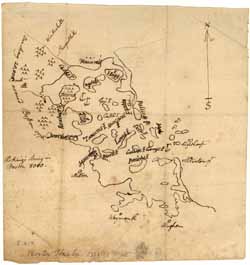
 Manuscript map of Boston and Boston Harbor, 1776
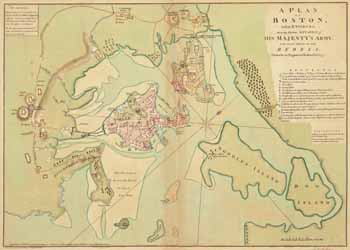 A Plan of Boston, and its Environs shewing the true Situation of His Majesty's Army
![A Plan of Boston in New England with its Environs, including Milton, Dorchester, Roxbury, Brooklin [sic], Cambridge, Medford, Charlestown, Parts of Malden and Chelsea, with the Military Works Constructed in those Places in the Years 1775 and 1776](https://www.masshist.org/database/images36/5005_map_trans_work_ref.jpg) A Plan of Boston in New England with its Environs...
A Plan of Boston in New England with its Environs...
Arranged by Name of AuthorOrganizes the documents by their creator and provides brief contextual statements about the manuscripts
Samuel Adams
In this letter by Adams written on 19 May 1775 from Philadelphia (where the Second Continental Congress had convened) to Samuel Purviance, Jr., a man from Maryland who promoted the revolutionary cause, Adams mentions that he had firsthand knowledge of the battle on 19 April 1775. Adams also acknowledges the harsh conditions in besieged Boston and the difficulty of communicating with people in that town.
"At present the Sufferers by the Port bill are confined within the Town of Boston with the other Inhabitants and there can be no Communication between them and their friends without..." 19 May 1775, Page 1
John Andrews
Two letters from John Andrews, a merchant in Boston, to his brother-in-law William Barrell, a merchant in Philadelphia. In these letters, written on 6 May and 1 June 1775, Andrews describes conditions in Boston. The first letter details conditions shortly into the Siege including the large number of people to leave Boston and the difficulty of communicating between town and country. In the second letter, Andrews struggles to survive by himself in Boston; his family having left, Andrews remained to ensure that his family's belongings were not stolen by the British troops.
"...you must know that no person who leaves the town is allow'd to return again." 6 May 1775, Page 2.
Letter from John Andrews to William Barrell, 6 May 1775
"I find an absolute necessity to be here myself, as the Soldiery think they have a license to plunder evry ones house & Store who leaves the town..." 1 June 1775, Page 2.
Isaac Bangs
A journal kept by Isaac Bangs of Harwich, Mass. after he joined the Continental Army as a 2nd lieutenant in Colonel John Bailey's 23rd Continental Regiment. In journal entries dating from January - July 1776, Bangs recounts his service in a militia regiment stationed near Boston during the Siege and as an officer in New York from April - July. The entries he kept during the Siege mention the following locations: Roxbury, Dorchester, Prospect Hill, Lechmere's Point, Cobble Hill, Nooke Point and the Neck.
"...had they been so rash they would in all probability have found the 5th of March 1776 more Bloody on their Side than Preston made the same Day in 1770 on ours..." Page 10.
Boston freeholders and inhabitants
These manuscript town meeting minutes record the two votes passed at the meeting of property owners and residents of Boston on 22 April 1775, three days after the Battle of Lexington and Concord. The first vote pertained to peaceable actions and intentions of the Provincial army outside the city in conjunction with those men remaining in the city. In exchange for peace, inhabitants and their property within Boston would be protected by General Gage and His Majesty's Troops. The second vote related to communications and the transfer of supplies, provisions and people, which all had been prohibited once the army had blocked access at Boston Neck. Inhabitants of Boston were permitted to leave the town provided they left their arms behind at a secure location under the care of the Selectmen.
"the Troops should do no damage, nor Commit any Act of Violence on the Town but that the lives & properties of the Inhabitants should be protected & Secured, if the Inhabitants behaved peacably."
Obadiah Brown
This diary kept by Obadiah Brown, a soldier from Gageborough (now Windsor), Massachusetts, who served as a private during the Siege and later in New York, contains entries dating from 30 January 1776 to 7 January 1777. Brown's entries written during the Siege of Boston include brief descriptions of basic military duties, summaries of British troop activities, a statement about being fired upon while standing guard at Lechmere Point, and daily life--disciplinary actions and injuries--in his regiment. Brown's diary also describes his military experiences after the Siege of Boston when his regiment went to New York in July where he was shot in the arm and badly wounded.
"...Stood Sentry where ye balls and shots flew like hailstones" 4 March 1776 (page 4).
William Cheever
This brief diary kept by William Cheever in Boston from 19 May 1775-17 March 1776 contains remarks on skirmishes between British and American troops, the food shortage, and the evacuation of the British. Diary entries make mention of many events that occurred in numerous locations: Noddles Island, Thompson Island, Charlestown, lighthouse on Little Brewster Island, Thatcher's Island, Gardner's Island, Fisher's Island, Bunker's Hill, Prospect Hill, West Hill, Roxbury, West Meeting House, Cambridge, Quebec. Cheever's diary also mentions the troubles of Henry Williams, and the imprisonment of James Lovell, John Leach, and John Gill.
"An Account taking of all the Houses, etc., in town; and every Inhabitant required by Proclamation to give in a List of those in his Family" 2 October 1775, page 7.
Sarah Winslow Deming
Within this 12-page letter written in the form of journal entries from 15-26 April 1775 Sarah Winslow Deming transmits news of Lexington and Concord and the first few days of the Siege including the unpleasant conditions in the town until her difficult departure from Boston on 20 April 1775. Deming, the wife of Captain John Deming, describes various locations in Boston: Charlestown Ferry, Bartons Point, Boston Common, Boston Neck, as well as outside of the town in Jamaica Plain, Roxbury Hill, Dedham, Attleborough, and Providence.
"Out of Boston, out of Boston at almost any rate -- away as far as possible from the infection of small pox, & the din of drums & martial Musick as its call'd, & horrors of war -- but, my distress is not to be described -- I attempt not to describe it" ca. 15 April 1775, Page 1.
Peter Edes
In this diary, Boston resident Peter Edes records entries about his capture and his 107-day-imprisonment by the British. In entries dating from 19 June 1775 to 3 October 1775, Edes, an apprentice printer (and son of the printer Benjamin Edes) writes about the difficulty of getting information about his case and describes the Boston Jail and mentions James Lovell, John Leach, and other prisoners. The last page of the diary is a list of 30 prisoners taken from the Battle of Bunker Hill and in his entry of 21 September 1775; Edes mentions that only 11 of them are still living.
"From before Sunrise till after Sunset a continued Scene of horrid Swearing, obscene talk, and Shocking blasphemy..." 20 August 1775, Page 13.
Andrew Eliot
In letters written on 23 and 24 April 1775, and a draft of a letter of 31 May 1775, Boston Minister Andrew Eliot describes Boston shortly after the Siege began. Eliot was minister of the New North Church in Boston, and although he made great efforts to get his family safely out of Boston, he stayed to serve the members of the community and his congregation who remained in town. The letter written on 23 April 1775 to one of his sons (most likely his oldest son, Andrew, who was a minister in Connecticut) describes the importance of getting his wife out of Boston. The draft of the letter he wrote in May 1775 describes shops and warehouses being shut up, grass growing in the public walks and streets, and "every one in anxiety and distress." In addition to describing Boston he mentions Cambridge College (Harvard), Roxbury, and Dorchester.
"poor Boston May God sanctify our distresses which are greater than you can conceive - Such a Sabbath of melancholy and darkness I never knew" 23 April 1775, Page 1.
Letter from Andrew Eliot to his son, 23 April 1775
"The unhappy situation of this town....Filled with the Troops of Britain & surrounded with a provincial Army, all communication with the Country is cut off, & we wholly deprived of the necessaries of Life" 25 April 1775, Page 1.
Jonathan Green
These two detailed financial accounts list the expenses and losses of Jonathan Green (1719-1795) of Chelsea, whose crops, property, and livestock were affected by the Siege of Boston. Green's property along Boston Harbor faced Charlestown, a location that got the attention of both the British and American troops. One history of Chelsea indicates that Lieutenant-Colonel Loammi Baldwin and his men occupied Green's property for part of the Siege, and also noted that the property allowed a good view of the Battle of Bunker Hill. At the request of the Committee of Correspondence, Green moved much of his livestock inland (to Stoneham, where some of his family lived) to protect them from being taken by British soldiers. However, Green's property was damaged and his crops were lost to plundering groups of soldiers from both sides.
"to Remove all his Stock of Creatures from Said Chelsea Back to Some more Distant place and as he could not Get them kept nearer he was obliged to Remove them to Stoneham, Eight miles Distance" [7 May 1776], Page 1 of Account of damages (first link below).
Estimate of damages done during the Siege, list by Jonathan Green, 7 May 1776
Account of damages done to Jonathan Green during the Siege, [7 May 1776]
Robert Harrison
This letter, written on 13 November 1775 from the Continental Army's headquarters in Cambridge, from Robert Harrison to Colonel Loammi Baldwin in Chelsea grants permission to distribute livestock such as oxen and milch cows. Harrison, an aide-de-camp of General George Washington, cautions Baldwin of the importance that the livestock not fall into the hands of the British soldiers.
"but he would have them take the utmost care that they do not fall into the enemy's hands, for should they, the publick will make them no compensation as for the loss" 13 November 1775.
Letter from Robert Harrison to Loammi Baldwin, 13 November 1775
William Jackson
William Jackson was born in Boston in 1731 and was a long-time Boston merchant. He consistently defied patriot attempts to embargo British goods during the years before the Revolution, earning him the ire of the Sons of Liberty who urged Bostonians to boycot his shop. He left Boston with the British in March 1776, but his ship was captured, and he was returned to Boston and jailed. In this letter to the Continental Congress on 6 July 1776, Loyalist William Jackson complains of his imprisonment in the Boston jail and requests that his confiscated property be recovered. Jackson also describes the evacuation of Boston on 17 March 1776. Jackson went into exile in England and was formally banished by the Revolutionary government of Massachusetts in 1778.
"as soon as we came out of the Inn we received Blow's, mud, stones, Eggs, and every other abuse and proceeded to Boston being 40 miles on foot" 6 July 1776, Page 3.
Letter from William Jackson to the Continental Congress, 6 July 1776
Nathaniel Ober
This diary was kept by Nathaniel Ober from 15 May - 3 September 1775. Ober, a shoemaker, served as a member of John Mansfield's Massachusetts Regiment. (This regiment was recruited in southeastern Essex County and was taken into the Continental Army when it formed in June 1775.) Although his entries describe events and army life during the Siege (including a description of the Battle of Bunker Hill, the arrival of General Washington at Cambridge, the desertion of soldiers, and military punishments), on many days Ober simply writes, "nothing remarkab[le] today."
"the 29d [of July] it Being Saterday we Concluded the Day with a Drink to wives and Sweatharts" Page 13.
Nathaniel Ober diary, 15 May - 3 September 1775, with accounts and notes, 1776-1781
John Thomas
In this letter written to his wife Hannah from Dorchester Hill on 9 March 1776, Brigadier General John Thomas details the military preparations toward the end of the Siege that would lead to the evacuation of the Boston eight days later. In addition to his role as an army officer, rising to the rank of major general, Thomas was a doctor. He died of small pox during the retreat from Canada within three months of this letter.
"about Sunrise the Enemy & others in Boston appeared Numerious on the Tops of Houses & on the wharfes vewing us with astonishment for the appearance was unexpected to them" 9 March 1776, Page 1.
[Unidentified] American Lady
This manuscript poem by an anonymous "American Lady" satirically describes British officials and generals including General Thomas Gage who relinquished command of the British Army to General Howe in October 1775 and departed for England.
"From Boston comes the frited Cow / The ruins left happless Howe!"
Henry Howell Williams
This selection of documents conveys the arduous experience of Henry Howell Williams who owned property on Noddles Island in Boston Harbor and suffered great financial losses in May 1775 when the Continental Army burned his property and confiscated his livestock to prevent them from being taken by the British Army. The documents (including statements certifying the events that occurred and a detailed list of items lost by Williams) were assembled around 1787, about 12 years after the Siege, when Williams petitioned the Commonwealth of Massachusetts for proper compensation for his losses. Williams's case was finally settled in 1789 and he was awarded £2,000. Three years later, in 1792, a committee appointed by the two houses of the Legislature of the Commonwealth found that the compensation that was awarded to Williams in 1789 wouldn't preclude him from receiving additional compensation from other agencies.
View the documents related to Henry Howell Williams's property losses on Noddles Island
Arranged by TopicExplore the documents by browsing some selected topics.
Battle of Bunker Hill
17 June 1775. Cheever (Merchant).
See page 2: William Cheever diary, 1775-1776
17 June 1775. Edes (Resident). Subtopic: list of prisoners taken to jail.
See page 23: Peter Edes diary, June-October 1775
11 August 1775. Edes (Resident). Subtopic: death of prisoner taken during battle.
See page 9: Peter Edes diary, June-October 1775
17 September 1775. Edes (Resident). Subtopic: account by minister who fought for Provincial army then deserted to British army.
See page 19: Peter Edes diary, June-October 1775
17 June 1775. Ober (Soldier).
See page 7: Nathaniel Ober diary, 15 May - 3 September 1775, with accounts and notes, 1776-1781
Battles of Lexington and Concord
19 April 1775. Adams (Member of Continental Congress).
See page 1: Letter from Samuel Adams to Samuel Purviance, 19 May 1775
19 April 1775. Deming (Resident).
See page 3: Sarah Winslow Deming journal, 1775
British Evacuation of Boston
March 1776. Bangs (Soldier).
See pages 15-16: Isaac Bangs journal, 1776
17 March 1776. Brown (Soldier).
See page 6: Obadiah Brown diary, 1776-1777
5 March 1776. Cheever (Merchant). Subtopic: preparations.
See page 11: William Cheever diary, 1775-1776
17 March 1776. Cheever (Merchant).
See page 12: William Cheever diary, 1775-1776
March 1776. Jackson (Merchant). Subtopic: aftermath.
See: Letter from William Jackson to the Continental Congress, 6 July 1776
Challenges of residents leaving Boston
May 1775. Adams (Member of Continental Congress).
See page 3: Letter from Samuel Adams to Samuel Purviance, 19 May 1775
6 May 1775. Andrews (Merchant).
See page 1-2: Letter from John Andrews to William Barrell, 6 May 1775
22 April 1775. Boston freeholders and inhabitants (Resident). Subtopic: including requirement to surrender firearms.
See pages 3 -5: Boston town meeting minutes, 22 April 1775
21 April 1775. Burbeck (Soldier).
See: Statement of William Burbeck certifying that he received help from Henry Howell Williams in April 1775, written on 17 April 1776
20 April 1775. Deming (Resident).
See page 3: Sarah Winslow Deming journal, 1775
23 April 1775. Elliot (Minister). Subtopic: including requirement to surrender firearms.
See page 1: Letter from Andrew Eliot to his son, 23 April 1775
Conditions in Boston
6 May 1775. Andrews (Merchant).
See page 2: Letter from John Andrews to William Barrell, 6 May 1775
1 June 1775. Andrews (Merchant). Subtopic: scarcity of food.
See pages 2-3: Letter from John Andrews to William Barrell, 1 June 1775
22 April 1775. Boston freeholders and inhabitants (Resident). Subtopic: attempts to preserve peaceful relations between soldiers and residents.
See page 2: Boston town meeting minutes, 22 April 1775
12 August 1775. Cheever (Merchant).
See page 5: William Cheever diary, 1775-1776
19-20 April 1775. Deming (Resident).
See page 3: Sarah Winslow Deming journal, 1775
23 April 1775. Eliot (Minister).
See: Letter from Andrew Eliot to his son, 23 April 1775
25 April 1775. Eliot (Minister).
See page 1: Letter from Andrew Eliot to Thomas B. Hollis (copy), 25 April 1775 and letter from Andrew Eliot to unidentified recipient (draft), 31 May 1775
31 May 1775. Eliot (Minister).
See page 4: Letter from Andrew Eliot to Thomas B. Hollis (copy), 25 April 1775 and letter from Andrew Eliot to unidentified recipient (draft), 31 May 1775
Fortification of Dorchester Heights
4 March 1776. Bangs (Soldier).
See page 4: Isaac Bangs journal, 1776
9 March 1776. Thomas (Soldier). Subtopic: preparations.
See: Letter from Gen. John Thomas to Hannah Thomas, 9 March 1776
Military generals
May 1775. Adams (Member of Continental Congress).
See page 3: Letter from Samuel Adams to Samuel Purviance, 19 May 1775
1 January 1776-17 March 1776. Bangs (Soldier).
See page 28 for one example: Isaac Bangs journal, 1776
25 May 1775. Cheever (Merchant).
See page 1: William Cheever diary, 1775-1776
13 November 1775. Harrison (Soldier).
See: Letter from Robert Harrison to Loammi Baldwin, 13 November 1775
Fall 1775-spring 1776. Jackson (Merchant).
See: Letter from William Jackson to the Continental Congress, 6 July 1776
2 July 1775. Ober (Soldier).
See page 9 for example: Nathaniel Ober diary, 15 May - 3 September 1775, with accounts and notes, 1776-1781
Circa October 1775. Unidentified woman (Resident).
See: Poem about British by an American Lady, 11 Feb. [1776]
Prisoner account
19 June 1775 - 3 October 1775. Edes (Resident).
See: Peter Edes diary, June-October 1775
Raids/plundering of property
1 June 1775. Andrews (Merchant).
See page 2: Letter from John Andrews to William Barrell, 1 June 1775
30 May 1775. Cheever (Merchant).
See page 1: William Cheever diary, 1775-1776
12 July 1775. Cheever (Merchant).
See page 3: William Cheever diary, 1775-1776
15 November 1775. Cheever (Merchant). Subtopic: mentions damage to Old South Meeting House.
See page 7: William Cheever diary, 1775-1776
9 January 1776. Cheever (Merchant).
See page 10: William Cheever diary, 1775-1776
30 May 1775. Doolittle (Soldier).
See: Orders to take cattle issued by Col. Ephraim Doolittle to Capt. Nathan Fuller (copy), 30 May 1775
June 1775. Gill (Soldier).
See: Statement of Moses Gill certifying that the horses, cattle, and sheep removed from Noddles Island in June 1775 were used for the benefit of American troops, undated
20 April 1775. Green (Resident). Subtopic: expenses occurred when moving cattle and horses to prevent British from obtaining livestock.
See page 1: Estimate of damages done during Siege, list by Jonathan Green, 7 May 1776
31 May 1775. Green (Resident).
See page 1: Estimate of damages done during Siege, list by Jonathan Green, 7 May 1776
10 July 1775. Green (Resident).
See page 2: Estimate of damages done during Siege, list by Jonathan Green, 7 May 1776
11 November 1775. Green (Resident). Subtopic: expenses occurred when moving cattle and horses to prevent British from obtaining livestock.
See page 2: Account of damages done during Siege to Jonathan Green, [7 May 1776]
13 November 1775. Harrison (Soldier). Subtopic: hope to prevent British from obtaining livestock.
See: Letter from Robert Harrison to Loammi Baldwin, 13 November 1775
6 July 1776. Jackson (Merchant). Subtopic: attempt to recover confiscated property.
See: Letter from William Jackson to the Continental Congress, 6 July 1776
6 August 1775. Ober (Soldier).
See page 16: Nathaniel Ober diary, 15 May - 3 September 1775, with accounts and notes, 1776-1781
May 1775. Williams, H. H. (Resident).
See: List of items belonging to Henry Howell Williams destroyed in 1775, 10 March 1787
1789. Williams, H. H. (Resident). Subtopic: attempt to recover confiscated property.
See many selections: Documents relating to Henry Howell Williams and Noddles Island
Setting of Siege
1776. Unidentified (Unidentified).
See: Manuscript map of Boston and Boston Harbor, 1776
1775-1776. Unidentified (Unidentified).
See: A Plan of Boston in New England with its Environs, including Milton, Dorchester, Roxbury, Brooklin [sic], Cambridge, Medford, Charlestown, Parts of Malden and Chelsea, with the Military Works Constructed in those Places in the Years 1775 and 1776
October 1775. Williams, R (Soldier).
See: A Plan of Boston, and its Environs shewing the true Situation of His Majesty's Army
Skirmishes and bombardments
4 March 1776. Bangs (Soldier).
See pages 6-7: Isaac Bangs journal, 1776
20 February1776. Brown (Soldier). Subtopic: from the perspective of a soldier.
See page 3: Obadiah Brown diary, 1776-1777
2 March 1776. Brown (Soldier).
See page 5: Isaac Bangs journal, 1776
4 March 1776. Brown (Soldier).
See page 4: Obadiah Brown diary, 1776-1777
12 March 1776. Brown (Soldier).
See page 5: Obadiah Brown diary, 1776-1777
2 August 1775. Cheever (Merchant).
See page 4: William Cheever diary, 1775-1776
22 September 1775. Cheever (Merchant).
See page 6: William Cheever diary, 1775-1776
31 May 1775. Eliot (Minister). Subtopic: from the perspective of a Boston resident.
See page 4: Letter from Andrew Eliot to Thomas B. Hollis (copy), 25 April 1775 and letter from Andrew Eliot to unidentified recipient (draft), 31 May 1775
28 May 1775. Ober (Soldier). Subtopic: from the perspective of a soldier.
See page 4: Nathaniel Ober diary, 15 May - 3 September 1775, with accounts and notes, 1776-1781
31 July 1775. Ober (Soldier).
See page 14: Nathaniel Ober diary, 15 May - 3 September 1775, with accounts and notes, 1776-1781
27 August 1775. Ober (Soldier).
See page 19: Nathaniel Ober diary, 15 May - 3 September 1775, with accounts and notes, 1776-1781
View of Siege, written by a woman
19-20 April 1775. Deming (Resident).
See page 3: Sarah Winslow Deming journal, 1775
Circa October 1775. Unidentified woman (Resident).
See: Poem about British by an American Lady, 11 Feb. [1776]
View of Siege, written from outside of Boston
1 January 1776-17 March 1776. Bangs (Soldier).
See: Isaac Bangs journal, 1776
30 January 1776 - 17 March 1776. Brown (Soldier).
See: Obadiah Brown diary, 1776-1777
15 May 1775 - 3 September 1775. Ober (Soldier).
See: Nathaniel Ober diary, 15 May - 3 September 1775, with accounts and notes, 1776-1781
View of Siege, written from within Boston
6 May 1775. Andrews (Merchant).
See: Letter from John Andrews to William Barrell, 6 May 1775
1 June 1775. Andrews (Merchant).
See page 2: Letter from John Andrews to William Barrell, 1 June 1775
19 May 1775 - 17 March 1776. Cheever (Merchant).
See: William Cheever diary, 1775-1776
19-20 April 1775. Deming (Resident).
See page 3: Sarah Winslow Deming journal, 1775
25 April 1775. Eliot (Minister).
See: Letter from Andrew Eliot to Thomas B. Hollis (copy), 25 April 1775 and letter from Andrew Eliot to unidentified recipient (draft), 31 May 1775
Arranged by Occupation of AuthorPresents the documents by the occupation of the writer.
Member of Continental Congress
Adams. Document format: Letter
See: Letter from Samuel Adams to Samuel Purviance, 19 May 1775
Merchant
Andrews. Document format: Letter
See: Letter from John Andrews to William Barrell, 1 June 1775
Andrews. Document format: Letter
See: Letter from John Andrews to William Barrell, 6 May 1775
Cheever. Document format: Diary/Journal
See: William Cheever diary, 1775-1776
Jackson. Document format: Letter
See: Letter from William Jackson to the Continental Congress, 6 July 1776
Minister
Eliot. Document format: Letter
See: Letter from Andrew Eliot to his son, 23 April 1775
Eliot. Document format: Letter
See: Letter from Andrew Eliot to Thomas B. Hollis (copy), 25 April 1775 and letter from Andrew Eliot to unidentified recipient (draft), 31 May 1775
Resident
Boston freeholders and inhabitants. Document format: Meeting minutes
See: Boston town meeting minutes, 22 April 1775
Deming. Document format: Diary/Journal
See: Sarah Winslow Deming journal, 1775
Edes. Document format: Diary/Journal
See: Peter Edes diary, June-October 1775
Green. Document format: Financial accounts
See: Estimate of damages done during Siege, list by Jonathan Green, 7 May 1776
Green. Document format: Financial accounts
See: Account of damages done during Siege to Jonathan Green, [7 May 1776]
Unidentified woman. Document format: Poem
See: Poem about British by an American Lady, 11 Feb. [1776]
Williams, H. H.. Document format: List
See: List of items belonging to Henry Howell Williams destroyed in 1775, 10 March 1787
Soldier
Bangs. Document format: Diary/Journal
See: Isaac Bangs journal, 1776
Brown. Document format: Diary/Journal
See: Obadiah Brown diary, 1776-1777
Burbeck. Document format: Statement
See: Statement of William Burbeck certifying that he received help from Henry Howell Williams in April 1775, written on 17 April 1776
Doolittle. Document format: Military orders
See: Orders to take cattle issued by Col. Ephraim Doolittle to Capt. Nathan Fuller (copy), 30 May 1775
Gill. Document format: Statement
See: Statement of Moses Gill certifying that the horses taken from Noddles Island in 1775 were turned over to those in charge of supplies for American troops, 20 March 1786
Gill. Document format: Statement
See: Statement of Moses Gill certifying that the horses, cattle, and sheep removed from Noddles Island in June 1775 were used for the benefit of American troops, undated
Graves. Document format: Military pass
See: Pass issued on behalf of Rear Admiral Samuel Graves to Henry Howell Williams allowing access to Noddles Island, 1 May 1775
Harrison. Document format: Letter
See: Letter from Robert Harrison to Loammi Baldwin, 13 November 1775
Ober. Document format: Diary/Journal
See: Nathaniel Ober diary, 15 May - 3 September 1775, with accounts and notes, 1776-1781
Thomas. Document format: Letter
See: Letter from Gen. John Thomas to Hannah Thomas, 9 March 1776
Williams, R. Document format: Map
See: A Plan of Boston, and its Environs shewing the true Situation of His Majesty's Army
State committee
State committee. Document format: Statement
See: Report of the committee appointed by the Commonwealth of Massachusetts to consider the petition of Henry Howell Williams, 14 February 1792
State official
Unidentified
Unidentified. Document format: Map
See: Manuscript map of Boston and Boston Harbor, 1776
Unidentified. Document format: Map (facsimile map)
See: A Plan of Boston in New England with its Environs, including Milton, Dorchester, Roxbury, Brooklin [sic], Cambridge, Medford, Charlestown, Parts of Malden and Chelsea, with the Military Works Constructed in those Places in the Years 1775 and 1776
Arranged by Date of DocumentSelect from a list of documents arranged by the dates they were written.
15-26 April 1775 Deming (Resident).
See: Sarah Winslow Deming journal, 1775
22 April 1775 Boston freeholders and inhabitants (Resident).
See: Boston town meeting minutes, 22 April 1775
23 April 1775 Eliot (Minister).
See: Letter from Andrew Eliot to his son, 23 April 1775
25 April and 31 May 1775 Eliot (Minister).
See: Letter from Andrew Eliot to Thomas B. Hollis (copy), 25 April 1775 and letter from Andrew Eliot to unidentified recipient (draft), 31 May 1775
1 May 1775 Graves (Soldier).
See: Pass issued on behalf of Rear Admiral Samuel Graves to Henry Howell Williams allowing access to Noddles Island, 1 May 1775
6 May 1775 Andrews (Merchant).
See: Letter from John Andrews to William Barrell, 6 May 1775
15 May 1775 - 3 September 1775 Ober (Soldier).
See: Nathaniel Ober diary, 15 May - 3 September 1775, with accounts and notes, 1776-1781
19 May 1775 - 17 March 1776 Adams (Member of Continental Congress).
See: Letter from Samuel Adams to Samuel Purviance, 19 May 1775
19 May 1775 - 17 March 1776 Cheever (Merchant).
See: William Cheever diary, 1775-1776
30 May 1775 Doolittle (Soldier).
See: Orders to take cattle issued by Col. Ephraim Doolittle to Capt. Nathan Fuller (copy), 30 May 1775
1 June 1775 Andrews (Merchant).
See: Letter from John Andrews to William Barrell, 1 June 1775
19 June 1775 - 3 October 1775 Edes (Resident).
See: Peter Edes diary, June-October 1775
13 November 1775 Harrison (Soldier).
See: Letter from Robert Harrison to Loammi Baldwin, 13 November 1775
1776 Unidentified (Unidentified).
See: Manuscript map of Boston and Boston Harbor, 1776
1776 Williams, R (Soldier).
See: A Plan of Boston, and its Environs shewing the true Situation of His Majesty's Army
1 January 1776-17 March 1776 Bangs (Soldier).
See: Isaac Bangs journal, 1776
30 January 1776 - 17 March 1776 Brown (Soldier).
See: Obadiah Brown diary, 1776-1777
11 February 1776 Unidentified woman (Resident).
See: Poem about British by an American Lady, 11 Feb. [1776]
9 March 1776 Thomas (Soldier).
See: Letter from Gen. John Thomas to Hannah Thomas, 9 March 1776
17 April 1776 Burbeck (Soldier).
See: Statement of William Burbeck certifying that he received help from Henry Howell Williams in April 1775, written on 17 April 1776
7 May 1776 Green (Resident).
See: Estimate of damages done during Siege, list by Jonathan Green, 7 May 1776
7 May 1776 Green (Resident).
See: Account of damages done during Siege to Jonathan Green, [7 May 1776]
6 July 1776 Jackson (Merchant).
See: Letter from William Jackson to the Continental Congress, 6 July 1776
1777 Unidentified (Unidentified).
See: A Plan of Boston in New England with its Environs, including Milton, Dorchester, Roxbury, Brooklin [sic], Cambridge, Medford, Charlestown, Parts of Malden and Chelsea, with the Military Works Constructed in those Places in the Years 1775 and 1776
20 March 1786 Gill (Soldier).
See: Statement of Moses Gill certifying that the horses taken from Noddles Island in 1775 were turned over to those in charge of supplies for American troops, 20 March 1786
probably 1787 Gill (Soldier).
See: Statement of Moses Gill certifying that the horses, cattle, and sheep removed from Noddles Island in June 1775 were used for the benefit of American troops, undated
19 March 1787 Williams, H. H. (Resident).
See: List of items belonging to Henry Howell Williams destroyed in 1775, 10 March 1787
1 April 1787 Flint (State official).
See: Statement of Royal Flint certifying the status of Mr. Henry Howell Williams's claim regarding his property on Noddles Island in June 1775, written on 1 April 1787
14 February 1792 State committee (State committee).
See: Report of the committee appointed by the Commonwealth of Massachusetts to consider the petition of Henry Howell Williams, 14 February 1792
Arranged by Document FormatBrowse the documents grouped by their format (diary/journal, letter, statement, etc.)
Diary/Journal
Bangs. Occupation: Soldier
See: Isaac Bangs journal, 1776
Brown. Occupation: Soldier
See: Obadiah Brown diary, 1776-1777
Cheever. Occupation: Merchant
See: William Cheever diary, 1775-1776
Deming. Occupation: Resident
See: Sarah Winslow Deming journal, 1775
Edes. Occupation: Resident
See: Peter Edes diary, June-October 1775
Ober. Occupation: Soldier
See: Nathaniel Ober diary, 15 May - 3 September 1775, with accounts and notes, 1776-1781
Financial accounts
Green. Occupation: Resident
See: Estimate of damages done during Siege, list by Jonathan Green, 7 May 1776
Green. Occupation: Resident
See: Account of damages done during Siege to Jonathan Green, [7 May 1776]
Letter
Adams. Occupation: Member of Continental Congress
See: Letter from Samuel Adams to Samuel Purviance, 19 May 1775
Andrews. Occupation: Merchant
See: Letter from John Andrews to William Barrell, 1 June 1775
Andrews. Occupation: Merchant
See: Letter from John Andrews to William Barrell, 6 May 1775
Eliot. Occupation: Minister
See: Letter from Andrew Eliot to his son, 23 April 1775
Eliot. Occupation: Minister
See: Letter from Andrew Eliot to Thomas B. Hollis (copy), 25 April 1775 and letter from Andrew Eliot to unidentified recipient (draft), 31 May 1775
Harrison. Occupation: Soldier
See: Letter from Robert Harrison to Loammi Baldwin, 13 November 1775
Jackson. Occupation: Merchant
See: Letter from William Jackson to the Continental Congress, 6 July 1776
Thomas. Occupation: Soldier
See: Letter from Gen. John Thomas to Hannah Thomas, 9 March 1776
List
Williams, H. H.. Occupation: Resident
See: List of items belonging to Henry Howell Williams destroyed in 1775, 10 March 1787
Map (facsimile map)
Map
Unidentified. Occupation: Unidentified
See: Manuscript map of Boston and Boston Harbor, 1776
Williams, R. Occupation: Soldier
See: A Plan of Boston, and its Environs shewing the true Situation of His Majesty's Army
Meeting minutes
Boston freeholders and inhabitants. Occupation: Resident
See: Boston town meeting minutes, 22 April 1775
Military orders
Doolittle. Occupation: Soldier
See: Orders to take cattle issued by Col. Ephraim Doolittle to Capt. Nathan Fuller (copy), 30 May 1775
Military pass
Graves. Occupation: Soldier
See: Pass issued on behalf of Rear Admiral Samuel Graves to Henry Howell Williams allowing access to Noddles Island, 1 May 1775
Poem
Unidentified woman. Occupation: Resident
See: Poem about British by an American Lady, 11 Feb. [1776]
Statement
Burbeck. Occupation: Soldier
See: Statement of William Burbeck certifying that he received help from Henry Howell Williams in April 1775, written on 17 April 1776
Flint. Occupation: State official
See: Statement of Royal Flint certifying the status of Mr. Henry Howell Williams's claim regarding his property on Noddles Island in June 1775, written on 1 April 1787
Gill. Occupation: Soldier
See: Statement of Moses Gill certifying that the horses taken from Noddles Island in 1775 were turned over to those in charge of supplies for American troops, 20 March 1786
Gill. Occupation: Soldier
See: Statement of Moses Gill certifying that the horses, cattle, and sheep removed from Noddles Island in June 1775 were used for the benefit of American troops, undated
State committee. Occupation: State committee
See: Report of the committee appointed by the Commonwealth of Massachusetts to consider the petition of Henry Howell Williams, 14 February 1792
Related to Henry Howell Williams's Property Losses on Noddles IslandDocuments relating to a specific raid in which livestock was confiscated and private property was destroyed.
These documents, selected from the Noddles Island papers at the Massachusetts Historical Society, convey the story of Henry Howell Williams, who owned property on the island in Boston Harbor. Williams suffered great financial losses in late May and early June 1775 when American troops burned his house and property and confiscated his livestock to prevent them from being taken by the British Army.
Who was Henry Howell Williams?
Henry Howell Williams (1726-1802) moved to Noddles Island in 1762, shortly after he married Elizabeth Bell, whose father, Thomas, had previously leased the land. By the time the Siege of Boston began in spring of 1775, the Williams farm was thriving and he and his family (six of his nine children were born before the start of the Siege) lived in a large mansion. Many factors, including the accessibility of his property, the ample resources of his farm (horses, sheep, cows, hay, and grain), and his activities (in addition to selling provisions to ships leaving Boston for distant destinations, Williams reportedly earned income by selling provisions to the British troops up until the Siege) elicited great interest from both the British troops and the American soldiers who were in need of provisions during the Siege.
The documents indicate that Williams had connections and relationships with individuals on both sides of the military conflict. Two days after the Battles of Lexington and Concord, on 21 April 1775, Williams helped William Burbeck (appointed lieutenant-colonel of the Massachusetts Artillery Regiment unit in May) leave the town of Boston. Williams took Burbeck to Noddles Island and, from there, arranged for Burbeck to get to Chelsea. On the first day of May, Williams received a pass signed by Rear Admiral Samuel Graves of the Royal Navy, allowing Williams to travel between Boston and Noddles Island provided he neither transport people nor goods without permission.
By late May 1775, conditions and provisions had dwindled for all involved with the Siege and between 29 May and 2 June 1775, the American army seized horses, cattle, and sheep from the Williams property. In the process of confiscating the livestock, a majority of Williams's household possessions were reportedly destroyed. The copy of the orders from Colonel Doolittle and the two statements of Moses Gill confirm that the American troops seized the livestock but make no mention of the damage done to the mansion.
Documents
The documents featured here were assembled around 1787, years after the Siege, when Williams formally petitioned the Commonwealth of Massachusetts for proper compensation for his losses. The list assembled by Williams totals his losses of property (furniture, clothing, housewares, food stores, livestock, grains, and tools) at £3,645. A statement written by Royal Flint of the Commissioners Office in Boston indicates that the United States government would only make financial awards for the loss of provisions that benefited the American troops, and states that no compensation would be made for damages done to household furniture. Williams's case was settled in 1789 and he was awarded £2,000. Three years later, in 1792, a committee appointed by the two houses of the Legislature of the Commonwealth found that the compensation awarded to Williams in 1789 would not preclude him from receiving additional compensation from other agencies (if indeed other agencies authorized such payments).
Orders to take cattle issued by Col. Ephraim Doolittle to Capt. Nathan Fuller (copy), 30 May 1775
List of items belonging to Henry Howell Williams destroyed in 1775, 10 March 1787
See also: Entries for 28 May 1775 and 30 May 1775 on page 1 of William Cheever diary
See also: Plan of Boston