A Gilded and Heartbreaking Life: The Photographs of Clover Adams, 1883-1885
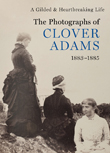 In May 1883, Clover Adams, a descendant of Boston’s Sturgis and Hooper families and the wife of the historian Henry Adams, picked up her camera and began taking photographs—of her husband, of afternoons at the beach on Boston’s North Shore, and of eminent friends who frequented the Adamses’ home on Lafayette Square in Washington, D.C., including Oliver Wendell Holmes, Jr., H. H. Richardson, Francis Parkman, George Bancroft, and John Hay. Examples of these photographs are on exhibit through 2 June at the MHS. Based on guest curator and MHS Fellow Natalie Dykstra’s book, Clover Adams: A Gilded and Heartbreaking Life, published by Houghton Mifflin Harcourt this month, the exhibition showcases Clover’s striking photographs, many of which have not been seen before in a public venue. It also highlights Clover’s many letters and the notebook she used to record the chronology and technical aspects of her photographs, as well as Henry’s letters and other family materials.
Clover Adams came from privilege, married into one of America’s first families, and presided over a celebrated salon in Washington, D.C. She had, as a friend noted, “all she wanted, all this world could give.” With her photography, she began an exploration of visual beauty that she also imbued with questions about life’s meaning and a woman’s place in her culture, conveying what she thought and felt not with words but with expressive, vital images. Inspiration for the composition of her photographs came from fine art she had seen and collected, and while her pictures could be playful—her “dogs at tea” is a perfect example—she could also evoke an intense feeling of loss, as with her photograph of the Arlington graveyard.
Clover’s life began to unravel just as she became adept with this powerful new technology for recording it . A recurrent undertow of dark moods gathered force until, on a Sunday morning in December 1885, Clover committed suicide by drinking from a vial of potassium cyanide. A chemical she needed to develop her photographs had become the means of her death.
Clover’s story has long been shrouded in mystery, yet she left behind clues. Most eloquent are her revelatory photographs, which invite us to look beyond the circumstances of her death and to stand with her in the world where she lived.
read more
Diary of Thomas Jefferson's Granddaughter Published
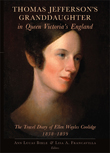 The Massachusetts Historical Society (MHS) announced the publication of Thomas Jefferson's Granddaughter in Queen Victoria's England: The Travel Diary of Ellen Wayles Coolidge, 1838-1839. The diary, part of the Society's collections, unveils the story of Ellen Wayles Coolidge and her experiences abroad. Co-published by the Massachusetts Historical Society and Thomas Jefferson Foundation, the book was edited by Ann Lucas Birle and Lisa A. Francavilla, and is distributed by the University of Virginia Press. Books are on sale at the Massachusetts Historical Society and will soon be available on amazon.com.
In June 1838, Ellen Wayles Coolidge traveled to London with her husband, Joseph Coolidge, Jr. During her nine-month stay Coolidge recorded details of her experiences abroad and of her conversations with writers such as Thomas Carlyle and Harriet Martineau. This volume brings the full text of her diary to publication for the first time with carefully researched annotations that provide historical context. “The publication of this book is the culmination of a wonderful collaboration between the Massachusetts Historical Society and Thomas Jefferson Foundation,” said MHS President Dennis Fiori.
London's docks, theaters, parks, public buildings, and museums all come under Coolidge's astute gaze as she and her husband travel the city and gradually gain entry into some of the most coveted drawing rooms of the time. Coolidge gives firsthand accounts of the fashioning of the young queen’s image by the artists Charles Robert Leslie and Sir Francis Chantrey and takes notes as she watches the queen open Parliament and battle the first scandal of her reign. Her love of painting reawakened, Coolidge chronicles her opportunities to view over four hundred works of art held in both public and private collections, acknowledging a new appreciation for the modern art of J. M. W. Turner and a fondness for the Dutch masters. Across the spectrum of her observations, Coolidge's diary is always strikingly vivid and insightful—and frequently quite funny.
Her diary entries also include memories of her family in Boston and Virginia. As she encounters her mother's schoolgirl friends and recalls the songs her grandfather, Thomas Jefferson, sang while working in his study, Coolidge's thoughts return to her youth at Monticello and the lessons she learned there.
The original four-volume travel diary that Coolidge wrote during her trip to England is housed at the MHS. In 1825, Ellen Wayles Randolph married a Bostonian, Joseph Coolidge, at Monticello and then moved to Massachusetts. The Coolidge family subsequently established a relationship with the MHS that would span generations. Thanks to the generosity of the Coolidge family, the Society is home to the second largest collection of Thomas Jefferson manuscripts and related family papers. Coolidge’s travel diary came to the MHS in 1964 thanks to Jefferson descendent Mary Barton (Mrs. Edward) Churchill.
Ann Lucas Birle, co-editor of the book, is a scholar at the Robert H. Smith International Center for Jefferson Studies at Monticello. She will give a presentation about Ellen Wayles Coolidge and her diary at the MHS on 2 February 2012 at 6:00 PM. A book signing will follow. Co-editor Lisa A. Francavilla is Managing Editor of The Papers of Thomas Jefferson: Retirement Series.
read more
The Purchase by Blood: Massachusetts in the Civil War, 1861-1862
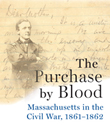 Following the surrender of Fort Sumter on April 13, 1861, Northerners rallied behind Pres. Lincoln’s call for states to send troops to preserve the Union. Opening October 7, the Massachusetts Historical Society’s exhibition The Purchase by Blood: Massachusetts in the Civil War, 1861-1862 follows a small group of officers—husbands, brothers, and friends of the first families of Massachusetts—through the first years of the Civil War. These young men, like so many, wanted to feel the glory of combat and enlisted with a sense of adventure and unquestioning patriotism. Not anticipated was the bloody aftermath of early conflicts—the Battle of Ball’s Bluff, the Seven Days Battle, the Battle of Cedar Mountain, the Battle of Antietam—and the horrifying loss of life and optimism. This exhibition showcases letters, photographs, broadsides, journals, and works of art surrounding one group of men as the cost of war is brought home to Massachusetts.
read more
UNIQUE SET OF REVOLUTIONARY-ERA NEWSPAPER VOLUMES REUNITED
AT THE MASSACHUSETTS HISTORICAL SOCIETY
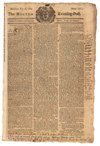 BOSTON, August 2011—The Massachusetts Historical Society (MHS) announced today the acquisition of the fourth volume of a set of Revolutionary-era Boston newspapers collected, annotated, and indexed by Harbottle Dorr, Jr., from 1765-1776. With the other three volumes already in the Society’s collections, volume four, covering the years 1772-1776, completes the set as originally compiled by Dorr. It was auctioned at James D. Julia, Inc., an auction house in Fairfield, Maine, on August 25. The purchase was made possible through a combination of gifts to the MHS from anonymous donors and a distribution from the Society’s acquisition fund.
read more