 The Sugar Act
 The Stamp Act
 The Formation of the Sons of Liberty
 The Townshend Acts
 Non-consumption and Non-importation
 The Boston Massacre
 The Formation of the Committees of Correspondence
 The Boston Tea Party
 The Coercive Acts
 The First Continental Congress
 Lexington and Concord
 The Second Continental Congress
 The Battle of Bunker Hill
 Washington Takes Command of the Continental Army
 Declarations of Independence
The American Party (the Know-Nothing Party) comes to power in Massachusetts in 1855
 The Massachusetts Election of 1854
The inauguration of Henry J. Gardner as governor of Massachusetts on 9 January 1855 marked a revolution in state politics. The American Party (the Know-Nothings) enjoyed great success in many state elections during 1854 and 1855, but its spectacular rise to power in Massachusetts was unparalleled. In the 1854 Massachusetts election, all successful candidates for statewide elected office were affiliated with the American Party. In addition, candidates supported by the American Party won elections for all forty seats in the state senate; all but three seats in the very large state house of representatives; the entire state delegation to the United States Congress; and many local government offices, including in the City of Boston. The vast majority of the Know-Nothing candidates were new to politics; only a very small number had held public office before the 1854 election.
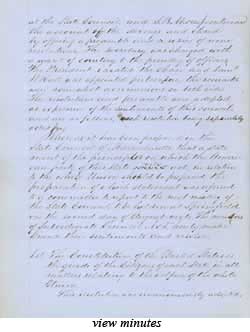
The minutes of the 11 July 1855 meeting of the East Boston Council of the American Party contain a declaration of party principles (see online display) that appeared in a somewhat different form in the Constitution of the State Council of the American Party of Massachusetts adopted on 7 August 1855 (see online display). The Massachusetts Historical Society holds the records of Subordinate Council No. 5 (the East Boston chapter) of the American Party of Massachusetts that include both the manuscript council minutes and the published party constitution.
Who were the Know-Nothings?The American Party earned the nickname of "Know-Nothings" because it was a secret patriotic/political organization with initiations, passwords, and closed meetings. 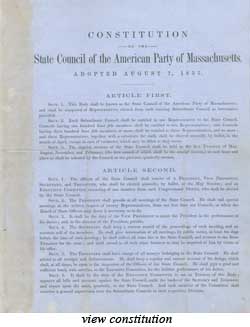 Members deflected questions about their party with the set phrase "I know nothing about it" and Know-Nothing became the popular name for the party. Many members of the American Party supported government reform and other progressive causes, but their central goal was to severely restrict the rights of immigrants -- specifically, Irish Catholic immigrants in Massachusetts, and large numbers of German (Catholic) immigrants elsewhere in the United States.
In the national election of 1856, the American Party was badly split over the question of slavery -- as was the entire country -- and the Know-Nothing Party candidate, former president Millard Fillmore was a distant third in the popular vote. A decline in the rate of immigration to the United States and the rise of other pressing national issues undercut the Know-Nothing agenda. In Massachusetts, however, Henry J. Gardner was reelected in 1855 and again in 1856 before losing to Nathaniel P. Banks in 1857. Banks previously had served as a Know-Nothing member of the United States Congress from Massachusetts, before running for governor as a candidate of the new Republican Party.
Billington, Ray Allen. The Protestant Crusade: 1800-1860: A Study in the Origins of American Nativism. New York: Macmillan, 1938.
Haynes, George H. "The Causes of Know-Nothing Success in Massachusetts," in The American Historical Review, Vol. 3, 1897-1898, 67-82.
Massachusetts. Governor. Address of his Excellency Henry J. Gardner, to the two Branches of the Legislature of Massachusetts, January 9, 1855. Boston: William White, 1855.
Mulkern, John R. The Know-Nothing Party in Massachusetts: The Rise and Fall of a People's Movement. Boston: Northeastern University Press, 1990.
Taylor, Steven. "Progressive Nativism: The Know-Nothing Party in Massachusetts," in Historical Journal of Massachusetts, Vol. 28 (2) summer 2000, 167-185.
Funding from the Massachusetts Society of the Cincinnati supported enhancements to this website.