 The Sugar Act
 The Stamp Act
 The Formation of the Sons of Liberty
 The Townshend Acts
 Non-consumption and Non-importation
 The Boston Massacre
 The Formation of the Committees of Correspondence
 The Boston Tea Party
 The Coercive Acts
 The First Continental Congress
 Lexington and Concord
 The Second Continental Congress
 The Battle of Bunker Hill
 Washington Takes Command of the Continental Army
 Declarations of Independence
African Americans and the End of Slavery in Massachusetts
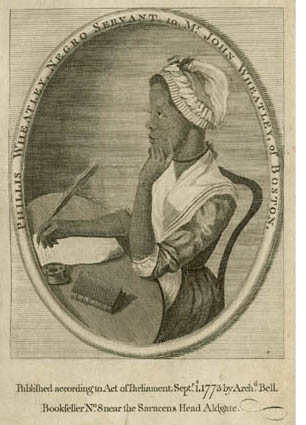 Phillis Wheatley was the author of the first book of poetry by an African American, published in London in 1773. Prior to the book's debut, her first published poem, "On Messrs Hussey and Coffin," appeared in 1767 in the Newport Mercury. In 1770, her elegy on the death of George Whitefield, a celebrated evangelical Methodist minister who had traveled through the American colonies, drew international attention and the particular interest of Selina Hastings, the Countess of Huntingdon. Whitefield had been the Countess's personal chaplain. Wheatley published numerous individual poems in addition to her book, Poems on Various Subjects, Religious and Moral, but a proposed second volume of poetry never appeared, and the manuscript was lost after her death in 1784.
Her Early Life
Born in West Africa about 1753, Wheatley was named for the slave ship, the Phillis, that brought her to Boston on 11 July 1761, and the Wheatley family who purchased her from the slave trader John Avery. John Wheatley was a prominent Boston merchant with a wholesale business, real estate, warehouses, wharfage, and the schooner London Packet. Susannah Wheatley was an ardent Christian and admirer of George Whitefield. A frail child between seven and eight years old, Phillis was chosen to be a domestic servant and companion to Mrs. Wheatley in her later years. Although she spoke no English upon her arrival in this country, she soon proved to be a precocious learner, and was tutored by the Wheatley's daughter Mary in English, Latin, history, geography, religion, and the Bible in particular. She was treated more as a member of the family than a servant or slave, and her education was that of a young woman in an elite Boston family. She was particularly well-acquainted with the classics, the Bible, and contemporary works, especially those of Alexander Pope, and these influences are readily apparent in her writing.
Fame and Misfortune
 Phillis's debut volume of poetry was first proposed in 1772, but this early venture was unsuccessful, and eventually she turned to an English publisher for her Poems on Various Subjects, Religious and Moral. In May of 1773 she accompanied the Wheatleys' son Nathaniel to England, where plans for the publication had begun, but she was called home by the illness of Mrs. Wheatley, and departed before the book appeared in September. While she met many notables in London, she was unable to see the Countess of Huntingdon, who was away in Wales for the summer. Shortly after her return to Boston, Phillis was freed by her master, possibly under pressure from her English admirers. Mrs. Wheatley died in March of 1774, and Phillis's life from that point was plagued by ill health and an unhappy marriage. She drew up proposals for a second volume of poetry which was never published, probably due to wartime shortages in Boston. Her marriage in 1778 to John Peters, a free African American living in Boston, produced three children, two of whom soon died. By 1784 she was living in a boardinghouse, and, in December of that year, she and her remaining child died and were buried in an unmarked grave.
Featured Items
Poems by Phillis Wheatley
- Poems by Phillis Wheatley, "An Address to the Atheist" and "An Address to the Deist," 1767
- Poem by Phillis Wheatley, "Atheism," July 1769
- "An Elegiac Poem On the Death of that celebrated Divine, and eminent Servant of Jesus Christ, the Reverend and Learned Mr. George Whitefield," 1771
- Poem by Phillis Wheatley, "A Poem of the Death of Charles Eliot ...," 1 September 1772
- Poems on Various Subjects, Religious and Moral (title page and frontispiece of 1773 edition)
- Poem by Phillis Wheatley, "To His Honor the Lieutenant Governor on the death of his Lady," 24 March 1773
- An Elegy, To Miss Mary Moorhead, On the Death of her Father, The Rev. Mr. John Moorhead, 1773
- An Elegy, Sacred to the Memory of the Great Divine, the Reverend and the Learned Dr. Samuel Cooper, 1784
- Poems on Various Subjects, Religious and Moral (title page and front matter of 1802 edition)
- "To the Right and Honorable William, Earl of Dartmouth ..." from Poems of Various Subjects, Religious and Moral (1802 edition)
- Earliest surviving verse by Phillis Wheatley, copied into Jeremy Belknap's diary
Letters by and about Phillis Wheatley
- Letter (copy) from Phillis Wheatley to Lord Dartmouth, 10 October 1772
- Letter from Phillis Wheatley to Obour Tanner, 19 July 1772
- Letter from John Andrews to William Barrell, 24 February 1773 and response from William Barrell to John Andrews, 22 March 1773
- Letter from S. Huntingdon [Selina Hastings, Countess Huntingdon] to Susannah Wheatley, 13 May 1773
- Letter from Phillis Wheatley to David Wooster, 18 October 1773
- Letter from Phillis Wheatley to Obour Tanner, 30 October 1773
- Letter from John Andrews to William Barrell, 28 January 1774
- Letter from Phillis Wheatley to Obour Tanner, 21 March 1774
- Letter from Phillis Wheatley to Obour Tanner, 6 May 1774
- Letter from Phillis Wheatley to Obour Tanner, 29 May 1778
- Letter from Phillis Wheatley to Mary Wooster, 15 July 1778
- Letter from Phillis Wheatley to Obour Tanner, 10 May 1779
Funding from the Massachusetts Society of the Cincinnati supported enhancements to this website.