
by Susan Martin, Senior Processing Archivist
In my last post for the Beehive, I wrote about the European revolutions of 1848. I’d like to follow up today by focusing on one particular revolutionary, Lajos Kossuth of Hungary.
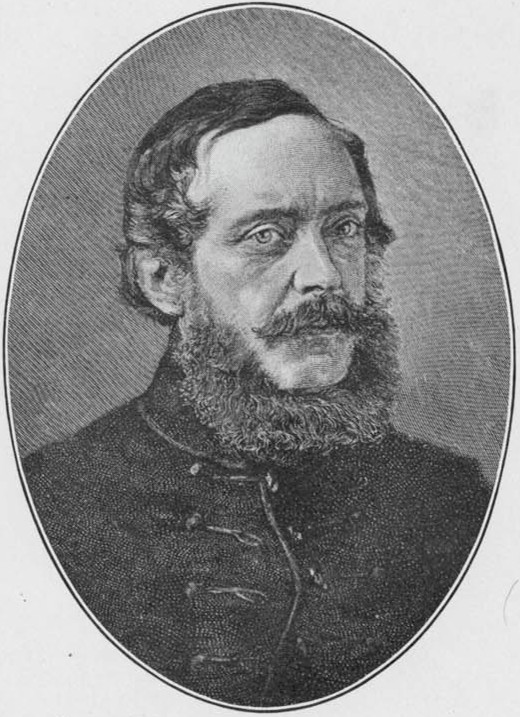
Lajos (often anglicized Louis) Kossuth served as leader of the Hungarian revolutionary government from 1848 to 1849. I wanted to write about Kossuth because his name appears frequently in manuscript collections here at the MHS, and I was intrigued. I’ve run across him in the Channing family papers, Caroline Wells Healey Dall papers, Joseph H. Hayward papers, Theodore Parker papers, Perry-Clarke additions, Catharine Maria Sedgwick papers, and many others. Several of our autograph collections include his signature.
The MHS also holds a number of books and pamphlets about Kossuth, including Authentic Life of His Excellency Louis Kossuth, Governor of Hungary (1851); Daniel Webster’s Sketch of the Life of Louis Kossuth, Governor of Hungary (1851); Kossuth in New England (1852); and White, Red, Black: Sketches of American Society in the United States During the Visit of Their Guests (1853). We have engravings of Kossuth and even three brass gaming tokens stamped with his name and likeness. He was clearly a phenomenon.
I won’t attempt the difficult task of summarizing the Hungarian Revolution of 1848 here, but I would like to discuss Kossuth’s popularity in the US, and Massachusetts in particular. Although the revolution failed, many Americans admired and sympathized with Kossuth.
He visited the US between December 1851 and July 1852 to raise money for Hungarian independence from the Austrian Empire and to advocate for American intervention against Russia, Austria’s ally. He was feted everywhere he went. Newspaper articles filled with breathless exclamation points tracked his every move. Enterprising hatters even started selling “Kossuth hats.”
His itinerary included a meeting with President Millard Fillmore at the White House. He also addressed a joint session of Congress, only the second foreigner to do so after the Marquis de Lafayette 28 years before.
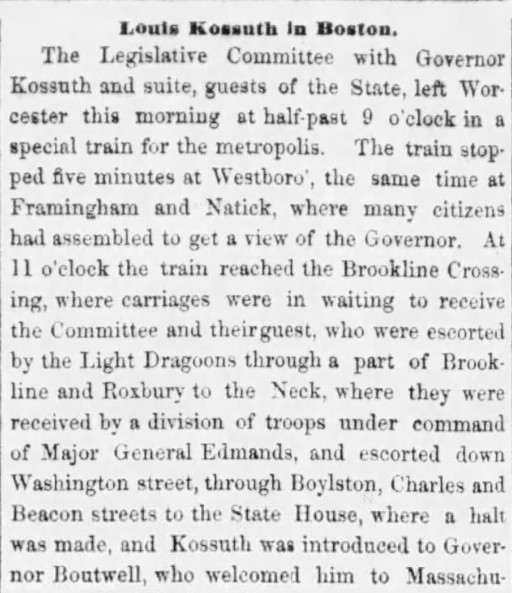
Kossuth arrived in Boston on 27 April 1852, coincidentally his 50th birthday. His enthusiastic welcome by Bostonians is described in Kossuth in New England: “On the whole route to Roxbury line, the windows were full of ladies, who waved their welcome with their handkerchiefs, and the streets were literally crammed with people.” (p. 68) Buildings were draped with the Hungarian, American, and other flags, and banners compared Kossuth to George Washington.
By all accounts, Kossuth was a skilled and fascinating orator, and people flocked to hear his speeches. Author Catharine Maria Sedgwick heard one and later wrote to her niece, “I never had so profound an impression from the presence of any human being.” Lawyer Tracy P. Cheever gushed in his diary, “I rejoice in the privilege of having heard one of the greatest Orators and Patriots (as I suppose) of modern days!”
Of course, admiration for the Hungarian revolutionary was not universal. In the pages of The Liberator and elsewhere, abolitionists repeatedly and vociferously criticized Kossuth for his silence and hypocrisy on slavery, even after he witnessed it first-hand in the southeastern states. This issue became a dark cloud over his otherwise celebrated visit and may have contributed to his abrupt and unobtrusive departure from the country.
In the end, Kossuth left the US with donations and well wishes from supporters, but Americans had no appetite at that time for involvement in foreign conflicts.
Lajos Kossuth died in Italy in 1894 at the age of 91. He is buried in Budapest.