
Silent Sentinel, Silent Witness: Reflections upon Fort Washington & the Siege of Boston

by Aaron Peterka, MHS Early Career Scholar Committee & Mentorship Program Member

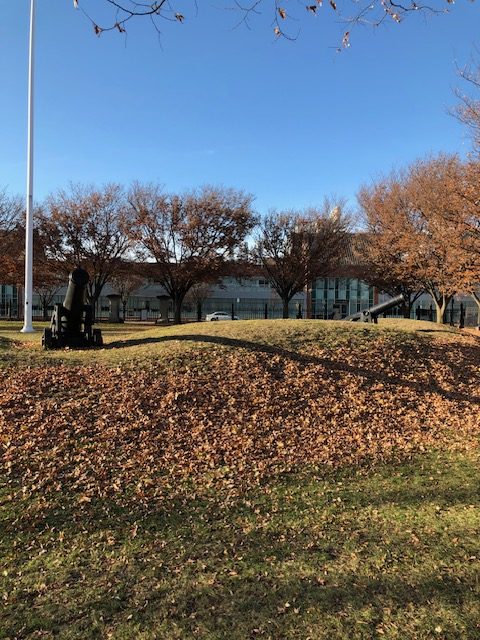
At 95 Waverly Street in Cambridgeport, a silent sentinel still keeps watch. Its four earthen mounds, cradling three eighteen-pound cannons, still face eastward towards Boston, standing at the ready for a long-departed foe from a long-ago war. This is Fort Washington. A relic from the beginning of the American Revolution, this unimposing redoubt is all that remains of the fortifications that besieged the British army in Boston from April 1775 to March 1776. As the country marks the Revolution’s semiquincentennial anniversary, it is all together appropriate to reflect upon Fort Washington and its testimonial to the perilous origins of an army and the embryonic country for which it fought.
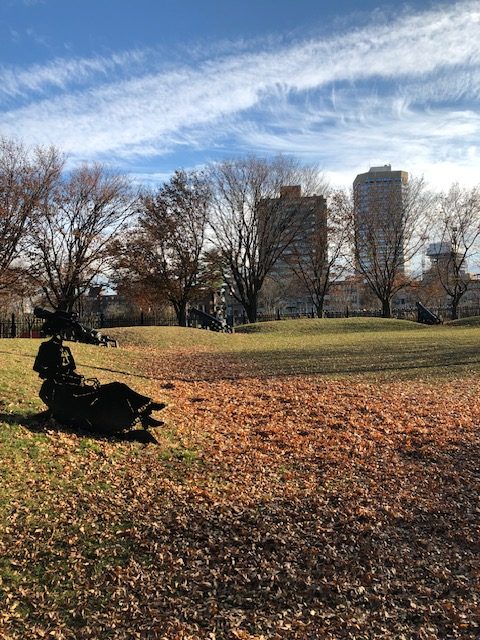
Photo of a grassy area with some cannons. Large buildings and trees are in the background.
Facing east, Fort Washington’s three 18-pounder guns positioned between earthworks dug by the Continental Army besieging Boston in 1775-1776.
Courtesy of Aaron Peterka.
Photo of a grassy mound with two cannons on it
Looking west into Cambridge. Although not the originals, the cannons date from the Revolutionary era, while the gun carriages are from the 1850s.
Courtesy of Aaron Peterka.

Fort Washington’s service began on a simple piece of paper upon which General George Washington penned a letter to Lieutenant Colonel Joseph Reed on November 27, 1775. When he first arrived in Cambridge that July to take command of the fledgling Continental Army, he found the fortifications woefully inadequate for a siege, with “shallow redoubts on Winter Hill and Prospect Hill,” a “crude abatis on the Boston Road,” a mere trench stretching across Roxbury’s main street, and a single “breastwork on Dorchester Road.” Rightly concerned with such vulnerabilities, the general labored to improve the American defenses through the coming months, and it was under this labor in the fall of 1775 that he informed Reed that he “caused two half Moon Batteries to be thrown up, for occasional use, between Litchmores point to command that pass, & rake the little rivulet which runs by it to Patterson’s Fort.” Washington also commissioned the construction of three other fortifications “between Sewells point, & our Lines on Roxbury Neck” to further reinforce the American lines.

These fortifications are clearly visible on the Henry Pelham Map from 1775 in the Massachusetts Historical Society’s collection, with Fort Washington appearing as the “3 Gun Battery” sitting along the Charles River just before it empties into Boston Harbor. Today, modern Cambridge surrounds the fort, but in 1775, it commanded both the river’s mouth and the southernmost extremity of a meadow that is now part of the MIT campus. This strategic position contributed to Washington’s goal of preventing a British “Sortee, when the Bay gets Froze” and securing Cambridge from attack. Designed to accommodate roughly 50-60 soldiers, the earthen redoubt took the name of the American general-in-chief, its garrison scanning the marshy approaches for any sign of British encroachment. Although there is no record of the fort having ever fired its guns in anger, it nevertheless served an important purpose; a brick in the greater wall that Washington designed to restrict General William Howe’s freedom of movement. And yet, Fort Washington’s service transcends the realm of strategy.

Beyond its military utility, Cambridge’s redoubt gives testament to the harsh realities that confronted the infant American army outside of Boston. In another letter to Reed dated November 28, 1775, Washington conveyed his fears of dwindling gun powder supplies, writing that the vital commodity was “so much wanted, that nothing without it can be done.” Also weighing heavily upon Washington was the omnipresent threat of British spoiling attacks and counter-strikes. Indeed, the general expressed his expectation that the British would interfere with the digging of the “Letchmores point” earthworks, “unless Genl Howe is waiting the favorable moment he has been told of, to aim a capitol blow.”

Facing a growing force of British regulars with an army of untrained civilian-soldiers and his supplies dangerously low, General Washington confided to Reed that had he been able to foresee the dismal state of affairs outside Boston, “no consideration upon Earth should have induced me to accept this Command.” Thus, Fort Washington is both a literal product and reflection of the crisis of 1775, wherein the siege of Boston, even the survival of the Revolution, was in doubt. Erected out of military exigency, the Cambridge earthworks remain a physical reminder that no cause, no revolution, no fight for independence, is ever guaranteed.     

Further Reading:

“From George Washington to Lieutenant Colonel Joseph Reed. 27 November 1775,” Founders Online, National Archives. https://founders.archives.gov/documents/Washington/03-02-02-0401.

“From George Washington to Lieutenant Colonel Joseph Reed. 28 November 1775,” Founders Online, National Archives. https://founders.archives.gov/documents/Washington/03-02-02-0406.

“Fort Washington,” https://historycambridge.org/Cambridge-Revolution/Fort%20Washington.html.

Robert Middlekauf. The Glorious Cause: The American Revolution, 1763-1789. Oxford: Oxford University Press, 1982.
The Diaries of Henrietta Maria Schroeder Stout, Part I

by Susan Martin, Senior Processing Archivist

I’d like to introduce you to a young woman named Henrietta, whose diaries form part of the Stout family papers here at the MHS. This post will be the first in a multi-part series.

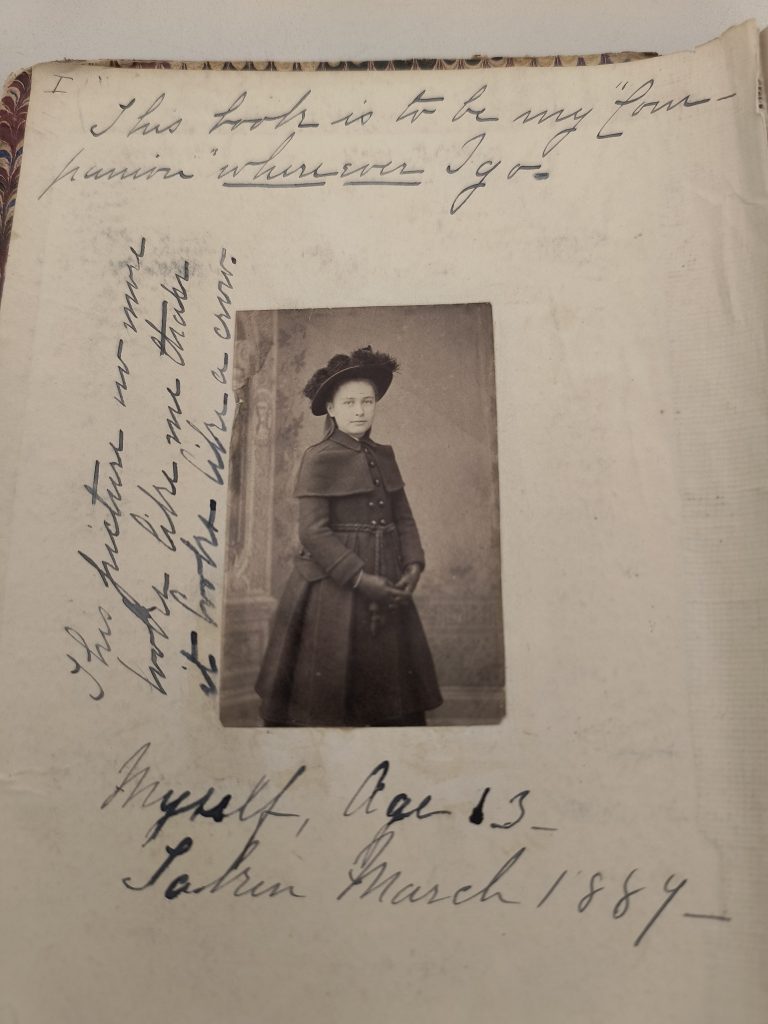
Color photograph of one page of a manuscript volume with some creases and stains. In the center is a black and white photograph of a white girl wearing a dark coat, dark hat, and dark gloves. She is standing, and her fingers are interlocked in front of her. Below the photograph is written, in black and white ink, “Myself, age 13, taken March 1889.” Along the side of the photograph is written, “This picture no more looks like me than it looks like a crow.” At the top of the page is written, “This book is to be my companion wherever I go.”
Inside front cover of Henrietta M. Schroeder’s 1889 diary, including her photograph, taken March 1889, and the text: “This picture no more looks like me than it looks like a crow.”

Henrietta Maria Schroeder, or “Yetta,” was born in New York on October 9, 1875. Her father, Francis Schroeder, had been a diplomat, ambassador to Sweden, and superintendent of the Astor Library. Francis had had two children with his first wife, Caroline (née Seaton), and four with his second wife, Lucy (née Langdon). Henrietta was Lucy’s third child.

The Stout collection includes four of Henrietta’s diaries, two kept as a young teenager and two kept in her twenties. The first starts on June 27, 1889, when she was thirteen and on a trip through Europe with her mother and three siblings, Langdon, Lucy, and Harry. I was immediately drawn to the diaries because of how lively, creative, and sometimes laugh-out-loud funny they are. I think Henrietta will sound familiar to anyone who knows (or is) a thirteen-year-old. To give you a taste of her style, here’s an entry she wrote about the ocean voyage to Europe.

In the first place I was ill: not actively so, but I was ill. Days and days passed which seemed like years, but still I was ill, at last Mamma called the doctor, and such a doctor, […] and he gave me some lime water, & some awful stuff that tasted just like pepper and vinegar, but he cured me just the same! […] He is the most “blasted English don cher know” thing I ever saw, and I burst out laughing every time I see him. He waxes his mustache into spears about 4 inches long.

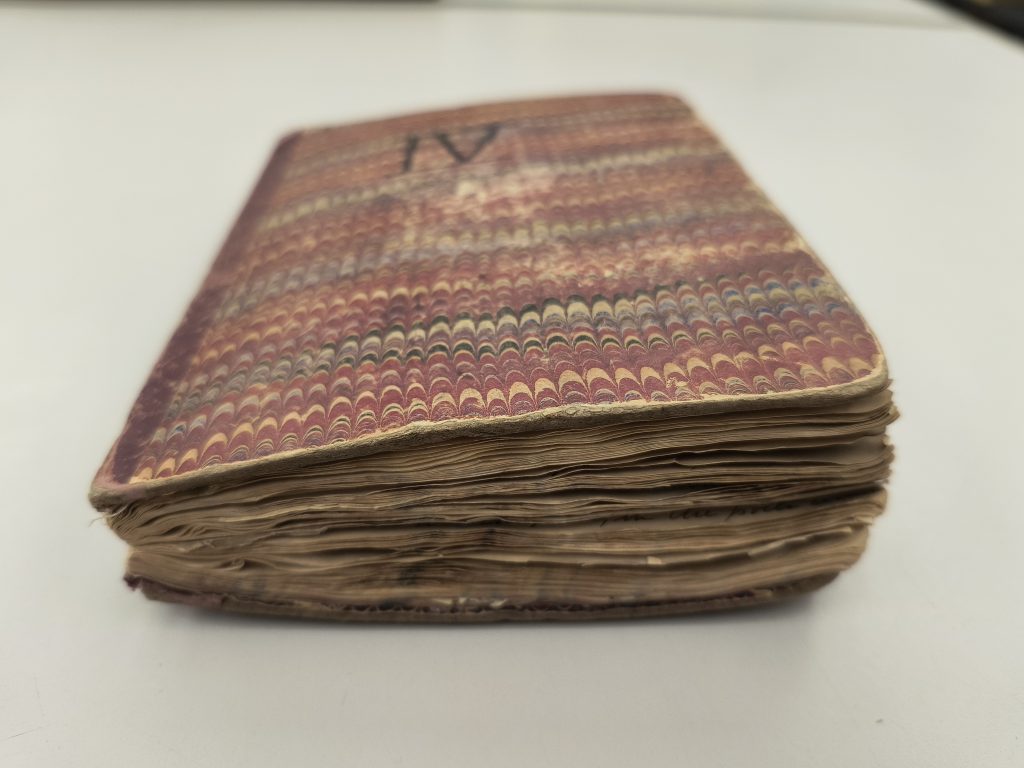
In addition to Henrietta’s entertaining run-on sentences and stream-of-consciousness anecdotes, the diaries also contain her original sketches and objects she added as illustrations or keepsakes. Here’s a partial list of items she pasted or pinned to the pages: letters, photographs, ticket stubs, menus, flowers, feathers, leaves, ribbons, wax seals, a piece of lead from a pencil-making factory, a piece of stone from Chester Cathedral, and a pouch of sand from the shores of Loch Katrine. You can see how overstuffed the volume is.

Color photograph of a volume on a table. The cover has a marbled pattern and the letters “IV” written on it in black ink. The pages of the volume are bulging out of its binding.
The 1889 diary of Henrietta M. Schroeder

As you can imagine, volumes like this are a preservation nightmare for archivists and conservators. Organic and acidic material will stain and degrade the pages. In most cases, all we have the time and the resources to do is stabilize the volume and prevent any further deterioration by housing it in an appropriate container and storing it in our climate-controlled stacks. We also often interleave the pages with tissue to protect them.

But the very same thing that makes these diaries tricky from a preservation standpoint also makes them interesting from a historical standpoint. The inserted material is fully integrated into the narrative, adding context and (literal!) texture to Henrietta’s stories. I love how free-wheeling and genre-bending it all is, this first diary in particular. Henrietta has taken a volume that cost her, she says, just 28 cents and turned it into a unique, interesting, and very fun historical document.

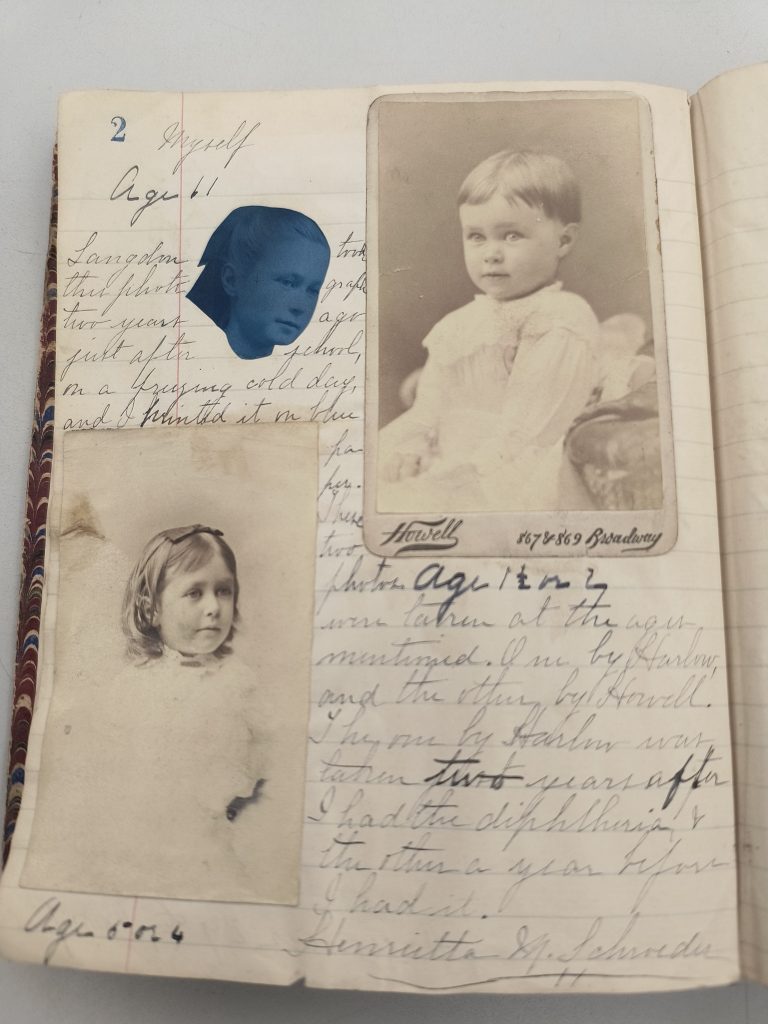
Color photograph of one page of a manuscript volume. At the top of the page is written, in black ink, the heading: “Myself.” Pasted to the page are three photographs of the same girl at different ages. Next to the photographs are written, “Age 1 ½ or 2,” “Age 5 or 4,” and “Age 11.” The page includes handwritten text around and between the photographs.
Page of Henrietta M. Schroeder’s 1889 diary including three photographs of herself at different ages

I look forward to telling you more about Henrietta in future Beehive posts.

Volunteer as a Judge for Massachusetts History Day!

by Alexandra Moleski, Massachusetts History Day Program Coordinator

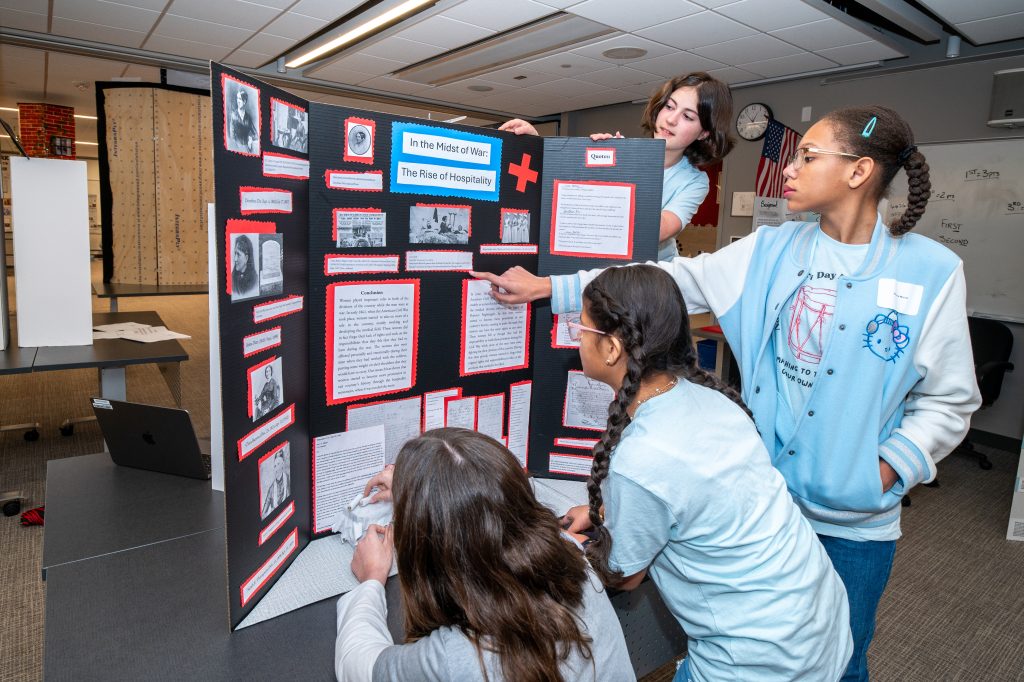
Four young students are looking at a trifold exhibit board, the student in the middle pointing their finger at a label on the board

Calling all history enthusiasts–the 2026 Massachusetts History Day (MHD) contest season is here and judge registration is officially open! The MHD team has a lot of fun updates this year, and we would love to have you join us. All you need is a love of history–no experience or prior knowledge required!

Massachusetts History Day is a project-based learning program in which students grades 6-12 conduct research on a historical topic of their choice and present their work as a documentary, website, performance, paper, or exhibit. And this year, we’re thrilled to launch a new project category–the podcast! Students will have the opportunity to explore the 2026 theme Revolution, Reaction, Reform in History through storytelling.

We’ve also added two new contests this year: the Boston Metro Regional Showcase at the John F. Kennedy Presidential Library and Museum, and the Western MA Regional Showcase at Mater Dolorosa Elementary School.

We are so grateful to our MHD judges, and we are so excited that a new project category and two new contests allow us to welcome many more enthusiastic judges this contest season. Judging is a great opportunity to learn from and celebrate our student historians and their hard work. You will:

  • Be assigned to a small judging team, as well as a specific age division and project category
  • Review student research projects and their project paperwork
  • Interview the students using sample questions provided to you
  • Work with your team to determine the rankings and provide written feedback for each project
  • Receive a judging orientation and all the information you need beforehand
  • Enjoy breakfast, lunch, coffee, and sweet treats on us!

Visit https://www.masshist.org/masshistoryday/judges for more information on MHD contests, the judging experience, and how to register.

Are you an educator? Join us as an MHD judge and earn professional development points. Teachers who judge at a contest/showcase will receive 10 PDPs per event.