
Commemorating the 250th Anniversary of Dr. Joseph Warren’s Funeral

By Rakashi Chand, Reading Room Supervisor

April 8, 2026, marks the 250th anniversary of the funeral of Dr. Joseph Warren, whose death at the Battle of Bunker Hill helped define the beginning of the American Revolution. After nine months in a shallow grave on the battleground on Breed’s Hill, his remains were recovered following the British evacuation of Boston and brought into the city for a ceremony that united Americans in renewed resolve.

Only thirty-four years old; a widower with four young children; newly engaged; admired for his intellect, courage, and striking presence; Warren was a leader of the colonists’ rebellion and embodied the promise of a rising nation. His death in battle quickly became a catalyst that spread revolutionary fervor throughout the colonies. Some historians have speculated that had he survived, Americans might today walk along “Warren Street” in every major city instead of “Washington Street.” News of his death raced through colonial newspapers, carrying shock and sorrow to communities that had never seen his face yet mourned him as one of their own.

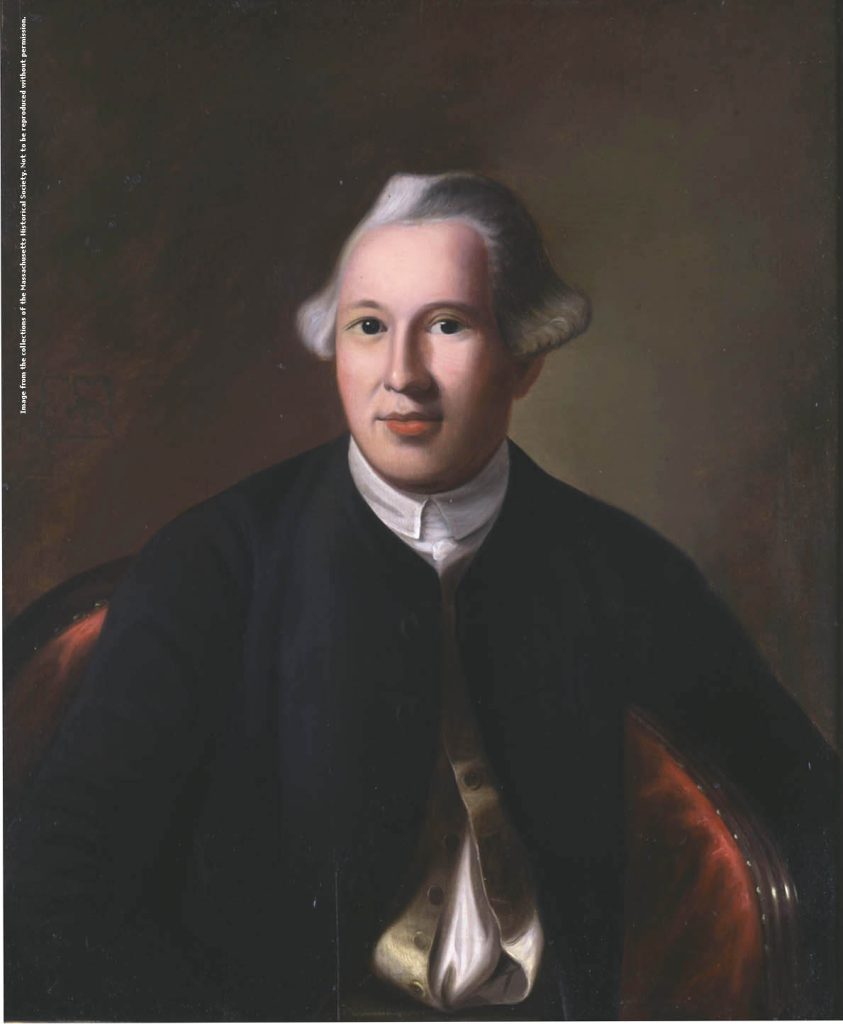
Oil painting of man with white wig and dark coat
Joseph Warren, by Edward Savage, after portrait by John Singleton Copley

By the time his remains returned to Boston for burial in April 1776, Warren had become the Revolution’s first great martyr—a figure whose courage at Bunker Hill and choice to fight beside ordinary militiamen rather than take command captured the spirit the colonies were beginning to claim as their own.

No contemporary voice captures the meaning of that day better than Abigail Adams. In a letter dated 7-11 April 1776 she wrote to her husband, John Adams:

“Yesterday the Remains of our Worthy General Warren were dug up upon Bunker Hill and carried into Town and on monday are to be interred with all the Honours of War.”

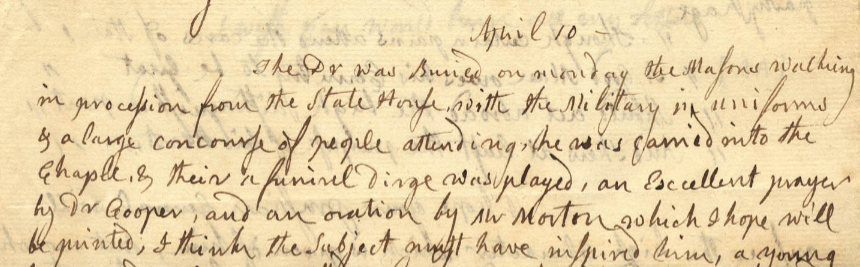
Three days later, she described the funeral itself:

“The Dr. was Buried on monday the Masons walking in procession from the State House, with the Military in uniforms and a large concourse of people attending… The amiable and heroic virtues of the deceased… the noble cause to which he fell a Martyr… must give weight and energy to whatever could be delivered upon the occasion.”

Handwritten letter in ink
Excerpt of letter from Abigail Adams to John Adams, 7 – 11 April 1776

Her account evokes a city still bearing the scars of occupation, now gathered around Warren’s body “like that of Caesar’s before their Eyes” to confront the cost of liberty. The funeral procession made up of Masons in regalia, militia in uniform, and citizens in great number was one of the largest public gatherings Boston had seen since the outbreak of war.

Inside King’s Chapel, young attorney Perez Morton delivered an Eulogy that gave voice to the dead themselves. His most powerful passage urged the living to understand the depth of their betrayal and the justice of their cause:


“Ought we not to listen to the Voice of our slaughtered Brethren, who are now proclaiming aloud to their Country—

Go tell the King, and tell him from our Spirits,

That you and Britons can be Friends no more;

Tell him to you all Tyrants are the same:

Or if in Bonds, the never conquer’d Soul

Can feel a Pang, more keen than Slavery’s self,

‘Tis where the Chains that crush you into Dust,

Are forg’d by Hands, from which you hop’d for Freedom.”


Not merely a break with Britain, but the recognition that the oppression now suffered came from those once trusted to protect. For the mourners gathered around Warren’s coffin, this was not rhetoric, it was lived experience. For a city emerging from siege, the ceremony was both a memorial and a moment of political awakening.

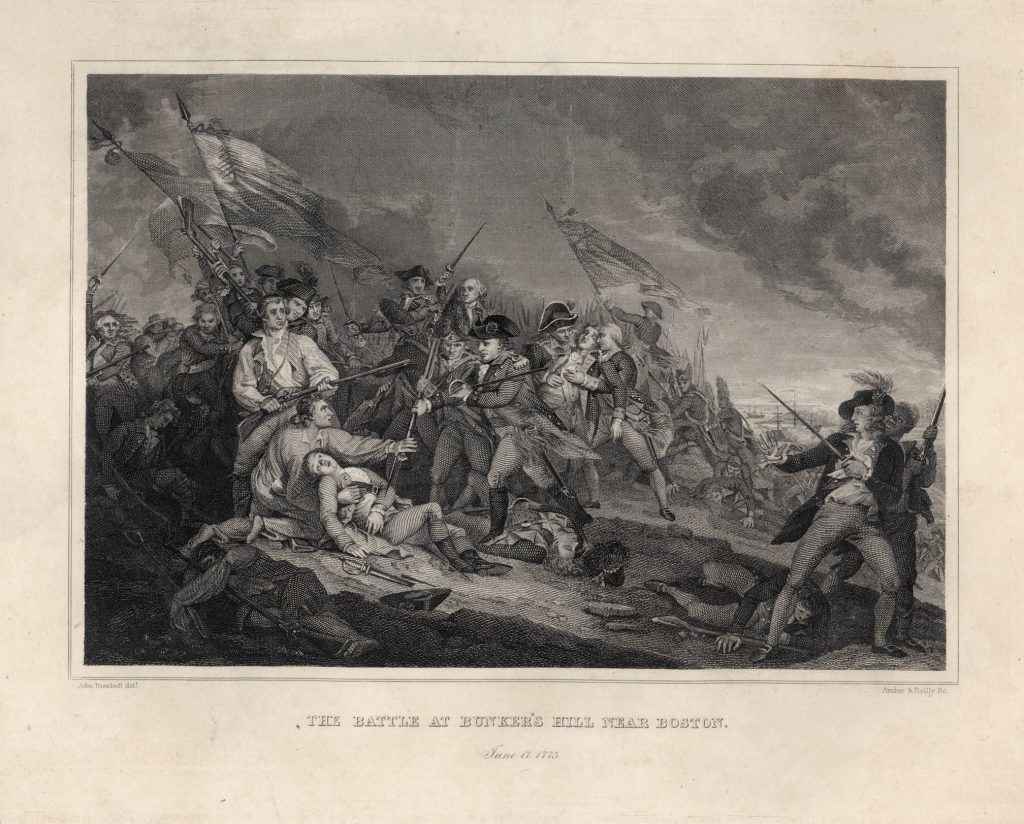
Engraved scene of battle. In the foreground a crowd of soldiers gathers around a fallen man.
The Battle at Bunker’s Hill Near Boston. June 17, 1775, Engraving after painting by John Trumbull, 1786.
John Trumbull’s paintings of The Death of General Warren at the Battle of Bunker’s Hill visually framed Warren as a martyr whose sacrifice sanctified the cause of Revolution.

On this 250th anniversary, we remember that Warren’s funeral was not merely an act of mourning. It was a public reckoning with sacrifice, betrayal, and the moral necessity of separation. In honoring Warren, the city made its own symbolic declaration of independence, months before Congress put the sentiment into words.

Visit the Massachusetts Historical Society for an in-person look at the documents that declared independence in the current exhibition 1776: Declaring Independence.

Further Reading:

Letter from Abigail Adams to John Adams, 7 – 11 April 1776

MHS Collections Online: John Rowe diary 13, 8 April 1776, pages 2136-2138

Perez Morton’s 1776 eulogy for Joseph Warren

Early Forensic Odontology – The Dr. Samuel D. Harris National Museum of Dentistry The effort to recover Warren’s body led to the first documented use of forensic dentistry in America, when Paul Revere recognized the wire and dental work he had placed in Warren’s mouth identifying his remains.

“Salted Cod, According to the Weather”

By Morgan S. Hardy, Mary B. Wright Environmental History Fellow (2025-2026)

It had been eleven years since loyalist Samuel Quincy left his hometown of Boston, Massachusetts. The Harvard-educated lawyer and friend of both John Adams and John Hancock fled Boston after the fighting at Lexington and Concord in 1775. Despite his self-exile, Samuel Quincy missed the comforts and staples of New England. In particular, he missed the taste of freshly salted Atlantic cod. In a letter dated March 4, 1786, Quincy wrote, “My Mouth has watered for their salt-Fish ever since your last letter.” Then, lamentingly, Quincy wrote, “I fear I never shall taste the Relish of the Quintal you say you bought for me.” Quincy never returned to Massachusetts after passing away in 1789.

Black and white illustration
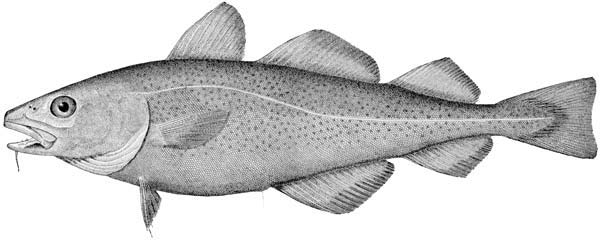
Image of Cod fish
From George Brown Goode, The Fisheries and Fishery Industry of the United States, (Washington, D.C.: Washington Government Printing Office, 1884), plate 58A. Drawing by H. L. Todd.

Salted Atlantic cod was New England’s most profitable export in the eighteenth century. This export was made possible through “curing,” a commercial process designed to prevent decay and turn perishable fish into durable products. However, only about two-fifths of the cured fish qualified as “merchantable” and were shipped to Spain, Portugal, and Italy for substantial profit. The remaining three-fifths were labeled as “refuse” fish. These badly cured, oversalted, or sunburned fish, among others, were sent to feed chattel slavery on Caribbean plantations. Fishers, shoremen, fishmongers, and parliamentary lobbyists all knew that nature influenced how well a fish cured.

Various weather conditions and fierce storms were among the notorious factors affecting the daily fishing life in New England. Fishers had to be hardy persons who were “oblig’d to life at the Mercy of the Winds, and [who] are often expos’d to Storms.” Good weather was always preferred for fishing, but it was never guaranteed. In September 1775, a giant storm struck the North American coast from Virginia to Newfoundland. A storm surge, over thirty feet high, wrecked the coast and caused chaos among the Newfoundland fishing fleet. It’s estimated that 4,000 people, mostly fishers, lost their lives. Storms and unpredictable weather emphasize the vulnerability of eighteenth-century fishing communities, making it tough to find, secure, and process salted Atlantic cod.

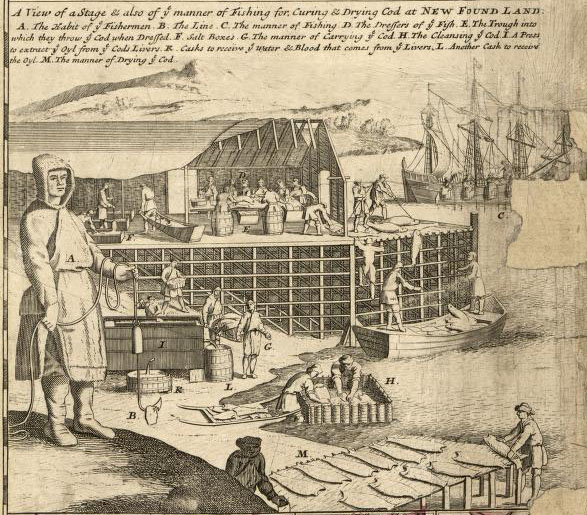
Printed image showing a shore line and men doing multiple activities.
“A View of a Stage” depicting “the manner of Fishing for, Curing & Drying Cod.” This image is from a map by English cartographer Herman Moll published in 1718 based on a 1698 map by French cartographer Nicolas De Fer.
Library of Congress, Geography and Map Division.

Being exposed to the “inclemencies of the severest weather [and] the dangers of the turbulent Atlantic” meant that New England fishers had to read the signs of the weather. This was helpful not only to avoid disasters while fishing but also for locating baitfish. New England fishers caught large amounts of baitfish, including herring, alewives, capelin, and squid, to catch other species such as the prized Atlantic cod and mackerel. John Knox, a Scottish philanthropist aiming to expand England’s fishing industry, reported in 1785 that “young herring always come in a body some time in June [but] their stay depends on the wind and weather.” Knox also noted that “herring shoals are subjected to the “tides, currents, and bays.” New England fishers relied on their understanding of weather patterns and the ocean’s depths to efficiently find, catch, and process the fish that supported their livelihoods. This knowledge was gained through extensive time at sea.

Samuel Quincy’s home of Boston was supported by fishers who understood that the environment posed a challenge to curing cod effectively. A fisher’s work, toil, and knowledge of the sea proved invaluable in making cod a profitable export and a local favorite. Salted cod’s unique, briny flavor was still prevalent to Samuel Quincy after almost a decade of fleeing Boston. Perhaps the next time you find yourself in Boston, try the salted cod—and remember that nature has been undermining human schemes for centuries.

Further Reading:

Letter from Samuel Quincy written from Tortola, March 4, 1786, Quincy Family Letters, Massachusetts Historical Society. Please note that a quintal was about 112 pounds of salted cod.

For how fishers were exposed to the elements, see “The Importance and Management of the British Fishery Consider’d,” (London, 1720), Folger Shakespeare Library, Washington, DC.

Chuck Lyons, “The Independence Hurricane: Chuck Lyons Examines the Events Around a Massive Storm That Brought Destruction to Newfoundland, and Likely Helped to Determine the Outcome of the American Revolution,” History Magazine 14.4 (Toronto: 2013): 24–26.

For inclemencies and herring, see John Knox, “A View of the British Empire: More Especially Scotland: with some Proposals for the Improvement of that Country, the Extension of its Fisheries, and the Relief of the People,” Volume 1 (London, 1785), Massachusetts Historical Society.