Remembering Fernald: Uncovering the Hidden History of Disability in Massachusetts

by Meg Szydlik, Visitor Services Coordinator

On February 12, 2026, the MHS welcomed Alex Green of the Harvard Kennedy School to give a talk on his book, A Perfect Turmoil: Walter E. Fernald School and the Struggle to Care for America’s Disabled. Green’s research has been ongoing, so he included information in his talk that he has uncovered since publication. It was a fascinating glimpse into a subject I have been researching in the MHS collection with my Disability in the Archive series, which you can check out in the further reading section. Green’s work looks at the ways disability was treated in Boston’s own backyard at the Walter E. Fernald State School in Waltham, Massachusetts.

Book cover is a grid of images. Most grids show a three-story stone building, which is placed differently and rotated in each box. One box is a photograph of an older man in a hat.
Green’s book A Perfect Turmoil: Walter E. Fernald School and the Struggle to Care for America’s Disabled.

Green took us through the context around the creation of the Fernald School. He complicated the narrative of Walter Fernald, the man who founded the school, who was neither good nor evil. Through Green, the audience understood that Fernald was a man who was trying his best, even when his best failed people. Fernald was a eugenicist who eventually changed his opinion and fought against his prior beliefs. Green discussed the way the Fernald School was set up and the impact this particular school had on the education of disabled children in the United States, and later the world. Fernald believed that hard work and busyness could improve disabilities. Green pointed to the way the theories Fernald espoused are still present in special education practices around the United States today, and even presented his own rather radical idea that there should be no separation of disabled and abled children in schools.

However, Green did not shy away from the damage that Fernald’s theories created. He showed image after image of truly horrifying ways the students were treated, including being locked up, chained, and other brutalizations. Much of what he described was remarkably similar to the things I read in Dorothea Dix’s texts about the treatment of disabled people in jails and almshouses. The cruelty is still startling to me, no matter how many descriptions of it I read or images I see. And Green was clear about how cruel these things were. He was clear too about how that cruelty extended to the way the school handled the health and safety of these students. Those who died while attending the Fernald School, as well as the Metropolitan State Hospital, are buried in a cemetery on the grounds. I have been to the cemetery myself and the anonymity of the graves is as striking as Green said. It is not meant to be a place for loved ones to come and weep. And that is even more clear from Green’s explanation that sometimes families were never told what happened to their loved one who entered the school.

The research Green has done is not without controversy or challenges. Even accessing the records of the Fernald School at the Massachusetts State Archives was difficult, as a state law requires that an individual’s medical records remain private after their death, even to family members. He was able to get a court order to unseal them, but he noted his belief that these records should be accessible to survivors and family members without such extreme measures and described his frustration that only an Ivy League professor could access them. He also emphasized that much of the restricted material did not seem to be medical records at all, including drawings done by residents of the school and hospital. The issue of access to information is further complicated by the lack of centralization. As hospitals and schools closed, many of the records did not go to a single location or even an archive at all. In fact, many of these records have been sold on eBay and other similar sites in the ensuing years. It is a multi-pronged problem with no clear solution.

Green shared an important story. The brutality of what happened in these schools should not be forgotten or swept under the rug. The same ideas that formed the Fernald School are still present in American society today, as Green pointed out by linking the philosophy of Fernald to modern special education. Green demanded an unflinching look at the treatment of disabled people, one with compassion towards all but particularly towards the victims of an abusive system. It was a good reminder, and one we should take care to listen to.

Further Reading of the Disability in the Archive Series
Freaks and Geeks

Insanity and Institutions

Veteran Voices

Fairies or Workers?

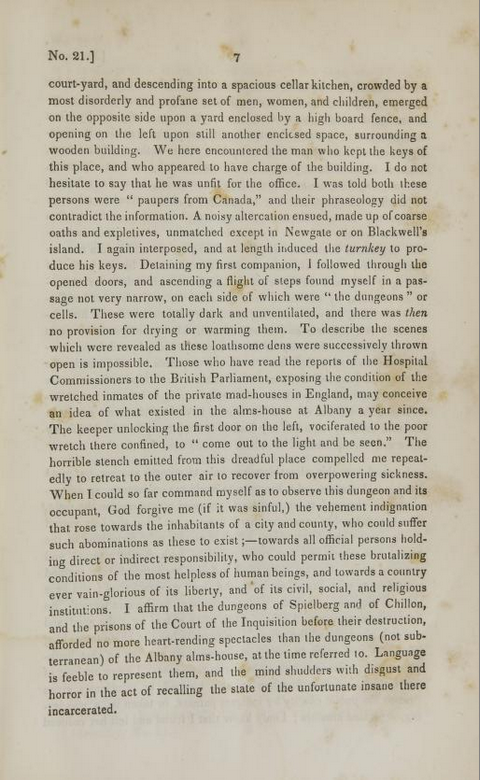
The Mind Shudders With Disgust

“The Mind Shudders with Disgust”: Dorothea Dix’s Crusade for Insane Asylums

By Meg Szydlik, Visitor Services Coordinator

Content warning: use of 19-century terminology to describe individuals with disabilities.

I’ve written before on Dorothea Dix’s writings regarding those she referred to as the “insane” here in Massachusetts. Since she was a very prolific writer and advocate in the 19th century, I was curious what else the MHS had of hers. When exploring the MHS library catalog, Abigail, I found that we held three additional addresses to state legislatures—New York, Pennsylvania, and Tennessee, out of the twelve total she wrote.

Curious if they were similar to her statement to the Massachusetts legislature, I examined their contents. And while each address was related to a different state and focused on slightly different arguments, her message of humanization and care is consistent throughout the four speeches. Her legacy in driving the creation of asylums and hospitals for disabled people, ultimately, is mixed, but her intentions are clear. She pulled no punches, saying that “God forgive me (if it was sinful,) the vehement indignation that rose towards the inhabitants of a city and county, who could suffer such abominations as these to exist;— towards all official persons holding direct or indirect responsibility, who could permit these brutalizing conditions of the most helpless of human beings.”

In her Memorial: To the Legislature of Massachusetts, Dix devoted a lot of time to the slow and careful unveiling of the ways the state, counties, and cities had failed the “insane” and the “idiots” (her terms, using the technical language of the 19th century). And there were many. She tracked the brutalization and cruelty exerted against people deemed insane, a thread that continued in her other texts as well, though none so intensely as in her statement to the Massachusetts legislature. The descriptions of cages, chains, beatings, and intentional isolation were meant to horrify and therefore motivate the different legislatures to make monumental policy changes. She called on the Massachusetts legislature to “commit to [the legislature] this sacred cause. Your action upon this subject will affect the present and future condition of hundreds of thousands.” This call-to-action rang across the states and even rings into today.

typewritten page 7 of the Memorial, to the Honorable the Legislature of the State of New-York
Page from of the Memorial, to the Honorable the Legislature of the State of New-York

Her arguments were effective, particularly when it came to her calls for states and counties to open hospitals and asylums to care for disabled people, and they were heeded in state after state. Her position was certainly logical, since the primary institutions previously used for this purpose were jails and almshouses. She repeatedly argued that a hospital would allow those whose insanity was “curable”—and thus could be made into something palatable—to recover and become productive members of society.

It is interesting to read these arguments in favor of insane asylums and mental hospitals with the knowledge of what these institutions ultimately became. Her statements about almshouses in New York that “language is feeble to represent them, and the mind shudders with disgust and horror in the act of recalling the state of the unfortunate insane there incarcerated,” could also be said of many mental hospitals. Even the Metropolitan State Hospital here in Massachusetts has a long, ugly history of abuse, covered here by WBUR. Hospitals are just as dependent as other institutions on the ethics of those in charge, and, as Dix wrote, “if public institutions are not guarded from such shameful abuses, I do not know why they should not be fully exposed; what people are not careful to prevent, they must not be too delicate to hear declared.”

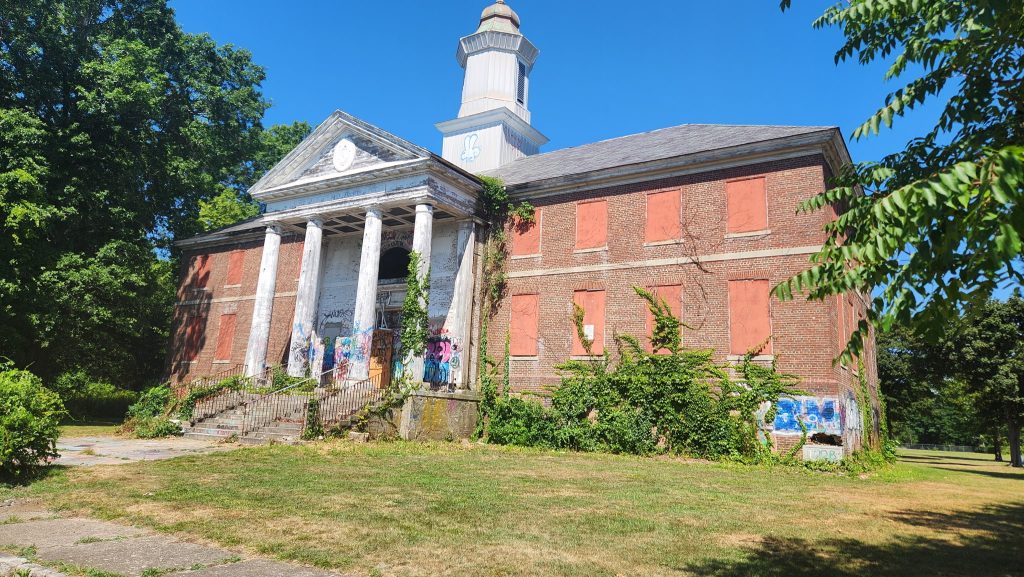
large brick building with white columns in front and a white steeple. The building is surrounded by trees and has graffiti spray painted onto it
The Massachusetts Metropolitan Hospital
(Credit: Juniper Johnson)
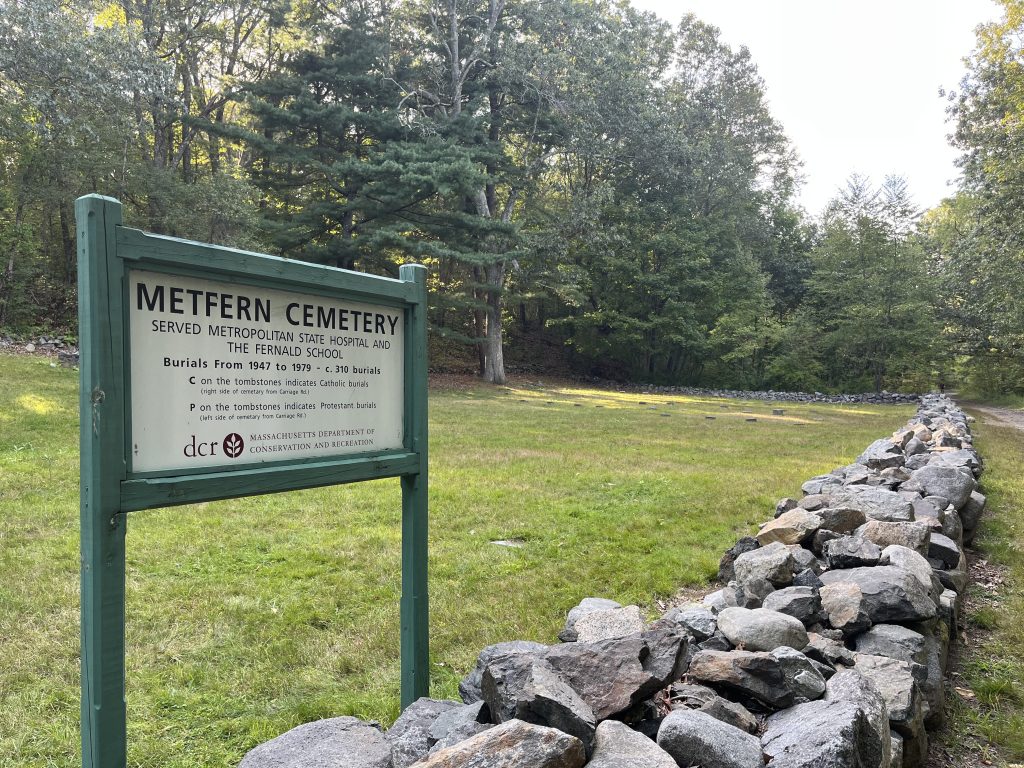
Recent color photograph. In the foreground there is a sign that reads “Metfern Cemetery/Served Metropolitan State Hospital and Fernald School. In the background is a field with some small granite stone grave markers in the ground.
Photograph of the Metfern Cemetery, which served the Metropolitan State Hospital and the Fernald State School.

Well-meaning advocates, like Dorothea Dix, who do not actually involve the people who are having the experience, frequently have impacts they do not intend. “Nothing about us without us” remains a salient point, even today. I am confident that Dix would be truly horrified at the results of her advocacy for hospitals. Insane asylums being a regular feature in the horror genre does not come from nowhere, after all, and reports that come out of psych hospitals and other care institutions even today can feel uncomfortably similar to what Dix was trying to avoid. Studying Dix brings to mind things like the Disability Day of Mourning, which honors disabled people killed by their caretakers. The tragedy is that disabled people are still abused in many ways and ableism is alive and well. However, there has been a lot of incremental progress towards disabled people taking the agency so long denied to them, from laws like the Americans With Disabilities Act to more public knowledge and acceptance of mental illness and neurodivergence. I certainly hope we continue to move in that direction.

Disability in the Archives: Fairies or Workers?

By Meg Szydlik, Visitor Services Coordinator

Content warning: use of outdated but period-typical language to describe disabled individuals.

With this post, I am returning to my old stomping ground in the archives. I have written three previous blog posts focusing on the presence of disability in our archives which can be found here, here, and here. I wanted to dive into some more collection materials on the topic.

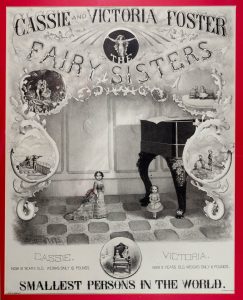
Poster with an image in the center of two girls next to a piano. They are both very small compared to the piano, but are dressed in classic 1870s dresses for an older girl and a little girl. On either side, there are images of different adventures children might be interested in contained in circles. Written above the image in the center are the words “Cassie and Victoria Foster/The Fairy Sisters” and beneath the image is written “Cassie. Now 10 years old. Weighs only 12 pounds” and “Victoria. Now 3 years old. Weighs only 6 pounds.” Between the two is another image of the 2 sisters together on a chair and below that it reads “SMALLEST PERSONS IN THE WORLD”
Cassie and Victoria Foster, The Fairy Sisters : Smallest Persons in the World, Poster based on drawing by A. Briggs, [Boston]: Clear & Co., [1873]

While looking at our online collections, I came across this poster advertising the “Fairy Sisters” in 1873. The two girls, named Cassie and Victoria Foster, were little people and were billed as the smallest people alive. Whether or not that was true, that was their claim to fame, and later that of their brother, Dudley. Both of the girls died tragically young of infections Victoria at 3 ½ and Cassie at 11. Dudley lived to 17 before dying of a heart condition. Their lives, and the way some people still talk about these performers, demonstrate the tendency of others to romanticize the exploitation these children experienced. Personally, I’m not convinced that a 3 ½ year old should be working in any capacity and I’m even less convinced when the work consists of being gawked at by strangers for their disability. However, it would be many years after all three of these children’s deaths that legislators would even sign the Coogan Act, a law intended to protect child performers.

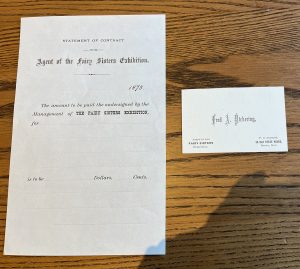
Left: paper contract that reads “Statement of Contract with the Agent of the Fairy Sisters. (space for date) 1873. The amount to be paid the undersigned by the Management of the Fairy Sisters Exhibition for (space to write) is to be (space) dollars and (space) cents.” Right: business card that says “Fred Pickering” in the center and then “Agent to the Fairy Sisters Exhibition” in the bottom left corner and then “P.O. Address, 35 Old State House, Boston, Mass.” In the bottom right corner.
Business card for the Fairy Sisters agent and contract to sign with him to engage them as performers

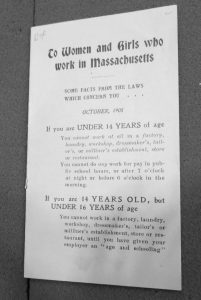
The 19th and 20th centuries were full of labor strikes and gains, including laws limiting and prohibiting child labor. The 1908 pamphlet shown below outlines some of the restrictions for girls and women in the workforce, including hour restrictions, school requirements, and access to workers comp if injured on the job. Their lives were certainly not easy, but there were at least some protections. Others took up the fight against child labor as part of the general battle for labor rights. It’s hard to read about all the child labor fights and not think about how different the lives of child performers would have been had they been afforded the same opportunities, limited as they were for the impoverished mill worker children these pamphlets were given to. In fact, the entertainment industry is still exempt from a lot of the same child labor laws that govern virtually every other industry and it shows in the current boom of podcasts from grown-up child stars

Pamphlet against a dark grey background. The pamphlet reads “To Women and Girls who work in Massachusetts/Some facts from laws with concern you…/October 1908/If you are under 14 years of age you cannot work at all in a factory, laundry, workshop, dressmaker’s, tailor’s, or milliner’s establishment, store, or restaurant. You cannot do any work for pay in public school hours, or after 7 o’clock at night or before 6 o'clock in the morning./If you are 14 years old but under 16 years of age you cannot work in a factory, laundry, workshop, dressmaker’s, tailor’s, or milliner’s establishment, store, or restaurant, until you have given your employer an “age and schooling.”
The first page of the 1908 pamphlet outlining the rights of workers

Both the mill children and child circus performers lived brutal lives, but there was little romanticization of mill workers’ lives. In contrast, there was (and still is) a romanticization of circus and sideshow life. The lights! The glamour! Life on the road! They were loved by millions! What could they possibly have to complain about? That perspective fails to account for the rampant abuse in the industry. Being on display is not something many people are comfortable with, especially when they are not demonstrating a skill. A gymnastics showcase is a bit different than staring at someone because something about their body is non-normative and usually specifically disabled, whether it is microcephaly, dwarfism, or giantism. The objectification is made even worse by how young some of the people in the sideshow were.

Eventually laws were signed to protect disabled children including the 1975 Individuals with Disabilities Education Act (IDEA). Regardless, the Fairy Sisters and their brother should never have been sideshows as children. They should have been children and children only.

Disability in the Archive: Veteran Voices

By Meg Szydlik, Visitor Services Coordinator

Trigger warning: use of outdated but period-typical language to describe disabled individuals.

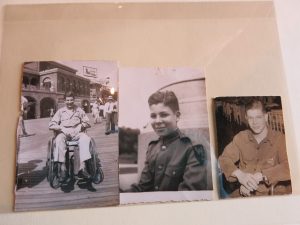
The third and (for now) final installment of my series on Disability in the Archive is a hopeful one. Read Part 1 and Part 2. As I investigated the treatment of disabled veterans, I had my first opportunity to use the actual voices of disabled people in this blog post. I examined the letters and photographs of Samuel “Sammy” Barres, a WWII bilateral amputee who wrote faithfully to his “sweetheart” Bernice and his mother, giving us a window into his thoughts. I am not a veteran and being deaf/hard of hearing is a very different disability, but in his letters, I see echoes of my own experiences.

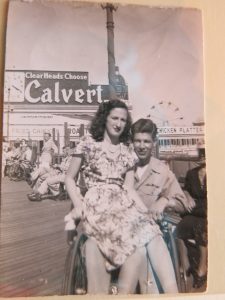
Black and white series of images of Samuel Barres. From left to right: Sammy on the Boardwalk in Atlantic City in his uniform and in his wheelchair, Sammy in his dress uniform sitting down, Sammy sitting in a chair in his hospital ward and wearing glasses.
Three photographs of Sammy he sent to Bernice

The first things I noticed were how other people talk about him and his consistently overly positive attitude in response. After Sammy’s legs are amputated, one above the knee and one below, he receives letters from friends, all of whom clearly love him but who talk like his life is over and praise his cheerfulness. His friend Bill says, “reading the letter again, I began to notice your high morale and as I read more I couldn’t figure out how anyone under your circumstances could display such high spirits.” Sammy himself even says “how thankful I am for being spared my sight, and my hands, and my brain. Handicapped? Sure I am. But so very little, comparatively speaking.”

It is reminiscent of modern-day inspiration porn, which is when people create content around disabled people doing things that are only inspiring because they are disabled. For an excellent introduction, read this article and this article. In a more direct example, Sammy’s picture is shared to raise funds for amputees, which is one reason that inspiration porn gets made. Abled people feel grateful that they are not disabled and are more willing to participate. Inspiration porn asks: how can someone who is disabled continue to exist and even succeed? That is certainly a question I have been asked- directly and indirectly.

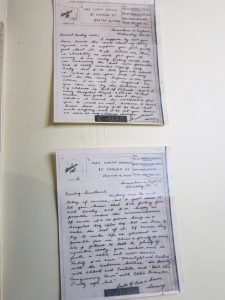
Image of a handwritten letter from Sammy’s friend Bill after Sammy’s accident.
Letter from Bill to Sammy where he tells Sammy that no matter how cheerful his letters to his mother are, Bill believes that he must be somewhat sad about his accident

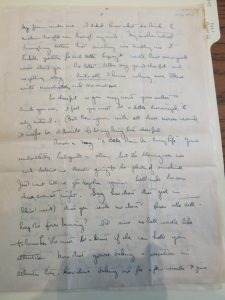
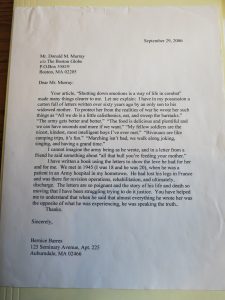
The differences between his letters to his mother and to Bernice are striking, and not just because he is lovesick for Bernice. Letters that were mailed around the same time and talk about the same things are far less cheerful and inspiring when he writes to his nurse “sweetheart” than when he writes to his mother. I have done similar things, kept the full truth from someone, either because they would overreact (as Sammy’s mother does), because I don’t want to be pitied, or even because I don’t want to explain all the background. Sometimes “fine” is the best answer! I’m sure that Sammy felt similarly. In fact, years later Bernice writes that “almost everything he wrote her [his mother] was the opposite of what he was experiencing.”

Image of a typed letter
Letter from Bernice to Donald Murray about his article on how soldiers lied in their letters back home
Color image of two handwritten letters
First two letters from Sammy to his mother after he lost his legs

Another thing I noticed while reading is the extraordinary frustration of bureaucracy that was present then and is still present now. Sammy talks about how difficult it is to get help from the limb shop. He tells Bernice that he “went to the limb shop this morning to remind them that [he] was still alive” and then the very next day he “spent a very upsetting afternoon in the limb shop. And [he] still got nowhere.” That frustration is so common for chronically ill or disabled people. While in Boston his leg has a significant issue, and he struggles to find a place that can fix it for him. Similar things have certainly happened to me where getting my assistive device fixed was much more challenging than others think. Like Sammy, I am very good at troubleshooting and finding ways around things that break or around the limits my body has placed on me.

Photograph of Sammy in his uniform in a wheelchair on the boardwalk with a ferris wheel in the background. Bernice is in a dress and sitting on his lap.
Photograph of Sammy and Bernice on the Boardwalk in Atlantic City

Hearing a disabled person’s own perspective was valuable. While Sammy Barres is only one man and his experience is not universal, it is a story worth telling as part of understanding disability and the presence of disability in the archives. In his case, he and Bernice married— over the objections of her family, who never spoke to Bernice again because she married her “legless love—” and had five children. They generally seem to have lived a happy and loving life, one where they were not separated long enough to write the stacks of letters telling their story, like they did during their engagement. This story has a happy ending! Not an easy one, but a happy one nonetheless.

Disability in the Archive: Insanity & Institutions

By Meg Szydlik, Visitor Services Coordinator

Trigger warning: use of outdated but period-typical language to describe disabled and mentally ill individuals and includes descriptions of abuse.

In my last post, I looked at disabled people in the circus. For this post, I’m looking at how people deemed “insane,” “idiots,” or “feeble-minded” were treated. Like those of the previous post, the voices of these people were also missing in my searches of the MHS archives. What we do have, however, are records that help paint a picture of what life was like for someone “insane” and how abled people perceived them.

Insanity and feeble-mindedness cover a wide range of behaviors. In addition to mental illness and probable psychosis, developmental disorders, and neurodivergence are also included under this label. While the sources had different treatment plans, all of them used a “one size fits all” approach to these disabilities. However, modern practice is that individual treatments that center the person’s dignity are best.

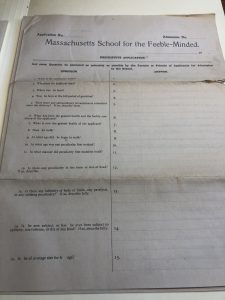
Image of a page of an application to the Massachusetts School for the Feeble-Minded. The application asks questions ranging from basic demographic information to more invasive questions about how the person’s disability manifests itself. Questions about overall health, mental difficulties, and physical disabilities are included.
Application for placement in the Massachusetts School for the Feeble-Minded

In the pre-Civil War era when the materials I used were written, there were essentially two options for people considered insane. They could stay at home with family, or they could enter an institution. Poorhouses, hospitals, and even jails were used to house those the state deemed insane.

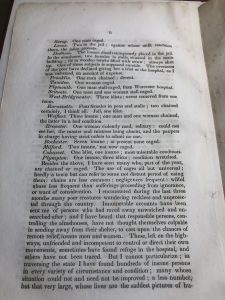
Whatever the caretakers of these places thought they were doing, Dorothea Dix’s Memorial: To the Legislature of Massachusetts demonstrated their actions were abusive. Originally delivered orally, her testimony was published and made its way into the MHS collection. It features page after page of stories of people being beaten, chained, and deprived of food, bathrooms, and clothing and even light or shelter. The abuse is horrifying to read and must have been even worse to hear about. However, I’m glad Dix was clear and explicit about the harm, as she says herself, “the condition of human beings reduced to the extremest states of degradation and misery, cannot be exhibited in softened language, or adorn a polished page.” You can read her words yourself by visiting the MHS or by reading an online copy.

Image of a page from the MHS copy of Dix’s Memorial. This page discusses some of the abuse that occurred to individuals on a town by town basis, as well as Dix’s thoughts on the treatment.
Page from the MHS copy of Dix’s Memorial: To the Legislature of Massachusetts

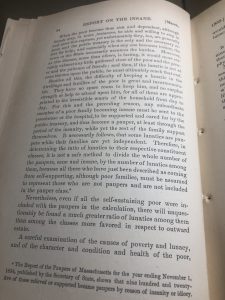
In addition to Dix’s more personal words, the MHS has government documents on the topic, including a copy of the Report on insanity and idiocy in Massachusetts by the Commission on Lunacy under resolve of the Legislature of 1854. This report looks at how insane persons were counted and treated in Massachusetts, starting with the complications involved in getting an accurate count of these populations because of the shame associated with the diagnosis. Their review revealed interesting things, including a fairly even gender split, a belief that lunacy is curable, and disproportionate numbers of “aliens,” or non-Americans, receiving treatment in institutions. The treatment of non-Americans was especially interesting, with the writers pre-answering critiques by countering that these “generous provisions for the alien lunatics will not be questioned here, for not one of these thus provided for should have been neglected. Indeed, it is the great honor of our Commonwealth that it has built…these institutions for the relief of the suffering.” Though lacking in many areas, this report and the men who created it seemed to have the dignity of the people they were serving at the core, which was comforting. Despite these positive elements, these documents are still primarily about abled people’s responses and responsibilities. The voices of the “insane and idiots” are not present in the text.

Image of a page of text from the “Report on Insanity.” The text discusses why people considered insane might not be kept at home and instead be in an institution.
Page from the “Report on Insanity” by the Commission on Lunacy

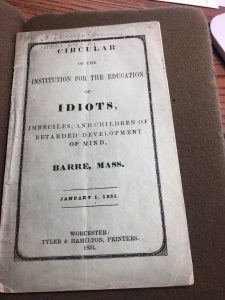
The final materials I examined were ephemera and reports from The Massachusetts School for the Feeble-Minded. Archivist Susan Martin wrote a wonderful blog post about the collection, so I won’t rehash everything, but I did find it interesting how these materials fit with the other documents the MHS has about idiocy and insanity. The reports are focused on how well students are progressing, as well as the work and value of the school. It operated significantly more like modern schools for severely disabled people than anything else I looked at, which is striking given that the documents are still pre-Civil War. Still, there is no element of the student voice anywhere in the ephemera, which consists largely of information on how to enroll and what to bring rather than content produced by students. Once again, abled people are telling disabled people’s stories–no matter how well-meaning they are.

Image of the cover page of the “Circular of the Institution for the Education of Idiots, Imbeciles, and Children of Retarded Development of Mind.” The page has text in a decorative border.
Cover page of the “Circular of the Institution for the Education of Idiots, Imbeciles, and Children of Retarded Development of Mind.”

Reading about the treatment of what was deemed idiocy and insanity was a deeply upsetting experience that required breaks. There’s so much dehumanization in the sources and even Dorothea Dix’s testimony, the source that focused primarily on their humanity and victimhood, highlighted that dehumanization. The treatment of these disabled people is, quite frankly, horrifying. In many ways, I see echoes of that treatment in the present with things like #FreeBritney and Disabled Day of Mourning.

Tune in next time, when I will look at some of the ways disabled veterans are represented in the archive.

Disability in the Archive: Freaks & Geeks

By Meg Szydlik, Visitor Services Coordinator

Trigger warning: use of outdated but period-typical language to describe disabled individuals.

As a disabled person myself, I’ve always had a particular interest in the treatment of disabled people. With that in mind, I wanted to explore what materials the MHS has regarding disability. One thing I immediately noticed was that the stories of disabled people I found in the archive are rarely told from their perspective. “Nothing about us, without us” is a slogan from the disability rights movement. Looking at these materials, it is clear why.

One group of disabled people in the archives is circus freaks. Freak shows populated by disabled people travelled around the country, providing an uncomfortable kind of entertainment in a world where disability usually meant death or concealment. Similarly named geek shows often traveled with circuses or sideshows and were equally exploitative (and something I don’t recommend looking up unless you have a strong stomach). Both types of shows were popular and traveling sideshows drew enormous crowds during the 19th and 20th centuries.

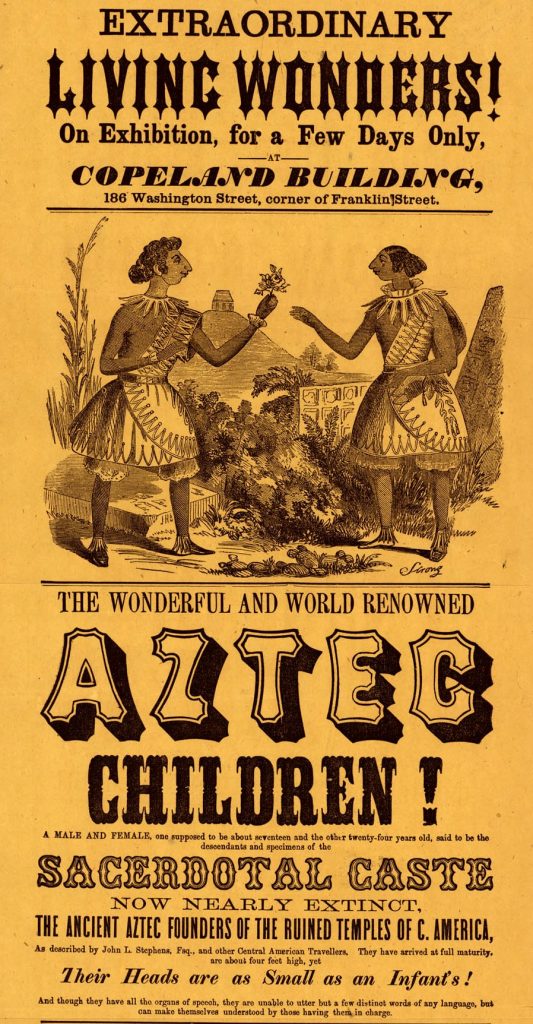
Yellow-orange broadside with an image of two people dressed in clothing associated with Mesoamerican dress broadly. The text surrounding them reads: Extraordinary Living Wonders, On Exhibition, for a few days only at Copeland Building 186 Washington Street, corner of Franklin Street. The Wonderful and World Renowned AZTEC CHILDREN! A MALE and FEMALE, one supposed to be about 17 and the other 24 years old, said to be descendants and specimens of the SACERDOTAL CASTE now nearly extinct, the Ancient Aztec founders of the ruined temples of C. America, as described by John L. Stevens, Esq., and other Central American Travelers. They have arrived at full maturity, are about 4 feet high, yet their heads are as small as an infant’s! And though they have all the organs of speech, they are able to utter but a few distinct words of any language, but can make themselves understood by those having them in charge.
Part of an 1862 broadside advertising the “Aztec Children”

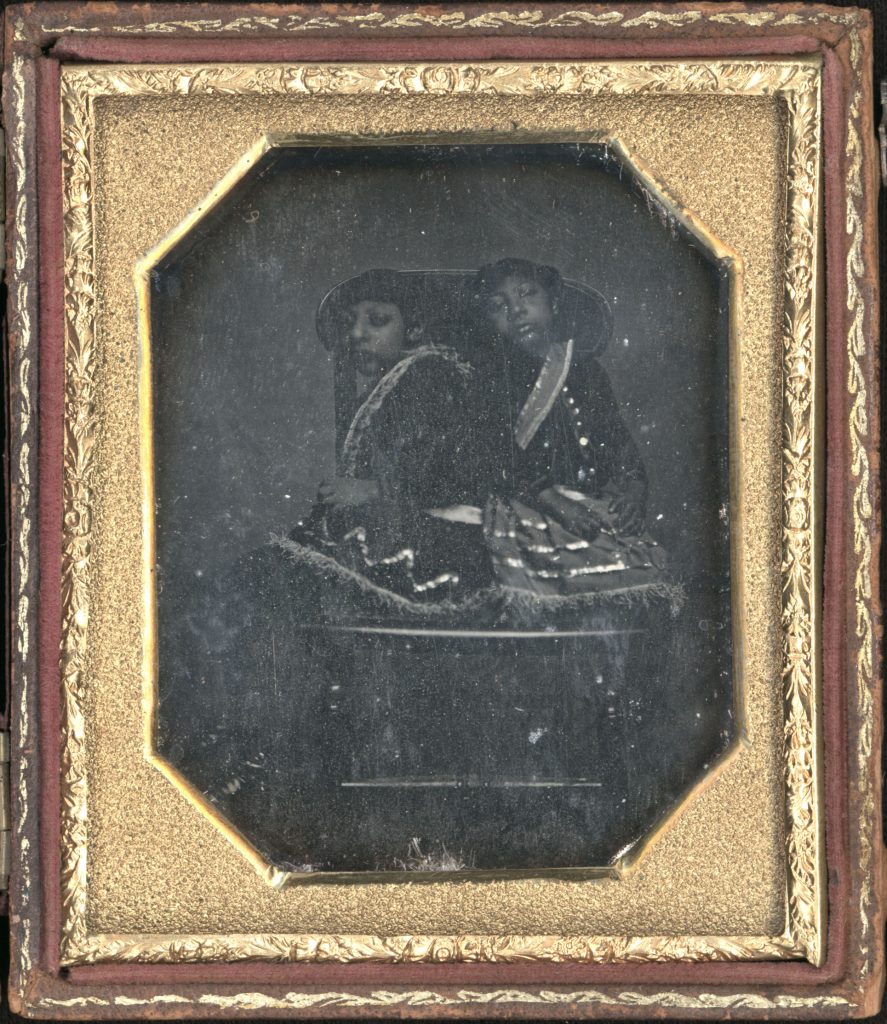
The MHS collection of broadsides includes some that feature a pair of siblings referred to as “The Aztec Children.” They are billed as one of the last remaining examples of a particular priestly “caste” in Mesoamerican culture. In reality, the siblings (Maximo and Bartola) were born into poverty in El Salvador with microcephaly, and their mother was assured that they would get treatment if she allowed them to go. There is no historical evidence that the “caste” claimed for their heritage ever existed.

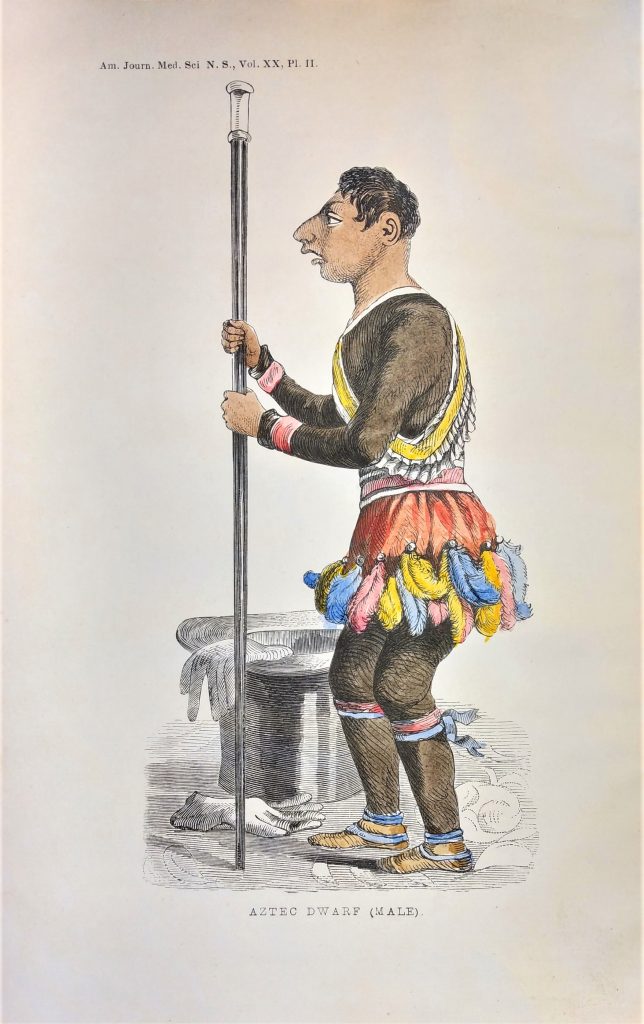
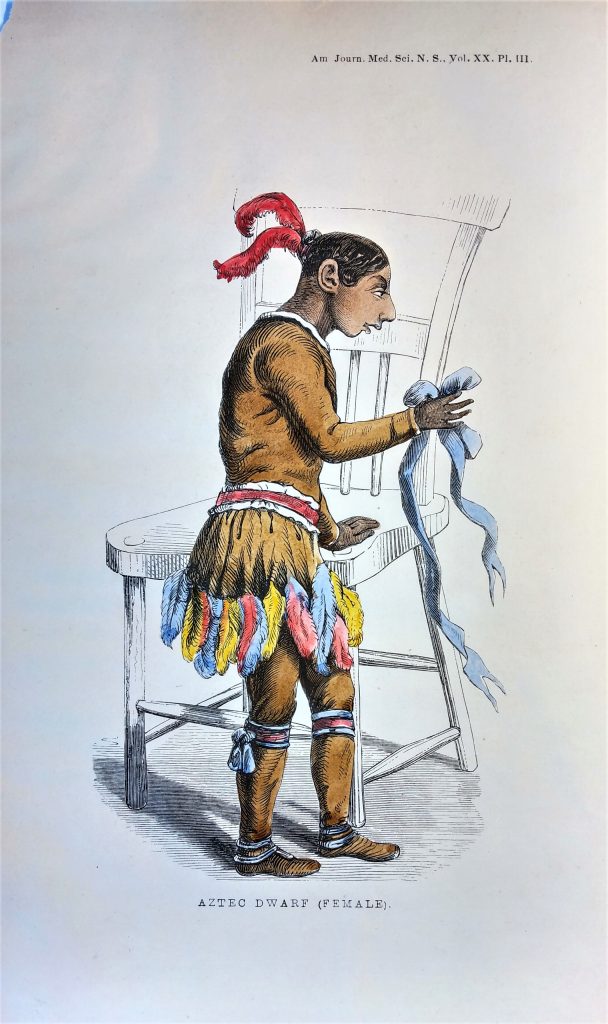
These broadsides are a window into how people in the 19th century perceived those with disabilities. The language treats them as curiosities and oddities, rather than the fully formed people they are. An article called “An account of two remarkable Indian dwarfs exhibited in Boston under the name of Aztec children” was published by the American Journal of Medical Sciences after Maximo and Bartola were examined repeatedly compares them to monkeys and comments on the shape and size of their heads as evidence of idiocy. Phrenology was rampant and the foundation for a lot of race “science” and white supremacist arguments. It’s not an accident that so many “pinheads” (circus performers with microcephaly, because of the pointed shape of their heads) were from Latin America and billed as the “missing link.”

Illustration of Maximo. His clothing is black with a red, blue, and yellow feathered skirt and some brightly colored accessories. He has short, dark hair and a small head and body. Also in the picture are a top hat, gloves and walking stick, all of which are comically large compared to him. Underneath is written “Aztec Dwarf (Male).”
Illustration of Maximo from The American Journal of Medical Sciences
Illustration of Bartola. Her clothing is tan with a feathered skirt and some brightly colored accessories. Her hair is dark and has red feathers in it and she has a small head and body. Also in the picture is a chair, which is comically large compared to her. Underneath is written “Aztec Dwarf (Female).”
Illustration of Bartola from The American Journal of Medical Sciences

Reading these sources left my skin crawling. The language they use to describe disabled people is deeply dehumanizing and infantilizing. The American Journal of Medical Sciences also approached their examination of the Aztec Children as though they were scientific curiosities to be analyzed rather than actual human beings. While presenting himself as neutral, the author, Jonathon Mason Warren, notes that “a question naturally arises to an observer first visiting these beings, whether they belong to the human species; and it is only after the eye becomes accustomed to their appearance that the brotherhood is acknowledged. (8)” It is impossible to remain both detached, “scientific,” and respectful of the other party’s humanity. Through it all, I never saw anything with the voice of the actual Aztec Children, or other circus performers. I know they exist, and places like Circus World share a more complete history of circuses.

Daguerreotype of Maximo and Bartola, aka The Aztec Children. It is in a leather case with a gold frame and depicts the two children sitting on a chair together and dressed in their typical “Mesoamerican” style with a skirt and shirt combination. They are both very small. Details are difficult to make out because the background and lighting are both extremely dark.
Daguerreotype of Maximo and Bartola, the Aztec Children, from 1851

On the flip side, despite how degrading it was, working as a circus freak was one of the only ways for visibly disabled people to make a living in this time. Huge numbers of disabled people lived in almshouses or were cared for at home, and experiences in those places could be brutal. At a circus, at least performers were making their own money that they could use however they wanted. When weighing a decision between starvation and degradation, it’s no wonder so many people chose to live. It’s hard to blame them for accepting the treatment they did when the Americans With Disabilities Act was still more than a century in the future, especially knowing that disability discrimination is still rampant. Yet the romanticization of these kinds of environments in movies like The Greatest Showman leaves a lot of room for a more robust look at what went into this form of entertainment.

While circus freaks are one group of disabled people in the MHS archives, they are not the only one. Next time, I will look at the way that “feeble-minded” disabled people were treated and how their experience was recorded.