
by Meg Szydlik, Visitor Services Coordinator
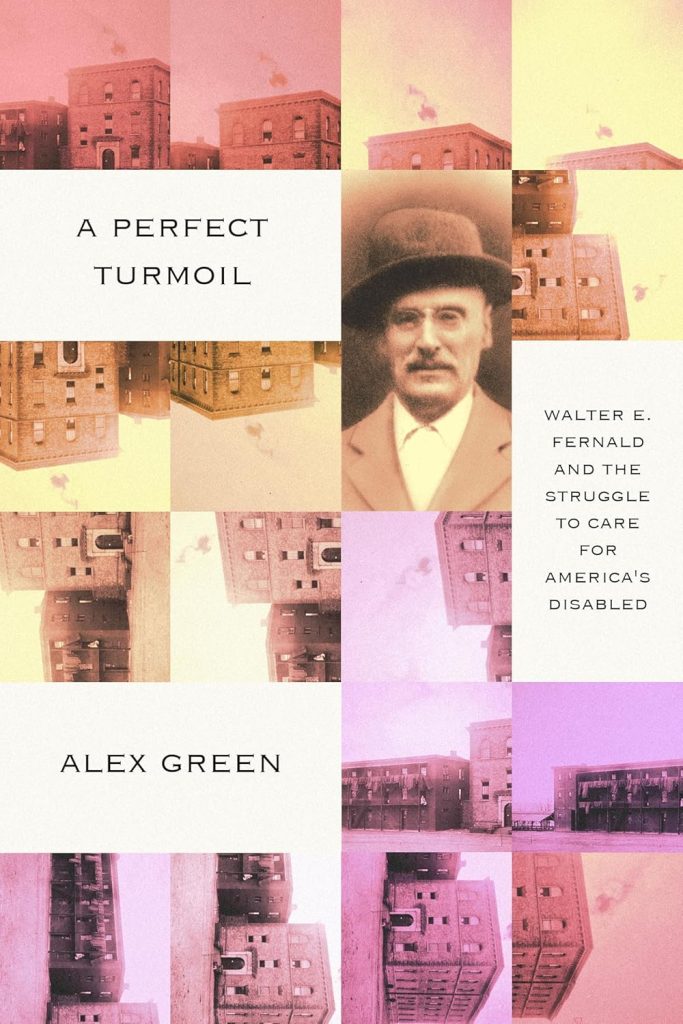
On February 12, 2026, the MHS welcomed Alex Green of the Harvard Kennedy School to give a talk on his book, A Perfect Turmoil: Walter E. Fernald School and the Struggle to Care for America’s Disabled. Green’s research has been ongoing, so he included information in his talk that he has uncovered since publication. It was a fascinating glimpse into a subject I have been researching in the MHS collection with my Disability in the Archive series, which you can check out in the further reading section. Green’s work looks at the ways disability was treated in Boston’s own backyard at the Walter E. Fernald State School in Waltham, Massachusetts.
Green took us through the context around the creation of the Fernald School. He complicated the narrative of Walter Fernald, the man who founded the school, who was neither good nor evil. Through Green, the audience understood that Fernald was a man who was trying his best, even when his best failed people. Fernald was a eugenicist who eventually changed his opinion and fought against his prior beliefs. Green discussed the way the Fernald School was set up and the impact this particular school had on the education of disabled children in the United States, and later the world. Fernald believed that hard work and busyness could improve disabilities. Green pointed to the way the theories Fernald espoused are still present in special education practices around the United States today, and even presented his own rather radical idea that there should be no separation of disabled and abled children in schools.
However, Green did not shy away from the damage that Fernald’s theories created. He showed image after image of truly horrifying ways the students were treated, including being locked up, chained, and other brutalizations. Much of what he described was remarkably similar to the things I read in Dorothea Dix’s texts about the treatment of disabled people in jails and almshouses. The cruelty is still startling to me, no matter how many descriptions of it I read or images I see. And Green was clear about how cruel these things were. He was clear too about how that cruelty extended to the way the school handled the health and safety of these students. Those who died while attending the Fernald School, as well as the Metropolitan State Hospital, are buried in a cemetery on the grounds. I have been to the cemetery myself and the anonymity of the graves is as striking as Green said. It is not meant to be a place for loved ones to come and weep. And that is even more clear from Green’s explanation that sometimes families were never told what happened to their loved one who entered the school.
The research Green has done is not without controversy or challenges. Even accessing the records of the Fernald School at the Massachusetts State Archives was difficult, as a state law requires that an individual’s medical records remain private after their death, even to family members. He was able to get a court order to unseal them, but he noted his belief that these records should be accessible to survivors and family members without such extreme measures and described his frustration that only an Ivy League professor could access them. He also emphasized that much of the restricted material did not seem to be medical records at all, including drawings done by residents of the school and hospital. The issue of access to information is further complicated by the lack of centralization. As hospitals and schools closed, many of the records did not go to a single location or even an archive at all. In fact, many of these records have been sold on eBay and other similar sites in the ensuing years. It is a multi-pronged problem with no clear solution.
Green shared an important story. The brutality of what happened in these schools should not be forgotten or swept under the rug. The same ideas that formed the Fernald School are still present in American society today, as Green pointed out by linking the philosophy of Fernald to modern special education. Green demanded an unflinching look at the treatment of disabled people, one with compassion towards all but particularly towards the victims of an abusive system. It was a good reminder, and one we should take care to listen to.
Further Reading of the Disability in the Archive Series