
Family Portraits: Pastel, Memory, and the Legacy of John Singleton Copley

By Megan Baker, Andrew Oliver Fellow, 2024-2025

As newlywed Elizabeth Copley Greene (1770–1866) settled into her new estate, she found herself thousands of miles away from the artistic family who raised her. Born in Boston in 1770 but raised in cosmopolitan London after her family fled during the American Revolution, Greene grew up immersed in the artistic circle of her father, painter John Singleton Copley (1738–1815). In July 1800, she married the Boston merchant and planter Gardiner Greene in London. Elizabeth’s subsequent reverse migration produced a bountiful correspondence between her and her family spanning decades—materials I studied as the Andrew Oliver Fellow at the Massachusetts Historical Society for my dissertation on the use of pastel in Revolutionary-era North American art.

Before Copley left for London, he was the most prominent portraitist in colonial North America, renowned for his work in oil, miniature, and pastel. Popular for replicating textures like skin and textiles, pastel was nevertheless controversial for its fragility—a quality evident in some portraits, like that of Jonathan Jackson (figure 1). Despite this concern, Copley thought his “best portraits done in that way,” and worked in pastel until he left for Europe in 1774. He favored the medium enough to use it for pendant portraits of himself and his wife, Susannah, around the time of their marriage in late 1769, a year before Elizabeth’s birth.
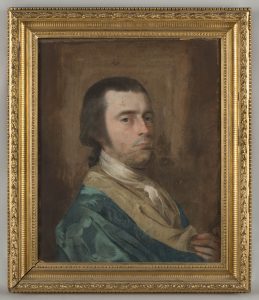
Portrait of a light-skinned man with brown hair. He wears a blue robe and white neckerchief.
Figure 1. John Singleton Copley, Jonathan Jackson, ca. 1767-1769, pastel on paper, 56.2 cm x 46 cm, Massachusetts Historical Society, Artwork 01.252

Of Copley’s children, only Elizabeth returned to North America; it was her branch of the family that became most invested in sustaining his artistic legacy. Elizabeth’s daughter, Martha Babock Greene Amory, wrote The Domestic and Artistic Life of John Singleton Copley, R.A. (1882), a history drawing from oral history and family letters. Another descendant, Harcourt Amory, later deposited these materials at Massachusetts Historical Society. While the Copley Family papers (Ms. N-1034) preserve Elizabeth’s received family correspondence through 1847, they lack later letters excerpted in Amory’s book, raising questions about how descendants sought to shape Copley’s legacy as they preserved it. 

While many of the works in Copley’s studio eventually reached Boston through Elizabeth’s descendants, the pastel portraits had never left. Fleeing Massachusetts with three young children during wartime, Susannah could not transport the fragile artworks. During Elizabeth’s first year in Boston, she noted that she was in possession of the portraits of her parents. Her mother’s response expressed extreme distaste (figure 2): “I have to say that I hope you will not adorn your new house with those sad portraits which you mention, pray hang them in a closet.” Though fashionable in 1769, thirty years later, they were out of style in London.
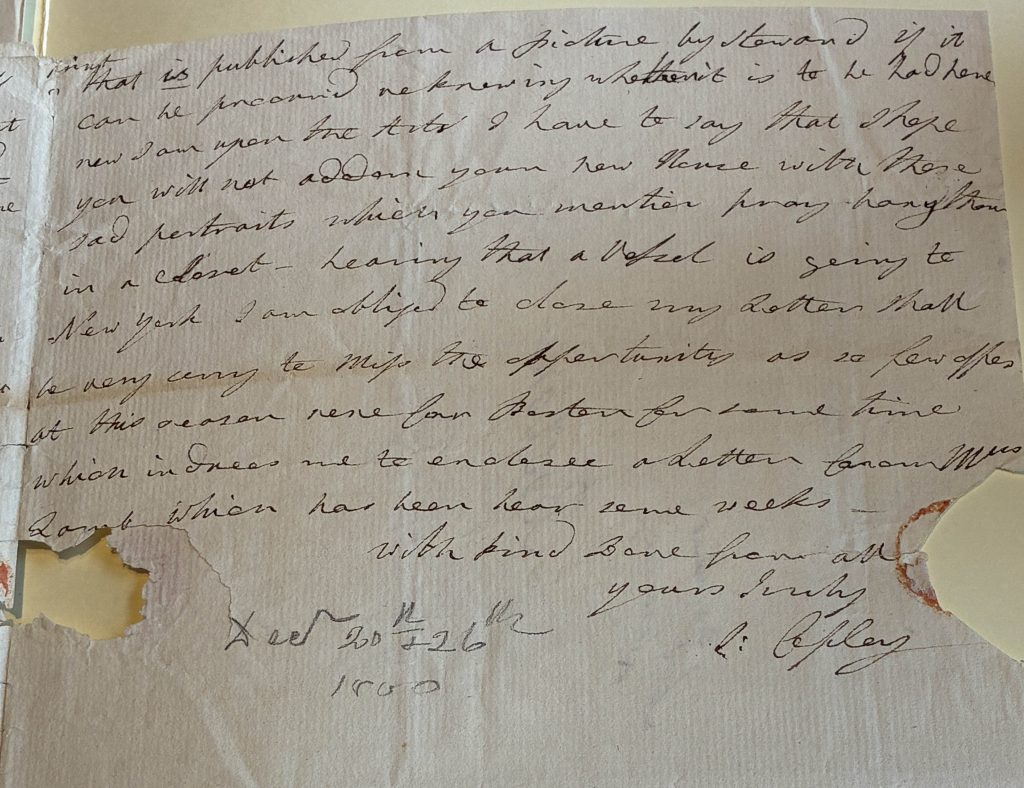
Handwritten letter in ink with some holes in the paper.
Figure 2. Letter from Susannah Clarke Copley to Elizabeth Copley Greene, December 20, 1800 (section dated December 26), Copley Family Papers (Ms. N-1034), Box 1 (Folder Oct-Dec 1800), Massachusetts Historical Society

 For Elizabeth, that did not matter; the portraits were the only representations she possessed of her parents. They remained in her family a for a generation longer than the letters before being sold to the collector Henry Francis du Pont, at whose Winterthur Museum they remain today. These portraits remain in good condition because they never crossed the ocean on a ship, rather remaining as a stand-in for Copley in Boston and cared for by his descendants. To Elizabeth, their chalky faces served as daily reminders of her beloved parents; the value of seeing their faces was worth whatever the aesthetic cost. The survival of art depends on such personal devotional acts. From a daughter’s insistence on displaying reminders of home to the researcher’s study of her letters, these materials—protected through generations at Massachusetts Historical Society—help reveal human priorities and desires across time and distance.

Further Reading:

Gurnsey Jones, ed., Letters & Papers of John Singleton Copley and Henry Pelham, 1739-1776 (Massachusetts Historical Society, 1914)

Copley Family Papers, Ms. N-1034, Massachusetts Historical Society
The Diaries of Henrietta Maria Schroeder Stout, Part VI

By Susan Martin, Senior Processing Archivist

This is the sixth part of a series. Read Part I, Part II, Part III, Part IV, and Part V to catch up.

For the last few months, I’ve been telling you about Henrietta Schroeder, a 14-year-old American girl on a European tour with her family in 1889. Her diary in the Stout family papers is a very entertaining record of that trip.

Today I’d like to introduce you to some of her friends. One of Henrietta’s most endearing qualities, I think, is her love for her friends, so I wanted to know more about the girls that meant so much to her.

The Curiosity Raising Club

On October 19, 1889, Henrietta had a great idea: “Lina Wetherill, Edith Speyers & Lena Schroeder & myself are going to get up a club, called the ‘Cur[i]osity Raising Club,’ […] for the purpose of getting up the cur[i]osity of others.” Just who were these curious young women?

I’ve mentioned Lina Wetherill before – that is, Caroline Bowen Wetherill, Henrietta’s best friend. Henrietta often wrote about Lina in her diary like this: “Oh! how I long for her, pray for her, love her. Oh! how I wish I could see her over here and (if only for an hour) press her to my heart once more, and be able to hear her voice, and feel her warm kiss once more.”

Lina, the daughter of Civil War veteran Francis Dring Wetherill, was born in 1876 and grew up in Philadelphia. At the age of 30, on a trans-Atlantic ocean liner, Lina met a 42-year-old bachelor lawyer from Seattle named Josiah Collins. They married a few months later and went on to have two sons together. Lina died in Seattle at the age of 80. I sincerely hope she and Henrietta stayed friends for the rest of their lives.

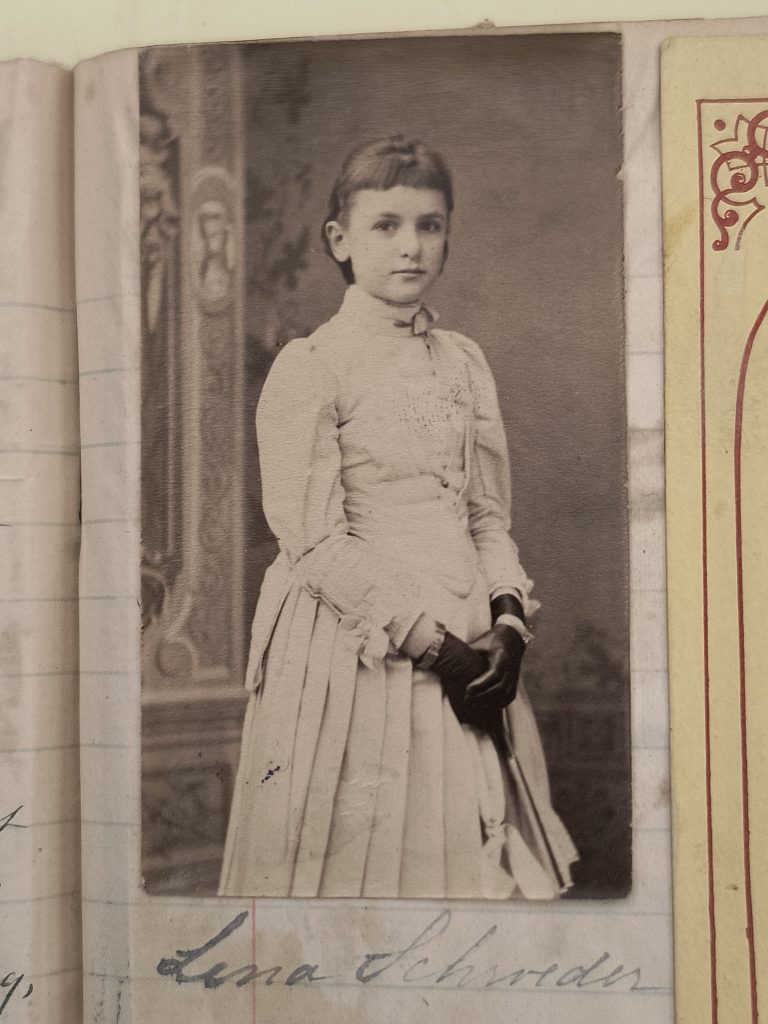
Confusingly, there was another Lena in Henrietta’s life, this one with an “e.” Here she is in an adorable photograph pasted into Henrietta’s diary.

Black and white portrait photograph of a white girl with brown hair in front of a blurry backdrop. She is wearing a white dress and black gloves, and her hands are clasped in front of her. The photograph is pasted onto a lined manuscript page, and below it is written “Lena Schroeder.”
Photograph of Lena Schroeder, ca. 1889

This Lena was Selina Richards Schroeder, Henrietta’s first cousin once removed, the daughter of New York cotton broker Gilliat Schroeder. She was born in 1875, just ten days before Henrietta. The Historical Society of Pennsylvania holds three diaries kept by Lena between 1888 and 1891. They look very similar to Henrietta’s; one of them even includes her picture!

In 1896, Gilliat Schroeder made some bad investments, and as the New York newspapers quaintly expressed it, “unfortunate speculation swept away the [family’s] fortune.” Lena, who was just 20 years old, went into business as a dressmaker to support her family, soon moving to larger premises in Manhattan and employing at least 25 other women. Her entrepreneurship was lauded in contemporary papers and in an 1898 book called What Women Can Earn.

The last member of the Curiosity Raising Club was Edith Lawrence Speyers, also of New York, Lena Schroeder’s first cousin through their mothers, Louisa and Selina Lawrence. Edith was also born in 1875, the oldest of the friends by a few months.

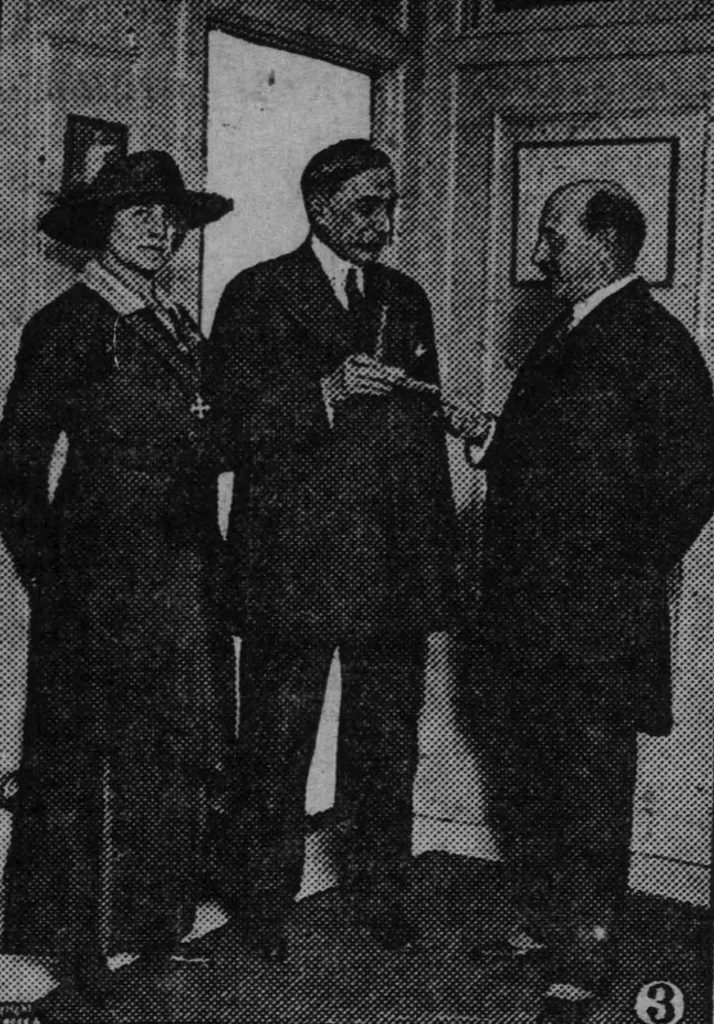
Edith would become best known as a leader in relief organizations during both world wars. She was chair of the National League for Women’s Service during World War I and, in 1920, founded the Dug Out, a Manhattan club for disabled veterans. For her various wartime efforts, she was decorated by the governments of France, Romania, and Serbia. But Edith didn’t rest on her laurels. She headed the National Women’s Council of the Navy League during World War II, when she was in her sixties. She was widowed twice and died in 1949.

Alt-text: Black and white photograph of a white woman and two white men standing inside a room by a doorway. The white woman wears a wide-brimmed hat, a dark dress, and a medal around her neck. Her hands are clasped behind her back, and she looks directly at the camera. The two men, standing to her left, are smiling at each other and passing an unidentified object between them.
Edith McVickar (née Speyers) and Breck Trowbridge receiving honors from Romanian politician Gogu Negulescu, clipped from the Dodge Center Record, October 9, 1919

I hope you’ll join me as I pick up Henrietta’s story in a future post!