Sometimes when we have a quiet afternoon at the MHS I’ll sit and read through our historical newspaper collection. A very historic hobby to keep, and one that turns up a lot of interesting things—like what some of our founding fathers were doing during their non-founding hours. I hope you find this selection of clippings as amusing and interesting as I do!
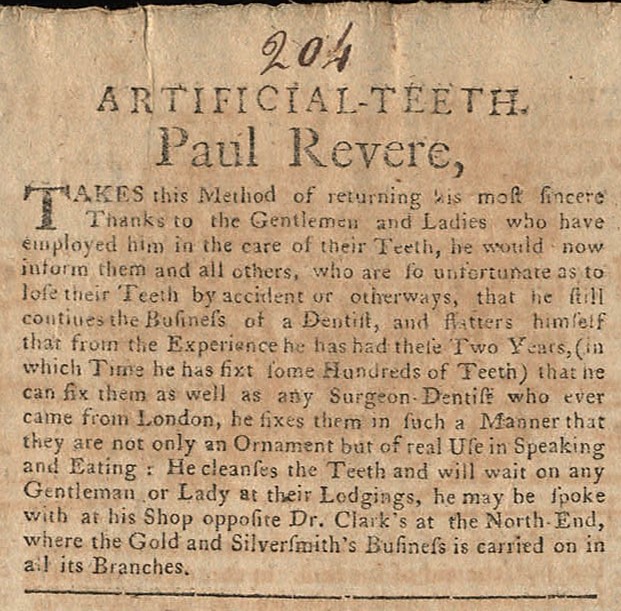
Paul Revere, silversmith and midnight rider, was also Paul Revere, dentist. Although it seems primarily on the side, as he directed potential patients to meet with him in his Silversmith’s Shop.
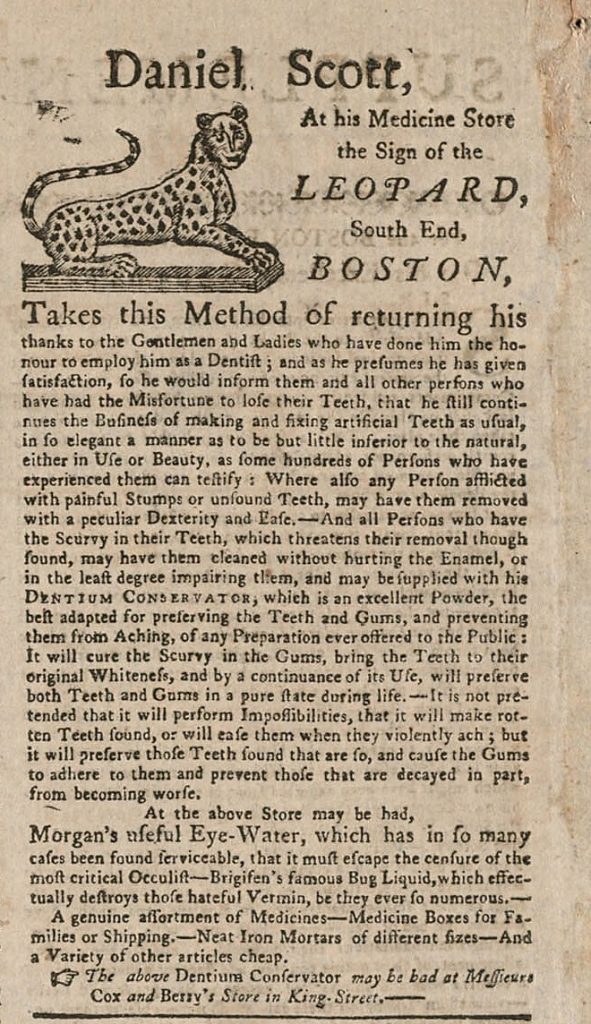
You had more options for tooth care in Boston than just Paul Revere: You could visit Daniel Scott at his medicine store at the (very memorable) Sign of the Leopard, where among other services “all Persons who have the Scurvy in their Teeth, which threatens their removal though sound, may have them cleaned without hurting the Enamel, or in the least degree impairing them, and may be supplied with his DENTIUM CONSERVATOR, which is an excellent Powder, the best adapted for preserving the Teeth and Gums, and preventing them from Aching”
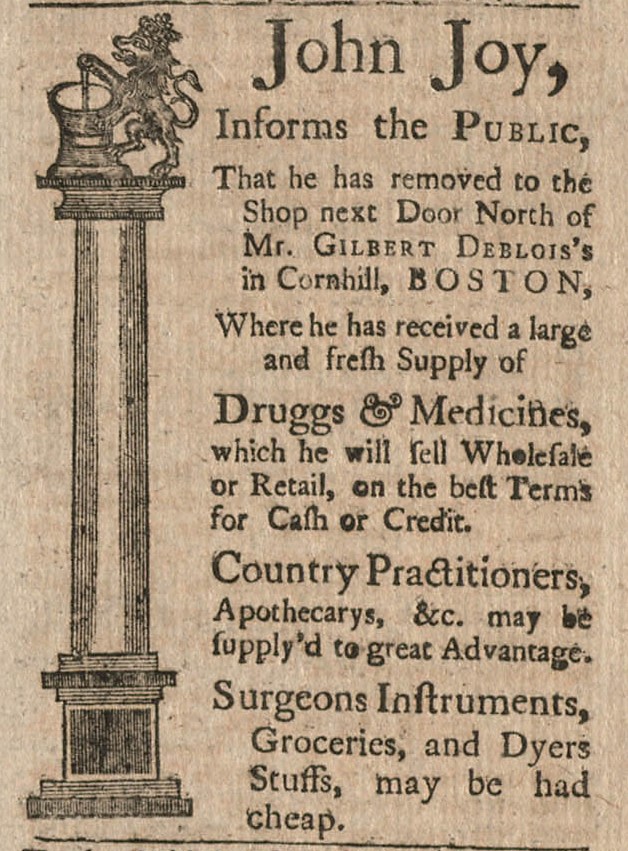
John Joy joined his colleagues in selling “a fresh Supply of Druggs & Medicines,” promising “Country Practitioners, Apothecarys, etc. may be suppy’d to great Advantage.” I’m interested in the implied distinction of practice between “country” and “city.”
John Hancock, heir to one of the richest merchant families in Boston, inherited his Uncle Thomas Hancock’s business after his death in 1764. In 1765 it seems he was still balancing accounts and “desires those Persons who are still indebted to the Estate of the late Hon. Thomas Hancock, Eqs: deceased, to be speedy in paying their respective Ballances, to prevent Trouble.”
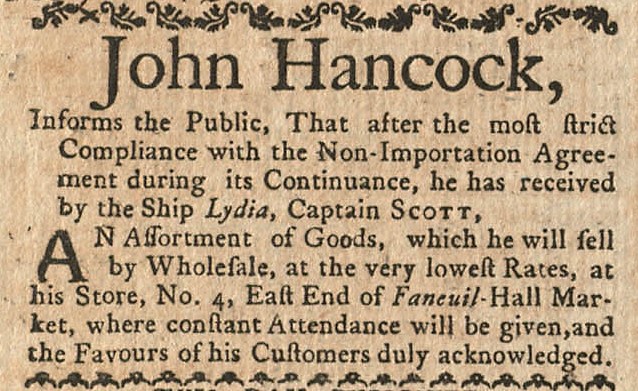
Even one of Boston’s most prominent merchants was not immune to the backlash against imported British goods. But in 1771 he found it palatable to once again advertise imported goods, while assuring the public that he kept “the most strict Compliance with the Non-Importation Agreement during its Continuance.”
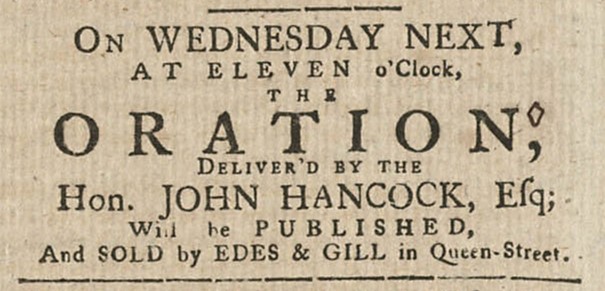
John Hancock continued to balance his identity of merchant with that of revolutionary. Advertisements for his Oration given on the anniversary of what we now know as the Boston Massacre can be found in the same paper where he advertised his goods for sale.
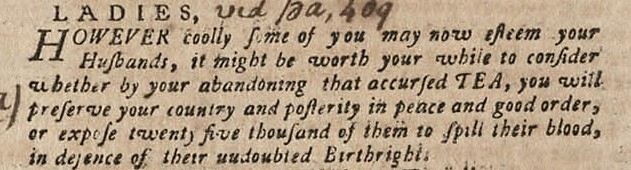
John Hancock was not the only one to face social pressure during the non-importation agreement. Women (or “Ladies”) were often appealed to directly, especially regarding the non-consumption of British tea. I still get a kick out of the line “However coolly some of you may now esteem your Husbands” in the 21st century.
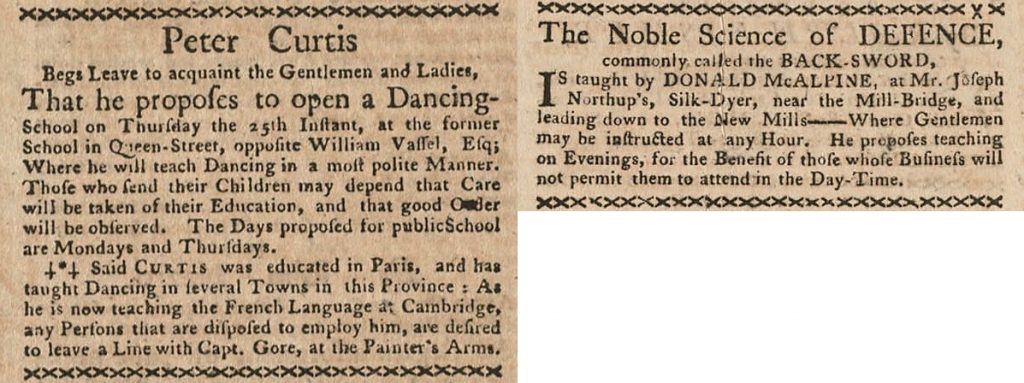
I also greatly enjoy the advertisements for less-remembered fields of business. Ladies (and Gentlemen) may have sent their children to join Peter Curtis at his new Dancing School. And Gentlemen who wished to learn “The Noble Science of DEFENCE commonly called the BACK-SWORD” may join Donald McAlpine in the Day-Time or Evening.
Thanks for joining me on this quick little jaunt through our Harbottle Dorr newspaper collection—there’s way more where that came from! You can browse the collection yourself here.
I’m very pleased to announce a new collection available for research, the Perry-Clarke additions. I’ve been processing this collection for a while now, and I can honestly tell you I’m a little sorry to be finished with it. It’s been one of the most interesting (and challenging) I’ve worked on here at the MHS.
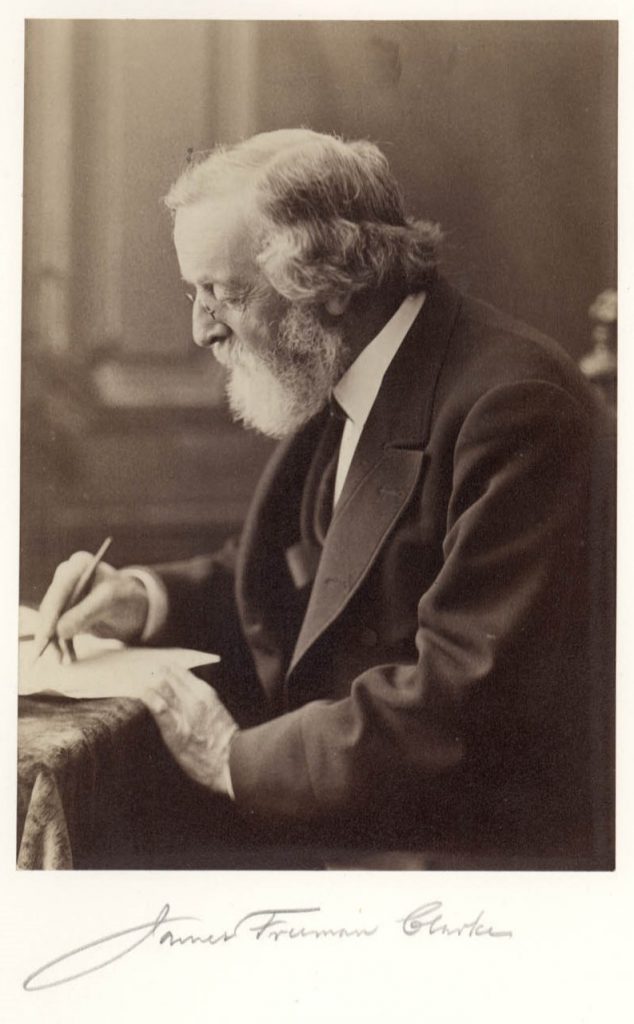
The collection contains the papers of Unitarian minister, transcendentalist, author, and social reformer James Freeman Clarke, as well as many family members from multiple generations. The “Perry” in the title comes from the collection’s donor, Clarke’s great-granddaughter Alice de Vermandois (Ware) Perry.
As you can probably tell from the name, these papers consist of additions to the Perry-Clarke collection, which Alice Perry gave to the MHS back in 1979. After that collection was processed and made available to researchers, Perry donated multiple subsequent installments of family papers. These additions posed a number of problems: many of them were completely unorganized and unidentified, and some portions were even covered in active mold.
Unfortunately, because of these problems and the lack of time and staff to address them, most of the additions have been malingering in our backlog. We did arrange, catalog, and make available four boxes of some of the most significant material—all the letters James Freeman Clarke wrote to his wife between 1832 and 1888—but the rest was largely unusable.
Thankfully that’s no longer the case! While it wasn’t possible, at this late date, to incorporate the additions into the primary collection, I’ve processed the additions separately and created links between the two. At 46 boxes, this collection is smaller than the first (64 boxes), but there’s a lot of overlap.
The collection contains ten boxes of family correspondence (the previously cataloged letters from James to Anna are filed here), followed by nine boxes of James’s papers, primarily manuscript and printed copies of his sermons and other writings.
James may be the headliner, but the collection also includes papers of several equally impressive relatives. Among them are his sister Sarah Freeman Clarke, an artist, author, teacher, and philanthropist; his wife Anna (Huidekoper) Clarke and members of the influential Huidekoper family of Meadville, Pennsylvania; his incredibly high-achieving children, Lilian (reformer and translator), Eliot (engineer and mill manager), and Cora (botanist and entomologist); and his daughter-in-law Alice and her family.
In fact, while the additions complement the original donation in many ways, they have even more to offer. Alice was, through her mother, a member of the famous Lowell family of Boston, so about a third of the additions is made up of Lowell family papers that Alice brought along with her when she married Eliot Channing Clarke in 1878.
The Lowell material includes, for example, nearly 30 volumes kept by Alice’s great-aunt Rebecca Amory Lowell during her decades of work as a Sunday School teacher, as well as 21 diaries of another great-aunt, Anna Cabot Lowell, that neatly fill the gap in one of our other collections! An entire box consists almost exclusively of letters written by Alice’s great-great-aunt, another Anna Cabot Lowell, during the Federalist Era.
Processing this collection meant opening a lot of boxes of miscellaneous unidentified loose manuscripts and crumbling volumes and identifying, to the best of my ability, what they were, who wrote them, and where they belonged. I was particularly impressed by how much material I found documenting the accomplishments of women.
I hope and expect the Perry-Clarke additions will get a lot of use by researchers. I know I intend to mine it for many future blog posts. Thanks to Interim President Brenda Lawson for prioritizing the processing of this collection.
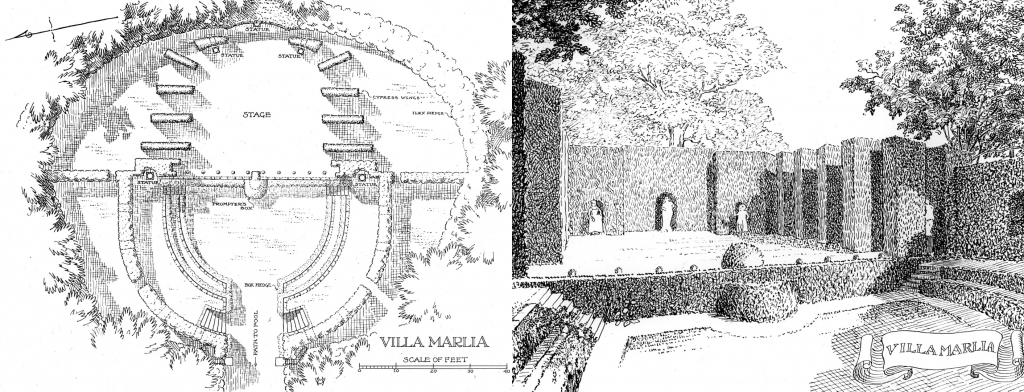
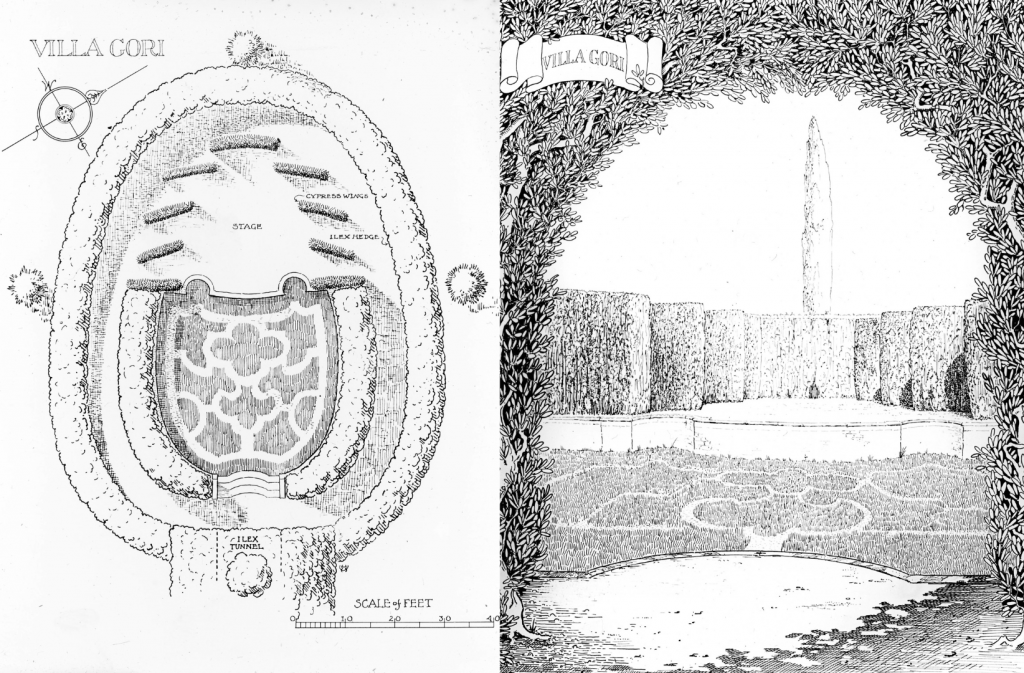
In 1599, William Shakespeare wrote As You Like It, in which the famous monologue by the character Jacques begins, “All the world’s a stage, and all the men and women merely players.” I didn’t expect that line to play in my head as I looked through MHS’s collection of glass lantern slides belonging to Arthur A. Shurcliff. However, that’s what happened when I came across this image (also shown farther below) of a garden theater, or hedge theater, a kind of theater I hadn’t heard of before, and wanted to learn more about.
Two views of Lucca, Italy’s, Villa Marlia Garden Theater, unidentified photographer, undated, from the Arthur Asahel Shurcliff collection of glass lantern slides.Two views of the Siena, Italy’s, Villa Gori Garden Theater, unidentified photographer, undated, from the Arthur Asahel Shurcliff collection of glass lantern slides.
According to Katrina Grant who wrote Teatri Vi Verzura: Hedge Theatres in Baroque Lucca, hedge theaters were created in 1652 in the Tuscan province of Lucca, Italy. They rose in response to the prevailing theory of Italian gardens at the time, that the visual display, or spectacle, of artfully designed gardens was live theater. Such gardens were a way to show the public your life, your money, your taste, and your style. Most hedge theaters comprised a raised, half circle of grass, with a stone wall or large hedgerow as the backdrop. This “stage” could have other features, such as fountains, archways, statues, seating, or fishponds. The property owners would invite friends and acquaintances to their hedge theaters for performances of poetry, music, excerpts from plays, or lectures on a variety of subjects; however, opera wasn’t offered, for it needed paid singers, which was not the idea behind these garden theaters—nor was there space for an orchestra.
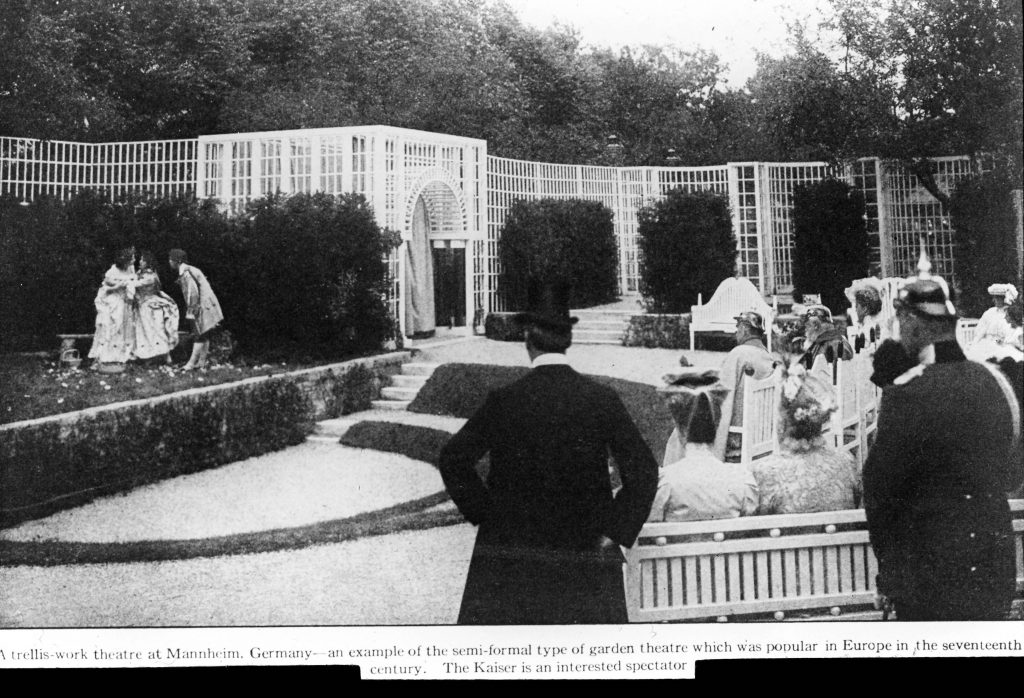
Hedge theaters later became popular in other places, first in France, then in Germany, and finally, in Great Britain. The image below shows a hedge theater in active use. The bottom of the slide notes that “The Kaiser is an interested spectator.” Although the slide itself isn’t dated, “Kaiser” (emperor) was used in Germany from 1871 through 1918, so we can fairly date this photograph to that time frame. What I love about it is how it captures a hedge theater with an audience present and enjoying the performance.
Garden Theater, Mannheim, Germany, unidentified photographer, undated, from the Arthur Asahel Shurcliff collection of glass lantern slides.
One thing that Grant noted in her book was the impermanence of hedge theaters: “Such theatres are imitations of permanent structures rendered in impermanent material, and conversely, living performers are frozen in stone or terracotta.” I liked the idea that such theaters were the opposite of traditional theater space, with four walls and a ceiling that have longevity, with generations of actors coming and going. And the impermanence within the design also plays into the current day thought that the Baroque period was one of intense color, decoration, and drama.
With Shakespeare in the Park and other outdoor theatrical performances becoming more popular in the past few decades, perhaps hedge theaters are about to make a related comeback.
by Sally Keil, Secretary, Richard III Society – American Branch, Team leader for The Missing Princes Project in America
In August 2012 the search for the mortal remains of King Richard III, led by Philippa Langley MBE and her “Looking for Richard” project team, came to a successful conclusion when the King’s grave was located under a parking lot in Leicester, England. With this mystery solved, Langley turned her attention to the disappearance of the two sons of King Richard’s elder brother and predecessor, King Edward IV: what happened to the two boys following the coronation of their uncle? The last time they were seen playing on Tower Green was in July 1483. Over the course of that summer they were seen ‘less and less’ until they were no longer seen at all. With no proof whatsoever of their demise, the theory that they were put to death by their uncle calcified and is now taken as fact.
Solving the mystery of the disappearance of the two boys became Langley’s next challenge. She formed The Missing Princes Project (TMPP) and solicited help from researchers around the world to hunt for primary source documents that might offer clues to their whereabouts. To participate in this effort, I formed The Missing Princes Project in America in December 2018. The objective: search the 497 institutions listed in the Directory of Collections in the US and Canada that have Pre-1600 Manuscript Holdings. I reached out to the membership of the Richard III Society-American Branch asking for volunteers; thirty-one people raised their hands. Beginning in December 2018 we scoured 497 US-based libraries, archives and special collections looking very specifically for primary source documents dated between 1483 and 1509. With the outbreak of COVID all searching had to be online.
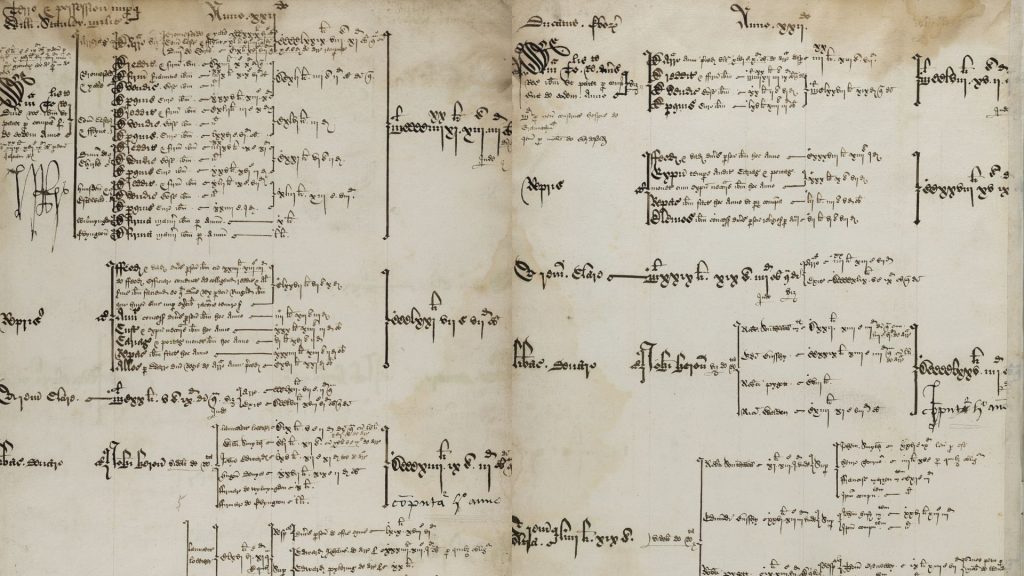
In querying the Massachusetts Historical Society’s digital archives, I was tremendously excited to find the original manuscript of a financial account book from the court of King Henry VII that was dated within our required timeframe. This manuscript was donated to the MHS in 1905 by the estate of Charles Edward French, a Bostonian businessman. I think it’s fun to learn that a Tudor period court record has been sitting right in our own backyard! However, it is written in Latin with medieval script, and is therefore indecipherable to most people who do not have the necessary paleographic skills. With a generous donation of funds from the Scottish branch of the Richard III Society, Langley commissioned Dr. Shelagh Sneddon of York University to transcribe and translate the account book. While it did not hold any clues to our search for the missing boys, it shines a bright light on the finances of King Henry VII and his court. With the kind agreement of Dr. Sneddon, The Missing Princes Project is pleased to donate a copy of the translation to the MHS. This gift enables MHS to provide students, researchers, and the wider online communities direct access to an original Tudor period manuscript.
Household book, ca. 1500. “An account imposed upon the lands and possessions of Henry VII” of England, dated during his reign (1485-1509). Contains assessments of property and the amounts of expenditures for the royal household.
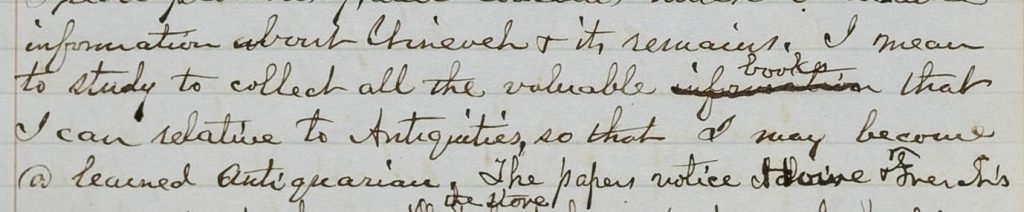
A challenge to MHS researchers! As noted above, the estate of Mr. Charles Edward French donated this manuscript to MHS back in 1905. He also donated his diaries. In trying to determine from whom he obtained the account book, I came upon an entry in volume six, reel 2, box 2 page 125, written in the spring of 1864 that reads “I mean to study to collect all the valuable books that I can relative to antiquities, so that I may become a learned antiquarian/”. I have been unable to proceed beyond that. A small research challenge perhaps? It would be wonderful to be able to trace the provenance of the account book.
By Dr. Kristof Loockx, Centre for Urban History, University of Antwerp
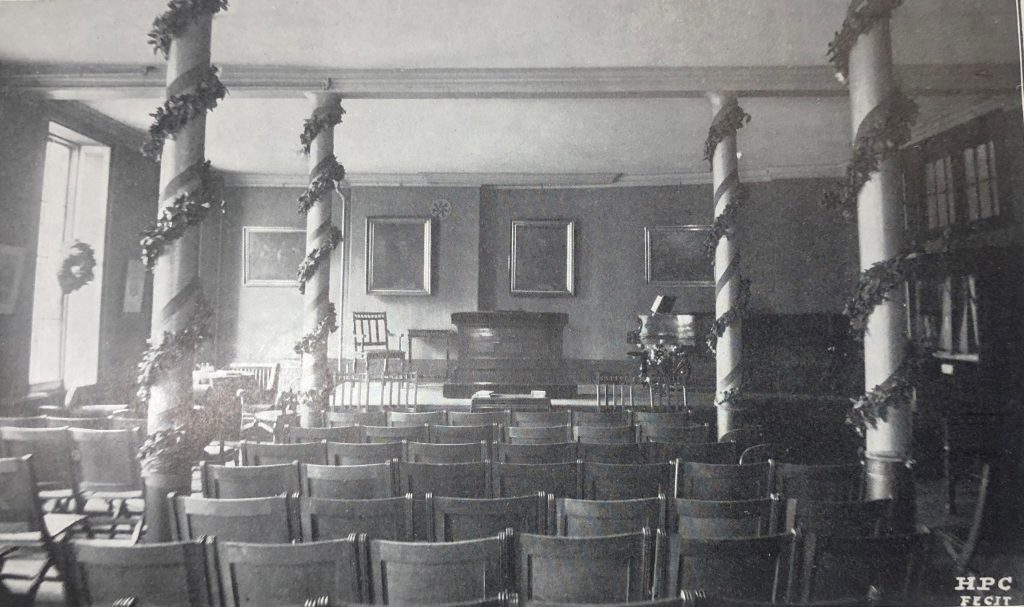
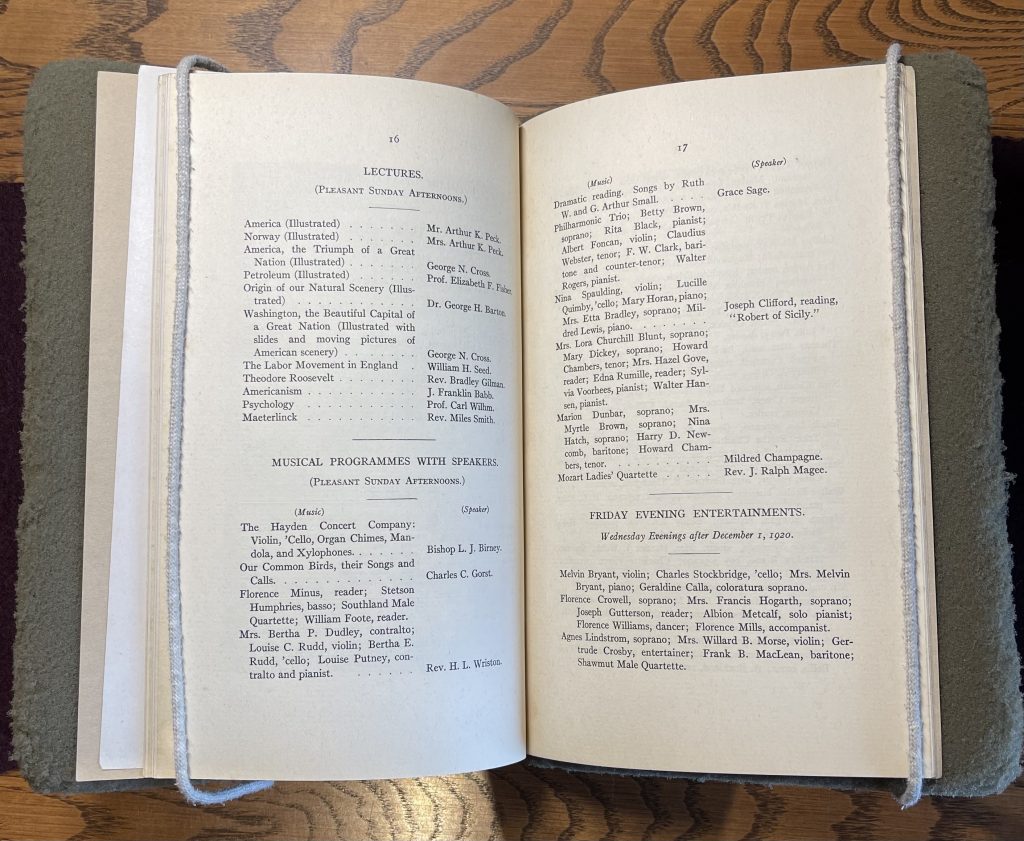
On a Sunday afternoon in 1920, the Boston Port and Seamen’s Aid Society invited Professor Elizabeth F. Fisher (1873-1941) to deliver an illustrated lecture on petroleum at the Mariner’s House on 11 North Square.[1] Born in Boston, Fisher was a renowned scientist who graduated from MIT and held a permanent position as Professor of Geology and Mineralogy at Wellesley College. Like many other lecturers of that era, she most likely presented findings from her recent book.[2] In it, she offered educational insights into the geographical distribution of various natural resources, such as oil, and their industrial applications in the US. The book featured a rich variety of illustrations, such as geological maps and images of industrial uses of petroleum, that were likely used at the time of her lecture.[3] The seamen’s society had acquired a stereopticon in 1894, which marked a significant change in the programming of the organization’s lecture and entertainment series, as it enabled presenters to enrich their talks with illustrated projections on a wall.[4]
Photograph of the Chapel at the Mariner’s House on 11 North Square where the Boston Port and Seamen’s Aid Society organized lectures and entertainment events, c.1905. Source: BPSAS, MHS, Annual Reports, 1832-1977, Report of the Managers, 1906, 26-27.
My research at the MHS explores a relatively uncharted aspect of maritime history: the role of seamen’s societies in organizing educational and entertainment events to impact the lives of transient seamen. This focus aims to illuminate the broader implications of such organizations beyond merely providing room and board. Organizations like the Boston Port and Seamen’s Aid Society increasingly engaged in promoting cultural programs to foster education, community, and self-improvement, which was part of a broader strategy to instill Christian values and counteract the exploitation of seafarers while ashore. These efforts also addressed the presumed relationship between industrialization and the deterioration of seamanship by re-educating those marginalized by capitalism.[5]
By exploring the rich archival records of the Boston Port and Seamen’s Aid Society at the MHS, I aim to reveal the nuances of how lectures and entertainment events were planned, executed, and received by their intended audiences. This research will provide a more comprehensive picture of the seafarer’s urban and social world, which is all too often reduced to prostitution, gambling, and drinking.[6] The study also demonstrates that seamen’s organizations were an integral part of the broader, flourishing lecture and entertainment circuit in the late 19th and early 20th centuries, echoing the principles of the lyceum movement, which was instrumental in promoting adult education through public lectures, debates, and concerts.[7] Furthermore, the prominent role of figures like Elizabeth F. Fisher highlights the integral part women played in these educational endeavors, as was the case for women who led concerts, delivering musical performances that enriched these gatherings.
Overview of the lectures and entertainment events hosted by the Boston Port and Seamen’s Aid Society in 1920, including the illustrated lecture by Prof. Elizabeth F. Fisher. Source: BPSAS, MHS, Annual Reports, 1832-1977, Report of the Managers, 1921, 16-17.
While not all lectures, entertainments, and religious gatherings were illustrated, the incorporation of technology like the stereopticon, as well as the employment of instruments during performances, and the later use of the film projector for the showing of silent films –often accompanied by live music– aligned with the broader lecture circuit’s embrace of innovative methods to enhance learning and retention, making complex subjects accessible and engaging to a wide audience.[8] Additionally, seamen’s organizations also fostered a sense of camaraderie and joy through singing religious hymns and singalongs, with the latter often accompanied by the projection of song names to facilitate participation.[9] This use of projection technology highlights seamen’s societies’ aims to blend education with essential social interaction.
The enduring legacy of the Boston Port and Seamen’s Aid Society’s commitment to the welfare and education of seafarers remains a testament to the enduring value of community and knowledge. The rich archival material at the MHS not only sheds light on a neglected facet of maritime history but also underscores the timeless relevance of educational outreach in empowering individuals against the challenges of their times. By delving into the past, we gain insights into the methods and motivations that shaped lives, offering lessons that remain profoundly applicable in today’s ever-evolving societal landscapes.
Link to Multimedia Resources
To give readers a taste of the atmosphere during entertainments at seamen’s organizations like the Boston Port and Seamen’s Aid Society, links to a typical song and film from this era, enjoyed during the singalongs and screenings of silent films, are included below. These examples not only reflect historical tastes but also enrich our understanding of seafarers’ social lives during the period.
[1] Boston Port and Seamen’s Aid Society records (BPSAS), MHS, Annual Reports, 1832-1977, Report of the Managers, 1921, 16.
[2] Robert R. Shrock, Geology at MIT, 1865-1965: A History of the First Hundred (Cambridge: MIT Press, 1977), 400.
[3] Elizabeth F. Fisher, Resources and Industries of the United States (Ginn and Co: New York, 1919).
[4] BPSAS, MHS, Annual Reports, 1832-1977, Annual Report of the Managers, 1895, 7.
[5] For a general overview of the Boston Port and Seamen’s Aid Society’s history, see: Patrick M. Leehey, A History of the Mariner’s House (Boston: Boston Port and Seamen’s Aid Society, 1995).
[6] The Boston Port and Seamen’s Aid Society records at the MHS consist of 69 volumes and other records in 17 record cartons (Ms. N-366) and 3 reels of microfilm (P-717), spanning the years 1829-1977.
[7] For the lyceum movement, see, for instance: Tom F. Wright (ed.), The Cosmopolitan Lyceum: Lecture Culture and the Globe in Nineteenth-Century America (Amherst: University of Massachusetts Press, 2014).
[8] Margo Buelens-Terryn and Kristof Loockx, ‘Bringing the World into View: Explorations and the Illustrated Lecture Circuit in Early Twentieth-Century Antwerp and Brussels,’ in: J. Happel, M. Hussinger, and H. Raupach (eds.), Expeditions in the Long Nineteenth Century: Discovering, Surveying, and Ordering (New York: Routledge, 2024), 244-245.
[9] Seamen’s Church Institute’s Digital Archives, Outreach Text and Images, Song-Hit Slides.
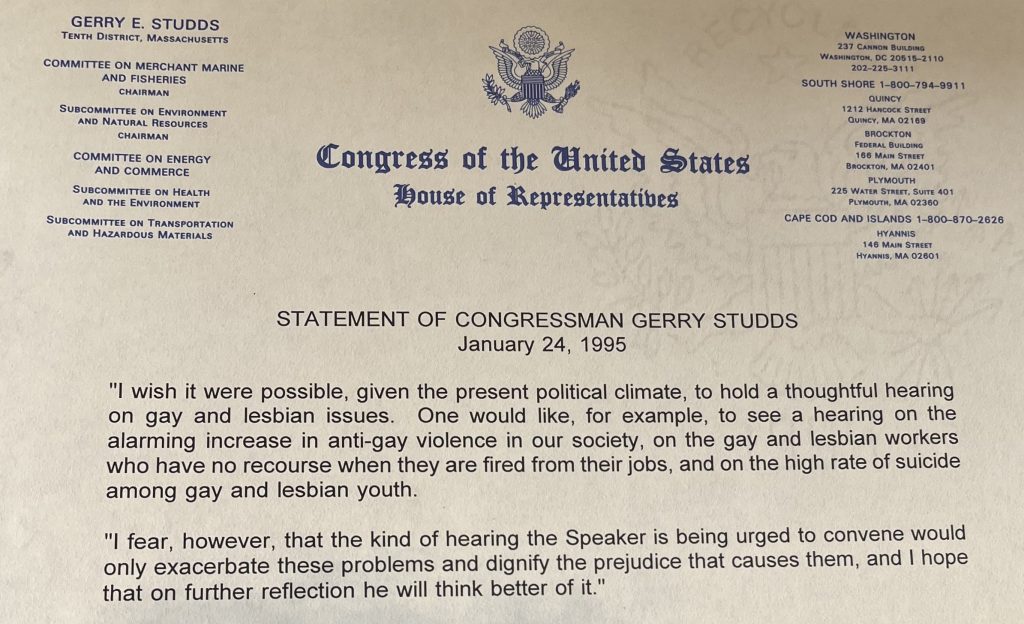
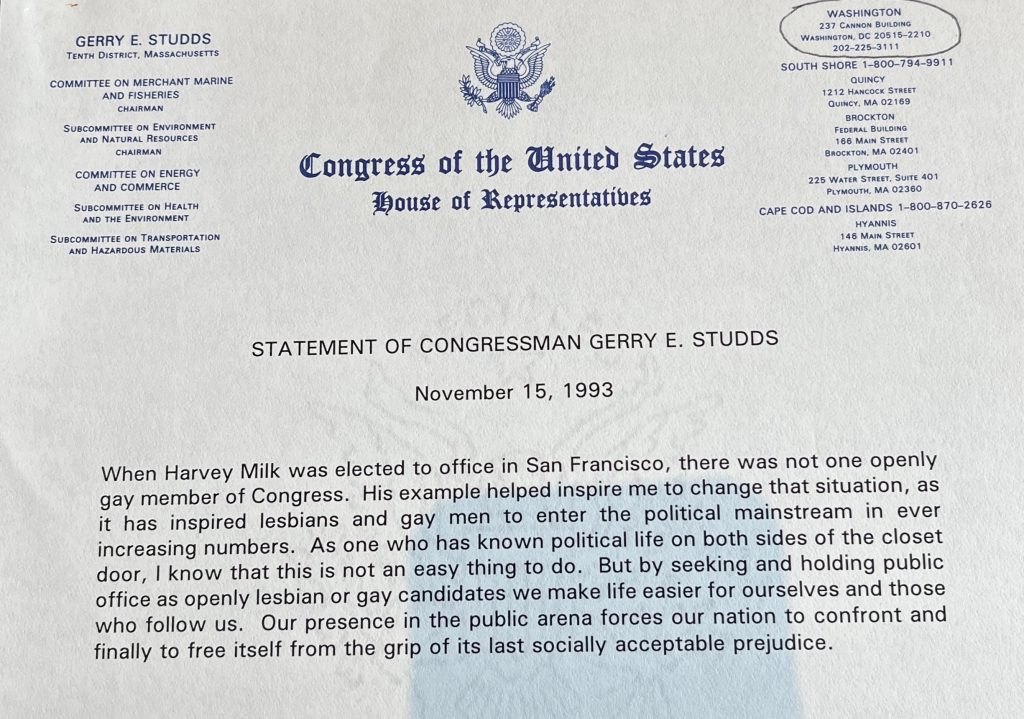
May 17, 2024, was the 20th anniversary of the Supreme Judicial Court of Massachusetts’ ruling that legalized gay marriage in the state, the first state in the nation to do so. To celebrate such an important landmark, as well as Pride month, I wanted to look at some LGBTQIA+ representation in our archives. I found out that we have the papers of Gerry E. Studds, the first openly gay US Congressman, and decided to explore them. I had never heard of him before, so it was fascinating to learn about this piece of history as someone who did not grow up in Massachusetts. Outed after a male ex-page reported having a consensual sexual relationship with Studds when he was 17, Studds chose to acknowledge and claim his sexuality rather than hide behind a veneer of heterosexual respectability. His bid worked. He would go on to serve in Congress for more than a decade after the scandal broke. Representing the 10th District including Cape Cod and the South Shore, he was committed to addressing marine and environmental concerns and maintained a strong anti-war stance throughout his time in Congress. I would love to explore his other activist focuses eventually, but for this blog I want to focus on his AIDS advocacy and support for gay rights.
I remember learning about AIDS as a child, but by the time I learned about it, it was no longer a death sentence the way it was in the 80s when Studds first spoke up about it. In his papers, he continually pointed out how HIV/AIDS was a deadly infection. He heavily critiqued his fellow representatives for not considering groups affected, such as gay men and intravenous drug users, as worthy of protection. In his view, it was a serious disease and a health crisis. Studds’ disagreement with Reagan’s hands-off approach to the epidemic is rooted in his observation that it “seems that the principal social activity today of a whole generation of young gay men and women is attending the funerals of equally young friends.” He also explicitly links support for an improved healthcare system to an improved prognosis for AIDS patients and vocally calls for more funding for AIDS care, treatment, and research.
Studds’ concerns about anti-gay violence were well-placed. Matthew Shepard was murdered 3 years after this statement, in 1998.
He does not only care about AIDS, however. Studds is vocal about other gay issues, like military service. He objects to the anti-gay rules in the military, including what became known as “Don’t Ask, Don’t Tell,” and calls for gay military members to be able to serve openly and “with dignity,” pointing out that “you cannot blackmail someone who has nothing to hide.” It was not until 2011 that the policy was repealed and LGBTQ people could serve openly in the military without threat of being discharged. He argued that “the fear of gays is largely based on an ignorance that breeds ignorance” and that normalizing being gay was the key to creating a society where LGBTQ people are welcomed and cared for.
Today there are 12 openly LGBTQ members of Congress, which surely would have thrilled Studds.
It’s striking to read these documents and see just how recent many LGBTQ gains are. Studds came out in 1983. Gay marriage was legalized federally in 2015. The US Supreme Court upheld that employers cannot discriminate on the basis of sexual orientation or gender identity in 2020. These are all well within living memory. Civil rights are living, breathing, developing laws and policies, and the reality is still very far from rosy. As Gerry Studds said, “we will continue the struggle until the final chapter has been written and everyone is treated with dignity and respect.”
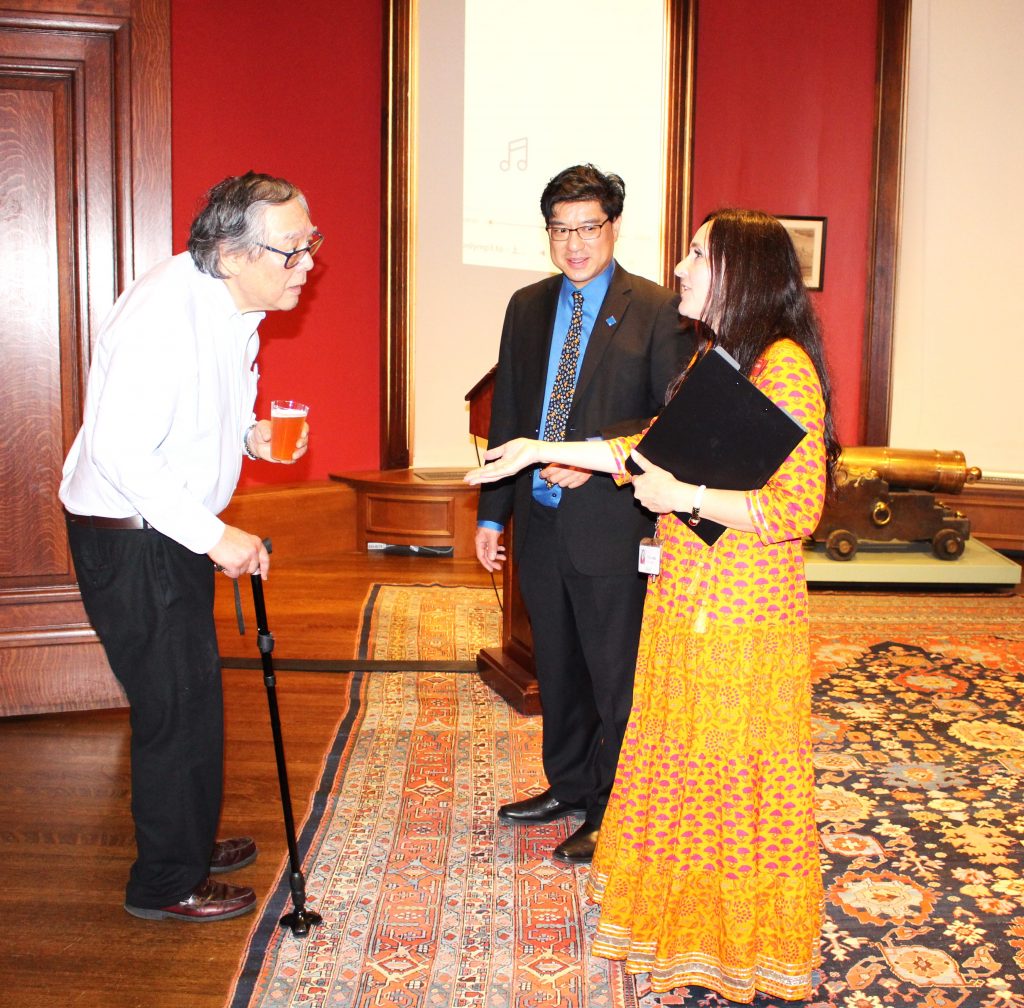
The MHS held a special event featuring Asian American and Pacific Islander history to mark Asian American and Pacific Islander heritage month on 28 May 2024. The event began with a reception to bring together guests from various communities, institutions and organizations, followed by two special guest speakers, Representative Tackey Chan, of the Second Norfolk District in the Massachusetts House of Representatives and Dr. Paul Watanabe, Professor of Political Science and Director of the Institute for Asian American Studies at the University of Massachusetts Boston.
From left to right: Dr. Paul Watanabe, Rep. Tackey Chan, and Rakashi Chand, MHS.
Rep. Chan and Dr. Watanabe both spoke about the need to bring Asian American histories and people into sight, as the stories and voices of AAPI peoples have been historically ignored or removed from the narrative. Representative Chan discussed the many incidents of mistreatment, discrimination, exclusion and hate crimes committed against Asian Americans through the centuries. Both spoke about the importance of being seen and the importance of teaching and learning the history of AAPI people.
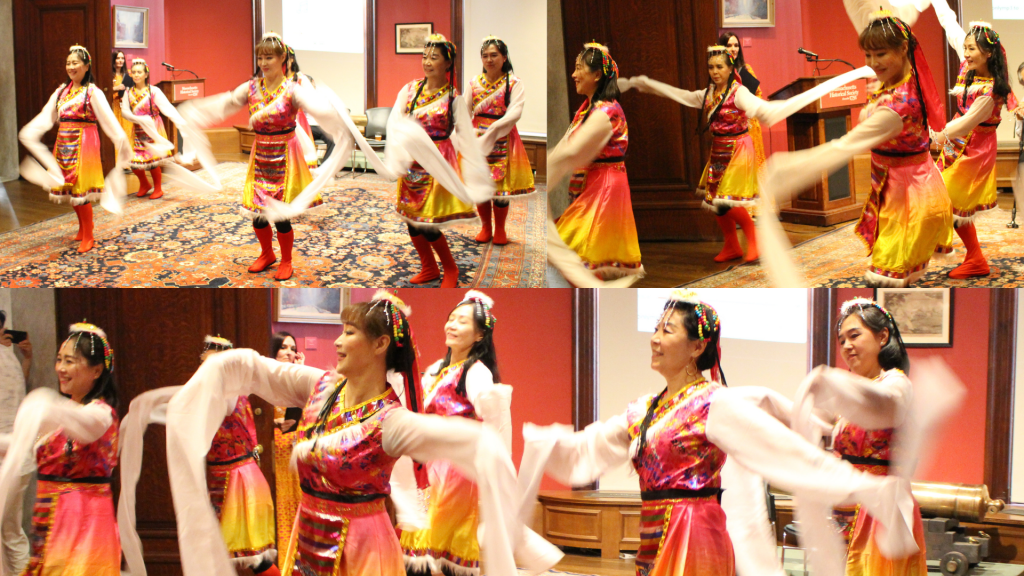
This was followed by a beautiful dance performed by members of the Newton Chinese Language Teachers Club, mesmerizing attendees and filling the MHS with music.
Photographs captured of the Newton Chinese Language Teachers Club dance
Rakashi Chand, Reading Room Supervisor, then welcomed the crowd to the MHS, along with Peter Drummey, Chief Historian & Stephen T. Riley Librarian, and kicked off the multi-case interpretation featuring collection items related to Asian American and Pacific Islander history at the MHS.
Items featured throughout the building for the event included:
This handsome hand-painted silk menu was printed for a farewell dinner honoring Japanese diplomats and technical advisors after a seven-month visit to the United States. Among the visitors were key figures in the Meiji Restoration of 1868 and the new imperial regime. Ralph Waldo Emerson and Oliver Wendell Holmes delivered speeches that evening.
This watercolor painting by Estelle Ishigo depicts the Heart Mountain Relocation Center in Wyoming, one of ten internment camps established for Japanese Americans during World War II. Ishigo was recruited as a “Documentary Reporter” for the War Relocation Authority and recorded the internment experience in illustrations, line drawings, oil, and watercolors.
The first print of the first Chinese-language Newspaper in America.
Letter from Pandita Ramabai from the Judith Walker Andrews Correspondence, 1887-1911, consists of letters from Pandita Ramabai describing her work to care for and educate child widows at Sharada Sadan and Mukti Sadan as well as other correspondence and accounts.
The event was well attended and enjoyed by an appreciative audience, many of whom attended for the first time. The MHS features material and scholarship related to Asian American and Pacific Islander History every May in honor of AAPI Heritage Month. Check the events calendar to attend next year.
If you are interested in viewing these or other Asian American and Pacific Islander collection items at the MHS please use the online catalog, Abigail, to request items in the Library. Everyone is welcome to use the library and conduct research in the Reading Room. If you are interested in donating items to the collection, please see the webpage on Donating to the Collection.
The MHS, like all archives, holds a number of manuscripts that are unidentified for one reason or another. Of course, we try to identify the authors of these materials whenever possible, but if we can’t, they can still be cataloged by subject, location, time period, etc.
Recently I was tasked with identifying the author of an anonymous diary in our collections. I always enjoy these “investigations,” and I’ve written about a few of them here at the Beehive. So let’s dive in!
Anonymous diary, 1895–1899
The diary is a thin hardbound volume measuring 5 ½ x 7 inches. The leather binding is suffering from red rot and separating from the text block, but the paper itself is in good shape. Only about a third of the pages contain any writing, and the handwriting is, well, challenging. So my first hurdle was just figuring out what the diary says.
The entries date from 24 April 1895 to 19 July 1899 and describe a number of separate trips from Boston to the Midwest and Northwest U.S., as well as Mexico, Jamaica, and Europe. The author was apparently a man traveling on business of some kind, visiting places like factories, stockyards, and other properties. He wrote a lot about railroads, and the front of the volume contains detailed itineraries of each trip. At the back is a pencil sketch signed “M.A.A.” Could these be the initials of our author?
Pencil sketch at the end of the volume
Between the scrawly handwriting, cryptic abbreviations, and lack of context, I had a tough time finding clues at first. I noticed two names: Harry, who was ill and in whom the writer was interested, and Molly, with whom he corresponded. But this wasn’t much to go on.
Then I stumbled across a recurring name that would prove crucial. The writer’s frequent traveling companion was a Mr. Adams, sometimes C.F. Adams or just plain C.F.A. These initials are of course very familiar to MHS staff and historians. Were these references to one of the several Charles Francis Adamses, relatives of presidents John and John Quincy Adams?
The diary was written in the 1890s, so assuming I was on the right track, I had two candidates. One was Charles Francis Adams (1866-1964), but I ruled him out because, as mayor of Quincy, Mass. at the time, he was probably not traipsing around the country looking at properties. But his uncle, Charles Francis Adams (1835-1915), served as chair of the Massachusetts Railroad Commission and president of the Union Pacific Railroad. This set off alarm bells. I literally wrote in my notes beside his name: “Railroad guy!”
Next I consulted Adams family genealogies. In fact, “railroad guy” had a daughter Mary Ogden Adams, who went by Molly. She married Grafton St. Loe Abbott in 1890. Maybe Grafton was our man? He and Molly had a son Henry Livermore Abbott, who might have been the Harry who was ill.
Now that I was more familiar with the handwriting, I returned to the diary for confirmation. Sure enough, on 13 May 1895, the writer was recognized by a friend and used his own name in relaying the story: “As I was walking up [the] street a man stopped me & asked if I [was] Mr Abbott, it turned out to be Prescott.” And an entry at the end of 1897 refers to the death of Molly’s aunt Anne Ogden. Molly’s mother was Mary Hone Ogden.
Grafton St. Loe Abbott graduated from Harvard with a degree in law, but spent most of his life working in the mining and railroad businesses. This diary describes trips taken with his father-in-law Charles Francis Adams in the latter capacity. A detailed biographical notice of Grafton was printed in the 1917 report of the Harvard Class of 1877.
The sketch at the end of the volume, from a trip Grafton and Molly took to Falmouth, Jamaica, was drawn by Molly in 1898.
The catalog record for the diary is here. The MHS also holds the papers of Charles Francis Adams, Molly and Grafton’s daughter Mary Ogden Abbott, and other members of the Abbott family. Special thanks to MHS library assistant Hannah Goeselt, who helped gather details from the diary.
“Norse Tower” engraving by Brunner & Tryon (left) & my own visit to Norumbega Tower (see arm at the top), Weston, MA, (right).
In the Preface to the 1892 publication The Landfall of Leif Erikson, AD 1000, and the Site of his Houses in Vineland, Horsford points out “the Committee appointed by the Massachusetts Historical Society to investigate the problem of the Northmen give the following as, in the judgement of the Corresponding Secretary, “the result of the best historical criticisms”: [and here he quotes back the verdict from the December 1887 Proceedings] These authorities seem to have written under the impression that the evidence, if there be any, of the presence of the Northmen at any particular point on the New England coast might be found in print. As they have failed to find it, they have been led to the conviction that such evidence cannot be found.”
Haynes, as the author of this quote, for his part elaborated on this point in the 1890 Proceedings in that he “was entirely innocent of any intentional disrespect when I ventured upon the unlucky comparison of Leif Ericson with Agamemnon”1, and that the parallel came more from a real belief in the Iliad king rather than skepticism in the existence of the Sagas Vikings.
Despite this—or maybe in some passive aggressive way because of—the Society’s continued animosity to his theories, Horsford made sure to gift a copy of every one of his published books to the MHS at the earliest opportunity. A closer look at the Society’s copy of The Landfall of Leif Erikson shows it is personally inscribed at the front: “Massachusetts Historical Society / with the compliments of the author / Cambridge Dec. 25. 1891”.
Within this whole drawn-out affair, we also see the erasure of Indigenous history in the battle for Leif Erikson’s presence in New England, with the most blatant being the memorial committee’s insistence on Dighton Rock2 being somehow of Nordic production rather than created by a group much more local. Horsford’s theory behind a Viking Norumbega follows a similar line of thought, in that he reasoned the word itself must be a bastardization of ‘Norbega’, an archaic wording for Norvega, or Norway. The word “Norumbega” had originally appeared on several 16th century European maps of the American Northeast before the region became New England. Thought to be a mythic city of gold and riches, a bit like its Southern cousin of El Dorado, it is now acknowledged as most likely a misquote of the Abenaki ‘nolumbeka’, a calm stretch of water between two rapids3.
Aftermath
Horsford had alluded to the actual site of Leif’s home at Gerry’s Landing (a strip along the Charles in Cambridge) multiple times in previous writings with the intention of eventually publishing an in-depth monograph on it. However, after his death in early 1893, it was his daughter, Cornelia “Nellie” Horsford, who published Leif’s House in Vineland. / Graves of the Northmen later that same year, a posthumous collaboration investigating evidence for Horsford’s other major discovery. The experience of finding archeological “evidence” of Leif Erikson’s home in Cambridge would inspire Cornelia to continue her father’s research, including sponsoring trips to Iceland to visit actual Viking sites and digs.
In 1895, the Norumbega tower and Leif statue were further linked by the construction of Comm Ave and its new street railway line, the two monuments now situated at opposite ends. Two years later, an amusement park and boating house named after Horsford’s precious Viking city sprung up on the opposite side of the Charles, within site of the tower. The Norumbega Park & Totem Pole Ballroom would become a beloved weekend destination for families and couples well into the 1960s.
Trapeze Act performed by Baechtold & Abel, with Norumbega Park’s surviving Boathouse in the background, 1 August 2021.
Silverstein, Clara and Sara Leavit Goldberg. Norumbega Park and Totem Pole Ballroom. Arcadia Publishing, 2021.
1 Proceedings of the Massachusetts Historical Society, Second Series, vol. V (February 1890), p.332-340.
2 this is explored more in depth in the publication The Place of Stone: Dighton Rock and the Erasure of America’s Indigenous Past by Doug Hunter (Chapel Hill, the University of North Carolina Press, 2017).
As spring arrives, the world around the MHS becomes full of life. Ellis Hall’s large windows frame Fenway’s new leaves, budding flowers, and traffic of all sorts. Any given day, you can see cars, buses, bicycles, scooters, pet strollers (my personal favorite), and on rare occasions–roller skaters.
Though roller skating isn’t as popular as it was in the mid-1990’s, it remains a popular warm weather activity here in Boston. Largely thanks to the fact that Boston, the second most walkable city in the United States, has plenty of flat, paved surfaces, but perhaps also because the inventor of the modern skate grew up nearby!
Born in 1828, James Leonard Plimpton showed an early affinity for machinery and invention. His mechanical skills were so strong that at 16, he moved from the family farm in Medfield to a machinery shop in Walpole. By 18, he supervised more than 50 employees at a factory in New Hampshire.[1] A young entrepreneur and mechanist, James was well-suited for the Industrial Revolution underway across the United States.
A tinkerer at heart, James filed his first patent in 1853. The invention was a “cabinet bed,” designed so a bed could be stored and retrieved without much strength or bending over. Sources simply note that Plimpton invented the cabinet bed “to supply a personal need,” but we may be able to guess what this need was. In December 1852, James married the bright, book-loving Harriet Amelia Adams. [1] Perhaps the newlyweds needed to save space or were preparing to add children to the home and needed a bed that would be easier for a pregnant Harriet to store. It is possible that Plimpton, in the words of Ana Ruhl, “loved her to the point of invention.” They would go on to have eight children together; only four lived to adulthood.
Around 1860, James and Harriet moved their family to New York City. The MHS collection has a single image of James Plimpton, probably taken shortly after arriving in the Big Apple. He gives the appearance of a hopeful, determined man. Within a year, James took ill. Consulting a doctor, James “was advised to practice ice skating,” and happily, James “took much benefit from it.” [2] Like many Northeasterners, James grew up ice skating in the winters. (The MHS has many materials about ice-skating, including a heroic rescue.) When spring arrived and the ice melted away, James purchased an early pair of roller skates.
James Plimpton in 1860 (Photo. 2.234)
Yes, roller skates existed before James Plimpton’s came along. The first recorded use of roller skates was “in a 1743 theater production in which actors affixed wheels to their footwear to mimic ice skating on the stage.” [3] Early roller skates were commercially available by the mid-19th century, but they were uncomfortable, awkward, and difficult to turn. They didn’t feel like ice-skating at all. After some experimenting and tinkering, James produced a new set of roller skates with two pairs of wheels, called “rockers” or “quad-skates.” [4] These new skates were more comfortable and far easier to turn. The modern roller skate was born.
Advertisement for roller skating in Winslow’s Roller Skate Catalog (Book 1882)
The invention was a giant success. Advertisements boasted that Plimpton’s skates were “the only one upon which all the graceful movements and evolutions of Ice Skating can be executed with ease and precision on a Smooth Floor.” [5] The MHS collection has plenty of evidence of this phenomenon: admittance tickets to roller skating rinks, skate advertisements and catalogues, bookplates, and photos of popular roller-skating clubs. Senior Processing Archivist Susan Martin has written about Great Depression-era debutantes making appearances by skating around town.
People gathered at the Onset Roller Skating Rink, circa 1870 (Photo. 11.468)
James Plimpton spent the rest of his life selling, improving, and litigating his patents. Harriet was a caring mother and educator to their children, as well as an irreplaceable business partner. “Her quick perceptions and correct impressions as to social, legal and business points” ensured that she could “give her husband that assistance in the preparation of his patent cases that could not otherwise have been as thoroughly prepared within the time required.” [6] Roller skating was a family business and only possible through the hard work and intelligence of both Harriet and James.
The roller-skating crazes of the late 19th and 20th centuries have come and gone. Hoverboards, Onewheels, and E-bikes have replaced them on the sidewalks of Boylston Street. But occasionally, if you’re lucky, you may look out the windows of Ellis Hall and see a piece of Massachusetts history skate past you.