The Case of the Redacted Husband

by Susan Martin, Senior Processing Archivist

While processing the MHS collection of Huse family papers, the following letter caught my eye, for obvious reasons.

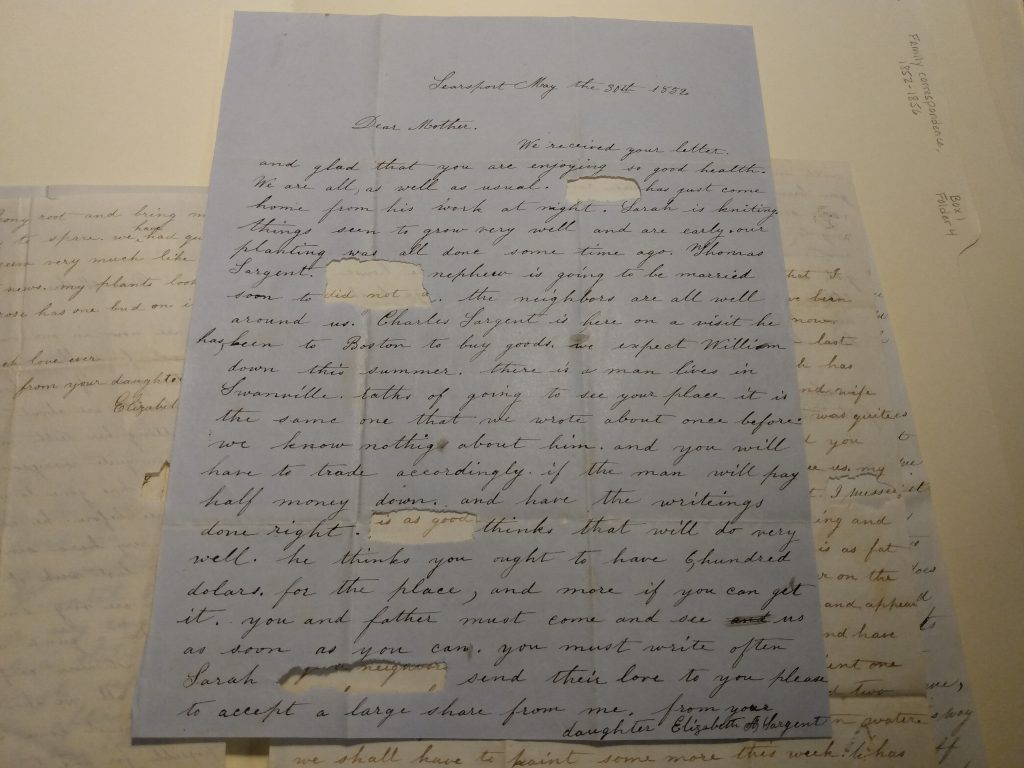
Color photograph of several black ink handwritten letters piled on top of each other. They have oval or rectangular ripped out sections, about the size of one word.
Letter from Elizabeth Sargent to Sarah Fuller, 30 May 1852

This letter was written by Elizabeth “Lizzie” (Fuller) Sargent to her mother Sarah Fuller. For some reason, everywhere Lizzie mentioned her husband Samuel, his name had been physically removed from the letter. “Hmm, that’s interesting,” I thought, and carried on processing. Then I noticed several more.

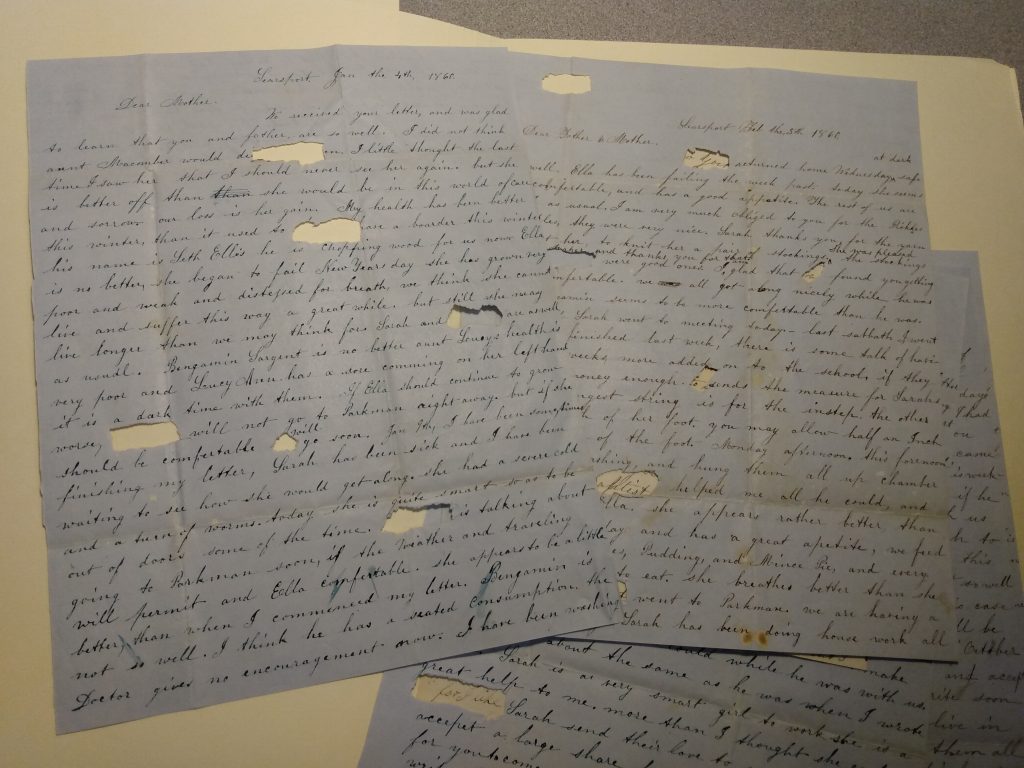
Color photograph of several black ink handwritten letters spread out in a messy layer. Each one has ovals or rectangles ripped out, the size of one word or one letter. The papers are folded, dirty, and discolored with age.
Letters from Elizabeth Sargent to Sarah Fuller, 1860

Something weird was definitely going on here. Nearly every letter from Lizzie to her mother got the same treatment. For example, “[?] sends his love with mine to you all”; “[?] has gone to meeting at the village this afternoon”; and “This is Saturday evening and [?] is oiling his harness and Sarah is rocking the cradle.” From context, it’s clearly her husband’s name that’s missing, and sometimes apparently just his initial!

I’ve occasionally seen words physically removed from letters, but only by a military censor or an aggressive autograph collector. This is obviously different. My first thought was that Samuel did something that landed him in the doghouse. It reminded me of cutting someone out of a photograph after a bad break-up. Had there been a divorce or separation?

Hoping to solve the mystery, I started researching the family, primarily using online genealogical resources. Unfortunately, I wasn’t able to find very much. Lizzie was born in 1827, the daughter of Sarah (née Austin) and Thomas Fuller, a Maine shoemaker. In 1849, she married Samuel Winthrop Sargent, who was twelve years her senior. They lived first in Charlestown, Massachusetts, and later in Searsport, Maine.

The Sargents appear to have been a typical 19th-century family. Samuel worked as both a brick mason and a farmer, while Lizzie stayed home with the children. Sadly, of their five children, only two—Sarah and George—survived to adulthood. On 1 July 1861, Lizzie wrote this passage after losing her third child.

It is with a sad and heavy heart that I write you, again. tears almost blind my eyes. Death has visited us once more, and taken our dear little Ella. she died this morning 25 minutes past 4. it seems as if I cannot be reconciled. O pray for me, that I may not lose my reason […] my home seems, desolate now.

As far as I can tell, Samuel and Lizzie never lived apart. He died in 1901, and she lived until 1903. They and several other relatives are buried at Mount Hope Cemetery in Searsport.

The collection also contains correspondence from Lizzie’s brother and sister-in-law, Andrew and (yet another) Sarah. Their story is compelling. Andrew, feeling “discontented” and “miserable” and wanting a change, joined the California Gold Rush of 1849. During his absence, his wife was desolate: “There is an acheing void […] I wonder when I eat what he has got to eat and when I go to bed what he has got to sleep on.” Andrew apparently died out west sometime in 1851, but I couldn’t confirm the circumstances. His wife Sarah remarried a few years later—believe it or not, to a man named Samuel!

While I enjoyed learning these details about the family, in the end I found nothing that accounts for the redactions. I don’t even know who was responsible for them. Was it Lizzie? Her mother? Someone else entirely? Did they happen at the time or later? Muddying the waters more, in a few instances, the name of another person was also removed. Perhaps an archival colleague or intrepid researcher out there has seen this sort of thing?

Whatever the answer, these letters are a good example of manuscripts that are interesting not just for their content, but as historical artifacts in and of themselves.

Amelia Peabody

by Heather Rockwood, Communications Manager

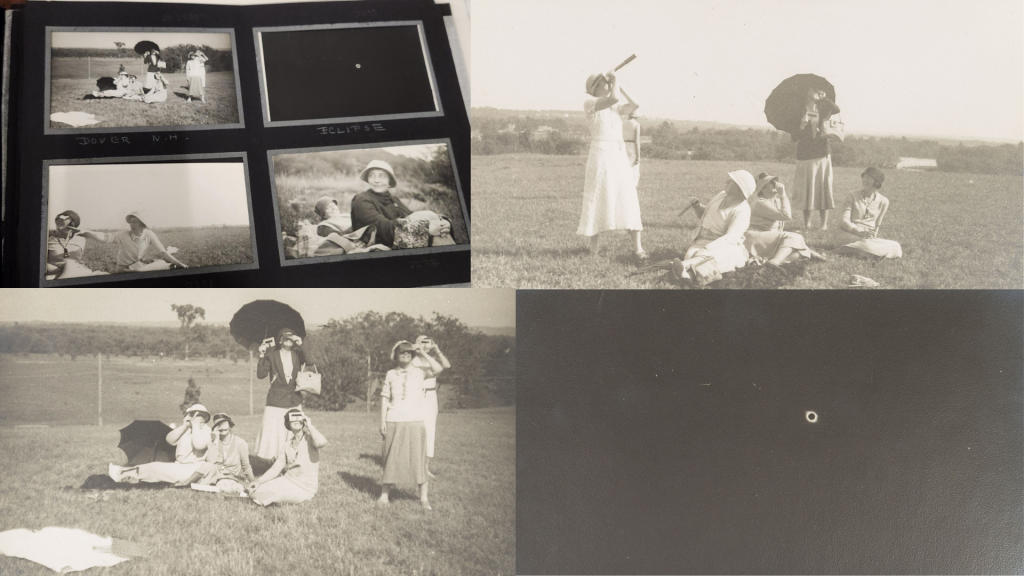
A recent researcher at the MHS told staff about an interesting page in one of Amelia Peabody’s (1890‒1984) volumes of photographs (yet to be digitized). The photos related to our excitement over the eclipse on 8 April 2024. Peabody’s images captured a viewing party for an eclipse on 8 June 1918, from Dover, New Hampshire. The pictures show several seated or standing white women holding viewers over their eyes. I was enchanted to see this scene from 106 years ago, and how it was much like our own viewing parties this early spring. I felt inspired to look up Amelia Peabody and discovered a fascinating person from Massachusetts history.

A collage of four, color photographs of four different black and white photographs, two side by side, two on top and two on bottom. From the top left, clockwise: A photograph of a black album page with four photographs on it, three are of the viewing party, one of a dark solar eclipse, there is white writing below the photographs. A photograph of the viewing party of six women mostly dressed in light colors, half are looking up to the sky either through viewers or a telescope, the other three are looking at each other or are turned away. A dark image with a small white flaring ring around a dark circle. A last picture of the viewing party, in this one all the women are holding viewers up to their eyes and are looking up at the sky.
Images from Amelia Peabody’s photograph collection. From top left clockwise: A photograph of a page from a photograph album with four photographs on it; women looking at the eclipse; the eclipse itself, and another of women looking at the eclipse.

Amelia Peabody was born to Frank Everett Peabody and Gertrude Bancroft Peabody (née Bayley) in 1890 and lived to be 93 years old. Her father was a partner at the brokerage firm Kidder, Peabody & Co. Her mother descended from Robert Gray, the American captain lauded as the first seaman to circumnavigate the globe and open trade with China. The family resided in a townhouse in Boston’s Back Bay and owned oceanfront property in Gloucester.

After her debut in 1909, Amelia studied sculpture at the School of the Museum of Fine Arts under Charles Grafly and became an accomplished sculptress. Her artworks have been displayed worldwide, from Paris to New York. Some of her work lives on in Massachusetts, notably at Mugar Hall, the Bouvé College of Health Sciences at Northeastern University.

Her father, Frank, died in 1918 after a brief illness. Her mother, Gertrude, then married a family friend, William Eaton. Because her older brother Everett Peabody died aged 15 in 1900, Amelia was the sole heir to her father’s fortune. She maintained her family home at 120 Commonwealth Avenue in Boston, as well as Mill Farm, her residence in Dover, and Powisset Farm, also in Dover, with several other landholdings in that town.

As well as being an artist, Amelia was also a horsewoman, farmer, breeder, and philanthropist. Amelia had a wide range of interests and charitable causes, which included animal husbandry, the arts, veterans affairs, medicine, music, and scientific discovery. At her farms in Dover, she raised registered Hereford cattle, Yorkshire pigs, sheep, and thoroughbred horses. For many years, she was the chairman of the Arts and Skills Service of the American Red Cross, which promoted art therapy for wounded servicemen during World War II and continued to promote art therapy for hospital patients after the war.  She sat on the boards of various esteemed medical institutions in Boston. In her golden years, she volunteered at the front desk of the Massachusetts General Hospital. She supported a variety of engineering projects, including a solar home built on her Dover property and spearheaded by scientist and Hungarian immigrant Maria Telkes. She was a staunch advocate for education and scientific exploration and formed a strong relationship with the Museum of Science.

In 1942, Amelia put part of her fortune into what would become the Amelia Peabody Foundation upon her death. She died of natural causes in 1984, leaving the bulk of her vast estate to charity.

See Amelia Peabody’s photographs collection guide and papers collection guide online.

John Quincy and Louisa Catherine Adams: The Original Tortured Poets

By Gwen Fries, Adams Papers

With her 11th studio album, Taylor Swift introduced the world to her “Tortured Poets Department,” inducting like-minded artists to her fictional committee. After a week of assiduously studying the criteria, I have two new members to nominate. I hereby call this meeting to order.

I stand before my fellow members of the Tortured Poets Department with an application for two new members—John Quincy and Louisa Catherine Adams. I enter into evidence the following summary of my findings.

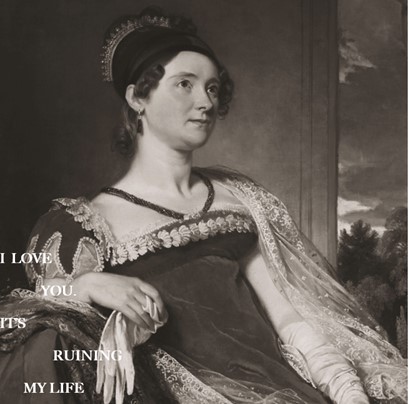
Louisa Catherine Adams. Oil by Charles Robert Leslie, 1816. Courtesy of Diplomatic Reception Rooms (Taylorized by the author)

Exhibit A: TorturedI love you. It’s ruining my life

That like the esteemed founder and chairwoman of the Department, Ms. Swift, Mrs. Adams found it difficult to balance her private life with her public demands.

In her Diary she wrote that it was “a very painful thing to me to be dragged into public notice, and made an object of debate in every company—but these are the penalties I must pay for being the Wife of a man . . . who by his real and extraordinary merits throws those who are more ambitious than himself into the shade.” (LCA, Diary, 21 Dec. 1819)

Her husband’s vocal political views on the gag rule and slavery alienated many of her loved ones in the South. “Every friend is turned into an enemy; and now the prospect terminates with the fear of losing the love, the friendship and the society of my own nearest and dearest connections.” (LCA, Diary, 21 Dec. 1835)

In private, she was tortured by the belief that her husband would have been better off married to someone else. “Few have laboured harder to correct the defects of their character than I have, or have studied their faults so keenly,” Mrs. Adams confided to her diary, “but there is a constitutional irritability about me of late years, trying to my friends and painful to myself, which is I know so disagreeable to all who live with me; it induces me to live much alone, that I may not burthen those, whose happiness I most desire in this life, and for whom I would willingly make any sacrifices to promote their welfare.”

Exhibit B: Poets
Straight from the Tortured Poets Department

That both Mrs. and Mr. Adams were lifelong poets. A catalog of their extant poetry is entered into evidence. “Could I have chosen my own Genius and Condition I should have made myself a great Poet,” John Quincy wrote on 16 Oct. 1816. “I have wasted much of my life in writing verses.”

John Quincy Adams. Oil by Pieter Van Huffel, 1815. Courtesy of the NPG. (Taylorized by the author)

Exhibit C: Independent Thinkers

I’ll tell you something about my good name
It’s mine alone to disgrace
I don’t cater to all these vipers

That like our esteemed chairwoman, Ms. Swift, Mr. Adams refused to be steered by the opinions of others or dominated by his reputation or the reputation of his illustrious father. As a young senator serving in the years immediately following his father’s loss to the new President Jefferson, John Quincy chose to follow his instinct rather than the party line of the Federalists who had supported his father.

On 20 Dec. 1803, Adams wrote to Joseph Hall, “When I accepted the station I hold, it was not with the expectation of giving satisfaction at all times to all my constituents.— I expected to be often censured & from various & opposite quarters.”

To his Diary, Adams declared, “I find myself of course in opposition to the federalists in general. . . . In this state of things my situation calls in a peculiar manner for prudence; my political prospects are declining, and as my term of Service draws near its close, I am constantly approaching to the certainty of being restored to the situation of a private citizen— For this Event however, I hope to have my mind sufficiently prepared— In the mean time I implore that Spirit from whom every good and perfect gift descends to enable me to render essential Service to my Country, and that I may never be governed in my public conduct by any consideration other than that of my duty.”

Exhibit D: Florida!!!
No one asks any questions here

That as Secretary of State, Adams negotiated the Adams-Onis (Transcontinental) Treaty, convincing Spain to relinquish Florida to the United States. Without this intervention, the chairwoman, Ms. Swift, would have nowhere to go when she “need[s] to forget” and to “bury” her “regrets.”

The above evidence is respectfully submitted to the Department.

Sincerely,

Gwen Fries

The Adams Papers editorial project at the Massachusetts Historical Society gratefully acknowledges the generous support of our sponsors. Major funding for the John Quincy Adams Digital Diary was provided by the Amelia Peabody Charitable Fund, with additional contributions by Harvard University Press and a number of private donors. The Mellon Foundation in partnership with the National Historical Publications and Records Commission also supports the project through funding for the Society’s digital publishing collaborative, the Primary Source Cooperative.

Letters from the Collections

By Hilde Perrin, Library Assistant

April is designated National Card and Letter Writing Month by the United States Postal Service, a month dedicated to the joy of writing and receiving correspondence. Here at the MHS, letters are in no short supply. With over 13 million documents in our collection, we have lots of correspondence ranging from famous figures like the Adams family to regular friends writing to friends. I asked a few of our library staff members to share some of the fun letters they have come across in our collections.

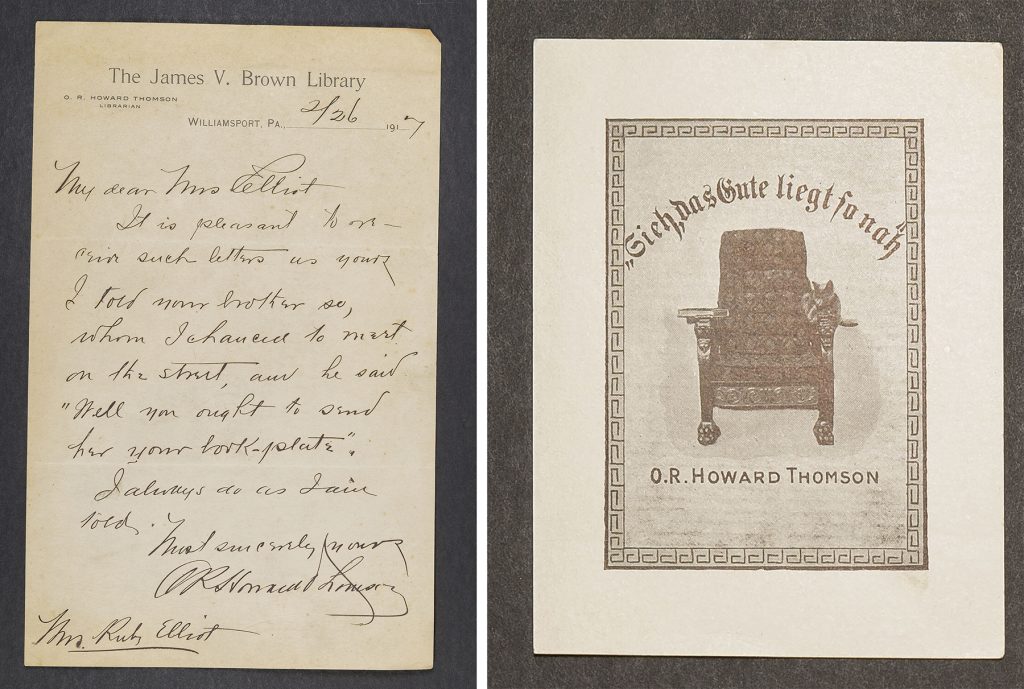
Library Assistant Grace Doeden chose a letter written by O.R. Howard Thompson to Ruby V. Elliot in 1917. Grace is currently working with the Ruby V. Elliot Bookplate collection, a compilation of bookplates that Elliot collected from friends and acquaintances. Thompson sent this letter to Elliot, along with his bookplate, joking that he did it because her brother told him to, stating that “I always do what I am told.” The bookplate that accompanies the letter features a cat lounging on an armchair, and a quote in German attributed to Johann Wolfgang von Goethe: “Sieh, das Gute liegt so nah” or “Look, the good lies so near.”

Left: Letter written by O.R. Howard Thompson to Ruby V. Elliot, 26 February 1917, Ruby V. Elliot Bookplate collection. Right: Bookplate of O.R. Howard Thompson, Ruby V. Elliot Bookplate collection.

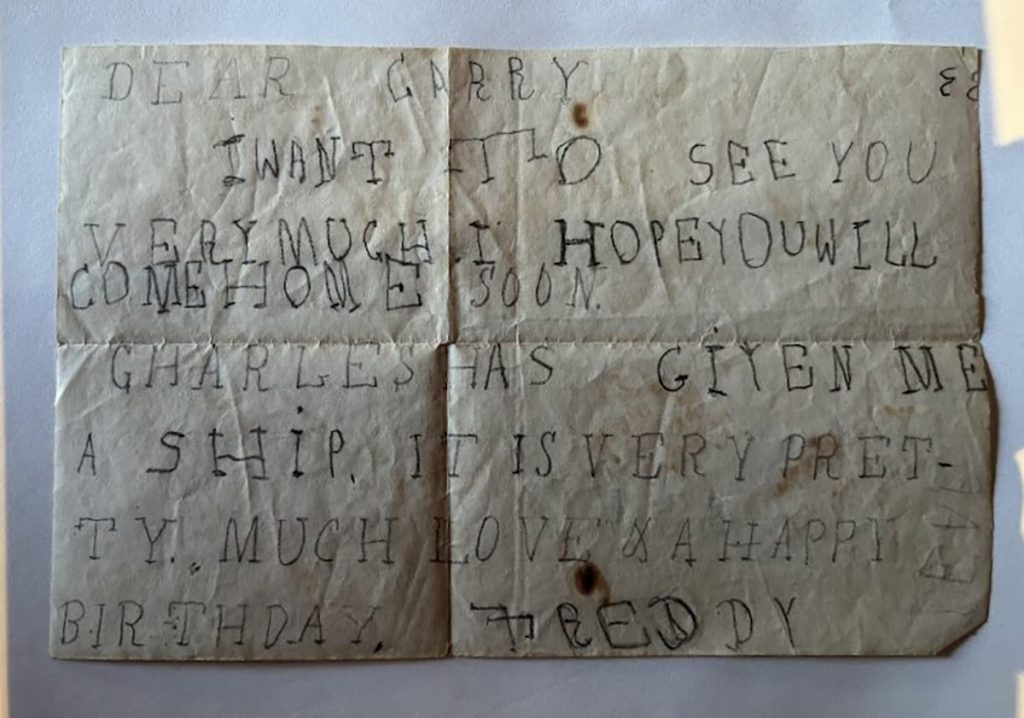
Associate Reference Librarian for Rights and Reproductions Hannah Elder picked a rather endearing letter, written by a child named Freddy. Here’s what she has to say about it:

“I first came across this letter while making reproductions from the Horatio R. Storrer papers [hyperlink: https://www.masshist.org/collection-guides/view/fa0001] a few years ago. I snapped a quick picture of it with my phone and have been enchanted ever since. It is a birthday greeting written to “Carrie Gilmore,” Caroline Augusta Gilmore, by an unidentified child (“Freddy”) at an unknown date. We so rarely see the letters of children and this one is so very sweet. It’s fun to see Freddy’s emerging handwriting – note that he puts serifs on almost all of his letters. I especially love the stick figure drawn on the back of the letter. Is it a snowman? A dapper gentleman? Only Freddy knows.”

Transcription: Dear Carry

I want to see you very much. I hope you will come home soon.

Charles has given me a ship, it is very pretty. Much love & a happi birthday. Freddy

Letter from Freddy to Carrie Gilmore, Horatio R. Storrer papers

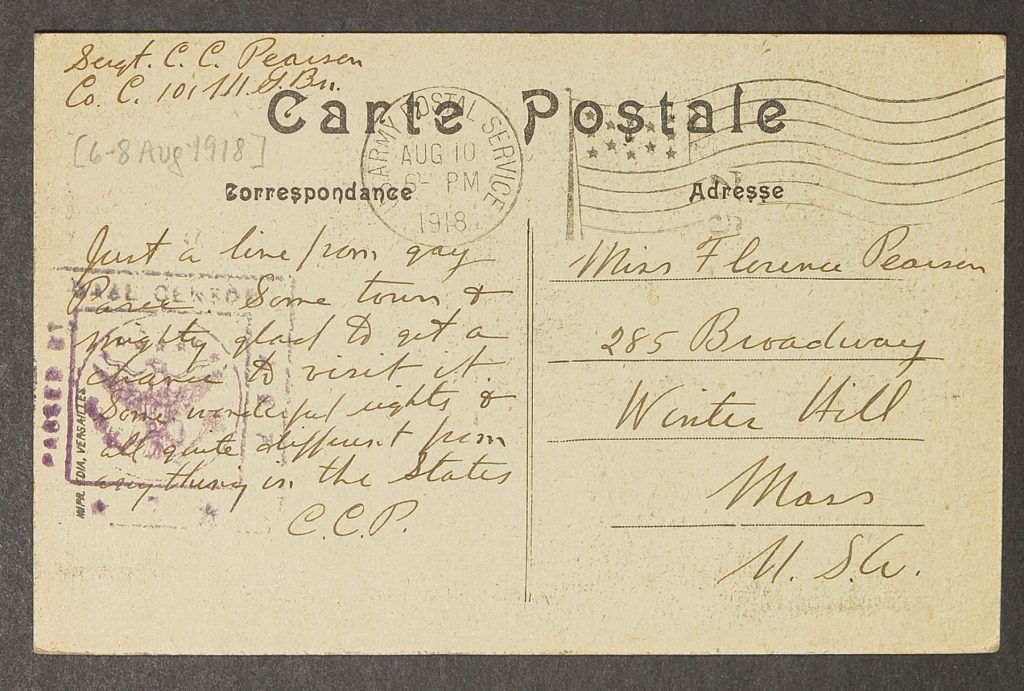
The letter I chose for this spotlight is a postcard from the Charles Cornish Pearson papers. Pearson served in France during World War I, and the majority of the collection is made up of the letters he wrote home to his family. While he wrote page-length letters to his parents and siblings, he often opted to send short postcard messages to his aunt, Florence Pearson. Not only do these postcards contain short messages of what he had been up to, they also feature fun images of the places Pearson was visiting during his time in France. This missive was written while visiting Paris and features an image of the tomb of Napoleon, with the caption explaining his impression of Paris. He writes:

“Just a line from gay
Paris. Some town &
mighty glad to get a
chance to visit it.
Some wonderful sights &
all quite different from
everything in the States.
C.C.P”

Postcard from Charles Cornish Pearson to Florence Pearson 10 August 1918, Charles Cornish Pearson papers

Take inspiration from the letters in the MHS collection in this final week of National Card and Letter Writing Month to send your own letters and postcards. You never know, they might end up in an archive!

“Unto the Least of These”: Animal Welfare in the 1930s

By Susan Martin, Senior Processing Archivist 

The Massachusetts Society for the Prevention of Cruelty to Animals (MSPCA) was founded in March 1868 by George Thorndike Angell. (You might recognize his name from the Angell Animal Medical Center.) That same year, he and his prominent backer Emily (Warren) Appleton were instrumental in getting the first anti-animal cruelty law passed in Massachusetts.

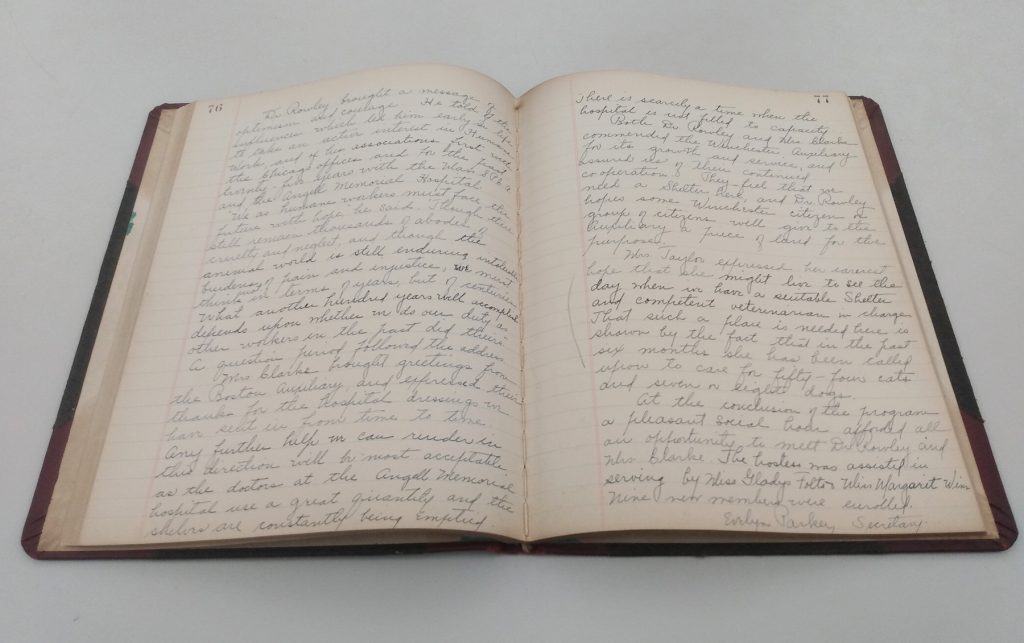
The MHS holds a number of printed items related to the MSPCA, but today I’d like to focus on a small manuscript volume we acquired a few years ago: the records of the Winchester (Mass.) Women’s Auxiliary of the MSPCA. What’s interesting about this volume is how we can see the mission of the state organization applied to local issues.

Records of the Winchester Women’s Auxiliary, MSPCA

The Winchester Auxiliary was founded in 1931, and these records document its first seven-plus years. The organization’s work consisted of fundraising via fairs, food sales, and other events; support for animal facilities and services; education on the humane treatment of animals, including Be Kind to Animals Week every spring; and lobbying for animal-friendly legislation.

Most meetings were held at the home of Marion Munroe (Rice) Taylor, the group’s founder and president, at 137 Mount Vernon Street. Her sister Carolyn B. Rice served on the Work Committee. Sometimes there were guest speakers, among them Edith Washburn Clarke and Francis H. Rowley, and members routinely spent time during meetings preparing surgical dressings for veterinary hospitals.

Local concerns addressed by the group included: the lack of an animal clinic or qualified veterinarian in town, conditions at the dog pound, and the summer watering of horses. One member successfully appealed to Eugenia Parker, scion of the wealthy Parker family of Winchester, to allow drivers to water their horses on her property at 60 Lloyd Street during the hot summer months.

Speaking of horses, the auxiliary also participated in the annual MSPCA Horses’ Christmas. Every holiday season, the MSPCA collected and distributed free food to working horses in Boston. One year, Winchester residents donated “fifteen and a half bushels of grain, about four bushels of carrots, several pounds of loaf sugar and many bags, large and small, of apples.” As the secretary wrote, “although the number of horses in the State is now so much smaller than before the days of the automobile, the records show that of the cases of cruelty handled by the Society in the past three months, 50% were for cruelty to horses.”

The organization also advocated for legislation that ran the gamut, from laws against steel traps, animal experimentation, and exploitative and abusive roadside zoos and pet shows, to the protection of coastal waterfowl from pollution by oil-burning ships. In particular, the auxiliary fought for a ban on “setting up” horses’ tails, a practice which, as expert Sandra Tozzini explains, included removing or cutting bones, muscles, or tendons for purely cosmetic purposes.

I was impressed with the initiative and the ingenuity of these women and the variety of their activities. Wherever they saw a need, they took action. At the end of one meeting, the chairperson quoted from Matthew 25:40: “Inasmuch as ye have done it unto the least of these, ye have done it unto me.”

As word got out, membership in and donations to the group increased. Marion Taylor became the go-to person for complaints about animal abuse or neglect in Winchester. She offered advice, referred matters to the authorities, and even took animals into her home. In one ten-month period, she “personally cared for 78 cats, 4 pigeons, 5 baby squirrels, 2 baby owls, and 9 dogs.”

Mrs. Taylor wasn’t the only person celebrated by the Women’s Auxiliary. Also recognized were “the brave Winchester girl, Miss Dorothy Goodhue, who jumped into the icy water of the Aberjona River to save her dog,” as well as “the lineman who, while working recently in Winthrop, rescued two tiny puppies from an ashcan where they had been abandoned.”

Lighting Strikes on the Longitude: John Adams and Lodestones

By Heather Rockwood, Communications Manager

In 1780–1784, John Adams was in Amsterdam negotiating loans from the Dutch Republic so that the United States could be more independent from France. On 1 June 1783, Adams wrote in his diary what he knew about lodestones, and what experiments he thought scientists should do to learn more about them.

“The Loadstone is in Possession of the most remarkable, wonderfull and misterious Property in Nature. This Substance is in the Secret of the whole Globe. It must have a Sympathy with the whole Globe. It is governed by a Law and influenced by some active Principle that pervades and operates from Pole to pole, and from the Surface to the Center and the Antipodes. It is found in all Parts of the Earth. Break the Stone to Pieces, and each Morcel retains two Poles, a north and a south Pole, and does not loose its Virtue. The Magnetic Effluvia are too subtle, to be seen by a Microscope, yet they have great Activity and Strength. Iron has a Sympathy with Magnatism and Electricity, which should be examined by every Experiment, which Ingenuity can devise.

Has it been tryed whether the Magnet looses any of its Force in Vacuo? in a Bottle charged with Electrical Fire? &c. This Metal called Iron may one day reveal the Secrets of Nature. The primary Springs of Nature may be too subtle for all our Senses and Faculties. I should think however that no Subject deserved more the Attention of Philosophers or was more proper for Experiments than the Sympathy between Iron and the magnetical and Electrical Fluid.

It would be worth while to grind the Magnet to Powder and see if the Dust still retained the Virtue. Steep the Stone or the Dust in Wine, Spirits, Oyl and other fluids to see if the Virtue is affected, increased or diminished.

Is there no Chimical Proscess, that can be formed upon the Stone or the Dust to discover, what it is that the magnetic Virtue resides in.

Whether boiling or burning the Stone destroys or diminishes the Virtue.

See whether Earth, Air, Water or Fire any wise applied affects it, and how.”

Diary of John Adams, vol. 3, 1 June 1783

A lodestone is a type of rock found naturally magnetized and usually near the earth’s surface. The current theory (pun intended) is that the stone, called magnetite or Fe₃0₄, is not magnetized by the poles of the earth, which would be too weak to magnetize rock so far from them, but by magnetic fields surrounding lightning bolts. The lodestone had been used for more than a millennium for seafaring navigation because of its property to point towards the north and south poles anywhere on the globe, and because of its availability in North and South America and Europe.

Searching the internet to see if anyone has performed the tasks suggested by Adams on a lodestone, I came up with the following items: an article that confirms “garlic breath” has no effect on lodestones; a book published in 1600, De Magnete by William Gilbert (1544?–1603); and a letter written byPetrus Peregrinus The Magnet (1269). All these sources discuss experiments conducted on lodestones.

In 1787, while John Adams served as the first U.S. ambassador to Great Britain, he received a letter from Pelatiah Webster (1726–1795), dated 7 June 1787. Webster’s letter recommended Mr. John Churchman of Philadelphia, Penn., who had discovered a way to decipher the longitude of any place on the earth on any day using a magnetized lodestone. (Latitude lines are the same distance from each other and therefore easier to determine than longitude lines, which grow closer together as they reach the poles.) This excerpt is from Webster’s letter:

“Viz that the Magnectic needle has two poles one 13.°56′ from the N. Pole of the Earth the other South, abt. 18.o from the S. Pole of the Earth, Which Poles have a Constant Rotation from West to East, & form their Revolutions in 463 Years, & 344 days i.e. abt. 47′ Minutes of a degree in a Year, that the True place of these poles may be Ascertain’d, & Tables of the Same calculated for Every Given Minute of Time, & of Course that the line or point of no Variation for Any place & the Time, may be Easily found, & of Course the Angle of Variation & Radius will always be Attainable, & the Difference of Latitude of the place of observation & that of the Magnetic Pole will be one Side of the Triangle Necessary to be found.”

Churchman also corresponded with Thomas Jefferson and wrote this letter on 6 June 1787, transcribing his pamphlet and explaining his theory a bit more.

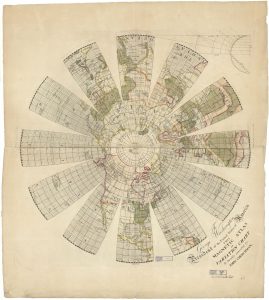
From Churchman’s research he created this map:

Color photograph of a printed map on paper discolored with age. The main image is a globe with longitude and latitude lines with the continents colored in and labeled. The view is from the north pole down with the pole in the center and the globe sliced into 6 longitude sections all the way around. In the bottom right corner is black ink printed text that is written in cursive and print which reads, “To George Washington President of the United States of America This Magnetic Atlas or Variation Chart is humbly inscribed by John Churchman.” With two blue stamps that read “Harvard College Library.”
“An explanation of the magnetic atlas, or variation chart, hereunto annexed; projected on a plan entirely new, by which the magnetic variation on any part of the globe may be precisely determined for any time, past, present, or future: and the variation and latitude being accurately known, the longitude is of consequence truly determined,” John Churchman, 1790. Provided by Harvard University.

The way to decipher longitude had not been discovered by 1714 when Great Britain’s Parliament created a large monetary prize for the person who presents the solution to the newly formed Board of Longitude. Churchman took his theory to the board for 17 years from 1787 to 1804, convinced he had the solution; however, the Board never approved it. See their record of correspondence with Churchman’s many letters.  He also applied to the American Philosophical Society for recognition of his theory in 1787, where it was also declined.

Preservation Practices in the Early American Kitchen

By Emma Moesswilde, Georgetown University

Spring in New England seems, finally, to be just around the corner, with the promise of fresh food and sunshine after a long winter. Yet, with snow on the ground, it isn’t too hard to remember that late winter and early spring were historically periods of extreme leanness for European settlers living in Maine and Massachusetts in the seventeenth and eighteenth centuries. The gap between the dwindling of winter stores and the advent of spring vegetable and dairy produce could be a daunting time for early modern cooks facing a scant larder.

My research on seasonal variability and rural life in the British Northern Atlantic world has led me to examine the recipes that these cooks might have employed through the winter and early spring. Looking at manuscripts from the MHS collections has revealed a rich array of culinary knowledge recorded in the few published cookbooks of early America and the many manuscript recipe collections which maintained culinary knowledge across communities and generations.

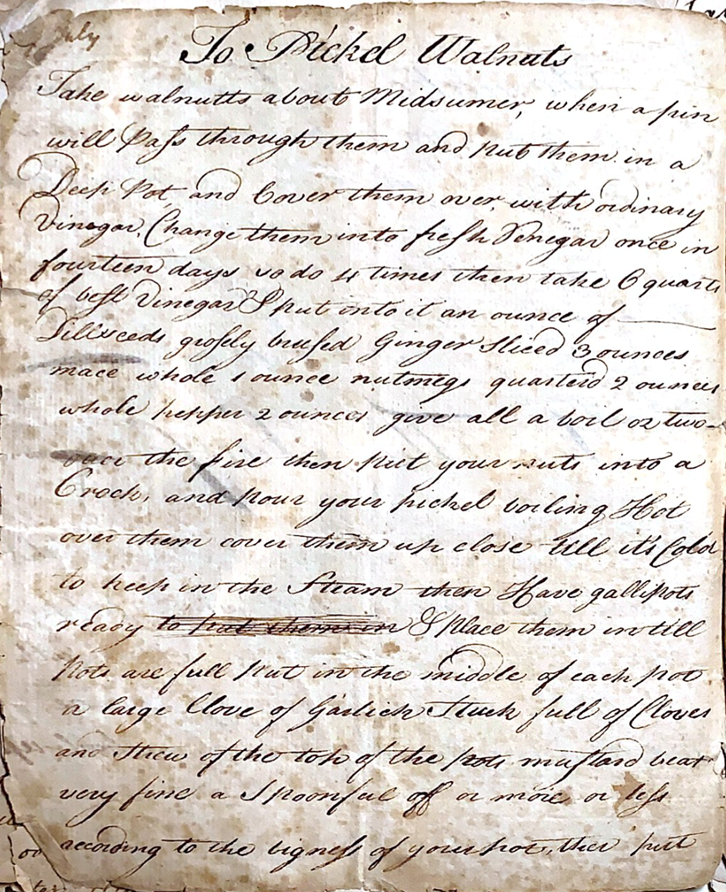
One of the most important ways in which early American cooks prepared for leaner seasons was through preservation practices. Even in periods of abundance, when the produce of fields, forests, oceans, and livestock filled the pot and the plate, those who worked in the kitchen looked towards leaner times by ensuring this bounty would be available to eat months in the future. My research in the MHS collections has found diverse recipes for preserving all kinds of rural produce. Walnuts, for instance, could be picked “about Midsummer, when a pin will pass through them,” and soaked in a mixture of vinegar, dill, ginger, mace, nutmeg, pepper, garlic, cloves, and mustard. According to an anonymous recipe book from around 1800 (Ms. S-835), the walnuts must be kept “under the pickel they are first Steep’t in or they lose their Colour” and could add interest to dishes throughout the winter as a “rellish with fish, fowl or Frigasy [fricassee, i.e., stew].”

Pickled walnut recipe from anonymous recipe book, ca. 1800 (Ms. S-835)

The development of preservation recipes preoccupied early American cooks and agricultural thinkers facing the challenge of food availability. Among the Vaughan family papers is a document entitled “Recipe for Preserving Butter” (Box 22, Ms. N-83, Oversize) which exemplifies the development of preservation techniques. Cooks interested in preserving butter (presumably for a season in which cows had run dry and were not producing milk) were instructed to beat sugar, salt, and saltpeter into butter “thoroughly cleansed from the milk” which could be topped with salt as a brine and “kept in pots of ten or twelve pounds.” “It requires then only to be covered from dust,” the instructions conclude. Yet below this recipe, more ruminations follow in the same handwriting: “If to be preserved several months — would it not be effectually secured from the air by pouring melted butter on the top so as to form a perfect crust?” The multifold methods for preservation ensured that cooks could put food by through a variety of methods, and for even longer periods of time.

Preservation recipes also abound for meats such as bacon, fruit preparations such as preserves and vinegars, and the preparation of drinks such as cider, to name just a few. Recipes from the period are also rife with references to dried goods such as peas, beans, and salted fish whose storage was detailed in farming manuals like that of Samuel Deane (22450 Evans fiche). The broad expertise required to stock the early American larder is preserved in household manuscripts such as the recipe books of the Karolik-Codman family, which contain multiple types of handwriting and interleaved recipes that reference the knowledge of others, as in the case of “Mrs. Englishes receipt for Preserving Pears” (Box 4, Ms. N-2164). Such recipes provide insight into what may have stocked the pantries of early American cooks and ensured that, at least for most of the winter and early spring, some produce was still available. By the time fruit trees blossomed and fields thawed in April and May, bare shelves awaited another cycle of preservation practices.

Journey to the South Pole with John Quincy Adams & Charles Francis Adams, Part 3

By Heather Rockwood, Communications Manager

In part 2 of Journey to the South Pole, Jeremiah N. Reynolds (1799–1858), petitioned the US Congress to fund an expedition to the South Pole to prove a theory that there was an opening there that led to an inhabitable hollow inside the earth. He was successful in his petitions, until John Quincy Adams (JQA, 1767–1848) lost the 1829 election, and President Andrew Jackson removed the funding. The voyage still took place, with Reynolds on board the ship. His expedition reached Antarctica, but turned back, mutinied in Chile, and abandoned Reynolds there. He remained in Chile for two years until picked up by the US frigate Potomac and eventually brought home. Most would assume his adventure with the South Pole ended there, but as it turned out, Reynolds was not ready to give up!

When Reynolds returned to New York, he studied to become a lawyer and wrote a book about his years traveling the seas on the Potomac, Voyage of the United States frigate Potomac, under the command of Commodore John Downes, during the circumnavigation of the globe, in the years 1831, 1832, 1833, and 1834, and a tale about an elusive white whale hunted off the coast of Chile that Herman Melville (1819–1891) cited as one of the inspirations for his novel Moby Dick, Mocha Dick: Or The White Whale of the Pacific: A Leaf from a Manuscript Journal, published in 1839 in The Knickerbocker.

By 1836, Reynolds was back in Washington lecturing and petitioning Congress for another venture to the South Pole. On 2 April 1836, JQA, now a Massachusetts representative in Congress, attended a lecture and wrote about it: “In the Evening I went to the Capitol, and heard a Lecture two hours and a half long from Mr Reynolds in support of his old project of a scientific naval expedition to the South Pole and pacific Ocean.” On 10 May 1836, JQA wrote about a few resolutions in the House of Representatives, one of which approves the new South Pole expedition: “The Committee rose, and in the House an amendment by the Senate to the exploring expedition section of the Navy Appropriation Bill was sharply debated, by Graves of Kentucky—and me— The amendment was finally agreed to by yeas and nays 80 to 65—I met Reynolds and told him the result—He said he could now die content.” After this last, it seems JQA and Reynolds no longer met, or at least, JQA never mentioned him again in his diaries.

Ironically, Reynolds was excluded from the expedition, known as the US Exploring Expedition, or sometimes, the Wilkes Expedition, which left in 1838 and returned in 1842. In his fervor to create the expedition, he made himself unwelcome. He felt deeply insulted and mostly retreated from public life after that, although he continued to write and publish articles such as Mocha Dick. His influence in popular culture is another interesting corner of history to research. Information on the internet reveals a connection between Reynolds and Edgar Allan Poe (EAP, 1809–1849). It’s especially fascinating because EAP called out “Reynolds!” several times on his deathbed. There’s much speculation on the internet as to which Reynolds EAP meant. Reynolds fell ill and died while traveling in Canada in 1858.

On 10 December 1836, JQA noted in his diary: “Mr Pickering came again this morning; but I had not found Ira Hill’s Theory of the Earth—Mr Pickering thinks he has made very wonderful discoveries in Geography, and among the rest that the Poles of the Earth have changed their position, from East and West to North and South – He said that Ira Hill had made the same discoveries.” I couldn’t find much information on Ira Hill, the author of An Abstract of a New Theory of the Formation of the Earth, but likely this is the book to which JQA is referring. I was able to find more information on Charles Pickering (1805–1875). He was a naturalist, curator, author, and physician, as well as one of the scientists on Wilkes’ expedition toward the South Pole in 1838–1842. Charles Wilkes (1798–1877), the leader of the expedition, used Pickering’s journal as an influence for his Narrative of the United States Exploring Expedition, which he published in 1845. From 1842–1843, Pickering was the curator of the collection brought back to the United States from the Wilkes expedition which became a part of the Smithsonian Institution’s collection. Although Pickering did not publish his theory of Pole changes, current scientific research, at least from 2020, shows that the last pole shift happened millions of years ago, which makes me wonder if Pickering was having the same findings, but could not prove it at the time.

Images of flora brought back from the Wilkes Expedition and available online at the Smithsonian Institution. From left to right: Iridaea mertensiana Postels & Rupr., Ulva latissimi, Gigartina skottsbegii, and Quercus garryana Douglas ex Hook.

Thank you for joining me on this expedition to the South Pole through the diaries of John Quincy Adams and Charles Francis Adams. Although our travels end here, I hope you will take time to read a few of the (free online) books linked throughout these three blog posts, and that you are inspired to look through the online Adams Family Papers for more interesting stories like these.

Read Part 1 and Part 2 of the series.

Archives Revealed: Conservation at the MHS

By Samantha Couture, MHS Nora Saltonstall Conservator & Preservation Librarian, and Lauren Gray, Reference Librarian 

Welcome to part 1 of a blog series about the preservation and conservation of the MHS collections.

Part of our mission at the MHS is to preserve and protect rare and important historical materials and to make collections available for research, which requires us to have a robust preservation and conservation effort. Preservation refers to the environment, storage, and handling of items, and has a significant impact on the long-term safety of our collections. Conservation encompasses the cleaning, repair, and chemical treatment of items. Without the ability to improve the physical conditions of our books, manuscripts, photographs, and art on paper, many of these materials would become unusable by researchers and lost to the historic record. Diligent preservation and conservation measures ensure that the individual items that tell the story of Massachusetts and the early history of the United States will be available for generations.

Librarians and archivists have been concerned with the deterioration of books and paper for as long as there have been libraries and archives. Preservation techniques have evolved over time as technology changes. Over the following months, we will introduce you to the importance of sound preservation and conservation practices, the history of how items have been conserved, and how the MHS approaches conservation today. Along the way, we will discuss why paper-based collections deteriorate and how to care for your own collections at home. 

To begin our discussion on preservation, we will first look to the past. In 1881, bibliophile William Blades published the second edition of his book on preservation, titled The Enemies of Books, which we hold in the MHS collections. Blades lists many factors that affect the condition of books and paper: fire, water, dust & neglect, the bookworm, bookbinders, and book collectors (which is ironic, considering Blades was an avid collector of the printed word). Many of these dangers continue to threaten paper collections, like those at the MHS, but as our understanding of the medium has evolved, new threats to paper collections must be assessed.

Title Page of The Enemies of Books by William Blades, 1881

While Blades’ text covers many well-known preservation concerns, there is a particularly pressing ‘Enemy’ that he does not mention: acid. Acid reacts in the presence of water in a process called acid hydrolysis. During hydrolysis, acid breaks the long, flexible cellulose fibers of paper, causing the paper to yellow and eventually become brittle. Brittleness cannot be reversed, and leaves books and documents in a very fragile state. If you’ve ever held an old book or newspaper and found it flaking apart in your hands, you may have experienced this first-hand. Acid can be introduced into paper in three ways.

An example of acid migration from newspaper clippings. You can see the outline of the shapes on the opposite page.

Acids can migrate from one material to another, so documents stored in acidic containers will absorb some of those acids. Acids are often in the material used to make or process paper. Inks, especially writing ink called ‘iron gall ink’ contain a form of iron that will oxidize and break down paper fibers similarly to acid.

Example of iron gall ink corrosion on correspondence in the George Rogers Hall Papers

Why don’t acids and iron feature as dangers to books in Blades’ text? In 1881, acid hydrolysis as it relates to paper was not well understood. Before 1850, paper in the west was made from linen and cotton rags, which do not naturally contain acids. After 1850, wood pulp was discovered to be a plentiful and cheaper source of paper fibers. It took until about 1950 for the paper industry to produce stable papers using wood pulp for book and document production. It can take years or decades for this kind of ‘inherent vice’ to cause breakage and discoloration, so the paper in his own Enemies of Books would have been white and flexible long past his death in 1890. Ironically, Blades’ volume contains the acids which are slowly destroying it, as you can see below where the first page is breaking.

Cracking first page of The Enemies of Books

At the MHS, the majority of our manuscript collections contain iron gall ink, and many documents and books contain wood pulp paper. Luckily, there is a lot we can do to prolong the useful life of our unique and rare items. We’ll continue to talk about how we conserve our collections in part 2 of this series. Check back soon!

Archivist as Detective: Hello, Newman

By Susan Martin, Senior Processing Archivist 

After a long hiatus, I’m happy to return to my sporadic series about manuscript mysteries! As I’ve written in previous posts, sometimes the work of an archivist is like that of a detective: we follow clues, narrow searches, evaluate sources, and make educated inferences that hopefully lead us to an answer. Sometimes we’re waylaid and have to backtrack, and sometimes we come up empty, but I for one always enjoy a chance to don my deerstalker cap.

This time, I was looking for the man who wrote a letter, recently acquired by the MHS, dated 5 August 1856 and sent from Buffalo, N.Y. to Leominster, Mass. The text of the letter is interesting, if somewhat verbose. Among other things, it discusses the 1856 presidential election, a three-way race between James Buchanan, John C. Frémont, and Millard Fillmore.

The letter in question

Actually, I started on first base with this one, because I did know the man’s name: William Newman. He signed the letter “Yr devoted Brother Wm” and addressed it to Miss Anna B. Newman.

I could have left it at that, but I was determined to find out which William Newman he was, who Anna was, anything specific to help researchers that may be interested in this letter. After all, the MHS already had three different William Newmans in our online catalog ABIGAIL. The Library of Congress lists over 50 of them.

My first step was to gather clues. The last paragraph of a letter is a good place to look for specific names. A correspondent will often use this space to ask after family members or mutual friends. Besides William and Anna, I found a Luke (cousin), Margaret (possibly sister), and Caroline (no idea). William also mentioned a wife, as well as a son named William Henry who was apparently home for school vacation.

Unfortunately these names were too common for me to find a family genealogy at any of my go-to online sources: Internet Archive, Google Books, Ancestry.com, and Findagrave.com. Anna may have married and changed her surname. And the connection to Leominster was too tenuous; I couldn’t be sure if the Newman family hailed from there. Better to stick with what I knew.

I got my first break from a series of strategic online searches using Newman’s name, Buffalo, and 1856. And not for the first time, it was other archivists that came to my rescue. I found the Henry Newman family papers at the University of Michigan Library. Henry, originally from Boston, had a son named William who settled in Buffalo in the 1820s and established a business there. In our letter, William mentions buying some real estate.

I couldn’t be 100% sure yet, but the Michigan collection gave me a few crucial details. Their William married Lydia Scrafford (a much more distinctive name) and died in 1860. So I tried another search for confirmation. By adding his wife’s name to my keywords, I finally uncovered published records of a very messy court case related to the settlement of William’s will.

This was definitely my guy: died 4 April 1860, wife Lydia Scrafford, son William Henry Harrison Newman born in 1846. The records also included the names of siblings Henry, Jr., Margaret, Caroline, Anna, and Susan. (Interestingly, William was the only one to marry and have children.) The clincher was a passage referring to property on Clinton Street in Buffalo—property William mentioned in his letter.

William was apparently born in 1799 or 1800, assuming his tombstone is correct and he was sixty when he died. I identified his parents, Henry and Deborah (Cushing) Newman, and his wife Sarah Elizabeth née Cole, but found very little about his siblings. Henry, Jr. died in 1861, Susan in 1862, Margaret in 1866, and Anna in 1883.

These are just the dates of which I’m relatively confident. I don’t think I’ve ever seen so much conflicting information about a family I was researching! It goes to show how fallible the historical record can be and how important it is to find trustworthy sources.

William Newmans in the MHS catalog