
Pirates in Boston: The Trial and Execution of John Quelch

By Wesley Fiorentino, Reader Services

On June 30, 1704, six men were hanged in Boston in what was the first trial for piracy by the British Admiralty Court outside of England.  The Arraignment, Tryal, and Condemnation of John Quelch provides a transcript of what is perhaps Boston’s earliest trial for piracy.  The court proceedings provide a detailed account of the events leading up to Quelch’s capture, as well as of the crimes committed Quelch and his crew.
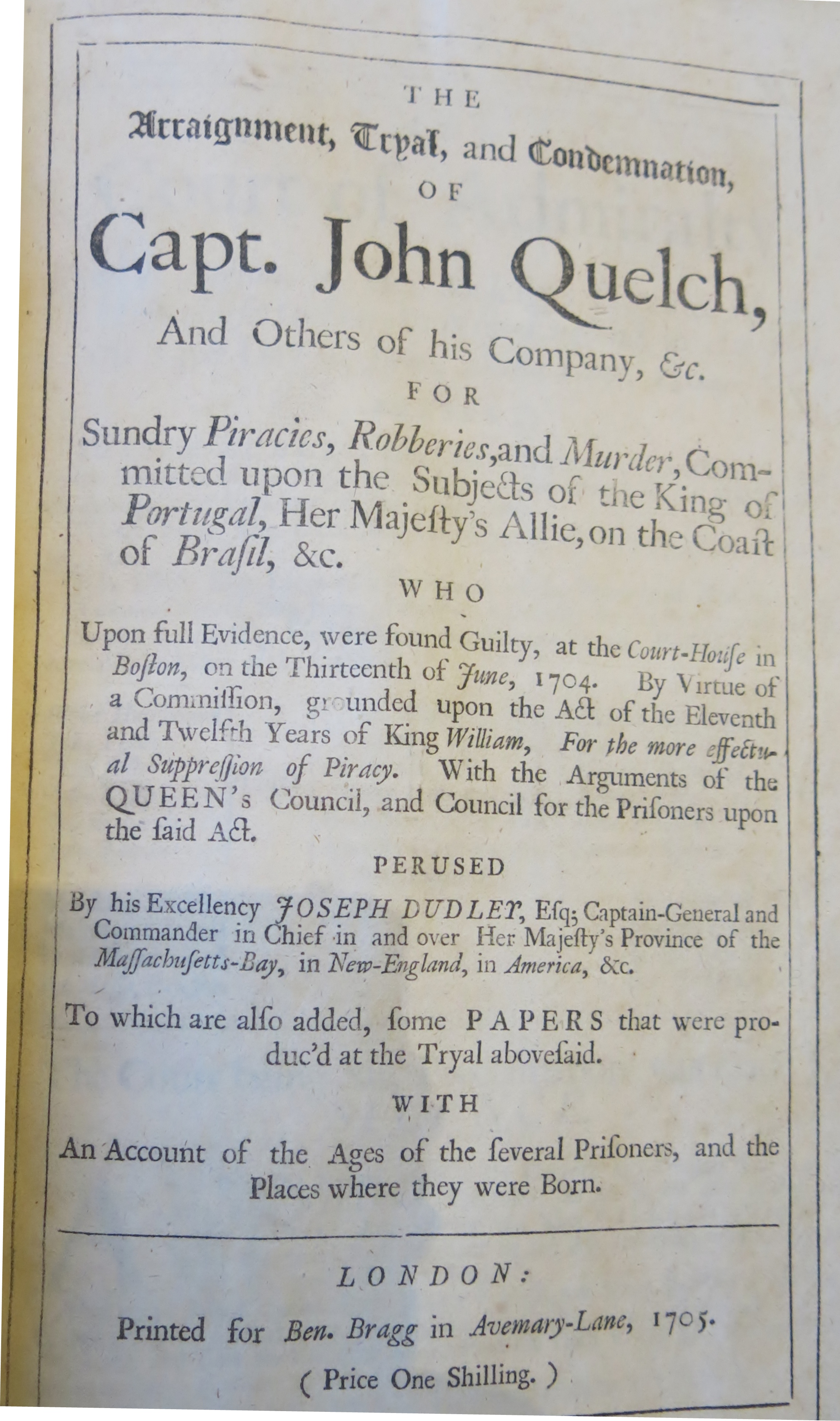
In July of 1703, Governor Joseph Dudley granted a privateering license to Captain Daniel Plowman of the Charles and sent the ship to attack French and Spanish vessels near Newfoundland and Arcadia.  However, while the ship was still in Massachusetts, Captain Plowman became extremely ill and was confined to his quarters by the rebellious crew.  Plowman’s lieutenant, John Quelch, was chosen to be the new captain by the crew and the ship’s course was changed.  Plowman was thrown overboard, whether dead or alive seems uncertain, and Quelch led the crew of the Charles on what would be nearly a year-long piracy spree against Portuguese ships in the Caribbean and off the coast of South America.

Between August of 1703 and February of 1704, Quelch and the crew of the Charles attacked and captured no fewer than nine Portuguese vessels off the coast of Brazil, stealing a wide variety of goods and valuables and committing a number of other crimes including murder.  Precise dates are given for each of the nine attacks, as well as detailed descriptions of the crimes committed and the goods stolen.  The various commodities stolen from the different ships include gold dust, sugar, molasses, rum, rice, textiles, pottery, and a large quantity of coined Portuguese money.  Quantities are listed for the goods taken, and values also provided, offering insight into the monetary value of these goods around the turn of the eighteenth century.  A value of thirty pounds is given for one of the ships, which had apparently been sunk by Quelch and his crew.

The court record also provides historical information on Africans enslaved both in British and Portuguese colonies during this period.  A number of enslaved people of African descent are referred to in the records both as the property of the crew and as plunder from piratical raids.  At least three people are referred to in a letter of John Colman, provided in the appendix to the court proceedings, to colonial authorities in the West Indies.  Two of them, named Charles and Caesar, are mentioned by Colman as the property of a Colonel Hobbey.  The third, named Mingo, is listed as belonging to Captain Plowman himself.  Colman mentions the three men in a plea to the colonies of the West Indies to secure the goods on board the Charles and prevent them from being stolen by the mutinous crew.  Colman asks for the return of the men “and their shares,” and it is unclear whether this means that Charles, Caesar, and Mingo had any actual share in the goods on the ship, or whether it means the shares of their respective owners.

At least two more enslaved men were captured by Quelch and his crew during several of their attacks on Portuguese ships.  Joachim, an enslaved person aboard a Portuguese brigantine taken by the Charles, was valued at twenty pounds.  Joachim is described as baptized, possibly as a Catholic given his ownership by a Portuguese master, though this is not expressly stated.  He is the only enslaved person in the record described as baptized.  Emmanuel, an enslaved person valued by the court record at forty pounds, was the property of a Portuguese commander named Bastian whose ship was captured by Quelch and his crew near the River Plate (Rio de la Plata) in South America.  Bastian was shot and killed during the attack, apparently by Christopher Scudamore the ship’s cooper, according to the testimony of Emmanuel.  For a time Joachim and Emmanuel served the crew, but were both sold to crew members at some point during the voyage.  Joachim was purchased by one George Norton, and Emmanuel was purchased by Benjamin Perkins, both for undisclosed amounts.

During the trial itself, three members of the crew, Matthew Pymer, John Clifford, and James Parrot, testified against Quelch in court and so avoided prosecution.  The transcript also repeatedly states that the English and Portuguese crowns had recently become allies at the time of Quelch’s crimes, further exasperating the case against him.  Among those presiding over the trial were Governor Joseph Dudley and Samuel Sewall, First Judge of the Massachusetts-Bay Province.  John Quelch, John Lambert, Christopher Scudamore, John Miller, Erasmus Peterson, and Peter Roach were sentenced to hang.  The execution was carried out “in Charles River; between Broughton’s Ware-house, and the Point.”

Joachim and Emmanuel were both called upon to testify against Quelch and certain members of his crew.  Emmanuel specifically identified Christopher Scudamore as the murderer of his master Bastian, while both men testified that Quelch and his crew ordered them to claim that they had been Spanish enslaved people rather than Portuguese upon returning to Boston in order to cover up the crimes against Portuguese ships.  Charles, Caesar, and Mingo were all charged with piracy along with the crew, though they were found not guilty.  Charles and Caesar were presumably returned to their master, Colonel Hobbey, while the fate of Mingo is not recorded.  The fates of Joachim and Emmanuel following the trial are not recorded either.  It is interesting to note that though they were considered property, enslaved personswere still called upon to testify in an important trial like free men.

Several important documents and letters are provided in the appendix, including Captain Plowman’s commission from Massachusetts Governor Joseph Dudley as well as his instructions.  In the commission, Dudley explains to Plowman that he is “Hereby Authorizing you in and with the said Briganteen and Company to her belonging, to War, Fight, Take, Kill, Suppress and Destroy, any Pirates, Privateers, or other the Subjects and Vassals of France, or Spain, the Declared Enemies of the Crown of England, in what Place soever you shall happen to meet them.”  Plowman is warned that “Swearing, Drunkenness and Prophaneness be avoided,” and that no one, even enemies of the British crown, “be in cold Blood killed, maimed, or by Torture or Cruelty inhumanly treated contrary to the Common Usage or Just Permission of War.”  Also included are correspondence between Plowman and the Charles’ owners John Colman and William Clarke regarding Plowman’s illness and his growing mistrust of the crew.

Taking place during Queen Anne’s War (1702-1713), the crimes of John Quelch and the crew of the Charles should be viewed in the context of the affairs between the European colonial empires in the New World at the dawn of the eighteenth century.  Licensed by Governor Dudley as a “private man-of-war,” the Charles was expressly instructed to attack the ships of “Her Majesty’s enemies,” namely France and Spain.  Instead, the crew mutinied against their licensed captain and, to the chagrin of Governor Dudley and British colonial authorities, they attacked the ships of Britain’s ally Portugal.  It is clear from the text that these crimes are taken very seriously not only as acts of piracy, but as an embarrassment to the crown.

An American Woman in Egypt, 1914-1915: An Introduction

By Anna J. Clutterbuck-Cook, Reader Services

In my previous post, I explored the world of early twentieth-century travel by train. Inspired by the glimpse into another era the diary behind that post evoked, I went looking for other travel diaries from the same era and found an anonymous diary kept by a Boston woman while on a steamer cruise up the Nile in Egypt.

Intrigued by the notion of an American tourist riding donkeys out to explore Egyptian archeological sites and having tea at British colonial resorts while Europe was at war, I have decided to use this diary as a jumping-off point to write a series of posts this winter placing this diary, and the adventure it describes, in broader historical context.

The diary begins abruptly on 25 November 2014 with our diarist already en route up the Nile by steamer. The author begins each day with the date and writes a few lines about her daily activities — notes on where and how she and her party traveled, the sites visited, as well as where and when she had breakfast, lunch, and tea. Even without detailed information about the author’s identity and the personal context of her foreign travel, her written record of progress up the Nile can serve as a catalyst for a number of historical questions.

We might explore, for example, what the diary can tell us about the history of travel, and particularly the history of women travellers. Her story is part of a long history of Anglo-American fascination with Egypt and the Middle East that bears unpacking — by virtue of her anonymity her experience may shed light on the experience of everyday, rather than famous (or infamous), Americans abroad.  We might ask what her narrative can tell us about the materiality of travel, about human interaction with the natural and built environment. We can also note the silences and erasures within her narrative: those aspects of Egypt which she may or may not see, but certainly doesn’t write about.

Stay tuned for the second post in this series, coming in February, in which we will delve into the timeline of our diarist’s journey up the Nile and some of the activities she did record along the way.

A Vacation of the Mind

By Andrea Cronin, Reader Services

I went to Ceylon (modern day Sri Lanka) this morning. The flight from Boston normally costs upwards of $1,000. Flight time, with layovers, averages 24 hours. However my trip to Ceylon did not cost me a dime or any flight time. I went on a “mind vacation.” The concept sounds a little quirky but a mind vacation is a great way to visit another place or time without actually spending the money for a flight or inventing time travel. (Although if you are currently devising time travel, I want in.)

My mind vacation materialized as I read Reverend James Cordiner’s Description of Ceylon. In these two volumes, Cordiner recorded his experiences in Ceylon while serving as chaplain to the garrison of the capital Colombo from 1799 to 1804. The first volume contains descriptions of the island’s geography, resources, inhabitants and climate. When I first read the climate description of Colombo, thoughts of the brisk January temperatures in Boston today — and the approaching blizzard — simply melted away.

With great detail, Cordiner contrasts the climate of Colombo with the nearby British trading port of Madras (modern day Chennai, India).  “…with the arid plains, withered vegetation, scorching winds, and clouds of burning dust, which, for several months in the year, cast an inhospitable gloom around the vicinity of Madras. There in, the month of May, 1804, Farenheit’s thermometer appeared above ninety degrees before nine o’clock in the morning, and, in the course of the day, rose in many houses to one hundred and nine degrees.” Cordiner considers this port’s climate to be lacking. I also think Madras is a little too hot and dusty for a comfortable mind vacation.

I find his description of Colombo comparatively restorative to read in the middle of January. “The smallest inconvenience from heat is never felt within doors at Columbo. Even passing through this moisture under the full blaze of the meridian sun, the air is ten degrees cooler that than of Madras … There is then always a fresh breeze from the sea, which greatly lessens the effects of the sun’s power.” Colombo is a tropical vacation compared to dusty Madras — and snowy Boston!  With temperatures in the 80s and a sea breeze, who would not want to visit?

Do you need a mind vacation this week? I encourage you to visit our reading room (although check our homepage, as we may close due to snow) for a mind vacation to plenty of local and distant destinations throughout the centuries available in our collections.  I would love to hear your adventures.

The 18th Amendment to the United States Constitution

By Dan Hinchen

Amendment XVIII

Section 1.

After one year from the ratification of this article the manufacture, sale, or transportation of intoxicating liquors within, the importation thereof into, or the exportation thereof from the United States and all territory subject to the jurisdiction thereof for beverage purposes is hereby prohibited.

Section 2.

The Congress and the several states shall have concurrent power to enforce this article by appropriate legislation.

Section 3.

This article shall be inoperative unless it shall have been ratified as an amendment to the Constitution by the legislatures of the several states, as provided in the Constitution, within seven years from the date of the submission hereof to the states by the Congress.


The 18th amendment to the United States Constitution was ratified by Congress on 18 December 1917. About thirteen months later, on 16 January 1919, Nebraska signed on as the 36th state approving the amendment, thus ratifying it as law. For the next 14 years, the sale, manufacture, and transportation of alcohol was illegal in the United States.

The calls for prohibition and temperence were nothing new. In fact, Massachusetts already had experience dealing with prohibitory laws. In 1855, a law passed that forbade the sale of all intoxicating liquors (including beer, wine, and cider) as a drink or medicine, except when sold by certain agents of the State. Appeals for a more lenient license law were constant until 1875 when the new Governor Gaston recommended repeal of the law. As it turns out, not everyone was strictly abiding by the law while it was in place, a problem that was endemic during the national prohibition decades later

Here at the MHS, we have documents relating to these issues going back a century before the 18th amendment became law. Much of the material here is in support of prohibition and is pro-temperance. In some cases, women involved in the suffrage movement tried to combine forces with the temperance movement, encouraging suffrage so that the temperance movement could have more votes. Francis Parkman, a temperance advocate, disagreed with the strategy:


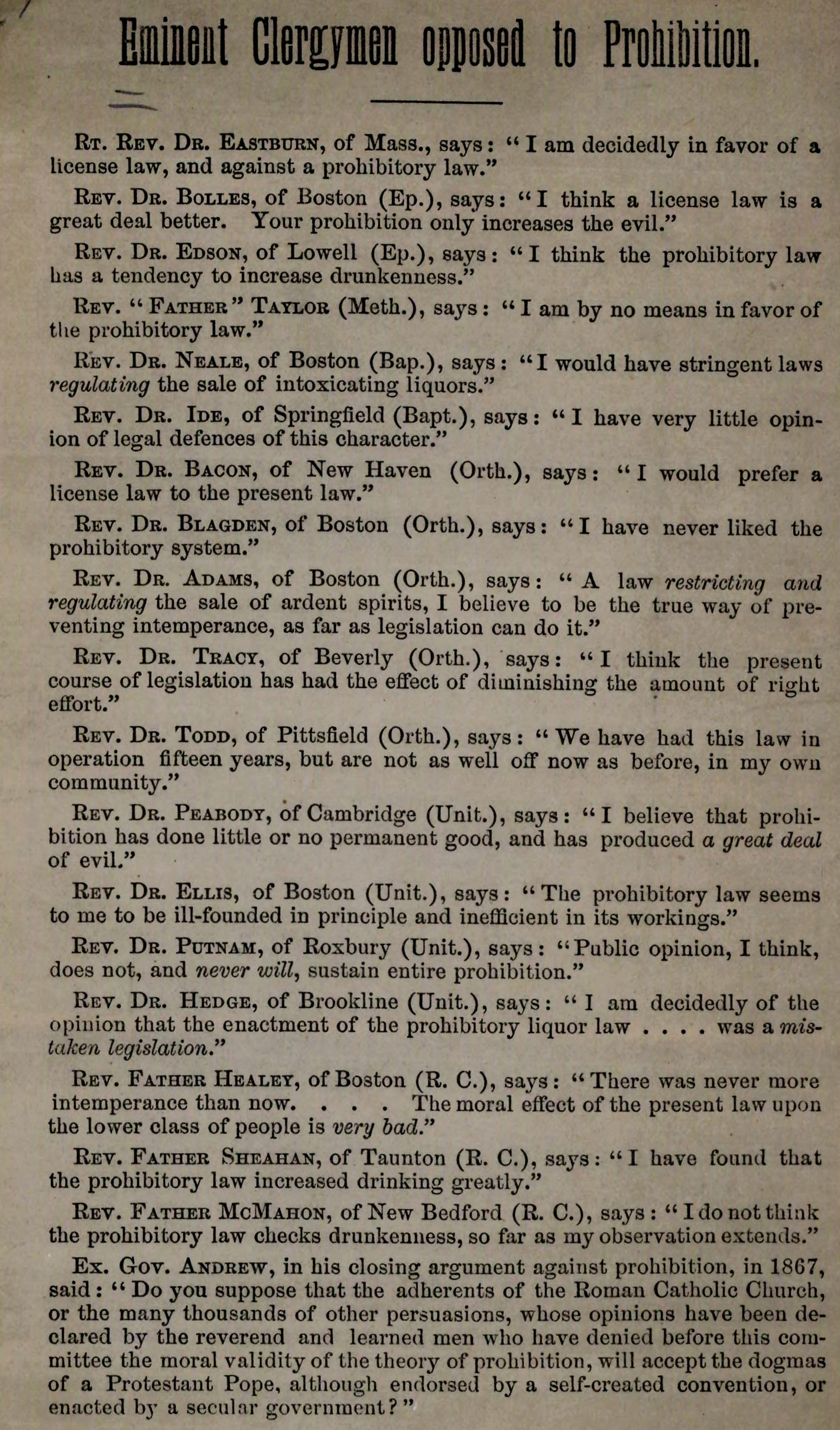
However, among all the 19th century voices condemning the consumption of alcohol, there were still those opposed to full prohibition, even some that were members of the clergy:


After just a few years, there were claims that Prohibition and the 18th amendment were already failing. One such example comes from Joseph Curtis who wrote a pamphlet simply titled Prohibition is a Failure in 1924. Prompted by an article stating that stricter enforcement of the law was soon to come (embodied in the Volstead Act), Curtis recounts reading a statement by Dr. C.W. Eliot calling for such enhanced enforcement and how he felt that his “life, liberty and happiness, and that of every other american citizen was going to be imperiled if Dr. Eliot’s views should prevail. For without liberty and happiness, life isn’t worth living…” 

To find out what else the MHS has regarding temperance and prohibition, try searching the terms in our online catalog, ABIGAIL. Then raise a glass to the liberty and happiness of Mr. Curtis which make life worth living!

Homegrown Gifts: George Washington’s Locks

By Andrea Cronin, Reader Services

Our exhibition Father of His Country Returns to Boston closes today as the holiday season wraps up. The exhibition commemorates the 225th anniversary of President George Washington’s month-long tour of New England in October 1789. One of the most interesting items on display as part of this exhibition is a lock of hair that George Washington gave to Alexander Hamilton.

Hamilton worked closely with Washington throughout the American Revolution and their political careers. Hamilton was born the second illegitimate child of James Hamilton and Rachel Faucett Lavien on 11 January 1755 or 1757 in Charlestown on the island of Nevis in the British West Indies. He worked as a clerk until he traveled to the British North American colonies for education. In New York, Hamilton became increasingly involved in the rumblings of Revolution during his studies at King’s College before responding to a call for recruits in 1776. Washington appointed Hamilton to the position of aide-de-camp at the rank of Lieutenant Colonel on 1 March 1777. Washington mentored Hamilton as he did with all his aides-de-camp until a parting of ways in February 1781 when Hamilton resigned from Washington’s staff position over insult. However, their working relationship did not end there. Washington later appointed Hamilton as first Secretary of the Treasury in  September 1789 just before the President’s tour of New England commenced in October.  The circumstances surrounding the gift of Washington’s hair to Hamilton however remain undocumented.

The practice of gifting hair seems particularly strange to the 21st century observer. Nowadays people share photographs of themselves and their families in holiday cards or digitally through social media. Portraiture remained the primary way individuals shared images of themselves prior to the invention of the daguerreotype by Louis Daguerre in the late 1830s. But the gift of hair also held considerable value. Hair was often woven and incorporated into rings, bracelets, and other jewelry throughout the 18th century. Lovers, friends, and family often exchanged locks of hair as mementos.   Vestiges of hair traditions remain even today when parents save locks of their children’s hair.

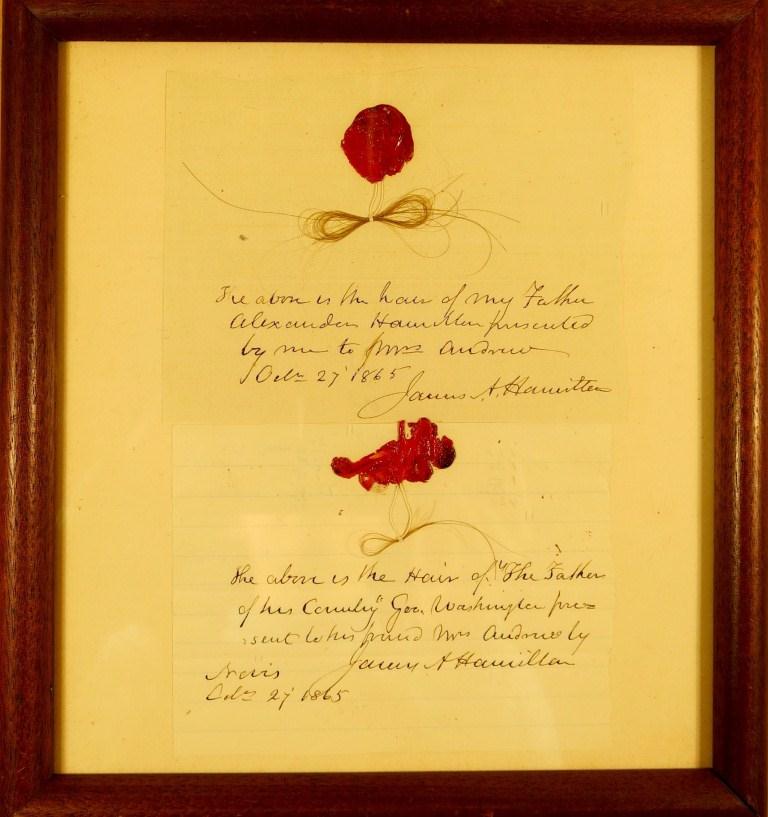
The Massachusetts Historical Society has not just one but two separate locks of hair that George Washington gave to Alexander Hamilton. Mrs. Charles Mason donated the first singular lock to the Society on 11 May 1876. The second lock of Washington’s hair is framed together with a lock of Hamilton’s own hair. The son of Alexander Hamilton, James A. Hamilton of Nevis, gave these locks to Eliza Andrew, wife of Massachusetts Governor John Albion Andrew, on 27 October 1865. The Society later received the locks from Andrew’s children, Edith and Henry Hersey Andrew in December 1920.

The text of the frame states:

“The above is the hair of my Father
Alexander Hamilton, presented
by me to Mrs. Andrew
Octo. 27 1865
James A. Hamilton”

“The above is the Hair of “The Father
of his Country” Geo. Washington pre=
sent to his friend Mrs Andrew by
James A. Hamilton
Nevis
Oct 27 1865”


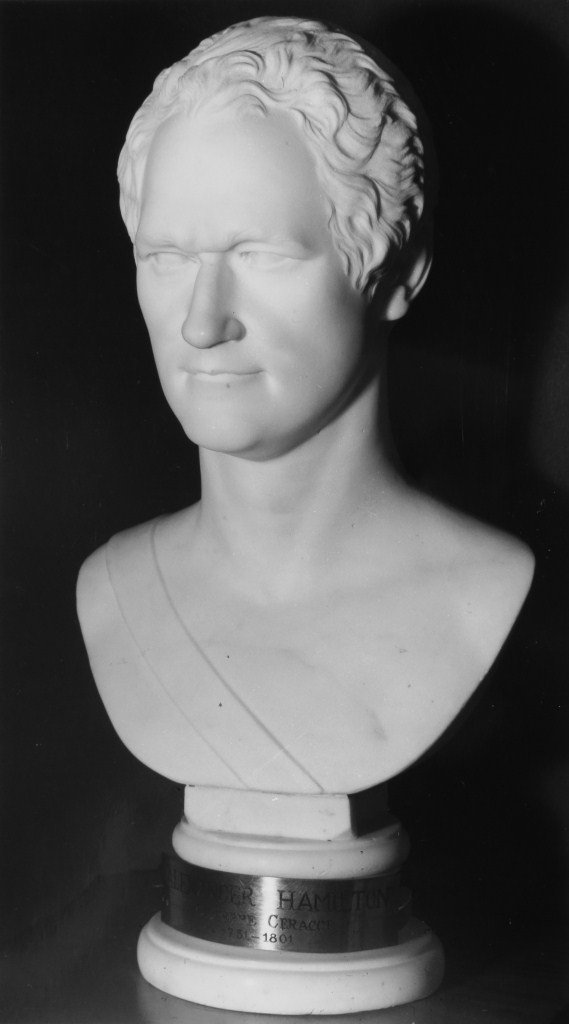
Marble bust of Alexander Hamilton by Giuseppe Ceracchi, 1794

Their working relationship tempered by respect endured any snarls. Washington’s death on 11 December 1799 came as a great loss not only to the country he fathered but also to his former mentee. In a letter to Washington’s personal secretary Tobias Lear on 2 January 1800, Hamilton wrote, “Perhaps no man in this community has equal cause with myself to deplore the loss. I have been much indebted to the kindness of the General, and he was an Aegis very essential to me.”

Hacking John Adams

By Amanda A. Mathews, Adams Papers

At the end of 2014, the hack into Sony Pictures and the subsequent publication of the private communications of Sony employees drew massive public interest. While many decried the methods, and resentful of foreign meddling, many people were still deeply interested in the revelations about the executives’ opinions on various celebrities.

John Adams faced a “hack” of his own in the summer of 1775 when private letters he had written to his wife, Abigail Adams, and to his friend James Warren were intercepted by the British and subsequently published in Boston and London. Adams, participating in the Second Continental Congress in Philadelphia, was growing increasingly frustrated at the reluctance of some of the members to take strong measures of resistance against Great Britain and took to his letters to vent his frustration, in particular against John Dickinson, a member from Pennsylvania who believed that even with hostilities ongoing, reconciliation with Great Britain was still possible and should be pursued. John Adams fed up with this, vented to Warren: “In Confidence,—I am determined to write freely to you this Time. —A certain great Fortune and piddling Genius whose Fame has been trumpeted so loudly, has given a silly Cast to our whole Doings—We are between Hawk and Buzzard.” To Abigail he alluded to his fellow congressmen: “I wish I had given you a compleat History from the Beginning to the End of the Journey, of the Behaviour of my Compatriots.——No Mortal Tale could equal it.——I will tell you in Future, but you shall keep it secret.——The Fidgets, the Whims, the Caprice, the Vanity, the Superstition, the Irritability of some of us, is enough to——” and there broke it off.

Entrusting these private thoughts to Benjamin Hichborn, a young lawyer, making his way back to Boston, Adams had no idea that he had just penned words that would bring him more fame than anything he had written to that point. While at a ferry crossing in Rhode Island, a British naval vessel captured the ferry and took possession of the letters Hichborn carried. Unsurprisingly they found the contents very interesting. The British officers made several copies, some of which were sent off to London, and the letters were also quickly printed in the Massachusetts Gazette and other Boston papers, trying to create division within the patriot cause.

The breach deepened the rift between Adams and Dickinson and occasioned a great deal of gossip on both sides of the Atlantic; however it had no long term effect on John Adams’ reputation in the Congress, continuing to be an influential member, nor did it influence British policy. Still, just as many were fascinated to know what executives really thought about Angelina Jolie, there were many Americans in 1775 fascinated to hear such candid opinions about congressional members.

To read more about the incident and the subsequent reaction see the complete coverage.

Equality in Incarceration: The Push for Women’s Prisons in Massachusetts

By Kittle Evenson, Reader Services

For my inaugural Beehive post I delved into the world of female incarceration, attempting to better understand the creation of women’s prisons in Massachusetts, and the codified societal controls imposed on women in the 19th century.

In 1874, Emory Washburn published “Reasons for a Separate State Prison for Women” and with impassioned rhetoric, called out the systemic inequalities leading to women’s imprisonment, and called for a shift in focus from punishment to reformation.

While I initially read his publication expecting a paternalistic discourse, what I found was a sharp commentary on women’s power for self-determination and democratic participation.

But for what we are bound to suppose wise reasons, the voice of only one sex can be heard at the ballot-box, while the other must content themselves with humbly making known their wishes to the legislature, that something may be done to relieve the Commonwealth from this inequality in the administration of justice in the case of the two sexes. It is not overlooked, that not a few of those who would be the inmates of such a prison as is here advocated, have become so from causes with which those whose votes help to settle questions of this kind have had much to do [emphasis added].

Crime is a form of social action; the criminal justice system a type of social control; and the arc of women’s history is inexorably linked to both. In puritan New England, women were predominantly brought up on charges of fornication and adultery, and even crimes such as murder, were often the result of secretive abortions, or desperate acts of infanticide. Punishment was evocative and public. As concrete expressions of social control, it served dual purposes as both a lesson to the female perpetrators and an establishment of boundaries for the women waiting in the wings.

Within our collections, there is a smattering of “last words” of colonial-era women convicted and punished for felonious crimes. Secondary sources, such as N.E.H. Hull’s Female Felons: Women and Serious Crime in Colonial Massachusetts deftly explicate the female experience in colonial courts, but women’s first-hand accounts of the 19th century justice system prove maddeningly elusive.

In his call for sex-segregated prisons, Washburn is speaking to a society in which women are jailed in the same institutions as men, yet offered no means with which to train or educate themselves.

Reformers saw the harsh conditions of men’s prisons as hardening and detrimental to women, with the lack of educational and vocational trainings failing to prepare them for a productive life beyond their incarceration. With no prospects independent of crime, recidivism among women was high, and the cycle of crime in the mid-19th century rarely broken. By advocating for separate women’s reformatories, Washburn saw a chance to break women free from this cycle. So long as the women had sufficient time to internalize the reform.

The process of working to reform in such prisons must, at best, be slow, and the attempt to do it in the period of a few months practically hopeless. Such sentences have reference to disposing of bad subjects for the time being, and not to the reforming of them (6).

To better understand the women’s prisons that arose from this movement, I found the 1888 report to the Massachusetts Commissioners of Prisons detailing the first year of the  Reformatory Prison for Women at Sherborn. The report echoes Washburn’s call for longer sentences and the necessity for access to education and vocational training. But it also complicates our understanding of female incarceration – detailing the all-female prison staff tasked with monitoring, controlling, and reforming the women under their care. This staff included a chaplain: Eliza L. Pierce, a physician: Eliza M. Mosher, and superintendent: Eudora C. Atkinson.

In its first year the prison held 794 women. 143 of the inmates were sentenced for acting “idle and disorderly”; 147 for being a “common night-walker”; and the most, 161, for being a “common drunkard” (161). While the women’s financial backgrounds are unclear, it was recorded that the majority, 54%, were foreign born.

Fom this tableau of sources, we see the beginnings of a rich context into which the experiences of women as gatekeepers, educators, protectors and prisoners can be woven. Questions abound as to the concrete changes these women pursued; the dynamics between domestic and foreign-born inmates; and the support these prisoners received after their release, specifically from institutions such as Temporary Asylum for Discharged Female Prisoners.

These are just a selection of the MHS’s offerings pertaining to women’s incarceration. Researchers interested in engaging further with these sources, or our broader manuscript and print collections, are encouraged to contact the library or stop by for a visit.

The Old North Cemetery of Holliston, Mass.

By Susan Martin, Collection Services

The MHS recently acquired a small volume of records of a cemetery in Holliston, Mass. that contains some fascinating information about this 19th-century town. The volume is not the original record book, which has apparently been lost, but a manuscript copy made by local historian John Mason Batchelder between 1894 and 1916. The loss of the original book makes this copy that much more significant, since it may contain records that exist nowhere else.

The North Burying Yard of Holliston, now known as the Old North Cemetery (or the Old Indian Cemetery), was established on an acre of land bought from Henry Lealand in 1801. Subscribers purchased lots for their families, and the appointed clerk, Samuel Bullard, recorded “the death and age of all persons buried in any of the Lots in said yard.” The burials listed in this volume date from 1803 to 1876. The entries are brief, but include some interesting details.

 Many of the townspeople interred here are members of the Bullard, Eames, and Lealand families. Included is Civil War soldier Emerson Eames of the 22nd Mass. Regiment, who died on 22 Oct. 1862. (His remains have since been moved to the U.S. Soldiers’ and Airmen’s Home National Cemetery in Washington, D.C.) The cemetery also contains several veterans of the American Revolution, including Aaron Eames (d. 1827), Reuben Eames (d. 1818), Timothy Lealand (d. 1843), Ephraim Bigelow (d. 1834), and Aaron Pike (d. 1848). In recognition of their military service, some or all of these men received new headstones from the U.S. government in 1916, as noted by Batchelder. Pike’s story is especially poignant: he was buried as a town pauper at the age of 82 and apparently had no grave marker at all before 1916.

 Also buried in the pauper section is the “child of an Irish family,” who died in 1838 at 16 months. Elsewhere we find 14-year-old Isaac Allard, a victim of typhoid fever in 1860; the unnamed baby daughter of a “single woman”; and poor James Bigelow, who “came to his death by his neckhandkerchief being caught in the turning lathe.”

 Sadly but not unexpectedly, most family lots hold the remains of a husband and wife and any of their children that died young. For example, Eleazer Bullard and his wife Patty are buried with their children: Luke (10 mos.), John (3 days), Peter Parker (3 years), and Martha (4 weeks). Grown children of Eleazer and Patty were presumably buried elsewhere.

 The Old North Cemetery also contains the graves of a few black residents of the town, including Jane Muguet, a state pauper and “colored girl” who died in 1846 at 16. Reuben Titus was another pauper who “lived with Wm Lovering until aged and infirm” and died at about 90 in 1855. The earliest recorded death of a black resident is that of Rose, “negrowoman of Isaac Cozzens,” in 1812.

After copying the records, Batchelder compared his book against the headstones in the cemetery, checking off the names he found there. About half of the names are not checked off, indicating burials recorded by the cemetery clerk but graves unmarked at the time of Batchelder’s visit. (These names are also missing from the Old North Cemetery name index compiled by the Holliston Historical Society in July 2011.) There are several possible explanations for this discrepancy: an error in the original record book or the transcription, a grave that was moved, or one that was never marked in the first place, such as those of the paupers. If the original volume really is lost, this copy may be the only record of the final resting places of Isaac, James, the four Bullard children, Jane, Reuben, Rose, and many others of Holliston.