
Marion’s Hidden Curriculum: Sexuality Education in the 1930s (Part Two)

By Anna J. Clutterbuck-Cook, Reader Services

In my last post, I highlighted the curriculum for a mid-twentieth-century course on “the family” located in the Frank Irving Howe, Jr. Family Papers. The young woman who attended the course was eighteen-year-old Marion Howe, whose diaries from the period elliptically document her questions and anxieties about sexual desire. These diaries, read in counterpoint to the formal curriculum on family life, suggest a hidden curriculum of social constraint that shaped Marion’s experience of her body, her emotions, and the choices she would face in forming adult relationships.

As an adolescent in the newly-constructed American youth culture, Marion’s experience of heterosocial was shaped by the social norms and expectations of her high school peers. Consider these snippets from the winter of 1934:

Johnnie snubbed me, and he and Charlie had another ‘argument.’ Gosh, I don’t know what to do. I like Charlie, I like Johnny, and I like Joe — and I’m in love with one of them, and I don’t know who. I wouldn’t want to give up any of them — Gee, I guess I must be awfully selfish. … I know I’m going to be called a ‘two-timer,’ but what on earth can I do about it? (3 January)


I can’t love Charlie. I might — ! Wotta life! I wrote a note to Johnny, but I haven’t the courage to give it to him. But when I do, I’m gonna ask him if he’s going ‘steady’ with Elie. Gee, how I hate her, even tho’ I don’t know her! (5 January)


Got up rather late after raising Cain in bed with Shrimp and Dutch this morning. … Shrimp and I had a talk last night before going to sleep — and we decided C, J, and I should all have an understanding. … I don’t know what Shrimp means when she says I haven’t learned my lesson yet. (13 January)


I guess I’m fickle, but as long as I’m gonna be an old maid, it’s okay. (23 February)


Charlie came up. Joe asked me if I would go to the movies. Though I liked Johnny. G[eorgie] G[lebus] asked me for a date. Helped prepare Ma’s party at church tomorrow. Cooked 100 or so cakes. (14 March)

As historian Beth Bailey has documented in From Front Porch to Back Seat: Courtship in Twentieth-Century America (Johns Hopkins University Press, 1988), mid-twentieth-century youth culture differentiated between dating and “going steady.” Dating was nonexclusive and embedded one’s peer network whereas “going steady” meant exclusivity and a more serious intention to consider engagement or marriage. Yet in practice, where did one slide into the other? It’s clear in these diary entries that Marion is caught up in the pleasure of dating and fantasizing about the relationship potential of the young men who appear to be competing for her attention. Yet she also worries about being read as a “two-timer” for refusing to “give up” Charlie, Johnnie, or Joe. But Johnnie might be “going steady” with Elie — and thus out of bounds for a casual date? Maybe it’s better just to be an “old maid” rather than navigate these uncertain waters.

Dating, and going steady, also meant negotiating physical intimacies — something that Marion expresses a deep ambivalence about. Consider the entry from 1 April 1934:

After church at night Joe and I went for a ride. He let me drive. I’m glad he doesn’t try to get mushy. That’s the greatest trouble of boys of this age. Whenever they take you in their car, they expect you to start petting; and if there’s one thing only in this world that is sickening, it’s petting and the like. (Maybe it’s all right with the right boy.)

Is Marion’s “sickening” displeasure at getting “mushy” due to her own discomfort with relational sex, her disinterest in Joe (whom she will marry two years later), or tension borne of her social role as gatekeeper? It’s impossible to know — likely a combination of all three. 

By her late teens, a job-seeking high school graduate whose parents resist her interest in attending college, Marion’s adolescent dating relationships take on a greater degree of seriousness and urgency as the year moves on. In August 1935 she writes of a flirtation with Jim, a lifeguard she has had a crush on, and then a series of entries are cut out of the volume. When the diary resumes, it seems clear she has had some sort of unsettling or violating sexual experience:

Got up about 8. All I could think of was what Jim would be doing. … I’d get thinking of Jim and then lose the sequence of the plot. I hate myself for falling for him. … [her close friend] Shrimp wanted to know more of the Experience Monday, so to oblige her, I told her some of it. The rest she doesn’t know, and so I won’t hurt her. At night it hurts most to remember. And I can’t forget, much as I try. (28 August)

Whatever lessons she has had about human sexuality have not helped her feel confident making sense of her the situation. Several days later, she reports that she’s “had the talk with Shrimp today about generation [and] realize how completely ignorant I have been” (1 September 1935). The details relayed by Shrimp, however, fail to relieve the anxiety she feels about sexual intimacy, and the following spring — shortly after she and Joe commit “the indiscretion” together — she screws up her courage and seeks medical advice:

I went to see a doctor, not so much because I’m afraid but because I am curious, and would like to end this lethal ignorance that always leads to worry. My greatest misery, however, lies in the fact that HE DOESN’T CARE if I worry…

The rest of the entry is ripped out, leaving the question of what constituted Marion’s worries unanswered, though we can make our educated guesses.

Diaries such as Marion’s shed invaluable light on the experience of Depression-era teens exploring their sexuality and emerging adulthood in an era where reliable sexual health information was often difficult to come by — particularly for young women. If you are interested in exploring Marion’s story further, the Frank Irving Howe, Jr. Family Papers are open for research and can be requested from offsite storage by contacting the reference department.

Just Launched! Nine Fully Digitized Civil War Collections

By Nancy Heywood, Collection Services

Reading handwritten letters and documents by men who experienced Civil War battles and military life can be a riveting experience.  Nine collections of Civil War manuscripts are available at the Massachusetts Historical Society’s website as complete online collections.   You are invited to examine digital facsimiles of over 9,000 pages including letters from a surgeon (Charles Briggs) serving in the 54th Regiment, letters from a 16-year-old drummer (Edward Peirce, who later served as a private) describing routine life within a military unit, and warm and informative letters from a Captain (Richard Cary) in the 2nd Regiment to his wife.

The following collections are available on our website:

Charles E. Briggs letters

This collection primarily contains letters by Dr. Charles E. Briggs, assistant surgeon with the 24th Massachusetts Volunteer Infantry Regiment, 1862-1863, and surgeon with the 54th Massachusetts Volunteer Regiment, 1863-1865. 

Richard Cary letters

Captain Richard Cary served in the 2nd Regiment Massachusetts Volunteer Infantry.  Unfortunately he was shot during the battle at Cedar Mountain in Virginia and died a short time later.  This collection includes the letters he sent to his wife, as well as condolence letters she received after her husband’s death.

Norwood Penrose Hallowell papers

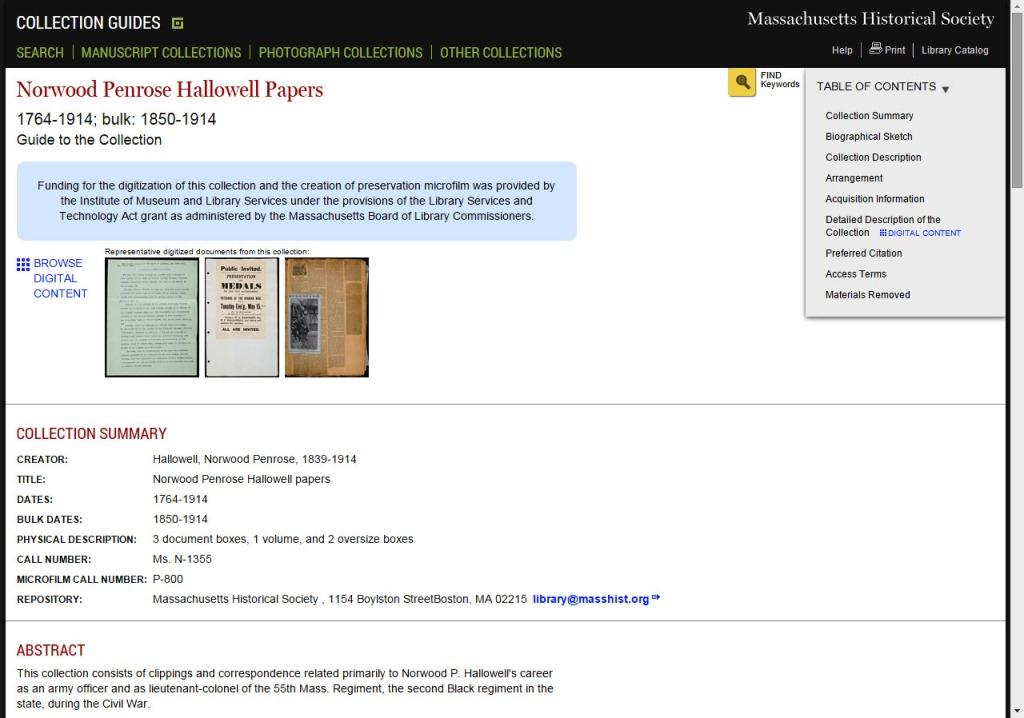
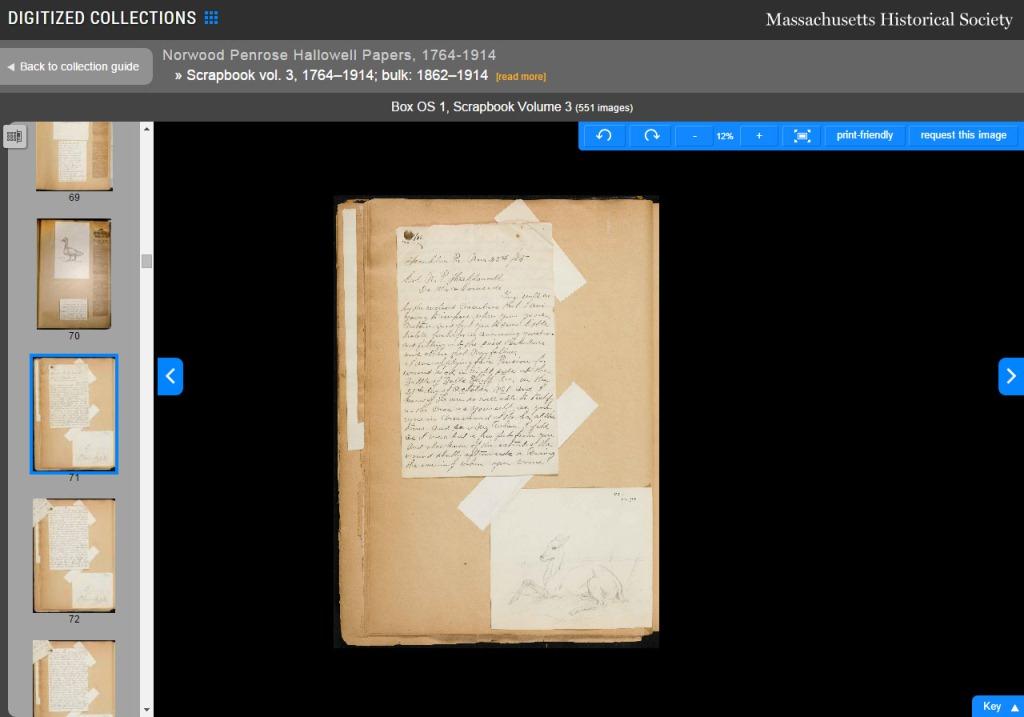
Hallowell began his service in the Civil War in the 20th Regiment Massachusetts Volunteer Infantry and then later served as lieutenant colonel of the 55th  Regiment Massachusetts Volunteer Infantry Regiment, the second Black regiment in the state.  This collection contains letters and a large number of clippings assembled in scrapbooks. These materials relate to a wide variety of Hallowell’s activities—from his time as a student at Harvard College, through his years serving in the Civil War, to his activities as a Boston businessman.

Frederick Newman Knapp papers

Knapp was a clergyman and teacher from Plymouth, Massachusetts. He wasn’t a soldier, but he held the position of superintendent of the Special Relief Department, U.S. Sanitary Commission.  The focus of this commission was to assist sick and wounded Union soldiers.  This collection includes Knapp’s personal and professional letters as well as a manuscript of a history of the Sanitary Commission.

Francis William Loring papers

This collection contains letters Loring wrote to his mother and sister while he served in a variety of military units.  Loring was a sergeant major in the 24th Regiment Massachusetts Volunteer Infantry; first lieutenant and adjutant in the 38th Regiment Massachusetts Volunteer Infantry; and aide-de-camp for Gen. William H. Emory of the 19th Corps.

Edmund Miles papers

Miles was a lieutenant in the 41st Regiment Massachusetts Volunteer Infantry, later renamed the 3rd Regiment of Cavalry Massachusetts Volunteers.  This collection includes letters Miles sent to his family describing his activities in the Civil War, and letters he received from his family in Cambridge, Massachusetts.

Charles F. Morse papers

This collection contains letters (some with drawings) written by Lieutenant Colonel Morse of the 2nd Regiment Massachusetts Volunteer Infantry, who saw action at Cedar Mountain, Antietam, Chancellorsville, Resaca, and the Siege of Atlanta in 1864. The collection also includes some correspondence relating to his post-war activities in the railroad business.

Edward Burgess Peirce letters

Peirce was a drummer and a private in Company F. of the 2nd Regiment Massachusetts Volunteer Heavy Artillery, from July 1863 to September 1865. This collection includes letters he wrote to his parents in Lowell in which he described many aspects of day-to-day activities as an enlisted soldier including accounts of camp life and troop movements.

Stephen Minot Weld papers

This collection contains letters written by Weld who was promoted several times during the four years he served in the Union Army. Weld was a second lieutenant and then captain in the 18th Regiment Massachusetts Volunteer Infantry, 1862-1863, and later was lieutenant colonel and then colonel in the 56th Regiment Massachusetts Volunteer Infantry, 1864-1865.

Please explore and read these collections from any location where you have a web browser and access to the Internet!

Funding for the digitization of the nine Civil War manuscript collections that enabled both the creation of preservation microfilm and the online version of the collections was provided by the Institute of Museum and Library Services under the provisions of the Library Services and Technology Act grant as administered by the Massachusetts Board of Library Commissioners.


The Mysteries of the Elisha W. Smith, Jr. Logbook, 1853-1857: Part II

By Andrea Cronin, Reader Services

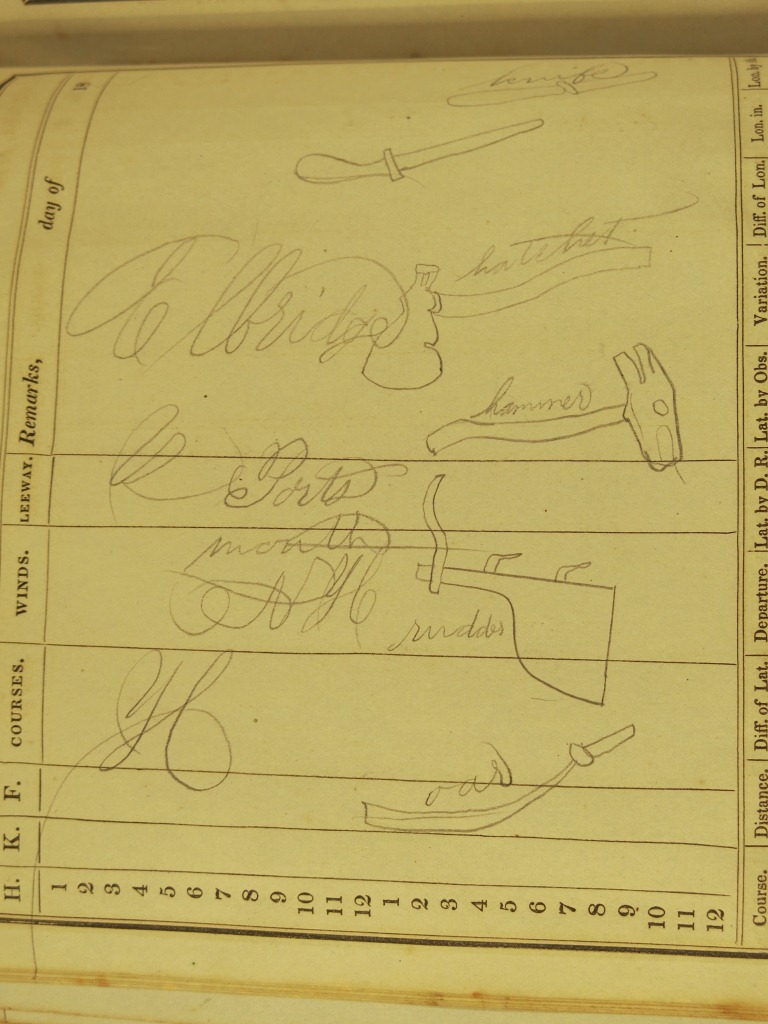
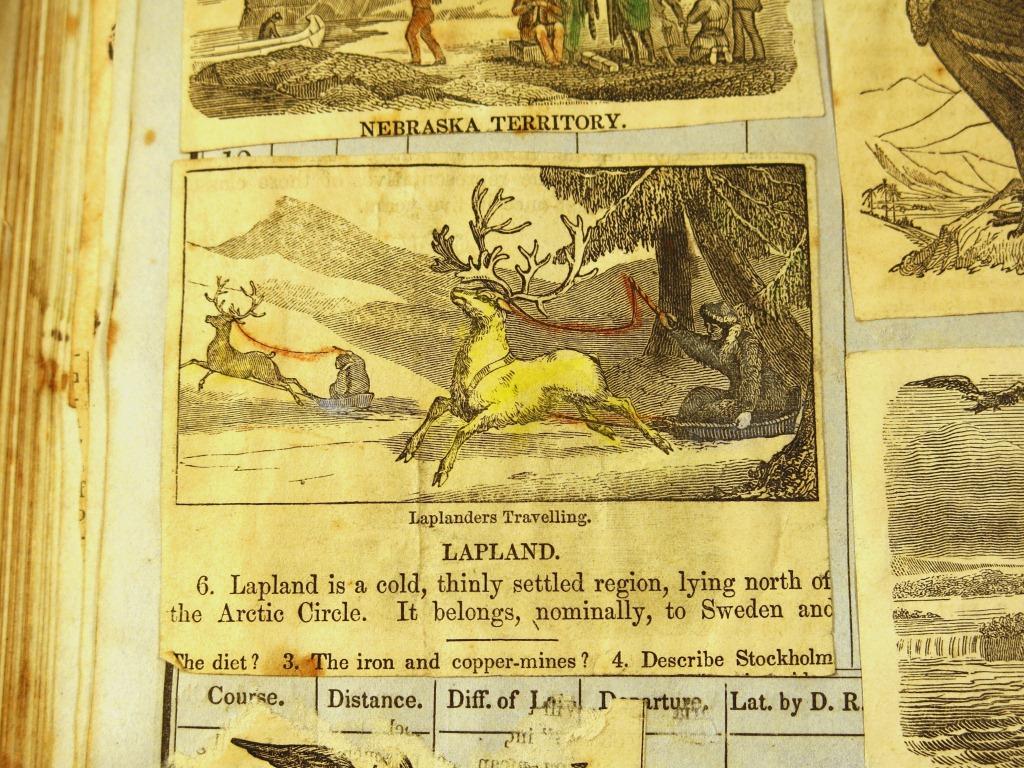
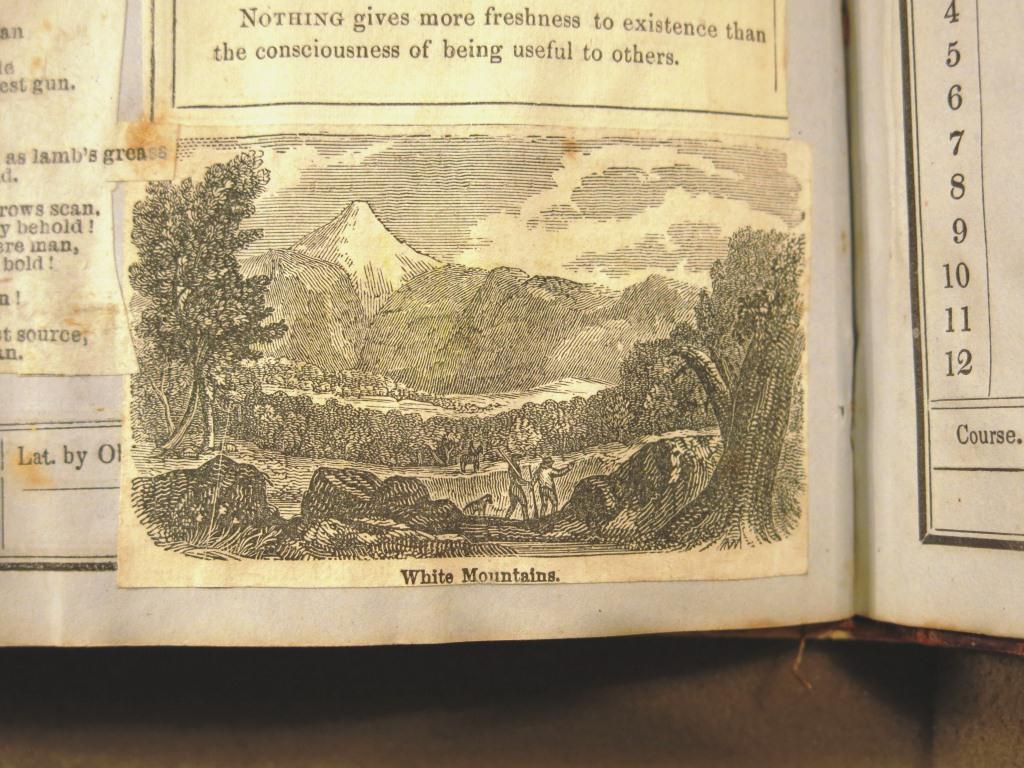
In a prior blog post I discussed a note on the inside cover of the logbook of the schooners Flying Dragon (1853) and William Freeman (1857), which identified the log keeper as Elisha W. Smith. This particular logbook contains a mystifying collection of logs, sketches, poems, engravings, and literary clippings. The engravings caught my attention with the bright crayon colors. A scrapbooker clipped, hand-colored, and pasted images into this logbook. Intrigued by the scrapbook curation, I hoped that identifying the engravings would tell me when the creator fashioned this curious assemblage.  

After coming up empty searching Google Books and Internet Archive for the poems and literary clippings within the volume, I examined the engravings in closer detail. The informative images depict locations such as the White Mountains and Lapland and highlight the creator’s clear interest in travel. Other selections within include maps, images of sailing ships, more distant locations and depictions of native peoples.


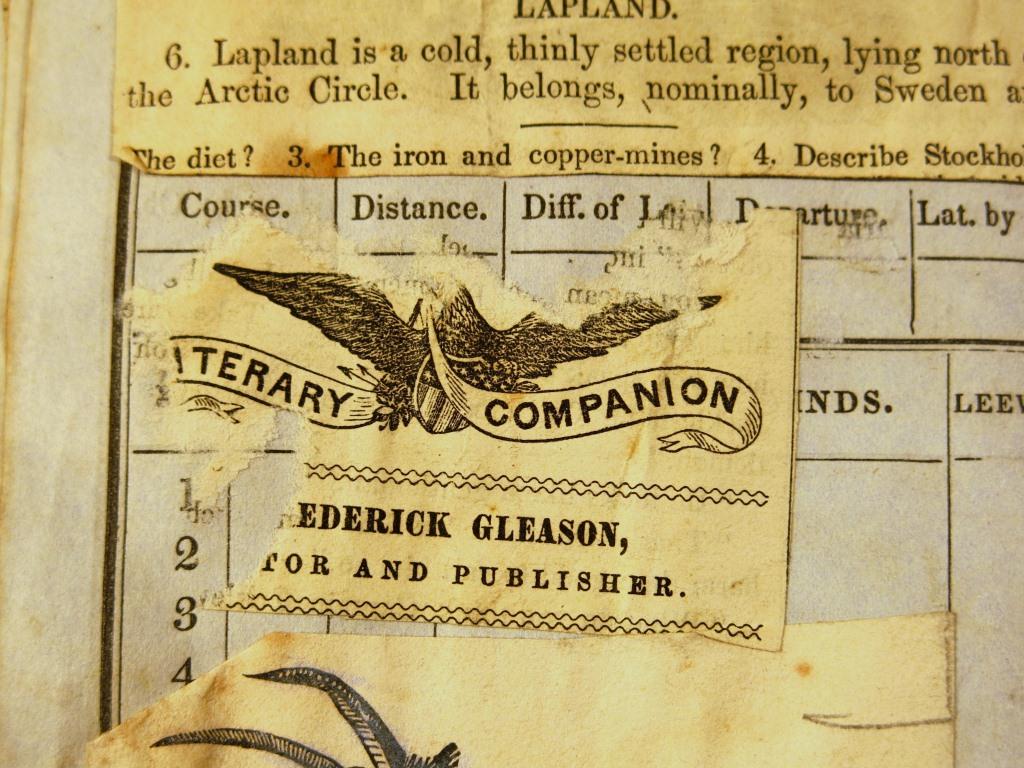
Then I spotted a timeworn masthead of a literary magazine pasted under the engraving of travelling Laplanders. Through the wear and tear I could clearly read the words “Gleason” and “Companion.” The Gleason’s Literary Companion masthead appeared several times in the scrapbook. The inclusion of an official “citation” made my day. I researched the Literary Companion and found that Frederick Gleason published this literary magazine from his Boston home near Franklin Park from 1860 to 1870. He also published several other pictorial magazines during his career. The MHS does not hold Gleason’s Literary Company but does hold Gleason’s Pictorial Drawing-room Companion (1851) and several of Gleason’s engravings.

Satisfied that I had discovered the origin of the engravings, I remained curious about the scrapbook’s creator. Who put the care into selecting, coloring, and pasting these images into the logbook? In my final post, I will delve into discovering the scrapbooker’s identity.

The Art of Ludvig Sandöe Ipsen

By Susan Martin, Collection Services


On 27 January 1880, the Apollo Club of Boston, an all-male chorus, performed Mendelssohn’s Oedipus at Colonus at the Boston Music Hall. The program for that concert featured this beautiful design by Danish illustrator Ludvig Sandöe Ipsen (1840-1920). It is one of the 51 black-and-white ink illustrations that make up part of the Apollo Club records, on deposit here at the MHS since 2012.

The Apollo Club was founded in 1871, incorporated in 1873, and is still going strong. In fact, it is Boston’s oldest active male chorus and the second oldest continuously active male singing group in the country. Throughout its long history, the club has performed at many notable occasions, including the funeral of Massachusetts Senator Charles Sumner in 1874, the centennial celebration of the Battle of Bunker Hill in 1875, and the memorial service for President William McKinley in 1901.

Arthur Reed, the club’s first secretary, commissioned Ludvig S. Ipsen to design covers and page details for concert programs and publications. Ipsen was quite a “get” for the Apollo Club. After training as an architect in Copenhagen (not to mention serving in the Danish Army engineer corps during the Second Schleswig-Holstein War), he had immigrated to the United States in 1867 and soon made a name for himself in Boston as a designer of book covers, book plates, posters, etc. His illustrations appeared in volumes by Henry Wadsworth Longfellow, Sir Walter Scott, Mark Twain, and Nathaniel Hawthorne, but arguably his most important and best-known work was the illustrated edition of Elizabeth Barrett Browning’s Sonnets from the Portuguese published in 1886.

Ipsen designed 130 program covers for the Apollo Club over 23 years. His illustrations include historical and mythological figures, as well as musical instruments and notes, trees and flowers, cherubs, birds, ribbons, seascapes, etc., all carefully composed and depicted in amazing detail.


Ipsen also designed the Apollo Club seal, still used by the organization today.

Many memorials of Ipsen and reviews of his illustrations note that he worked at a time when advances in printing technology made the reproduction of images faster and cheaper, and original hand-drawn artwork for mass-produced books was in decline. But Ipsen found a receptive audience in the Apollo Club, and the result is a beautiful and skillful synthesis of music and art.

The Western Front Recedes: The St Mihiel Operation

By Dan Hinchen

In the autumn of 1918, the Great War in Europe was nearing its termination after four years of fighting. Beginning in August of that year, the Allies launched what became known as the Hundred Days Offensive, a series of attacks against the Central Powers which pushed the Western Front and the German lines out of France and, ultimately, resulted in an armistice. One such two-day offensive occurred near the French town of St. Mihiel on 12-13 September. The action was carried out by the 26th Infantry Division under the command of Maj. Gen. Clarence R. Edwards.


The 26th was formed by Edwards in the summer of 1917 and the first units of the Yankee Division sailed in September, “the first fully formed American division in France.” Over the next several months the division undertook training in France with their English and French counterparts so that they could acclimate to life in trenches and amidst hostile fire.

Fast forward to September 1918. Edwards and his division were in the area of St. Mihiel as a result of several months of fighting on the move in the northeast of France. Despite the rain and mud that slowed down some units from reaching their start line the night before the offensive, “the attack came off without any major hitch, following a tremendous artillery barrage during the early morning hours of September 12, 1918.”

Here at the Society are the Clarence Ransom Edwards papers, within which are several reports providing details about the operations performed by the 26th Division. One intelligence report, dated September 11 to September 12th, 1918, 16 o’clock to 16 o’clock, states that

The enemy, surprised by our attack, and with all communication to the rear out by our artillery fire, offered what resistance he could during the day, chiefly with his machine guns. In the open country the resistance was very weak. In the woods his machine gun nests proved fairly effective. The first day’s objective was reached before 22 o’clock.

These intelligence summaries, along with correspondence, memoranda, and other materials in the Edwards papers provide detailed insight into some of the operations of the “war to end all wars” and also highlight some of the personal drama between Edwards and his military colleagues. If you would like to learn more, visit the MHS library and see them for yourself!


-Shay, Michael E., Revered Commander, Maligned General: The Life of Clarence Ransom Edwards, 1859-1931. Columbia: University of Missouri Press, c.2011.


“Signed, sealed and delivered”: The Treaty that Ended the Revolutionary War

By Amanda A. Mathews, Adams Papers


“On Wednesday the third day of this Month, the American Ministers met the British Minister at his Lodgings at the Hôtel de York, and signed, sealed and delivered the Definitive Treaty of Peace between the United States of America and the King of Great Britain.” John Adams reported this news to the President of Congress on September 5, 1783 and congratulated Congress on the “Completion of the work of Peace.”

It was eight o’clock in the morning when John Adams along with Benjamin Franklin and John Jay, met the British peace negotiator, David Hartley, at his residence in Paris and months of negotiations, first the previous year leading to the preliminary peace treaty, and then in earnest from April until the end of August culminated in this definitive treaty.

While this was no doubt a significant moment—after all, eight long years of war were officially ending with complete American independence—the signing was more of an anticlimax for Adams. His immediate feelings, as he revealed to Abigail the following day, were that as the definitive treaty was no more than “a Simple Repetition of the provisional Treaty,” they had “negotiated here, these Six Months for nothing.” Nevertheless, Adams understood that given the political realities of their position relative to Great Britain, “We could do no better Situated as We were.”

The key provisions of the Treaty of Paris guaranteed both nations access to the Mississippi River, defined the boundaries of the United States, called for the British surrender of all posts within U.S. territory, required payment of all debts contracted before the war, and an end to all retaliatory measures against loyalists and their property. Throughout John Adams’s term as minister to Great Britain in the 1780s, he and the British foreign secretary, the Marquis of Carmarthen, regularly discussed the actions each side saw as breaches of and a failure to fulfill the treaty—a debate that went unresolved until the signing of the Jay Treaty in 1794.

When editors at the Adams Papers Editorial Project are asked to name our favorite document in the immense collection that is the Adams Family Papers, John Adams’s copy of the Treaty of Paris, is certainly a top choice. This duplicate original in the Adams Papers is the only original not in a government archive. One can easily imagine that the legal- and legacy-minded John Adams was keen to retain a copy of this founding document over which he had so long toiled so far from his home for his posterity. Of particular interest are the seals—as there was no official seal for the American commissioners to use, each used whatever was convenient to him. See here for a full discussion of the Boylston family coat of arms, which Adams used as his seal on both the preliminary and definitive treaty and for more on Adams’s thoughts at the conclusion see the newly launched digital edition of Papers of John Adams, volume 15.

Image: First and last pages of the Definitive Peace Treaty between the United States and Great Britain (Treaty of Paris), September 3, 1783, Adams Family Papers.

Stephen Greenleaf Bulfinch Diary, Post 35

By Elaine Heavey, Reader Services

The following excerpt is from the diary of Stephen Greenleaf Bulfinch.

Tuesday, Aug. 7th, 1864

Thursday was a day of fasting for our national afflictions; – a day of thanksgiving too to the community for a blessed rain the day before after an unexampled drought.

Tuesday, Aug. 28th

Uncertain rumors of peace negotiations, & political arrangements, are the order of the day. Democ. Convention to nominate candidate meets tomorrow at Chicago.

Marion Learns About the Family: Sexuality Education in the 1930s (Part One)

By Anna J. Clutterbuck-Cook, Reader Services

Wearing my historian hat, I am interested in the ways in which twentieth-century Americans made sense of shifting sexual and gender practices. The mainstream media often figures conflict over sexual morality as fallout from the post-Sixties “culture wars,” feminist activism and backlash, and the rising visibility of queer citizens. In actuality, American anxiety over — and enthusiasm for adopting — modern family and relationship practices can be traced back to at least the Progressive Era.

These anxieties often manifested themselves, much as they do today, through adult debates over what youth should know about human sexuality and when they should know it. By 1929, adult fears about discussing sex with young people were familiar enough that satirists E.B. White and James Thurber devoted a whole chapter of their book Is Sex Necessary?: or, Why You Feel the Way You Feel to the question of “What Should Children Tell Their Parents?”:

If young folks lack the tact of intelligence requisite to enlightening their parents, the task should be intrusted to someone else. Yet it is hard to say to whom. A child should think twice before sending his father around to the public school to secure sex information … women teachers, to borrow a phrase, are apt to be ’emotionally illiterate.’

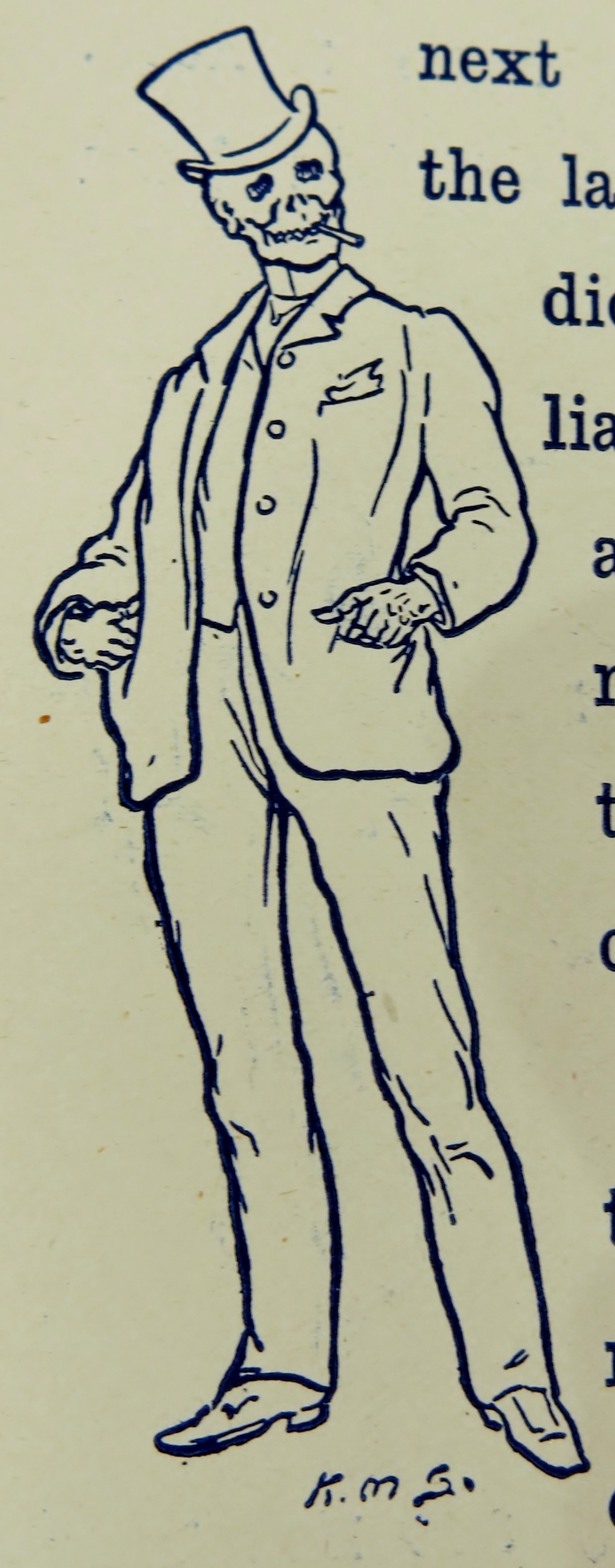
Here in the Massachusetts Historical Society we can find evidence of the lessons teens have been taught throughout the past two centuries regarding sexual health and sexual relationships. Within the Frank Irving Howe, Jr. Family Papers, for example, we find course materials for a class on “The Family,” offered at Walpole (Mass.) High School during the 1934-1935 academic year — a few years after Is Sex Necessary? went to print. The class was attended by high school senior Marion Howe, whose Thurber-like doodles offer visual commentary on the curriculum’s typescript pages.

“The Family” is perhaps best understood as a course on the sociology of family life. It is part premarital counseling, part anthropological study. Readings — drawn from religious pamphlets, sociological writings, and popular journalism — cover the various forms of marriage, divorce, religious views on family life, family planning, sexuality within and “without” marriage, homosexualty (“inversion”) and birth control. Absent from this 1930s “sex ed” curriculum is frank discussion of sexual hygiene, the mechanics of partnered sex, or discussion of sexual pleasure beyond such vague phrases as “the sex instinct” or “a sex experience.” Perhaps Thurber and White spoke from experience when they suggested youths should “think twice” before securing reliable information about human sexuality from public school teachers — at least those in Walpole, Massachusetts!

Many of the social issues outlined by curriculum’s introduction have a familiar, if slightly fusty, ring to them. “The problems of sex and the family are more acute and more wide-spread today,” the anonymous author begins, observing an “increased desire for freedom without an accompanying sense of responsibility.” Shifts in social order, including the industrial revolution, “has made marriage an economic liability instead of an asset for the man … [and] no longer the only career open” to women. Prolonged education leads to postponed marriage, while contraception “eliminates the fear of offspring.” As in the twenty-first century, feminism is criticized for encouraging bad behavior among women: “Many women [today] are making the single standard the low one practiced by many men.”


In other sections, the rhetoric of 1935 stands in stark contrast to what would be socially acceptable to articulate in a mainstream sexuality textbook today. Consider the following passage on family planning: 

The question of the right of couples to remain childless involves the question of the desirability of race survival and the obligation of desirable potential parents to assume their share of the burden… With the rapid increase of undesirable human stock and the rapid depletion of desirable stock, an obligation certainly rests on those who have valuable biological and environmental contributions to make. The choice between single blessedness and a home with children cannot be settled altogether on a personal basis.

While such racialized fears and negative stereotypes about non-parenting couples still inform debates about family policy and morality today, the language of “undesirable human stock” and “the burden” of “race survival” used earnestly within a public school curriculum suggest how acceptable expression of anxieties change over time, even if the anxiety itself remains alive and well.

What did eighteen-year-old Marion Howe make of her education in “the family”? In part two of this story, we will endeavor to answer that question by cracking open her diary. Kept intermittently between 1934-1937, the volumes document her social activities and academic studies during her final year of school, as well as her first marriage (1936-1941) and the birth of her first child in 1937. Stay tuned!

The Mysteries of the Elisha W. Smith, Jr. Logbook, 1853-1857: Part I

By Andrea Cronin, Reader Services

Several questions burn brightly in my mind when I look through the Elisha W. Smith, Jr. logbook,1853-1857. If curiosity is a wildfire, this particular logbook sets me aflame in that it contains not one but two ship logs and a scrapbook. Elisha W. Smith, Jr., son of Elisha W. Smith and Ruth A. Smith of Wellfleet, Mass., served as a mariner and log keeper for the schooner Flying Dragon in 1853 and the schooner William Freeman in 1857. While these voyages are by no means uninteresting, the myriad mysteries surrounding the physical logbook and its various chroniclers captivate my attention. I will unveil three mysteries I uncovered within this logbook in a series of blog posts.

Inside cover of the Elisha W. Smith Jr. Logbook, 1853-1857

The inside cover of the logbook resembles a communal notebook. The cover contains not only the book plates of the MHS General Fund dated 21 July 1919 but also the book plate of nautical stationer Frederick W. Lincoln, Jr. There are several penciled accounting notes as well one fading inked note, but more interesting to me is this message in the top right corner written by a distinctly different hand: “Log book of the Flying Dragon kept by Elisha W. Smith Jr of Wellfleet, Mass. See Aug 11, 1853”.

Immediately I questioned the “see” note. What was important about this particular date in the logbook of the schooner Flying Dragon? The voyage of the Flying Dragon from Boston to San Francisco commenced on 22 July 1853. The log does not, however, confirm that the schooner found safe harbor in San Francisco. The last entry dated 29 September 1853 describes a “Hurricane” during the passage around Cape Horn. The log entry of 11 August 1853 reads:

Commences with light
winds & clear weather
2 P.M. tacked to the East-
ward 6 P.M. furled main
skysail 11 P.M. furled
Royals.
—————————————-

12 might tight
baffling winds, with
heavy rain squalls.
—————————————-

7 A.M. made all sail
This day ends with light
winds & cloudy weather
All draging sail set
by the wind
No Observation.
Elisha W. Smith jr

A brief glance through the pages of the log confirmed that this entry contains the first date on which the log keeper signed his name. The note on the inside cover refers to this entry by date as proof that the log belongs to Elisha W. Smith, Jr. The mystery of the cover note is solved!

However, I wonder who wrote this particular note. Did a member of the succeeding Smith family write it? Was it inscribed on the logbook by an MHS staff member in 1919? The logbook holds such a curious mix of ship logs, sketches, printed poems, engravings, and literary clippings. Here is a sketch of a ship on the back inside cover. In the next post in this series, I will discuss these sketches, poems, engravings, and literary clippings included within the log. Stay tuned!

Back cover of the Elisha W. Smith Jr. Logbook, 1853-1857


The MHS as Time Machine

By Susan Martin, Collection Services

In my work as a manuscript processor here at the MHS, I often come across the diaries or letters of a person I wish I could meet face to face. It’s rarely the well-known movers and shakers of history, just someone with a unique and interesting voice. I’ve introduced you to some of these people (Eliza Cheever Davis & Moses Hill) in previous posts, but my latest discovery is Jacob Newman Knapp (1773-1868), teacher and occasional preacher of Walpole, N.H. I wrote about Jacob before, but I hope you’ll indulge me if I quote from him again. Here he is in a letter to his son Francis on 21 May 1850 (from the Knapp family correspondence):

We are all well and active. When I say active I speak more particularly for others, than for myself. My days of activity have either gone by, or not yet arrived….Well, it is said that it takes a variety to constitute a world! There is certainly a good variety of characters in the world. Life is undoubtedly a serious trust and must be seriously accounted for; but there is so much of the ludicrous, of the absurd extravagant and incomprehensible in the human character, that I feel inclined to cry and to laugh at the same time. What a display, at different times, in the same person, of saint and sinner, of philosopher and fool, of man and monkey, a perpetual, practical antithesis, a combination in one person of the two sons of Leda, mortal and immortal by turns.

His wit, eloquence, and philosophical attitude endeared Jacob to me immediately. Not to mention his obvious affection for his family:

We [Jacob and his wife Louisa (Bellows) Knapp] have many topics of interest for conversation; one never tiring, never exhausted subject is our sons. We follow them every where, and when facts are unknown, we reason upon the probable and the improbable, the possible and the impossible, and at times free the imagination from its cage of logic, and let it fly at large, at liberty to light anywhere, and to sing its wildest notes. We have no dull hours. We have occasionally some silent hours, but no vacant ones, for they are crowded full of reminiscences or compendiums and abstracts of future developments.

Jacob lived to be almost 95 years old. He was born 7 Nov. 1773 and died 27 July 1868. Imagine, a man born a few weeks before the Boston Tea Party, old enough to remember events of the Revolutionary War (he was almost 10 when the Treaty of Paris was signed), who lived to see the end of the Civil War and the ratification of the 14th Amendment! No wonder his letters are full of so much wisdom. How fascinating he would be to talk to.

There’s only so much we can know about the people of the past from the writings they leave behind, but it’s hard not to feel that I have, in a way, “met” Jacob.