By Elaine Grublin
The following excerpt is from the diary of Stephen Greenleaf Bulfinch.
Feb. 2d, 1864
The President has just ordered out 500,000 men.


By Elaine Grublin
The following excerpt is from the diary of Stephen Greenleaf Bulfinch.
The President has just ordered out 500,000 men.
By Andrea Cronin
On 7 February 1870, Henry H. Warden, of the Russell & Company trade firm in Shanghai, wrote to colleague John Cunningham. Cunningham served as an agent in Boston for the Walsh, Hall & Company of Nagasaki in the tea trade. In this particular letter, Warden replied to an inquiry Cunningham had made concerning a potential shoe business in China.
“Thanks for yours of Nov 30 –
As to the McKay Machine. If it
is capable of turning out 4 @ 5000
shoes a day (those are your figures)
I should say it might be run
here to advantage for a week,
the Leather coming with it, and
supply China and the regions
round about for a year, I
fancy it is only adapted to making
foreign shoes. E. C. will be able
to give you a better opinion
than I can – He will be able
also to say whether you are
likely to find anything here
worth your while. I did not
forget to speak to him about
it-“
What is the McKay machine that Henry Warden references in this letter from John Cunningham papers?
The McKay stitcher was a sewing machine created by inventor Lyman Reed Blake and improved by businessman and self-educated engineer Gordon McKay. Prior to the introduction of this stitcher, shoes were hand stitched in a time-consuming and piecemeal manner. The machine revolutionized the speed of footwear production by machine sewing the uppers to the soles.
In 1858, Lyman Reed Blake initially invented an interesting, but not entirely functional, sewing machine. Foreseeing a future in shoe machinery, Gordon McKay bought the patent from Lyman Reed Blake in 1858 for an immediate $8,000. An agreement was reached that Lyman Reed Blake would receive a $72,000 share of future profits. The entrepreneurial engineer for whom the machine is named then improved upon the design until submitting an enhanced patent in 1862. The McKay machine produced finished shoes far faster than hand stitching; it is often credited with giving the North a material edge during the Civil War while the Confederates went without proper footwear.
After the war, having found his market in shoe machinery, Gordon McKay made all moves to retain his profits. In 1866, he designed a leasing system for the McKay machinery which demanded royalties for each pair of shoes made. The low cost of leasing the machines allowed manufacturers to engage in the production of shoes. This production in turn furthered Gordon McKay’s business as he secured a profit for each pair made by his machines.
In his letter, Warden refers Cunningham to the expertise of his brother, Edward Cunningham (“E. C.”), a senior partner of the Russell & Company trade firm in Hong Kong. The John Cunningham papers at the Society do not contain information about further footwear business plans in China or correspondence between the brothers about the McKay stitcher. However, it is still a true mark of global prowess that Henry H. Warden and John Cunningham discussed the introduction of the McKay machine to Asian markets less than a decade after its invention.
By Dan Hinchen,
Over the last couple of weeks, we in Massachusetts were reminded of the unpredictability and harshness of the winter in New England. Of course, we are not alone and a significant portion of the rest of the country received an even greater shock. Still, the driving snow, sub-zero temperatures, and bitter winds force us to remember what a coastal winter can be. But if you think your commute was bad, the experience of Roger Williams might make you turn up the heat and clutch your hot chocolate a bit more tightly.
In October of 1635, after various hearings and disputes over intersecting matters of theology and secular power, Massachusetts Bay banished Roger Williams forcing him to leave the colony’s borders. But with winter coming on and Williams falling ill the court allowed him the courtesy of commuting the sentence until spring on the condition that Williams would not speak publicly in the interim. He consented to this term and agreed not to publicly proclaim his views.
This agreement did not prevent Williams from welcoming his friends and followers into his home and holding private discussions. However, the Massachusetts court viewed even this as a breach of his promise and, in January, 1636, sent armed soldiers led by Captain John Underhill to Williams’ home in Salem to arrest him and put him on a ship bound for England.
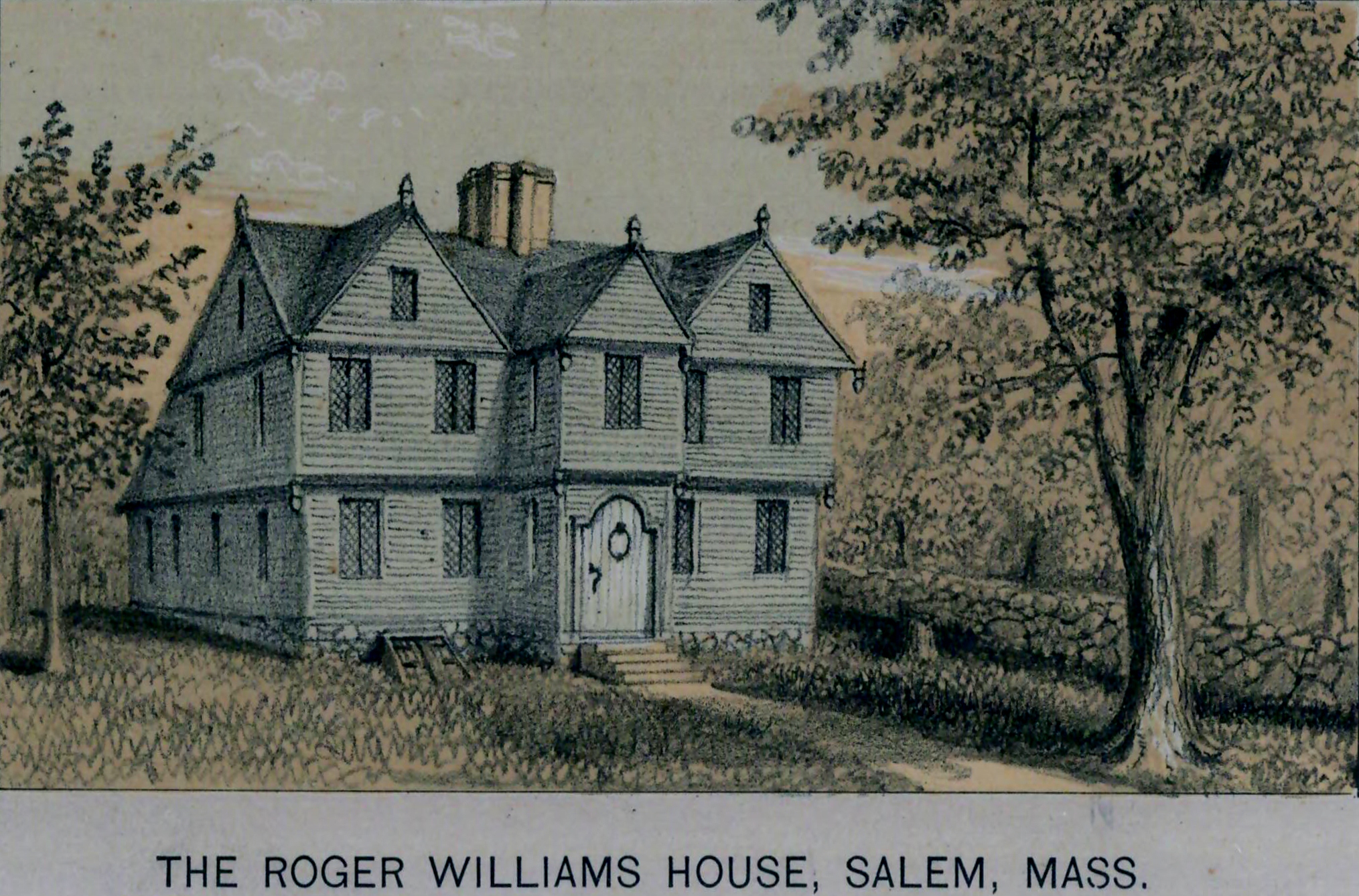
As a blizzard and accompanying gale blustered out of the northeast, the ailing Williams received a secret message from none other than Governor John Winthrop, alerting him to the approaching soldiers. By the time Underhill and his men arrived, Williams had been gone three days.
Williams escaped with his life, liberty, and little else. Leaving his wife and children behind until he could find a new home, he plunged into the winter woods by himself. “He entered the wilderness ill and alone…Winthrop described that winter as ‘a very bad season.’ The cold was intense, violent; it made all about him crisp and brittle…The cold froze even Narragansett Bay, an extraordinary event, for it is a large ocean bay riven by currents and tidal flows.”i
“But the cold may also have saved his life: it made the snow a light powder . . . it lacked the killing weight of heavy moisture-laden snow. The snow also froze rivers and streams which he would otherwise have had to ford.”ii A silver lining to the winter clouds is one that we benefited from during our last storm and surely made our shoveling much easier.
That Roger Williams endured his trek from Salem to Narragansett Bay is no doubt a testament to his personal relationships with the native peoples and their willingness to give him shelter. Yet, “There was no comfort in this shelter. For fourteen weeks he did ‘not know what Bread or Bed did meane.'”iii
And yet Roger Williams survived this ordeal and soon thrived in his new home of Providence, itself a further attestation to the good relations that Williams shared with the indigenous tribes. While Plymouth and Massachusetts Bay colonies both were formed by English settlers putting roots down in a spot without much thought for the original inhabitants, Williams was able to secure a piece of land with the blessing of the Narragansett sachem Canonicus and his nephew Miantonomi, two men who were otherwise ill-disposed toward the English.
“Canonicus and Miantonomi gave Williams permission to settle there after negotiating what seemed clear boundaries. Williams later declared that Canonicus ‘was not I say to be stirred with money to sell his land to let in Foreigners. Tis true he recd presents and Gratuities many of me: but it was not thouhsands nor ten thouhsands of mony could have bought of him and English Entrance into this Bay.’ He said the land was ‘purchasd by Love.'”iv
Though we grumbled about the cold and snow that we experienced last week, chances are the memories are already fading. Williams’ journey, though, had a lasting effect: “Thirty-five years later he would refer to that ‘Winter snow wch I feele yet.'”
To find out more about the life of Roger Williams, try these biographies:
Also, visit our online catalog, ABIGAIL, and search for Williams, Roger as an author to see what works the MHS holds written by Williams or where he appears in other manuscript collections.
iBarry, John M., Roger Williams and the Creation of the American Soul: Church, state, and the Birth of Liberty (New York: Viking Penguin, 2012) 213.
iiBarry, Roger Williams and the Creation of the American Soul, 213.
iiiBarry, Roger Williams and the Creation of the American Soul, 214.
ivBarry, Roger Williams and the Creation of the American Soul, 217.
By Elaine Grublin
The following excerpt is from the diary of Stephen Greenleaf Bulfinch.
In regard to public events, the year has witnessed many calamities, through the rage of civil war; but God has sustained us, and it now seems as if the end, – and a righteous and permanent end, – was nigh. May He grant its speedy attainment!
By Amanda A. Mathews
The women of the Adams family may not have held public office themselves, but they were vital to their husbands’ political careers. Abigail aided John both through her counsel and astute management of their property during his long absences. Louisa Catherine Adams, on the other hand, choosing to remain near her husband at his various posts, used her charm and entertaining skills to showcase John Quincy to the political world in her parlor.
Perhaps her greatest triumph in this vein came on 8 January 1824, the ninth anniversary of the Battle of New Orleans, an important victory for the United States at the end of the War of 1812. Louisa hosted a grand ball to honor the hero of the battle, Andrew Jackson.
The Jackson Ball that Louisa planned was a magnificent affair that took over two weeks for the family to prepare. Five hundred invitations were issued to congressmen, cabinet members, and the social elite of Washington, and newspapers estimated that potentially 1,000 people attended the ball that required the Adamses to install pillars to support the upper floors of their F Street, Washington, D.C., home. Wreaths, garland, and roses covered the walls, while delicate chalked eagles and flowers graced the floors and guests were treated to a sumptuous buffet. “Mr Adams and I took our stations near the door that we might be seen by our guests and be at the same time ready to receive the General to whom the fete was given,” Louisa recalled in her diary. “He arrived at nine o’clock and I took him round the Rooms and introduced him to the Ladies and Gentlemen whom we passed. . . . my Company dispersed at about half past one all in good humour and more contented than common with their entertainment.”
But this was no mere party. This was politics. The Adamses hoped to win over the support of a yet undeclared candidate and potential political rival in Jackson, and showcase their leadership as John Quincy became a leading presidential candidate. During the evening, a small mishap underscored this understood overlap between the social and political worlds. Louisa recorded, “While sitting in the dancing Room one of the lamps fell upon my head and ran all down my back and shoulders— This gave rise to a good joke and it was said that I was already anointed with the sacred oil and that it was certainly ominous— I observed that the only certain thing I knew was that my gown was spoilt—” While this lavish ball failed to win Jackson’s political support, as he became Adams’s chief rival in the Election of 1824, it was a smashing social success, spoken of for years to come, and clearly revealed Louisa’s mastery of social politics.
If you would like to learn more about Louisa in her own words, the forthcoming A Traveled First Lady: Writings of Louisa Catherine Adams is available for pre-order now.
By Susan Martin
On friday evening came the chunky, fat, merry, rosy cheeked dutchman Santa Claus, who makes an annual visit to good children, who have loving parents, on Christmas eve, bringing with him his pack of all sorts of nick-nacks to put into the Christmas stocking. How he makes out to get down our narrow throated chimneys, and these obstructed by grates or stoves, I dont know, unless he and his pack can be contracted and expanded by volition, like Miltons fallen angels, who reduced their gigantic forms to the size of bees, that they might be accommodated in Pandamonium…
This Christmas letter from Jacob Newman Knapp (1773-1868) to his son Frederick, written on 27 Dec. 1852, is just one of many interesting letters in the Knapp family correspondence, a new collection at the MHS.

Jacob’s long life stretched from the American Revolution to the Civil War. He had been a teacher for many years and now lived on a farm in Walpole, N.H. with his wife Louisa (Bellows) Knapp and Frederick’s younger brother Francis. Frederick was minister of the First Parish Church in Brookline, Mass. The family was obviously very close, and letters were frequent and affectionate. Jacob’s in particular, though not short on paternal advice, also reveal a playful and endearing sense of humor.
Christmas at the Knapp home that year was a big event. The guest of honor was a young girl named Rebecca. Rebecca’s name had suddenly appeared in the correspondence just a few days earlier, and any letter indicating who she was or why she was staying with the family has since been lost. Neither Frederick nor Francis was married or had children yet, so I assumed Rebecca was the daughter of a friend or distant relative, or perhaps the child of a servant. The Knapps were known for their hospitality, and Jacob and Louisa seem to have taken this girl under their wing. Whoever she was, she was fêted in grand style, with her very own Christmas tree, a Queen Mab doll, sleigh rides, and afternoon tea with seven other children of Walpole.
One of my favorite passages in the letter is Jacob’s description of a sleigh ride with Rebecca and the other children. He was obviously a natural storyteller, painting a vivid picture for us:
They were as full of happiness, as they could hold. The people in the street stared at the passing show, for the children, comely by nature, were bright, and cleanly dress’d. There were so many little heads peeping above the sleigh, that you might have imagined it a man and horse running off with a birds nest.
Then this fascinating detail:
Ah! a certain friend of ours would say, “you are spoiling that little coloured girl, if you have not already done it.” That we cannot readily assent to. Goodness, in every condition of life, should be encouraged, merit rewarded, and practical reform be prefer’d to theoretical and visionary. When our dignity requires to be enclosed in a glass case to guard it from plebean contact, we shall distrust in generousness, and we prefer being obeyed by love, rather than by fear.
I was more intrigued than ever. Who was Rebecca? A few other letters in the collection contain passing references to her, but nothing more. I consulted published biographies of the Knapps, but turned up nothing.
On 27 June 1853, Rebecca left the Knapp household under the care of a Mr. Makepeace, probably Walpole resident George R. Makepeace. The last letter in the collection is dated a few days later. In it, Jacob tells Frederick: “Rebecca’s safety was well cared for, as much so, as if her complexion had been a combination of white and red. She is a good girl, and will, I hope, continue so.”
By Andrea Cronin
In a prior post about American Sericulture, Dr. James Mease of Philadelphia wrote to Colonel Timothy Pickering about his sericultural pursuits in 1826. Small American sericulture experiments such as Dr. Mease’s endeavor gave way to industrial enterprise by the 1840s. In Northampton and its surrounding towns, businessmen Samuel Whitmarsh and Samuel Lapham Hill spun the necessary structure for the Nonotuck Silk Company and its Corticelli production line of sewing silk.
Though Samuel Whitmarsh gave Nonotuck Silk Company its name, the company did not survive the mulberry speculation bubble and subsequent implosion in the late 1830s. The Northampton Association of Education and Industry purchased the remains of Whitmarsh’s operations but struggled to produce raw silk until the ultimate dissolution of the association in 1846.
Samuel L. Hill converted the silk production operations of Northampton Association of Education and Industry into manufacturing mills. The company began importing the silk from China and Japan thereafter. Hill began to manufacture a new silk sewing thread known as “machine twist” that was durable enough to be used in mechanical sewing machines. Hill sent sewing machine inventor Isaac M. Singer some of his entrepreneurial “machine twist” silk spools in 1852. Singer was so impressed that he requested all of the company’s silk spools stock. The silk thread market blossomed under the influence of these two businessmen.
Samuel Hill remained president of the Nonotuck Silk Company until his retirement in 1876. At the 1876 Centennial International Exposition in Philadelphia, the Nonotuck Silk Company presented this gorgeous 1876 broadside that depicts twelve steps in silk production process from silkworms to raw silk.
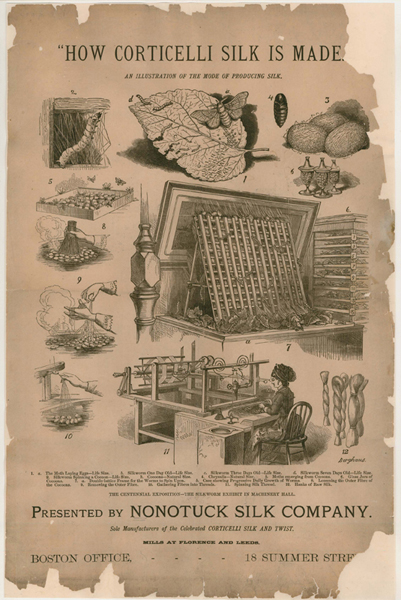
What step in this broadside interests you the most?
By Anna J. Clutterbuck-Cook, Reader Services
As one of our staff prepared to depart on maternity leave this fall, I took the opportunity to delve into the print and manuscript materials in our collection related to pregnancy and childbirth, parenting and childhood. The MHS has a wide variety of print, manuscript, art and artifact materials related to the history of parents and children, from Cotton Mather’s Help for Distressed Parents, Or, Counsels & Comforts for Godly Parents Afflicted with Ungodly Children (1695) to the children’s health diaries of Helen C. Morgan (in the Allen H. Morgan Papers), who kept tidy notes on her children’s growth, eating habits, childhood illnesses, and medical treatments from their infancy through their college years (1923-1951).
One of my favorite discoveries was the diary kept by Sophie French Valentine during the first months of her daughter’s life. Perhaps in anticipation of her daughter’s birth, Sophie purchased a page-a-day Standard Diary for 1910. In the days before Internet-based social media was our platform of choice for documenting the everyday, Standard Diaries offered a way for many Americans to keep account of their own comings and goings with “status updates” that continue to resonate with intimate immediacy for future generations.
Sophie Valentine’s 1910 diary remained blank until the page for Saturday, July 23, on which she wrote simply, “She came. 8 pounds 7 ounces, 21 inches. Thoroughly healthy. abt 11.42 a.m.”
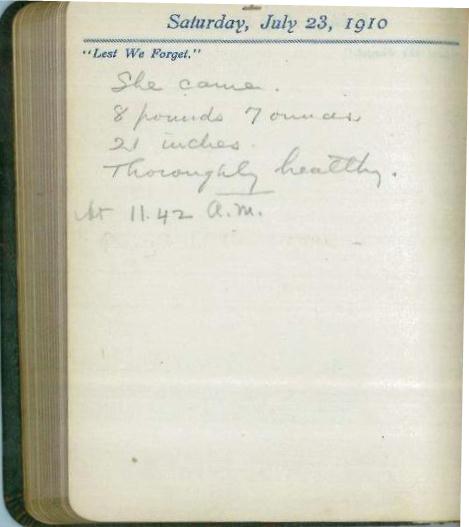
While her infant daughter was healthy, Sophie was not. On August 2nd she had to undergo an operation (unspecified), that necessitated separation from her daughter and several days’ sedation with “narcotics.” Sophie wrote on the page for August 2nd, “I nursed the baby every three hours up to this time – but just before the operation it was decided best to take her from me!”

As the summer waned, Sophie recovered from her surgery and chronicled the comings and goings of her household, as well as the growth of her daughter (also christened Sophia). Several weeks after the birth, the family doctor paid a visit and pronounced “the little one…sound and vigorous.” Three days later, infant Sophie “went out in the bassinette in front of the house” for the first of what would be many afternoons in the fresh air with her mother. Sophie’s husband, a diplomat, appears to have been away during much of his wife’s convalescence, but a steady stream of female friends and relatives populate the pages of Sophie’s diary. On August 14th, for example, the day “the little one” was baptized Sophia French Valentine, she “had pictures taken with Harriet, Charles, Aunt Martha, Auntie May; and Elizabeth and Lucy,” as well as with her mother and Aunt Caroline (“who held her and talked to her lots”). Later she was visited by “Theodore, Mrs. Graves, and Auntie Beth.”

By Thursday of that week the social whirl may have worn thin for both mother and daughter: the entry for August 18th reads simply, “Long sleeps last night for both Sophias.” A heartfelt status update that will no doubt resonate with many new parents generations hence.
The Sophie French Valentine Papers are part of the Robert G. Valentine Family Papers and available for use by researchers in the reading room of the MHS library.
By Andrea Cronin, Reader Services
Penguins unexpectedly cover the first page of a 1939 sketchbook in the Henry Daland Chandler papers. The rest of the sketches within the book are detailed and shaded images of Bermudian buildings created with the critical eye of the professional architect, Henry Daland Chandler. These penguins from the Bermuda Aquarium add a delightful and personal touch to this small volume.

I nominate the chubby grump in the lower left corner as “cutest penguin.” Do any of these penguins speak to you?
By Susan Martin, Collection Services
The life of a Civil War soldier was difficult even at the best of times, but holidays were particularly poignant. Many of the men were very young and away from home for the first time. Edward J. Bartlett of Concord, Mass. had been just 20 years old when he enlisted in August 1862. In his letters home in November of that year, written from New Bern, N.C., he described his first Thanksgiving as a soldier, the elaborate preparations, the decorations, and especially the food:
First we had oysters then turkey and chicken pie then plum pudding then apple raisin & coffee with plenty of good soft bread & butter. After we had all eaten a little too much, people usualy do on Thanksgiving days and we who had lived so long on hard tack did our best[,] we had a fine sing.
The meal was followed by songs (including “Auld Lang Syne”), speeches, toasts to President Lincoln and the troops, games, and a dance. Deep in hostile territory, the men were determined to celebrate “in the true home style.” Bartlett concluded that:
The whole day was very succesfull every thing went of[f] pleasently, not a thing went wrong. We were surprised that such a dinner could be got up in this God forsacken country. Twas pleasent to celebrate Thanksgiving in such a way.
The next year, his letters were more sober. Writing on 15 November 1863 from Nashville, Tenn., Bartlett reflected:
Our company Thansgiving in the barracks last year is a day that I can never forget. Six of those boys are now dead. Poor Hopkinson, the president, in his address, [said] “that he hoped the next year would see us all at our own family tables.” He died two months after.
Bartlett spent Thanksgiving 1864 stationed at Point Lookout, Md., guarding Confederate prisoners-of-war. He wrote to his sister Martha about his homesickness on the evening before the holiday:
Thankgiving eve. I sat over the fire, thinking of what you were doing at home, and what I had done on all the Thanksgiving eve’s, that I could remember.
The day itself, however, proved to be a rousing celebration that included music and dancing (“It was fun to see them kick thier heels about.”), horse races, sack races (“Such a roar of laughter I never heard before. Most of them were flat in the dirt before they had gone three steps.”), wheelbarrow races, a turkey shoot, greased-pole climbing, and greased-pig chases (“This made more sport than all the rest put together.”). Bartlett again, unsurprisingly, lingered over his description of the meal: oysters, turkey, duck, beef, chicken, vegetables, apple pie, pumpkin pie, mince pie, etc., finished off with cigars.
Edward J. Bartlett survived the Civil War and lived to 1914. To learn more about Bartlett, visit our Civil War Monthly Document feature for November 1863 or visit the MHS Library to read more of the papers in his collection.