The Idiosyncratic Index Subjects of Harbottle Dorr, Jr.

By Peter K. Steinberg, Collection Services

Part of the Harbottle Dorr, Jr. Annotated Newspaper project has been to transcribe and encode for presentation and searching at our website his interesting and detailed indexes. In the process, we took special notice of those subject headings that were quirky, weird, and–to our “modern” sensibilities–humorous.
There are four volumes, as you now know. (If you do not, read more about Dorr’s newpaper collection here.) At the time of this post, three of these indexes have been completely transcribed and encoded for display on our website, and we are working feverishly on the fourth — the last and longest volume. This is the first of two posts on Dorr’s idiosyncratic index terms in volumes one and two; a second post later this year will feature some entries from the third and fourth volumes.

In the Index examples below, we have kept true to Dorr’s spellings and abbreviations, which, because he worked on the indexes while running his shop, can include “misspelt” words.  The general structure of the index is similar to that found in a book: index term(s) followed by a page number.

Volume 1
Eater a remarkable one yt had 3 Stomachs 21
Frost bitten person’s Receipe for 10
Hutchinson Govr. censured by the House, as having a Lust of Ambition and Power 581
Irish Blunders of two that fought a Dad 13
Lunatic’s sensible reply 13
North Carolina Men kill Beaver & make uneasiness 49
Printers on their bad Spelling 32
Prediction of Good News 279
Toms desire 174
Vampres (Vampyres) Account of 49
Vampres (Vampyres) Essay against 55

Volume 2
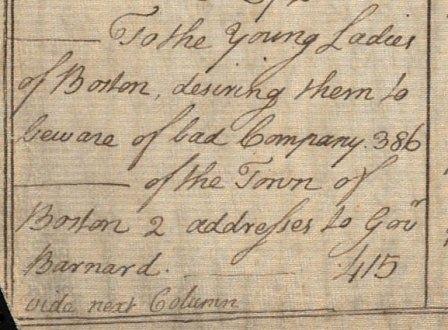
Address of the Lords To the young Ladies of Boston, desiring them to beware of bad Company. 386
Addresses, absurdity of them in general. 455
Anarchy better than Tyranny. 222. 759. 771.
Bleeding at the Nose a Remarkable Cure for it. 641
Dogs, Mad. 729. 778.
Mulberry Trees the methods of Cultivating them. &c. 194. 457. 580.
Pimps and Cooks appointed to Places in America 21.
Suns, or fixed Stars, their appearance continually encreasing, proves that there are millions of habitable Words 679. 702. 705
Toads, a Cure for Cancers. 211.

Some of these terms, no doubt, have relevance today. Some terms–if applied today in a news story–might even tender a person instant, though ultimately ephemeral, Twitter or YouTube fame.

In early 2013, MHS will present page images of all the annotated newspapers assembled by Harbottle Dorr and the index pages he created.  The images of the actual index pages that we will present in early 2013 should be clear enough to read as Dorr’s handwriting is generally neat. However, the MHS will provide a transcription of Dorr’s index pages, and in the transcription each of the page numbers will be hyperlinked, taking you directly to the page referenced.

The Death of a Soldier

By Joan Fink, Volunteer

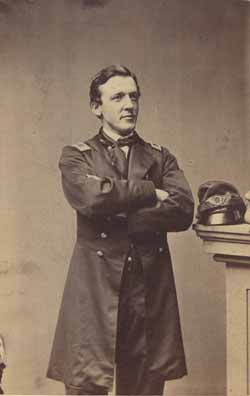
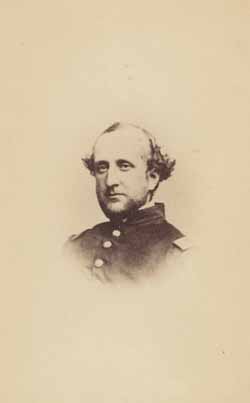
Carte de visite photograph of Captain Richard CaryCaptain Richard Cary of the Second Massachusetts Volunteer Infantry Regiment, the subject of the March 1862 feature in the MHS’ online presentation Looking at the Civil War: Massachusetts Finds Her Voice, was shot in the leg on 9 August 1862 during the battle of Cedar Mountain in Virginia. Although Cary’s injuries were not immediately fatal, his company was unable to bring him to a field hospital as there were no ambulances available for transport. Cary died of his injuries on the battle field the following day.

In a letter dated 11 August 1862 contained in the Cary Family Papers III held by the MHS, Eugene Shelton, Richard Cary’s brother-in-law and fellow officer, wrote to his parents informing them of the circumstances surrounding Richard’s death. Eugene relates that as Richard lay dying in an area occupied by Confederate soldiers, “a rebel got a piece of old wood & placed it under Richard’s head for a pillow & gave him a mug of water.” However, he added that after his death the “rebels robbed him of everything & turned his pockets inside out.” A fellow soldier who also lay dying in the field persuaded the rebels to return his locket of his wife Helen (Eugene’s sister) as well as his seal ring and Eugene reports those items would be forwarded home “as soon as teh express will take them. Eugene notes that while it is generally believed that Richard died from a loss of blood, “his countenance is perfect and he looks very pleasant” and closes his letter “Tell Helen, Richard died without a murmur & without pain.”**

Headstone of Richard and Helen Cary, Mt. Vernon Cemetary, Cambridge MA

Coming forward to the 21st century, after reading all of Captain Cary’s correspondence and doing research for the contextual essay corresponding with the March 1862 feature, I became thoroughly enthralled with his tragically short life. My fascination with Captain Cary led me to visit his grave at the Mount Auburn Cemetery in Cambridge, Massachusetts where I brought him a spray of roses to thank him for allowing me the opportunity to read his charming, insightful, and thought provoking letters.


** For more insight into letters sent home to the family members of slain soldiers see Drew Gilpin Faust’s This Republic of Suffering: Death and the American Civil War (New York: Alfred A. Knopf, 2008).


The Benefit of Hindsight

By Susan Martin, Collection Services

One of the things that makes working with original manuscripts so interesting is hindsight. We may have the advantage of knowing how historical events ultimately played out, but there’s nothing quite like reading the words of the people who experienced them first-hand. Sometimes their words are eerily prescient, other times wildly off-base.

The recently processed collection of Henry P. Binney family papers, on deposit at the MHS from the Mary M. B. Wakefield Charitable Trust, contains the papers of many members of the Binney family of Milton, Mass., including Florence Ethel Binney (1861-1944). In 1888, Florence, or “Flossy,” married Pietro Paolo Beccadelli di Bologna and became the Princess of Camporeale. She lived in Italy in the decades leading up to World War II, ran in elite social circles, and met many heads of state. The letters she wrote to her Boston cousin Alberta Binney have a light-hearted tone that  belies the increasingly serious conditions in pre-war Europe.

On 19 January 1923, just three months after Benito Mussolini’s coup d’état in Rome, Florence wrote from that same city:

Do you ever intend to come to, so-called, ‘Sunny Italy’? If so bring furs. We are having intensely cold weather (delicious I think) fountains frozen, and deep snow between Firenze and Bologna! I imagine that foreign newspaper[s] are exaggerating the occupation of Essen, etc. by the French, the complications in Turkey, and the possible effects on all Europe of these movements, as well as on the rest of the world. Meno male, that Italy has Mussolini to hold the reins of government with a firm hand!

 (According to a Boston Herald article from September of that year, Florence considered Mussolini the “saviour” of Italy and an “idol of the people.”)

 A decade later, Florence was still writing letters with this mix of carefree chattiness and political commentary:

This afternoon am motoring to a marvellous old castle, 2 hours distant from Rome, taking with me the Archduchess [of Austria] and my little grandson….When are you coming over again? From our papers it seems that MacDonald and Roosevelt have concluded nothing definite. Let us hope that Hitler in Germany, your Roosevelt, and our Mussolini here, will prove to be for the good of their respective nations. But I will not touch on the complicated present situation of the world, lest my letter would be endless!

Florence was later disappointed when a planned visit from Alberta’s daughter Polly was canceled. She wrote:

Too bad, for never was Rome more gay socially, or more fascinating in every way, than this spring. Evidently [Polly’s father] Harry let himself be influenced by the American newspapers greatly exaggerated reports of the European situation, and believed war imminent. May le bon Dieu spare us such a disaster, although the whole world is in a dangerously chaotic state.

 The date of this letter is 3 June 1939.

 For more information on the multi-generational papers of the Binney family, including papers related to the War of 1812, the Civil War, the Russian Revolution, the Great Depression, and World War II, see the guide to the collection.

The USS Constitution Takes to the Seas

By Elaine Grublin

If you missed seeing it in person, Boston.com provides a short piece about yesterday’s historic sailing of the USS Constitution in Boston Harbor. The sailing marked the 200th anniversary of the ship’s victory over the British frigate HMS Guerriere during the War of 1812 and was the first time the ship has sailed on its own since 1997. It is estimated that thousands of spectators came out to catch a glimpse of the almost 215-year-old ship at sail.

This was by far not the first time the Constitution attracted a crowd in the Boston’s harbor. On 16 September 1797 Revolutionary War hero Henry Knox wrote to fellow veteran David Cobb stating:

As relates to Harry. He is well, and as busy as a devils needle, in preparing for the launch which is fixed for Wednesday the 20. The President of the United States, and all the eastern world will be here. From the probable crowd and indiscretion, it may be expected as many lives will be lost as in a small action. (David Cobb papers, reel 1, Massachusetts Historical Society.)

Indeed on 20 September 1797 crowds of spectators did gather to view the maiden voyage of the Constitution. Although he did not comment on it in his correspondence, newspapers reports indicate that President John Adams and his “suite” were indeed present for the launch. But that day the crowd left disappointed, as mechanical problems prevented the ship from getting out to the open sea. On a subsequent attempt, 21 October 1797, the ship completed her maiden sail. According to historian Justin Winsor, in his Memorial History of Boston (Boston: James R. Osgood & Company, 1881), the weather on the 21st was overcast and cold, keeping the large crowds at bay that day. 

The Constitution garnered much attention during the War of 1812, earning the nickname Old Ironsides. She remained in service for many years after that war. On the eve of the Civil War, the ship was again at sea. In our collections we have found at least two letters referencing the Constitution while the ship was near Annapolis in late April 1861.

Charles Bowers, a lieutenant in the 5th Regiment Massachusetts Volunteer Militia, wrote to his wife in Concord:

In the afternoon the young men about 170 in number were removed in the U.S. Sloop Constitution to Newport R.I. It was a sad sight. It was a great disappointment for them to leave, and almost all were in tears. They marched in a bevy to the wharf the splendid band of the Constitution offering musick. The thousands of troops lined their way, the feelings of the whole subdued in sympathy for the noble looking lads so suddenly separated from scenes and friends they loved. (Charles Bowers Letters, Massachusetts Historical Society.)

Another Massachusetts native, although a resident of New York at the time of the outbreak of the war and serving in a New York regiment,offers a slightly different perspective to his brother in Massachusetts:

So we kept up the bay, and at daylight on Monday morning, found ourselves off Annapolis with the Old Frigate Constitition alongside, and another steamboat something like ours aground in the harbor with Ben Butler again, and his men on board. … He [Butler] came to Annapolis on Saturday night, and found the Constitution lying near the Naval School Station and uable to get out, on account of her heavy guns, beside being short men. … General Butler took out of her half her guns and lightened her so much that he could tow her out beyond the reach of the shore; which he did, and afterward sent 100 of his own men (able seamen from Marblehead and thereabouts) to fill up her crew. (Charles Henry Dalton Correspondence, Massachusetts Historical Society.)

We will keep an eye out for other Constitution references in our collection, and hope that perhaps in the not too distant future, we can see her sail again.

Glimpses of Harbottle Dorr, Jr.

By Nancy Heywood, Collection Services

The Massachusetts Historical Society has a collection of 796 newspapers dating from 1765-1776, collected, annotated, and indexed by a Boston man named Harbottle Dorr, Jr. This collection is comprised of 4 volumes containing 3,674 pages. Of that total number of pages, 3,314 are newspapers; 133 are handwritten index pages; and 227 are pamphlets and some introductory pages. Last summer when the MHS purchased volume 4, the collection was finally reunited!  Volumes 2 and 3 had been donated to MHS in 1798 and in 1915, the MHS purchased volume 1.  Please see the press release describing the exciting acquisition of volume 4 in 2011.

Harbottle Dorr, Jr. (1730-1794) was a shopkeeper, a member of the Sons of Liberty, and served as a Boston selectman for many years (but not all the years) between 1777 and 1791. Beginning in 1765, Dorr spent a dozen years purchasing newspapers, writing comments in margins (as well as inserting reference marks in articles), and assembling indexes. Bernard Bailyn, who wrote the essential essay about the annotated newspapers and their annotator, stated, “Dorr was an ordinary active participant in the Revolution. That is why what he began in 1765 and completed some twelve years later is so extraordinarily revealing.”** 

The annotated newspapers convey Dorr’s words and perspective on what he witnessed as a Boston citizen during the years leading up to the American Revolution. The MHS is currently digitizing the annotated newspapers and this project will be completed in early 2013. As we work on the digital project, we’d like to share a few glimpses of Harbottle Dorr, Jr. living and working in Boston.

On 14 August 1769, Harbottle Dorr, Jr. Detail of Sons of Liberty Dinner Listattended a dinner of the Sons of Liberty at Liberty Tree Tavern in Dorchester. A handwritten list by William Palfrey (who eventually became paymaster of the Continental Army during the Revolution), states the names of the 300 men who attended the event. Harbottle’s name appears below Ebenezer Dorr, who was probably Harbottle’s younger brother. 

Harbottle’s handwritten introduction to his third assembled volume of newspapers indicates that he worked on his annotation project at his store. Dorr acknowledges that some of his marginalia includes misspelled words “which I hope whoever peruses will excuse, especially as they were wrote at my Shop amidst my business, when I had not leisure to be exact.” 

Clipping of page 3 of 15 January 1770 issue of Boston GazetteA newspaper advertisement appearing in the 15 January 1770 issue of the Boston-Gazette, and Country Journal (on page 3) indicates that Dorr sold many kinds of nails and different types of steel in his shop located on Union Street. His inventory included jobents (nails used to fasten hinges and/or other thin iron plates to doors and window frames), deck nails (nails used to fasten planks to the decks of ships), German steel, and English steel. These details help us formulate a picture of Harbottle Dorr–at the counter of his shop, surrounded by hardware, with a newspaper open in front of him, writing in the margins in between transactions with customers.

Dorr’s funeral was held on 7 June 1794.  The Columbian Centinel from that day included the following notice (on page 3) but didn’t mention the precise date of Dorr’s death: 

In this town, Harbottle Dorr, Esq. Æt. 64. A number of years one of the Selectmen of Boston, which he served with honor and integrity.  His funeral will be from the house of Mr. Thomas Capen, in Cross-street this afternoon at 5 o’clock, which his relations and friends are requested to attend.


**Bernard Bailyn, “The Index and Commentaries of Harbottle Dorr” in Faces of Revolution: Personalities and Themes in the Struggle for American Independence (NY: Alfred A. Knopf, 1990), 85-103. 

“What a merry Company there is of Us, in the Universe”

By Amanda A. Mathews, Adams Papers

Earlier this week, the world received the exciting news of the NASA rover “Curiosity” successfully landing on Mars. The great questions of whether or not we are alone in the Universe, whether other life exists and what forms it might take call out to us for answers. But these are not merely the questions of this present “Space Age.” Both John and John Quincy Adams took great interest in questions of astronomy.

Sir William Herschel’s work with telescopes and writings on the Milky Way inspired John Adams to write, “Herschell indeed with his new Glass, has discovered the most magnificent Spectacle that ever was seen or imagined, and I suppose it is chiefly as a Spectacle that his Discovery is admired. If all those Single double, tripple quadruple Worlds are peopled as fully as every leaf and drop is in this, what a merry Company there is of Us, in the Universe? . . . Why are We keept so unacquainted with each other? . . . The Bishop of Landaff, has made the Trees, not walk, but feel and think, and why should We not at once settle it that every Attom, thinks and feels? An universe tremblingly alive all over.”

While John Adams was content to ruminate on such thoughts philosophically, John Quincy Adams put these questions to the federal government. “The voyages of discovery . . . at the expence of those [European] Nations,” Adams remarked in his first annual message to Congress on December 6, 1825, “have not only redounded to their glory, but to the improvement of human knowledge.” Now it was time for the United States to join in such pursuits by erecting an “Astronomical Observatory. . .to be in constant attendance of Observation upon the phenomina of the Heavens.” The United States had a “sacred debt” of “returning light for light,” but that was not possible as long as “the Earth revolves in perpetual darkness to our unsearching eyes.”

One can certainly imagine with what joy and fascination both these Adamses would greet our now ever searching eyes and await the discoveries and knowledge that “Curiosity” may bring to all mankind.

Divorce, Colonial Style

By Susan Martin, Collection Services

The MHS recently acquired a manuscript collection called the Russell-Cutter family papers (Ms. N-2866) that contains one particularly interesting item: a divorce agreement dated 30 April 1735. It reads, in part:

Know ye that James Smith of Boston in the County of Suffolk in New England Coachman and Hannah his Wife In Consideration of the want of mutual Love & Affection between them, and for sundry acts which they each of them acknowledge is the Strongest proof for any divorce in Law, Have Agreed and by these Presents do agree to and with each other to part and Seperate themselves Voluntarily, and never to molest or Disturb each other in any act or acts Business or Imployments whatsoever or even if Either of them should marry again, they will not prosecute each other but will Look upon themselves as though they had never marryd at all.

Not knowing much about divorce law in colonial America, I did a little digging and found that, although rare, divorce was by no means unheard of at the time. Massachusetts Bay granted the first divorce in the colonies in 1639. (The husband was a bigamist.) According to historian Peter Charles Hoffer, in Law and People in Colonial America (Baltimore: Johns Hopkins University Press, 1998), the immigrants who settled in New England in the 17th century considered marriage a civil contract, not a religious sacrament. In fact, despite its Puritan beginnings, the New World had more permissive divorce laws than Anglican England. The laws varied from colony to colony and were generally more lenient in the north than in the south. Of course, social stigma would also have acted as a powerful deterrent.

Hoffer provides some helpful statistics:

In Massachusetts and in Connecticut, whose divorce practices were even more liberal than those of Massachusetts, there was rarely one petition per year in the seventeenth century. In the next century the number of petitions steadily increased. Between 1692 and 1785 the Massachusetts General Court heard 229 petitions for divorce, 101 of them from men, and granted 143. The Connecticut Superior Court would grant almost 1,000 divorces before 1800. (p. 108)

The most common reasons for divorce were adultery, cruelty, or desertion. The Russell-Cutter collection contains no clues to the unspecified “sundry acts” cited in this particular document, but it’s telling that, even in 18th-century Massachusetts, “the want of mutual Love & Affection” might be considered grounds for the dissolution of a marriage. I don’t know what happened to James or Hannah after 1735, but I like to think their divorce was a mutual and amicable one.

JQA’s Self-Assessment on His Birthday in 1812

By Nancy Heywood, Collection Services

On 11 July 1812, John Quincy Adams (JQA) celebrated his 45th birthday.  JQA was living in St. Petersburg, Russia, where he was serving as a diplomat from the United States.  His title was minister plenipotentiary to Russia, a position to which he was appointed in 1809.  Although he was still several years away from his eventual accomplishments as secretary of state under President James Monroe, and his own challenging term as U.S. President, by 1812, JQA had held a number of notable professional positions.  He had worked as a lawyer, held diplomatic positions in the Netherlands and in Prussia, served as a U.S. Senator, and taught rhetoric at Harvard. 

By the summer of 1812, JQA had an active family life too.  He and his wife, Louisa Catherine Adams (LCA), had three sons and a daughter.  JQA and LCA made the long journey to Russia in the summer of 1809 with their third son, Charles Francis Adams leaving their two older sons, George Washington Adams and John Adams 2d, in the care of relatives in New England.  In August 1811, JQA and LCA celebrated the birth of their daughter, who was named after her mother.

Despite these significant professional and personal accomplishments, JQA gave a rather harsh assessment of his situation on his birthday in 1812: 

I am forty-five years old— Two thirds of a long life are past, and I have done Nothing to distinguish it by usefulness to my Country, or to Mankind— I have always lived with I hope a suitable sense of my duties in Society, and with a sincere desire to perform them— But Passions, Indolence, weakness, and infirmity have sometimes made me swerve from my better knowledge of right, and almost constantly paralyzed my efforts of good— I have no heavy charge upon my Conscience—for which I bless my Maker, as well as for all the enjoyments that he has liberally bestowed upon me— I pray for his gracious kindness in future—  From John Quincy Adams diary 28, 5 August 1809 – 31 July 1813, page 394.


Do you think JQA had “done Nothing to distinguish [his life] by usefulness to [his] Country”?

If somehow you were able to send JQA a birthday message in 1812, what would you say?


Help Us Identify This Civil War Photo

By Emilie Haertsch, Publications

We need your help identifying the location of this photo! Taken during the Civil War, it was a 1911 gift from Edmund A. Whitman to the Society. The photograph accompanied the materials of his father, Col. Edmund Burke Whitman, a Harvard graduate and army quartermaster in the Civil War. Col. Whitman played a key role in the creation of the cemetery system for the Civil War dead, which was constructed after the war. During the war his career took him many places in the North and South, so it does not narrow the possibilities of this photograph’s location.

View a larger scan of the image here. It depicts what appear to be four African American soldiers with a cannon, probably a rifled Rodman breech-loading siege gun, a large cannon designed to knock down enemy fortifications. These Rodman guns were used by both the North and South. Since the Rodman gun fired cylindrical shells that looked like enormous modern-day bullets, the round cannon balls depicted were not used for that gun and may indicate that the emplacement had been in use before the arrival of these soldiers.

The fortification in the photograph appears old, and the grass growing over it indicates it was not very well maintained. Churches and other large buildings and a wide, bending river are visible in the background.  It is likely that some of the buildings in this photograph still stand and the modern-day view from the same vantage point is somewhat similar.

The soldiers could have been members of one of several U.S. Colored Heavy Artillery Regiments from the Civil War, designated with the numbers 1 and 3-14. They were raised in 1864, although some existed as state units prior to being called into federal service and re-numbered. Some remained in service, occupying the South after the end of the war. If the soldiers were part of these regiments, it would narrow the possibilities of the photo’s location because they often were assigned to border garrisons away from the fighting or to areas of the South occupied by the Union. However, the soldiers depicted in the photograph would not have needed to be members of a heavy artillery battery in order to man a siege gun, and there were African American artillery men not assigned to heavy artillery regiments.

Please help us solve this longstanding mystery! If you think you recognize the location of this photograph or have other related information, please share it in the comments below.

Caroline Dall Gears Up for Summer in 1862

By Jim Connolly, Publications

I don’t know how your week is going, but Caroline Healey Dall had a pretty nice one 150 years ago.

Daguerreotype of Caroline Wells Healy DallDall was a leading 19th-century reformer and essayist who played a significant role in the antislavery and women’s suffrage movements. The MHS published the Selected Journals of Caroline Healey Dall, Volume I (1838-1855), edited by Helen R. Deese, in 2006. The second volume, covering 1855 to 1866, is in the works: I am in the midst of preparing Helen’s manuscript for publication next year.

On 11 June 1862, Dall and her twelve-year-old daughter Sarah Keen Dall (“Sadie”) and sixteen-year-old son Willie were living in Medford, Mass. (my hometown, incidentally, and, the site of Lydia Maria Child’s “grandfather’s house,” of “Over the River and through the Woods” fame). She spent time with fellow Medford resident Mary B. Hall, who was apparently in a generous mood. Dall writes:

“Miss Mary gave me a little black silk sack for Sadie, & later with most tender motherly kindness–a bill for 100$–which I am to use now, & repay, if ever I am able to some one who needs it more than either of us, & whom I think Miss Mary would like to help if she were about.”

Not bad. A gift for her daughter and a C-note with instructions to “pay it forward,” if you will. Then Mary’s nieces show up with a nice surprise.

“Came home–& laid a cold tea for Sadie & self. Later Fannie & Anna Hall came with the first strawberries for Mr Towne, & in the eveg I helped him with his Ms.”

Nothing like iced tea and strawberries to prepare oneself for summer–assuming, of course, that her friend, the Unitarian minister Edward Towne, was kind enough to share the sweet fruit in exchange for help with his manuscript. Such help was valuable: Dall was an accomplished writer in many forms, including lectures, articles, and books, such as Woman’s Right to Labor (1860), Woman’s Rights Under the Law (1861), and The College, the Market, and the Court (1867).

An entry from later that week (14 June 1862) finds her in similarly idyllic territory, enjoying a “busy but peaceful morng.” and combing Towne’s hair “till he fell into a light slumber.”

page from journal of Caroline Wells Healy Dall

Union and Confederate troops in Virginia, meanwhile, enjoyed no such idylls as the disastrous Peninsula Campaign dragged on, resulting in tens of thousands of deaths. You can learn about the Peninsula Campaign and other aspects of the Civil War at the MHS Civil War web resource page.

Caroline Dall’s personal papers live at the MHS. To learn more about her and her materials, check out the Caroline Wells Healey Dall Papers 1811-1917: Guide to the Microfilm Edition, or pick up a copy of the MHS publication Selected Journals of Caroline Healey Dall, Volume I (1838-1855), mentioned above. Editor Helen R. Deese has also published a one-volume, redacted version of Dall’s diary, Daughter of Boston: The Extraordinary Diary of a Nineteenth-century Woman, Caroline Healey Dall (2005) through Beacon Press.