By Alexandra Moleski, Massachusetts History Day Program Coordinator
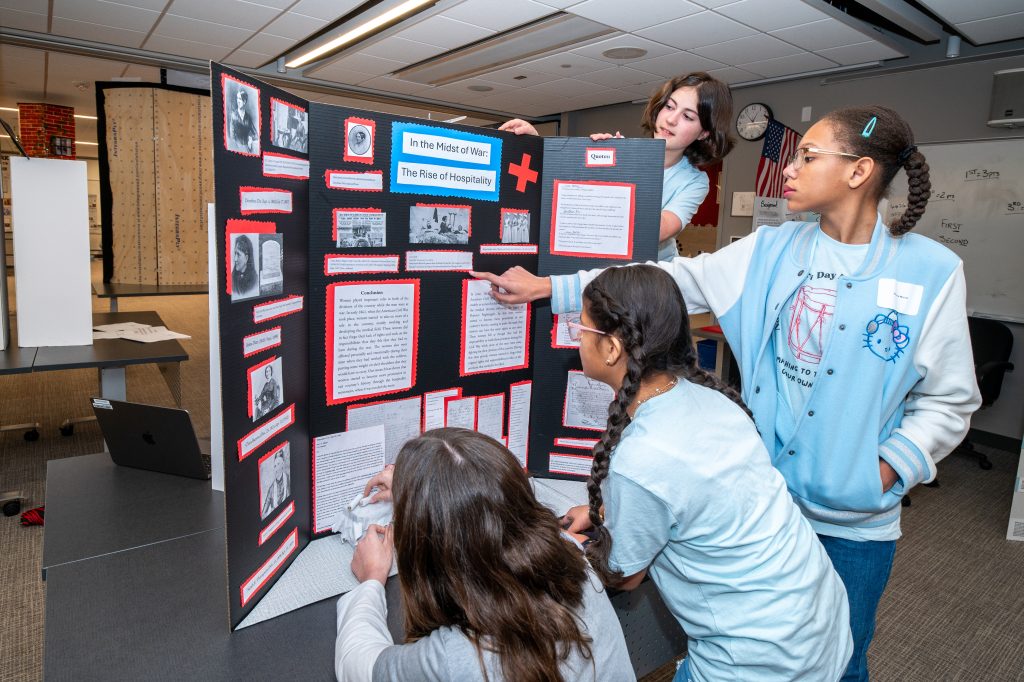
The 2026 Massachusetts History Day (MHD) season is in full swing and we would love to have you join us as a judge. Spend your day supporting history and civics education with other like-minded history buffs of all ages! All you need is a love of history–no experience or prior knowledge required.
Massachusetts History Day is a project-based learning program in which students grades 6-12 conduct research on a historical topic of their choice and present their work as a documentary, website, performance, paper, exhibit, or–for the first time ever–a podcast. Think science fair, but history! Through their research and the curation of their projects, students will explore the 2026 theme, Revolution, Reaction, Reform in History.
Judging is a great opportunity to learn from and celebrate our student historians and their hard work. You will:
Be assigned to a small judging team, as well as a specific age division and project category
Review student research projects and their project paperwork
Interview the students using sample questions provided to you
Work with your team to provide written feedback for each project
Receive a judging orientation and all the information you need beforehand
Enjoy breakfast, lunch, coffee, and sweet treats on us!
Are you an educator? Join us as an MHD judge and earn professional development points. Teachers who judge at a contest/showcase will receive 10 PDPs per event.
by Alexandra Moleski, Massachusetts History Day Program Coordinator
Calling all history enthusiasts–the 2026 Massachusetts History Day (MHD) contest season is here and judge registration is officially open! The MHD team has a lot of fun updates this year, and we would love to have you join us. All you need is a love of history–no experience or prior knowledge required!
Massachusetts History Day is a project-based learning program in which students grades 6-12 conduct research on a historical topic of their choice and present their work as a documentary, website, performance, paper, or exhibit. And this year, we’re thrilled to launch a new project category–the podcast! Students will have the opportunity to explore the 2026 theme Revolution, Reaction, Reform in History through storytelling.
We’ve also added two new contests this year: the Boston Metro Regional Showcase at the John F. Kennedy Presidential Library and Museum, and the Western MA Regional Showcase at Mater Dolorosa Elementary School.
We are so grateful to our MHD judges, and we are so excited that a new project category and two new contests allow us to welcome many more enthusiastic judges this contest season. Judging is a great opportunity to learn from and celebrate our student historians and their hard work. You will:
Be assigned to a small judging team, as well as a specific age division and project category
Review student research projects and their project paperwork
Interview the students using sample questions provided to you
Work with your team to determine the rankings and provide written feedback for each project
Receive a judging orientation and all the information you need beforehand
Enjoy breakfast, lunch, coffee, and sweet treats on us!
Are you an educator? Join us as an MHD judge and earn professional development points. Teachers who judge at a contest/showcase will receive 10 PDPs per event.
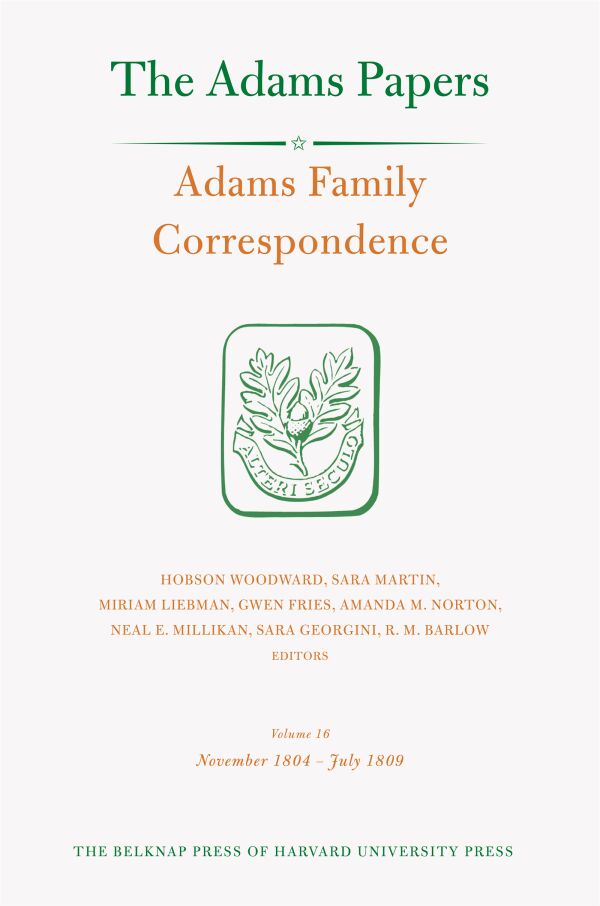
The newest Adams Papers publication is here! Adams Family Correspondence, volume 16, follows the Adams family from the end of 1804 through the middle of 1809 as John and Abigail Adams spent time at Peacefield and guided their growing family through challenges, big and small. This is the last of three blog posts exploring the volume’s main themes.
Part Three: The Adams Family, Party Politics, and Great Britain
The third major narrative arc in Adams Family Correspondence, volume 16, concerns the increased tensions between the United States and Great Britain, which posed the greatest threat to the new nation. Conflicts on the seas and impressment of sailors threatened war. As Federalists and Democratic-Republicans sought solutions to these issues, John Quincy Adams broke from family and Massachusetts tradition and sided with the Democratic-Republicans in voting for an embargo against Great Britain. Abigail challenged him to explain his vote since it would affect local families, and an anonymous newspapers article asked John Quincy to consider his father’s legacy when deciding his congressional actions. John Quincy defended himself by saying country comes before party. In response, the Massachusetts General Court voted to replace him as senator when his term ended, but he did not wait and resigned immediately.
While the United States sought to eliminate the prospect of war, tensions would further escalate between the two nations over the next several years. The volume ends with John Quincy heading off to St. Petersburg to serve as the first US minister to Russia. For those adventures, you will have to stay tuned for Adams Family Correspondence, volume 17.
The cover of the latest Adams Family Correspondence volume
The Adams Papers editorial project at the Massachusetts Historical Society gratefully acknowledges support for this volume from the National Endowment for the Humanities, the National Historical Publications and Records Commission, and the Packard Humanities Institute.
The newest Adams Papers publication is here! Adams Family Correspondence, volume 16, follows the Adams family from the end of 1804 through the middle of 1809 as John and Abigail Adams spent time at Peacefield and guided their growing family through challenges, big and small. This is one of three blog posts exploring the volume’s main themes.
Part Two: The Adams Family and the Miranda Expedition: Scandal, Intrigue, and Rumor
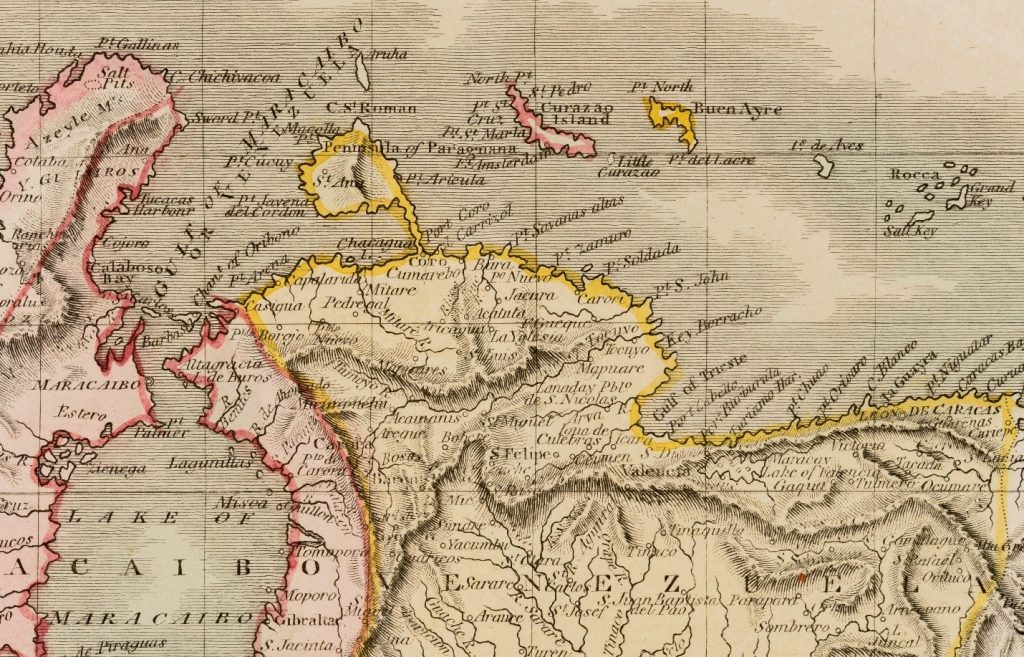
Adams Family Correspondence, volume 16, contains many political stories, but the Miranda Expedition might be the most surprising one. From their home in Quincy, Mass., the Adamses were drawn into scandal from the involvement of their son-in-law, William Stephens Smith, and grandson, William Steuben Smith, with Francisco de Miranda’s failed attempt to overthrow Spanish rule in Venezuela. From February through August 1806, Miranda, a Venezuelan revolutionary and friend of William Stephens Smith, staged an expedition to liberate Venezuela. Miranda met with President Thomas Jefferson and James Madison seeking financing from the United States but failed to garner their support. William Steuben joined as a member of the expedition. Prior to her son’s departure, Nabby wrote to Miranda asking him to care for her son and stating that due to his long friendship with her husband and her “own observations, I can say that I do not know any person to whom I could with so much confidence entrust him.” As newspapers reported the mission’s failure and rumors swirled regarding the sailors, the Adams family worried about William Steuben’s fate. The family learned he was safe when he crossed paths in Cambridge with his uncle John Quincy on his way to Peacefield. Many others in the expedition were not as lucky; the Spanish executed and imprisoned many of the participants.
Detail from “Caraccas and Guiana,” by John Moffat, 1817. Collection of the Massachusetts Historical Society.
William Stephens Smith lost his job as surveyor of the port of New York and was indicted for helping Miranda but was ultimately acquitted of the charges. John Quincy was “very sorry to see a connection of ours so much implicated.” William Steuben Smith struggled to find a career path upon his return and went with his uncle to serve as his secretary in St. Petersburg. For more on his time in Russia, stay tuned for the (already underway!) next volume of Adams Family Correspondence.
The Adams Papers editorial project at the Massachusetts Historical Society gratefully acknowledges support for this volume from the National Endowment for the Humanities, the National Historical Publications and Records Commission, and the Packard Humanities Institute.
The newest Adams Papers publication is here! Adams Family Correspondence, volume 16, follows the Adams family from the end of 1804 through the middle of 1809 as John and Abigail Adams spent time at Peacefield and guided their growing family through challenges, big and small. Several of the volume’s main themes will be explored over the course of three blog posts, including family, the Miranda Expedition and its repercussions, and the deteriorating politics between the United States and Great Britain.
Part One: The Adams Family at Home
At the center of volume 16 of Adams Family Correspondence is the growing Adams family at their home, Peacefield. The 236 letters in this volume highlight the bustle of almost every family member crossing paths with John and Abigail, including some of the first letters to their older grandchildren. Settled into their retirement, Abigail oversaw the household, cared for grandchildren, and even looked at houses to rent in Cambridge for John Quincy and his family, while John took care of his farm and educated the grandchildren. Daughter Nabby and all three of her children briefly lived at Peacefield to escape her husband William Stephens Smith’s financial and political troubles before they moved to a new homestead in upstate New York. John Quincy and Louisa Catherine Adams spent Senate recesses in Boston, and briefly moved to the area during John Quincy’s short tenure as a professor at Harvard. They also welcomed son Charles Francis Adams. Thomas Boylston Adams tried the family business of politics but settled instead into his career as a lawyer. He lived at Peacefield with his new wife Ann Harrod Adams, where two daughters were born to the youngest Adams couple.
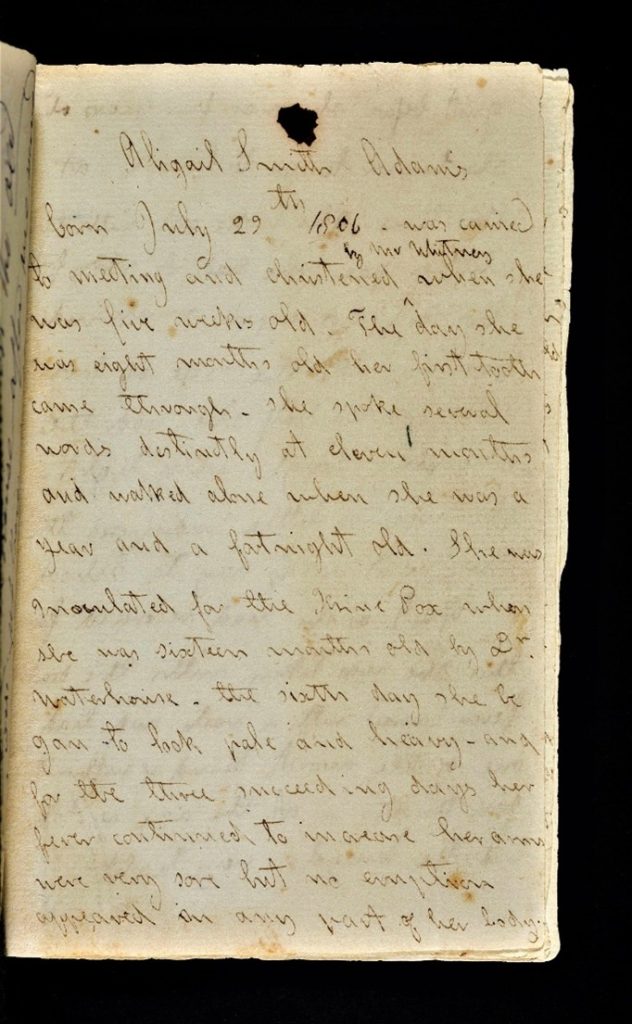
Ann Harrod Adams retained a journal recording her children’s growth, illnesses, and milestones. Family Record, by Ann Harrod Adams, 1806–1825. Collection of the Massachusetts Historical Society.
Even with all their family events, Abigail and John remained apprised of and involved with political happenings. Abigail questioned John Quincy’s Senate votes and his attendance at a Democratic-Republican caucus writing that it was “inconsistant both with Your principles, and your judgment, to have countananced such a meeting by Your presence.” John began to write about his political life for the newspaper Boston Patriot in the endeavor to pursue “Truth and Justice” in shaping his legacy. From their home, they worried as domestic scandals and international tensions challenged the new nation.
The Adams Papers editorial project at the Massachusetts Historical Society gratefully acknowledges support for this volume from the National Endowment for the Humanities, the National Historical Publications and Records Commission, and the Packard Humanities Institute.
The MHS has held a collection of ships’ logs kept by John Boit, Jr. since his descendant, John Boit Apthorp, donated them in 1919. Three volumes kept by Boit on trading voyages from 1790 to 1802, including a log of the Columbia, document voyages to the Northwest Coast to trade for fur before sailing on to the Sandwich Islands (now Hawaii) and to China in the early years of the newly-opened China Trade. Boit served as a captain’s mate on the Columbia and other vessels before taking command of the Union.
Two volumes covering the Union’s voyage from Newport, R.I., to China via the Northwest Coast had reportedly disappeared when the collection was sent offsite to be microfilmed, probably in the 1960s or 1970s. Until now.
Rusty Farrin of Farrin’s Country Auctions in Randolph, Maine, recently contacted the MHS to report the recovery of two of Boit’s logbooks that were discovered in a storage locker. Farrin’s research revealed that the volumes had been part of the Society’s collection and he generously returned them, as he said, “back where they belong.”
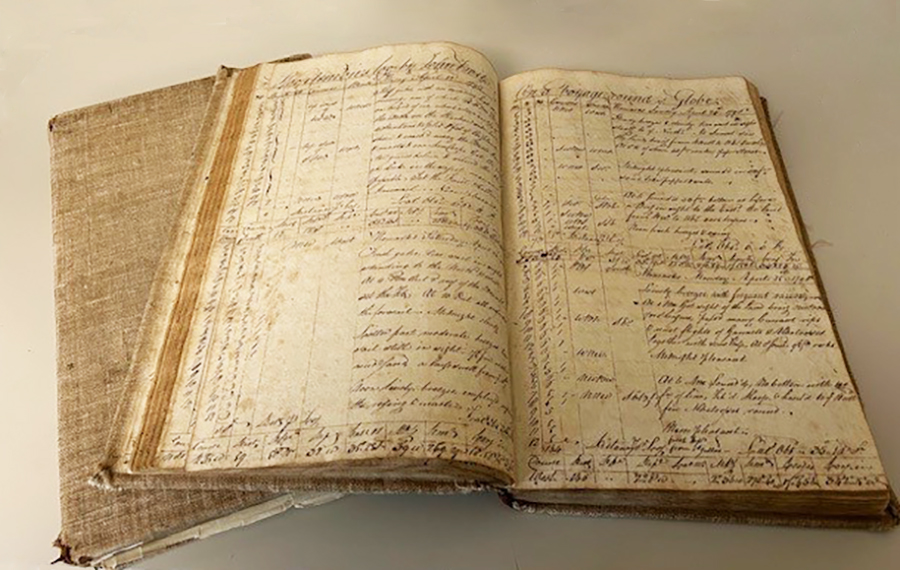
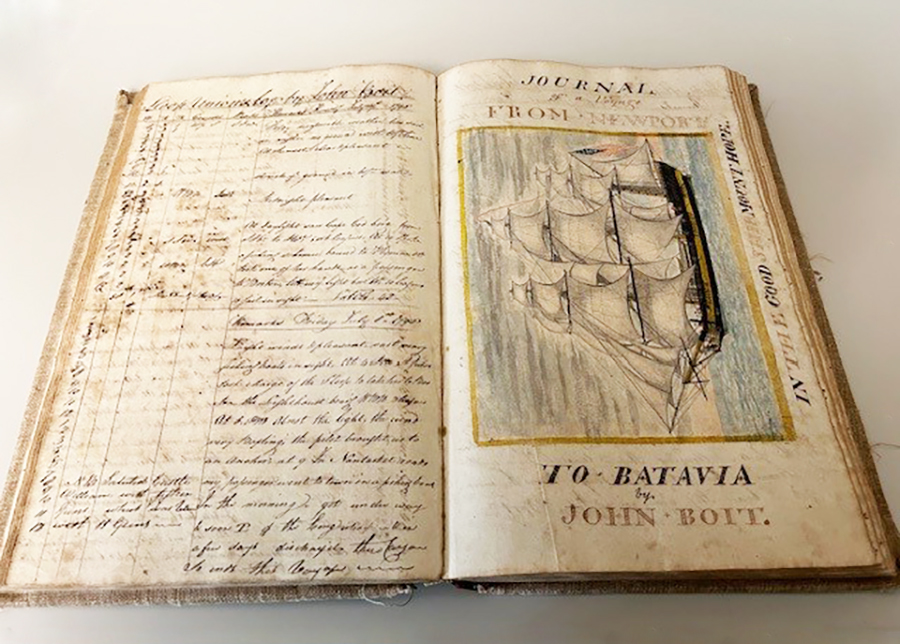
John Boit logbooks
The voyage of the Union spans the two volumes and includes stops in the Falkland Islands, Nootka Sound and other locations in British Columbia, Macao, Canton, and Mauritius from August of 1794 to July of 1796. One volume also documents a voyage from Boston to Charleston, S.C., Dublin, Ireland, and back on the ship Eliza, 1793-1794, and the second includes a voyage from Newport to Batavia in the Dutch East Indies and back on the Mount Hope, 1801-1802. Both volumes include long narrative passages that describe the locations where they anchored, including encounters with indigenous people, as well as watercolor drawings of the vessels and land formations seen along the way.
We are enormously grateful to Mr. Farrin for ensuring these volumes made their way back to the MHS.
by Cassandra Cloutier, Assistant Director of Research
The Research Department is pleased to announce the 2025-2026 cohort of research fellows. Each year, the Massachusetts Historical Society provides financial support for scholars utilizing our unique collections on American history to produce original scholarship.
The MHS typically offers various short-term fellowships as well as NEH-funded long-term fellowships each award season. Short-term fellowships support four to eight weeks of research while long-term fellowships require a minimum of four months in residence at the MHS. Unfortunately, after the selection of this year’s long-term fellows, the NEH funding for this fellowship program was terminated. Although four scholars were selected for long-term fellowships, the awards will not be distributed.
This year’s awarded projects span the sixteenth century to the present and investigate topics such as the history of commodities, borderlands, and various religious traditions. Others reexamine women in the transcendentalist movement, colonial-era witch trials, and, of course, the American Revolution. Congratulations to the fellows selected to receive this year’s awards! We look forward to welcoming these scholars to the MHS and learning more about the following projects in the coming year.
MHS-NEH Long Term Fellows
Nicole Breault, Assistant Professor, University of Texas at El Paso, “Set the Watch: Policing and Governance in Early America”
Alexander Clayton, Assistant Professor, University of Vermont, “The Living Animal: Menageries and the Nature of Empire”
Leland Jasperse, Humanities Teaching Fellow, The University of Chicago, “Theories and Practices of Intimate Friendship in the 19th-Century New England Literary Scene”
Jonathan Schroeder, Lecturer, Rhode Island School of Design, “Harriet and John Jacobs: Their Worlds and the Worlds They Made”
New England Regional Fellowship Consortium (NERFC)
NERFCFellows Visiting the MHS
Andrew Abrams, Ph.D. Candidate, College of William & Mary, “Days and Hours: Labor, Technology, and Temporality in Early America”
Robert Colby, Assistant Professor, University of Mississippi, “William and Sarah Jackson’s Civil War”
Amy Finstein, Associate Professor, College of the Holy Cross, “In the Center Yet on the Side: Elisabeth May Herlihy and the Mechanics of American City Planning, 1910-1950”
Ella Hadacek, Ph.D. Candidate, University of Notre Dame, “Going to Rome: British and American Women’s Conversion to Catholicism, 1840-1930”
Claire Lavarreda, Ph.D. Candidate, Northeastern University, “Cultural Transformation in the Process of Text Production: Indigenous Catholicism in New France and New Spain, 1521-1701”
William Morgan, Ph.D. Candidate, Indiana University Bloomington, “A Long Revolution: Emancipation, Black Politics, and Radical Memory in New England”
Tristan New, Ph.D. Candidate, Boston University, “The People, the Courts, and the Contested Revolution in Massachusetts, 1772-88”
Ariel Silver, Assistant Professor, Southern Virginia University, “The Conversationalists”
Evelyn Sterne, Associate Professor, University of Rhode Island, “Faith in Crisis: Religion in Boston During the Great Depression”
Rachel Walker, Associate Professor, University of Hartford, “Free Radicals: Fringe Thinkers and the Fight for Liberty in Nineteenth-Century America”
Tingfeng Yan, Ph.D. Candidate, University of Chicago, Colonial Society Fellow, “Administration and the Making of the Constitutional Order in Founding-era America”
Yuan Yi, Assistant Professor, Concordia University, “Yellow Cotton: Nankeen, Biodiversity, and Material Culture in the Early Transpacific World”
Carolyn Zola, Postdoctoral Fellow, Library Company of Philadelphia, “Public Women: Urban Provisioners and the Rise of American Capitalism”
Fellows Not Visiting the MHS
Anne Bardaglio, Ph.D. Candidate, University of Maine Orono, “Island Time: Cultural Production of Sense of Place in the Gulf of Maine and Bay of Fundy, 1850-1920”
Jacqueline Beatty, Associate Professor, York College of Pennsylvania, “Engendering Orientalism in the Empire of Liberty”
Kathryn Gindlesparger, Associate Professor, Thomas Jefferson University, “Old Money: The Language of Philanthropy and the Foundation of American Higher Education”
Genevieve Kane, Ph.D. Candidate, Boston University, “Climate Resilient: An Environmental History of Boston’s Waterfront and its Architecture since the Nineteenth Century”
Brian Knoth, Associate Professor, Rhode Island College, “A Creative Research-based Exploration of the Original Songs and Poetry Written on New England Whaling Ships”
Cecilia Márquez, Assistant Professor, Duke University, “Latinos on the Fringe: Latinos and the Right since World War II”
Erica McAvoy, Graduate Student, University of New Hampshire, “’For the Use of Said Parish:’ Black New Englanders, the Congregational Church, and the Intersection of Opportunity and Oppression in the 18th Century”
Arrannè Rispoli, Ph.D. Candidate, University of California, Los Angeles, “Murder and the Mundane: Capital Punishment and the Architecture of Black Criminality in Early New England”
Christine Sears, Associate Professor, University of Alabama in Huntsville, “Mariners and Labor in the Early American Republic”
MaryKate Smolenski, Ph.D. Candidate, Boston University, “The Loyalist Legacy: Memory and Material Culture of New England Loyalists, 1776 – 1976”
Gretchen Starr-LeBeau, Professor, Principia College, “Between the Law of Divine Love and the Law of the State: The Global Growth of Christian Science to 1950”
Alicia Svenson, Ph.D. Candidate, Northeastern University, “Turning Craft into Technology: Standardization within the U.S. Stone and Brick Industries, 1880-1940”
Peter Twohig, Professor, Saint Mary’s University, “Women’s Activism and the ‘Third Wave’ of Occupational Health, 1970-1985”
Claire Urbanski, Independent Scholar, “Settler State Spiritual Violence and the Human Sciences: from the Anatomy Acts to the Army Medical Museum”
Karen Weingarten, Professor, Queens College, CUNY, “The Birth of the Radical Abortion Rights Movement: A Collective Biography of an Activist, a Journalist, a Doctor, and a Lawyer”
Suzanne and Caleb Loring Fellowship on the Civil War, Its Origins, and Consequences
Robert Colby, Assistant Professor, University of Mississippi, “William and Sarah Jackson’s Civil War”
Short-Term Fellowships
Kathryn Angelica, Visiting Assistant Professor, Purdue University Fort Wayne, “Community Strongholds: Creating, Maintaining, and Defending African American Institutions for the Vulnerable in the United States” (African American Studies Fellowship)
Lydia Burleson, PhD Candidate, Stanford University, “Early Constructions of the American-Native Self” (Samuel Victor Constant Fellowship from the Society of Colonial Wars in Massachusetts)
Vincent Calvagno, Undergraduate Student, Adelphi University Honors College, “Aquatic Appropriation: Water and Property in Colonial New England” (W. B. H. Dowse Fellowship)
Kate Culkin, Professor, CUNY–Bronx Community College and Graduate Center, “’One Cannot Do Everything for One’s Self:’ Pragmatic Collaboration and Artistry in the Career of Sarah Freeman Clarke” (Andrew W. Mellon Fellowship)
Julie Dobrow, Lecturer, Tufts University, “Mrs. Emerson’s House” (Ruth R. Miller Fellowship)
Xiaoyu Gao, Ph.D. Candidate, The University of Chicago, “Empire of Copper: British and American Global Trade, Chilean Copper, and the Transformation of the Chinese Monetary System (1800-1862)” (Andrew W. Mellon Fellowship)
Simon Gilhooley, Associate Professor, Bard College, “The Declaration of Independence as Constitutional Authority in the Long Nineteenth Century” (Andrew W. Mellon Fellowship)
Sara Gregg, Associate Professor, Indiana University-Bloomington, “Parallel Lives: The Making of a Marriage” (Louis Leonard Tucker Alumni Fellowship)
Sarah Gronningsater, Assistant Professor, University of Pennsylvania, “Rejecting the 1778 Massachusetts Constitution: Local Democracy, Race, and the Possible in the Revolutionary Era” (Benjamin F. Stevens Fellowship)
Morgan Hardy, Ph.D. Candidate, University of Tennessee, Knoxville, “Changes in the Sea: How Nature Shaped Sustainability in the Early American Cod Fisheries” (Mary B. Wright Environmental History Fellowship)
Matthew Karp, Associate Professor, Princeton University, “Millions of Abolitionists: The Republican Party and the Political War against Slavery” (Andrew W. Mellon Fellowship)
Chloe Kauffman, Ph.D. Candidate, University of Maryland, College Park, “’If women are curious, women like also to speak’: Unmarried Women, Sexual Knowledge, and Female Mentorship in the Eighteenth-Century Anglo-Atlantic” (Alyson R. Miller Fellowship)
Bianca Laliberté, Ph.D. Candidate, Université du Québec à Montréal, “The American ‘Indian’ in the Eye of the American Revolution: A Critical Inquiry into the American Fabrication of Art History” (Andrew Oliver Fellowship)
Jonathan Lande, Assistant Professor, Purdue University, “The Civil War Battles of Frederick Douglass and His Soldier Sons” (Andrew W. Mellon Fellowship)
Lucia McMahon, Professor, William Paterson University, “’All learning and culture is centered in them’: An Early History of Women and Yoga in America” (C. Conrad & Elizabeth H. Wright Fellowship)
M. Michelle Morris, Associate Professor, University of Missouri – Columbia, “The Devil Comes to Hartford: The Hartford Witchcraft Trials of the 1660s” (W. B. H. Dowse Fellowship)
John Morton, Visiting Assistant Professor, Saint Joseph’s University, “Networks of Faith: Missionaries, Priests, and the Building of the US-Canadian Border” (C. Conrad & Elizabeth Wright Fellowship – Declined)
John Nelson, Assistant Professor, Texas Tech University, “A Renegades’ History of the Revolutionary Borderlands: Contesting Race and Nation in the Early American West” (Massachusetts Society of the Cincinnati Fellowship)
Robert O’Sullivan, Postdoctoral Fellow, University of Notre Dame, “Revolutionary Nationalism, European Imperialism and Anti-Slavery: Irish-American Global Consciousness in the Era of Emancipation, 1840-1865” (Malcolm and Mildred Freiberg Fellowship)
Steven Pitt, Associate Professor, St. Bonaventure University, “Bloodwood: The Rise of American Capitalism” (Samuel Victor Constant Fellowship from the Society of Colonial Wars in Massachusetts)
Arrannè Rispoli, Ph.D. Candidate, University of California, Los Angeles, “Murder and the Mundane: Capital Punishment and the Architecture of Black Criminality in Early New England” (Andrew W. Mellon Fellowship)
Sophie Rizzieri, Graduate Student, The University of Notre Dame, “Americans Abroad: Bridging Worlds of Law in the Eighteenth-Century British Atlantic” (Kenneth & Carol Hills Fellowship)
Sarah Rodriguez, Assistant Professor, University of Arkansas, Fayetteville, “Constitutional Revolutions: The US and Mexico in the Age of Civil Wars, 1855-1870” (Elizabeth Woodman Wright Fellowship)
Andrew Schocket, Professor, Bowling Green State University, “Several Degrees of Persons: How the First Census Made the Nation” (Andrew W. Mellon Fellowship)
Michael Schoeppner, Associate Professor, University of Maine-Farmington, “Living Illegally: Free Black Migrants, Border Controls, and Belonging in the Early United States” (Andrew W. Mellon Fellowship)
Madelaine Setiawan, Graduate Student, Texas A&M University, “Our Friends, the Enemies: How Southern Unionist Women were Remembered or Forgotten” (Military Historical Society of Massachusetts Fellowship)
Amy Sopcak-Joseph, Associate Professor, Wilkes University, “’From the Fair, To the Brave’: Gender and the Bunker Hill Monument” (Louis Leonard Tucker Alumni Fellowship)
Ella Starkman-Hynes, Graduate Student, Yale University, “A Different Kind of Mirror: Examining the Role of Alternate History in Civil War Memory” (Louis Leonard Tucker Alumni Fellowship)
R.B. Tiven, Ph.D. Candidate, CUNY Graduate Center, “One Person, One Vote: the Politics of the Nineteenth Amendment” (Abigail Bowen Wright Fellowship)
Rachel Wiedman, Ph.D. Candidate, University of Tennessee, Knoxville, “Stern and Aggressive, as Befitted the Times: Masculinity, Statesmanship, and the Transformation of Northern Political Culture in the Civil War Era” (Marc Friedlaender Fellowship)
Claire Wolnisty, Associate Professor, Austin College, “‘Commanded by a Woman’: Women and the Nineteenth-Century International Trade in Enslaved People” (Louis Leonard Tucker Alumni Fellowship)
Joseph Wrobleski, Ph.D. Candidate, University of Maine, “Wabanaki Legalities: Indigenous Sovereignty, Property, and Jurisprudence on the Maritime Peninsula, 1700-Present” (Samuel Victor Constant Fellowship from the Society of Colonial Wars in Massachusetts)
By Caitlin Walker, Digital Archivist and Metadata Analyst
The MHS collects, preserves, and provides access to collections that document the history of Massachusetts and the nation up to the present day. Information is increasingly being created and communicated in a digital environment, which means many twentieth and twenty-first century collections include or consist entirely of digital files, such as PDFs and JPEGs.
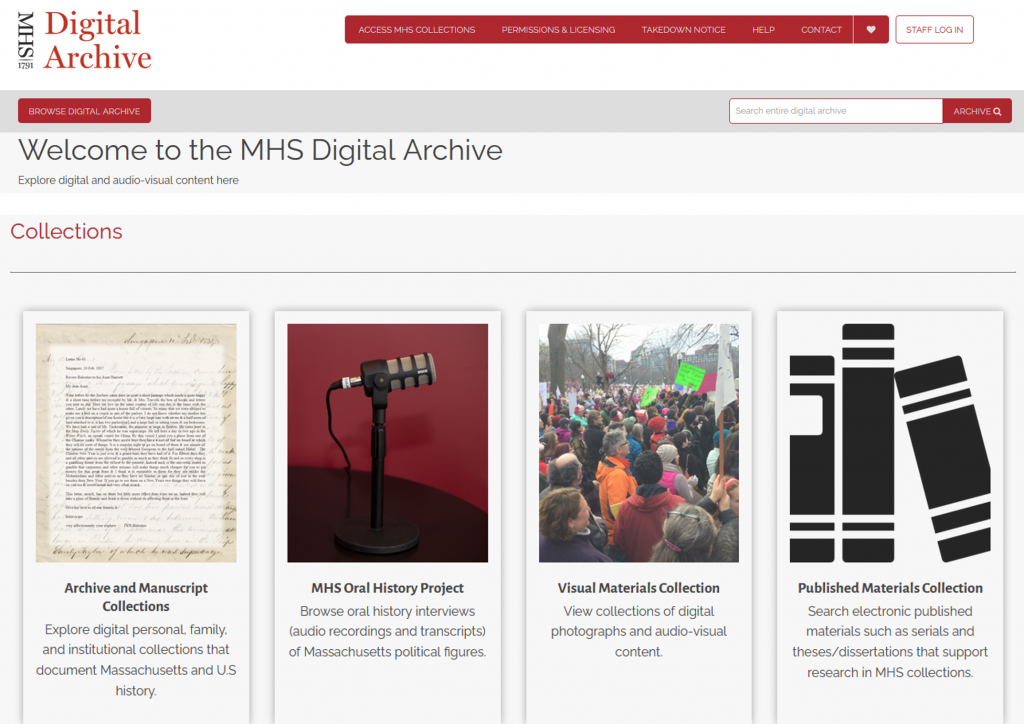
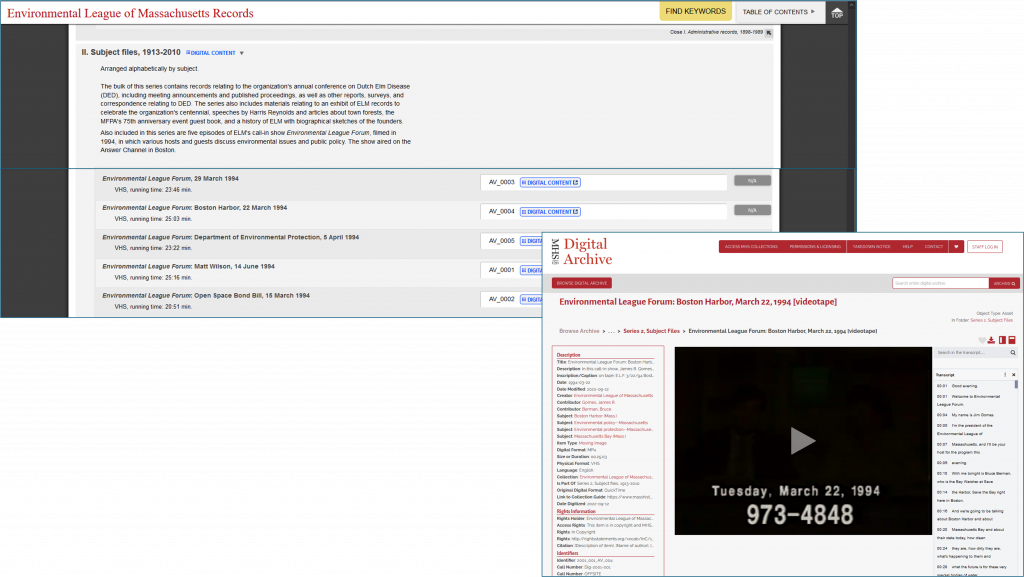
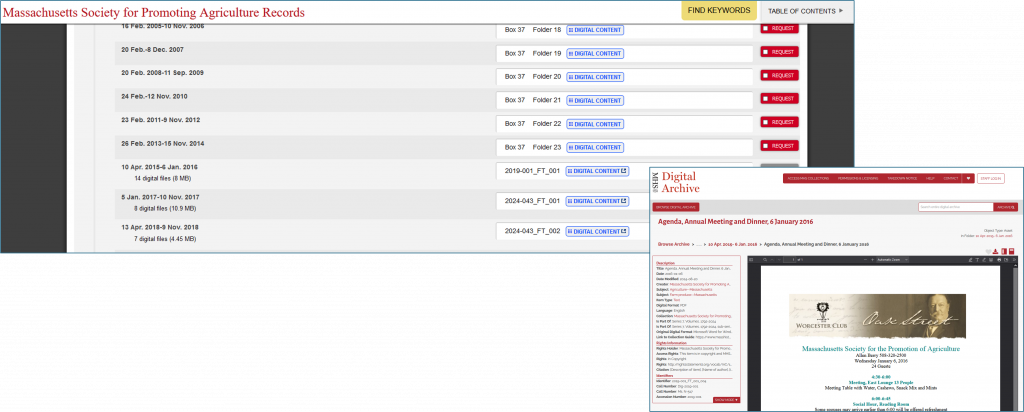
MHS has been working toward preserving and providing access to this content for many years through countless meetings with staff from the Collection Services and IT departments. We are now happy to announce the official launch of the MHS Digital Archive!
The MHS Digital Archive provides access to born-digital content and reformatted audiovisual files. We define these files as the following:
Born-digital is a term archivists use to describe content that was created in a digital environment. The emails you send and receive, the Microsoft Word documents you create and store on your computer or cloud storage like Google Drive, and the images and videos you take on your cellphone are all “born-digital.”
Reformatted-audiovisual items refer to physical audiovisual media (such as cassette tapes, VHS tapes, vinyl records, 16 mm film etc.) that have been converted to digital files, so users can access them without needing playback equipment such as a VCR or a record player.
How to access digital and audiovisual materials
If you have researched in MHS collections in the past, you may be familiar with using ABIGAIL, the MHS library catalog, and MHS Collection Guides to access physical materials in the MHS reading room. Or perhaps you have accessed physical items that MHS has digitized and made available on our website. We have added links to born-digital and audiovisual items within ABIGAIL and the collection guides so that users will be able to find content using the same tools, regardless of format.
Users can also access individual born-digital and reformatted audiovisual items by searching or browsing the MHS Digital Archive directly, but we encourage you to start your search with the MHS Collection Guides and ABIGAIL. I like to think of catalog records and collection guides like a recipe, and individual items (whether they be physical or digital) like an ingredient list. Without the context of the recipe, you just have a bunch of ingredients.
Please Note: Born-digital and audiovisual items that have no restrictions (not under copyright, contain no private or sensitive information) will be available online through the MHS Digital Archive. Restricted collections and items can only be viewed on a provided laptop in the MHS reading room upon request via Portal1791.
Stay tuned for blog posts next week that highlight some of the collections and items in the MHS Digital Archive!
by Sara Georgini, Series Editor, The Papers of John Adams
John Adams was nervous. Readying for his 4 March 1797 presidential inauguration, Adams flashed back to his days as a suburban schoolteacher, revolutionary lawyer, and self-taught statesman. The United States, born in the “Minds and Hearts of the People,” did not exist when Adams started out over forty years earlier. Neither did the shiny new role of president. Was he up to the job? “I never in my life felt Such an awful Weight of obligation to devote all my time, and all the forces that remain, to the Public,” he reassured Elbridge Gerry on 20 February 1797.
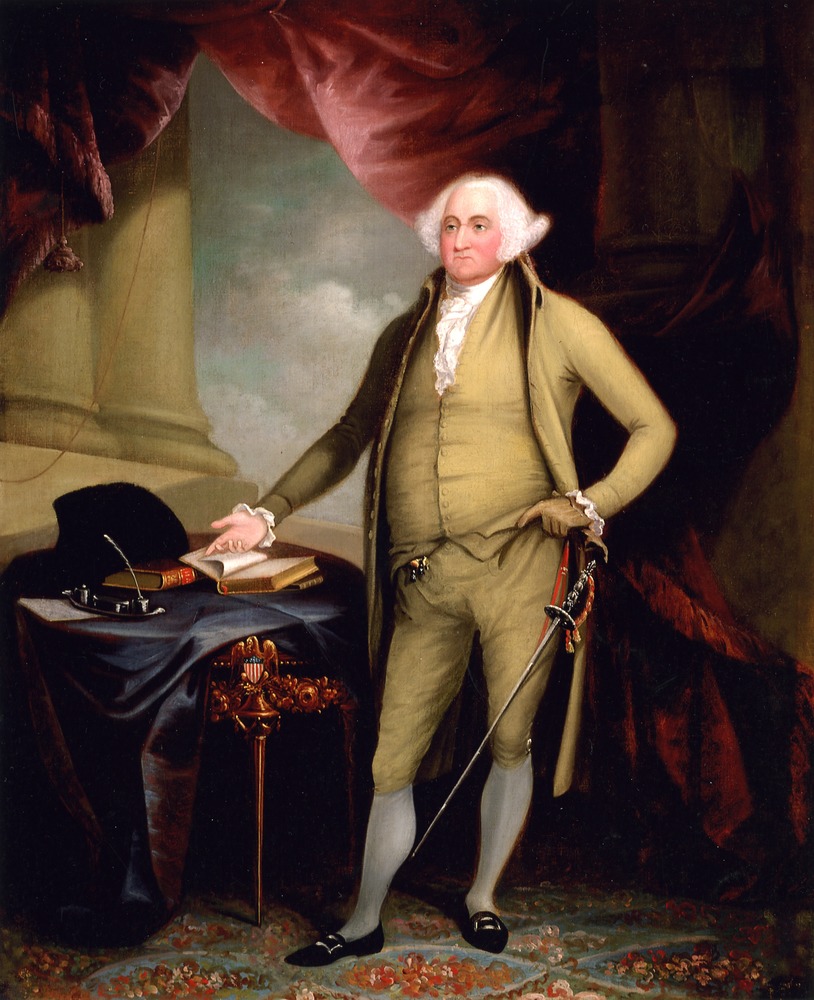
John Adams, by William Winstanley, 1798. Adams National Historical Park.
Brimming with international intrigue, domestic drama, and sly cabinet maneuvers, Volume 22 of The Papers of John Adams provides an insider’s tour of Adams’s tumultuous first year in office. This 59th volume published by the Adams Papers editorial project includes 304 documents that chronicle John Adams’s work from February 1797 to February 1798, revealing a new profile. Of the presidency, Adams vowed in his inaugural address: “It shall be my Strenuous Endeavour.” The popular narrative of Adams’s presidency is that he sidelined an inherited cabinet and chose to set major policy solo. This volume offers a richer and more complex history of a veteran statesman struggling within the bounds of the federal structure that he co-created.
Adams enjoyed just a few celebratory weeks on the job, before a wave of crises hit. Operating within the global upheaval of European war, the second president faced a set of hard trials. French privateers preyed on neutral American commerce. Yellow fever afflicted the federal seat in Philadelphia. Adams labored with Congress to shift money and resources for military preparedness. He drove the point home in his 28 Nov. 1797 note to the Senate: “A mercantile Marine and a military Marine must grow up together: one cannot long exist, without the other.” The Quasi-War loomed. Yet John Adams’s letters reveal an administration stubbornly bent on pursuing a policy of strategic peace—even at great personal and political cost.
Running the nation’s highest office presented fresh challenges for the lifelong public servant. From a glance at his overflowing desk, it seemed like everyone wanted something right now from the new chief: a job, a pardon, some patronage to float a book idea or to fund an invention. “The friends of my youth are generally gone,” Adams lamented to Joseph Ward on 6 April 1797. “The friends of my Early political Life are chiefly departed—of the few that remain, Some have been found on a late occasion Weak, Envious, jealous, and Spiteful, humiliated and mortified and duped Enough by French Finesse, and Jacobinical rascality to Shew it to me and to the world, Others have been found faithful and true, generous and Manly.” Beyond his wife Abigail, whom did he trust? Volume 22 sketches Adams’s widening networks, as he brokered relationships with a cabinet comprised of Charles Lee, James McHenry, Timothy Pickering, and Oliver Wolcott Jr.
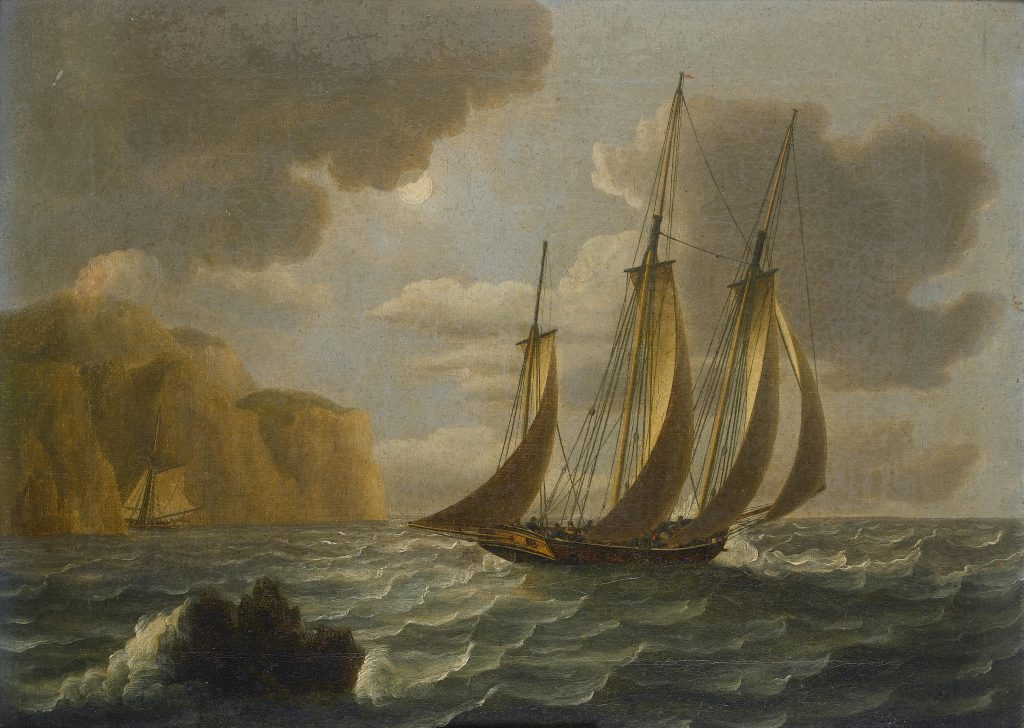
Thomas Buttersworth, “An Armed Revenue Cutter on Patrol with a Potential Quarry Sheltering below the Cliffs,” ca. 1802.
Overall, the urgent question of France dominated Adams’s mind. Shipping losses mounted. The country’s small fleet of revenue cutters worked mightily to defend American interests, but Adams knew that it was hard to safeguard the economy without the protection of a professional navy. He strained to salvage a tattered alliance and hold off war. “Commerce has made this Country what it is; and it cannot be destroyed or neglected, without involving the People in Poverty and distress,” Adams told Congress on [22 Nov.] 1797, adding: “I should hold myself guilty of a neglect of Duty, if I forebore to recommend that We Should make every exertion to protect our Commerce, and to place our Country in a Suitable posture of defence, as the only Sure means of preserving both.” The French threat sharpened Adams’s focus on the need for a real navy, with a six-frigate fleet under construction. When the winter froze French cruisers’ chances, Adams mobilized money and congressional support for a major military buildup. Volume 22 supplies a 360-degree experience of how cabinet members debated the future of Franco-American policy.
John Adams sensed his first steps into the presidency marked a final turn in his extraordinary life of service to the American people. “Their Confidence, which has been the Chief Consolation of my Life, is too prescious and Sacred a deposit ever to be considered lightly,” he told the Senate on [15 Feb. 1797]. He was no George Washington, but Washington’s America was changing too. John Adams’s Federalist ideology of tripartite government shaped his policymaking and his popularity; understanding how to preserve liberty while defending the people was his challenge. That history unfolds next in Volumes 23 and 24 of The Papers of John Adams, now underway.
The Adams Papers editorial project at the Massachusetts Historical Society gratefully acknowledges the generous support of our sponsors. Major funding for the Papers of John Adams is provided by the National Endowment for the Humanities, the National Historical Publications and Records Commission, and the Packard Humanities Institute. All letterpress Adams Papers volumes are printed by Harvard University Press.
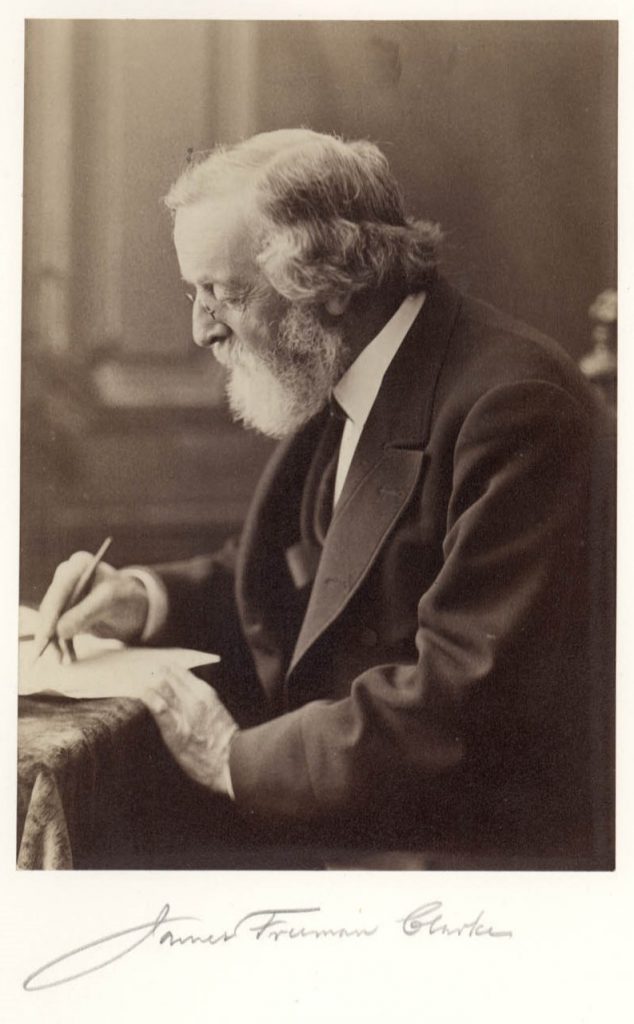
I’m very pleased to announce a new collection available for research, the Perry-Clarke additions. I’ve been processing this collection for a while now, and I can honestly tell you I’m a little sorry to be finished with it. It’s been one of the most interesting (and challenging) I’ve worked on here at the MHS.
The collection contains the papers of Unitarian minister, transcendentalist, author, and social reformer James Freeman Clarke, as well as many family members from multiple generations. The “Perry” in the title comes from the collection’s donor, Clarke’s great-granddaughter Alice de Vermandois (Ware) Perry.
As you can probably tell from the name, these papers consist of additions to the Perry-Clarke collection, which Alice Perry gave to the MHS back in 1979. After that collection was processed and made available to researchers, Perry donated multiple subsequent installments of family papers. These additions posed a number of problems: many of them were completely unorganized and unidentified, and some portions were even covered in active mold.
Unfortunately, because of these problems and the lack of time and staff to address them, most of the additions have been malingering in our backlog. We did arrange, catalog, and make available four boxes of some of the most significant material—all the letters James Freeman Clarke wrote to his wife between 1832 and 1888—but the rest was largely unusable.
Thankfully that’s no longer the case! While it wasn’t possible, at this late date, to incorporate the additions into the primary collection, I’ve processed the additions separately and created links between the two. At 46 boxes, this collection is smaller than the first (64 boxes), but there’s a lot of overlap.
The collection contains ten boxes of family correspondence (the previously cataloged letters from James to Anna are filed here), followed by nine boxes of James’s papers, primarily manuscript and printed copies of his sermons and other writings.
James may be the headliner, but the collection also includes papers of several equally impressive relatives. Among them are his sister Sarah Freeman Clarke, an artist, author, teacher, and philanthropist; his wife Anna (Huidekoper) Clarke and members of the influential Huidekoper family of Meadville, Pennsylvania; his incredibly high-achieving children, Lilian (reformer and translator), Eliot (engineer and mill manager), and Cora (botanist and entomologist); and his daughter-in-law Alice and her family.
In fact, while the additions complement the original donation in many ways, they have even more to offer. Alice was, through her mother, a member of the famous Lowell family of Boston, so about a third of the additions is made up of Lowell family papers that Alice brought along with her when she married Eliot Channing Clarke in 1878.
The Lowell material includes, for example, nearly 30 volumes kept by Alice’s great-aunt Rebecca Amory Lowell during her decades of work as a Sunday School teacher, as well as 21 diaries of another great-aunt, Anna Cabot Lowell, that neatly fill the gap in one of our other collections! An entire box consists almost exclusively of letters written by Alice’s great-great-aunt, another Anna Cabot Lowell, during the Federalist Era.
Processing this collection meant opening a lot of boxes of miscellaneous unidentified loose manuscripts and crumbling volumes and identifying, to the best of my ability, what they were, who wrote them, and where they belonged. I was particularly impressed by how much material I found documenting the accomplishments of women.
I hope and expect the Perry-Clarke additions will get a lot of use by researchers. I know I intend to mine it for many future blog posts. Thanks to Interim President Brenda Lawson for prioritizing the processing of this collection.