To Speak With the Hand — To Hear With the Eye.

By Kittle Evenson, Reader Services

The breadth of foreign-language materials in our collections often surprises me; we have English and French language conversation primers written in Italian, proverbs in Hebrew and Latin, and Chinese grammar books written in German. So it should not have surprised me, although it did, to discover several fascinating 19th century broadsides and pamphlets on manual languages hidden within our collections as well.

Two broadsides, Single and Double Hand Alphabet (c. 1856) and Charles Parker’s New Manual Alphabets (1856) depict a variety of manual hand and body alphabets, including narrative descriptions of their intended uses, audiences, and histories.
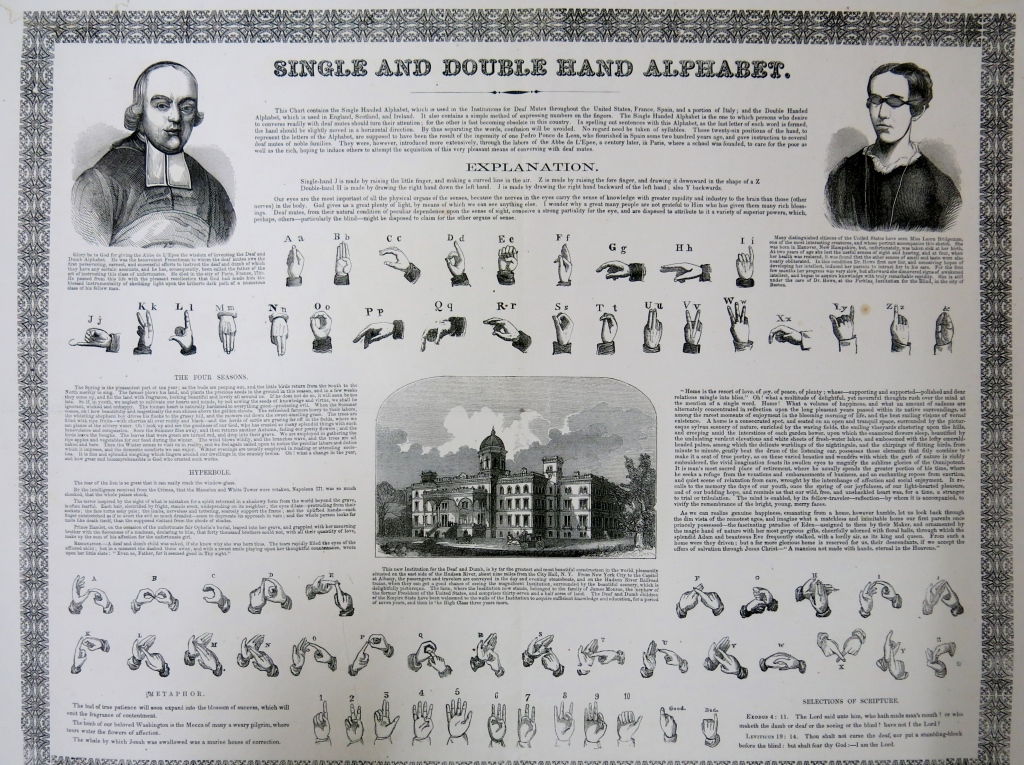
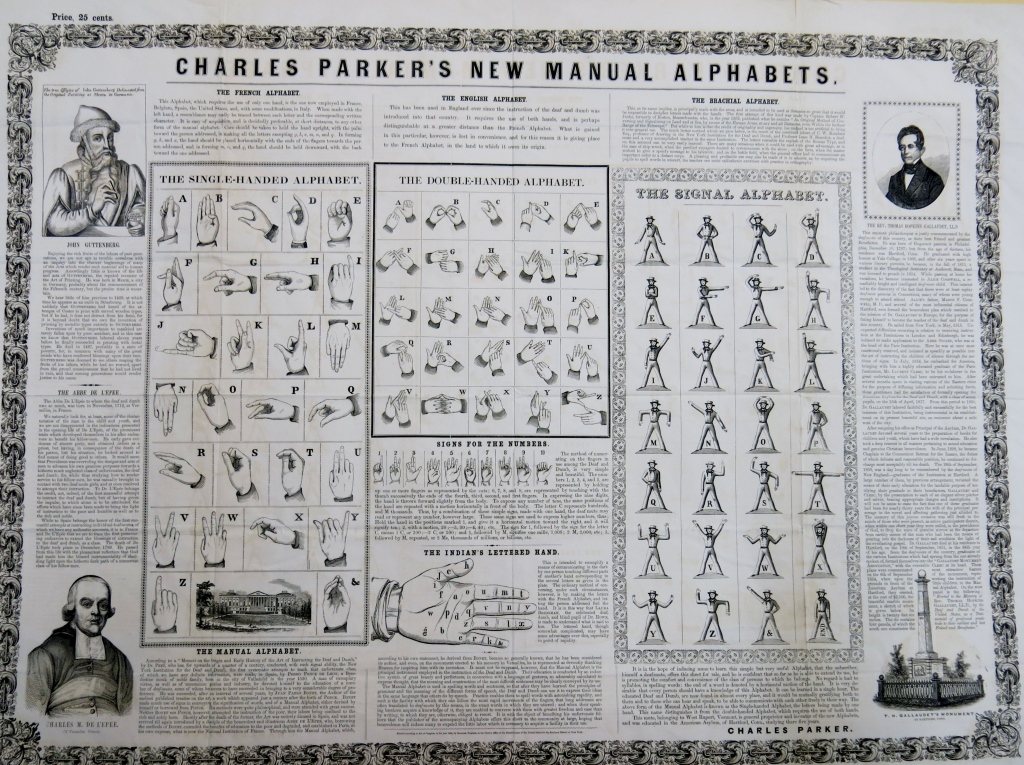
Both items show slight variations on a single-handed alphabet, a double-handed alphabet, and the numbers 1-10.
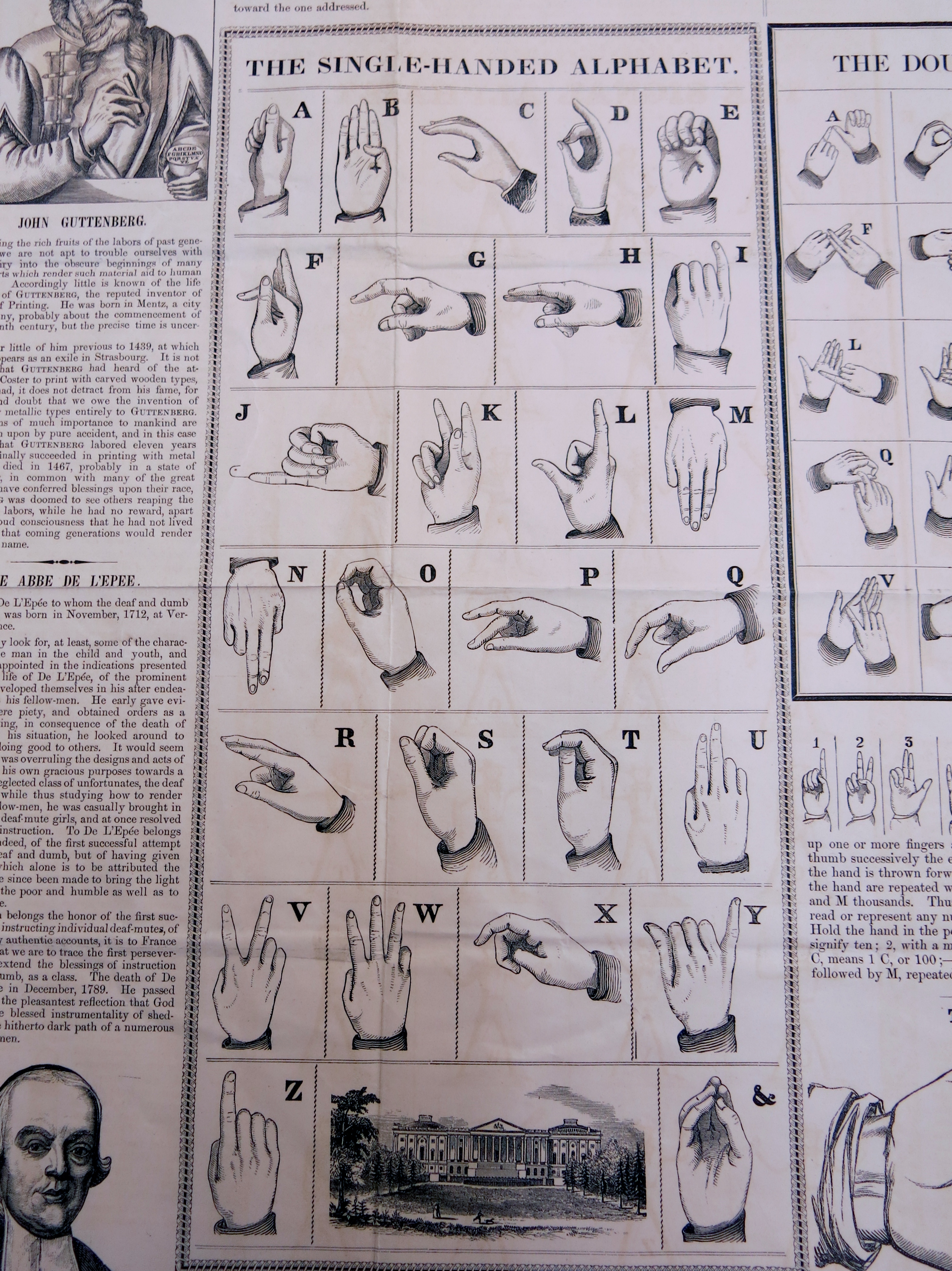
 

Single-Handed Alphabet
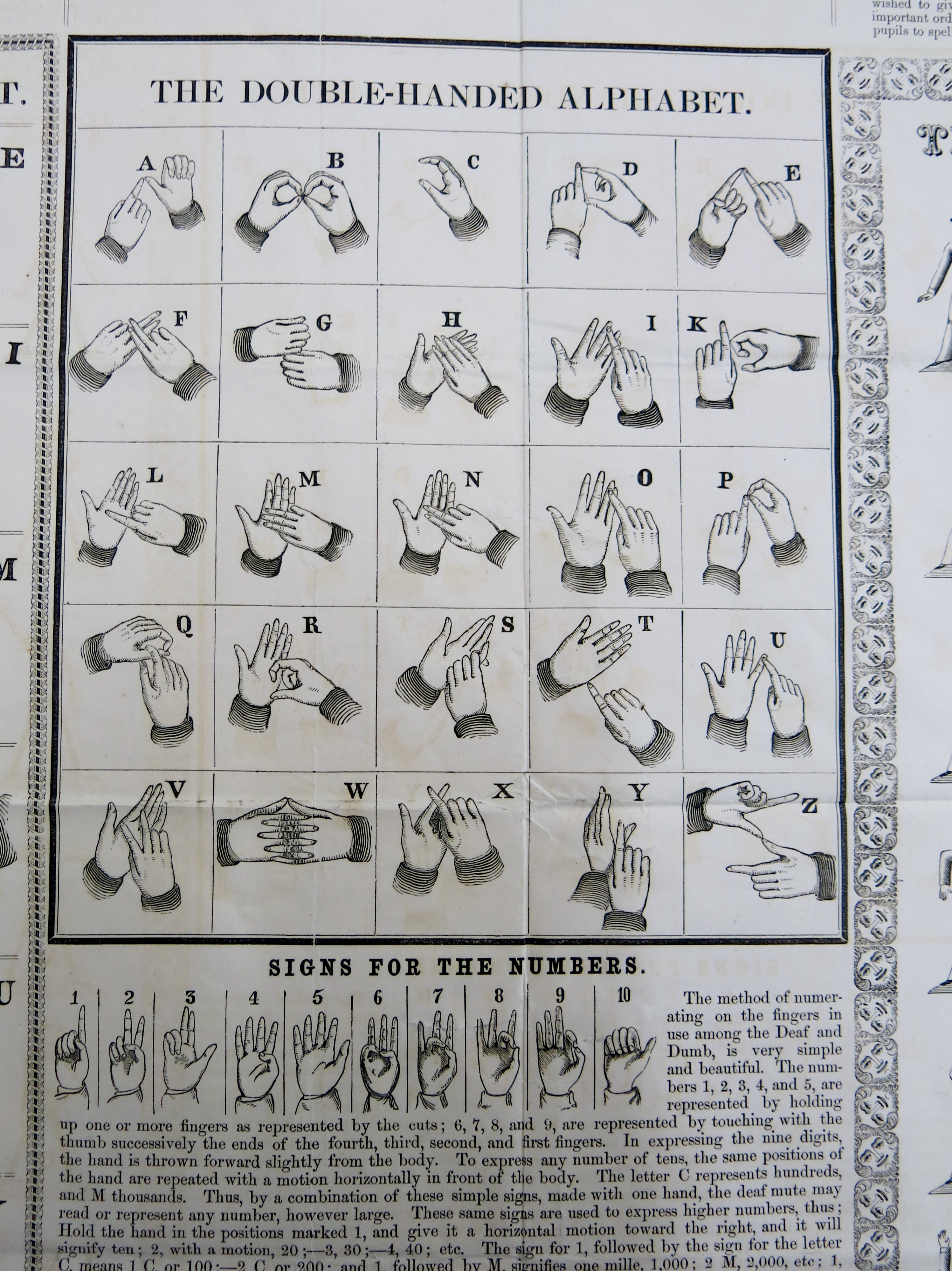

Double-Handed Alphabet


Charles Parker’s New Manual Alphabets also includes “The Indian’s Lettered Hand,” and “The Signal Alphabet.”
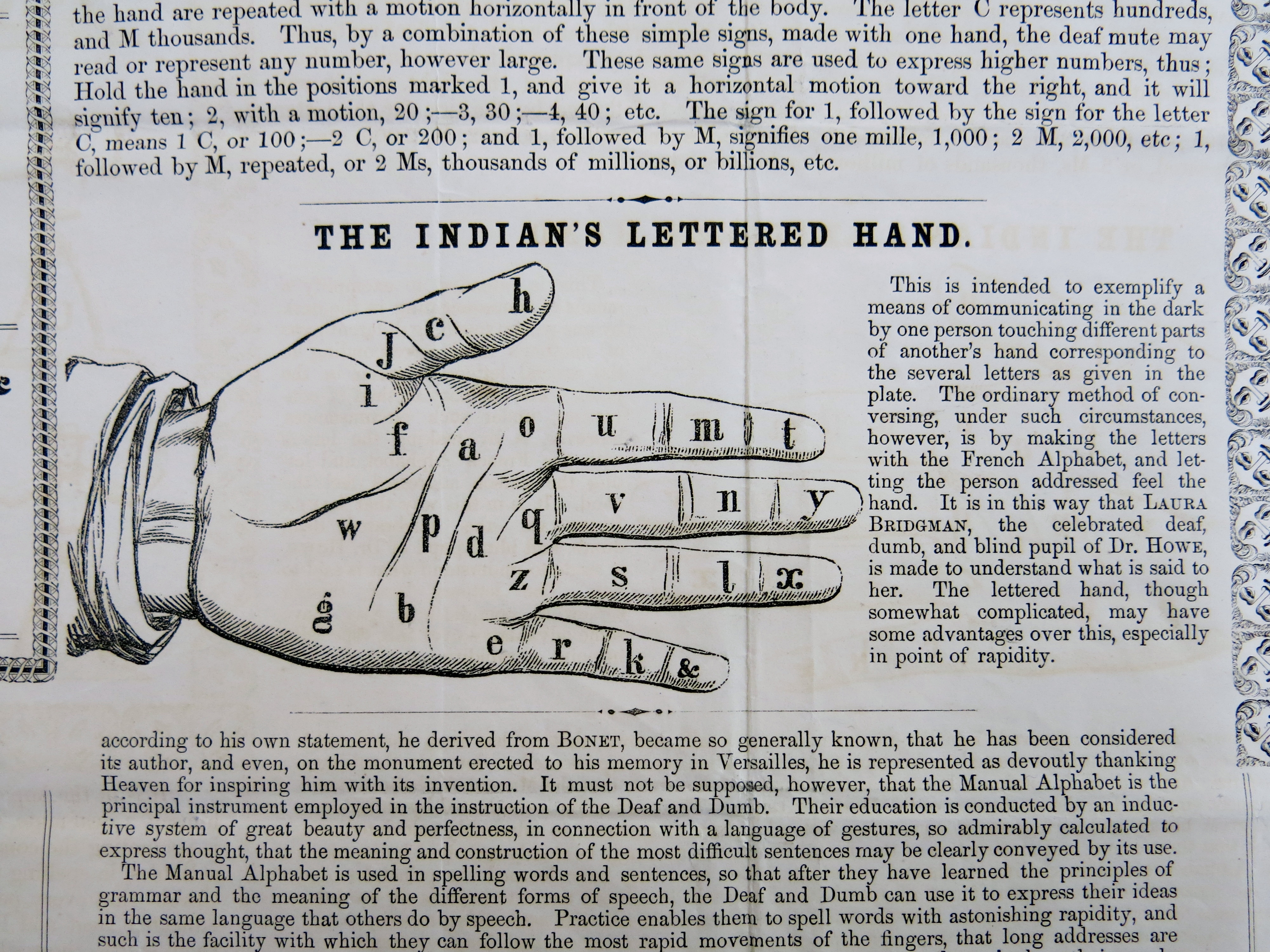
 

The Indian’s Lettered Hand
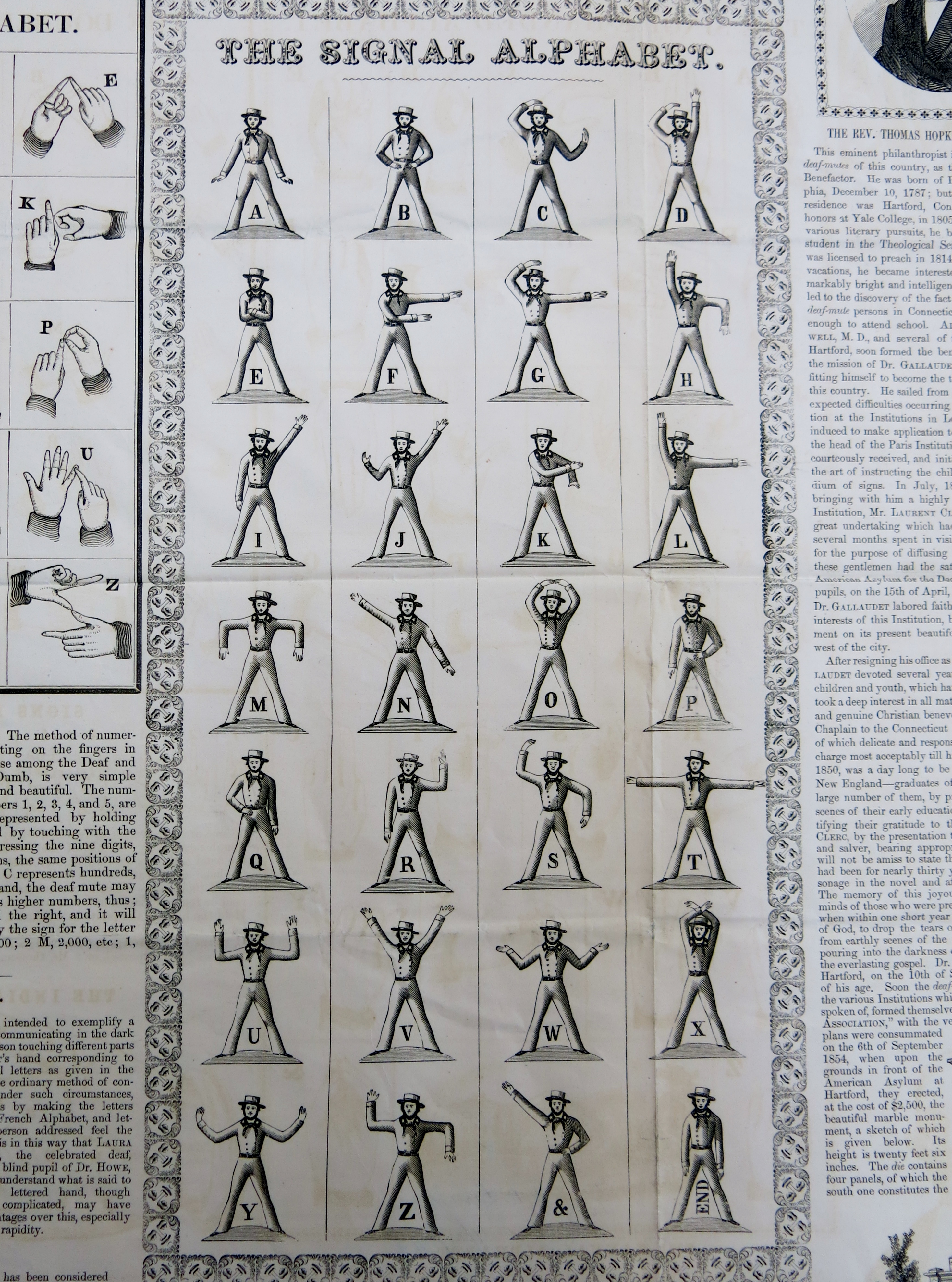


The signal Alphabet


“The Signal Alphabet” in particular, which looks similar to flag semaphore, caught my eye. Created by C. W. Knudsen Esq. and Professor Isaac H. Benedict, a deaf-mute individual and teacher at the New York Institution for the Deaf and Dumb, it was derived from a more complex alphabet called the “Brachial Alphabet,” which was published in 1852 by a former Bostonian, Captain Robert Jenks.

“There are many occasions when it could be used with great advantage,” the broadside advertises, “as in the case of ship-wreck . . . on the farm . . . and on the battle field [sic].” I was amused to find these logical implementations followed by the far more outlandish suggestion that “a pleasing and profitable use may also be made of it in schools, as, by requiring the pupils to spell words in concert, the teacher can unite callisthenic [sic] exercises with practice in orthography.”
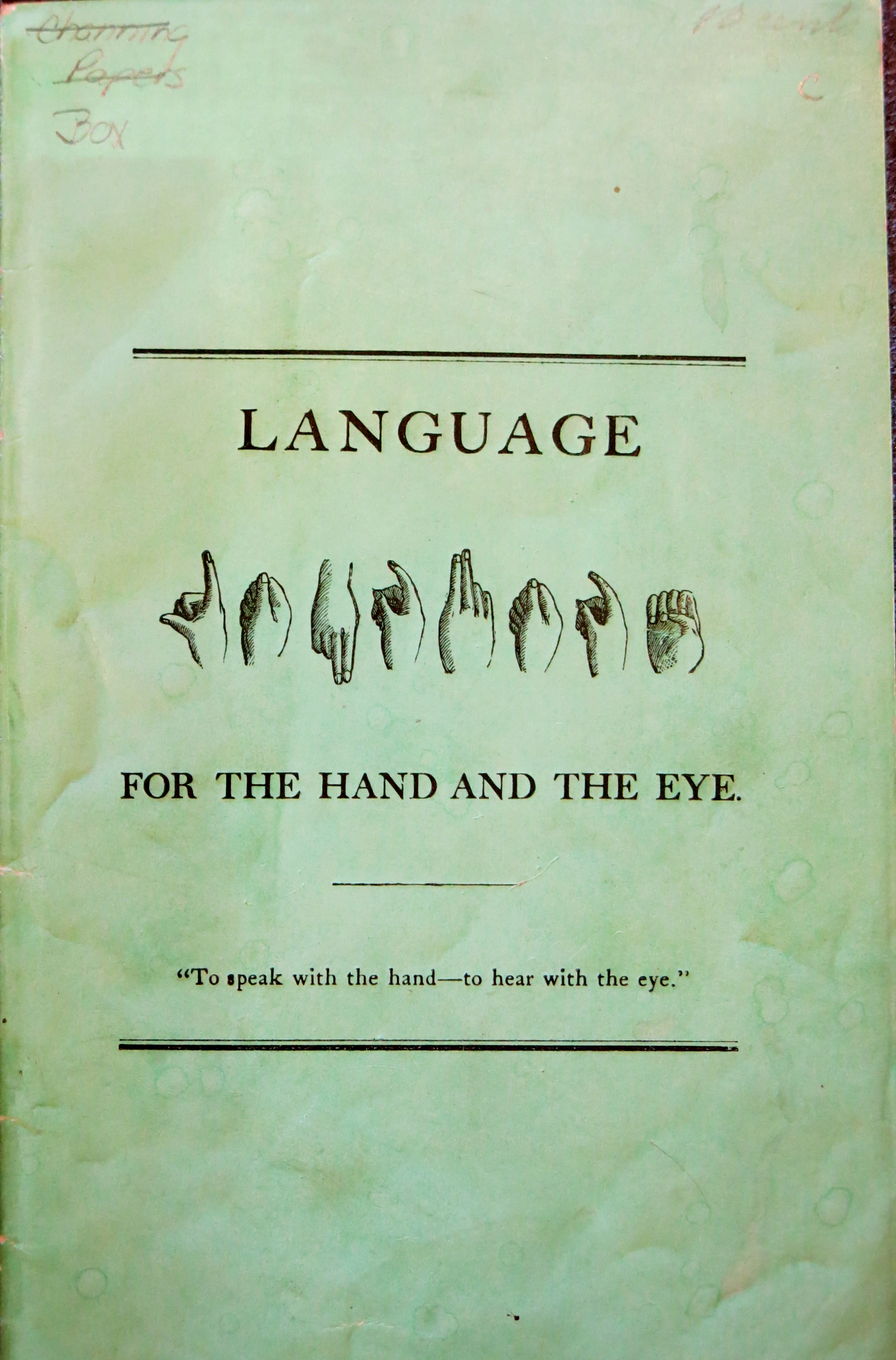


A pamphlet, entitled Language for the Hand and the Eye and dating to a decade after the broadsides, proposes similar benefits for hearing students.

It was a favorite idea of Dr. Gallaudet (the pioneer in the work of deaf mute education in this country,) that the use of the manual alphabet by hearing and speaking children, would prove highly advantageous, by leading their attention to the written form of words, thus aiding them greatly in forming the habit of spelling correctly.

The use of this alphabet is also a pleasant diversion to children. It is an entertainment to them to find that they can produce language in a new form. (7)
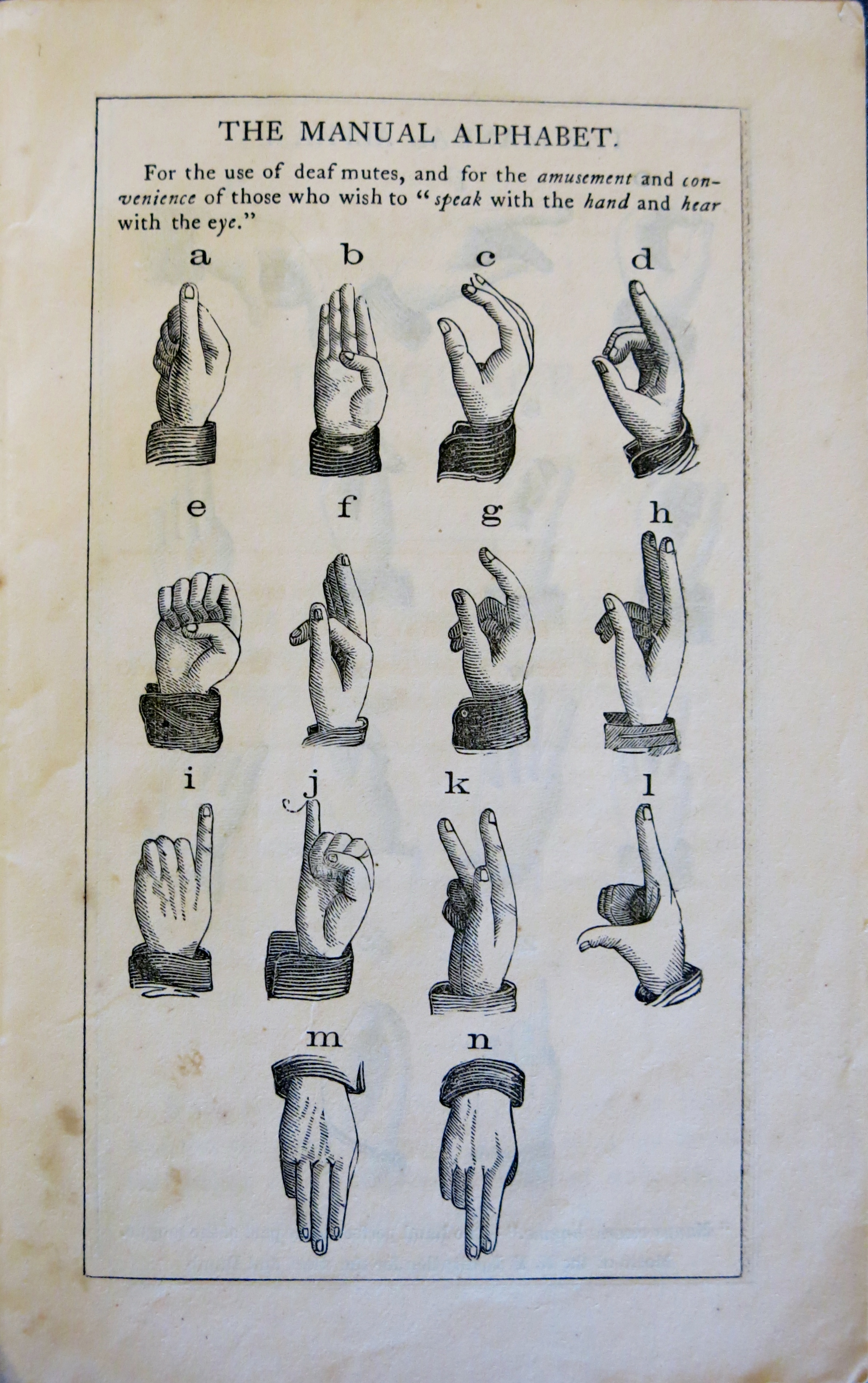


The audience for this particular pamphlet is clearly a hearing one. In the postscript of the text, the author, who is unnamed, addresses the reader directly:

Kind reader: — Is there among your acquaintances a little one who has not the power of hearing and speaking — a deaf mute child, unable to acquire this wonderful, beautiful power of language that we all acquire so readily by the ear? If you know of such an one, will you not try to aid the child by teaching it this alphabet, or by inducing the parents, or brothers and sisters, or friends of the little deaf mute to teach it early to use this form of language, and thus save it from unneccessary [sic] ignorance? (10)

The author’s final proclamation makes clear one of the most intriguing aspects of these sources: while they were distributed to propagate a language originally created by the Deaf community, they are directed at hearing individuals with the opinions of deaf individuals filtered through their re-telling by hearing doctors and educators, if they are even included at all.

While some acknowledgement is made of the variations in manual languages between regions, there is no mention of the broader range of formal sign languages to represent and communicate concrete and abstract thoughts beyond the creation of letters. Also omitted is any substantive mention of Deaf culture, or the first-hand account of communicating as a deaf individual.

In addition to these items on manual languages, the MHS also holds a variety of manuscript and print materials pertaining to the personal experience of deaf and mute individuals in New England, as well as educators and doctors who worked with, studied, and taught them. Interested researchers are encouraged to stop by during our open hours to view these, or any of our other collections in person.

 

The Shackles of Freedom: the Slave Trade in Colonial New England

By Zachary Hill, Nashoba Regional High School

Five weeks ago, I found myself playing chicken with the Green Line. My brush with death in Brookline was worth it.

As a high school student, my primary sources mostly come as nice, neat internet transcriptions. I never expected to be staring at a three hundred year old letter in which Hugh Hall, one of Boston’s prominent slave traders, complains rather vehemently of seasickness. The letter was written in big, loopy handwriting, the polar opposite of Hugh’s brother Richard’s cramped impossibility, on yellowed old paper that felt somewhat slimy.

For a moment, I was overcome by the idea that I was touching Hall’s DNA.

I was researching the development of the New England economy in relation to the slave trade. This rested chiefly on the shoulders of the exploits of early traders in the late seventeenth and early eighteenth centuries. I had first to establish the prominence and profitability of the trade, then track its influence, culturally and economically, as it inserted itself into the daily life of colonists. Slavery as a domestic institution was rather invisible in colonial Massachusetts, but the colony’s involvement in a booming international trade was not, and New England merchants grew rich by supplying Caribbean sugar plantations with slaves.

During this time I uncovered the most astounding stories. John Usher, later the Receiver General of the Dominion of New England, conspired with a group of London merchants and his friend John Saffin, to smuggle slaves into Rhode Island. At this time, the Royal African Company held a monopoly on all trade to “His Majesty’s Plantations” with Africa. Usher’s ship was nearly intercepted and had to be redirected to Nantasket, where the cargo was unloaded and sold (according to a bill of sale from 1681 in the miscellaneous manuscripts collection) three months later across New England.

These long-dead personages began to acquire personal characteristics. Richard Hall frequently wrote home to his children in Boston. Elizabeth Shrimpton, the grandmother of Shute Shrimpton Yeamans, who had inherited his father’s plantation in Antigua, sent him a letter in which she debated to herself whether he’d receive the Boston share of her will. With these personalities emerging, details that become almost tangible before the researcher, one finds it hard to imagine the sheer callousness of their commerce. Hall mentions slaves in the same breath as rum and turpentine. The Royal African Company frequently petitioned the King that New England smugglers were disrupting their quotas as to affect their quarterly margins, displeasing their Caribbean customers. I stood amazed that they trafficked in human beings, and that this “smuggling” and these “quotas” often decided the fate of hundreds of captive men, women, and children.

I made three visits to the Massachusetts Historical Society. In each I was awestruck by the sheer volume of resources available to me: original documents, collections, microfilm, and digitized materials. The staff was very helpful in my attempts to locate evidence, and I oftentimes would have been lost in a jungle of information had they not hacked through some vines. For those researching slavery and the slave trade, the John Usher sections of the Jeffries family papers have proved very useful, as has the account book of Hugh Hall, the Shrimpton family papers, the wills in the Dolbeare family papers, and certain sections of the Winthrop family papers. The Sir William Pepperrell papers are, despite the label on the collection guide, an impenetrable morass of personal correspondence mostly related to the Siege of Louisburg, so deceptively organized by the archivists of 1898 that there are indeed indices to indices. I finally stumbled upon a bit of clarity with the discovery of Documents Illustrative of the History of the Slave Trade to America, a collection of just the right sort of manuscripts by Elizabeth Donnan, conveniently stored at the Massachusetts Historical Society. Here I found the Charter of the Royal African Company, as well as several petitions in regards to said company, and the account of a certain Captain Moore, whose schooner, the William, was “taken and retaken again,” by her captives.

I have always wanted to be a historian. My time at the Massachusetts Historical Society obliterated any lingering doubts in that ambition. Words cannot describe the joy of these encounters with the past, an opportunity I will never forget.  With that in mind, I would like to thank all those at the Society who have aided me in my research, and for awarding me this tremendous opportunity.


**The MHS has awarded the John Winthrop Student Fellowship since 2013. This fellowship encourages high school students to make use of the nationally significant documents of the Society in a research project of their choosing.


This Week @ MHS

By Dan Hinchen

Please note that the Society is Closed on Monday, 7 September, in observance of Labor Day. The Library remains Closed through Friday, 11 September, with normal hours resuming on Saturday, 12 September.

On Wednesday, 9 September, join us at noon for a Brown Bag lunch talk with Jared Hardesty of Western Washington University. Hardesty’s talk is titled “Constructing Empire: Fortifications, Politics, and Labor in an Age of Imperial Reform, 1689-1715.” The talk is free and open to the public so pack a lunch and stop by for some midday history!

There is no building tour on Saturday, 12 September.

Boston by Broadside, part I: Prof. G. H. Boulet’s Gymnasium

By Dan Hinchen

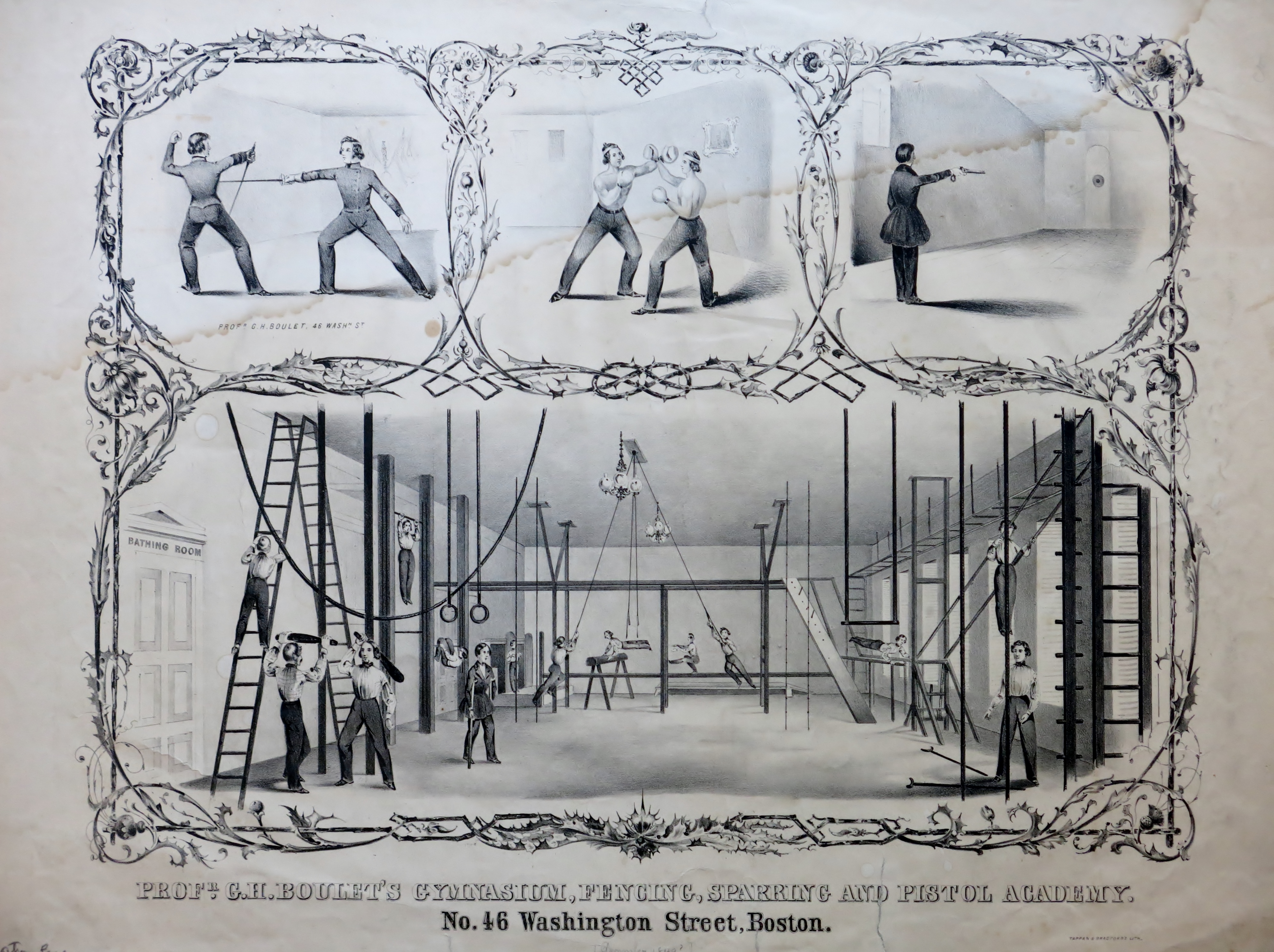
Welcome to my new series here on the Beehive: “Boston by Broadside.” Here I will use examples from the MHS’ collection of broadsides to show various views of our fair city as it used to be. 


For the first foray out into Boston-that-was, we begin in Charlestown. This first stop is just to make sure that everyone is physically up to the challenge of navigating the city by broadside. So, let us begin on Washington Street at Prof. G. H. Boulet’s Gymnasium, Fencing, Sparring, and Pistol Academy.

While your intrepid guide considers himself to be in passable physical condition, he realizes that his training thus far is lacking in many elements, most notably the swordplay and precision with firearms. There will need to be more work done here in the future.

But now, onto the next stop! Check back soon to see where we land!


This Week @ MHS

By Dan Hinchen

August is leaving us and September steps in. As fall approaches we will see increased activity on our events calendar, but we want to ease into so this week we keep things light.

On Wednesday, 2 September, we have a Brown Bag lunch talk taking place at noon. Pack a lunch and join us to hear Christopher Capozzola of MIT share “Brothers of the Pacific: America’s Forgotten Filipino Armies and the Making of the Pacific Century.” Capozzola’s talk and research explores the relationship between military service, immigration policy, and civil rights in modern American history. This talk is free and open to the public. 

Friday, 4 September, is your last chance to come in and see our current exhibition before it closes. “God Save the People! From the Stamp Act to Bunker Hill” is open to the public free of charge 10:00AM-4:00PM. Come take a look before it goes away for good! To see what is coming up next, be sure to check the Exhibitions page on our website. 

Please note that the MHS is CLOSED Saturday, 5 September, through Monday, 7 September, in observance of Labor Day. Also, the LIBRARY remains CLOSED through Friday, 11 September. Normal hours resume on Saturday, 12 September. 


Major Samuel Selden’s Powder Horn: A Revolutionary Map of Boston

By Allison K. Lange, PhD

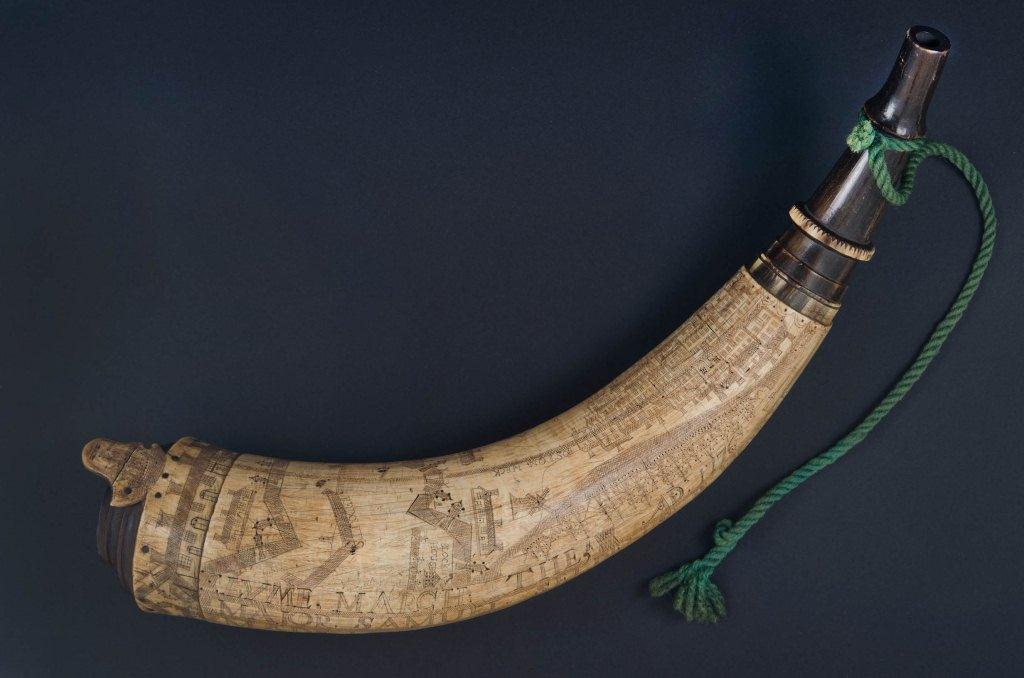
We expect to see maps on paper, not on animal horns. Maj. Samuel Selden might have thought this as he etched a map of Boston on his powder horn, which is dated 9 March 1776. During the Revolutionary War, soldiers used animal horns to hold their gunpowder. They filled them at the larger end and funneled the powder into their weapons. Not all militiamen had their own powder horns, so men like Selden carved unique designs on them in order to claim them as their own.

Selden was a member of Connecticut’s Provincial Assembly and became a major in the colony’s militia during the war. He served under George Washington’s direction during the siege of Boston. His powder horn depicts the sites of American fortifications as well as the positions of the Continental Army just before the British evacuated the city.

Even if we did not know Selden’s background, his carvings convey his allegiances. A ship labeled “Amaraca” displays a Continental Union flag. Another flag depicts the Liberty Tree, the tree near the Boston Common where locals met to protest British rule. Alongside his name, Selden also inscribed the words: “made for the defense of liberty.”

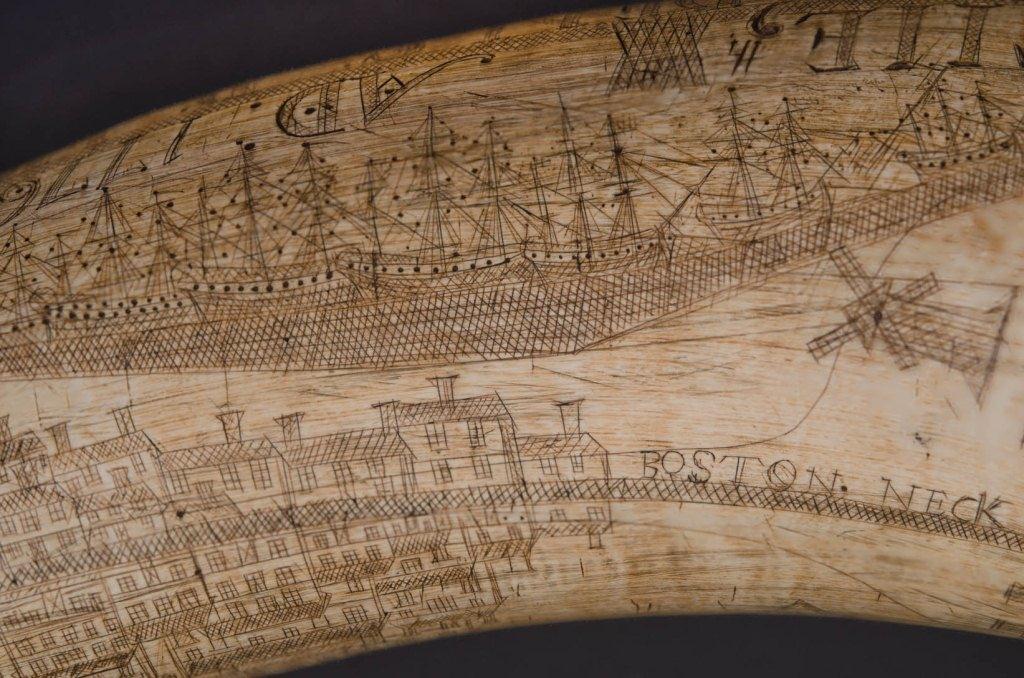
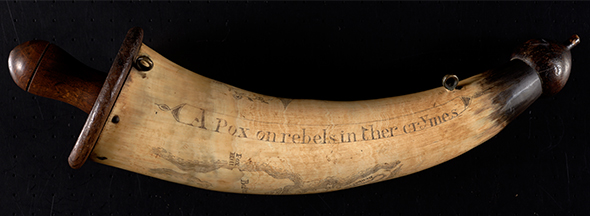
Selden’s map is a pictorial map rather than one focused on the area’s geography. His detailed carvings feature individual ships in the harbor and houses lining the Boston neck. Crosshatching adds depth to the water and makes his lettering stand out. In contrast, a 1775 powder horn housed at the Norman B. Leventhal Map Center features a more traditional map of Boston. Instead of pictures, this map traces shorelines. Unlike Selden’s, however, a British soldier carved this powder horn. He inscribed the words: “A Pox on rebels in ther crymes [their crimes].”

1775 powder horn

Photo courtesy of Norman B. Leventhal Map Center.

Just six months after Selden carved his horn, the British captured him at the Battle of Kip’s Bay during their campaign to take control of New York City. The prison’s conditions were poor. Less than a month later, Selden fell ill and died on 11 October 1776.

Selden’s powder horn, as well as that of his British counterpart, is currently on display in the Norman B. Leventhal Map Center’s exhibition at the Boston Public Library. The exhibition, We Are One: Mapping America’s Road from Revolution to Independence, uses maps to explore the events that led thirteen colonies to forge a new nation. We Are One demonstrates that maps, from Selden’s carving to early European maps of the new nation, were central to the revolutionary process. The exhibition features maps as well as prints, paintings, and objects from the Leventhal Map Center’s own collection and those of twenty partners, including the British Library and Library of Congress. Visit zoominginonhistory.com to explore geo-referenced maps from the exhibition.

The exhibition will be on display at the Boston Public Library through November 29, 2015. We Are One then travels to Colonial Williamsburg from February 2016 through January 2017 and to the New-York Historical Society from November 2017 through March 2018.

The Leventhal Map Center also hosts the NEH-funded American Revolution Portal database. Researchers can access maps from the Massachusetts Historical Society, British Library, Library of Congress, and other institutions in one search. Users can download images for research and classroom use. Access these resources and learn more about We Are One at maps.bpl.org/WeAreOne.

Find out more about the Society’s own map collection at their upcoming exhibition: Terra Firma: The Beginnings of the MHS Map Collection, which opens on 2 October. Through 4 September, visitors to the MHS can learn more about the American Revolution with exhibition: God Save the People! From the Stamp Act to Bunker Hill.

Image 1: Selden, Samuel, 1723-1776. [Powder horn scribed by Samuel Selden.] Lyme, Conn., 1776. 1 powder horn: ivory; 37 x 21 x 13.3 cm. Massachusetts Historical Society.

Image 2: Detail of above.

Image 3: E.B., [Powder Horn with Map of Boston and Charlestown]. [Boston], 1775. Scrimshaw horn, 14 x 3.5 x 3.5 inches. Norman B. Leventhal Map Center.

This Week @ MHS

By Dan Hinchen

Please note that the library closes early at 3:45PM on Wednesday, 26 August.

On Tuesday, 25 August, we have a Brown Bag lunch talk taking place at noon. Join us to hear Sean Munger of the University of Oregon as he presents “Journaling the Skies: New England’s Weather Diarists, 1810-1820.” This talk is free and open to the public. Pack a lunch and stop by!

Also on tap this week is the History and Collections of the MHS. Stop by on Saturday, 29 August, at 10:00AM for this 90-minute, docent-led tour, and learn about the history of the Society as well as the architecture of the building and the art and collections housed within. No reservations required for individuals or small groups, but parties of 8 or more should contact Curator of Art Anne Bentley in advance, at abentley@masshist.org or 617-646-0508.

He Said, She Said (Redux)

By Susan Martin, Collection Services

Three weeks ago, I introduced you to John Egbert Jansen and Margaret A. Wisner of Pine Bush, N.Y. Their papers form part of the Hall-Baury-Jansen family papers and include overlapping diaries for the years 1858 and 1859. One of my colleagues here at the MHS asked me what happened to John and Margaret after 1859, so I did a little more digging. 

Unfortunately, none of the rest of the diaries in the collection overlap. We have one more diary kept by Margaret in 1862, but the ink has faded so much that many of the entries are illegible. John kept five more diaries, two before his marriage to Margaret (1860, 1861) and three after (1873, 1875, 1878). So we have to rely almost entirely on him for further details. 

John’s diary entries are short and cryptic. He visited Margaret and thought of her often, and it seems his feelings were reciprocated, but something was apparently delaying their marriage. The fact that we have only one side of the story heightens the mystery and the pathos. We see John pining for Margaret, “living in hopes,” wanting to say things to her but not daring, and parting from her in “affecting” scenes, but her voice is silent. Here are some excerpts from John’s 1861 diary: 

Many wishes I have, but must not express them now, and some inferences to make from former actions. (17 Mar. 1861)

Saw some one in want of sleep as well as myself. I have to think quite little of what I’ve heard lately. (28 Apr. 1861)

The last attempt. […] Not at all afraid. (26 May 1861)

Thinking considerable as to what I must do. (1 July 1861)

Saw one in Church looking sad and lonely. Sorry for that. (24 Nov. 1861)

What the conflict was, I can only guess. There was some discord during John’s visit to the Wisners on 14 Mar. 1861: “Some apparently disappointed in hearing my oppinions of Intemperance as applied to my case.” The day before, he had written: “At home in the evening on account of shame perhaps or the want of a place to go. I dont know what it will amount to. I’ll have to stop after while I guess.” John did take the occasional drink. Did Margaret’s family disapprove? Or was it something else? All we know for sure is that harsh words were spoken, and someone was “very much put out or disgusted.” John felt the sting of “people passing remarks on and about me,” but thought he was “not so bad as I might be.”

His love for Margaret is unmistakable. He referred to her tenderly as “Maggie” and even, in one entry, as his “duckee.” Sometimes he just used a plus (“+”) sign to indicate her, as on 18 Aug. 1861: “Retired early, but could not sleep thinking of the goodness and other qualities of +.” As the year neared its end, with the prospect of their marriage still dim, John was glum: “Dark and gloomy out. Myself dull and lonely. Wonder if any one is thinking of me? Doubts arising.” But on New Year’s Eve, he clung to hope: “As the clock strikes 12 I was happy and alone and may I next New Year’s eve be the same except the alone.”

As I looked through John’s 1861 diary more carefully, I realized that Margaret was not entirely silent after all. At some point, she also read the volume and couldn’t resist adding her own sly comments after some entries. For example, on 7 Oct. 1861, John described an outing with some friends: “Bad companie but hard spoiling me as I am so innocent??” Margaret added a playful: “Poor boy.” (The question marks were also probably written by her.)

We have no diary kept by John in 1862, so we switch to Margaret’s point of view. Her diary for that year, though faded, does contain some legible entries, but their meaning is just as elusive as John’s. The couple had frequent “discussions” and “consultations.” When John visited on 12 Nov. 1862, with nothing decided, the two of them just “sat & sat hoping things would be right.” The wedding was put off at least once, and the next day John was nearly at the end of his rope: “John E. here & to tea. Quite cross when he left. To bad. To bad.”

Finally, on 17 Dec. 1862, John and Margaret were married. Margaret’s entry for that date reads: “Memorable day. Promised much, before many witnesses. Left with My husband […]” John’s later diaries describe the life of a typical New York farm family. The couple had three children: Lewis Wisner Jansen (1864-1925), Elsie (Jansen) Vernooy (1866-1949), and Lt. Col. Thomas Egbert Jansen (1869-1959).

Margaret died in 1923, and John in 1929. They, their three children, and other Jansen and Wisner family members are buried in New Prospect Cemetery in Pine Bush, N.Y.


This Week @ MHS

By Dan Hinchen

It is a quiet week here at the Society as we leave the dog days of summer behind. On Wednesday, 19 August, we have a Brown Bag lunch talk presented by Jordan Taylor of Indiana University. Taylor’s talk, “News in Flux: Early American Information and Commerce in the Age of Revolution,” explores how Americans’ sources of news, as well as their discourses of authority and authenticity, changed over the course of the American, French, and Haitian Revolutions. This talk is free and open to the public and begins at noon. 

Then, on Saturday, 22 August, join us at 10:00AM for the History and Collections of the Massachusetts Historical Society. This 90-minute, docent-led tour exposes visitors to all of the public spaces in the Society’s home on Boylston street while providing information on the history of the MHS, the collection it holds, and the art and architecture in the building. The tour is free and open to the public with no reservations required for small groups or individuals. Parties of 8 or more should contact Curator of Art Anne Bentley in advance at abentley@masshist.org or 617-646-0508. 

And finally, remember to come in and see our current exhibition, “God Save the People! From the Stamp Act to Bunker Hill.” The exhibit is free and open to the public, Monday-Saturday, 10:00AM-4:00PM, but only until 4 September, so come on in and check it out before it goes away!

This Week @ MHS

By Dan Hinchen

This week at the Society there are two teacher workshops and a Brown Bag taking place. Maritime Massachusetts: Falmouth Stories and Sources, is a three-day program (Monday, 10 August-Wednesday 12 August) which is open to educators and history enthusiasts with a fee of $35. The workshop will begin each morning at 8:30AM and run until 3:30PM. To register or to get more information, complete this registration form, or contact the education department at education@masshist.org or 617-646-0557. This program will take place in Falmouth, Massachusetts.

On Wednesday, 12 August, join us at noon for a Brown Bag lunch talk presented by Julia James, Syracuse University. “Women in the Woods: Crime, Gender, and Community in Colonial New England, 1675-1763” draws upon various primary sources to reveal information about Native women’s community roles and the intercultural relationships formed between Native and English peoples. This talk is free and open to the public.

Then, on Friday, 14 August, the Society hosts a free one-day program for teachers, co-sponsored by TeachingAmericanHistory.org and the Ashbrook Center at Ashland Univesity, and with assistance from the Lincoln and Therese Filene Foundation. Framing America’s Constitution is lead by Dr. Gordon Lloyd, Ashbrook Center Senior Fellow and Emeritus Professor at Pepperdine University. For more information, contact the MHS education department at education@masshist.org or 617-646-0557. To register, visit www.TeachingAmericanHistory.org to complete the online registraiton form. 

And on Saturday, 15 August, starting at 10:00AM is the History and Collections of the MHS. This 90-minute, docent-led tour is free and open to the public. Parties of 8 or more, please contact Curator of Art Anne Bentley in advance at 617-646-0508 or abentley@masshist.org.