The July 4 Protest of “Half Mast” Fay

By Susan Martin, Collection Services

This July 4 marked the 151st anniversary of an interesting political protest by local businessman Joseph Story Fay. His protest provoked heated debate in the Boston newspapers and had professional ramifications for Fay, even months later.

Fay was apparently a Peace Democrat during the Civil War, or what some called a “Copperhead” (as in, the snake). This subset of Democrats supported the Union, but wanted an end to the war through negotiated peace with the Confederacy. At their National Convention in Chicago in Aug. 1864, the Democrats nominated General George B. McClellan to unseat President Lincoln. Their platform read, in part:

[…] after four years of failure to restore the Union by the experiment of war, during which, under the pretense of a military necessity of war-power higher than the Constitution, the Constitution itself has been disregarded in every part, and public liberty and private right alike trodden down, and the material prosperity of the country essentially impaired, justice, humanity, liberty, and the public welfare demand that immediate efforts be made for a cessation of hostilities […]

It’s not hard to imagine what the Republicans thought of that! The Boston Evening Transcript, a pro-Lincoln newspaper, tore into the Copperheads in every issue published that election season. If McClellan won the presidency, the paper editorialized, “compromise and concession to traitors will be the policy of the new administration.” The paper ran stories of rebels cheering McClellan’s nomination and routinely implied that the Copperheads celebrated Confederate victories.

The Peace Democrats argued that the war wasn’t just destructive to the Union, but to the Constitution. They railed against the violations of civil liberties perpetrated by Lincoln’s administration. The spur to Fay’s protest on 4 July 1864 was the suspension of habeas corpus in the case of a group of Illinois Copperheads who had been arrested and detained in a military prison without due process of law. Fay chose Independence Day to make his stand. He flew an American flag at half mast outside his home in Woods Hole, Mass., and attached a note:
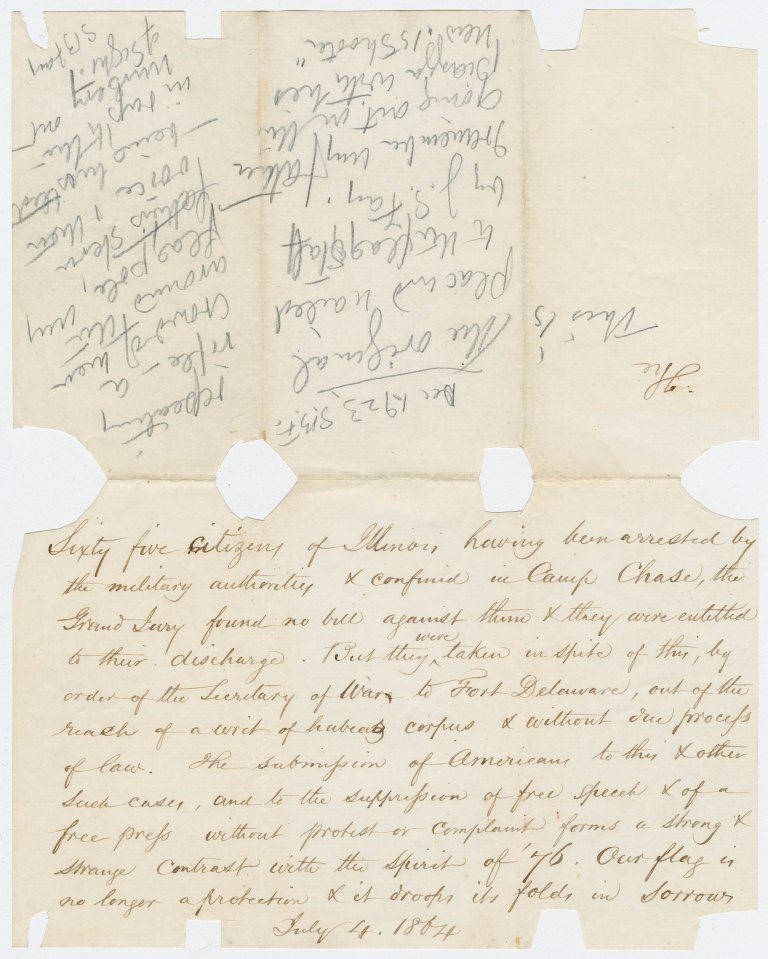
The submission of Americans to this & other such cases, and to the suppression of free speech & of a free press without protest or complaint forms a strong & strange contrast with the Spirit of ’76. Our flag is no longer a protection & it droops its folds in sorrow.

There’s some dispute about what exactly happened next, but all accounts agree that a group of people objecting to Fay’s protest confronted him at his house. Fay warned them off, armed with a rifle. His youngest daughter Sarah, about 8 years old at the time, wrote later (her note is visible on the image above): “I remember my father going out on the piazza with his new .15 Shooter repeating rifle – a crowd of men around the flagpole, my father’s stern voice & then being bustled in & up to the nursery out of sight.”

Thankfully no one was hurt, but the incident would come back to bite Fay two months later. After he presided at a pro-McClellan rally at Faneuil Hall in Boston on 17 Sep. 1864, the Transcript printed a letter from an unnamed person reminding readers about Fay’s earlier “dishonor” and “insult” to the flag. The Democratic Boston Courier supported him, but the Transcript was unimpressed: 

The Courier defends and applauds Mr. Fay for putting the American flag at half mast on the Fourth of July, and for threatening to shoot anybody who interfered “to alter the position of the flag.” […] If the party to which they belong gets into power they may have the consolation of seeing the American flag permanently at half mast, with Jeff. Davis, pistol in hand, threatening to shoot anybody who “alters its position.”

Fay wrote to the Transcript to defend himself and his patriotism. His letter was published in full, but with unflattering commentary. The paper assumed the guilt of the Charleston “traitors” and the necessity of their detention, criticized Fay’s arrogance, and called him out for hypocrisy by rattling off a litany of abuses of power by his party, the Democrats. Fay’s protest was a “desecration,” the paper said, and not the act of a “true gentleman.” 

The flagpole issue would rear its ugly head again two months later, when Fay was denied a position on the Committee of Arrangements of the Boston Board of Trade, set up to honor the captain and crew of the U.S.S. Kearsarge. The Transcript (who else?) wrote, somewhat gleefully, on 11 Nov. 1864: “Mr. Fay’s friends make a great mistake in constantly crowding him before the public. He has damaged his political party and his family name, brought discredit upon the fair fame of our State, and should retire from the public view for the remainder of his days.” One of his detractors dubbed him “Half Mast Fay.”

 Fay resigned from the Board of Trade in a printed circular letter dated 14 Nov. 1864. But he was not without defenders among his fellow businessmen. George B. Carhart, president of the New York and New Haven Railroad Company, wrote to Fay that his critics were “fanatics,” and abolitionist Amos Adams Lawrence also sent him an optimistic letter of support.

Joseph Story Fay was no stranger to controversy. He had lived in Savanna, Georgia, during the antebellum years and often sparred with newspaper editors there. He’d once had to refute public accusations that he was an abolitionist. (Not only wasn’t he an abolitionist, he was a slave owner!) In the case of the Woods Hole flagpole, he never wavered or apologized. As he declared in his circular letter:

I trust I shall never live to be recreant to my opposition to wrong acts, for it is above party or politics. […] I feel that I have a right to mourn over any submission to such violations of personal liberty as brought on our war for Independence. What is our nationality, unless that is its spirit? For what are we fighting to-day?

Joseph Story Fay’s papers form part of the Fay-Mixter papers at the MHS.

 

Stills and Strikes: Policing in Early-Twentieth Century Boston

By Brendan Kieran, Reader Services

For my first blog post for the Beehive, I decided to look beyond the major political and social names to see what the collections here could tell me about life for “everyday” people in Massachusetts. In my search, I came across the Robert E. Grant Diaries. These diaries, kept, between 1901 and 1930 by a Boston police officer, provide opportunities for research into a variety of events and developments that took place in the city during those decades, such as the Sacco and Vanzetti trial and executions. While Grant’s entries are usually brief and direct, they chronicle the career of a person who spent three decades experiencing urban life at the ground level. As such, they could be of potential interest to a variety of researchers studying early-twentieth century urban history.

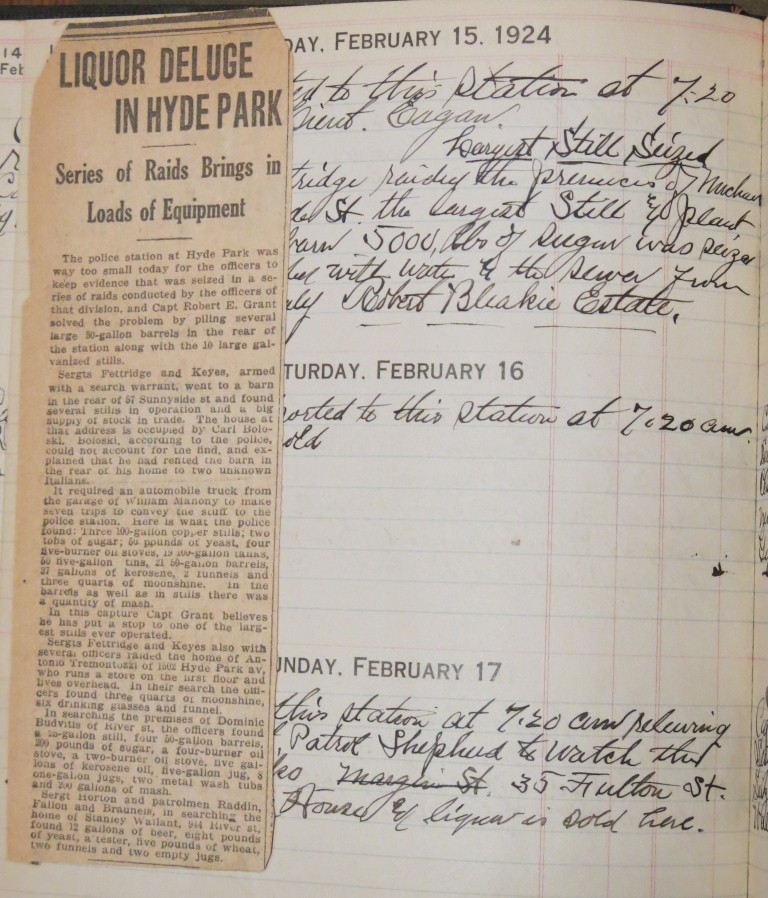
One interesting topic covered in the Grant diaries is Prohibition, including the police raids conducted during that period. For example, in an entry from Friday, 15 February 1924, he writes that “5000 lbs of sugar was seized,” following a mention of the “Largest Still Seized.” A newspaper clipping describing four raids that had recently occurred (and mentioning Grant’s name) is attached to this entry. This account captures the pride Grant must have felt on that day; it also serves as a snapshot of Prohibition-era Boston and the actions taken by law enforcement to enforce bans on alcohol. This story is not the only one of its kind described in Grant’s diaries, so there are certainly opportunities for further research into this topic contained in these pages.

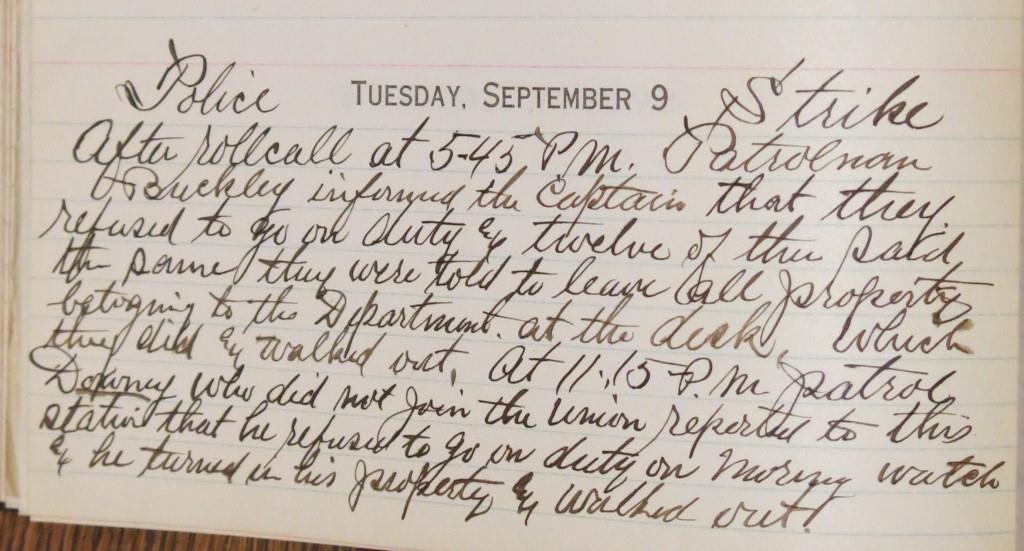
Grant also writes briefly about the Boston Police Strike of 1919. On Tuesday, 9 September 1919, he writes:

After rollcall at 5:45 PM, Patrolman Buckley informed the Captain that they refused to go on duty & twelve of them said the same they were told to leave all property belonging to the Department at the desk which they did & walked out. At 11:15 PM patrol Downey who did not join the union reported to this station that he refused to go on duty on morning watch & he turned in his property & walked out.

While Grant’s coverage of the police strike is brief, the MHS does hold other materials that offer some more details about the strike and the climate of the city during the strike. For instance, Dates, Data and Ditties: Tour of Duty, A Company, 11th Regiment Infantry, Massachusetts State Guard, During the Strike of the Boston Police, Nineteen Hundred and Nineteen, printed for members of the A Company in the aftermath of the strike, provides insight into the activities of the soldiers deployed to patrol the city during the strike. The book details incidents ranging from the violent, such as attempted assaults against women, to the mundane, such as giving directions to pedestrians at South Station.

In-depth studies of the strike help provide context for these materials. In A City in Terror, Francis Russell analyzes the context for the strike, the major players and events, and the aftermath of the strike.

The Grant diaries are an excellent example of the wide variety of research possibilities contained within the collections at the MHS. Researchers are welcome to visit the library and explore these opportunities.


This Week @ MHS

By Dan Hinchen

July is here and it is a busy month for teachers at the Society. This week, starting on Tuesday, 7 July, there is a three-day teacher workshop titled “Perspectives on the Boston Massacre.” The workshop includes a visit and tour to the Old State House, discussion with historians using historical documents, and suggestions for exploring the event further. Registration is required for the workshop with a fee of $35. Complete this registration form, or contact the education department at education@masshist.org or 617-646-0557.

On Wedensday, at noon, is a Brown Bag lunch talk called “Native Hawaiian Labor in a Global Economy: The View from Nineteenth-Century New England.” In this talk, Gregory Rosentahl of SUNY Stony Brook discusses the mansucript and archival sources he is currently using in his current research project. The talk is free and open to the public, so pack a lunch and stop on by!

And on Thursday, 9 July, there is an author talk taking place at 5:30PM. Join us as John Ferling of the University of West Virginia discusses his new book Whirlwind: The American Revolution and the War That Won It. In the book, Ferling attempts to balance social and political concerns of the period while examning the war itself. This event is open to the public. Registration is required at no cost, so please RSVP.

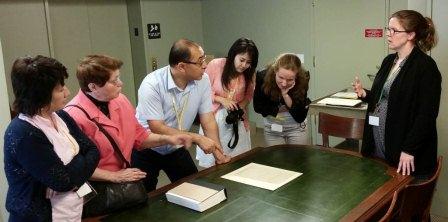
Finally, on Saturday, 11 July, stop by at 10:00AM for “The History and Collections of the MHS.” During this is a 90-minute docent-led walk through the public spaces at the MHS, visitors will learn about the history, collections, art, and architecture at the Society. The tour is free and open to the public. Parties of 8 or more should contact Curator of Art Anne Bentley in advance at 617-646-0508 or abentley@masshist.org. Small groups and individuals do not need to make arrangements beforehand. 


Incendiary Fun: 19th Century Toys for Boston Youth

By Kittle Evenson, Reader Services

As the school year draws to a close and students across Boston slip leisurely into the summer heat, I was inspired to look at the MHS collections through a more playful lens. As difficult as it can be to piece together a historical narrative of adolescence, I wanted to see what we might have on the most playful of subjects: toys. 

I found disappointingly few children’s artifacts or toys in the MHS collection. I did, however, find two items from the 19th century that brought a smile to my lips, and one or two questions to my mind. 

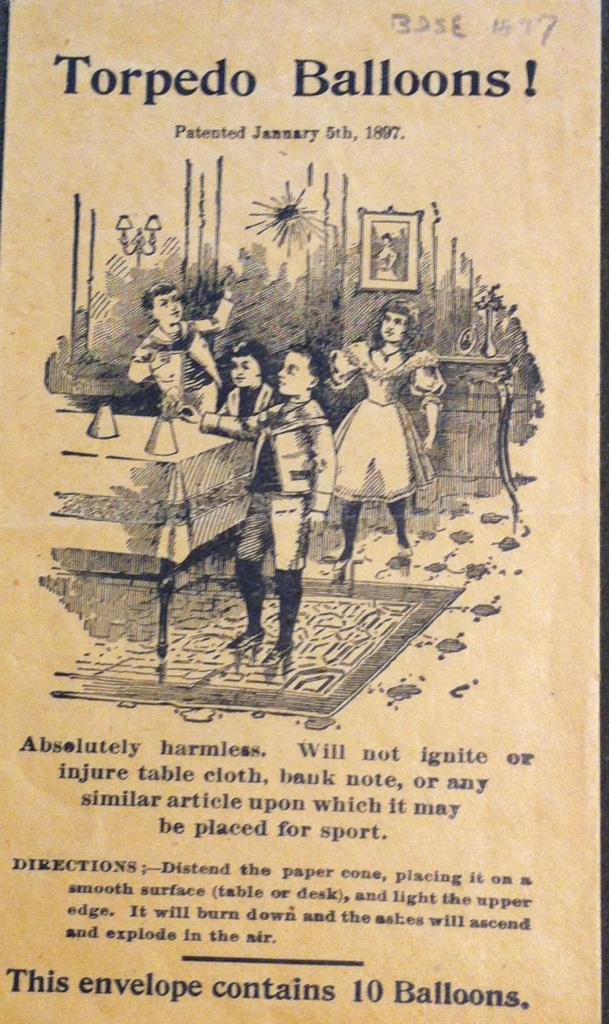
The first is a fascinating tease. An encasement for a toy dramatically named “Torpedo Balloons!”. If the name itself fails to ignite your excitement, the picture on the cover surely will. Dating to 1897, the envelop features four adolescents excitedly, yet purportedly harmlessly igniting bits of paper with a well-timed flame. Similar to fireworks, the “Balloons” are advertised to attract the budding pyrotechnic, with safety-conscious parents.


 Directions: Distend the paper cone, placing it on a smooth surface (table or desk), and light the upper edge. It will burn down and the ashes will ascend and explode in the air.

 As the boy in the foreground lights a “Balloon” with a match, ashes explode over his head. His unsupervised peers appear to be playing in a well-decorated formal dining room, with delicate furniture, portraits hanging in the background, and gas light fixtures on the walls. While the flying embers may enrapture the children, the advertisement reassures parents that no harm will befall their expensive possession (if not their children).

Absolutely harmless [it reads]. Will not ignite or injure table cloth, bank note, or any similar article upon which it may be placed for sport.

Though the envelope has been preserved in almost pristine condition, I was disappointed to discover that it no longer contains even a single “Balloon”.

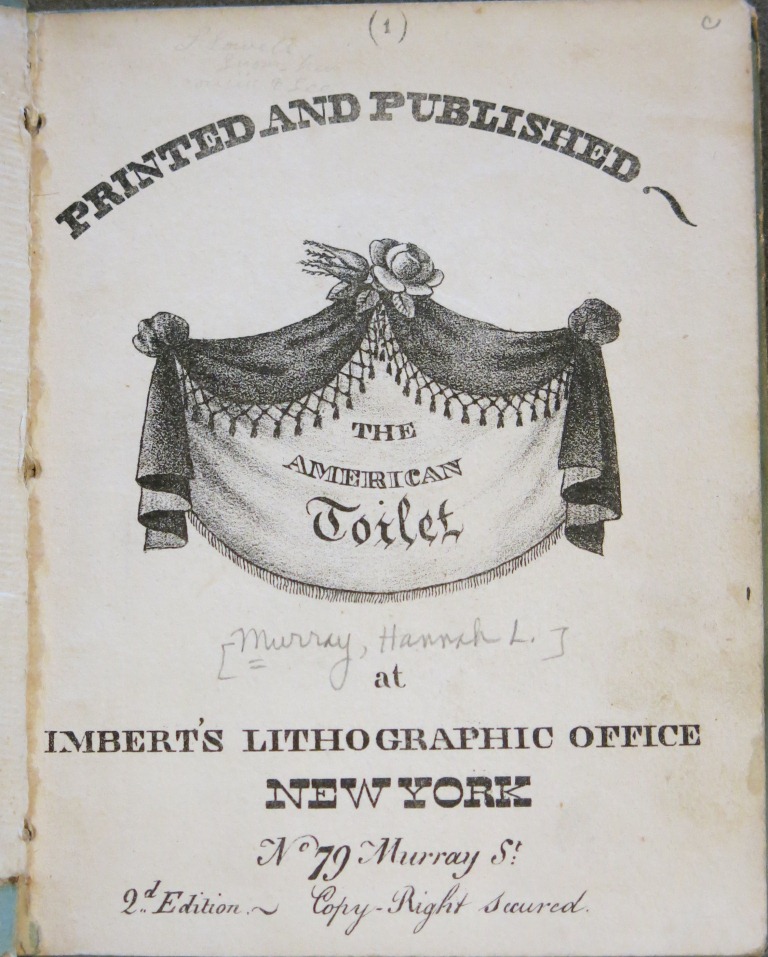
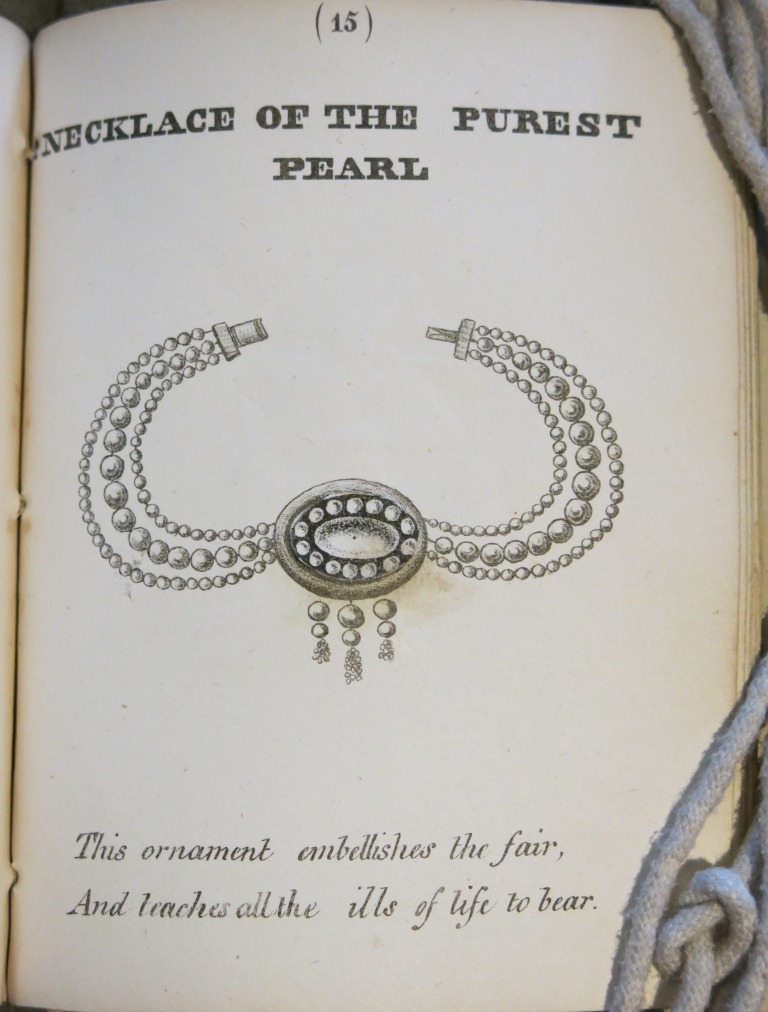
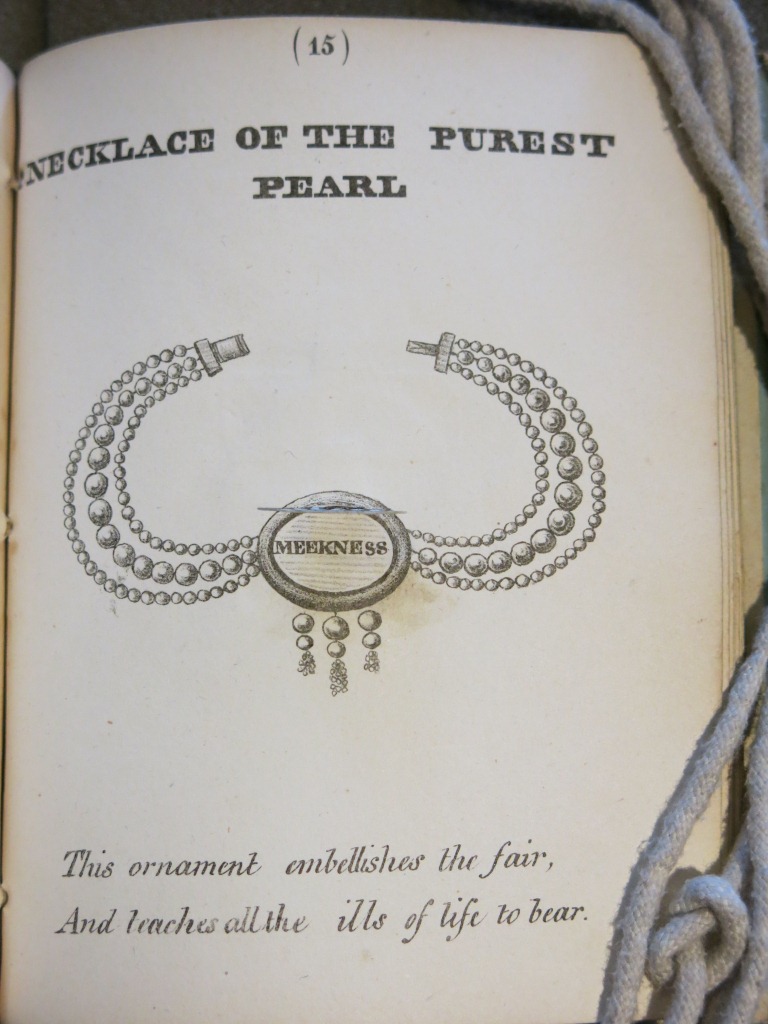
The second item I found is directed towards the girl we seen in the background of the “Torpedo Balloons!” cover image. The American Toilet, a small “conduct book” for young woman, uses emblematic illustrations to teach the reader moral precepts with regard to socially appropriate comportment and expectations.

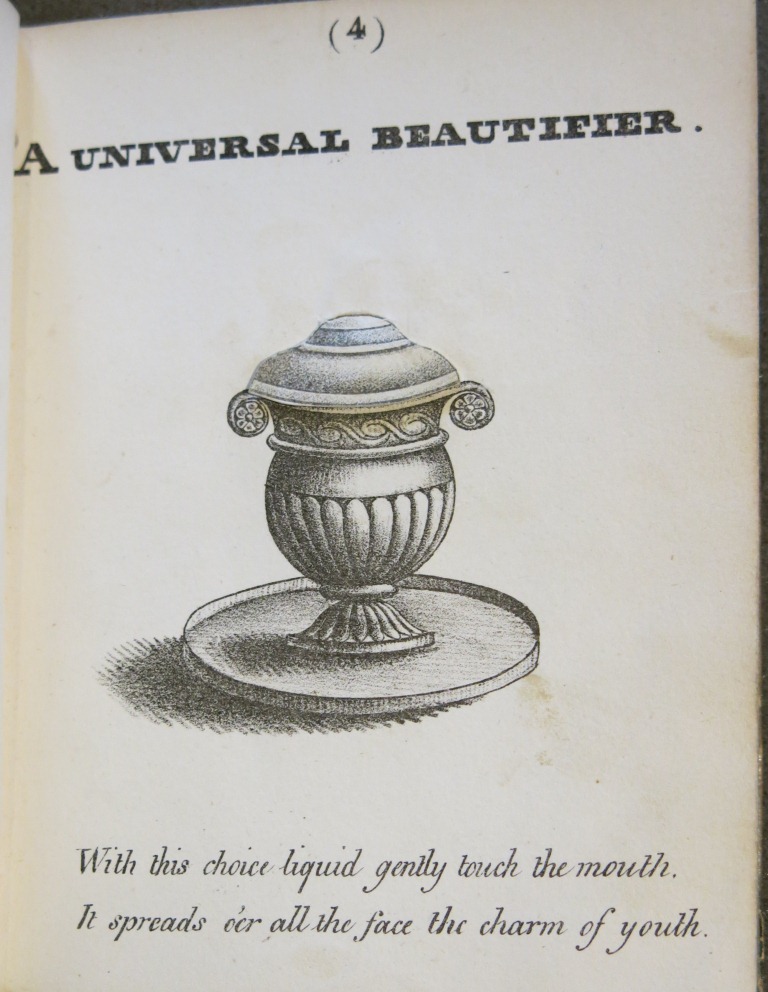
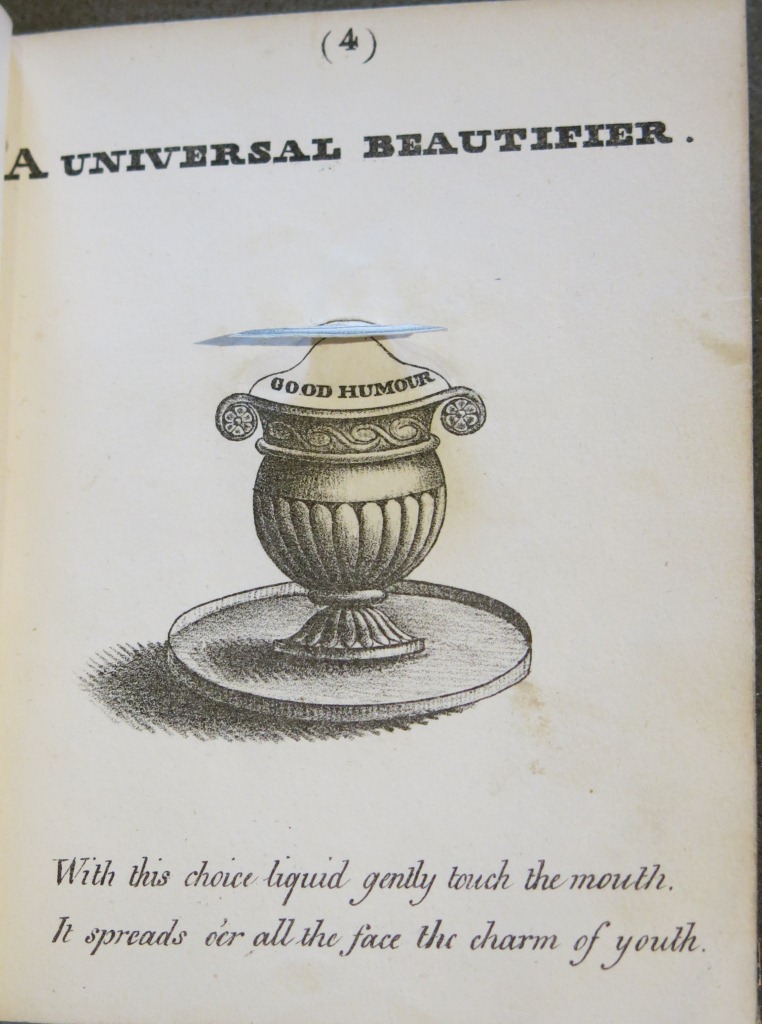
Hannah and Mary Murry’s The American Toilet was adapted from Stacey Grimaldi’s “The Toilet,” first published in London in 1822, and includes delicate illustrations of the materials often found on a woman’s dressing table. The book is an example of a flap book, referring to the bits of paper that can be lifted to reveal hidden messages throughout the pages.


caption: With this choice liquid gently touch the mouth. It spreads o’er all the face the charm of youth

The Toilet juxtaposes shallow desires for opulent jewelry and alluring, made-up lips, with attitudes of meekness and good charm. Girls were instructed at a young age that to be socially accepted and respected they must counter desires for beauty and glamour with overt modesty and unwavering deference. The work constantly reinforcing that girls should be seen and admired as implacably pleasant creatures, not engaged with as substantive individuals.

       and

caption: This ornament embellishes the fair, And leaches all the ills of life to bear

As engaging as the “Torpedo Balloons!” and The American Toilet are, it is important to note that they represent a very narrow experience of well cared for, educated childhood within Boston’s more affluent families. Just as adult narratives cannot be blindly generalized beyond class lines or economic boundaries; neither can children’s experiences be taken as monochrome. It is doubtful that the idyllic image of children in well-tailored clothes that adorns the “Torpedo Balloons!” packet would be mirrored in homes of less-wealthy children.

These are just a selection of our items at MHS pertaining to childhood; others include diaries and photographs that can expand our snapshot of youthful realities through personal writings, drawings, and images. If you are interested in viewing the “Torpedo Balloons,” The American Toilet, or any of our other collections in person, please contact the library or stop by for a visit.


This Week @ MHS

By Dan Hinchen

There are no events on the calendar this week at the Society. Please note that the library is closed on Friday, 3 July, though the exhibition galleries will remain open, 10:00AM-4:00PM. The MHS is closed on Saturday, 4 July. Normal hours resume on Monday, 6 July.

Happy Independence Day!

A Life in Bondage: The Narrative of Moses Grandy

By Wesley Fiorentino, Reader Services

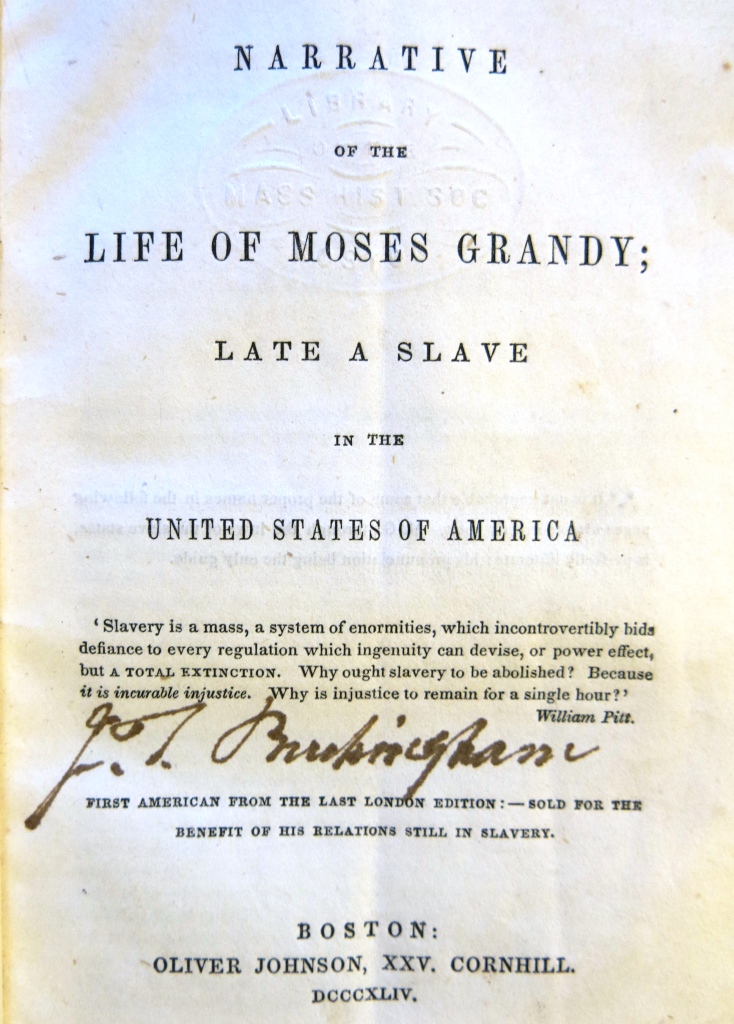
Fielding reference questions at the MHS often means I come across fascinating material that I might not have the opportunity to discover for myself.  One particular inquiry introduced me to Moses Grandy, an African-American born into slavery in about 1786 whose experiences during and after his bondage have fortunately been recorded for posterity.  The Narrative of the Life of Moses Grandy: formerly a slave in the United States of America is a disturbing but truthful account of one man’s suffering under forced servitude. Grandy’s narrative provides a firsthand insight into the lives of the men and women who lived in captivity.

The story of Grandy’s life, written down by noted abolitionist George Thompson and first published in 1843, became popular with the abolitionist movement both in the United States and abroad.  Grandy’s story, like a number of other slave narratives including those of Frederick Douglass and Solomon Northrup, served to illustrate for a wide audience the cruelties of slavery and the outrages endured by those kept in bondage.  Stories of this kind helped to spread the message of abolitionism far and wide in the decades prior to the American Civil War. 

Like many enslaved men and women, Grandy witnesses the break-up of his family when his siblings and father are sold away.  He recounts how his mother at times would hide some of her children to prevent them from being sold, but several of his brothers and sisters would be sold away never to see him again.  Grandy later witnesses the sale of his first wife.  When he protests her sale to the man who has purchased her, he is threatened at gunpoint and forced to watch her go.  As she is taken away, Grandy beseeches her new master to let him see her one last time.  “I asked for leave to shake hands with her, which he refused, but said I might stand at a distance and talk with her.  My heart was so full, that I could say very little.”  In addition to this heart-wrenching instance, Grandy describes in detail the atrocities endured by his fellow enslaved Americans, including beatings and malnourishment.  Grandy himself states that he was often half-starved for lack of proper meals. 

Grandy’s account also offers detail into some of the common practices of slaveholders and into the variety of responsibilities with which an enslaved individual may have been entrusted.  The narrative is an important historical source for studying the practice of “hiring out” slaves to work temporarily for different masters.  Moses is hired out by his master James Grandy at the age of ten.  He describes in detail some of the horrific incidents he experienced in the employ of various individuals, ranging from brutal beatings to being fed so little that he was forced to eat ground cornhusks.  One particular master who hires Grandy multiple times is described as a great gambler who would keep Grandy up for several nights in a row without sleep to wait on his gambling table.  In one case, Grandy writes that he “was standing in the corner of the room, nodding for want of sleep, when he took up the shovel, and beat me with it: he dislocated my shoulder, and sprained my wrist, and broke the shovel over me.”  A number of frightful incidents like this are described or referred to in the narrative, sometimes with Grandy as the victim and other times with him as a witness to similar instances of brutality.

However, Grandy also provides a valuable account of many of the tasks he performed at one time or another.  Grandy’s narrative provides a unique example of how enslaved men and women often became highly skilled laborers and artisans.  Grandy himself is managing ferry crossings at Sawyer’s Ferry in Camden, North Carolina by the age of fifteen.  He is eventually hired as a freightboat captain for several boats which navigate and transport goods on the Great Dismal Swamp Canal and the Pasquatonk River.  Grandy explains that he “took some boats on shares…I gave [the owner] one-half of all I received for freight: out of the other half, I had to victual and man the boats, and all over that expense was my own profit.” 

Grandy works a wide variety of other jobs as well, including the cutting of timber for the canal and working as a field hand.  Through these different tasks, Grandy is able to save up enough of his earnings to purchase his freedom.  However, he twice gives the money for his freedom to his respective masters and twice they keep his money and refuse to free him.  Ironically, it is one of the most brutal overseers described in his narrative who apparently expresses outrage over Grandy’s treatment and who connects him with a man who is willing to buy Grandy and help him earn his freedom.

The Narrative of the Life of Moses Grandy can be read in its first American edition, published in Boston by Oliver Johnson in 1844, here in the MHS reading room.  For those researchers who are unable to come to the MHS in person, Grandy’s narrative can be read through Project Gutenberg, as well as through the Internet Archive.


Voices of the Exhibition: Bostonians at the Centennial

By Hope Hancock, Hope College

One year ago, I embarked on my first major archival research project outside of the comfort of Hope College in Holland, Michigan, where I am an undergraduate student studying English literature, communication, and music.  The first stop on my journey was at the Massachusetts Historical Society (MHS) to connect with my research advisor, Professor Natalie Dykstra, and an MHS archivist, Anna Clutterbuck-Cook, who is a Hope alumna.

My research project, titled “Voices of the Exhibition,” is a series of four podcasts intended to bring the stories of different people who visited the Centennial Exhibition to life.  The Centennial Exhibition of 1876 was a world’s fair held in Philadelphia to commemorate the 100-year anniversary of the signing of the Declaration of Independence and was attended by 10 million people from around the globe, making it the highest attended world’s fair at that time.

Many diaries and letters of Exhibition-goers have been catalogued at the MHS and other Boston archives.  In searching through these archives, I found many interesting sources, but my favorite is the diary of Frank Dudley Chase, which currently resides in the collections at the MHS. 

Frank Dudley Chase was 16 years old when he visited the Exhibition, and in elegant penmanship he dutifully recorded everything he encountered while at the fair.  From the cost of his train ticket to elaborate descriptions of the exhibits, Chase left little about his journey out of his diary. 

Chase was a typical teenage boy who loved being outdoors and did not always like to do his chores.  He travelled from Dedham, Massachusetts to Philadelphia for the Exhibition and was at the Exhibition for five days from October 23 to October 28.  From descriptions of ammunition to meticulously painted foreign vases, Chase’s diary is a vivid record that provides a glimpse of what  exhibits and oddities attracted youthful Exhibition visitors.

On Tuesday, October 24, Chase wrote:

Had a heavy rain last night in the night.  Pleasant.  Visited Main building.  First went through U.S. dept.  Near So. Entrance of building were a number of large fancy mirrors.  Among these was a couple one concave; the other convex one showing an object unnaturally broad; the other unnaturally slim … Also saw an immense crystal of alum, weighing 9 tons, a 365 bladed pocket knife, a table knife 9 ft 6 in costing $1500 … the silk exhibit showing the eggs, butterflies, cocoons and raw silks … In the Brazilian department saw precious stones among them white topaz, amethyst and agate; collections of beetles and butterflies; a leather exhibit and a porcupine fish…

He and the rest of his group were undoubtedly eager to take in every facet of the Exhibition.  However, his diary provides more than a meticulous record of daily weather and exhibits: it is a window into Chase’s experience and the experiences of other teenagers who visited the Exhibition.

The Centennial Exhibition was a fair for the people.  It was designed to bring together Americans to celebrate independence and express their patriotism.  Furthermore, it provided an education tool that introduced Americans, like Chase, to cultures, inventions, and ideas that were brand new to them.

Before researching at the MHS, I was already able to recite many facts about the Exhibition.  I would not call myself an expert in every detail, but I knew a lot.  However, it was not until I read Chase’s diary that I fully understood the impact of the Exhibition on the American people.  On December 31, two months after visiting Philadelphia, Chase said it best when he wrote: “One great event distinguishes this year in my life, and that is my journey to the Centennial where I learnt more than I should have in many years of quiet life.”

As I look back on the past year, I am still so thankful for the experience I had at the MHS.  Not only did I find wonderful information in Chase’s diary, but I read the diary of George W. Ely, a young man who visited the fair, official addresses to the Centennial committee, and letters from prominent Boston citizens, such as members of the Saltonstall family and their friends. 

As an undergraduate student, I never thought that I would have the opportunity to do research at such a prestigious institution.  I cannot express enough the importance of the MHS to my education and professional development.

Listen to a podcast that features Chase’s diary, titled “Children at the Exhibition.” It is the second podcast in the four-podcast series, all of which can be found on my website at hopehancock94.wordpress.com.


Fathers’ Day: Louisa Catherine Adams and Joshua Johnson

By Amanda Mathews Norton, Adams Papers

Fathers have a tremendous impact on the lives of their children; and this is quite evident in the case of the Adams family. While John Adams and John Quincy Adams clearly and significantly influenced their children, I want to highlight the relationship of Louisa Catherine Adams with her father, Joshua Johnson. This relationship not only shaped Louisa’s upbringing, but indeed colored her entire life, and her relationship with the Adamses.

Joshua had moved to London before the Revolutionary War to forward his business interests, and during the 1790s served as the U.S. consul at London. Marrying an English woman, and raising his children in France and England, led some to question his patriotism and Louisa’s need to protect and defend her father’s honor and reputation is evident throughout her writings. This need not only grew out of Joshua Johnson’s long foreign residence but more especially because of her father’s financial circumstances at the period when she married John Quincy Adams. Just as she and John Quincy were married, her father’s business failed. Unable to provide the dowry he had promised and in debt, Joshua Johnson quickly took his family from London back to the United States to attempt to recover his losses. Louisa entered her marriage with the anxiety and shame that her husband and others would think that she and her father had conned John Quincy into marrying her with false promises; it was a sensitivity that never went away.

But for Louisa, her father had been entirely blameless, and this belief she also carried throughout her life. Fortune was unkind. His partners had cheated him. In her Autobiography, “Adventures of a Nobody,” Louisa reminisced:

The qualities of the heart and of the mind, excited a higher aim; and a romantic idea of excellence, the model of which seemed practically to exist before my eyes, in the hourly exhibition of every virtue in my almost idolized Father; had produced an almost mad ambition to be like him; and though fortune has blasted his fair fame; and evil report has assailed his reputation; still while I live I will do honour to his name, and speak of his merit with the honoured love and respect which it deserved— As long as he lived to protect them, his Children were virtuous and happy—amidst poverty and persecution.

Like many adults in times of sorrow or hardship, even at the age of 64, in her Diary in July 1839, she looked back with fondness and nostalgia for her childhood:

My Father! my Dear my honoured my revered Father! In the hour of sickness, of sorrow, of disappointment; memory carries me back to the days of my youth; when on the slightest complaint, I met thy sympathising tenderness, anxious solicitude, and affectionate indulgence to suffering and weakness; and the soothing encouragement which braced the nerves to fortitude, and the spirit to courage! Where in this world is thy likeness to be found! Thou wert not great, but thou wert good!!!

As we celebrate Fathers’ Day, this is yet another reminder that the emotions and relationships, particularly those of parent and child, remain familiar across the centuries.


This Week @ MHS

By Dan Hinchen

It is another quiet week at the MHS with only two items on the calendar. First up, on Wednesday, 24 June, is the MHS Fellows Annual Meeting & Reception. MHS Fellows are invited to the Society’s annual business meeting and reception. The meeting begins at 5:00PM and registration is required at no cost. Plesae call 617-646-0572 with any questions. This event is open only to MHS Fellows

And on Saturday, 27 June, if you find yourself strolling about the city and enjoying the new summer, why not stop by for a free tour? The History and Collections of the MHS is a free, docent-led, 90-minute tour that exposes visitors to all of the public spaces at the Society, while providing information about the art and architecture, history, and collections here. The tour is open to the public. Larger parties (8 or more), please contact Curator of Art Anne Bentley in advance at abentley@masshist.org or 617-646-0508.

Doctor & Artist Samuel W. Everett

By Susan Martin, Collection Services

The Everett-Boyle papers fill only half of a narrow box here at the MHS, but they include a lot of terrific material from these two interrelated families. One of the family members represented in the collection is Samuel Williams Everett (1820-1862), who served during the Civil War as a surgeon in the Illinois Infantry and later as brigade surgeon. (The Everett family is originally from Boston, which is why their papers happen to be here.)

Unfortunately, we don’t have any of Everett’s war-time correspondence—at least not intact. Some letter fragments obviously date from that time, but the only complete letters by him were written between 1835 and 1851. What the collection does contain, however, are many of his fantastic drawings, beginning when he was a teenager and continuing into the war years. Here are some of my favorites:


“Camp at Lamine river, near Otterville.”


“View up the Ohio at Cairo.”


“Fort Prentiss. Cairo.”


“Military Ball.”


It’s not just Everett’s artwork that makes his letters so entertaining. He was also a gifted storyteller. Even when narrating the mundane happenings of his life, he elaborated and exaggerated for comedic effect. In one letter from early 1851, he wrote about how his coat and some surgical instruments were stolen from his room, and the whole thing reads like a whodunit, complete with a whimsical “royal we”: “On that evil day the sun shone brightly, & we were tempted out to our dinner without a coat, which garment was left sweetly slumbering with the Case of Instruments in its pocket.” The story is illustrated in several panels, ending with an image of two empty nooses captioned: “View of the gallows, upon which the thieves are yet unhung.”

Everett’s description of his brother’s wedding is hilarious:

The parson retreated to avoid being knocked over in the rush of congratulation and kissing. The latter part, it was previously agreed, was to have been omitted at the particular request of the mother, the bride and the bridesmaids; but as in several rehearsals of the performance the rule had been relaxed, so it was at the ceremony and was extended to every young lady present; and repeated upon the discovery that one had been omitted.

(It was either at this wedding or shortly before that he met the bride’s cousin, his future wife, Mary Smith. He described her this way: “In spite of her common name, an uncommonly pretty girl.”)

In another letter, Everett related a humorous—though frightening—incident involving a runaway carriage, when he lost control of his horse’s reins as it raced down the street and sent bystanders scurrying for cover: “Sounds of ‘woe’ were raised from all quarters & sundry individuals appeared willing to sacrifice their lives in trying to stop the runaway, but they only stopped themselves upon re-considering the question.”

Other creative touches make his letters a real pleasure to read. When writing to his family, he addressed different paragraphs to different family members with headings like: “The Misses E.” “Anybody.” “Mrs. E.” “Ditto.” Along the top of one letter, he wrote a note that actually made me laugh out loud: “Nothing worth stopping to read in the street.”

Everett also had a talent for rebuses. Anyone care to take a stab at solving either of these in the comments section below? (Hint: the second snippet is from a published work not original to Everett.)

Everett was shot and killed at the Battle of Shiloh in Tennessee on 6 Apr. 1862, not even one year into his military service. Multiple sources, including The Medical and Surgical History of the War of the Rebellion, identify him as the first Union medical officer killed in action. His “talent for drawing” was noted in his obituary in the 1864 Transactions of the American Medical Association (pp.212-4).