This Week @ MHS

By Dan Hinchen

On Tuesday, 14 April, there is an Environmental History seminar taking place at 5:15PM. Join us as Joel Tarr of Carnegie Mellon University presents “Legacy Pollution Issues in Energy Development: The Cases of Manufactured Gas and Natural Gas.” Patrick Malong, Brown University, provides comment. Seminars are free and open to the public, though RSVP is required. You can also subscribe to receive advance copies of the seminar papers. 

And on Wednesday, 15 April, there is a Brown Bag talk, starting at noon, in which Mary Draper of the University of Virginia presents “The Urban World of the Early Modern British Caribbean.” Draper’s project examines the history fo the early modern British Caribbean through its cities and urban residents. This event is free and open to the public. 

Also on Wednesday is the fourth installment of the Lincoln & the Legacy of Conflict series which features John Stauffer, Professor of English and African American Studies at Harvard University. “Mourning Lincoln & Racial Equality” explores the responses of Frederick Douglass and other black and white abolitionists to Lincoln’s assassination and the degree to which it prompted Northerners to consider and accept full black citizenship. Registration is required for this event with a fee of $20 (no charge for Fellows and Members). Please RSVP. There will be a short reception beginning at 5:30PM with the program beginning at 6:00PM. 

Finally, on Saturday, 18 April, stop by the Society for a free tour. The History and Collections of the MHS is a 90-minute docent-led tour that explores all of the public spaces in the Society’s building on Boylston Street, touching on the history, art, architecture, and collections of the MHS. The tour begins at 10:00AM and is open to the public with no need for reservations for individuals or small groups. If would like to bring a larger group (8 or more) please contact Curator of Art Anne Bentley at 617-646-0508 or abentley@masshist.org. While you are here you will also have the opportunity to view our current exhibition, “God Save the People! From the Stamp Act to Bunker Hill.” 

Please note that the Society is closed on Monday, 20 April, in observance of Patriot’s Day.

Military Manuscripts at the MHS and Beyond

By Dan Hinchen

It is not uncommon for the MHS library to receive copies of new publications from authors that did research here. In fact, we have an entire set of shelves devoted to displaying this type of new publication. After some time on display, these volumes are typically moved to our closed stacks and then available by request. Less often, we receive a new publication from a researcher that we deem appropriate to move immediately into our reference collection.

We recently received a newly published book called Military Manuscripts at the State Historical Societies in New England (2014). This volume, put together by Paul Friday, provides extensive documentation of manuscript collections relevant to military history in New England. Each chapter shines a spotlight on one individual institution and provides detailed lists of manuscript collections that contain materials related to military matters.

Since I started working at the MHS in 2011, Mr. Friday’s face has been one of the more familiar ones in the reading room. Over the years he placed scores of requests to consult manuscript materials from myriad collections in our holdings. The result is a box-level, sometimes folder-level inventory of military-related papers that the Society preserves. The sources include a large variety of material types, from maps and charts to correspondence and orderly books to printed materials like broadsides. The materials he worked with encompass a large chronology, going back as far as the Pequot War of the 1630s all the way up to the Vietnam War.

The countless hours of work that Mr. Friday did result in extremely valuable identifications of military papers held here. From documenting a single letter by Gen. John Burgoyne in the Bromfield family papers, to identifying thirty-five boxes, seven volumes, and three oversize items in the Clarence Ransom Edwards papers.

In addition to identifying such relevant collections, Mr. Friday also provides explanations in each chapter about the various organization schemes used by the different institutions, catalogs available for researchers (online and physical), procedures for requesting materials, hours of operation, and so forth.

At the back of the volume there are four appendices made up of several glossaries and complementary information. Also, there are five separate indices and a section introducing them.

Because he used available finding aids and collection guides to locate collections with military papers, Mr. Friday acknowledges that each historical society holds additional relevant collections that did not have companion finding aids and so did not show up in the volume. Despite this limitation, the volume as a whole will surely prove a tremendous help for researchers performing primary source research into the military history of New England and the United States. 


This Week @ MHS

By Dan Hinchen

It is an active week here at the Society. Here is what is on tap.

Kicking things off on Monday, 6 April, is a special book launch featuring author David Grayson Allen and his new publication Investment Management in Boston: A History. This book explores the history of Boston’s evolution as a center of American money management, from early settlement to the twenty-first century. This event begins at 5:30PM and is open to the public. Please RSVP by calling 617-646-0578. 

On Wednesday, 8 April, stop by at noon for a Brown Bag lunch talk. This time around we have Jacqueline Reynoso of Cornell University presenting “When ‘the Fourteenth Colony’ Lost its Place: Quebec after 1776.” This event is free and open to the public. 

Also on Wednesday is the third program in the Lincoln & the Legacy of Conflict series. Join us as Martha Hodes, Professory of History – New York University, presents “Mourning Lincoln.” This event is open to the public with a fee of $20 (no charge for Fellows and Members). Registration is required so please RSVP. Reception begins at 5:30PM and the program begins at 6:00PM. 

And on Thursday, 9 April, begins “‘So Sudden an Alteration’: The Causes, Course, and Consequences of the American Revolution.” This conference continues on Friday and Saturday, 10 and 11 April and consists of a variety of sessions focused on discussion of academic papers circlated prior to the conference. While the conference is open to the public, registration is required to attend the various sessions

Kicking off the conference on Thursday evening is the keynote address given by Holton McCauslan, Professor of History at the University of South Carolina. McCausland’s talk, “‘Not Yet’: The Originality Crisis in American Revolution Studies” begins at 5:00PM and is followed by a reception, 6:00PM-8:00PM. All are welcome to attend. RSVP by email or phone 617-646-0568.

Please note that the library closes early at 3:30PM on Thursday, 9 April, and remains closed on Friday and Saturday, 10-11 April. Normal hours resume on Monday, 13 April. 

Untangling North Atlantic Fishing, 1764-1910, Part 2: Anglo-American Treaties regarding the Fishery, 1783-1818

By Andrea Cronin, Reader Services


As discussed in a prior post, Great Britain previously held claim to the fish in the North Atlantic. American negotiators successfully secured the right to fish the North Atlantic in the post-Revolution negotiations at Paris in 1783:

It is agreed that the People of the United States shall continue to enjoy unmolested the Right to take Fish of every kind on the Grand Bank and on all the other Banks of Newfoundland, also in the Gulf of Saint Lawrence and at all other Places in the Sea, where the Inhabitants of both Countries used at any time heretofore to fish … American Fishermen shall have Liberty to dry and cure Fish in any of the unsettled Bays, Harbors, and Creeks of Nova Scotia, Magdalen Islands, and Labrador.

As you can see, successful treaty negotiations in 1783 allowed the Americans to retain the right to fish in the region, and also to use British North American coastal lands for drying and curing, allowing them to better preserve their catches.

Yet, British impressment continued despite the stipulation that United States citizens “continue to enjoy unmolested the right to take fish.”  British maritime strength relied on the ability to force able seamen of any nation into service to fight its wars and replace the dead and deserters. Well aware of the injustice of the practice, the United States House of Representatives submitted a report entitled Legislative Provision Necessary for the Relief of American Seamen Impressed into the Service of Foreign Powers on 25 February 1796. The report’s proposals were twofold: relieve impressed seamen and provide documentation of citizenship. The House committee promoted “a provision for support of two or more agents, to be appointed by the Executive, and sent, the one to Great Britain, the other to such places in the West-Indies, where the greatest number of British ships of war may resort, and to continue there for such time as the President may deem necessary.” This plan did not cease the practice of impressment. British economic sanctions against the United States and increasing American outrage regarding impressment led to the War of 1812.

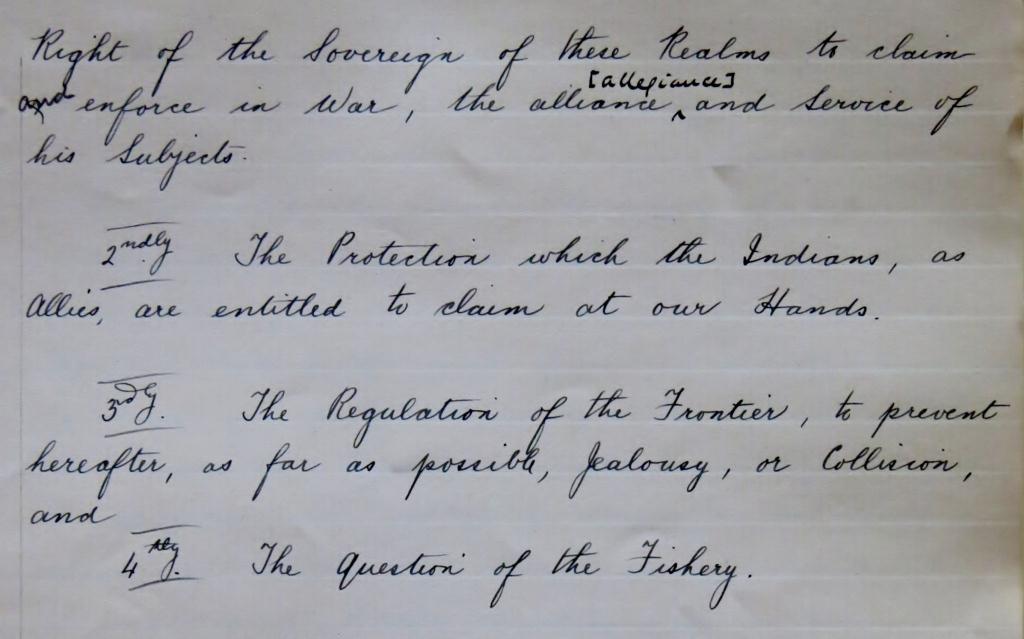
Following the British victory, the Treaty of Ghent in 1814 reversed much of the previous agreement regarding fishing rights made in 1783. Chief negotiator John Quincy Adams, Secretary of the Treasury Albert Gallatin, and statesmen Henry Clay, James A. Bayard, and Jonathan Russell met with Lord James Gambier, Doctor William Adams, and Under Secretary of State Henry Goulburn in Ghent, Belgium in 1814 to negotiate a peace. The British vied for retention of gains made during the war while Americans held fast to pre-war boundaries and rights. In manuscript copies of Henry Goulburn’s correspondence held at MHS, the British negotiator outlines the important topics for discussion: British maritime rights, Indian protection, establishing borders, and fishing rights. While the third article of the Treaty of Ghent stipulated the restoration of prisoners of war, the British retained the right to impress men into maritime service.

Anglo-American land and sea disputes may have continued ad nauseam without the circumstances and consequential agreements following the War of 1812. The end of the Napoleonic wars in 1815 reduced British impressment of American seamen. The Rush-Bagot Treaty of 1817 restricted naval armaments from the Great Lakes and Lake Champlain. The Treaty of 1818 resulted in the solidification of the 49th parallel as the northern land boundary between the United States and British North America. The British confirmed the United States’ right to fish the coast of Newfoundland, Magdalen Islands, and Labrador and to dry and cure in unsettled Newfoundland and Labrador. In exchange, “the United States hereby renounce for ever, any Liberty heretofore enjoyed or claimed by the Inhabitants thereof, to take, dry, or cure Fish on, or within three marine Miles of any of the Coasts, Bays, Creeks, or Harbours of His Britannic Majesty’s Dominions in America.” These agreements established important borders that remain today. This middle ground agreement between Great Britain and the United States held for nearly two decades before resuming contestation.


“More fool than Knave”: Dr. George Logan and the Logan Act

By Amanda A. Mathews, Adams Papers

Over the last few weeks the Logan Act, a bill passed by Congress and signed by President John Adams in late January 1799 has been widely discussed in the national news. Here at the Adams Papers, work has just begun on Adams Family Correspondence, volume 13, in which Dr. George Logan, whose actions provoked this legislation, is a major topic of conversation for the Adamses on both sides of the Atlantic.

In September 1798, tensions between France and the United States were running high. The specter of war loomed large as the revelation of France’s bribery attempt in the XYZ Affair and continued attacks on American vessels led to a buildup of American armed and naval forces with growing chants of “millions for defense, but not a sixpence for tribute.” It was in this climate that from their place in Berlin, John Quincy and Thomas Boylston Adams reported on the arrival of Logan in Europe. John Quincy detailed that Logan was claiming to be an envoy representing the Democratic-Republican Party, which opposed John Adams’s administration. At first refused a passport into France, Logan continued to represent himself as officially representing the United States while waiting in the Netherlands, and was eventually granted permission to enter France and given audiences with members of the French government to discuss the differences between the two nations. Thomas summarized his views on Logan—“a villain & a traitor to his Country.”

After Logan returned to the United States in November, he met with President Adams to discuss what he had learned from his meetings with the French government and to convince Adams that the French had peaceful intentions. Abigail’s nephew, William Smith Shaw, serving as John’s secretary, reported to the First Lady, who had remained in Quincy: “[Logan] then said, that he had just come from France and that he had the pleasure to inform the president that the directory had altered their conduct respecting America and had become more pacifick. Why then, said the president, have they not repealed their decrees against our commerce? here Logan stammered and said they were making preparations to do it.” John next asked if Logan believed that France would faithfully maintain a new treaty with the US, and he answered affirmatively claiming “the firm and united conduct of the Americans had proved to the directory the impolicy of their conduct.” Shaw reported that this response made John “burst into a broad laugh.” Adams continued his questioning, as Logan became increasingly uncomfortable until he “seemed to want some lurking place like the Turtle to draw in his head and to hide his face.” From this report, Abigail ultimately concluded in a letter to her husband that Logan was “more fool than Knave.”

Whether fool or knave, hero or villain, the Federalist controlled Congress had no patience with his meddling and passed the act prohibiting unauthorized private citizens from negotiating with foreign governments on behalf of the United States. The law has been in force ever since.


This Week @ MHS

By Dan Hinchen

On Tuesday, 31 March, come in at 5:15PM for an Early American History Seminar called “Frontiers and Geopolitics of Early America.” This installment is presented by Patrick Spero of Williams College with Kate Grandjean, Wellesley College, providing comment. The seminar is free and open to the public though an RSVP is required. You can also subscribe to receive advance copies of the seminar papers. 

Then, on Wednesday, 1 April, pack a lunch and come by at noon for a Brown Bag talk given by Krista Kinslow of Boston Univesity. Ms. Kinslow will discuss her current research project, “Contesting the Centennial: Civil War Memory at the 1876 World’s Fair.” As always, this brown bag talk is free and open to the public and starts at 12:00PM. No fooling!

Also on Wednesday, 1 April, is the second installment in the Lincoln & the Legacy of Conflict Series. Join us as author and editor Richard Brookhiser presents “Founders’ Son: A Portrait of Abraham Lincoln,” the title of his newest book. Registration is required for this event with a fee of $20 (no charge for Fellows and Members). The events begins at 6:00PM with a pre-talk reception starting at 5:30PM. 

On Thursday, 2 April, is the next Biography Seminar, this time featuring Dave Sobel, author of Longitude and Galileo’s Daughter, in conversation with Susan Ware. The seminar is free and open to the public though an RSVP is required. You can also subscribe to receive advance copies of the seminar papers. The program begins at 5:30PM. 

And on Saturday, 4 April, we have two items on the calendar. First is our weekly tour, the History and Collections of the MHSa 90-minute docent-led walk through our public rooms. The tour is free, open to the public, with no need for reservations. If you would like to bring a larger party (8 or more), please contact Curator of Art Anne Bentley at 617-646-0508 or abentley@masshist.orgWhile you’re here you will also have the opportunity to view our current exhibition, “God Save the People!” which explores events leading up to the American Revolution.

Finally, on Saturday afternoon, starting at 1:00PM is “Begin at the Beginning: Boston’s Founding Documents.” This is the second of our lively MHS/Partnership of Historic Bostons co-hosted discussions, this time focusing on John Winthrop’s journal. The discussion is open to all, though the discussion group is limited to 15; available on a first come first served basis. Links to the documents are available at the registration site. (Registration for this discussion group is coordinated by the Partnership of Historic Bostons).

The Unstoppable Anna Maria Mead Chalmers

By Susan Martin, Collection Services

As a manuscript processor here at the MHS, I have the opportunity to meet new people every day. Well, okay, most of them died a long time ago, but that doesn’t make them any less interesting! One of the best parts of processing and cataloging a new collection is getting to know the personal stories behind the letters, diaries, and other papers. I almost always uncover something unexpected.

Case in point: a small collection recently donated to the MHS consists primarily of letters written by Sarah Louisa “Louly” (Hickman) Smith to her sister Anna Maria. Now, I knew that Louly had become a published poet in her teens before her untimely death at the age of 20, and her letters reveal a remarkable young woman. But I was also curious about Anna Maria. The collection contains letters written to her, but none by her, so she seemed more elusive.

The first clue I had about her life was her name. She was born Anna Maria Campbell Hickman on 23 July 1809. Simple enough so far, but it gets trickier. She married three times (and outlived all her husbands): first a Mr. Otis, then Mr. Mead, and finally Mr. Chalmers. For those of you at home keeping score, that would make her Anna Maria Campbell Hickman Otis Mead Chalmers. (She’s generally referred to as Anna Maria Mead Chalmers.)

The more I learned about Anna Maria’s life, the more interesting it became. Originally from Newton, Mass., she studied under some of the best teachers in the Boston area and spent a year with an aunt and uncle in Savannah, Ga. before marrying a young Boston lawyer named George Alexander Otis, Jr. in Feb. 1830. Unfortunately her husband died of consumption the following year when their son was only seven months old. George’s death was followed closely by that of her beloved sister Louly on 12 Feb. 1832.

In the mid-1830s, Anna Maria lived in Newton with her mother and young son (her father had died in 1824) and wrote several children’s books for the American Sunday-School Union. She met and married the Rev. Zachariah Mead, a Virginian, moving with him to Richmond in 1837. The couple had two sons and a daughter: Edward C., William Z., and Anna Louisa Mead. Zachariah died (also of consumption) on 27 Nov. 1840, and Anna Maria, still just 31 years old, was now twice widowed and the mother of four young children.

For about a year, she took over Zachariah’s editorship of the Southern Churchman, to which she had often contributed, before selling the paper and embarking on arguably the most significant chapter of her life. On 4 Oct. 1841, she opened a boarding school for girls in Richmond, which she would run for 12 years to great acclaim. During her tenure, hundreds of girls were educated in subjects as wide-ranging as history, literature, theology, the sciences, mathematics, languages, music, art, etc., all in accordance with Christian principles. An 1842 advertisement in the Southern Literary Messenger described the school’s mission this way: “to form the female character for its high duties here and its still higher destination hereafter.” Anna Maria also continued to write devotional fiction and articles.

Tragedy struck again when her youngest child and only daughter, three-year-old Anna Louisa Mead, died on 4 Dec. 1843. Her mother followed four years later. So, by the 1850s, Anna Maria had buried her parents, her sister, two husbands, and a daughter. She retired as schoolmistress of “Mrs. Mead’s School” and, on 3 Jan. 1856, at the age of 46, married her third husband, David Chalmers. He was a widower and a member of the Virginia House of Delegates, and he owned a large Halifax County plantation.

As a wealthy planter, David Chalmers was, unsurprisingly, an enslaver, and Anna Maria became “a true Virginia matron.” How did she feel about the South’s so-called “peculiar institution”? According to her son Edward in his comprehensive 1893 biography, she opposed slavery and often spoke out against it, but took no active part in the fight for abolition. She preferred to leave the matter to God. And while her husband advocated secession, she dreaded the coming war between the states. With very good reason, it turned out: the Civil War would find her with one son serving in the Union army, another in the Confederate army, and all of her northern property under threat of confiscation.

Her oldest son, George Alexander Otis (1830-1881), was a surgeon with the 27th Massachusetts Volunteers and the U.S. Volunteers. Her third and youngest son, William Zachariah Mead (1838-1864), fought for the Confederacy and was killed on 14 May 1864 in the Battle of Resaca, Ga.

Anna Maria traveled north in 1863 to protect her property there and stayed in New York until the end of the war. In 1865, she returned to Virginia, where she would spend years helping the poor, educating formerly enslaved people, and writing. She died on 8 Dec. 1891, outliving her third husband by 16 years and her oldest son George by ten, and survived by only one of her children, Edward Campbell Mead (1837-1908).

In her 82 years of life, Anna Maria Mead Chalmers was many things: a writer, an editor, a teacher, a philanthropist; a sister, a mother, and the wife (and widow) of a lawyer, a minister, and a farmer; a Northerner and a Southerner. It’s remarkable to find so much of American history all rolled up into one person!

This Week @ MHS

By Dan Hinchen

On Tuesday, 24 March, come in at 5:15PM for a seminar from the Immigration and Urban History series. Come listen as Thomas Chen from Brown University discusses “Remaking Boston’s Chinatown: Race, Place, and Redevelopment after World War II.” Jim Vrabel, author of A People’s History of the New Boston will be on-hand to provide comment. Seminars are free and open to the public;  RSVP requiredSubscribe to receive advance copies of the seminar papers.

Looking for some lunchtime learning? If so, come in on Wednesday, 25 March, for “Allegiance and Protection: The Problem of Subjecthood in the Glorious Revolution, 1680-1695.” This Brown Bag talk is presented by Alex Jablonski, State University of New York at Binghamton, and is free and open to the public. So pack a lunch and come on down!

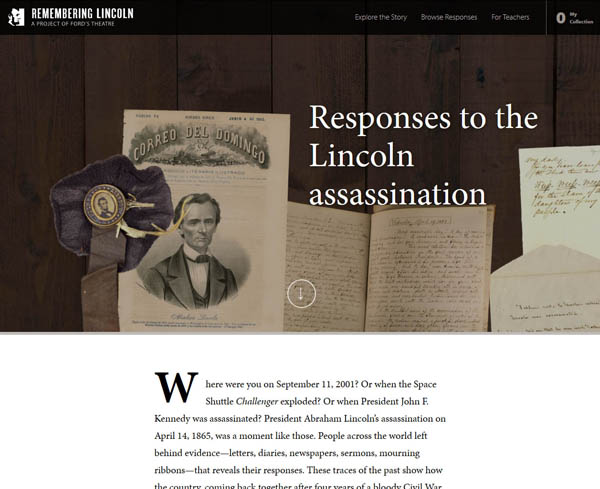
And on Thursday, 26 March, join us at 6:00PM for the first event in a series called Lincoln and the Legacy of Conflict. “A Civil Conversation” is an author talk and conversation featuring James McPherson and Louis Masur, facilitated by Carol Bundy. The program is open to the public at a fee of $20 (no charge for Fellows and Members). Registration is required; please RSVP. A pre-talk reception begins at 5:30PM.

Part 2 of Lincoln and the Legacy of Conflict takes place on Saturday, 28 March, this time taking the form of a Teacher Workshop. “Emancipation & Assassination: Remembering Abraham Lincoln” will highlight digital resources available from the MHS and Ford’s Theatre, Lincoln-related treatures from the Society’s collections, and discover methods for teaching Lincoln’s life and legacy. A fee of $25 includes lunch and materials. For more information, contact the education department at education@masshist.org or 617-646-0557. To register, complete our Registration Form and send it to the education department at education@masshist.org.

Lastly, there is also a tour on Saturday, 28 March. Beginning at 10:00AM, The History and Collections of the Massachusetts Historical Society Tour is a 90-minute docent-led walk through our public rooms. The tour is free, open to the public, with no need for reservations. If you would like to bring a larger party (8 or more), please contact Curator of Art Anne Bentley at 617-646-0508 or abentley@masshist.org.

While you’re here you will also have the opportunity to view our current exhibition, “God Save the People!” which explores events leading up to the American Revolution. 

Newly Digitized Photograph Collection

By Peter K. Steinberg, Collection Services

Collection Services at the Massachusetts Historical Society has recently created a collection guide for, and fully digitized, the 5th Massachusetts Cavalry Regiment carte de visite album, ca. 1864-1865 (Photograph Collection 228).

The 5th Massachusetts Cavalry Regiment was a “colored volunteer” regiment active from 9 January 1864-31 October 1965. Formed at Camp Meigs, Readville, Massachusetts, was commanded by some notable sons of Massachusetts including Charles Francis Adams Jr., Henry S. Russell, Charles Pickering Bowditch, and Henry Pickering Bowditch. The regiment saw some action in the war, notably in a battles which took place at Baylor’s Farm and the Siege of Petersburg in Virginia.

This collection consists of a photograph album containing 46 carte de visite photographs of officers from the regiment. In addition to those named above, the regiment included Edward Jarvis Bartlett, Daniel Henry Chamberlain, Patrick Tracy Jackson, and others. The album includes a two-page handwritten index which identifies all but one of the photographs. Each image appears on a page beautifully bordered, as can be seen in the examples presented here.

The cover of the album, also stunning, is embossed: “Col. H. S. Russell. 5th Mass Cavalry” and features the original, still-functioning brass clasps to keep the album closed. Henry S. Russell (1838-1905), an 1860 graduate of Harvard University, served several ranked positions in the Union Army reaching Lieutenant-Colonel of the 2nd Massachusetts Infantry and Brigadier-General of the 5th Massachusetts Cavalry. In 1864, Russell married Mary Hathaway Forbes, the daughter of the influential Boston businesman, railroad magnate, and abolitionist John Murray Forbes, and was a cousin of Robert Gould Shaw, Colonel of the 54th Massachusetts Volunteer Infantry Regiment.

Another family connection, but this time within the 5th Massachusetts Cavalry Regiment, were the brothers Henry Pickering Bowditch (1840-1911) and his younger brother Charles Pickering Bowditch (1842-1921). Both were Harvard educated; Henry being a physician and physiologist as well as dean of Harvard Medical School, and Charles becoming a financier, archaeologist and linguistics scholar.

This is the seventh fully digitized Civil War photograph album at the Massachusetts Historical Society. The MHS has additional fully digitized Civil War materials available, as well. Further Reading: Morse, John T., Jr. “Henry Sturgis Russell.” In Sons of the Puritans: A Group of Brief Biographies. Boston: American Unitarian Association, 1908:153-162.