By Andrea Cronin, Reader Services


By Andrea Cronin, Reader Services
By Susan Martin, Collection Services
The MHS recently acquired a small volume of records of a cemetery in Holliston, Mass. that contains some fascinating information about this 19th-century town. The volume is not the original record book, which has apparently been lost, but a manuscript copy made by local historian John Mason Batchelder between 1894 and 1916. The loss of the original book makes this copy that much more significant, since it may contain records that exist nowhere else.
The North Burying Yard of Holliston, now known as the Old North Cemetery (or the Old Indian Cemetery), was established on an acre of land bought from Henry Lealand in 1801. Subscribers purchased lots for their families, and the appointed clerk, Samuel Bullard, recorded “the death and age of all persons buried in any of the Lots in said yard.” The burials listed in this volume date from 1803 to 1876. The entries are brief, but include some interesting details.
Many of the townspeople interred here are members of the Bullard, Eames, and Lealand families. Included is Civil War soldier Emerson Eames of the 22nd Mass. Regiment, who died on 22 Oct. 1862. (His remains have since been moved to the U.S. Soldiers’ and Airmen’s Home National Cemetery in Washington, D.C.) The cemetery also contains several veterans of the American Revolution, including Aaron Eames (d. 1827), Reuben Eames (d. 1818), Timothy Lealand (d. 1843), Ephraim Bigelow (d. 1834), and Aaron Pike (d. 1848). In recognition of their military service, some or all of these men received new headstones from the U.S. government in 1916, as noted by Batchelder. Pike’s story is especially poignant: he was buried as a town pauper at the age of 82 and apparently had no grave marker at all before 1916.
Also buried in the pauper section is the “child of an Irish family,” who died in 1838 at 16 months. Elsewhere we find 14-year-old Isaac Allard, a victim of typhoid fever in 1860; the unnamed baby daughter of a “single woman”; and poor James Bigelow, who “came to his death by his neckhandkerchief being caught in the turning lathe.”
Sadly but not unexpectedly, most family lots hold the remains of a husband and wife and any of their children that died young. For example, Eleazer Bullard and his wife Patty are buried with their children: Luke (10 mos.), John (3 days), Peter Parker (3 years), and Martha (4 weeks). Grown children of Eleazer and Patty were presumably buried elsewhere.
The Old North Cemetery also contains the graves of a few black residents of the town, including Jane Muguet, a state pauper and “colored girl” who died in 1846 at 16. Reuben Titus was another pauper who “lived with Wm Lovering until aged and infirm” and died at about 90 in 1855. The earliest recorded death of a black resident is that of Rose, “negrowoman of Isaac Cozzens,” in 1812.
After copying the records, Batchelder compared his book against the headstones in the cemetery, checking off the names he found there. About half of the names are not checked off, indicating burials recorded by the cemetery clerk but graves unmarked at the time of Batchelder’s visit. (These names are also missing from the Old North Cemetery name index compiled by the Holliston Historical Society in July 2011.) There are several possible explanations for this discrepancy: an error in the original record book or the transcription, a grave that was moved, or one that was never marked in the first place, such as those of the paupers. If the original volume really is lost, this copy may be the only record of the final resting places of Isaac, James, the four Bullard children, Jane, Reuben, Rose, and many others of Holliston.
By Nancy Heywood, Collection Services
What do you remember learning about the Boston Massacre? Did you learn the event took place outside the Old State House (at that time called the Town House) in Boston? Was it presented to you as a key event leading up to the American Revolution? Do you remember learning that five people (including Crispus Attucks) lost their lives? If you think of a visual image, do you think of the engraving by Paul Revere depicting townspeople being fired upon by an orderly row of British soldiers? Are you curious to explore how various primary sources describe the chaotic confrontation that took place on 5 March 1770?
It is interesting to read the words of people who were either at the scene or were able to comment on the overall atmosphere of the town after the event. Thanks to funding from the Massachusetts Society of the Cincinnati, the MHS has created a new web presentation, Perspectives on the Boston Massacre, featuring letters, pamphlets, diary entries, legal notes, and engravings relating to the Boston Massacre.
Some examples of the manuscripts that are available for browsing and reading include diary entries written by merchant John Rowe who observed, “the Inhabitants are greatly enraged and not without Reason” and a letter dated 6 March 1770 by Loyalist Andrew Oliver, Jr. who wrote, “Terrible as well as strange things have happen’d in this Town.” The website also includes printed materials; some convey the Patriot perspective of the event (A Short Narrative of the Horrid Massacre in Boston and On the Trial of the Inhuman Murderers) and some the Loyalist view (A Fair Account of the Late Unhappy Disturbance at Boston).
One section of the new web presentation focuses on visual representations of the Boston Massacre. Seven prints of the event, as well as one painting showing the same location in Boston in 1801, are available for close examination. Website visitors can use a comparison tool to view any two of the featured images side by side.
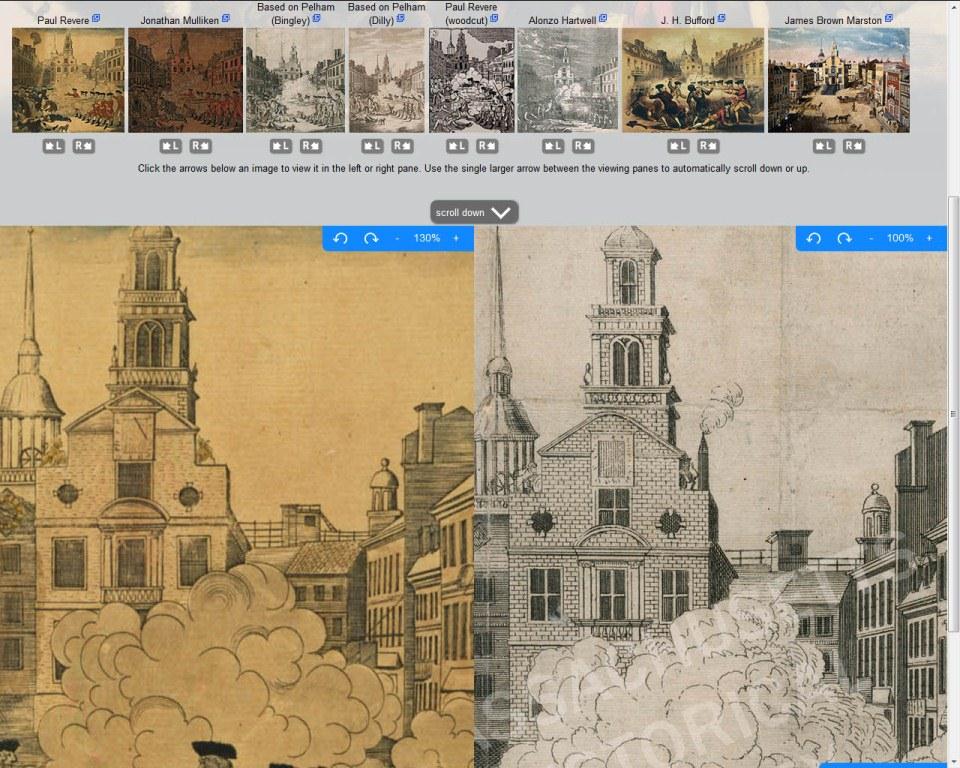
The website also features some selected documents relating to the two legal cases (the trial of Captain Thomas Preston and trial of the eight soldiers). John Adams served as one of the defense attorneys and the website includes page images of some of John Adams’s handwritten legal notes as well as links to the digital edition of The Legal Papers of John Adams, Volume 3, edited by L. Kinvin Wroth and Hiller B. Zobel, part of the Adams Papers Editorial Project.
The Boston Massacre was recognized as a pivotal event and supporters of the Revolutionary cause organized anniversary commemorations. The website includes published versions of orations given between 1771 and 1775 by noted figures including James Warren and John Hancock as well as a manuscript copy of an oration given by someone on the opposite side of the political spectrum who ridiculed many Patriot leaders.
Please visit www.masshist.org/features/massacre.

By Dan Hinchen
This is the final week of the year with events here at the Society. Here is what is on tap.
On Monday, 8 December, there is a special public program presented by students from Boston University. “Making History: King Philip’s War in Documents & Artifacts” is the culmination of a semester-long project on the bloody conflict between English colonists and Native Americans, using letters and diaries, sermons, early printed books, and objects from the war. The event begins at 6:00PM and is free and open to the public. Please RSVP.
Then, on Tuesday, 9 December, come by at 5:15PM for the next installment of the Environmental History seminar series. “Water Rights in the American Southwest” is presented by Steven Rudnick of UMass – Boston with author Megan Kate Nelson (Ruin Nation: Destruction and the American Civil War) providing comment. Seminars are free and open to the public; RSVP required. Subscribe to receive advance copies of the seminar papers.
And on Thursday, 11 December, there is a special author talk starting at 6:00PM. Writer-explorer Sheldon Bart presents “Race to the Top of the World: Richarc Byrd & the First Flight to the North Pole,” and will discuss his recent book of the same name. This talk is open to the public, registration required. There is a $10 fee (no charge for Fellows and Members). Please call 617- 646-0560 or click here to register. Pre-talk reception begins at 5:30PM.
Last but not least, on Saturday, 13 December, come by for a free tour beginning at 10:00AM. The History and Collections of the MHS is a 90-minute docent-led walk through our public rooms. The tour is free and open to the public with no need for reservations. If you would like to bring a larger party (8 or more), please contact Curator of Art Anne Bentley at 617-646-0508 or abentley@masshist.org. While you’re here you will also have the opportunity to view our current exhibition, “Letters and Photographs from the Battle Country: Massachusetts Women in World War I.”
We hope to see you one last time before the new year!
By Dan Hinchen
After a long weekend to be thankful for we have a heavy list of events this week at the Society. First, stop by Tuesday evening, 2 December, for “Threads that Bind: Irish Linens, Immigration, and the Consumer Atlantic World.” This installment of the Early American History Seminar is presented by Kristin Condotta of Tulane University with Marla R. Miller, UMass – Amherst, providing comment. The program is free and open to the public; RSVP required. Subscribe to receive advance copies of the seminar papers. The talk begins at 5:15PM.
On Wednesday, pack a lunch and stop by at noon for a Brown Bag talk that begins at noon and is presented by Seth Meehan of the Insitute for Advanced Jesuit Studies, Boston College. “Denominating a People: Congregational Laity, Church Disestablishment, and the Struggles of Denominationalism in Massachusetts, 1780-1865” is free and open to the public.
And on Wednesday evening, beginning at 6:00PM is the MHS Felllows and Members Holiday Party. Members and Fellows who wish to attend, please RSVP. This event is open only to MHS Fellows and Members.
Thursday evening, 4 December, features the second seminar of the week, this time from the department of the History of Women and Gender. “One’s Own Branch of the Human Race: Frances Watkins Harper, Anna Dickinson, and Frederick Douglass” is presented by Sharon Hartman Strom, University of Rhode Island, with Julie Winch, UMass – Boston, providing comment. The seminar begins at 5:30PM and is free and open to the public, RSVP required. Subscribe to receive advance copies of the seminar papers.
Finally, come by on Saturday, 6 December, for a free tour. “The History and Collections of the Massachusetts Historical Society” is a 90-minute docent-led walk through our public rooms. The tour is free and open to the public with no need for reservations. If you would like to bring a larger party (8 or more), please contact Curator of Art Anne Bentley at 617-646-0508 or abentley@masshist.org.
While you’re here you will also have the opportunity to view our current exhibitions, “Letters and Photographs from the Battle Country: Massachusetts Women in World War I” and “The Father of His Country Returns to Boston, October 24, 1789.”
By Amanda A. Mathews, Adams Papers
On October 3, 1789, President George Washington issued a proclamation, calling for November 26 of that year to be celebrated as a day of thanksgiving by the whole nation now independent and united under a new Constitution. Exactly 74 years later, President Abraham Lincoln, seeing the nation embroiled in a bitter, devastating, and deadly Civil War, recognized that there was still much to be grateful for as “the Most High God, who, while dealing with us in anger for our sins, hath nevertheless remembered mercy. It has seemed to me fit and proper that they should be solemnly, reverently and gratefully acknowledged as with one heart and one voice by the whole American People. I do therefore invite my fellow citizens in every part of the United States, and also those who are at sea and those who are sojourning in foreign lands, to set apart and observe the last Thursday of November next, as a day of Thanksgiving and Praise to our beneficent Father who dwelleth in the Heavens.”
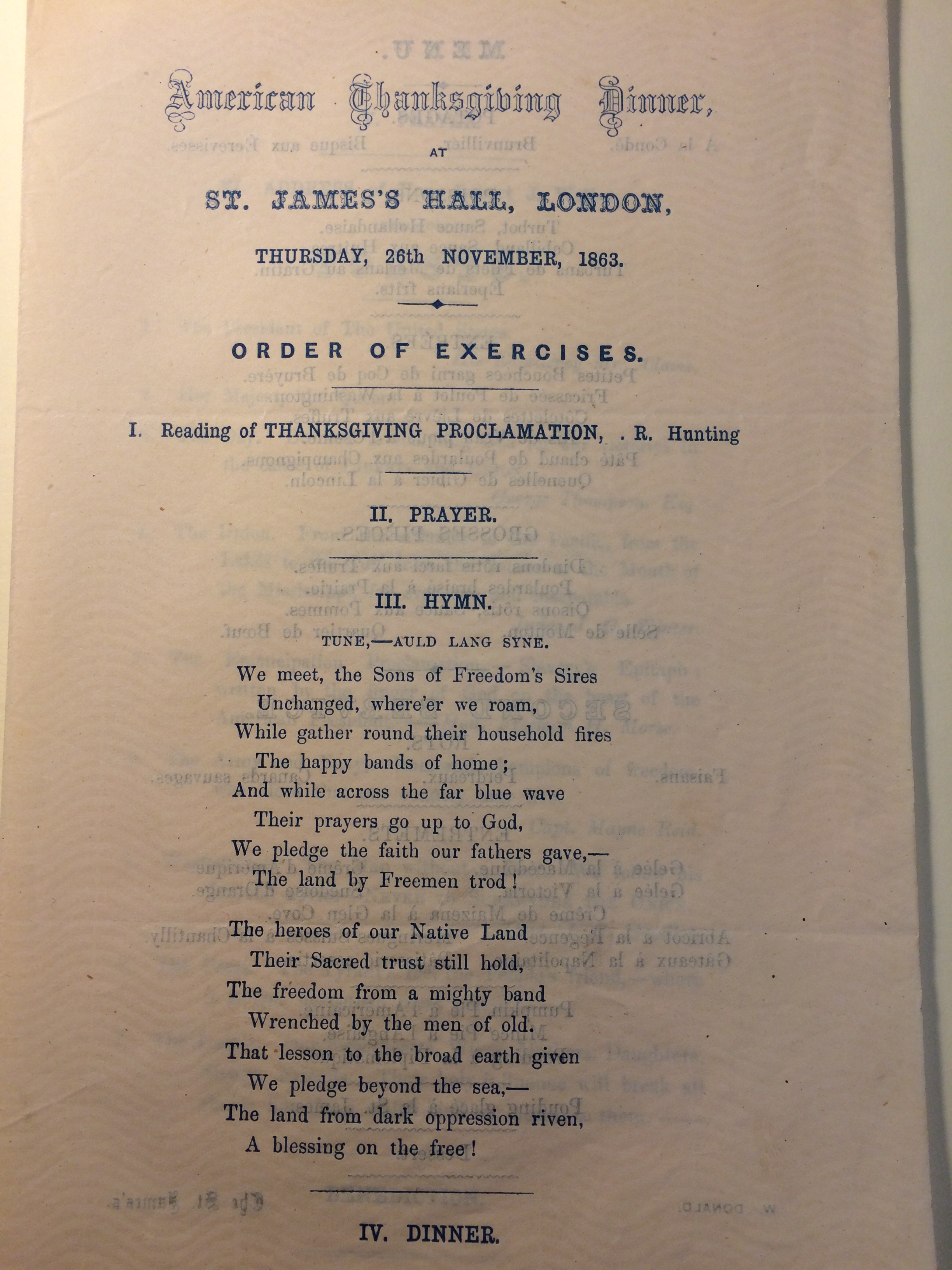
Charles Francis Adams was one of those Americans sojourning in foreign lands as the United States minister to Great Britain. Invited by a group of Americans living in London to attend a Thanksgiving Day celebration and give a toast to President Lincoln, the dinner opened with a reading of Lincoln’s proclamation. No devotee of the president, Adams noted that the proclamation was “very good, and…therefore never emanated from Mr Lincoln’s pen.” In his diary, Adams summarized his toast and feelings on the honoree:
“The press here had sneered at the notion of a thanksgiving in the midst of a desolating civil war. I thought it a good opportunity, whilst avoiding the topic of victories over our fellow countrymen which necessarily take a shade of sadness, to explain more exclusively the causes of rejoicing we had in the restoration of a healthy national solidity in the government since the announcement of the President’s term. I went over each particular in turn. The result is to give much credit to Mr Lincoln as an organizing mind, perhaps more than individually he may deserve. But with us the President as the responsible head takes the whole credit of successful efforts. It certainly looks now as if he would close his term with the honor of having raised up and confirmed the government, which at his accession had been shaken all to pieces. And this a raw, inexperienced hand has done in the face of difficulties that might well appall the most practised statesman! What a curious thing is History! The real men in this struggle have been Messr [William] Seward and [Salmon] Chase. Yet the will of the President has not been without its effect even though not always judiciously exerted.”
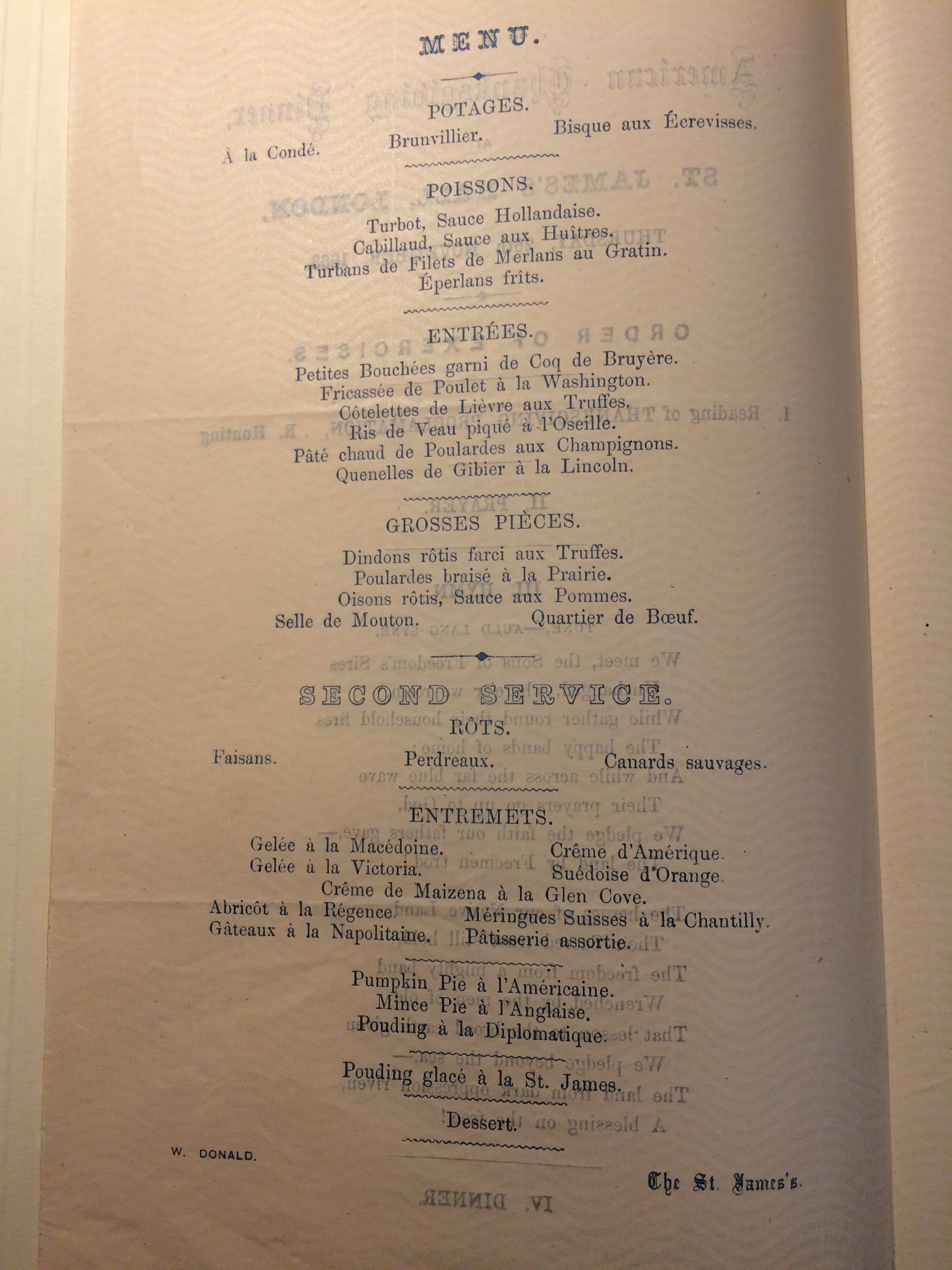
Shown here is the program for that Thanksgiving Day celebration. Since 1863, Americans around the world have stopped in late November each year for a day of joy and thanksgiving with friends and family, as we will tomorrow. Wishing you and yours a Happy Thanksgiving!

By Dan Hinchen
Before the long holiday weekend ahead we have two events at the Society this week. On Monday, 24 November, join us for a Brown Bag lunch talk given by Nathan Jérémie-Brink, Loyola University Chicago. “‘Gratuitous Distribution’: Distributing African American Antislavery Texts, 1773-1850” is free and open to the public and begins at noon. And on Tuesday, 25 November, we have the next installment in our Immigration and Urban History Seminar series. Stop by at 5:15PM for “‘Greetings from the Levee!’: Labor and Leisure on the Streets and Docks of Postbellum New Orleans.” This talk is presented by Theresa McCulla of Harvard University with Lynnell Thomas, UMass-Boston, providing comment. Seminars are free and open to the public; RSVP required. Subscribe to receive advance copies of the seminar papers.
Please note that the Society is closed on Thursday, 27 November, for Thanksgiving. The library is also closed on Friday and Saturday, 28 and 29 November. The exhibition galleries are open on Friday and Saturday, 28 and 29 November. Take a break from battling the shopping crowds and come in for some history! There is also a free tour taking place on Saturday, 29 November, at 10:00AM.
By Elaine Grublin
The following excerpt is from the diary of Stephen Greenleaf Bulfinch.
In public affairs, I record the startling discoveries of election fraud in New York, & of a conspiracy against the gov’t in Indiana. Next Tuesday decides the election of President; – & my preference is for Mr. Lincoln, alike from personal approval, – as he is identified with the cause I believe to be right, and as I think that a change of system now would delay, instead of advancing, the return of peace.
The election decided by a very great majority in favor of Mr. Lincoln, & the magnanimous & Christian manner in which he has expressed himself thereon, – are makers of history. There was a very [-elty] illumination here in honor of the result. Last news is of Sherman’s leaving Atlanta, supposed for Savannah & Charleston. At present there is going on in Boston a great ‘Sailors’ Fair,’ for the establ. of a naval hospital; My girls have attended, – through kindness of Uncles T. & H. & we propose to see some more of its wonders.
Public attention is now fixed on the daring march of Sherman through the interior of Georgia – & the recent capture of the Florida in the waters of Brazil, with the danger of misunderstanding with that power. Hope dawns, but we fear lest we hope too much.
By Dan Hinchen
We are kicking things off this week with a rare Sunday event, an MHS blue moon, if you will. Beginning at 1:30PM on Sunday, 16 November, is a special screening of The Better Angels, a film about Abraham Lincoln’s childhood.The screening is followed by a discussion led by Professor John Stauffer of Harvard University, current long-term research fellow at the Society. This event takes place at Landmark Theaters in Kendall Square (355 Binney Street, One Kendal Square, Cambridge, MA 02139).
On Monday, 17 November, join us at 6:00PM for an author talk given by Lindford D. Fisher of Brown University and J. Stanley Lemons of Rhode Island College. Decoding Roger Williams: The Lost Essay of Rhode Island’s Founding Father documents the interdisciplinary approach to cracking Williams’ handwritten code. There is a $10 fee (no charge for Fellows and Members). Please call 617-646-0560 or click here to register.
And on Tuesday, 18 November, come by for an Environmental History Seminar given by Derek Lee Nelson, University of New Hampshire. “The Ravages of Teredo: The Historical Impacts of Marine Wood-boring Worms on American Society, Geography, and Culture, 1865-1930” begins at 5:15PM and is free and open to the public. Robert Martello of Olin College of Engineering provides comment. Please RSVP if you plan to attend. Also, you can subscribe to receive advance copies of the seminar papers.
Last but not least, on Saturday, 22 November, there is another free tour at the Society. “The History and Collections of the MHS” is a 90-minute docent-led walk through our public rooms. The tour is free and open to the public with no need for reservations. If you would like to bring a larger party (8 or more), please first contact Curator of Art Anne Bentley at 617-646-0508 or abentley@masshist.org. While you’re here you will also have the opportunity to view our current exhibitions, “Letters and Photographs from the Battle Country: Massachusetts Women in World War I” and “The Father of His Country Returns to Boston, October 24, 1789.”
By Anna J. Clutterbuck-Cook, Reader Services
In late October of 1915, as the days in New England grew shorter and the temperatures colder, twenty-seven-year-old Mildred Cox Howes of Brookline, Massachusetts, boarded a train with her husband, Osborne “Howsie” Howes, and headed west. Between 22 October and 14 November 1915 the couple traveled to California, where they attended the Panama-California Exposition in San Diego and the Panama-Pacific International Exposition in San Francisco. As was her habit, Mildred carried with her a line-a-day diary in which she recorded their movements, travel times, meals, friends met along the way, and sights seen.
Despite the fact that Mildred had recorded in early October spending time rolling bandages at a local hospital, presumably to be sent overseas, her own life was largely untouched by the reality of war in Europe. While England and the continent were digging in for the war to end all wars, the United States was in an expansionist, celebratory mood. Having recently flexed its imperialist muscles in the Spanish-American and Philippine-American wars (1898-1903), in 1914 the United States finally saw the completion of the Panama Canal (1903-1914) which dramatically increased the speed of an ocean voyage from the Atlantic to Pacific coasts of North America, saving ships nearly eight thousand miles of travel around Cape Horn. The Panama-California and Panama-Pacific International expositions were a message to the world regarding the United State’s new place on the world stage, as well as an opportunity for San Francisco, particularly, to celebrate its reconstruction following the devastating 1906 earthquake.
Mildred’s diary is spare, but does provide readers with a sense of the nature of upper-middle-class travel during the early twentieth century, before widespread adoption of the automobile. The Howes left Brookline on Tuesday, 22 October by the 12:34 train for Chicago. Mildred reported a “very pretty” ride through the Berkshires. Arriving in Chicago the following morning, they spent the day in Chicago visiting friends, dining out, and attending a garden show that Mildred described as “not much good.” Departing on an evening train, the Howes passed through Kansas and New Mexico, reaching the Grand Canyon a week after leaving home.

The Grand Canyon was not yet a national park (it would be dedicated in 1919), but nonetheless a popular tourist attraction. “About 10- we started & walked down to the plateau 5 miles & very steep,” Mildred wrote, “A guide & mule met us there …I rode up. Howsie walked. Fine. Wonderful views.”
The Howes reached San Diego the following day, after a morning spent traveling by train across the desert to Los Angeles, and then changing trains for the trip south to San Diego. They spent three days in San Diego, sunbathing at Coronado Beach, visiting the Panama-California Exposition, and driving down to Tijuana for a day (“Most amusing & just like a book”).
Departing from Coronado Beach by motorcar, the couple drove through Murietta Springs, Riverside, Pasadena, Los Angeles, arriving in Santa Barbara on Monday, November 1st. The automobile appears to have been as much for pleasure as transport, as Mildred repeatedly describes having “motored around” the cities they pass through, including a detour up to the top of Mt. Rubidoux, today a city park. Mildred also lists the names of the hotels at which the couple stay, often luxurious locations such as the Mission Inn (Riverside) and the Potter Hotel (Santa Barbara). When they arrive by train in San Francisco, they take up residence at the newly-constructed Palace Hotel, about three miles from the exposition — located between the Presidio and Fort Mason in what is today the Marina District.

“First [day] at the exposition – cleared off into a lovely day,” Mildred reported on November 4th. “Saw the manufactural palace & fibral arts… Dined at the hotel & went out again. Took a chair & looked at the illumination & listened to the bands.” Mildred and Howsie remained in San Francisco for a week, taking in the exposition and exploring the area. On exposition days, they arrived mid-morning and stayed until dinner, sometimes returning in the evening. On Saturday, Mildred reported going to the cinema to see “On Trial” (“very good & exciting”); on Sunday they took a Packard car and drove to Palo Alto for lunch with friends. On Tuesday they went to see Houdini perform at the Orpheum.

Twenty days after leaving Boston, Mildred and Howsie packed and, after a final morning at the fair, left at 4 o’clock on an eastbound train, traveling through Nevada to Ogden, Utah, and on across Wyoming and Nebraska at a brisk pace; they reached Chicago after three days’ steady travel, stopping the day to visit the art museum and stretch their legs. Boarding the train in Chicago they discovered friends Jessie and Frank Hallowell, and John Balcheder, also headed for Boston. By Sunday, November 14th, they were home once more.
Briefly factual in tone, Mildred’s diaries reveal only glimpses of her subjective experiences as a traveler, but nonetheless strongly evoke the rhythms of early-twentieth century travel for modern readers. If you are interested in this, and other diaries, kept by Mildred Cox Howes, you are welcome to visit or contact our library to access the collection.
**Photographs from Henry Cabot Lodge, Jr. Photograph Collection: Grand Canyon of the Colorado (#183.2043); Lotta’s fountain in front of the New Palace Hotel (#183.2022); Crowds at the Golden Gate Park (#183.2027).