Guest Post: Searching for the Federalist Party in Massachusetts

By Kyran Schnur, Hopkinton High School

I plan to be a professional historian, but I had this nagging worry that sifting through a bunch of historical documents could be a mind-numbing slog that would turn me off of the subject I love so much. Thanks to the Massachusetts Historical Society, I now know I’m in this for the long haul. I had so much fun looking through old letters, speeches, and newspaper publications. Every text seemed to be an appeal from the long-dead author, saying, “Hear me! Know my story!” It was a thrilling experience to hear the perspective of contemporaries and draw my own conclusions.

Once I was shown around the building and told how to navigate the collection, I felt right at home. There is such a welcoming atmosphere, and I really felt the satisfaction of learning from the material, rather than simply completing an assigned project. I could assign real value to my work, and I wasn’t treated like a child. I really enjoyed working on my own investigation, alongside like-minded people, in an environment in which I felt completely at ease. During my visits I was delighted to see other young people doing the same kind of thing. The staff always took me seriously, and was always ready to help if I had a question. Until now I had never used microfiche, but within two minutes the reference librarian had me set up and I knew all I needed to know to use it. I could even take pictures of the old documents and email them to myself so I could do work at home.

My project was an investigation of just what happened to the Federalist party after the Revolution of 1800, the first major turnover of power in our government’s history. Usually we are taught that this defeated party, woefully out of touch with public opinion, faded into obscurity quickly after being defeated by Thomas Jefferson, apparently the dashing savior of the republic. The sources I looked over showed a very different story of a party that raised its standard against what they saw as misgovernment and staged a strong, if brief, political comeback.

My most invaluable resource was a collection of the letters by the arch-Federalist Harrison Gray Otis in the aftermath of the disastrous Hartford Convention. I actually came upon it by accident while looking through a collection of Massachusetts letters for a specific speech. The letters form a plea by Otis to posterity, people like us, to not let the name of Massachusetts be blackened by the misrepresentation of its conduct by the rest of the country. After watching a rival get elected governor and listening to that man’s denouncement of his own state during the War of 1812, he laments:

Hereafter it will be too late to blot out the blot made by His Excellency upon the historic page, by alleging that his speech was intended merely to chime with the slang of the day. It will be answered … that the accused party in the Legislature quailed under the pungent rebuke from the chair, and that members of the Convention continued to be dumb as sheep before their shearer … will not the rising generations of this State burn with shame and indignation when it shall constantly be thrown in their teeth by the rising generations of other States, that their base blood has crept to them through ancestors who silently admitted themselves to be stigmatized as outlaws from the “American Family!”

It was the discovery of documents such as this that helped me to develop a real connection to the project, unearthing old misconceptions and hearing age-old voices as directly as I possibly could. The MHS archives gave me a wonderful opportunity to experience historical research first hand. Even now that my fellowship is over I intend to go back and continue my research. We are so lucky to have access to these documents in Massachusetts and this organization, and I hope other people will take advantage of them as I did.


**The MHS has awarded the John Winthrop Student Fellowship since 2013. This fellowship encourages high school students to make use of the nationally significant documents of the Society in a research project of their choosing.

“Use the Elevated!”: The Boston Elevated Railway Promotes its Services in 1926

By Anna J. Clutterbuck-Cook, Reader Services

On July 1st, riders on the Massachusetts Bay Transit Authority (MBTA) rail and bus system saw fare increases that brought the cost of a single local bus ride to $1.60 and a single rapid transit (“T”) ride to $2.10. In light of this change, and the ongoing discussion within the Boston metropolitan area — as well as across the country — about the place of mass transit in the fabric of our lives, I thought it would be timely to look back at the history of Bostonians transit options.

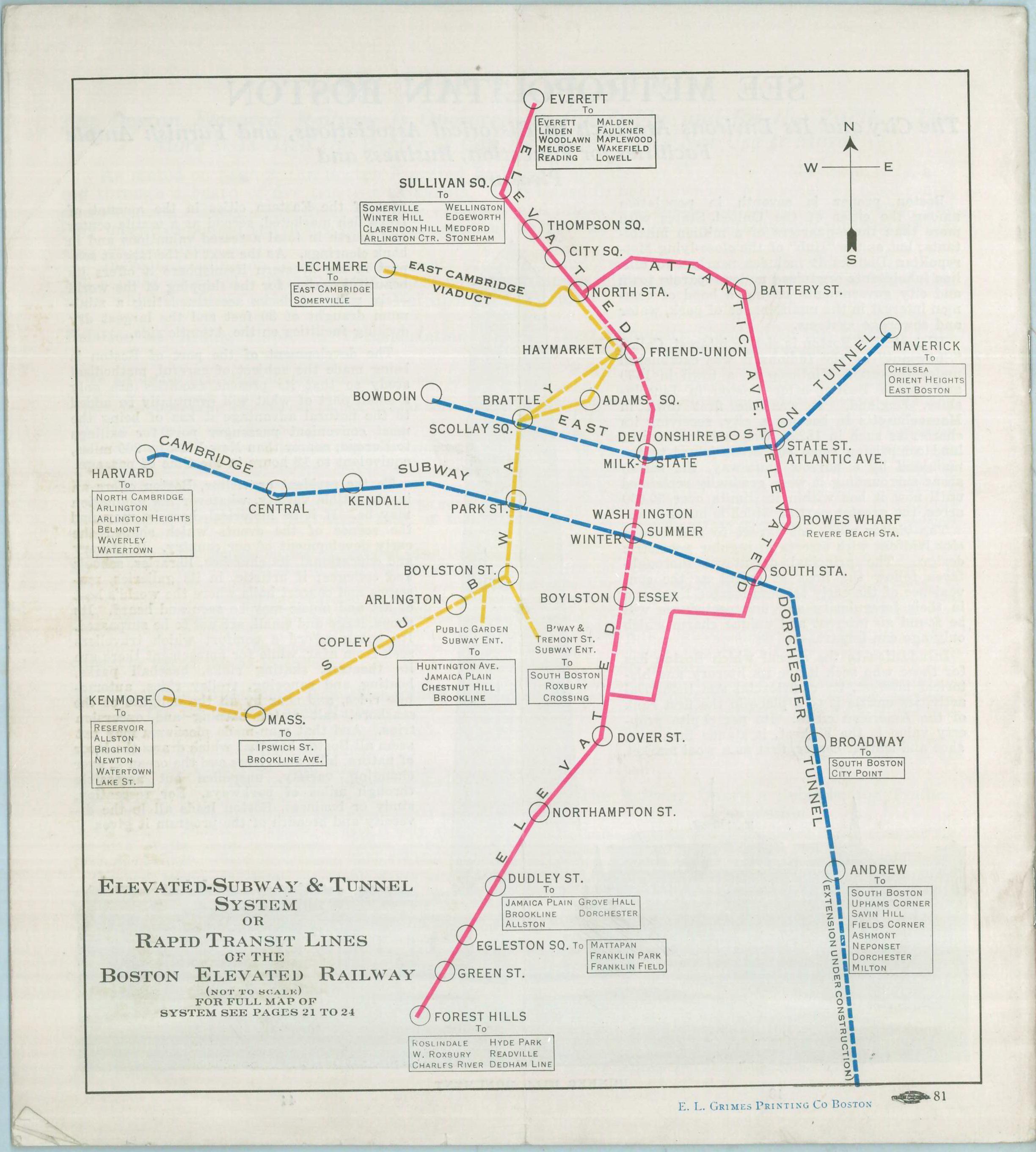
The history of “mass” transportation in the Boston area actually begins much earlier than one might assume, with the commencement of stagecoach service between Boston and Cambridge in 1793. The nineteenth century saw an expansion of horse-drawn omnibuses and railcars, then a conversion to electric trolley lines in the late 1800s. This shift came about in part due to organized opposition to the harsh treatment of the working horses. The 1890s also saw the construction of the first subway tunnel in the United States, Boston’s Tremont Street Subway completed in 1897. By the 1920s there were hundreds of miles of streetcar, elevated, and subway tracks wending their way through Boston, many of them run by the Boston Elevated Railway Company. In 1926, the Elevated issued a Guide and Information Book for riders which offers us a glimpse at what public transit was like almost a century ago.

In 1926 the fare for a single ride on the local rail and bus lines in Boston was ten cents, or $1.30 in today’s currency (adjusted for inflation). As today, the company struggled to make needed improvements in service on the income these fares produced. In a section of the pamphlet titled, “USE THE ELEVATED,” the company exhorted Bostonians to use the railway “operated by the public and for the public.” According to the company’s 1925 ridership statistics, the average resident rode the railway less than once per day. Their faith in the public’s civic engagement is admirable as they proceed to provide a line-item budget for needed improvements and suggest that “If the population served had traveled an average of once a day per capita … revenue would have increased by $7,800,000”! Would that Bostonians of today responded to such fiscally-minded challenges to “use it more”!

With a network of railways and bus routes that trace similar routes to modern-day transit lines, then, as now, “the railway [offered] a solution for traffic congestion.” Even before the highway and automobile boom following World War Two, Bostonians wrestled with the problem of congested streets and long commutes. “At Governor Square and Kenmore Station in the … period between 5.30 to 5.45 P. M.,” the Guide reports, “there were 30 elevated units comprising 78 cars transporting 4178 passengers [while] 1204 automobiles [carried] 2057 passengers.” One pictures earnest civil engineers standing on each corner, pencil and notebook in hand, scribbling away.

The Guide also offers visitors to Boston a useful list of cultural and historical sites of interest, including our very own Massachusetts Historical Society (“Subway–Ipswitch Street car”). “To the resident or visitor,” the Guide concludes on the final page, “Boston offers an inexhaustible variety, whatever his [sic] inclination may be”:

If it be historical, here he may find the scenes of the events which shaped the early development of our country. If literary and education, its churches, libraries, schools and colleges; if artistic, in its galleries, museums and concerts halls where the world’s best of art and music may be seen and heard. … for amusement there are its theatres, skating rinks, baseball parks, boating and canoeing, trolley rides, automobile rides, and nearby all the delights of the seashore, salt water bathing, and excursion trips.

Such boosterism would definitely make modern-day Boston’s promoters proud.

Interested in exploring the history of Boston’s transportation network further? For a live-action tour through the history of Boston street cars, check out Civil Engineering student Gil Propp’s twenty-minute documentary film “Streetcar Tracks” available to stream at his website Boston Streetcars. And of course, researchers are always welcome to stop by the Massachusetts Historical Society (Green line T–Hynes Convention Center) to explore our holdings!


This Week @ MHS

By Dan Hinchen

With the first full week of July the MHS events calendar is filled with public programs for the month. So, without further ado, here is what is on tap.

Starting things off on Wednesday, 9 July, come in for a Brown Bag lunch talk presented by Jordan Watkins of the University of Nevada, Las Vegas. “Slavery, Sacred Texts, and the Antebellum Confrontation with History” explores biblical and constitutional debates over slavery in the antebellum era and argues that the developing slavery crisis fueled the move to understand both the Bible and the Constitution as historical texts. Watkins also contends that the emphasis on contextual interpretation among biblical scholars in the first few decades of the nineteenth century informed a similar reading of the Constitution in the decades before the Civil War. The project demonstrates that these overlapping developoments cultivated an awarenedss of the historical distances that divided Americans from their favored biblical and Revolutionary pasts. This talk is free and open to the public and begins at noon. 

Then, beginning on Thursday, 10 July, is a two-day teacher workshop. “Symbols of Liberty: The Magna Carta, the Liberty Bowl, and the American Revolution” takes place in conjuction with the exhibition Magna Carta: Cornerstone of Liberty at the Museum of Fine Arts, Boston. This professional development workshop, offered by the MFA and the MHS, is aimed at teachers in grades K-12 and provides an introduction to the rich collections of 18th century documents and objects at both institutions. The workshop will include lectures, hands-on activities in the classroom, and gallery explorations using primary source documents and original art objects related to the founding of the United States. Registration is required for this event at a cost of $100. Registration covers admission to the MFA, lunch both days, and materials. Participants can earn one graduate credit from Framingham State University for an additional fee. Visit the MFA website to register. Contact education@masshist.org for more information. 

And on Friday, 11 July, there is another Brown Bag lunch talk scheduled. This time, Rachel Trocchio, University of California, Berkely, presents “Form and Failure: American Puritanism, Quantification, and the Way of All Grace.” From its foundations in the diagrammatic habits of sixteenth-century England to its intercourse with the new science of infinity, Puritanism applied a series of quantitative strategies for understanding an arbitrary God and the perfection of his decrees. This program argues that, simultaneously as these quantifications failed, their very failure inspired the imaginative leap between sensory and intelligible things that Puritanism made requisite for knowledge of God and one’s grace.

Finally, on Saturday, 12 July, there is a free building tour at 10:00AM. The History and Collections of the MHS is a 90-minute, docent-led tour that explores all of the public space in the Society’s home at 1154 Boylston Street and touches on the history, collections, art, and architecture of the building. This tour is free and open to the public. No reservations required for individuals and small groups. However, groups of 8 or more should contact art curator Anne Bentley in advance at 617-646-0508 or abentley@masshist.org.


Eight Is Enough: The Worcester Family in the Civil War

By Susan Martin, Collection Services

It can sometimes be difficult to comprehend the scale of the Civil War and to realize how deep an impact it had on the lives of families far and wide. Then something comes along that really drives the point home.

The MHS recently acquired a collection of the papers of Joseph E. Worcester, publisher of dictionaries, almanacs, gazetteers, atlases, and other reference works. While most of the collection relates to his lexicographical career, one letter, written in the midst of the Civil War, caught my eye. On 20 Apr. 1863, Joseph wrote to his sister Deborah (Worcester) Loomis from his home in Cambridge, Mass. The letter starts out simply enough: Joseph discusses some family business related to the death of their brother-in-law Daniel French and the disposition of French’s property. Then he changes the subject:

You know, I suppose, that we have eight nephews in the army, but how recent information you may have had respecting them, I know not. Henry P.’s wounded ancle [sic] is healed, and he has joined his regiment, and is now, or was recently, at Falmouth, in Gen. Hooker’s army. Charles, John, and William, who have passed most of the winter at St. Augustine, Florida, are now in South Carolina – were well early this month. Henry, br. G.’s son, has seen hard service in N.C. – has been very ill, and is now, I suppose, in the hospital at Port Royal. He will be, as I hope, soon discharged, if he is not already. I have seen a letter from Leonard’s son Edward, dated the 24 of March at Camp Farr, near New Orleans. He was in good health. Brother David’s sons Frank and Edward, who enlisted and left Bangor in February are now, I suppose, at Fort Alexandria, near Washington. It is to be hoped, though hardly to be expected, that all these young men will return in due time to their friends.

I was intrigued, so I set out to identify the (mind-boggling!) eight soldier nephews and learn their fates—no mean feat considering the size of the family. Joseph was one of fifteen children of Jesse and Sarah (Parker) Worcester of Hollis, N.H. Those fifteen siblings had, according to The Worcester Family: The Descendants of Rev. William Worcester, a total of nearly fifty children. Many of that generation’s young men died on the battlefields of the Civil War, and Joseph was right to be guarded in his optimism.

So how did the Worcesters fare? Amazingly, it turns out that seven of Joseph’s eight nephews survived the war—all except 24-year-old John Howard Worcester (1839-1863). In fact, John died on 26 July 1863, just three months after this letter was written, from wounds received during the infamous assault on Fort Wagner, S.C. The rest of the nephews did, in fact, “return in due time to their friends.” Taking them in order…

Henry Parker Worcester (1839-1882) was a member of the 3rd Maine Infantry and saw action at Fair Oaks, Wilderness, and Bull Run. Wounded twice and promoted multiple times, he finished his service as a captain. After the war, he settled in Norfolk, Va.

Charles Henry Worcester (1837-1919), the aforementioned John, and William Worcester (1840-1895)—Charles and John were brothers, and William their cousin—served together in the 7th New Hampshire Infantry. After the war, Charles went into business with his three other brothers and, as far as I can tell, lived the longest of the eight nephews. William died of heart trouble at the age of 55.

Henry (1842-1911), William’s younger brother and a member of the 24th Mass. Infantry, was, as his uncle Joseph hoped, discharged due to illness. Henry became a leather manufacturer, post commander of his local G.A.R. #40 in Malden, Mass., and a Civil War historian.

Edward Joseph Worcester (1831-1893) of the 42nd Mass. Infantry was the only one of the eight with a wife and children at home when he enlisted as a “hundred days man.” Happily he returned to his family and had two more children with his wife Maria.

Francis D. Worcester (1843-) was a member of the 1st Maine Heavy Artillery. He survived the war but may have suffered from mental illness later in life. His brother Edward Lewis Worcester (1845-1897), the youngest of the eight, also served in this regiment and went from private to first lieutenant over the course of the war. He later settled down as a farmer in Iowa.

After updating his sister Deborah on the status of their soldier nephews, Joseph wrote more broadly about the conflict itself:

This most iniquitous war, after two years of most destructive prosecution, seems now no nearer a successful termination than it did one or two years ago. I have all along had a hope that the war would lead to the extermination of the cause of it, that is slavery, but whether this will be effected seems doubtful. I think slavery is a much greater evil than the people of the Free States have considered it, but it is an evil that is very difficult to get rid of without the concurrence of the slaveholders. We know not what the designs of Providence may be, but we may hope good will come in some way.

This Week @ MHS

By Dan Hinchen

It is a shortened week here at the MHS as we enter July and the humidity rises, with only a single public program on offer. So, before you settle into your celebrations, why not take in some history? 

On Wednesday, 2 July, stop by at noon for a Brown Bag lunch talk. This week, Matthew Amato from the University of Southern California presents “The Camera and the Community: How Photography Changed American Abolitionism.” With this project, Amato examines the production, exchange, and visuality of photographs of abolitionists to show how radical activists harnessed the medium as a way to build their movement in the decades prior to the Civil War. This program is free and open to the public. 

And as always, remember to come in and see our current exhibition, “Letters and Photographs from the Battle Country: Massachusetts Women in World War I.” The galleries are open Monday-Saturday, 10:00AM-4:00PM.

Finally, please note that the Society is closed Friday, 4 July and Saturday, 5 July, in observance of Independence Day. Normal hours resume on Monday, 7 July. Enjoy the long weekend!

The Transcendental Tracings of Christopher Pearse Cranch

By Dan Hinchen

The last two times I wrote for the Beehive (here and here) I spoke about the important interplay that goes on between the library staff and researchers. In both cases this interplay revolved around the parties sharing information about and exploring collections relevant to a particular topic. Recently, though, one of our regular researchers casually asked me whether I saw a collection of sketches and drawings with which he was working. Since I did not see them before, prior to returning the material to the stacks I decided to have a peek.

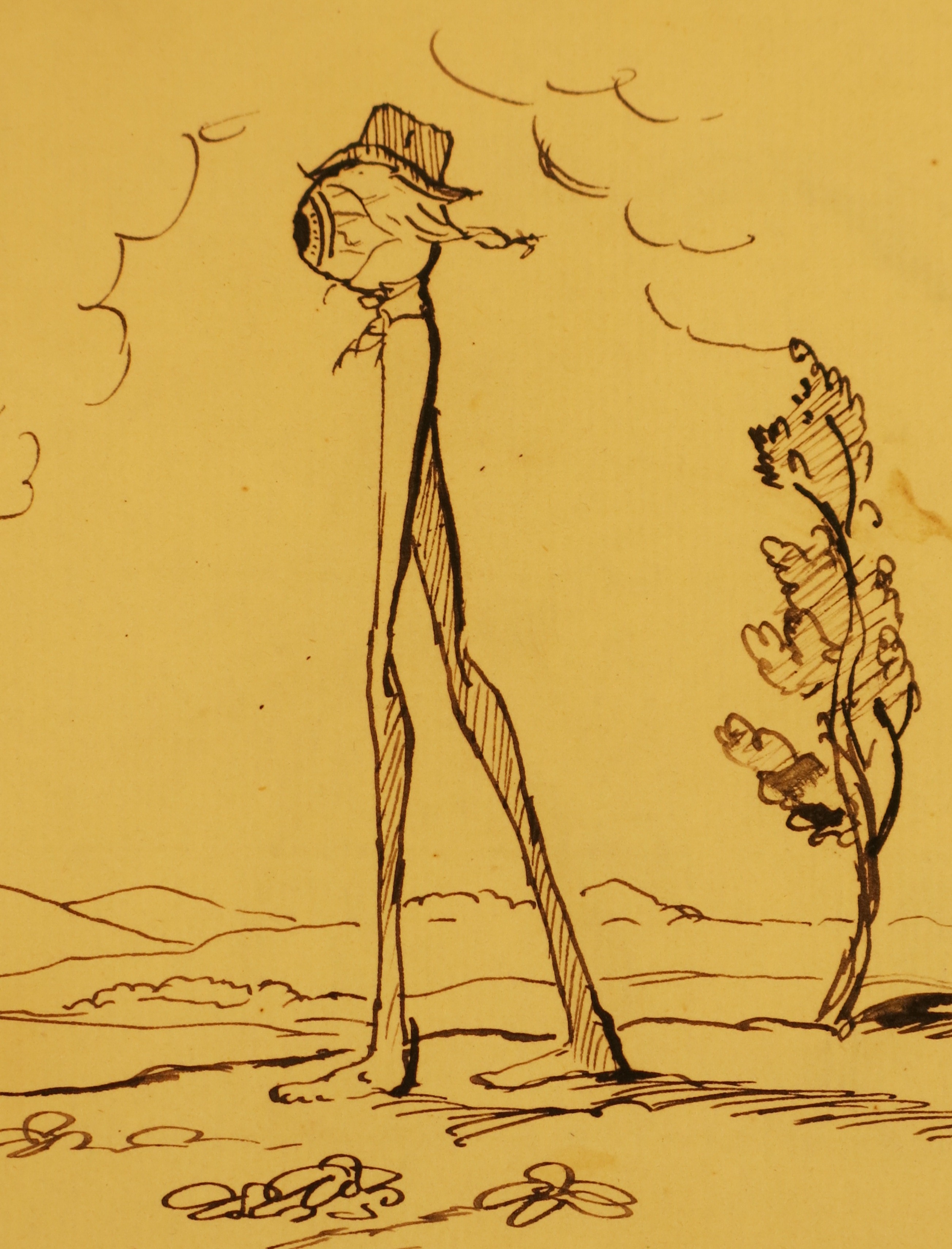
The first thing that I saw was a drawing I recognized immediately and which I remember seeing in a textbook in high school, showing an eyeball raised on long, spindly legs and wearing a top hat, striding through an unembellished countryside. The “transparent eyeball,” a facetious illustration of Ralph Waldo Emerson remains a popular image.

Christopher Pearse Cranch was a transcendentalist artist and poet. Born in 1813 in what is now Alexandria, VA, he eventually made his way to Boston to study divinity at Harvard in 1835. Though Cranch was never ordained, he served for a time as a missionary in New England and the Midwest. While at Harvard he became associated with the New England Transcendentalists. Through his life, Cranch published several volumes of poetry, served as an editor and contributor for James Freeman Clarke’s Western Messenger, wrote frequently for various periodicals, published a pair of children’s books, and did a blank verse translation of Virgil’s Aeneid. Despite all of this, it is his drawings for which he is most remembered, most of which were not published until they were rediscovered by F. DeWolfe Miller in 1951.

What struck me first as I looked through the drawings was how much his sketches called to mind images from other artists from very disparate times and places. The first thing conjured up by some of these drawings are the works of the 15th-16th century Dutch painter, Hieronymous Bosch, especially his famous triptych “The Last Judgement.”


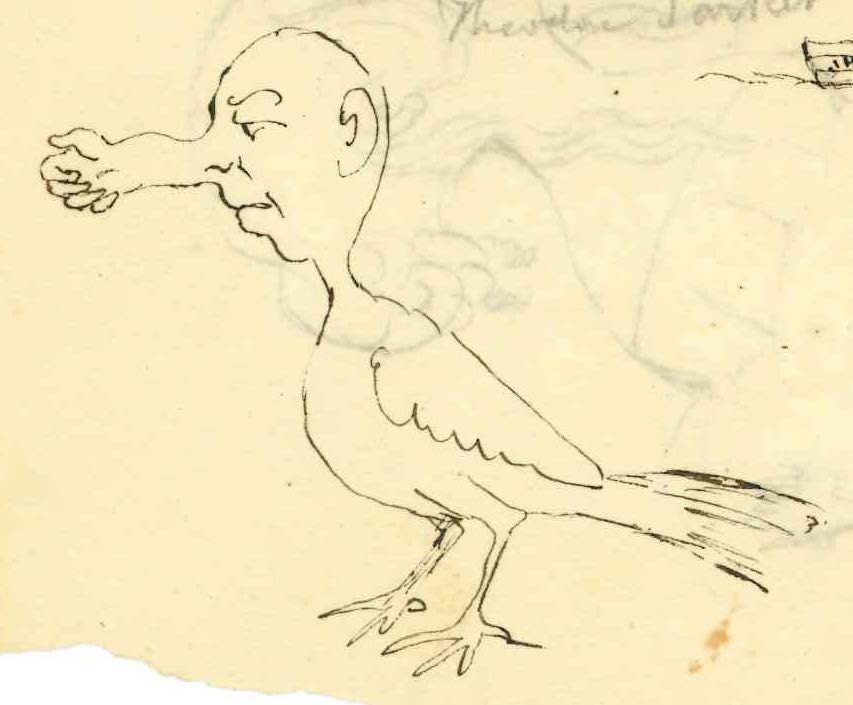
Beyond this first impression I was intrigued by the breadth of styles that Cranch employed and delighted in the strange doodles he created. Some of them are funny and slightly satirical, others are repetitive depictions of people in profile. Many of these profiles, as well as some other creatures he drew, remind my very much of the style employed in the Beatles’ animated movie Yellow Submarine, especially the Victorian-esque profiles:

Another image I found, depicting a cloaked and somewhat shadowy figure, looks like it would be right at home in a collection of drawings by the Massachusetts illustrator Edward Gorey:

“Oh: Charly is my darling, my darling.”

Also present were little pieces of satire, sometimes aimed at specific people or situations, and some, like this one, aimed at Americans in general:

“Some of them beautiful Merry-kins.”

In addition the types of images you see here, Cranch also did some serialized cartoons that followed themes. One series of drawings was made up of imaginitive illustrations of lines from various works of Shakespeare. Another series of several images showed the “Miseries of Landscape Painters.”

“Miseries of Landscape Painters.
No 3.”

Despite all of the whimsy present in many of Cranch’s drawings, and despite the “misery” of the form, he also showed talent with landscape images:


While Cranch’s drawings are nothing new to many people, without a casual interaction with one of our researchers I might never have seen them in this way. This is just one more example of how important and how beneficial it is for us as librarians to interact with our researchers. What do you think about Cranch’s drawing?


Sources:

Christopher P. Cranch drawings [graphic]

– Garraty, John A. and Mark C. Carnes, eds. 1999. American National Biography. New York: Oxford Univeristy Press.


This Week @ MHS

By Dan Hinchen

This week is the great calm at the MHS as there are no public programs scheduled. However, keep in mind that our exhibitions space is open to the public at no cost, Monday-Saturday, 10:00AM-4:00PM. Currently on display is “Letters and Photographs from the Battle Country: Massachusetts Women in the First World War,” an exhibition which celebrates the forthcoming MHS publication Letters and Photographs from the Battle Country: The World War I Memoir of Margaret Hall.

And on Saturday, 28 June, come by at 10:00AM for The History and Collections of the MHS, a 90-minute docent-led tour of the public spaces in the Society’s home at 1154 Boylston Street. The tour, free and open to the public, touches on the history, collections, art, and architecture of the Society. No reservation is required for individuals or small groups. Parties of 8 or more should contact the MHS prior to attending a tour. For more information please contact Curator of Art Anne Bentley at 617-646-0508 or abentley@masshist.org.

Stephen Greenleaf Bulfinch Diary, Post 33

By Elaine Grublin

The following excerpt is from the diary of Stephen Greenleaf Bulfinch.

Wednesday, June 1st, 1864

The Convention of Ultra-Republicans has met at Cleveland, & nominated Fremont for president. While thinking him the most brilliant man we have, I have not that confidence in his sound discretion, & what the Romans would have styled his fortunes, to think him the right man for the office. Mr. Lincoln is my choice, & will, I think, be that of the nation, unless possibly a brilliant victory gives Grant the preference.

Monday, June 13th

Our good president Lincoln has been re-nominated, by the Union Convention, with Johnson of Tennessee for Vice; – a good choice, as a tribute to the union men of the South, & I trust in other respects. 

This Week @ MHS

By Dan Hinchen

As we ease into the latter days of June there is a lull in activity here at the Society with only two programs on offer this week. 

First up, on Thursday, 19 June, stop in at 12:00PM for “At the Point of a Cutlass: The Pirate Capture, Bold Escape, and Lonely Exile of Philip Ashton.” In this talk, author Gregory N. Flemming (www.gregflemming.com) discusses his latest work, based largely on a rare copy of Ashton’s 1725 account. Flemming also drew on a wealth of other materials from the collections of the MHS, including hundred of colonial newspaper reports, trial recrods, and the hand-written logbooks and correspondence from the British warships that patrolled the Bay of Honduras and fought with the pirates of Captain Edward Low. Flemming is a former jounralist who holds a Ph.D. from the Unviersity of Wisconsin-Madison. This event is free and open to the public. 

And on Saturday, 21 June, come on by at 10:00AM for a free tour of the Society’s building at 1154 Boylston St. The History and Collections of the MHS is a 90-minute docent-led tour that explores all of the public space in the building, touching on the art, architecture, history, and collections of the MHS. The tour is free and open to the public. No reservation is required for individuals or small groups. Parties of 8 or more should contact the MHS prior to attending a tour. For more information please contact Curator of Art Anne Bentley at 617-646-0508 or abentley@masshist.org.

Finally, while there are only these two public programs on the calendar this week, please remember that our newest exhibition is now on display! “Letters and Photographs from the Battle Country: Massachusetts Women in the First World War” is free and open to the public Monday-Saturday, 10:00AM-4:00PM. 

Sarah Checkley’s Spirituous Liquor License, 18 July 1764

By Andrea Cronin, Reader Services

It is the season of graduations, celebrations, and toasts. My personal social network bubbled this past weekend with images of familial celebrations, beach weekends, and – of course – spirituous liquors. Many a photo popped up of friends in drinking establishments, and I became curious about the history of taverns as a result. I browsed our online catalog ABIGAIL and discovered a liquor license issued to Sarah Checkley of Boston on 18 July 1764. Naturally it piqued my interest for several reasons. The license states:

We the Subscribers Selectmen of the Town of Boston do approve of Mrs. Sarah Checkley’s being a Retailer of Spirituous Liquor, at the House where into she has lately removed and now dwells, in Hanover Street near the Mill Bridge Boston, and recommend her a Person of sober Life and Conversation, and suitably qualified and provided for the Exercise of such an Employment she having for many years past been a Retailer in this Town and behaved to good acceptance.

This document is peculiar for what it is not. The license is not the oldest item pertaining to liquor petitions in the Society’s collections. The honor of oldest liquor petition goes to Samuel Walton of Woburn, Mass. who petitioned the Massachusetts General Court on 30 March 1665 to sell “strong waters.” How strong, the document does not specify. Checkley’s 1764 petition is not even the only liquor license in the MHS collections granted to a woman! A quick glance among retailer’s licenses, tavern licenses, and innkeeper’s licenses shows the custom to issue such documents to women not unusual for the late 18th century.

The Suffolk County Court and Boston Selectmen approved retailer and liquor petitions from widow Elizabeth Pittson on 7 June 1767, widow Rachel Masters on 21 July 1767, and widow Mary Rose on 8 July 1773. The court also approved a petition from Mary Vinal to sell liquor on 30 July 1771. The petition did not designate Mary Vinal a widow unlike the aforementioned ladies. Her father suffered from palsy and could not provide for his family. Thus, Mary Vinal required a means to make an income as did the widows. In their petitions to the selectmen, the women granted these licenses all clearly stated a similar problem in their personal situations: a lack of income from male earners. Sarah Checkley’s petition lacks detailed information about her familial or marital status. This lack of information does not imply that she was not a widow or did not care for aging or sick male members of her family, but the petition is more interesting to me without these details. This absence lets me rosily imagine Sarah Checkley as a robust purveyor of spirituous liquors of her own accord.

For those of us celebrating graduations, petitioning for prospective employment, or just enjoying summer fun, we all know the important role income plays in our lives. May your summer be fruitful in your endeavors, but spirituous in fun! And remember to tip your bartenders.